Neptune Privacy (XNT) Review: Is XNT Safe in 2026?
Neptune Privacy (XNT) review covering tokenomics, liquidity, risks, zk-STARK technology, quantum resistance, and investment potential.


Author: Akshat Thakur
What Is Neptune Privacy (XNT)?
XNT is a proof-of-work, post-quantum Layer 1 privacy coin built on zk-STARKs, and it is a community fork of Neptune Cash.
Ticker
Type
Core Tech
Max Supply
Tail-emission model
Current Price
FDV
Market Cap
All-Time High
December 11, 2025
All-Time Low
January 26, 2026
Trades On
All figures as of June 9, 2026; verify before trading.
This is a microcap with thin liquidity, and the numbers are volatile. XNT launched as a community-driven project in late 2025. It remains small and early.
Liquidity sits in the low thousands of dollars per day on its main venues. Most holders and observers treat it as a high-risk experiment rather than an established asset.
First, the Thing Nobody Tells You: XNT Is Not Neptune Cash
The most important fact about Neptune Privacy is also the one most often overlooked. XNT is not Neptune Cash.
The two privacy projects share a common codebase and history, but they are separate networks with different teams, different tokenomics, and different leadership.
Neptune Cash is the original project. It was created by cryptographers Alan Szepieniec and Thorkil Værge and launched its mainnet in early 2025. The protocol was designed as a research-driven privacy blockchain built around zk-STARKs, post-quantum cryptography, Mutator Sets, and the Triton Virtual Machine. Neptune Cash operates with a fixed supply cap of 42 million NPT and continues to be maintained by its original developers.
Neptune Privacy emerged later as a community fork. The split was driven largely by disagreements over emissions and token economics. Members of the community and mining ecosystem supported a different monetary policy and eventually launched a separate chain. The fork significantly reduced emissions, introduced a different distribution model, and replaced the hard supply cap with a declining issuance schedule that eventually transitions into a permanent tail emission.
What matters most is that the original cryptography team did not move to XNT. Alan Szepieniec and Thorkil Værge remain associated with Neptune Cash, not Neptune Privacy.
This distinction is critical for investors. Someone buying XNT because they believe they are investing in the original Szepieniec-led project is purchasing a different asset than they likely intended. The projects share technical ancestry, but they do not share governance, leadership, or economic policy.
That does not automatically make the fork illegitimate. Open-source software allows communities to take projects in new directions. Many successful blockchain networks began as forks. However, readers deserve complete clarity. Neptune Cash is the original research-driven protocol. Neptune Privacy is the community-led fork. They are related, but they are not the same project.
The Technology: Post-Quantum Privacy With zk-STARKs
The main reason XNT attracts attention is its technology. Although Neptune Privacy operates independently, it inherits its core architecture from Neptune Cash.
At the center of the design are zk-STARKs, a type of zero-knowledge proof that allows transactions to be verified without revealing sensitive information. Unlike many privacy coins that rely on elliptic-curve cryptography, zk-STARKs use hash-based assumptions, require no trusted setup, and are widely viewed as resistant to known quantum attacks.
The second key innovation is Mutator Sets. Traditional privacy systems can become less efficient as transaction history grows. Mutator Sets aim to maintain privacy while keeping proofs compact and verification efficient. This helps reduce blockchain bloat without sacrificing confidentiality.
XNT also inherits the Triton VM, a virtual machine designed to operate within the zk-STARK framework. This allows developers to build private applications and confidential smart-contract-style functionality, extending privacy beyond simple payments.
The network is secured by proof-of-work. Miners validate transactions and protect the chain, while the fork retains the same underlying consensus model as Neptune Cash.
Together, these technologies combine privacy, programmability, and post-quantum design in a single Layer 1 network. The architecture is genuinely innovative. However, it is important to recognize its origins. The underlying technology was created by the Neptune Cash team, while Neptune Privacy inherited it through a community-led fork. This distinction matters when evaluating the project’s technical strengths and its independent ability to develop the technology going forward.
The Pitch: Quantum Resistance, and the Honest Counterpoint
The bull case for Neptune Privacy is straightforward.
Most privacy coins were designed before quantum computing became a serious discussion. Monero relies on elliptic-curve cryptography, while Zcash uses elliptic-curve-based zk-SNARKs. If powerful quantum computers capable of running Shor’s algorithm eventually arrive, those systems could require significant upgrades.
Neptune takes a different approach. It uses zk-STARKs and hash-based cryptography that are widely considered resistant to known quantum attacks. Supporters argue this gives the network a long-term advantage because it was designed with a post-quantum future in mind from the start.
That is the thesis.
The counterpoint is equally important. No quantum computer today can break Monero, Zcash, Bitcoin, or other major blockchain networks. The technology required remains far beyond current capabilities, and experts continue to debate when, or if, that level of quantum computing will become practical.
A more realistic concern is “harvest now, decrypt later,” where data collected today could potentially be targeted in the future. Neptune’s privacy model is designed to reduce that risk, but the timeline for any quantum threat remains uncertain.
Investors should also approach promotional metrics carefully. Community posts often cite quantum-readiness scores and rankings, but these are marketing claims rather than independent industry standards.
The result is a balanced picture. Neptune Privacy offers a genuinely differentiated approach to privacy and quantum resistance. At the same time, it remains a microcap project operating in a market where the quantum threat is still largely theoretical. The technology may prove valuable if post-quantum security becomes a major priority. Whether that translates into adoption and market success remains an open question.
Tokenomics: The Emissions Fork
XNT exists because of a disagreement over monetary policy, not technology.
Neptune Cash uses a hard supply cap of 42 million NPT and a halving schedule that reduces issuance every three years. Some miners and community members argued that the early emission profile remained too generous and would dilute long-term holders more than necessary.
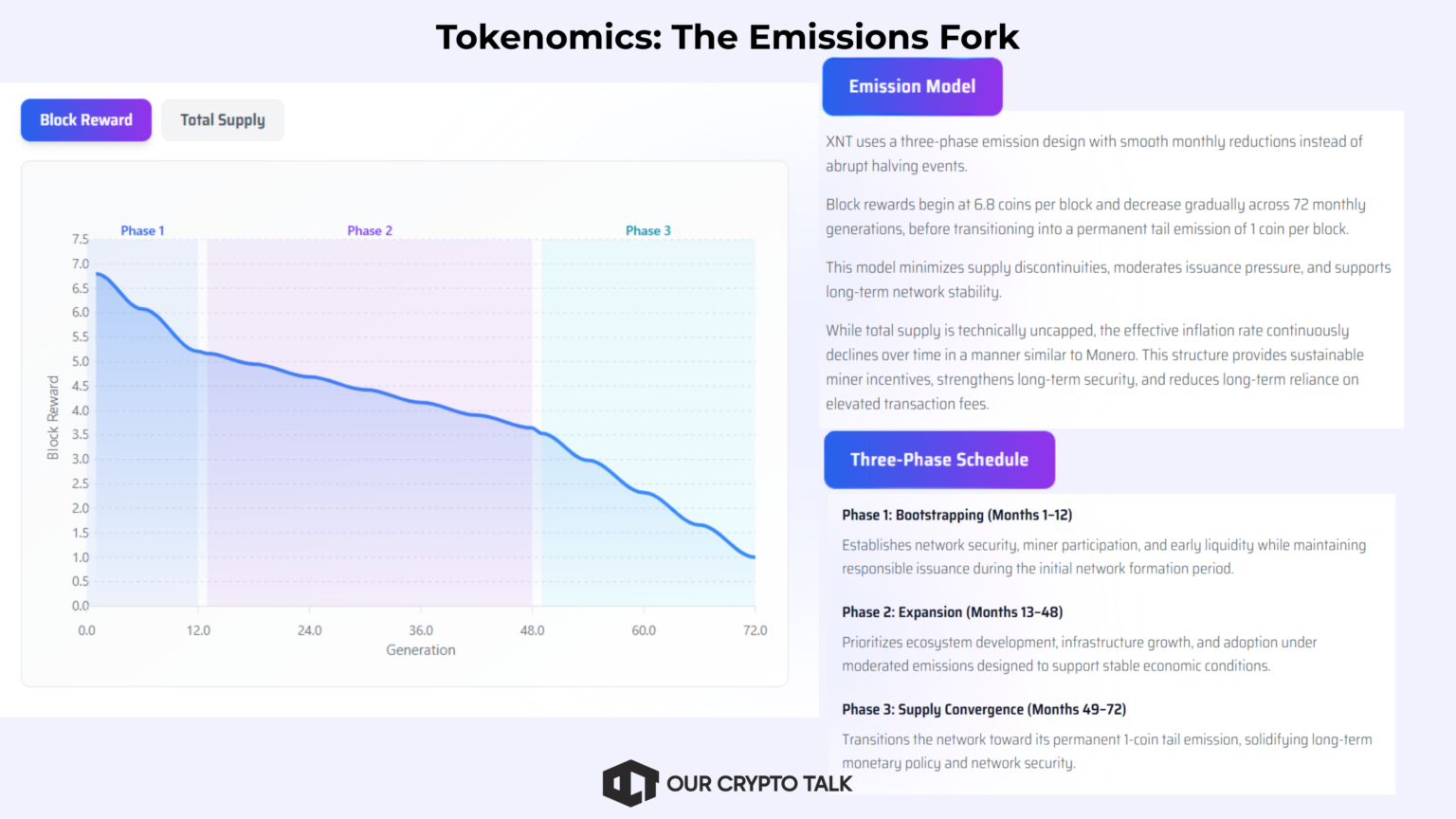
The fork introduced a different approach. XNT starts with block rewards of 6.8 XNT and gradually reduces issuance across 72 monthly generations before settling into a permanent tail emission of one coin per block. Unlike Neptune Cash, there is no hard cap. Instead, inflation declines over time as the circulating supply grows.
According to project materials, all future coins are distributed through proof-of-work mining. Genesis supply reportedly totaled 1,942,384 XNT. This included 1,526,640 XNT migrated from NPT holders, with the original migrated coins burned, plus a community-governed allocation of 415,744 XNT for ecosystem development.
The key question is whether lower issuance actually changes the investment case.
The answer is only partially.
Reduced emissions decrease dilution for existing holders. They can create a stronger scarcity narrative and potentially improve long-term supply dynamics. However, scarcity alone does not create demand. It does not attract users, developers, exchange listings, or liquidity.
The fork solved the monetary-policy issue that some participants cared about. It did not solve the harder challenge facing every microcap crypto project: convincing the broader market to care.
The Liquidity Reality: Read This Before You Buy
If you remember only one thing about XNT, make it this section.
The project carries a fully diluted valuation in the low single-digit millions of dollars. Daily trading volume typically sits in the low thousands. Most activity occurs on MEXC and SafeTrade, with no major exchange support and limited market depth.
That matters far more than any discussion about zk-STARKs or quantum resistance.
Thin liquidity creates practical problems. A relatively modest buy order can push the price higher before it fills. A similarly sized sell order can send the market sharply lower. The quoted market price often reflects only a small amount of available liquidity.
In practice, this means slippage becomes a major cost. A trader may see one price on the screen but receive a very different execution price when placing an order of meaningful size. Exiting a position quickly can be even harder than entering one.
Low liquidity also increases vulnerability to volatility and manipulation. It takes far less capital to move a market when daily volume measures in thousands rather than millions of dollars. A handful of large trades can create price swings that appear dramatic but say little about underlying adoption.
This is why position sizing matters.
For most participants, XNT should be viewed as a speculative microcap rather than a liquid investment vehicle. The technology may be interesting, but the market structure remains extremely fragile.
Investors should size positions based on what they can realistically exit, not on what they hope the quoted price represents. Investors looking for stronger liquidity may prefer some of the projects featured in our top 10 privacy coins for 2026.
Red Flags and Due Diligence
The biggest risk around XNT is not necessarily the technology. It is the lack of independent verification surrounding the project.
Most available information comes from community channels, promotional posts, and incentive-driven content. Neutral third-party research remains limited. That does not make the project dishonest, but it does make verification more difficult.
There is also limited visibility into long-term maintenance. Neptune Privacy is a community fork. The original Neptune Cash research team remains with Neptune Cash. Buyers should evaluate repository activity, contributor history, and development updates for themselves rather than assuming ongoing support.
Independent security audits specific to XNT are also difficult to identify publicly. Given the complexity of privacy-focused cryptography, that matters.
Recent history provides useful context. In 2025, Neptune Cash itself discovered an inflation bug severe enough to require a relaunch from a new genesis block. The issue was found and fixed, but it demonstrated how difficult advanced privacy systems can be to secure.
The lesson extends beyond Neptune. In 2026, Zcash disclosed a critical vulnerability affecting its Orchard shielded pool. The flaw existed for years before discovery and could theoretically have enabled undetectable counterfeiting. No exploit occurred, but the incident reminded the industry that sophisticated zero-knowledge systems can hide serious problems for long periods.
None of this proves XNT is fraudulent or unsafe.
It does mean the burden of proof belongs to the project, not the buyer. Investors should verify governance, code activity, audit status, and technical claims through primary sources whenever possible. The technology deserves attention. The risks deserve equal attention.
How XNT Compares: Monero, Zcash, and Neptune Cash
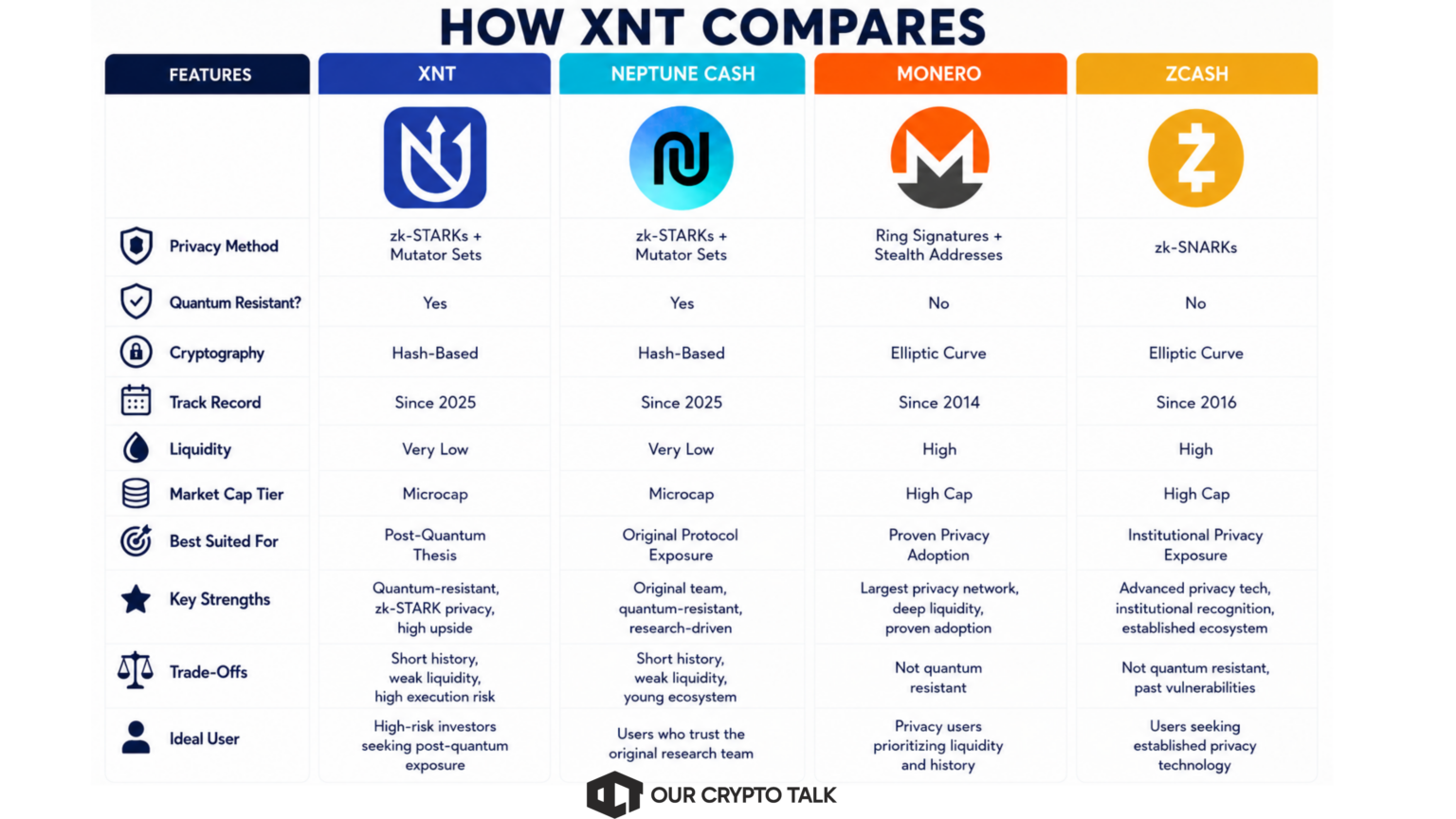
The easiest way to understand XNT is to compare it with the projects it is most often mentioned alongside. Each offers a different trade-off between privacy, maturity, liquidity, and quantum resistance.
XNT
Hash-based cryptography
Thin public development visibility and no publicly disclosed fork-specific audits.
~$10K daily volume
Neptune Cash
Experienced an inflation bug and relaunch, but the original research team remains active.
Monero
Elliptic-curve based
Battle-tested through multiple attack attempts and remains the benchmark for default privacy.
Zcash
(Orchard Shielded Pool)
Elliptic-curve based
Institutional support, grants ecosystem and brand recognition.
Critical Orchard-related bug disclosed in 2026.
XNT offers the strongest quantum-resistance narrative in the group. It was designed around zk-STARKs from the beginning and does not rely on the elliptic-curve cryptography used by Monero and Zcash. For investors who believe quantum security will become an important investment theme, that is the project’s main attraction.
The problem is that XNT also has the shortest track record and the weakest liquidity. Daily trading volume is measured in thousands of dollars rather than millions. That makes entering and exiting positions far more difficult than the quoted market price suggests.
Neptune Cash sits somewhere in the middle. It uses the same underlying technology as XNT but remains the original project developed by cryptographers Alan Szepieniec and Thorkil Værge. Investors who like the technology but prefer the original team may find Neptune Cash more compelling.
Monero remains the benchmark for real-world privacy adoption. It lacks the post-quantum story, but it has spent more than a decade proving itself in live markets. Zcash occupies a similar position, offering advanced privacy technology and greater institutional recognition, although recent vulnerabilities have reminded users that no privacy system is risk-free.
The comparison ultimately highlights XNT’s position in the market. It offers one of the most ambitious privacy architectures available today. It also carries the highest execution risk, the least liquidity, and the shortest independent history. Whether that trade-off is attractive depends entirely on what an investor values most.
So, Is It a Safe Privacy Bet in 2026?
XNT presents one of the more interesting privacy narratives in crypto today. Through its inherited zk-STARK architecture, Mutator Sets, and Triton VM, the project offers a vision of privacy that is designed with post-quantum security in mind from the outset. That alone makes it stand out in a sector still dominated by older cryptographic approaches.
The investment case, however, requires a different conversation.
XNT remains an early-stage community fork with a short independent history, limited exchange coverage, and thin liquidity. Trading activity is concentrated on smaller venues, and investors should understand that XNT is a separate project from Neptune Cash, despite sharing much of the same technological foundation.
As a result, XNT is best viewed as a high-risk, speculative thesis rather than a traditional privacy allocation. Its success depends not only on the strength of the underlying technology, but also on adoption, ecosystem growth, development activity, and whether the market eventually places significant value on quantum-resistant privacy.
For investors who have genuine conviction in that thesis, understand the distinction between XNT and Neptune Cash, and can tolerate both volatility and limited liquidity, a small speculative allocation may be worth considering.
For those seeking deep liquidity, a longer track record, or a more established privacy asset, XNT’s current risk profile may be harder to justify.
The verdict is straightforward. The technology is compelling and addresses a real long-term challenge. The asset itself remains early, speculative, and highly dependent on future execution. Investors should evaluate XNT on both fronts rather than assuming one guarantees the other.
Nothing in this article should be considered financial advice. Always conduct your own research and assess your own risk tolerance before investing.
What to Watch (Bottom Line)
The most important developments to watch are not price movements. They are signs that the project is reducing execution risk.
The first is liquidity. New exchange listings, deeper order books, and consistently higher trading volumes would make the asset more investable and reduce the slippage that currently defines the market.
The second is adoption. More users, more private transactions, and evidence of real on-chain activity would demonstrate demand beyond speculation. Technology matters, but usage matters more.
The third is independent development. XNT inherited its architecture from Neptune Cash. The market now needs evidence that the fork can sustain and improve that technology on its own. Public roadmaps, active development, and independent security audits would all strengthen confidence.
The fourth is the broader quantum-resistance narrative. Today, post-quantum privacy remains a niche topic. If institutions, regulators, or the wider crypto market begin treating quantum readiness as a meaningful concern, XNT’s core thesis could receive much greater attention.
The bottom line is simple. XNT is a way to express a specific and highly speculative view on the future of post-quantum privacy. It is not a place to park long-term privacy savings, and it is not a low-risk investment.
For readers interested in the underlying technology, the safest starting point may be studying Neptune Cash itself. It offers the same core architectural ideas, the original research team, and a longer track record than the fork that emerged from it.
Frequently Asked Questions
What is Neptune Privacy (XNT)?
Is Neptune Privacy the same as Neptune Cash?
What makes XNT different from Monero and Zcash?
Is Neptune Privacy quantum resistant?
What is the maximum supply of XNT?
Where can you buy Neptune Privacy (XNT)?
Is Neptune Privacy a good investment in 2026?
What are the biggest risks of investing in XNT?
In this article
What Is Neptune Privacy (XNT)?First, the Thing Nobody Tells You: XNT Is Not Neptune CashThe Technology: Post-Quantum Privacy With zk-STARKsThe Pitch: Quantum Resistance, and the Honest CounterpointTokenomics: The Emissions ForkThe Liquidity Reality: Read This Before You BuyRed Flags and Due DiligenceHow XNT Compares: Monero, Zcash, and Neptune CashSo, Is It a Safe Privacy Bet in 2026?What to Watch (Bottom Line)