Privacy coins hit $17.9B in 2026. Explore Monero vs Zcash, top privacy coins, global regulations, risks, and long-term portfolio potential.

Author: Akshat Thakur
Privacy coins are cryptocurrencies designed to conceal transaction data on public blockchains. When users ask what are privacy coins, they usually mean digital assets that hide wallet addresses, balances, and transfer activity to improve financial confidentiality.
The total privacy coin market cap stands near $17.9 billion as of May 2026. The sector recovered sharply after multiple years of regulatory pressure and exchange delistings.
Privacy-focused assets also outperformed Bitcoin on a year-to-date basis during several periods of the current market cycle, driven largely by renewed demand for confidential transactions and decentralized financial privacy.
The narrative around privacy coins changes significantly in 2026. Earlier cycles associated the sector with dark web activity and regulatory concerns. Today, the conversation shifts toward institutional privacy infrastructure.
Zcash leads much of the institutional discussion after strong growth in shielded transaction activity and renewed interest in zero-knowledge cryptography.
Monero remains the dominant fully private cryptocurrency because every transaction includes mandatory privacy protections by default. The network’s FCMP++ upgrade further strengthens anonymity by expanding transaction decoy sets and improving resistance against blockchain analysis.
Smaller projects continue building niche solutions within the sector. Firo focuses on lightweight privacy architecture and efficient anonymity systems. Salvium introduces compliance-oriented privacy through optional view keys and regulatory positioning. Beam pushes toward scalable confidential finance with DeFi integrations and audit-optional transaction models.
The sector now represents more than speculative demand for anonymity. Privacy coins increasingly position themselves as infrastructure for confidential payments, enterprise settlement, and financial data protection in an increasingly transparent blockchain economy.
Bitcoin is pseudonymous, not anonymous. Wallet addresses do not contain names or personal details, but every transaction still appears on a public blockchain. Anyone can inspect balances, transfers, timestamps, and wallet activity with a blockchain explorer.
That transparency creates a major privacy problem.
Blockchain analysis firms such as Chainalysis and Elliptic specialize in tracing Bitcoin flows across the network. Their tools use UTXO clustering to group addresses that likely belong to the same user.
A single transaction can expose years of wallet history. Once funds interact with a regulated exchange, tracing becomes much easier.
Most major exchanges require KYC verification. Users submit passports, IDs, and banking information before trading. The moment Bitcoin moves between a personal wallet and a KYC exchange account, that identity link can become permanent. Analysts can then track activity across the blockchain.
Many users still believe Bitcoin payments are private. Reality looks very different.
Imagine buying coffee with Bitcoin. Your employer, your landlord, and anyone who has ever sent you BTC could potentially trace that transaction. They could estimate your wallet balance and monitor future spending patterns. Even recurring payments or linked wallets can often be identified through transaction history.
The risks go beyond personal exposure. Governments monitor blockchain activity for compliance investigations. Corporations analyze wallet behavior for profiling and risk scoring. Cybercriminals search public ledgers for high-value targets.
Bitcoin was designed for transparent settlement, not financial confidentiality. Privacy coins emerged as a technological response to that limitation. These networks use cryptographic systems to conceal senders, receivers, and transaction amounts by default or through optional privacy layers.
Without privacy technology, digital payments remain highly traceable. Privacy coins exist because many users no longer accept permanent financial surveillance as the standard for online transactions.
Privacy coins do not follow a single philosophy. The sector splits into two fundamentally different approaches. One side treats privacy as a default condition of digital money. The other treats privacy as a configurable tool that users can enable when needed.
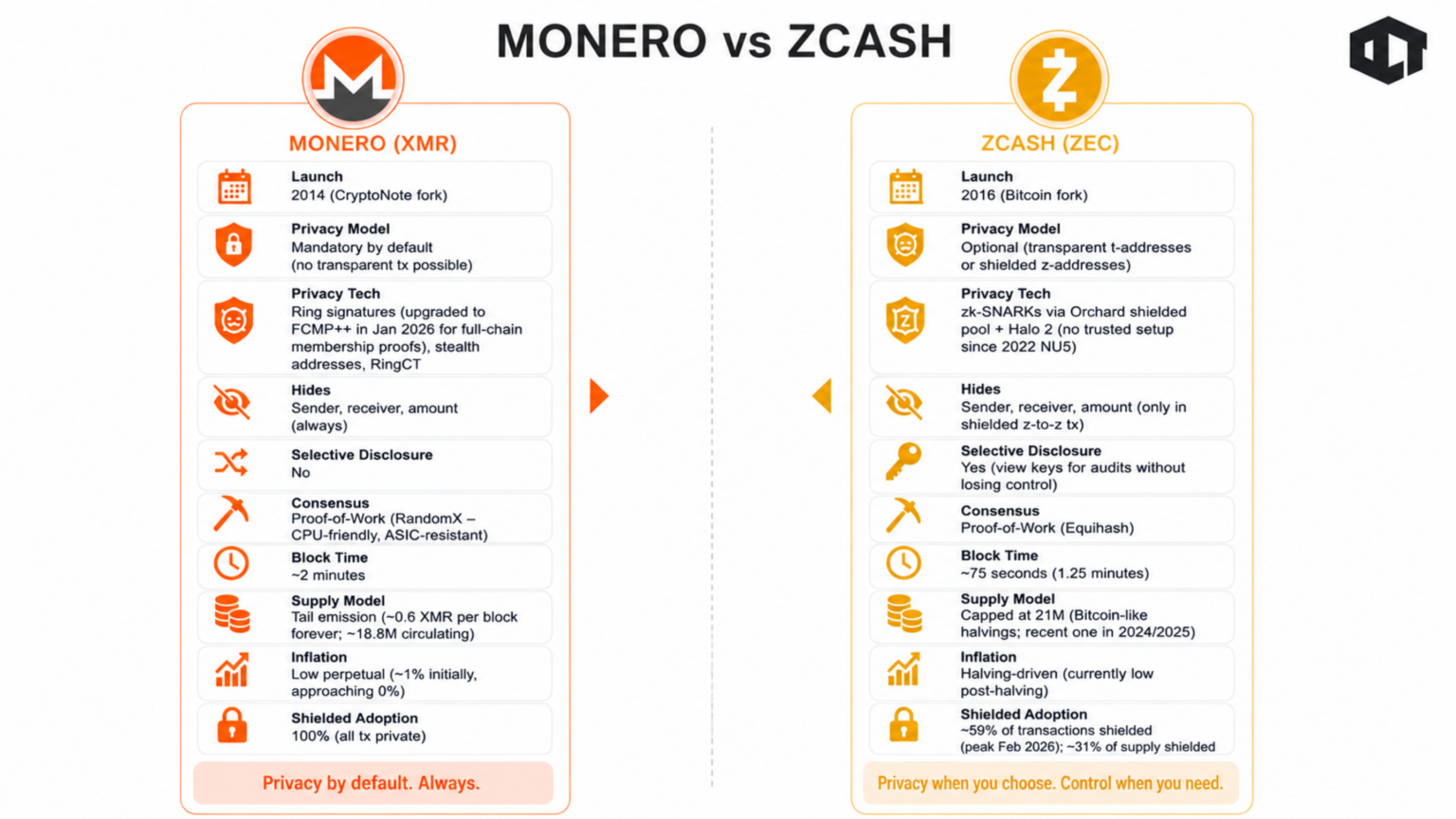
Monero represents the mandatory privacy model. Every transaction on the network includes privacy protections automatically. Senders remain obscured through ring signatures. Receivers stay hidden through stealth addresses. Transaction amounts disappear behind RingCT encryption. Users cannot disable these protections. The protocol enforces privacy at the network level for everyone equally.
That design creates a uniform anonymity set. Every transaction blends into every other transaction. Analysts cannot separate “private users” from “normal users” because privacy is the normal state of the system. Supporters argue this structure preserves fungibility. One XMR remains identical to another XMR because no transaction history becomes publicly visible or traceable.
Monero’s philosophy assumes optional privacy weakens anonymity over time. If only a small group uses shielded transactions, those transactions attract attention. Privacy becomes abnormal behavior instead of standard behavior. Analysts and regulators can focus surveillance efforts on the minority choosing protection. Mandatory privacy attempts to eliminate that distinction entirely.
Zcash follows a very different philosophy. The network supports both transparent and shielded transactions. Users choose which mode fits their situation. Transparent addresses function similarly to Bitcoin. Shielded addresses use zk-SNARK cryptography to hide sender details, recipient details, and transaction amounts.
This flexibility changes how institutions interact with the network. A company can receive shielded payments while still disclosing records for accounting or compliance purposes. Exchanges can support transparent deposits while offering optional privacy features to advanced users. Selective disclosure also allows users to share transaction data voluntarily through viewing keys when audits or legal reporting become necessary.
Zcash approaches privacy from a practical integration standpoint. Its model assumes financial systems still require interoperability with regulators, banks, institutions, and public markets. Optional shielding gives users privacy tools without forcing every participant into fully opaque transactions. Supporters believe this balance improves adoption potential and long-term survivability inside regulated environments.
The disagreement between these models is philosophical before it becomes technical.
Monero maximizes confidentiality and fungibility through strict default privacy. Zcash prioritizes flexibility and selective disclosure to support broader institutional compatibility. Both systems rely on advanced cryptography. Both attempt to solve the transparency problem created by public blockchains. The difference lies in how each project defines practical privacy in a digital financial system.
Neither side is wrong.
One model pursues universal protection. The other pursues adaptable privacy. The market continues testing both approaches in real time.
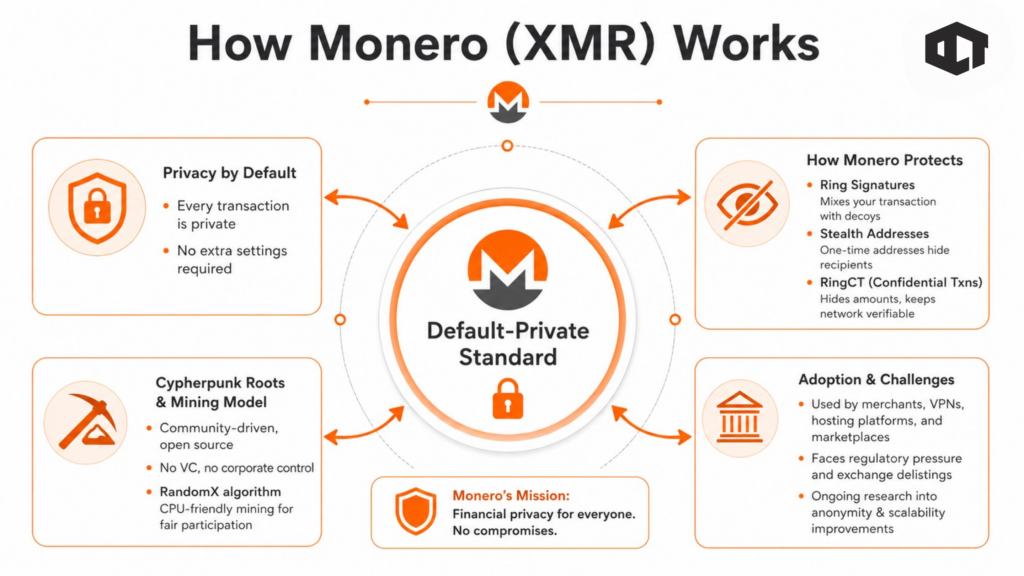
Monero remains the benchmark for default privacy in cryptocurrency. Every transaction on the network includes privacy protections automatically. Users do not need to enable extra settings or choose between public and shielded transfers. The protocol handles privacy at the base layer.
Three technologies form the core of Monero’s architecture. Ring signatures obscure the real sender by mixing a transaction with decoy outputs from unrelated users. Stealth addresses generate unique one-time addresses for every payment, preventing outsiders from linking transactions to a recipient’s public wallet. Ring Confidential Transactions, known as RingCT, hide transfer amounts while still allowing network verification.
Together, these systems make Monero transactions extremely difficult to trace.
The network gained renewed momentum after reaching a new all-time high of $798.91 in 2026, driven partly by the FCMP++ upgrade. The upgrade expanded anonymity sets and improved resistance against blockchain analysis techniques. Developers focused heavily on strengthening transaction ambiguity as forensic tools became more sophisticated.
Monero’s roots trace directly to cypherpunk ideas around digital cash and financial confidentiality. The project launched without venture capital backing or corporate ownership. Development remains community-driven. Contributors operate through open-source coordination rather than centralized governance structures.
Mining also reflects that philosophy. Monero uses the RandomX algorithm, which favors CPUs over specialized ASIC hardware. The goal is broader participation and reduced mining centralization. Ordinary users can still contribute network security using consumer-grade hardware.
Merchant adoption continues despite regulatory pressure. Online stores, VPN providers, hosting platforms, and marketplaces such as ShopinBit increasingly accept XMR because transactions reveal minimal financial metadata. For many merchants, privacy functions as operational security rather than ideology.
Limitations remain significant.
Ring signatures have faced criticism over statistical weaknesses tied to older decoy selection methods. Researchers demonstrated that transaction timing patterns could sometimes reduce anonymity under certain conditions. Monero developers responded with mandatory protocol upgrades and larger ring sizes, but forensic analysis remains an active area of research.
Scalability creates another challenge. Monero’s privacy data increases transaction size compared to Bitcoin. The blockchain grows faster, which raises storage and bandwidth requirements for full node operators over time.
Regulatory pressure also continues intensifying. Several exchanges, including Kraken in multiple jurisdictions, removed Monero trading pairs due to compliance concerns surrounding transaction traceability. Lawmakers increasingly scrutinize privacy-focused assets as governments push stricter anti-money laundering standards.
Even with those pressures, Monero maintains a clear identity. The project prioritizes mandatory privacy above exchange compatibility or institutional integration. Its supporters view that consistency as the network’s greatest strength.
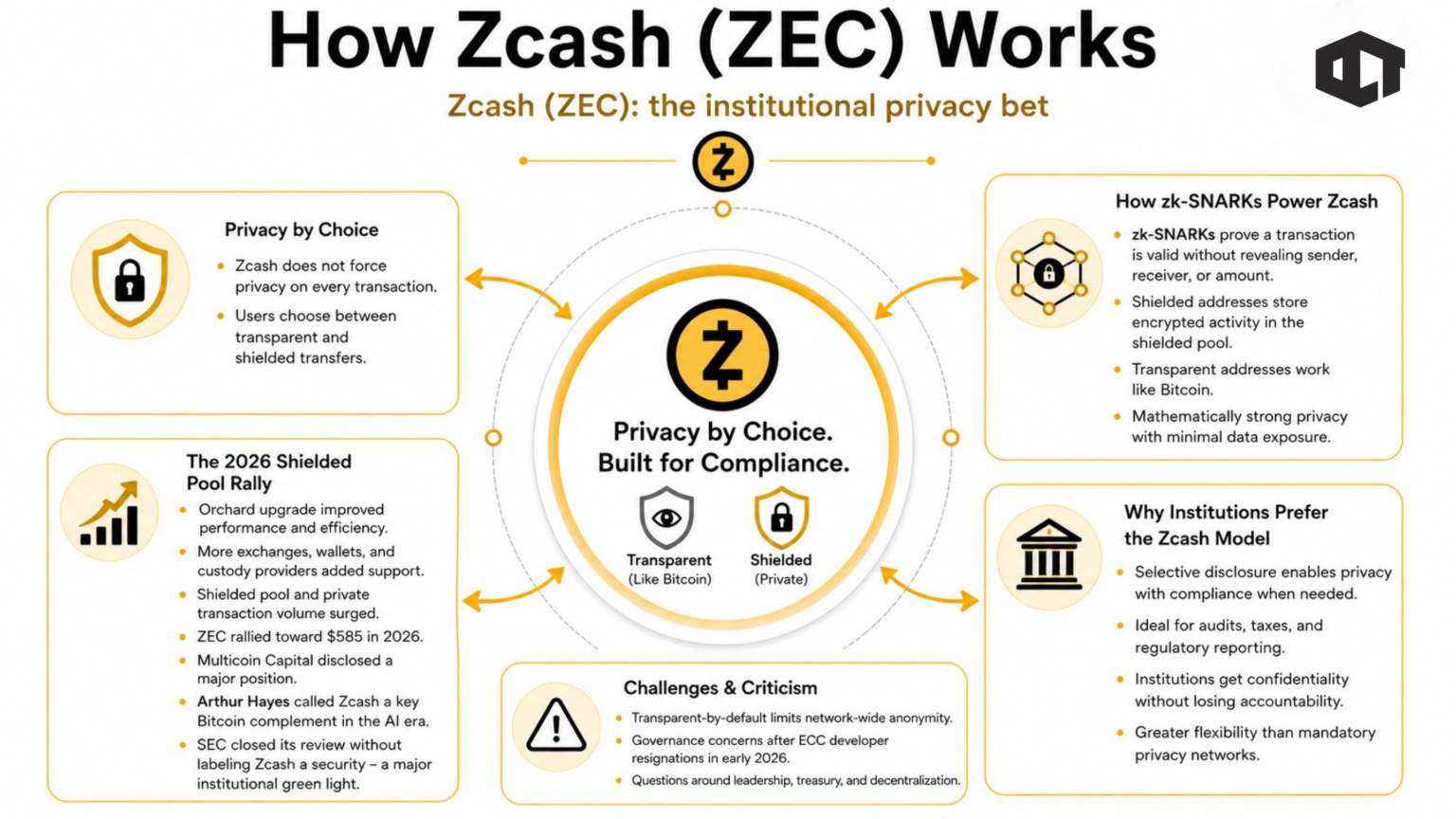
Zcash positions itself differently from most privacy coins. The project does not force privacy on every transaction. Instead, it gives users a choice between transparent and shielded transfers. That design increasingly appeals to institutions exploring confidential blockchain infrastructure without abandoning compliance requirements.
Zcash relies on zk-SNARKs, short for zero-knowledge succinct non-interactive arguments of knowledge. The cryptography sounds complex, but the idea is straightforward. The network can verify a transaction is legitimate without revealing who sent it, who received it, or how much moved.
This approach differs sharply from Monero’s ring-based privacy model. Zcash mathematically proves validity while exposing almost no transaction data. Shielded addresses store this encrypted activity inside the shielded pool. Transparent addresses continue functioning similarly to Bitcoin.
Historically, adoption of shielded transactions remained weak. Most Zcash activity stayed transparent for years. Critics argued that optional privacy undermined anonymity because shielded users stood out from the broader network.
That trend changed in 2026.
The shielded pool expanded rapidly during the year. Orchard, the latest shielded system, improved performance and lowered computational overhead. More exchanges, wallets, and institutional custody providers integrated shielded support. The result was a meaningful increase in long-term shielded balances and private transaction volume.
Momentum accelerated after ZEC surged toward $585 during the 2026 rally. Investor interest returned aggressively. Multicoin Capital publicly disclosed a significant position, framing Zcash as a hedge against growing financial surveillance. Arthur Hayes reinforced the narrative by calling Zcash one of the strongest complements to Bitcoin in a world increasingly shaped by AI monitoring and data collection.
The regulatory backdrop also shifted. The SEC closed its long-running review without classifying Zcash as a security. Markets interpreted the outcome as a major institutional green light. Funds previously hesitant to touch privacy assets began reevaluating exposure.
Zcash increasingly earns the label of the “institutional privacy coin” because its architecture supports selective disclosure. Users can shield transactions privately while still revealing records voluntarily when audits, taxes, or legal reporting require transparency.
This flexibility matters for enterprises and regulated financial firms. Institutions rarely want fully opaque systems. They want controllable confidentiality. Zcash fits that requirement better than mandatory privacy networks.
The model still faces criticism.
Transparent-by-default behavior continues frustrating privacy advocates who believe anonymity weakens unless everyone participates equally. Governance concerns also resurfaced after high-profile developer resignations at Electric Coin Company in early 2026. Critics questioned leadership structure, treasury allocation, and long-term decentralization.
Even so, Zcash became one of the strongest momentum stories in crypto during 2026. The project sits at the intersection of privacy technology, institutional adoption, and regulatory compatibility.
Follow OCT on X for ongoing coverage of Monero, Zcash, anonymous crypto, and privacy infrastructure trends, including market analysis, regulation updates, and institutional developments.
Monero and Zcash dominate privacy coin mindshare. The second tier looks far more fragmented. Some projects still push meaningful technical innovation. Others struggle to maintain relevance as liquidity and developer activity concentrate around larger networks.
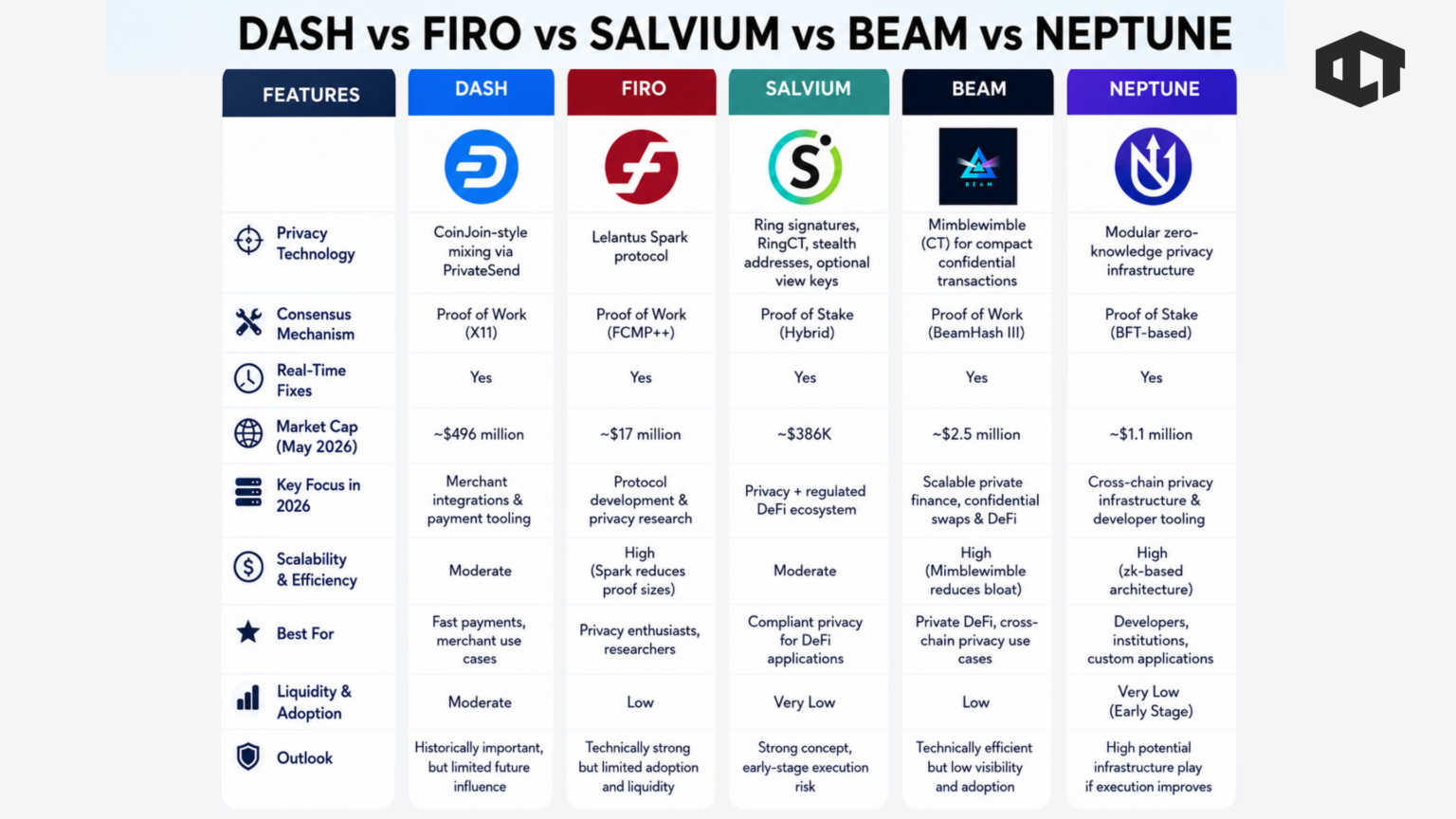
Dash uses CoinJoin-style mixing through its PrivateSend feature. The network originally positioned itself as digital cash for fast retail payments. Its market cap remains around $496 million as of May 2026.
The privacy model now feels dated compared to native privacy systems. Coin mixing works, but optional mixing attracts the same criticism aimed at transparent-by-default architectures. Analysts can still isolate mixed activity from standard transfers.
Dash spent most of 2026 focusing on merchant integrations and payment tooling rather than advancing privacy research. That strategy kept the network alive, but not particularly influential. The project still matters historically. Its role in the future privacy stack looks limited.
Firo remains one of the more technically interesting smaller privacy projects. The network uses the Lelantus Spark protocol, which improves transaction privacy while reducing proof sizes and verification overhead. Market capitalization stays near $17 million as of May 2026.
The project lacks major liquidity or exchange traction, yet developers continue refining the protocol aggressively. Spark gives Firo stronger scalability potential than many older privacy systems. The tradeoff is adoption. Few institutions or mainstream users actively use the network.
Firo matters more as a research-driven protocol than a market leader.
Salvium approaches privacy from a different angle. The project combines ring signatures, RingCT, stealth addresses, and optional view keys inside a DeFi-capable ecosystem. Market capitalization remains $386K as of May 2026.
Its 2026 white paper drew attention because it attempted to bridge privacy with regulated decentralized finance. Users can maintain confidential balances while selectively exposing information when required. That hybrid model mirrors some of the institutional logic driving Zcash adoption.
Execution risk remains high. Liquidity stays thin. The ecosystem remains early-stage. Still, Salvium targets a category many competitors largely ignore, compliant privacy infrastructure for DeFi applications.
Beam implements Mimblewimble for compact confidential transactions. The network focuses heavily on scalable private finance, confidential swaps, and DeFi functionality. Market cap sits near $2.5 million as of May 2026.
Mimblewimble reduces blockchain bloat more efficiently than many ring-based systems. Transactions remain lightweight while preserving confidentiality. Beam expanded cross-chain tooling and confidential DeFi products during 2026, though adoption remained relatively modest.
The technology looks efficient. The challenge is visibility. Beam struggles to compete for developer attention against larger ecosystems.
Neptune, trading under XNT, is the newest entrant attracting attention in 2026. The project focuses on modular zero-knowledge privacy infrastructure with cross-chain compatibility and developer tooling for custom confidential applications.
Early metrics remain speculative. Market capitalization stays at $1.1 million as of May 2026. The network still faces the typical risks attached to young infrastructure projects, low liquidity, uncertain adoption, and limited stress testing.
Still, Neptune deserves monitoring because it targets institutional-grade privacy systems instead of retail anonymity narratives. If execution improves, the project could emerge as a meaningful infrastructure layer rather than another short-lived privacy token.
Privacy stablecoins may become more important than privacy cryptocurrencies themselves.
Volatile privacy assets work well for speculation and treasury diversification. Stablecoins serve a different role. People actually use them for payments, salaries, remittances, settlements, and business operations. That makes transaction privacy far more practical at scale.
Public stablecoin transfers expose sensitive financial information constantly. Wallet balances, supplier payments, payroll flows, and treasury movements all remain visible on transparent chains. For businesses, that creates operational risk. For individuals, it removes the financial confidentiality cash once provided.
Privacy-preserving stablecoins attempt to solve that problem.
FUSD leads the category in 2026. The project combines stable value with shielded transaction infrastructure and optional disclosure tools. Users can transfer value privately while still enabling compliance reporting when necessary. That balance increasingly attracts attention from fintech platforms and institutional payment providers.
The larger trend matters more than any single token.
Several projects now experiment with confidential stable assets, zero-knowledge reserve verification, and selectively auditable payment rails. The category remains small today, but growth accelerated steadily throughout 2026.
Privacy plus stablecoins creates a stronger real-world use case than privacy plus speculative assets. Businesses need confidential settlements. Treasury managers need protected transfers. Organizations handling payroll or supplier invoices do not want competitors tracking every payment on-chain.
That demand pushes privacy technology closer to mainstream financial infrastructure.
Regulatory complexity remains unavoidable. Stablecoin issuers still face reserve audits, KYC obligations, and cross-border compliance requirements. Projects must balance confidentiality with verifiability carefully.
Privacy technology increasingly moves beyond standalone coins. The sector now expands into Ethereum layer-2 systems, confidential smart contracts, and privacy overlays on existing chains. This shift matters because users no longer need a separate blockchain just to access financial confidentiality.
Aztec operates as an Ethereum layer-2 focused on encrypted state and private computation. The network uses zero-knowledge proofs to validate transactions without exposing balances, wallet activity, or contract interactions publicly.
Developers can build private DeFi protocols, voting systems, identity applications, and confidential business tools directly on top of Ethereum infrastructure. Users bridge assets from Ethereum mainnet into Aztec and transact privately inside the rollup.
That model preserves Ethereum’s liquidity and ecosystem effects while adding confidentiality at the execution layer.
Railgun takes a different approach. Instead of launching a separate blockchain, it functions as a privacy system across existing EVM networks such as Ethereum, Arbitrum, and Polygon.
Users shield assets into Railgun smart contracts. Zero-knowledge proofs then hide sender details, recipient details, and transaction amounts during transfers or swaps. Wallets and decentralized applications continue working normally in the background.
The key distinction is integration. Railgun treats privacy as a modular feature instead of a standalone ecosystem. Users keep access to major DeFi protocols without abandoning the chains they already use.
Secret Network focuses on private computation rather than only private payments. Its architecture allows smart contracts to process encrypted inputs and outputs inside confidential execution environments.
This expands privacy beyond balances and transfers. Applications can hide trading strategies, governance votes, medical data, identity credentials, or business records while still operating on decentralized infrastructure.
Viewing keys let users selectively disclose information when necessary. That feature increasingly appeals to enterprise and compliance-oriented applications.
The broader shift changes the competitive landscape for privacy coins.
Monero and Zcash still deliver native blockchain-level confidentiality. Their systems remain stronger in some areas because privacy exists at the protocol layer itself. Yet privacy infrastructure increasingly appears as an optional feature inside dominant ecosystems rather than a separate destination.
That creates tension for standalone privacy assets.
If Ethereum users can access confidential swaps, encrypted smart contracts, and shielded balances directly through L2s or overlays, fewer users may feel the need to migrate into isolated privacy chains. Liquidity, developers, and applications tend to concentrate where network effects already exist.
The future of privacy might not look like a privacy coin at all. It may look like a standard feature integrated quietly into the chains people already use every day.
Readers wanting the deeper technical architecture can continue into Pillar 2 and the Ethereum Privacy Stack analysis.
Buying privacy coins in 2026 requires more planning than buying standard cryptocurrencies. Exchange delistings, compliance rules, and wallet configuration all affect how private your activity actually remains.
Start with a non-custodial wallet before purchasing anything.
Cake Wallet remains one of the most popular mobile options for Monero and Zcash. It supports shielded transactions and integrated swaps. Zashi focuses specifically on Zcash and supports modern Orchard shielded pools. Feather Wallet serves advanced Monero desktop users who want stronger control over nodes and transaction settings.
Always download wallets from official sources. Verify signatures when possible. Backup recovery phrases offline before transferring funds.
Zcash remains listed on more centralized exchanges because its selective disclosure model aligns more easily with compliance frameworks. Monero faces heavier restrictions after multiple delistings, including Kraken removals in several jurisdictions.
Some exchanges still support XMR trading outside highly regulated regions, though most require KYC verification.
That introduces an important privacy limitation.
If users buy privacy coins directly from a KYC exchange and immediately transfer them to a personal wallet, the exchange still records the withdrawal destination and account identity. Blockchain privacy begins after withdrawal, not before it.
Many users now prefer decentralized alternatives.
Haveno emerged as a major peer-to-peer marketplace for Monero trades using escrow systems and fiat settlement options. Atomic swaps also expanded during 2026, allowing direct BTC-to-XMR or ETH-to-ZEC exchanges without centralized intermediaries.
Protocols such as THORChain simplified cross-chain privacy trades considerably. Some users also access shielded liquidity through privacy overlays and decentralized routing systems.
Privacy technology only works properly when users understand operational security.
Avoid linking public wallets with private wallets unnecessarily. Use shielded addresses whenever protocols support them. Test small transfers before moving larger balances. Separate trading activity from spending activity when possible.
For Monero, privacy protections apply automatically through ring signatures and stealth addresses. Zcash users must actively select shielded z-addresses instead of transparent ones.
Storage practices matter as well. Long-term holdings should remain inside self-custodied wallets rather than exchanges.
Privacy begins with the protocol. Maintaining it still depends heavily on user behavior.
Privacy coin regulation differs sharply across jurisdictions. Some countries prohibit exchange listings entirely. Others allow trading under enhanced compliance requirements. Several governments still operate in a legal gray area.
Japan effectively removed privacy coins from regulated exchanges in 2018. Licensed trading platforms cannot offer Monero, Zcash, Dash, or similar assets. Individuals may still possess privacy coins privately, but official exchange access remains unavailable.
South Korea adopted a similarly restrictive approach. Major exchanges delisted privacy-focused assets following AML guidance from financial regulators. Platforms operating domestically cannot support trading pairs tied to anonymous transaction systems.
The UAE permits privacy coins under tighter compliance standards. Licensed virtual asset providers in Dubai and Abu Dhabi may support certain privacy assets if enhanced due diligence procedures remain in place. Regulators require exchanges to provide transaction records and cooperate with enforcement requests when necessary.
The European Union enters a more complicated phase under MiCA implementation in July 2026.
Crypto asset service providers must comply with stricter AML monitoring, customer due diligence, and suspicious activity reporting obligations. Privacy coins lacking selective disclosure features face growing pressure from regulated exchanges across the bloc.
Projects exploring compliance-compatible privacy systems may retain stronger positioning under the framework.
The United States has not banned privacy coins directly. Trading remains legal. Exchanges and custodians still operate under Bank Secrecy Act obligations and FinCEN guidance. Chain analysis requirements expanded significantly during 2026 as regulators increased scrutiny of anonymous transaction flows.
The Tornado Cash retrial also became a major reference point for the industry. Prosecutors continue testing whether developers of privacy infrastructure can face liability for how open-source protocols are ultimately used. The case affects perceptions around mixers, privacy L2s, and confidential smart contract systems.
India adopted one of the harshest positions globally. Authorities prohibit trading and promotion of privacy coins under anti-money laundering measures. Financial institutions block related activity, and enforcement pressure continues increasing against privacy-focused transactions.
The regulatory picture remains fragmented rather than unified.
Some governments tolerate privacy technology under reporting frameworks. Others restrict access at the exchange level while avoiding direct criminalization. A smaller group treats anonymous transaction systems as fundamentally incompatible with AML enforcement.
For projects building privacy infrastructure, regulation increasingly shapes adoption as much as technology itself.
Readers wanting the deeper legal framework can continue into Pillar 2 and the dedicated regulation analysis spokes.
The next 12 months present several major catalysts for privacy coins. MiCA enforcement reaches its final deadline in July 2026, forcing exchanges and custodians operating in Europe to tighten AML procedures or delist assets that conflict with compliance requirements. Coins without selective disclosure features could face renewed liquidity pressure on regulated platforms. Short-term volatility remains likely as trading activity shifts toward decentralized venues and offshore exchanges.
Institutional participation also continues expanding. Multicoin Capital’s Zcash position helped legitimize privacy infrastructure as a serious investment category rather than a fringe speculative trade. Other funds now monitor shielded transaction growth, confidential stablecoin activity, and Ethereum privacy layers as broader indicators of demand for on-chain confidentiality.
Zcash remains central to the institutional narrative. Orchard shielded pool growth serves as one of the clearest adoption metrics in the sector. Rising shielded balances improve anonymity sets while reducing effective circulating supply. Markets increasingly treat shielded pool expansion as a direct signal of real network usage rather than speculative activity alone.
Monero follows a different trajectory. The network no longer depends on traditional halving cycles after entering permanent tail emission. Fixed issuance maintains stable miner incentives and predictable network security. Supporters view this structure as more sustainable long term, especially as mining economics across other proof-of-work chains become increasingly volatile.
ETF speculation continues in the background. Grayscale’s push to convert its Zcash Trust into a regulated exchange-traded structure tests how far institutions and regulators are willing to go with privacy-focused assets. Approval could attract significant new capital. Rejection would reinforce the limits regulators still place on confidential transaction systems.
Sentiment across the sector remains cautiously constructive. Zcash carries institutional momentum. Monero continues benefiting from resilience and default privacy. Smaller projects react more heavily to protocol upgrades and exchange listings. The broader trend remains clear, demand for financial confidentiality keeps rising as blockchain surveillance tools become more advanced.
Privacy coins solve a real technical problem. Public blockchains expose transaction history permanently, while chain analysis firms grow increasingly sophisticated at linking wallets, identities, balances, and spending patterns. Exchange KYC systems strengthen those connections further. The demand for confidential transactions exists because blockchain transparency often reveals far more than users expect.
The case for holding privacy coins grows stronger in several areas. Institutional interest increased sharply during 2026, especially around Zcash and privacy infrastructure tied to Ethereum. Regulatory clarity also improved in some regions after the SEC effectively cleared Zcash as a non-security. Privacy technology increasingly looks less like a niche experiment and more like a long-term infrastructure layer for digital finance.
The risks remain substantial.
Regulatory pressure still varies sharply by jurisdiction. Exchange delistings continue reducing liquidity and access in multiple countries. Privacy coins also trade with thinner order books than Bitcoin or Ethereum, which increases volatility during market stress. Most users simply do not require maximum financial confidentiality for ordinary transactions.
Privacy coins make sense for your portfolio if you value financial privacy, operate in environments with heavy blockchain monitoring, or want exposure to technology designed specifically to resist transaction surveillance and UTXO clustering. They also make sense if you are comfortable using self-custody, decentralized exchanges, and lower-liquidity markets.
They do not make sense if you prioritize convenience, easy fiat access, high exchange liquidity, or minimal regulatory complexity. Privacy coins are equally poor choices for users seeking simplicity and streamlined compliance. They also do not make sense for users whose crypto activity remains simple, domestic, and low-risk from a privacy standpoint.
The conclusion is straightforward. Privacy coins are not necessary for everyone. They are highly useful for specific users with specific needs. The technology works. The question is whether your financial activity actually requires it.
Want to track how privacy coins perform against tightening regulation? Follow OCT on X or explore our full privacy coin coverage for ongoing analysis.
Disclaimer: This article is for educational and informational purposes only. It does not constitute financial or investment advice.
All the opinions in this article are that of the author and in no way are financial advice. Our Crypto Talk and the author always suggest you do your own research in crypto and to never take anything as financial advice that you read on the internet. Check our Terms and conditions for more info.