FOMO vs Pump.fun: Pump.fun makes tokens, FOMO helps you trade them. Compare $1B+ revenue, 22M users, fees, and which one actually fits your goal.

Author: Kritika Gupta
Searching “FOMO vs Pump.fun” implies they’re competitors. They’re not, at least not in the way you’d expect. Pump.fun is a token factory. FOMO is a social trading app. One creates meme coins. The other helps you find and trade them. So, the real question isn’t which platform is better. It’s which one you actually need.
Pump.fun sits on the supply side. More than 12 million tokens have launched through its bonding-curve infrastructure, making it one of crypto’s primary engines for creating new meme coins. FOMO sits on the demand side. Instead of launching assets, it helps traders discover existing tokens, follow other traders, track their activity, and copy trades. In simple terms, Pump.fun provides infrastructure for launching tokens, while FOMO provides infrastructure for finding alpha around them.
That distinction matters because the two products often sit at different stages of the same trade. A meme coin creator might use Pump.fun to launch a token. A trader might then use FOMO to discover that launch, evaluate who is buying it, and decide whether to trade it. Some users will naturally use both in sequence. Pump.fun creates the supply. FOMO organizes the demand around it.
To understand the FOMO vs Pump.fun comparison, it helps to first look at what Pump.fun actually does. Pump.fun launched in January 2024 and quickly became one of Solana’s biggest applications. By March 2026, it became the first Solana app to cross $1 billion in cumulative revenue. Its core product is simple: one-click token creation through bonding curves. Anyone can launch a token in minutes without setting up liquidity manually. Each new token starts on a bonding curve, which means the price rises as more people buy. Once the token reaches a market cap threshold of roughly $69,000, it “graduates” to PumpSwap, Pump.fun’s own AMM DEX, or historically to Raydium.
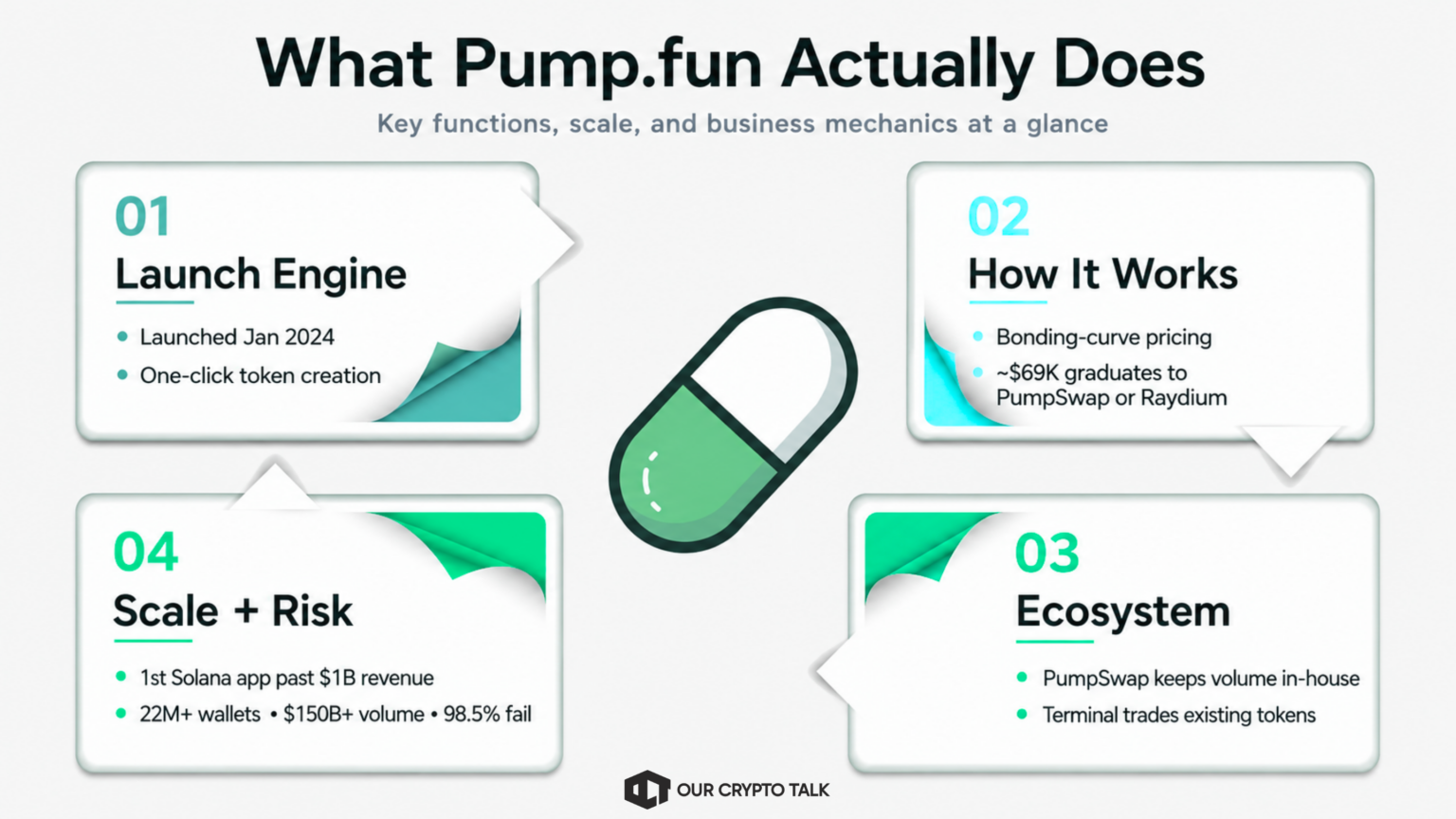
Pump.fun launched PumpSwap to keep more trading volume inside its own ecosystem after tokens graduate. It also expanded beyond token creation with Terminal, its trading interface for existing assets that was previously known as Padre. Then, in July 2025, Pump.fun launched the PUMP token and raised $500 million in under 12 minutes. The token currently sits at a market cap of roughly $1.1 billion, giving Pump.fun a live token layer on top of its already large trading and launch ecosystem.
The scale is massive, but so is the failure rate. Pump.fun has attracted more than 22 million lifetime unique wallets and processed over $150 billion in cumulative volume. At the same time, roughly 98.5% of tokens launched on the platform fail to complete the bonding curve. In other words, Pump.fun makes token creation extremely easy, but it does not make successful launches common. Meanwhile, discovered subdomains for Ethereum, Base, and Monad suggest that Pump.fun may eventually expand beyond Solana and take its launch infrastructure multi-chain.
On the other side of the FOMO vs Pump.fun comparison, FOMO launched in May 2025 and was founded by three former dYdX engineers. Despite operating with a lean 17-person team, it has built a social trading product around one core idea: showing what real traders are buying and selling in real time. Users can follow traders, track their P&L and win rates, and copy their trades directly from the feed. Unlike Pump.fun, FOMO does not focus on creating tokens. Instead, it helps users discover activity around existing ones.
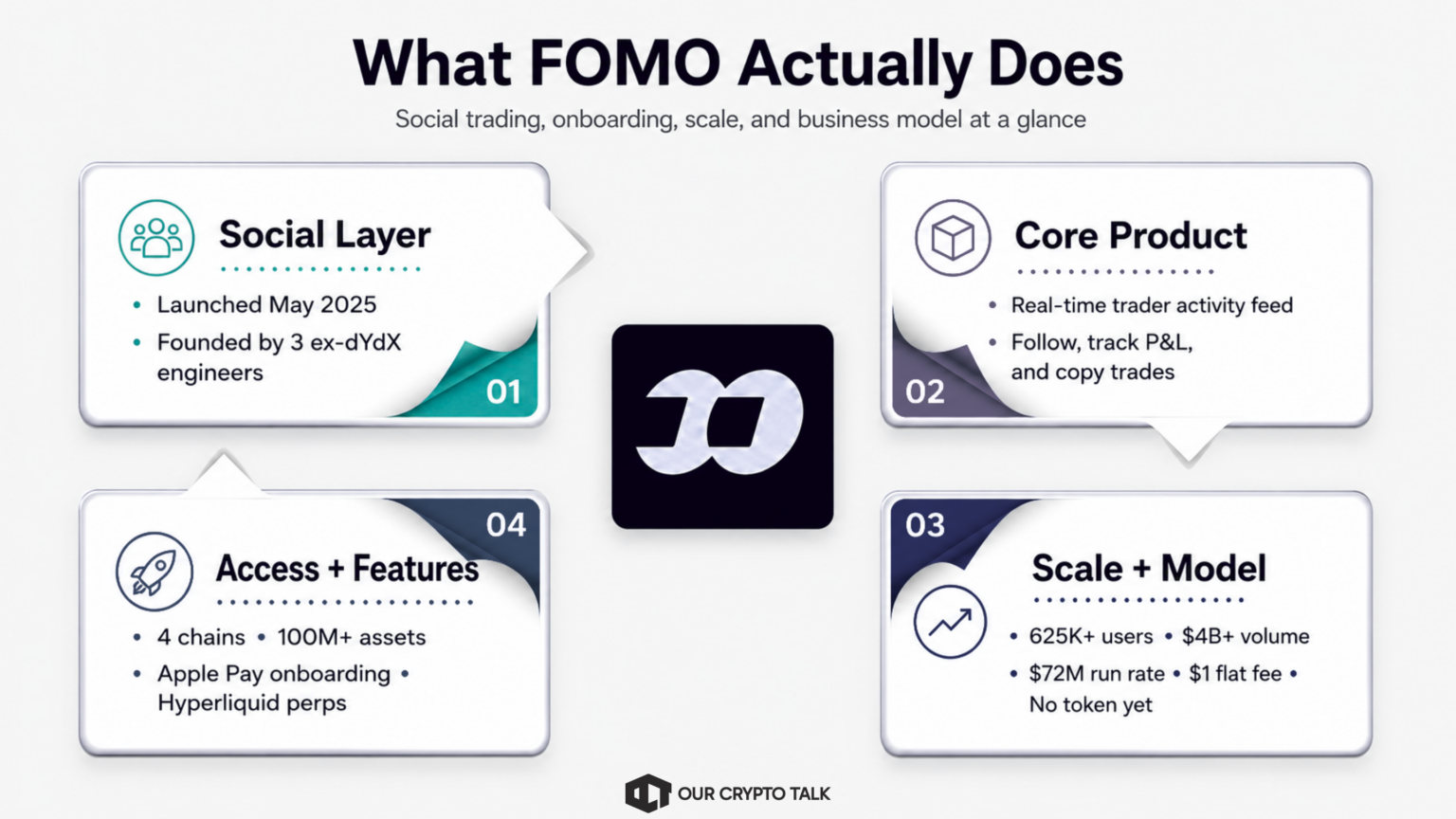
FOMO also takes a multi-chain approach from the start. The app supports Solana, Base, BNB Chain, and Monad, giving users access to more than 100 million assets from a single interface. In addition, onboarding removes much of the usual crypto friction. Users can go from fiat to on-chain in roughly 30 seconds through Apple Pay, and more than 68,000 first-time crypto buyers have entered through this flow. In June 2026, FOMO expanded further by adding perpetual futures through Hyperliquid for non-U.S. users. The platform remains self-custodial and charges a simple $1 flat fee per trade.
By mid-2026, FOMO had grown to more than 625,000 users and over $4 billion in cumulative trading volume, while reaching an annual revenue run rate of roughly $72 million. The company has raised $94 million from investors including Index Ventures, Union Square Ventures, and Benchmark, giving it a valuation of $550 million. However, unlike Pump.fun, FOMO has not launched a token yet. The market widely expects one, but for now the business remains centered on its social graph, trading activity, and fee revenue.
The FOMO vs Pump.fun comparison becomes especially interesting when you look at how each platform makes money. Pump.fun earns revenue across multiple parts of the token lifecycle, including bonding-curve trading fees, graduation fees, PumpSwap LP and protocol fees, Mayhem-mode fees, and Terminal trading fees. At the current rate, Pump.fun generates roughly $455 million in annualized revenue, while cumulative revenue has already crossed $1.22 billion. In addition, it uses protocol revenue to fund PUMP token buybacks, creating a deflationary mechanism that directly links platform activity to the token.
However, Pump.fun’s revenue can swing sharply with meme coin activity. Monthly revenue peaked at roughly $138 million during the height of the meme coin mania. After that, it fell to a weekly low of around $1.72 million in July before recovering to roughly $9.23 million per week by August. The reason is straightforward: Pump.fun depends heavily on new token creation and the trading activity around those launches. As a result, when meme coin cycles cool and fewer users launch tokens, revenue falls with them.
By comparison, FOMO runs a much simpler model. It charges a $1 flat fee per trade and operates at roughly a 96.7% gross margin, based on DefiLlama protocol data. Its annualized revenue run rate sits near $72 million, with weekly revenue peaking at around $1.39 million. More importantly, revenue grew from roughly $150,000 per week in late 2025 to $1.39 million per week by July 2026, a roughly 9x increase in eight months. Unlike Pump.fun, FOMO does not depend on users constantly launching new tokens. Instead, trading volume drives revenue, while the social feed encourages users to return, follow traders, and execute more trades. At the same time, FOMO has no token-related revenue yet, although an expected token launch could eventually add another value layer.
Ultimately, that creates a clear economic split in the FOMO vs Pump.fun debate. Pump.fun remains the much larger revenue machine, but its earnings are more cyclical because meme coin creation drives a large part of its business. Meanwhile, FOMO generates less revenue today, but its model looks steadier because ongoing trading activity and social engagement drive fees instead of launch cycles. Pump.fun monetizes the creation boom. FOMO monetizes the trading attention that continues after the launch.
The FOMO vs Pump.fun comparison gets more complicated because the two platforms overlap in several important areas. Both started as Solana-native products, both serve the meme coin ecosystem, both operate non-custodially, and both generate revenue from on-chain activity. At the same time, that overlap is getting wider. Pump.fun’s Terminal product increasingly looks like a full trading interface rather than just an extension of its launchpad, which moves it closer to FOMO’s territory.
However, the core products still differ. Pump.fun creates tokens, while FOMO centers its product around a social feed where users can follow traders, track their activity, and copy trades. By comparison, Pump.fun still offers relatively limited social features. FOMO also supports Solana, Base, BNB Chain, and Monad natively, while Pump.fun remains Solana-focused with broader expansion planned. In addition, FOMO offers perpetual futures through Hyperliquid and provides an Apple Pay fiat onramp for first-time buyers. Pump.fun offers neither and largely assumes users already understand crypto. Finally, Pump.fun has a live token, PUMP, while FOMO has not launched one yet.
Looking ahead, the biggest long-term factor in the FOMO vs Pump.fun debate is convergence. Pump.fun’s Terminal and FOMO’s trading interface are slowly moving toward the same part of the stack. If Pump.fun adds deeper social and copy-trading features, it will start competing more directly with FOMO for trader attention. Likewise, if FOMO adds native token creation, it will move into Pump.fun’s core market. For now, they still occupy different roles. However, the gap between them is getting smaller.
*Revenue per user uses cumulative protocol revenue divided by the latest publicly disclosed user or wallet count, so it should be treated as a directional comparison rather than a perfect cohort metric. At the moment, DeFiLlama tracks roughly $1.07 billion in cumulative Pump.fun revenue and $25.55 million for FOMO. Meanwhile, Pump.fun’s 22 million-plus lifetime wallet figure comes from the available platform data, while FOMO officially reported more than 625,000 users alongside $4 billion in trading volume.
Even so, the scale gap remains large. Pump.fun launched in January 2024, giving it roughly a 16-month head start over FOMO’s May 2025 launch, along with first-mover status in meme coin infrastructure and a live token. By comparison, FOMO has operated for roughly 15 months and still has no token, yet it is betting that a social trading graph can create stickier user behavior than a pure token launchpad. As a result, that difference matters because Pump.fun already owns enormous distribution on the supply side, while FOMO is trying to build its moat around trader attention and repeat engagement.
However, the efficiency numbers make FOMO interesting despite its smaller scale. At its previously reached $72 million annualized revenue run rate, its 17-person team translated into roughly $4.2 million of annualized revenue per employee. The latest DeFiLlama annualized figure of about $25.3 million, that ratio sits closer to $1.5 million. At the same time, FOMO reported onboarding roughly 3,500 new users per day around its June funding round. Pump.fun has far more lifetime users, but I could not verify a reliable current daily new-user figure from public data. Therefore, it is better to leave that comparison open than manufacture a number from daily active-address data.
If your goal is clear, the choice between Pump.fun and FOMO becomes much easier.
These are not competitors in the way Google and Bing are competitors. They are closer to YouTube as a creation platform versus TikTok as a discovery platform. They give users different entry points into the same ecosystem. Pump.fun helps create the assets. FOMO helps traders discover and trade them. Most power users will probably end up using both.
Pump.fun enters the long-term race with the stronger infrastructure position. It has an 18-month head start, more than $1.2 billion in cumulative revenue, and a live PUMP token that extends the business beyond trading fees through buybacks, staking, and broader token incentives. If Pump.fun successfully expands across multiple chains, it could multiply its addressable market while reinforcing an already powerful network effect: more tokens attract more traders, and more traders encourage more token launches. That flywheel can keep an infrastructure platform dominant for a long time.
FOMO is betting on a different moat. Its advantage is distribution. Social graphs tend to create stronger retention because users follow people, not just products. FOMO also launched multi-chain from day one, which reduces its dependence on any single Solana meme coin cycle. Perpetual futures add another high-margin revenue stream that Pump.fun does not currently offer, while backing from Index Ventures and USV gives FOMO institutional credibility and a broader network outside crypto-native venture circles. More importantly, Apple Pay onboarding lowers the barrier for first-time buyers and expands the market beyond users who already know how to fund a wallet and trade on-chain.
So, the real question is not simply whether Pump.fun or FOMO builds the better product. It is whether more value ultimately accrues to token creation infrastructure or to the platforms that control discovery and distribution. History often favors distribution. Google did not create the web. It organized it. Social platforms did not create most of the content they monetized. They captured attention around it. Still, infrastructure can dominate for years when it becomes the default venue, and Pump.fun already holds that position in meme coin creation.
Pump.fun built the factory. FOMO built the showroom. Both are needed. The long-term winner will be the platform that captures the larger share of value as users move from creating tokens to discovering, trading, and repeatedly engaging with them.
This is analysis, not financial advice. Both platforms serve speculative activity and most Pump.fun tokens go to zero.