Ramses brings concentrated liquidity and fee-first DeFi across multiple chains. Explore RAM, traction, risks, and growth potential.

Author: Akshat Thakur
Ramses is a live multichain concentrated-liquidity DEX that started on Arbitrum as a ve(3,3) Solidly successor. It has since expanded across HyperEVM, Polygon, Robinhood Chain, and remaining Arbitrum pools.
The protocol is built around a simple problem. Traditional emissions can attract liquidity, but that liquidity often leaves when incentives disappear. Long ve-locks can also make participation cumbersome, while MEV can capture value that otherwise could flow to LPs and stakers.
Ramses approaches this through concentrated liquidity, dynamic fees, internalized MEV, and its x(3,3) system.
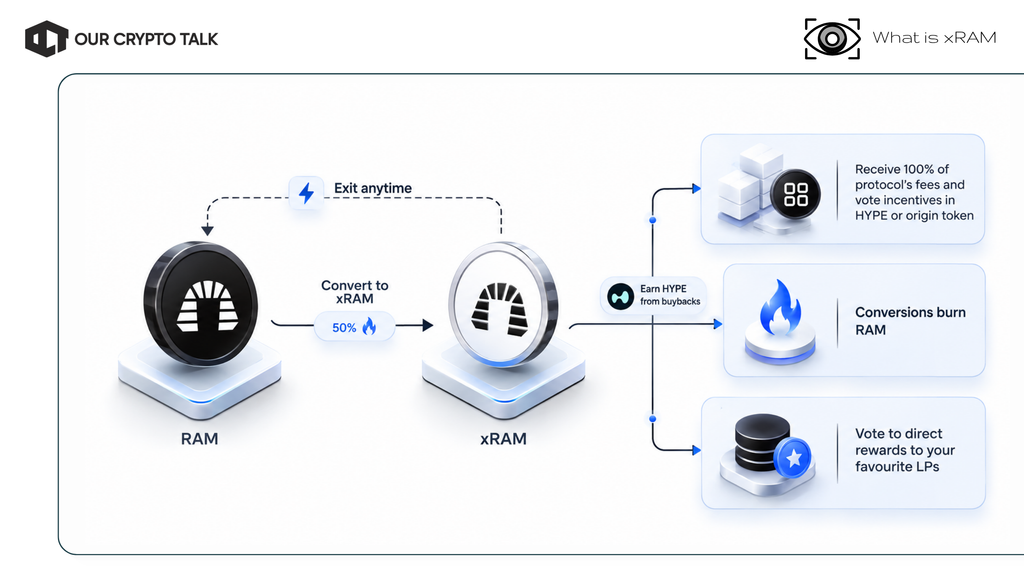
The xRAM model converts RAM into xRAM with a 50% burn while allowing more flexible voting. AutoVaults and r33 liquid staking add ways to participate without relying entirely on multi-year locks.
The protocol also aims to direct more trading fees toward liquidity providers. Its fee-only pools have marketed a roughly 95% LP and 5% protocol split.
Ramses is already generating activity. Recent figures put total TVL around $15 million, with newer deployments on Robinhood Chain and HyperEVM accounting for meaningful portions. Some snapshots have placed CL V2 liquidity across chains around $12 million to $13 million.
Its lifetime volume reaches into the tens of billions when legacy Arbitrum activity is included, while cumulative protocol fees have reached the multi-million-dollar range.
The timing is important because newer chains need native liquidity infrastructure. HyperEVM and Robinhood Chain are still developing their DeFi ecosystems, creating opportunities for DEXs willing to deploy early.
The question is whether Ramses can turn that expansion into sticky liquidity and sustainable fee revenue, rather than repeating the emissions-driven cycle that has affected many Solidly-style DEXs.
Ramses operates in one of DeFi’s most competitive categories.
Uniswap remains a major concentrated-liquidity benchmark and routing destination. Curve, Aerodrome, Velodrome, Thena, Equalizer, and other Solidly-derived protocols compete through gauges, incentives, and liquidity-directed governance.
Every new chain also creates another group of local DEXs competing for stablecoin pairs, token launches, and trading volume. Aggregators can further reduce the amount of flow captured by any single venue.
Ramses therefore does not have an empty market to capture.
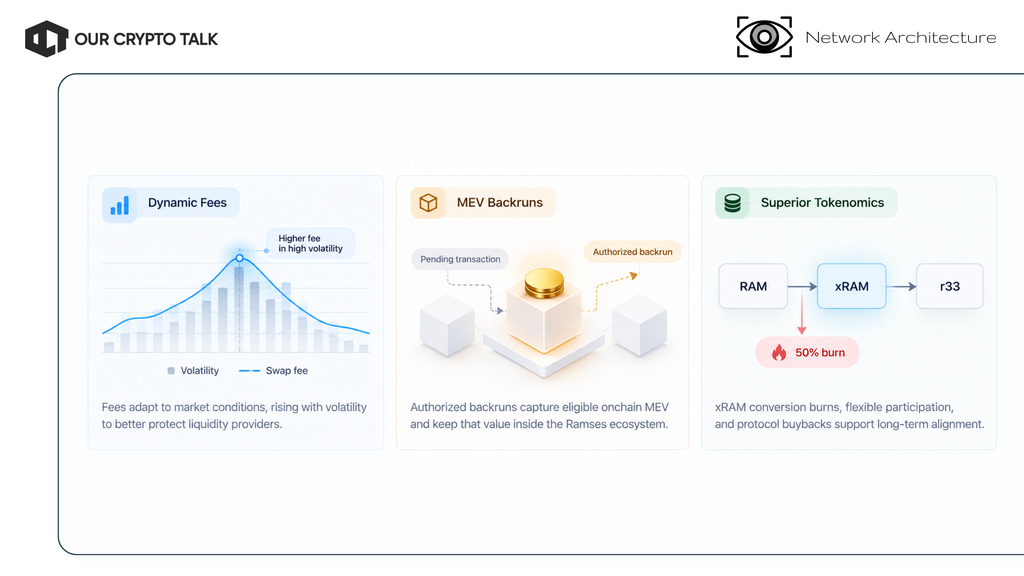
Its differentiation comes from combining several mechanisms. Concentrated liquidity provides more capital-efficient positioning, while dynamic fees can adjust trading costs based on market conditions. Its permissioned MEV backrun system attempts to keep some arbitrage value inside the protocol rather than allowing external searchers to capture it.
The x(3,3) model adds another layer. RAM can be converted into xRAM with a 50% burn, while voting is designed to be more flexible than traditional long-duration ve-locks. AutoVaults and r33 liquid staking provide additional liquidity-management options.
The fee structure is also part of the pitch. Ramses has promoted fee-only pools with around 95% of fees going to LPs and 5% to the protocol.
These features create a differentiated product, but not an uncopyable moat.
A competitor can build concentrated liquidity, dynamic fee systems, gauges, liquid staking, or MEV integrations. Uniswap or a well-funded native HyperEVM DEX could potentially replicate individual features.
Ramses’ more tangible advantage is its operating history. It has survived multiple market cycles, shipped across several chains, and accumulated years of liquidity and security experience.
The key metrics are therefore fee generation and sticky TVL, not how different the marketing sounds from Solidly.
Ramses has operated since March 2023 with a mostly pseudonymous team.
That is relatively common in DeFi, particularly among DEX protocols, but it provides less information about the individuals responsible for the protocol than a fully doxxed team would.
Ramses has instead built its track record through the product itself.
The protocol launched on Arbitrum, added concentrated liquidity, onboarded integrations across the ecosystem, participated in Arbitrum’s STIP program, and later expanded into HyperEVM and other chains through Ramses X.
Its GitHub organization also contains active infrastructure covering V3 contracts, SDKs, assets, and integrations.
Security is another part of the operating record. Ramses has cited more than $2 million in security work across firms and audit competitions including Cantina, ConsenSys Diligence, Code4rena, and Spearbit.
That does not eliminate smart-contract risk, but it gives the protocol a longer security history than a newly deployed DEX.
The pseudonymous structure remains a consideration, particularly because Ramses manages user liquidity and operates MEV-related infrastructure.
The counterpoint is that the protocol has remained live for several years. Its history of deployments, pools, integrations, and upgrades provides evidence that the team has continued shipping despite changing DeFi conditions.
Still, a multi-year operating history is not the same as a transparent founder track record.
For Ramses, the most useful way to evaluate the team is therefore through what it has shipped, how the contracts have performed, and how the protocol handles security and upgrades.
Ramses does not follow the conventional crypto fundraising model.
There is no major publicly disclosed Tier-1 equity round sitting behind the protocol. Its capital structure is closer to ecosystem support, protocol-owned incentives, and community allocations.
One notable example was participation in Arbitrum’s STIP Round 1. Ramses requested roughly 1.25 million ARB, which was paired with RAM incentives as part of an ecosystem-focused program rather than a traditional venture financing round.
Its later HyperEVM expansion has also emphasized community distributions, treasury allocations, and protocol-owned liquidity rather than a large named VC round.
That changes the way Ramses should be evaluated.
The protocol does not need to raise capital to reach TGE because RAM is already live. It has also operated through multiple market environments and chain rotations without relying on a conventional startup funding cycle.
The main financial question is therefore not runway.
It is whether protocol revenue can support the cost of attracting and retaining liquidity as Ramses expands across chains.
That matters because DEX competition can become expensive. New deployments often require incentives to attract LPs and traders, while competitors can respond with their own emissions or fee structures.
The absence of a large VC overhang can help align the protocol more closely with its community and treasury. But it also means Ramses does not have the balance-sheet resources of a heavily funded competitor.
Ultimately, the backing story matters less than the protocol’s own economics.
If trading fees, MEV capture, and liquidity activity grow sustainably, the existing treasury and protocol-owned liquidity can support further expansion. If activity depends heavily on incentives, another round of ecosystem funding may eventually become necessary.
Ramses has already survived the launch phase. Its next test is whether its multichain strategy can produce durable fee revenue without constantly buying liquidity.
Ramses is far beyond the testnet stage. The DEX has operated on Arbitrum since March 2023 and has since expanded through Ramses X across HyperEVM, Polygon, and Robinhood Chain.
Users can trade, provide liquidity, convert RAM into xRAM, and use r33, HyperRAM, and AutoVaults today.
The product stack includes concentrated-liquidity pools, legacy and stable pools, and DLMM on Robinhood Chain. Dynamic fees adjust with market conditions, while permissioned MEV backruns aim to keep more arbitrage value within the protocol.
The x(3,3) system is another core component. Converting RAM into xRAM burns 50% of the converted RAM while providing voting power and access to incentives. Liquid-staking options through r33 and HyperRAM reduce the need for users to manage every gauge manually.
Ramses also has a Sarcophagus mechanism that connects fees with RAM burning.
The development record supports the live-product claim. The RamsesExchange GitHub organization continues to cover contracts, SDKs, assets, and integrations. The protocol has also cited more than $2 million in security work across firms and audit competitions including Cantina, ConsenSys Diligence, Code4rena, and Spearbit.
But live does not mean equally mature everywhere.
Arbitrum is the oldest deployment, while HyperEVM and Robinhood Chain have recently generated more of the TVL and fee activity. Liquidity and feature availability can therefore vary significantly by chain.
Ramses is shipping production infrastructure. The next question is whether that infrastructure can retain liquidity and trading volume after the initial activity around newer chains cools.
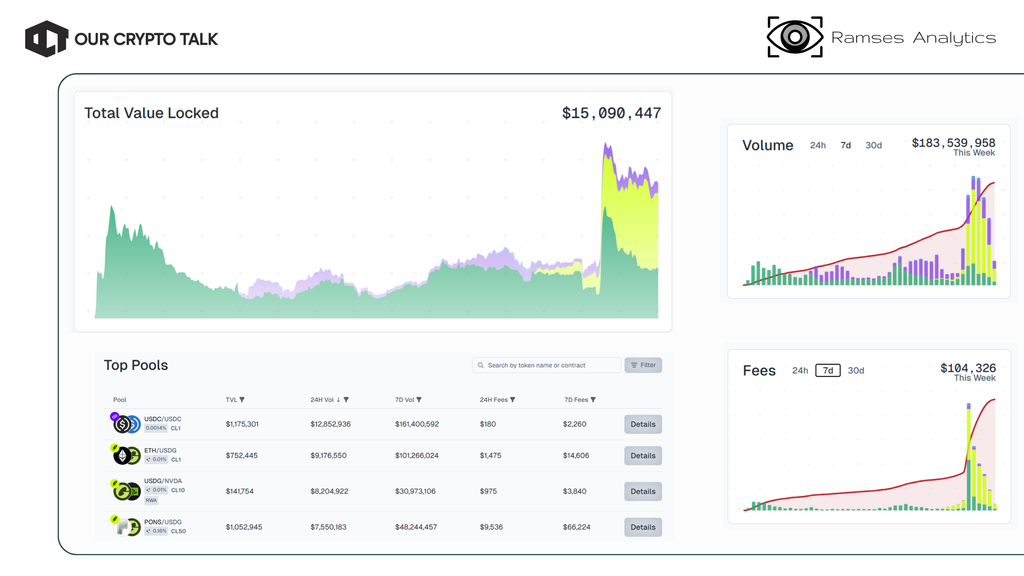
Ramses’ traction is better measured through volume, fees, and TVL than social metrics.
Recent combined TVL figures have landed around $15 million, with Robinhood Chain and HyperEVM often representing the largest portions. Polygon contributes a smaller share, while legacy Arbitrum activity remains comparatively limited.
Trading volume has been substantial during periods of strong activity. Recent aggregates put 30-day volume around $3B.
Fee generation is another important signal. Recent 30-day figures have shown around $3.1 million in fees. The protocol does not retain all of that because a large portion goes to liquidity providers.
That distinction matters.
High volume relative to TVL can indicate efficient capital usage, but a short period of high activity does not prove that the volume will remain once chain incentives and narratives change.
Users also have meaningful capital at risk inside the protocol. LPs face impermanent loss, while RAM-to-xRAM conversion permanently burns 50% of the converted amount.
The strongest traction signal is therefore the combination of sustained volume, fees, and TVL.
Robinhood Chain and HyperEVM have shown that Ramses can capture activity when a new ecosystem is hot. The open question is whether that activity remains once the incentive environment changes.
RAM is already a live token, so users are not entering a conventional TGE setup.
The tokenomics combine emissions, governance, fee capture, and supply reduction.
The HyperRAM-era distribution table started with 350 million RAM. The protocol also uses a 1 billion supply ceiling, while burns create additional room below that ceiling. Public token dashboards have shown total supply around 241 million, with approximately 83 million circulating and a significant amount held across xRAM, AutoVault, and r33 structures.
More than 200 million RAM has also been burned according to public tallies.
The main source of new supply is weekly gauge emissions. Recent epochs have produced roughly 1.5 million RAM in weekly emissions, with gross annualized inflation above 20% before accounting for burns.
Governance can adjust emissions by up to 25% per epoch based on protocol conditions.
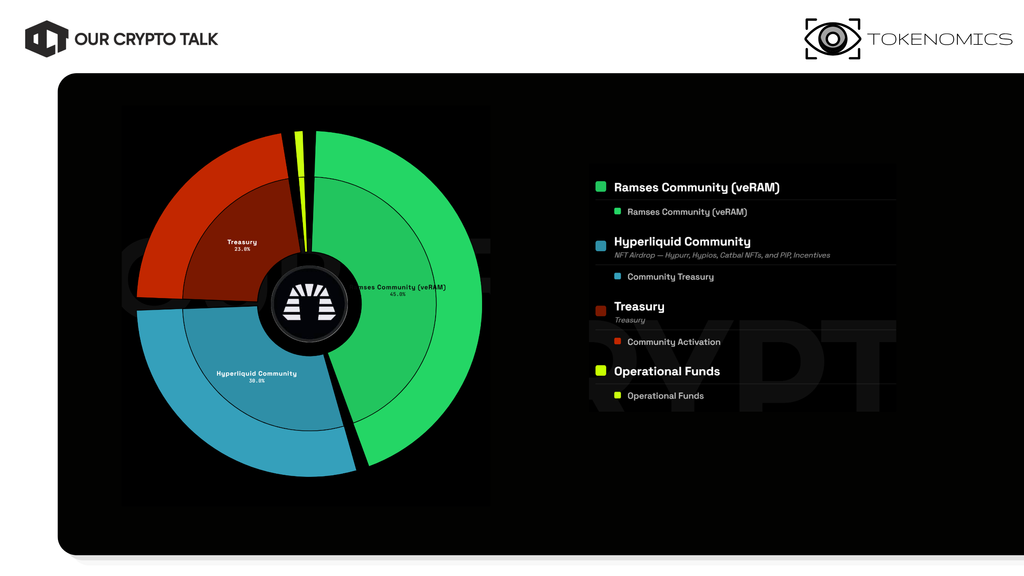
The initial 350 million allocation was divided between community and protocol-controlled categories. Ramses Community received 45%, the Hyperliquid Community received 30%, the treasury received 23%, and protocol-owned liquidity received 2%.
The structure therefore differs from a launch dominated by team and VC allocations. The weekly gauge stream is designed to distribute emissions to voted pools rather than directly to a team allocation.
But emissions remain the central risk.
RAM has genuine sinks. Converting RAM to xRAM burns 50% of the converted amount. Sarcophagus also connects fee accumulation to RAM burning, while protocol fees and MEV capture can potentially support additional supply reduction.
The important calculation is net supply.
If emissions consistently exceed burns, RAM remains inflationary despite the burn mechanics. If fee generation, voluntary conversions, and other sinks absorb more RAM than the protocol creates, the supply picture changes.
For RAM, epoch emissions, protocol fees, and actual burn rates matter more than the headline maximum supply.
There is no traditional pre-TGE opportunity left. Ramses has been live since 2023, so current participation is about using the existing stack and entering newer deployments early.
The most direct route is liquidity provision. Users can provide concentrated liquidity across Ramses deployments on HyperEVM, Robinhood Chain, Polygon, and Arbitrum, with DLMM available on Robinhood Chain. LPs can earn swap fees and, where applicable, gauge emissions.
Ramses has marketed fee-only pools with roughly 95% of fees going to LPs, making actual trading activity particularly important to LP returns.
Another route is converting RAM into xRAM. The conversion burns 50% of the RAM used and provides voting power and access to protocol incentives. The xRAM system is designed around a 0.5 RAM redemption relationship, subject to the protocol’s mechanics.
Users can also use r33, HyperRAM, and AutoVaults for liquid or automated staking. These products reduce the need to manually participate in every weekly gauge vote.
Sarcophagus offers a more advanced route by connecting accumulated protocol fees with RAM burning.
The secondary market remains the simplest way to gain exposure to RAM, although users need to verify the correct chain and contract because liquidity and pricing can differ across venues and between RAM, xRAM, and liquid-staking products.
The earlier RXP and community distribution phase is largely behind the protocol. That changes the definition of “early.”
A user is not early to Ramses itself after three years of operation. They can, however, be early to a specific chain deployment while that ecosystem is still developing.
That makes current participation less about farming points and more about LP strategy, gauge economics, impermanent loss, and the sustainability of trading fees.
Ramses is no longer an airdrop or points play. The current opportunity comes from LP fees, gauge emissions, and exposure to RAM, xRAM, or r33 on live chains.
For LPs, the economics depend heavily on the underlying chain. HyperEVM and Robinhood Chain have recently generated strong activity, but concentrated liquidity also brings impermanent loss and active range management. Gauge emissions can add to returns, but they should not be treated as the core thesis.
RAM is a different bet. Recent price prints have been around $0.04 to $0.06, with roughly 83 million circulating tokens and a market cap in the low single-digit millions. Weekly emissions have remained around 1.8 million RAM before burns.
At the same time, Ramses has produced substantial recent activity. Recent aggregates showed roughly $15 million in TVL, more than $3 billion in 30-day volume, and around $3 million in 30-day fees.
That creates an interesting setup, but the numbers need context. If those fee levels persist, RAM’s valuation looks very different from a scenario where activity falls back toward quieter Arbitrum-era levels.
The xRAM mechanism also has a direct cost. Converting RAM to xRAM burns 50% of the converted amount. Users receive voting and fee-related benefits in exchange, but the burned RAM cannot simply be recovered.
The key question is therefore whether fees can consistently outweigh emissions.
Ramses can make sense as a live LP or governance position for users who already want exposure to its active chains. It is harder to justify as a passive bet based purely on the idea that RAM is “early.”
Ramses operates in a market where liquidity can move quickly.
Uniswap remains a major routing destination, while Aerodrome, Velodrome, and other veDEXs have established positions on their respective chains. HyperEVM and Robinhood Chain can also attract new native DEXs with fresh incentives and deeper capital.
If token launches and stablecoin volume move elsewhere, Ramses can lose TVL quickly.
Chain dependence creates another risk. Much of the recent activity has come from HyperEVM and Robinhood Chain. Strong multichain numbers can therefore hide dependence on a small number of active ecosystems. If those chains experience a prolonged slowdown, Ramses’ volume and fee generation could fall with them.
Mercenary liquidity is another issue. Gauge emissions and incentives can attract capital without creating permanent market share. LPs may simply move to whichever pool offers the highest current return.
The tokenomics create a separate challenge. Ramses burns RAM through mechanisms such as the 50% RAM-to-xRAM conversion and Sarcophagus, but it also continues to issue weekly gauge rewards. If emissions consistently exceed burns, the supply remains inflationary despite the deflationary mechanics.
Smart-contract and infrastructure risk also increases with every deployment. Ramses operates across several chains, while its MEV modules introduce additional trust assumptions. Thin concentrated-liquidity ranges can also become difficult to exit during volatile markets.
The broader economic loop remains familiar: emissions attract liquidity, liquidity creates trading activity, and fees need to eventually replace the incentives.
Ramses has added meaningful product improvements around that loop. The question is whether those improvements can make the liquidity sticky enough to survive when the next chain narrative fades.
Ramses does not have a future TGE or major launch event to front-run. The important catalysts now come from live usage.
The first is sustained activity on Robinhood Chain and HyperEVM. Higher trading volume should translate into more swap fees and potentially stronger LP economics. A slowdown would show up just as quickly in TVL and fee figures.
The second is the relationship between emissions and revenue. Ramses can adjust gauge emissions by up to 25% per epoch. Whether those emissions remain justified by actual trading fees will be important for RAM’s supply dynamics.
New fee-focused deployments are another potential catalyst. Ramses can launch pools where liquidity providers receive a larger share of trading fees without relying as heavily on governance emissions. If those pools attract sustained volume, they could strengthen the fee-first thesis.
The x(3,3) system also remains important. Higher RAM-to-xRAM conversions and Sarcophagus activity would increase the amount of RAM being removed from circulation.
Negative catalysts are straightforward. A major host-chain outage, a competing DEX capturing important launches, a smart-contract or MEV incident, or a prolonged decline in trading volume could all weaken the current setup.
The useful checkpoint is a full quarter.
If Ramses can maintain strong fees across multiple chains rather than relying on one hot ecosystem, the multichain strategy becomes more meaningful. If volume falls sharply once the current chain narratives cool, the recent numbers will look more like a temporary liquidity cycle.
WATCH
Ramses is a real DEX with more than three years of operating history, audited infrastructure, multichain deployments, and meaningful recent volume and fee activity.
The x(3,3) model and 50% RAM-to-xRAM burn are also actual mechanisms rather than roadmap promises. Recent aggregate figures around $15 million in TVL, $3 billion-plus in 30-day volume, and $3 million in 30-day fees show that the protocol can capture significant activity when its target chains are active.
But the token remains exposed to the same economic forces that have affected other Solidly descendants.
Weekly emissions continue. Liquidity can be mercenary. Treasury and governance concentration matter. Most importantly, recent activity is concentrated around newer chains whose own growth cycles are still developing.
The milestone to watch is a full quarter where fee revenue and net RAM burns consistently outweigh gauge emissions across multiple deployments, while TVL remains sticky without relying on one chain’s narrative.
Until that happens, Ramses is better understood as a live multichain DEX with tactical LP and governance opportunities, rather than a passive long-term RAM thesis.
All the opinions in this article are that of the author and in no way are financial advice. Our Crypto Talk and the author always suggest you do your own research in crypto and to never take anything as financial advice that you read on the internet. Check our Terms and conditions for more info.


GEODNET Price Prediction: The $1B Thesis for GEOD
RWA Needs Better Access. Can NUVA Deliver?
Tokenization of RWA yields onchain might be the biggest opportunity that no one has noticed
Cold Wallet Safety 2026: Are Hardware Wallets Still Safe?
GEODNET Price Prediction: The $1B Thesis for GEOD
RWA Needs Better Access. Can NUVA Deliver?
Tokenization of RWA yields onchain might be the biggest opportunity that no one has noticed
Cold Wallet Safety 2026: Are Hardware Wallets Still Safe?