7 robotics crypto projects building the machine economy: GEODNET leads, with peaq, IoTeX, Auki, NATIX, and XMAQUINA filling the stack.

Author: Kritika Gupta
Robots can already move through warehouses, inspect crops, and deliver goods. But as more machines work across companies, they will need to identify themselves, pay for services, and coordinate with one another. That is where robotics crypto projects see an opportunity.
The seven projects in this article tackle different parts of that challenge. GEODNET provides precise positioning, while Auki and NATIX help machines understand their surroundings. peaq and IoTeX focus on identity and machine data, Fabric works on coordination, and XMAQUINA offers exposure to private robotics companies. Together, they show what a machine economy might need and where crypto still has to prove its value.
Robots need three things blockchain can provide: identity (who is this machine?), payments (how does it pay for services?), and coordination (how do millions of machines work together?). A company can manage those functions for its own fleet. However, machines from different manufacturers also need ways to recognize one another, exchange value, and work together. Decentralized networks aim to provide that shared infrastructure.
Before a robot makes its first payment, it must know where it is and what surrounds it. From there, the robotics stack runs through positioning -> spatial awareness -> visual data -> machine identity -> coordination -> investment. The robotics crypto projects below each address a distinct part of that stack. GEODNET handles positioning, while Auki maps shared spaces and NATIX supplies visual data. Next, peaq and IoTeX address machine identity and verified activity. Fabric and OpenMind focus on coordination. Finally, XMAQUINA gives people a route to invest in private robotics companies.
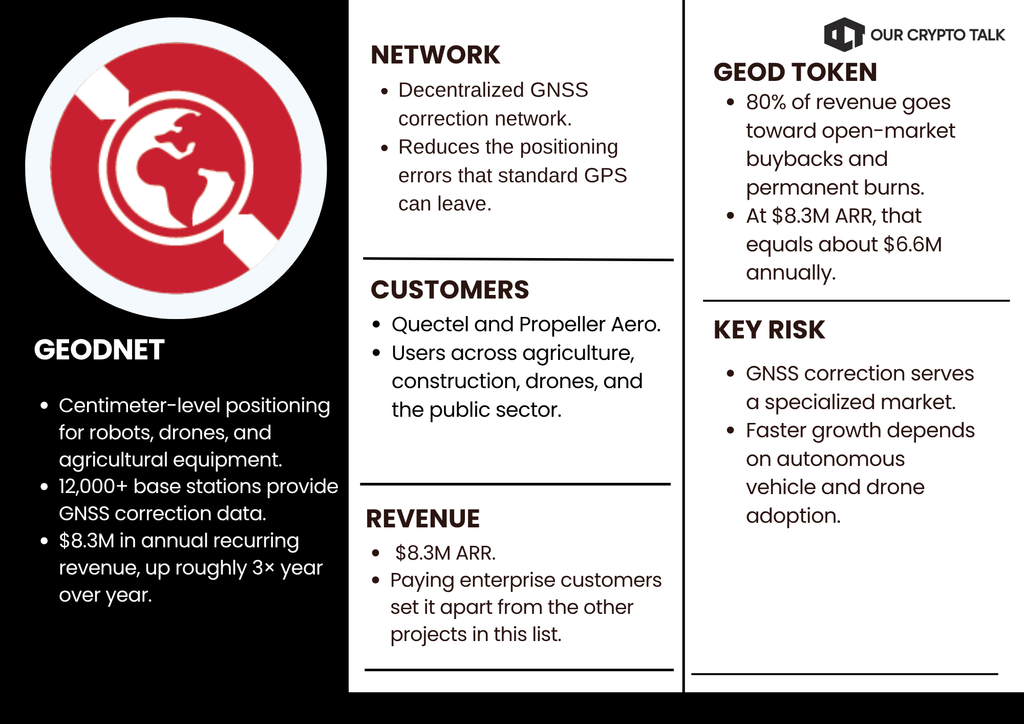
Standard GPS can miss a position by several meters, which creates problems for robots, drones, and autonomous vehicles. GEODNET addresses that gap with a decentralized GNSS correction network. More than 12,000 base stations around the world provide correction data that agricultural equipment, drones, and other machines use for centimeter-level positioning.
GEODNET reports $8.3 million in annual recurring revenue, roughly three times its year-earlier figure. That makes it the only project on this list with proven, growing enterprise revenue. Its customers and users include Quectel, a company with about $2.5 billion in revenue, Propeller Aero, the USDA, and businesses in agriculture, construction, and drone services. OCT’s full GEODNET review examines the network and its customers in more detail.
Revenue also feeds into the token. GEODNET directs 80% of revenue toward open-market GEOD buybacks and permanent burns. At $8.3 million in ARR, that works out to roughly $6.6 million a year in buybacks and burns. Meanwhile, GEOD’s market cap sits around $118 million to $125 million, and Multicoin Capital has made an $8 million token acquisition.
GEODNET’s strength lies in its paying customers, growing revenue, and tokenomics linked to usage. However, GNSS correction remains a niche market. Autonomous vehicles and delivery drones could expand demand substantially, but their adoption timelines will determine how quickly that opportunity reaches GEODNET.
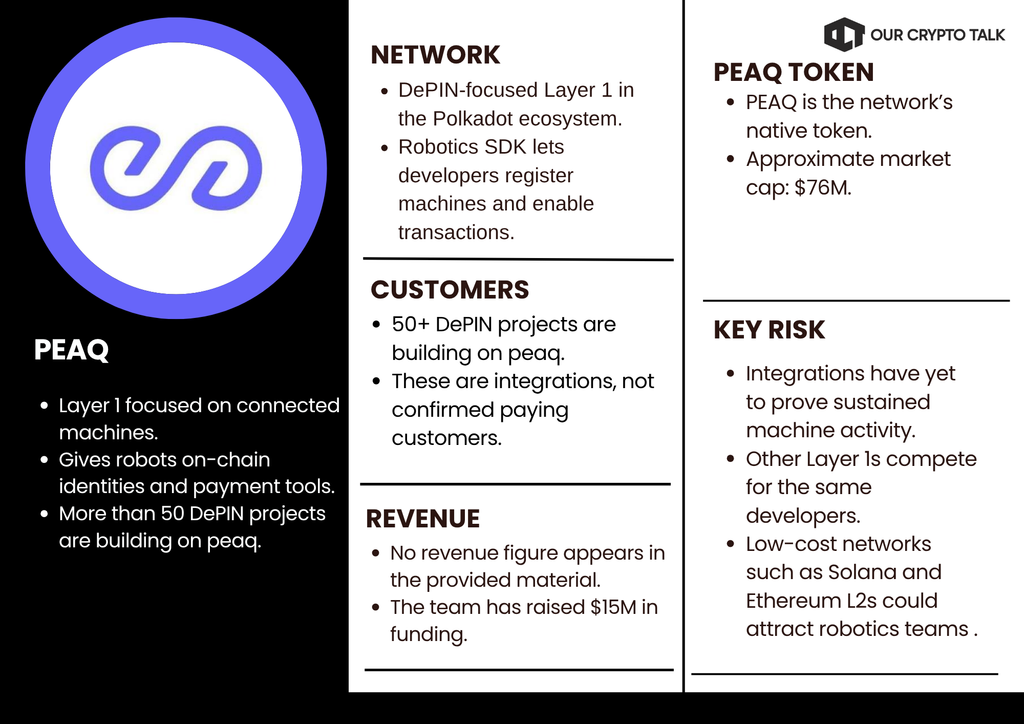
peaq is a DePIN-focused Layer 1 built in the Polkadot ecosystem, and its team has raised $15 million. It gives connected devices decentralized identities (DIDs), so a robot can identify itself on-chain. More than 50 DePIN projects are building on peaq. Its Robotics SDK also helps developers register machines, enable transactions, and coordinate their activity on-chain.
Among robotics crypto projects, peaq focuses on identity and payments. GEODNET tells a robot where it is, while peaq tells the network who it is and gives it a way to pay. A robot that identifies itself can prove which machine completed a task; payment tools can then settle the transaction. At a market cap of roughly $76 million, PEAQ gives investors exposure to that layer rather than the robots themselves.
peaq’s 50-plus DePIN integrations and Polkadot interoperability give it a starting network of developers and potential users. However, integrations do not guarantee sustained machine activity. Other Layer 1s and low-cost networks compete for the same builders, and peaq’s adoption metrics still lag the scale of its machine-economy narrative. Watch whether registered devices make repeat transactions and payments as deployments grow.
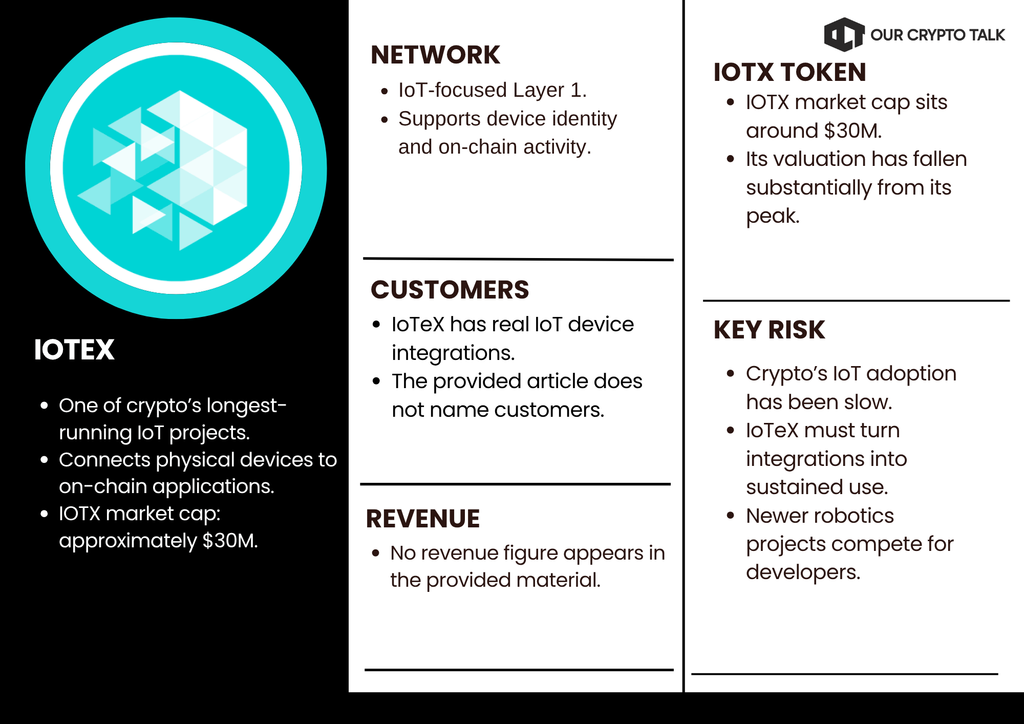
IoTeX is one of the oldest projects in this space. Its IoT-focused Layer 1 connects devices to on-chain applications, while its W3bstream middleware helps developers verify machine data before they use it on-chain. For example, a delivery robot can claim it completed a job; W3bstream can help a developer check data that supports the claim. IOTX’s market cap sits around $30 million.
IoTeX’s long track record and real IoT device integrations give it experience that newer robotics projects lack. W3bstream also gives it a distinct role in verifying what machines do. However, IOTX has lost substantial market value since its peak, and crypto’s IoT narrative has taken years to produce broad adoption. IoTeX now needs to show that developers and customers will use its infrastructure as physical AI expands.
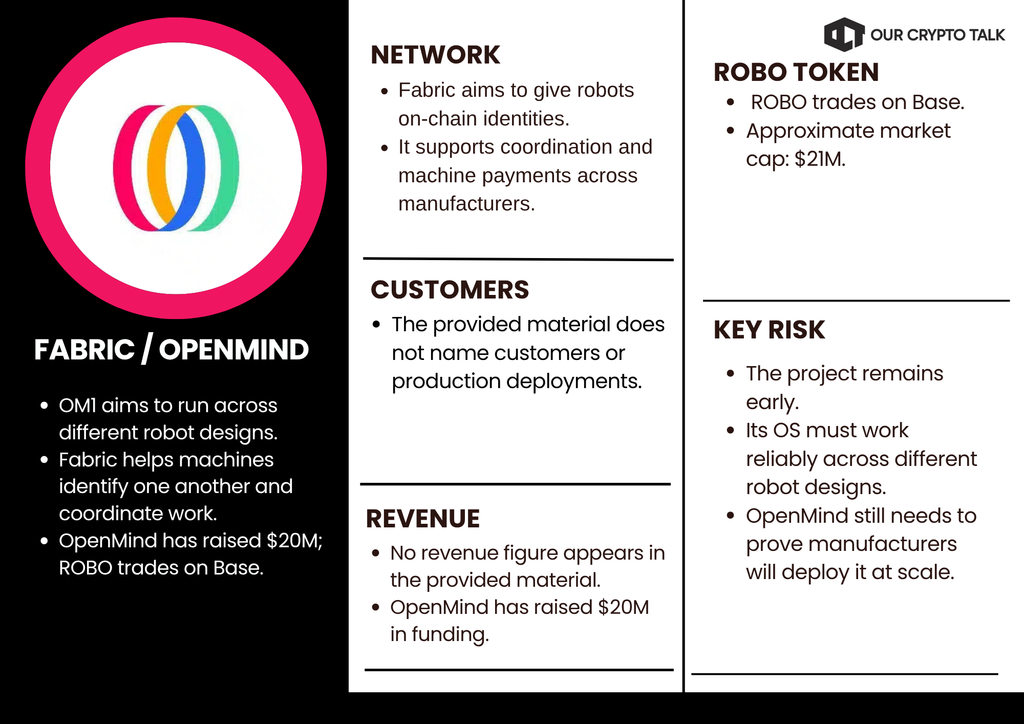
OpenMind has raised $20 million to build software that helps robots work together. Its OM1 operating system aims to run across different robot designs, while Fabric adds a blockchain-based identity network for coordination, AI compute, and machine payments. ROBO trades on Base, and its market cap sits around $21 million. Together, the OS and network aim to let machines from different manufacturers identify one another, share context, and settle work.
Among robotics crypto projects, Fabric / OpenMind tackles the software layer that connects machines. Strong funding and a clear product vision support that ambition. However, the project remains early. A robot OS must work reliably across different hardware and real-world conditions, and OpenMind still needs to demonstrate that manufacturers will deploy its tools at scale. That makes adoption the key test for ROBO.
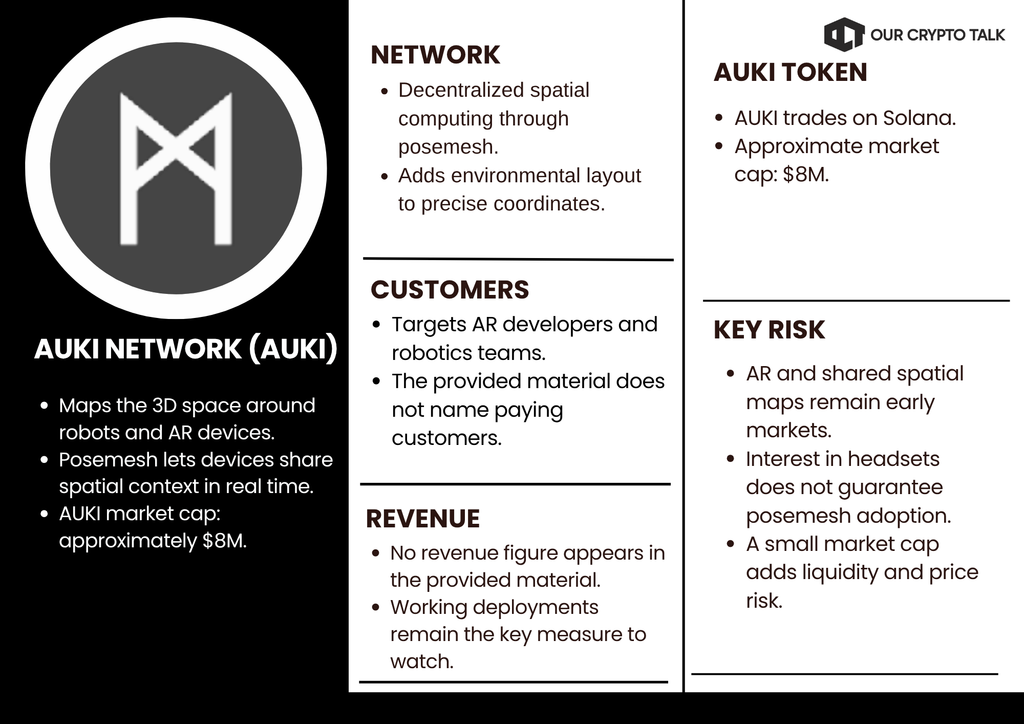
A robot can know its coordinates and still miss a doorway or a changed aisle. Auki Network addresses that gap through decentralized spatial computing. Its posemesh protocol helps AR devices and robots map and share an understanding of their surroundings in real time. In this stack, GEODNET supplies the coordinates, or where a robot is; Auki supplies spatial context, or how the environment around it is laid out. AUKI trades on Solana, with a market cap around $8 million.
Auki has a distinct role because robots need to understand 3D space as it changes. Devices such as Apple Vision Pro and Meta Quest also create potential demand for shared spatial maps. However, hardware interest has yet to prove broad adoption of Auki’s network. AR and spatial computing remain early markets, and AUKI’s small market cap adds substantial liquidity and price risk. Working deployments will matter more than the size of the wider AR opportunity.
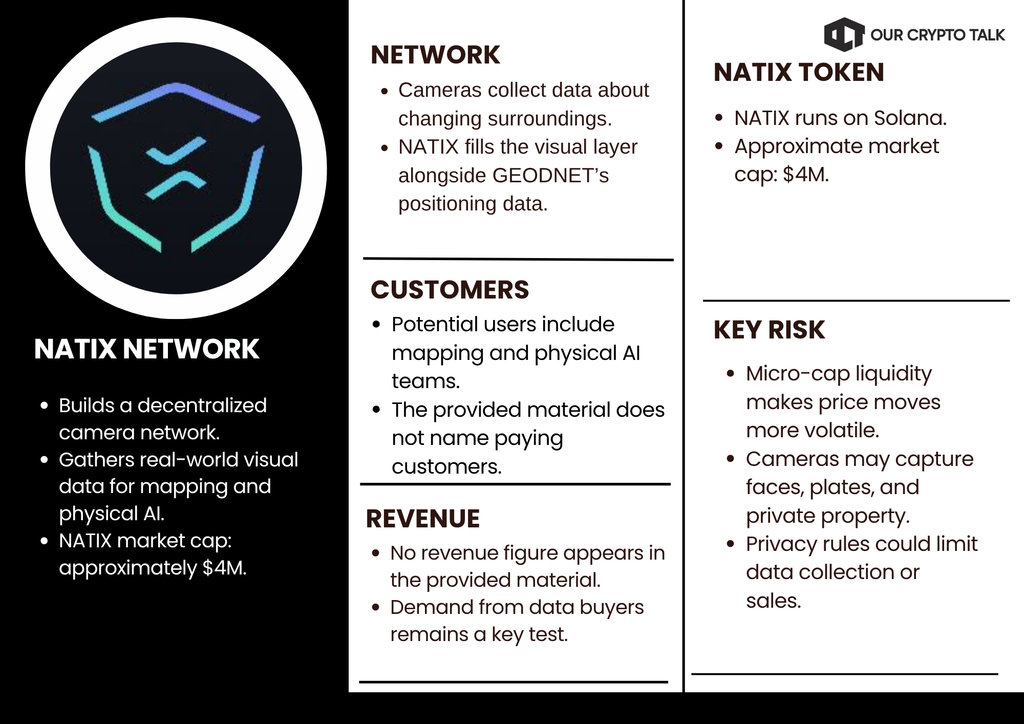
Machines need to see their surroundings as well as locate themselves. NATIX builds a decentralized camera network that gathers real-world visual data for mapping and physical AI. It fills the visual data layer of this stack. GEODNET helps them determine exactly where they are.” Together, those functions give a robot information about both nearby objects and its precise location. NATIX’s market cap sits around $4 million.
That small valuation also brings micro-cap liquidity and execution risk. Meanwhile, a camera network may capture faces, license plates, and private property as it collects data. NATIX will need to address privacy and regulatory questions while proving that buyers want the visual data its network gathers.
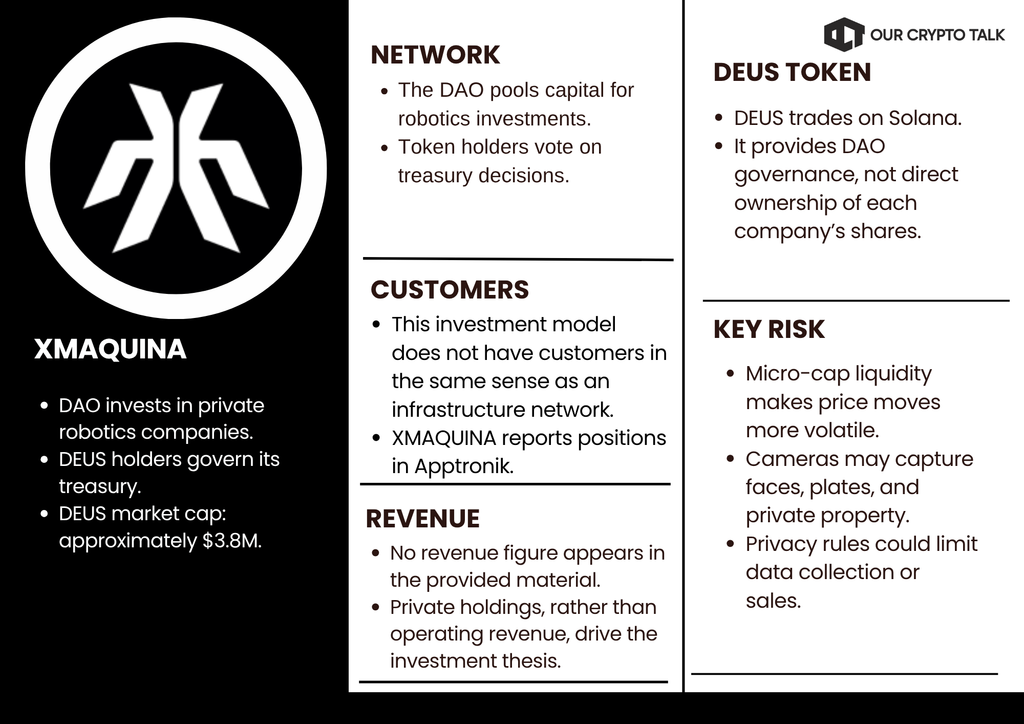
XMAQUINA differs from the other six projects: its DAO invests in private robotics companies instead of building infrastructure for robots. Retail investors generally cannot buy shares in these startups directly, so XMAQUINA pools capital and lets DEUS holders govern the treasury. XMAQUINA says it has deployed capital into Apptronik, Figure AI, 1X Technologies, Agility Robotics, and NEURA Robotics. It describes Robotico separately as an incubation, not one of those private equity holdings. DEUS trades on Solana, and its market cap sits around $3.8 million.
That model gives XMAQUINA a distinct place in the stack: investment access. Think of it as a proposed “Berkshire Hathaway of crypto robotics,” with an important distinction: DEUS holders govern a DAO; they do not directly own shares in each portfolio company. Its roughly $4 million market cap brings liquidity risk, while private-company valuations and DAO governance add further uncertainty. Investors should examine the DAO’s disclosed allocations and the rights DEUS gives them before treating the token as a direct proxy for its holdings.
These seven projects address different questions in the machine economy. The stack starts with what a robot needs to operate and ends with how people can invest in the companies building it.
These seven projects are not direct competitors. Consider a delivery robot: it could use GEODNET for positioning, Auki for the 3D layout, and NATIX data to interpret its surroundings. It could then use peaq for identity and payment, IoTeX to verify data about completed work, and Fabric to coordinate with other robots. XMAQUINA sits outside that operating flow and offers access to the investment side. This is a model of how the projects could fit together, not an existing integrated fleet.
Together, they outline possible decentralized infrastructure for the machine economy. The test is whether robots from different manufacturers actually use these services. Paying customers, active devices, repeat payments, and deployed integrations will show which layers have moved beyond the thesis.
This is analysis, not financial advice. Do your own research.


Tokenization of RWA yields onchain might be the biggest opportunity that no one has noticed
Cold Wallet Safety 2026: Are Hardware Wallets Still Safe?
One Token, Multiple Products. Can Zylo Deliver?
The Rise of NEAR Protocol 2026: Inside the 530% Rally and the ETF
Tokenization of RWA yields onchain might be the biggest opportunity that no one has noticed
Cold Wallet Safety 2026: Are Hardware Wallets Still Safe?
One Token, Multiple Products. Can Zylo Deliver?
The Rise of NEAR Protocol 2026: Inside the 530% Rally and the ETF