Learn how AI agents use crypto, agentic wallets, account abstraction, and x402 to make secure autonomous payments and manage funds in 2026.
In 2026, AI agents have moved far beyond chatbots. They trade tokens, pay for APIs, negotiate deals with other agents, stake assets, and even run micro-businesses 24/7. For any of this to work, they need reliable, programmable access to real money, without exposing themselves (or their owners) to catastrophic risk.
Traditional bank accounts don’t work for code. Banks require human identities, business hours, and manual approvals. Crypto, by contrast, offers programmable money: instant settlement, global reach, and smart contract rules. This is why the convergence of AI agents and crypto is accelerating so rapidly.
But the core challenge remains: How does a non-deterministic AI brain safely control and spend funds? This article breaks it down step by step, with diagrams, real-world examples, security best practices, and what the future holds.
AI Agents thrive in environments with:
Stablecoins (especially USDC) dominate the agent payments because of the low volatility and fast finality on chains like Base, Solana, and Ethereum L2s.
Early experiments gave agents direct access to Externally Owned Accounts (EOAs). One hallucinated prompt or prompt injection attack, and funds vanished. This led to the rise of Agentic Wallets, a new category built on account abstraction.
The foundation is ERC-4337 (Account Abstraction) on Ethereum and equivalents elsewhere, plus EIP-7702 for temporary smart-contract behavior on EOAs. These turn wallets into programmable smart accounts with built-in rules.
Key features of 2026 agent wallets:
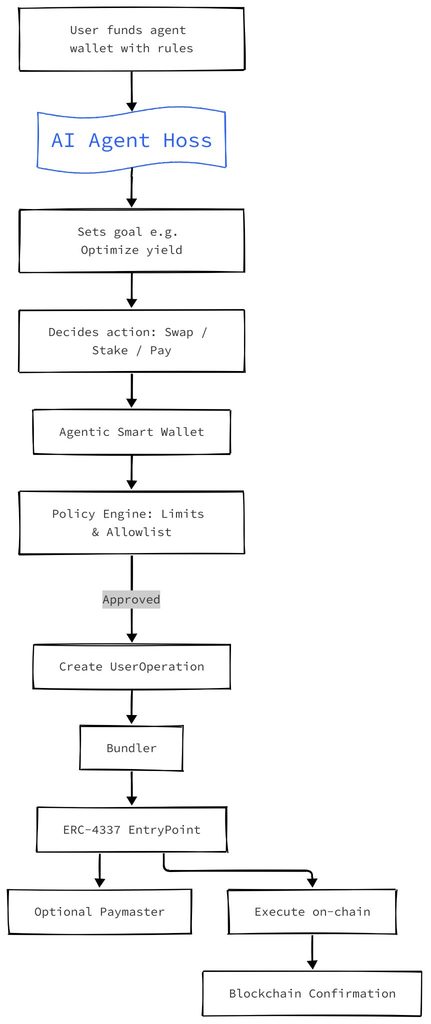
The agent reasons and decides, but the wallet enforces rules before signing.
High-Level Flow Diagram
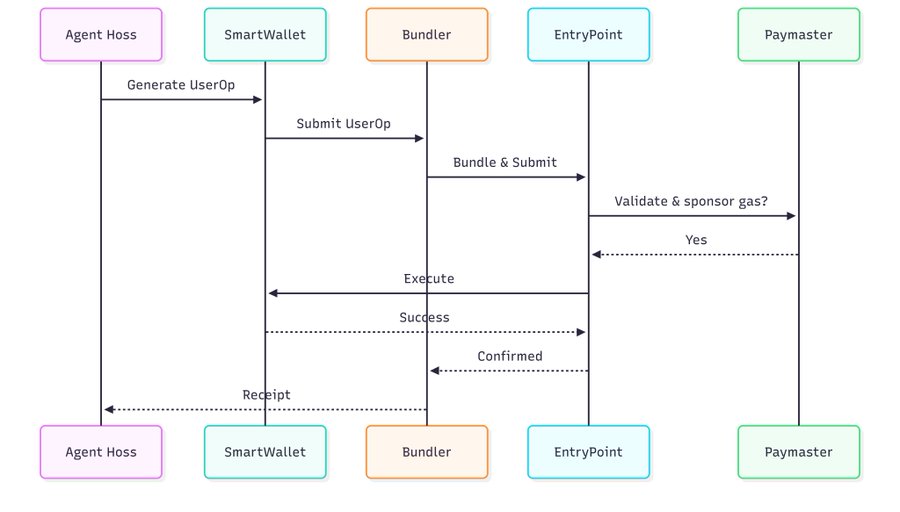
Transaction Sequence (ERC-4337 style):
The x402 standard (pioneered by Coinbase) lets agents pay for services the same way humans use credit cards. An agent requests data or an API, receives a payment request, sends USDC, and instantly gets access. This creates seamless agent-to-agent economies.
By the end of 2026, we’re seeing early agent-to-agent commerce. Agents pay for decentralized compute (Akash, Render), form temporary coalitions, generate revenue, and return profits to their creators or token holders.
Your personal AI could soon manage portfolios, book services, or run content businesses — all with its own funds under your defined policies.
For devs:
Start with Coinbase AgentKit, Eliza Framework, Virtuals SDK, or Privy/Turnkey for wallets.
For users:
Fund a new agent wallet with a small amount of USDC, set tight rules, and experiment.
In 2026, AI agents handling real money is no longer experimental — it’s live infrastructure. Thanks to account abstraction, smart policy engines, and protocols like x402, agents now function as true economic participants.
The risks are real, but the opportunity is enormous: faster innovation, new business models, and a 24/7 global economy powered by intelligence.
Will agent-managed capital surpass most retail trading volume by 2027? The infrastructure is already here.
Only time will tell…


Tokenization of RWA yields onchain might be the biggest opportunity that no one has noticed
Cold Wallet Safety 2026: Are Hardware Wallets Still Safe?
One Token, Multiple Products. Can Zylo Deliver?
The Rise of NEAR Protocol 2026: Inside the 530% Rally and the ETF
Tokenization of RWA yields onchain might be the biggest opportunity that no one has noticed
Cold Wallet Safety 2026: Are Hardware Wallets Still Safe?
One Token, Multiple Products. Can Zylo Deliver?
The Rise of NEAR Protocol 2026: Inside the 530% Rally and the ETF