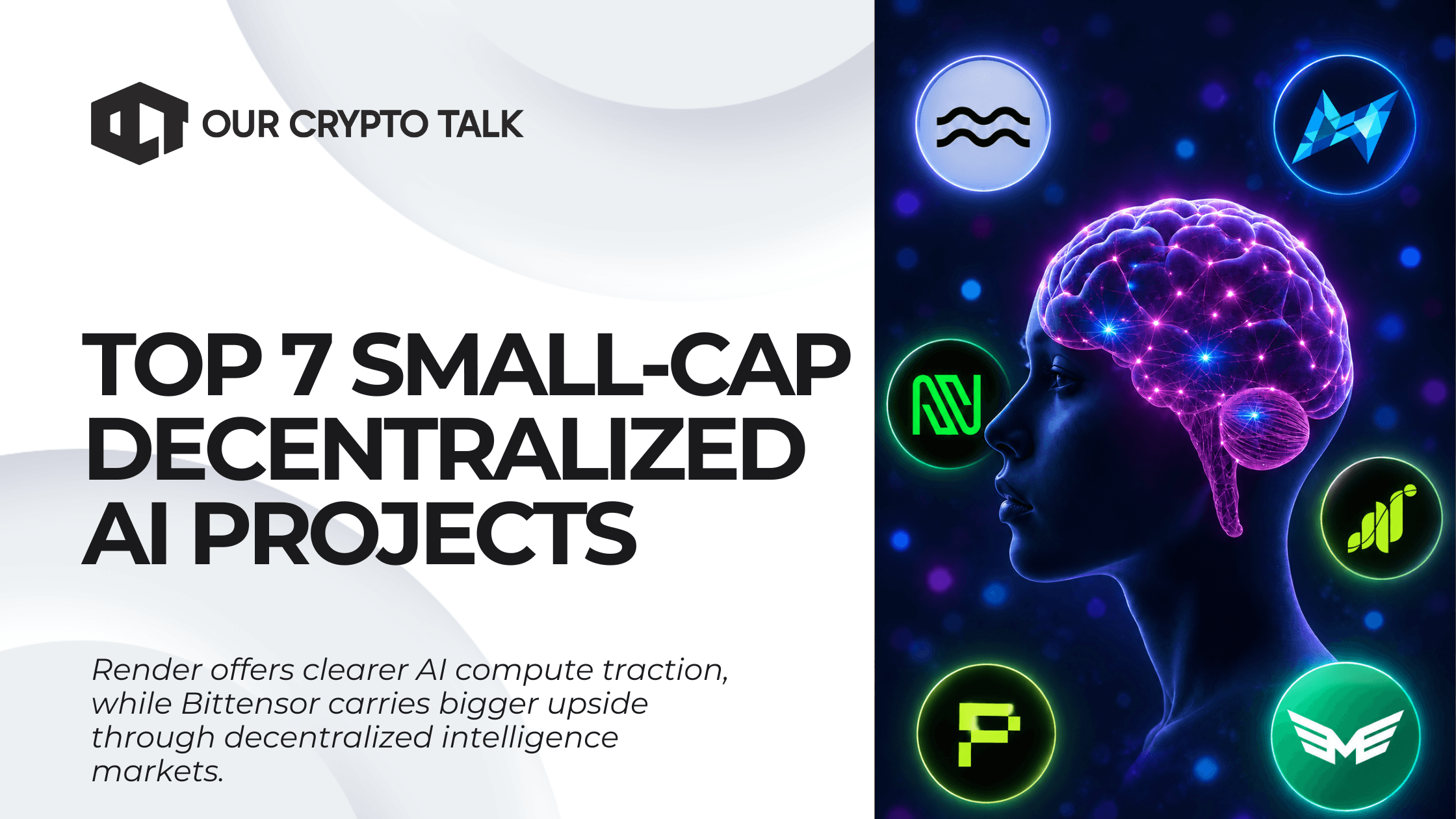
Discover 7 small-cap AI crypto projects under $100M market cap building GPU compute, private inference, and AI agents in 2026.

Author: Kritika Gupta
The AI crypto sector sits at roughly $22B in combined market cap (CoinGecko, September 2026). Bittensor, Render, FET, and NEAR own the headlines. Yet some of the most interesting innovation in decentralized AI is happening below $100M in market cap. There, small teams are building privacy layers, GPU marketplaces, and agent infrastructure that the large caps have not solved yet.
To start, demand for GPU compute still outpaces easy access to it. As AI workloads grow, decentralized marketplaces can tap idle consumer and edge hardware, provided they verify the work and pay operators reliably. At the same time, concerns about how centralized AI providers such as OpenAI and Google handle prompts and training data create demand for more private inference.
Small-cap AI infrastructure projects
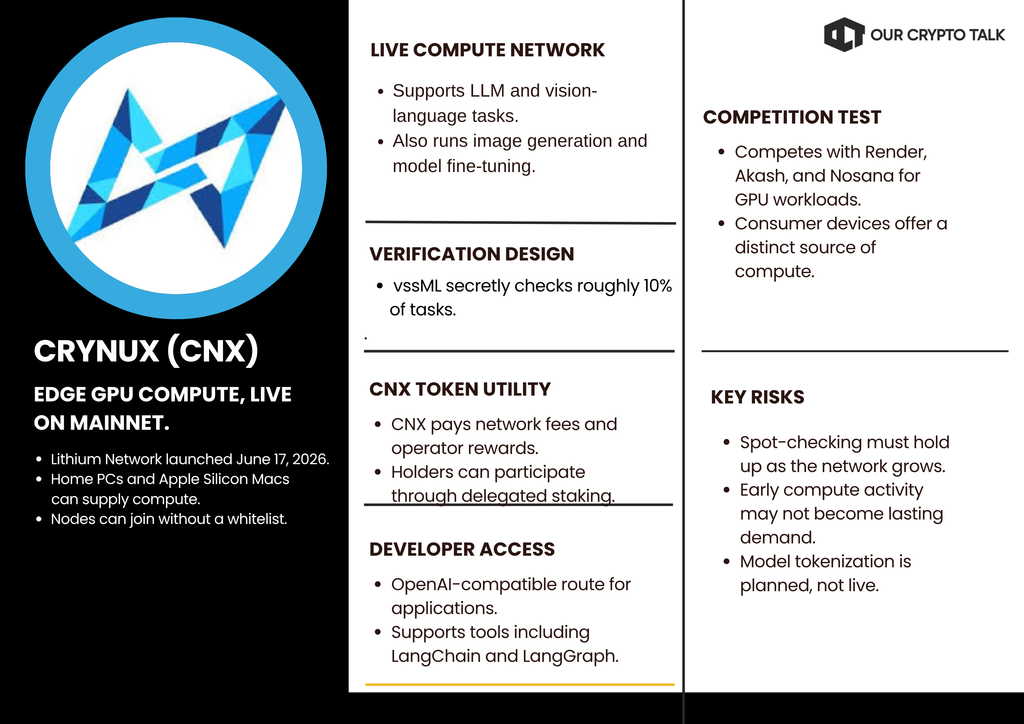
Crynux turns edge GPUs, including home PCs and Macs with Apple Silicon, into a shared resource for AI compute. Anyone can install its node app and start offering capacity without signing up or joining a whitelist. On June 17, 2026, Crynux launched Lithium Network as its mainnet, not another testnet. The network supports text generation with LLMs, vision-language models, image generation, and model fine-tuning.
Its vssML consensus design tackles a central problem for decentralized compute: how do you trust a GPU operator without sending every job to three machines? Crynux secretly spot-checks roughly 10% of tasks and can slash operators who cheat. Because nodes submit results before they know which jobs the protocol will check, the system aims to deter bad work without tripling the cost of every task. That design still needs to prove itself as workloads and operator numbers grow.
CNX handles network fees and operator rewards. Delegated staking also lets holders participate without running hardware. Meanwhile, Crynux plans to add model tokenization, which would represent models as onchain assets; that feature belongs to its roadmap rather than its current mainnet offering. Developers can connect through an OpenAI-compatible route and use tools such as LangChain, LangGraph, and other agent frameworks. The small team has continued to ship, and Our Crypto Talk covered its mainnet launch in June.
Crynux’s clearest strength is a live mainnet that already runs compute jobs. Its focus on consumer and edge devices also gives it a distinct supply strategy. However, it must turn early activity into lasting customer demand while competing with Render, Akash, and Nosana for GPU workloads. A functioning network gives Crynux a starting point, but adoption will determine whether that network can capture a meaningful share of the market.
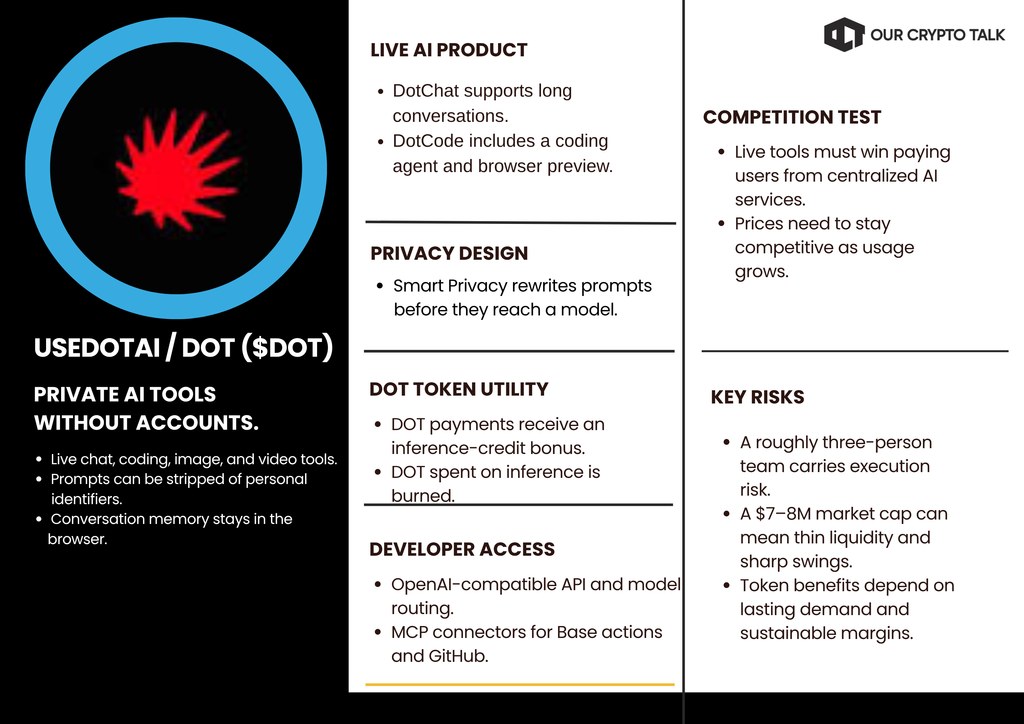
UseDotAi, or Dot, offers AI tools that users can access without creating an account. Its “Smart Privacy” feature rewrites prompts to remove identifiers such as names, wallet addresses, and locations before the prompts reach a model. The browser keeps conversation memory locally, while Dot says it does not retain user data. For payments, the platform uses Chaumian blind signatures to separate the funding wallet from subsequent usage. That cryptographic design makes it harder to link who funded credits to the prompts those credits pay for.
The product extends beyond a private chat box. DotChat supports text conversations with large context windows, while DotCode offers a coding agent with an in-browser preview. Dot also provides image and video generation, an OpenAI-compatible API, MCP connectors for Base onchain actions and GitHub, and orchestration tools. It routes requests across several models, including open-weight and some frontier-style options.
$DOT runs on Base at 0x23A2847d772803f9EFC64B4277b782b06296FE51. In late September 2026, its market cap sits around $7–8M, with roughly 831M tokens circulating from a 1B maximum supply. Users receive a bonus when they buy inference credits with DOT instead of USDC. Dot burns tokens that users spend on inference, and the team says platform revenue also funds buybacks and burns. However, readers should track how many paying users choose DOT, since USDC payments do not create the same direct token demand.
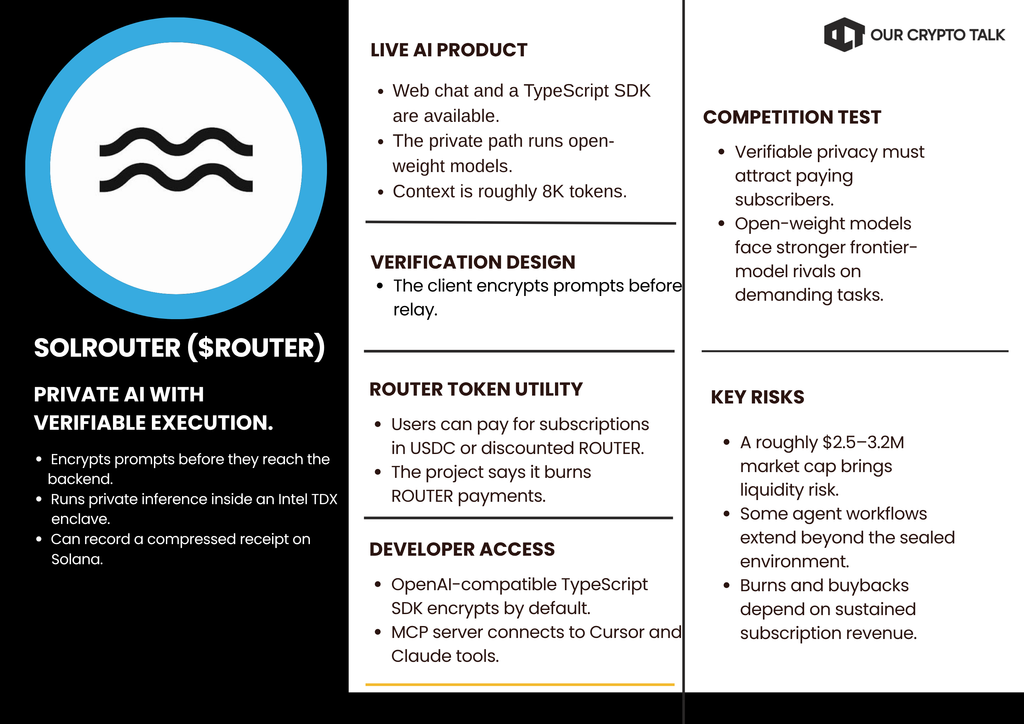
Solrouter provides private AI inference with a way to verify where a model handled a prompt. Its client encrypts prompts with X25519 and Arcium RescueCipher before the backend relays the ciphertext. An Intel TDX enclave powered by Phala then decrypts the prompt and runs inference. Under this design, the operator does not receive the plaintext. Each sealed call can also produce a compressed onchain receipt on Solana, giving users evidence that the attested environment handled the request.
Users can access Solrouter’s web chat, while developers can use an OpenAI-compatible TypeScript SDK that encrypts requests by default. Its MCP server connects to Cursor, Claude Desktop, and Claude Code. However, some agent connectors, including Notion and GitHub, do not keep the entire workflow sealed. Solrouter documents that distinction at docs.solrouter.com. The private path supports open-weight models such as GPT-OSS 20B, Qwen 3.8 27B, and Qwen3 Coder 30B, with roughly 8K context. It does not route private requests to OpenAI, Anthropic, or Google APIs.
Router Labs builds the product. Its Solana token, $ROUTER, trades at 6SjVTj1VGwFSXn7wEjwFm77LvACeTqB7sQUebYKX8Ds5. In late September 2026, its reported market cap sits around $2.5–3.2M, with approximately 703M tokens circulating from a 1B maximum supply. Users can buy monthly subscriptions in USDC or pay with ROUTER at a discount.
Solrouter’s strength lies in its hardware enclave design and onchain receipts: users can inspect evidence of sealed execution instead of relying only on a privacy promise. Still, a market cap near $3M brings substantial liquidity risk. Its roughly 8K context window also limits longer tasks, while its open-weight-only approach may struggle against frontier models on demanding work.
UseDotAi and Solrouter both target private AI, but they protect prompts in different ways. UseDotAi’s “Smart Privacy” removes names, wallet addresses, and other identifiers before it forwards a prompt to a model. Chaumian blind signatures also help separate credit funding from usage. Solrouter instead encrypts the prompt on the client and decrypts it inside an attested hardware enclave. Its Solana receipts can provide evidence that the enclave handled a sealed call. As a result, UseDotAi reduces the personal information a model provider receives, while Solrouter aims to keep plaintext away from the operator throughout its private inference path.
That architectural choice shapes what users can run. UseDotAi routes requests to open-weight models and some frontier-style options. Solrouter limits its private path to open-weight models and excludes proprietary APIs. Their chains and pricing differ too: UseDotAi runs on Base and sells usage credits, while Solrouter runs on Solana and offers monthly subscriptions. Therefore, users who prioritize model choice and a familiar workflow may prefer Dot, while those who need evidence of sealed execution may prefer Solrouter.
Both projects connect token burns to paid usage, describe revenue-funded buybacks and burns, cap their respective tokens at roughly 1B, and trade as micro-caps. However, those mechanisms depend on sustained paying demand. UseDotAi focuses on making AI privacy seamless, so users rarely need to think about it. Solrouter focuses on making AI privacy verifiable, so users can inspect evidence of how the service handled a sealed request.
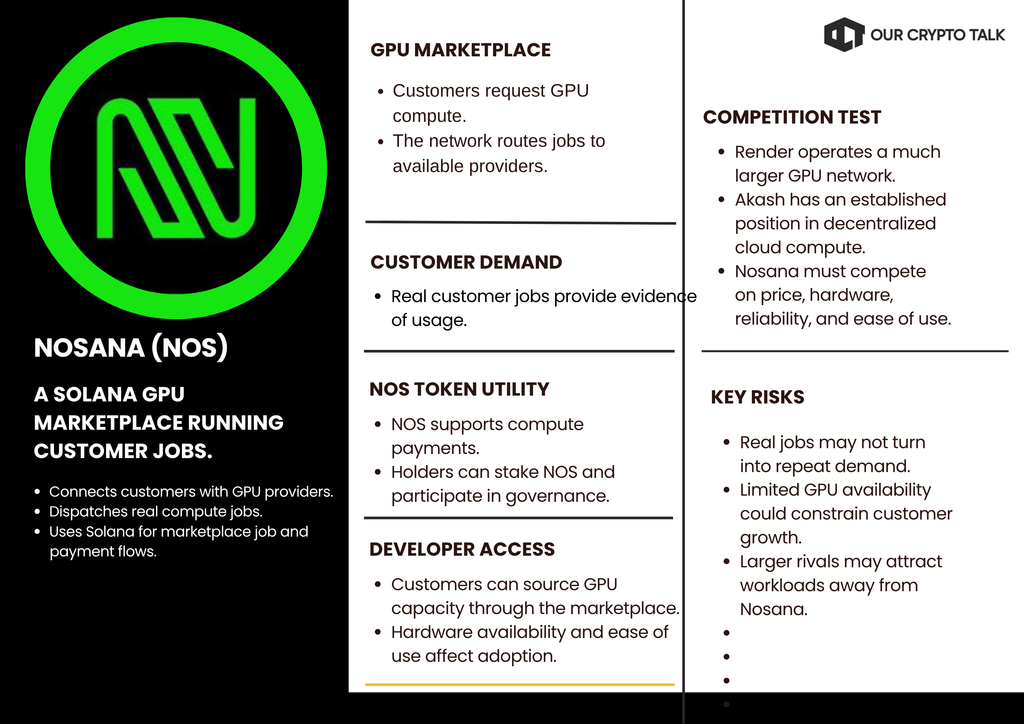
Nosana runs a decentralized GPU compute marketplace on Solana. It dispatches real GPU jobs for customers, giving readers more to assess than test workloads and incentive-driven activity. That customer demand makes Nosana one of the more practical small-cap DeAI projects. The network uses NOS for staking, governance, and compute payments, while its Solana base supports the marketplace’s job and payment flows.
Nosana’s strength lies in its working marketplace and evidence of real demand. However, it competes for GPU workloads against Render, a much larger network, and Akash, which already has a foothold in decentralized cloud compute. To keep winning customers, Nosana must prove that its pricing, available hardware, reliability, and developer experience justify choosing it over those alternatives. Real jobs establish a starting point; repeat demand will determine how much of the market it can capture.
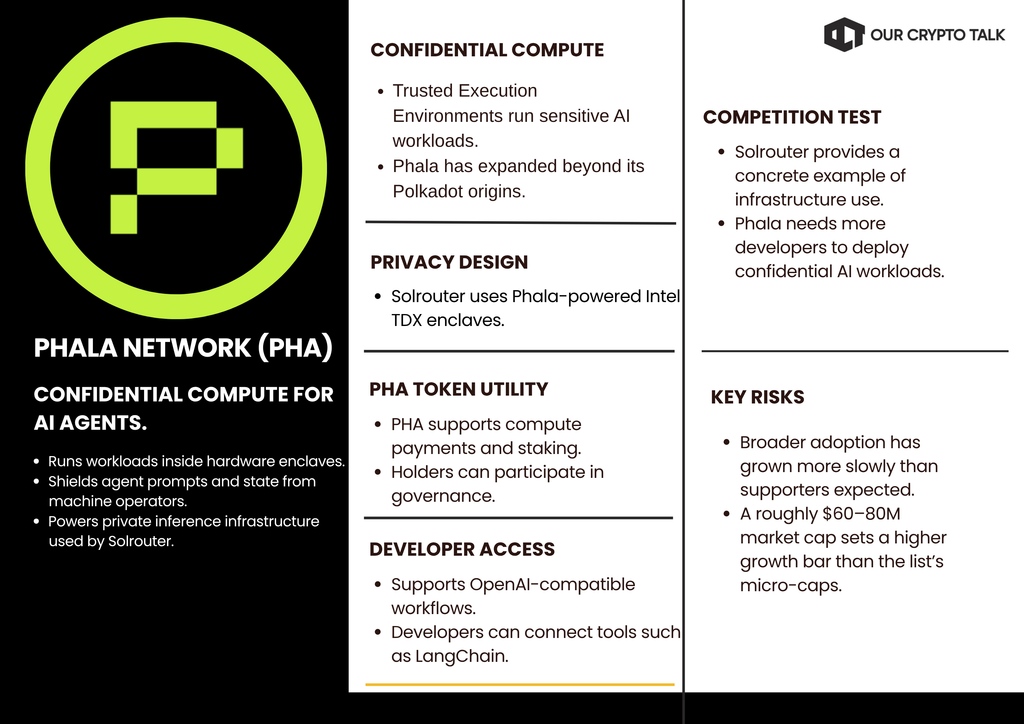
Phala Phala Network provides decentralized confidential compute through Trusted Execution Environments, or TEEs. These hardware enclaves let AI agents run while shielding their prompts and state from the machine operator. For developers, Phala supports workflows built around OpenAI-compatible APIs and LangChain.
Phala began as a Polkadot parachain and has since expanded across chains. It also supplies infrastructure to other DeAI projects: Solrouter uses Phala-powered Intel TDX enclaves for private inference. Within the network, PHA supports staking, governance, and compute payments.
Phala’s strengths include an established network and a clear role at the intersection of AI and privacy. Its position as infrastructure for projects such as Solrouter gives readers a concrete example of adoption. However, adoption across the broader market has progressed more slowly than supporters hoped. With a market cap of roughly $60–80M in the supplied figures, Phala is also larger than many of the micro-caps in this list. To justify further growth, it needs more developers to move confidential AI workloads onto its network and keep them there.
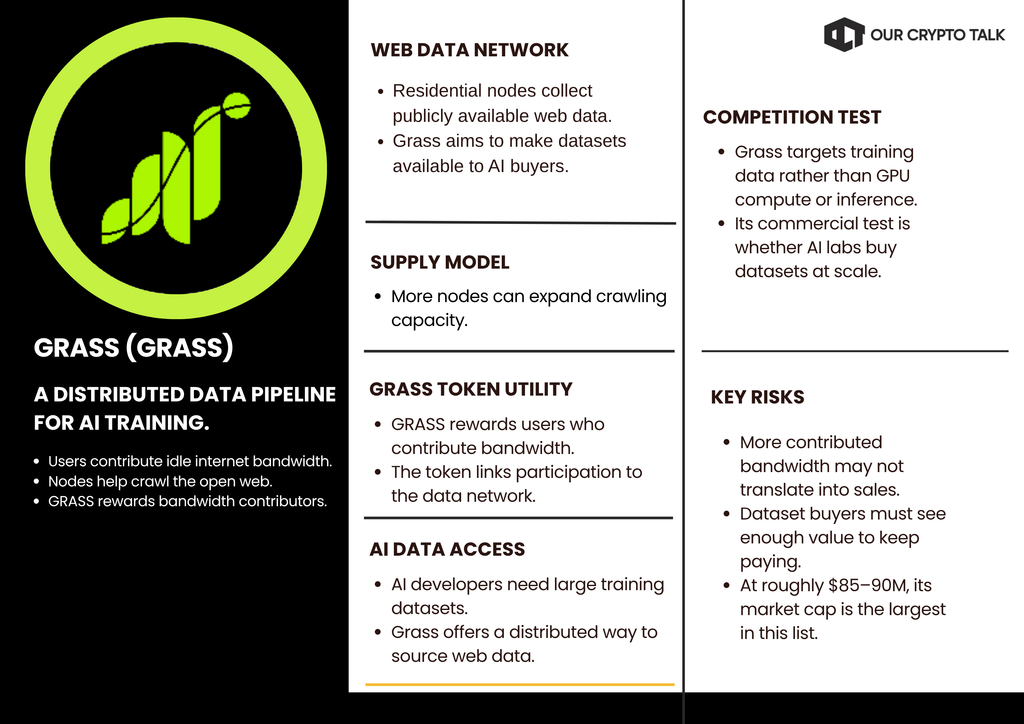
Grass turns idle internet bandwidth into a distributed source of web data for AI training. Users run nodes that help collect data from the open web and earn GRASS for contributing bandwidth.
Why does this matter? AI developers need large datasets, but major technology companies have historically had more resources to collect them at scale. Grass aims to make that data available to other buyers through a network of residential connections. It therefore addresses a different need from the GPU marketplaces and private inference services elsewhere on this list.
That distinct focus is Grass’s strength: it targets data collection, not compute or inference. The supplied market cap estimate of roughly $85–90M also makes it the largest project here and places it near the edge of the small-cap category. However, its commercial case depends on AI labs paying for crawled datasets at scale. Node growth and bandwidth contributions show supply, but sustained dataset sales would provide stronger evidence that Grass can turn that supply into lasting demand.
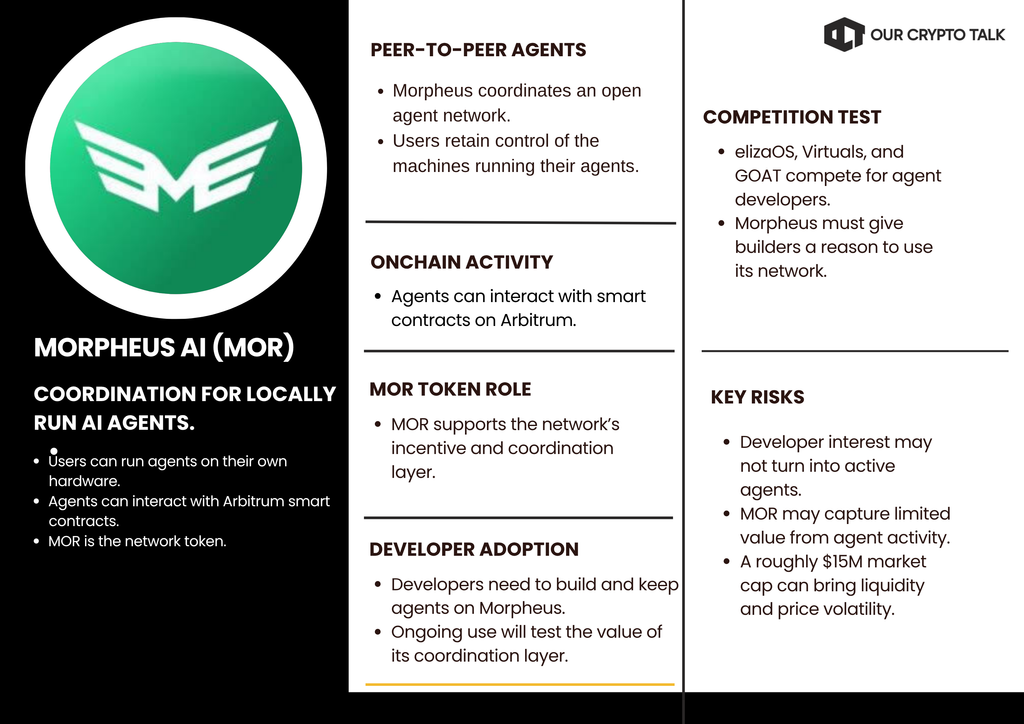
Morpheus coordinates an open network for AI agents that users can run on their own hardware. Those agents can interact with smart contracts on Arbitrum, while Morpheus supplies the incentives and coordination layer. Its thesis is direct: users should control the machines that run agents with access to their wallets and onchain activity. MOR is the network token. It reportedly gained 47% in one week in early 2025, but that move describes past trading, not its current momentum. In late September 2026, CoinGecko puts its market cap near $15M, well below the proposed $50–80M range. coingecko.com
Morpheus gives crypto investors a way to assess infrastructure for locally run agents as interest in AI agents grows. However, the category already has competing ecosystems and frameworks, including elizaOS, Virtuals, and GOAT. Morpheus must attract developers and keep their agents using its coordination layer. Otherwise, a popular agent framework could capture the users while leaving MOR with little role in day-to-day activity.
Liquidity risk comes first. At $3–8M market caps, pools and order books can run thin, and a $50K sell may move a token 10% or more if few buyers stand ready. Team risk compounds that exposure. Some projects rely on bootstrapped teams of only three people, so one departure or funding setback could stall development. Before trading, check pool depth, holder distribution, and whether a small number of wallets control supply.
Adoption creates a different test. A working product does not guarantee paying customers, and token holders can outnumber the people who actually buy compute or inference. Meanwhile, the decentralized small cap AI narrative can cool even if teams keep building. The metaverse and GameFi cycles show how quickly excitement can outrun adoption. Smart-contract risk adds another layer: small tokens on Base or Solana may lack rigorous audits, while bugs in payment, staking, or slashing systems can put funds at risk.
Small cap AI carries high risk and potentially high rewards. These teams are building infrastructure, but a useful product cannot protect a token from an 80% drawdown. Diversify, verify contracts through official project channels, assess liquidity and concentration, and do your own research before taking a position. This article does not provide financial advice.


Tokenization of RWA yields onchain might be the biggest opportunity that no one has noticed
Cold Wallet Safety 2026: Are Hardware Wallets Still Safe?
One Token, Multiple Products. Can Zylo Deliver?
The Rise of NEAR Protocol 2026: Inside the 530% Rally and the ETF
Tokenization of RWA yields onchain might be the biggest opportunity that no one has noticed
Cold Wallet Safety 2026: Are Hardware Wallets Still Safe?
One Token, Multiple Products. Can Zylo Deliver?
The Rise of NEAR Protocol 2026: Inside the 530% Rally and the ETF