Axis brings institutional yield onchain through USDx and sUSDx. Explore its yield model, tokenomics, traction, and risks.

Author: Akshat Thakur
Axis is an institutional quantitative trading firm bringing its market-neutral trading strategy onchain through synthetic dollars such as USDx and sUSDx. BTC and gold-linked products are also planned.
The firm says it has spent eight years running market-neutral, cross-venue arbitrage strategies. Its stated track record includes 36% annualized returns, a 4.9 Sharpe ratio and $400 million in peak AUM.
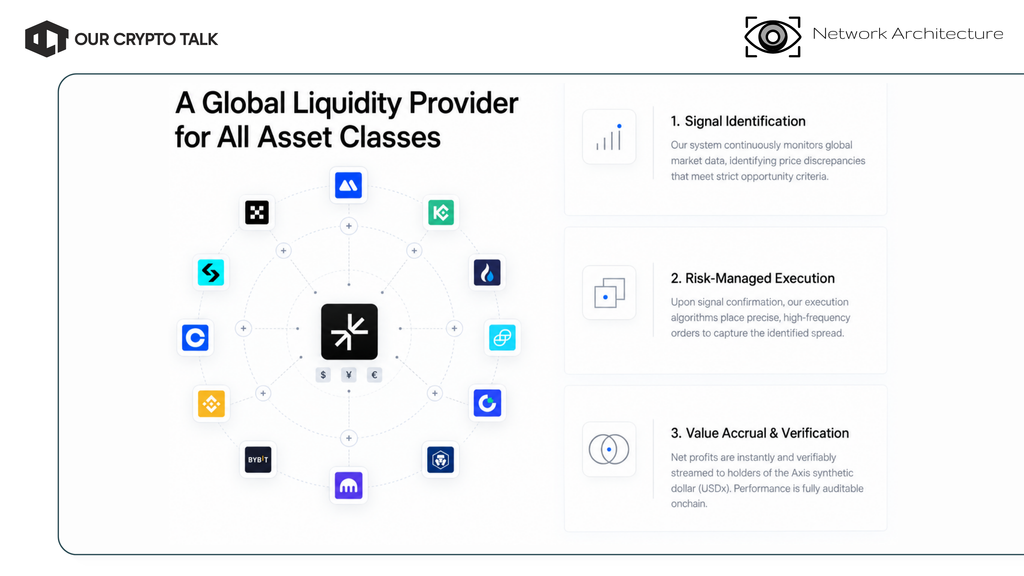
The core idea is to generate yield from trading spreads rather than token emissions. Axis takes its existing trading infrastructure and packages the strategy into onchain products, while publishing backing and performance data through its transparency dashboard.
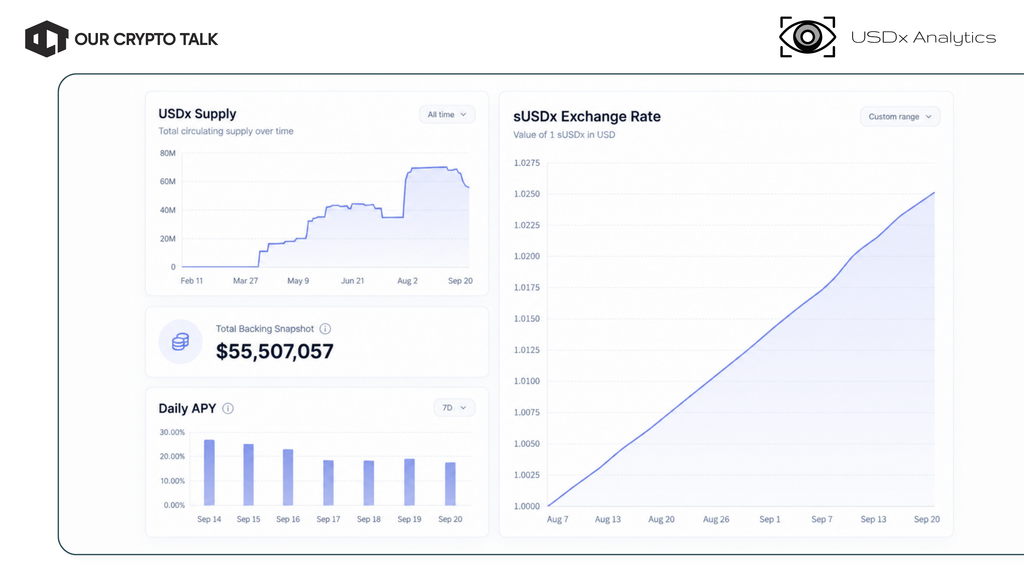
Recent figures showed roughly $55.5 million in total backing, with TVL around $55 million. Axis also reports more than $110 billion in lifetime trading volume across 14 venues. Reported net APYs have ranged from roughly 10% to 22%, depending on the product and measurement period.
The timing is important. Synthetic dollars and tokenized yield products have become major parts of the onchain market, while institutions increasingly demand transparency around reserves and performance.
Axis already has products in market. Its Origin Vault closed on August 5, 2026 with $67.25 million across 1,857 wallets. The 30-day lock expired on September 4, while Coordinates Season 1 is running and USDx is moving into DeFi liquidity.
That puts Axis beyond the fundraising and whitepaper stage.
The thesis is straightforward. Existing institutional trading infrastructure becomes public onchain inventory.
The challenge is proving that the strategy can maintain attractive returns while keeping backing fully collateralized and managing the additional liquidity demands that come with a public synthetic dollar.
Axis enters a market that already has established products across synthetic dollars, RWA yield and institutional DeFi.
Ethena remains a major crypto-native synthetic-dollar competitor through USDe and sUSDe. Sky, Ondo, Maple, Superstate and BlackRock’s BUIDL represent another side of the market, focusing on real-world assets and institutional yield products.
Axis also competes with delta-neutral vaults, basis strategies and hedge-fund-style onchain wrappers. Meanwhile, centralized exchanges and market makers already capture many of the spreads that Axis aims to monetize.
The differentiation comes from the operator rather than a novel financial primitive.
Axis says the same team and infrastructure that operated its institutional market-neutral book now supports its public synthetic-dollar products. The company combines cross-venue execution with published backing and performance data.
Its strategy also extends beyond yield. Axis Prime provides principal liquidity to counterparties, creating another potential use for the underlying trading operation.
That operational background is difficult to reproduce instantly. Venue relationships, execution infrastructure, risk limits and the ability to operate across fiat, stablecoin and crypto markets take time to build.
But the model itself is not unique.
Market-neutral arbitrage is increasingly competitive, and transparency dashboards can be added by other protocols. Axis’s historical 36% annualized return, 4.9 Sharpe and $400 million peak AUM also describe its prior trading operation. They do not guarantee future returns on USDx.
The important test is what happens after the initial capital cycle. Can Axis maintain attractive APYs once Origin capital is free to leave? Can it keep backing at or above 100% during periods of market stress?
The potential moat is operational. The financial mechanism is not.
Axis has a public multi-founder team with experience across quantitative trading, DeFi and institutional crypto markets.
Chris Kim is co-founder and CEO. He was the first employee at QCP Capital and worked on arbitrage and non-dollar stablecoin strategies before co-founding Alphanonce. Axis links his background to the firm’s claimed $400 million peak AUM.
Jimmy Xue is co-founder and COO. His background includes analytics work at Blackstone, co-founding Velodrome Finance and experience in MEV and searcher infrastructure. That gives the team exposure to both traditional financial analysis and onchain liquidity.
Changsung Kim is co-founder and CIO, with a background at Alphanonce and responsibility for the investment side of the strategy.
Justin Im is co-founder and CTO and previously served as Alphanonce’s CTO. He leads the technical infrastructure behind the products.
Ashwin Khosa is co-founder and CSO, with previous experience at Tether, Ondo and Maple. His background focuses more on distribution and crypto-native financial products.
Hyeonshik Ji leads operations and comes from Alphanonce’s financial operations function.
The team structure fits the product. Axis is effectively asking users to trust a trading operation with stablecoin deposits, so anonymous operators would create a significant credibility gap.
The lineage from QCP to Alphanonce to Axis provides a coherent operating history. More importantly, the firm claims eight years of market-neutral trading experience.
That history is the key signal.
The remaining question is whether the risk controls used in the private trading operation translate effectively into a public onchain product with different liquidity requirements and a much broader user base.

Axis has raised institutional capital from a group of crypto-native investors and market participants.
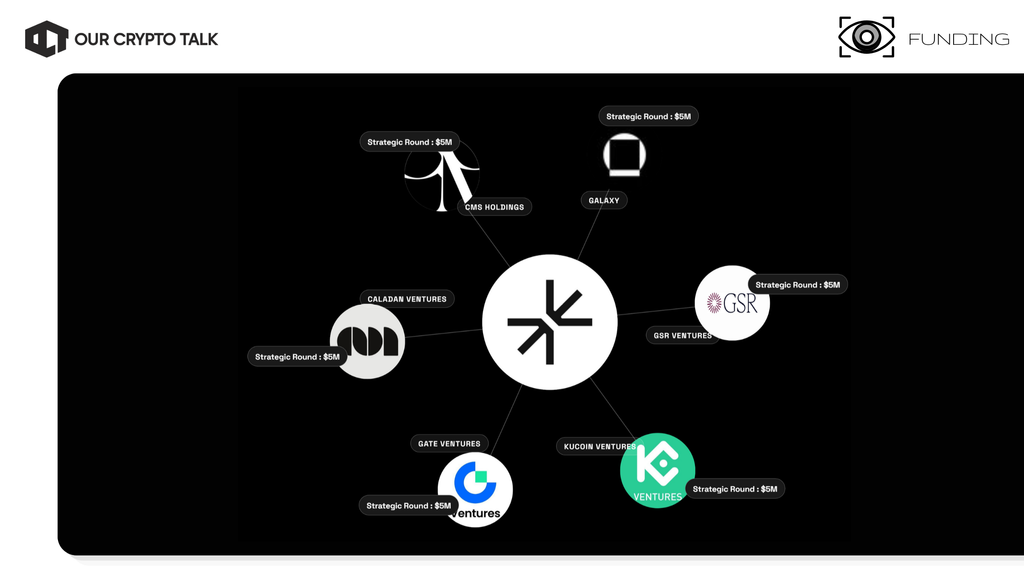
In December 2025, the company announced a $5 million private round led by Galaxy Ventures. OKX Ventures, CMT Digital, FalconX, GSR, Maven 11, CMS Holdings and Marc Zeller also participated. The round was described as oversubscribed, although the valuation was not disclosed.
Axis also said it had already deployed around $100 million of private LP capital during its closed-beta period to stress-test the trading engine.
In June 2026, Steakhouse Financial and Serotonin provided additional strategic backing. The amount was not disclosed.
The investor mix matters because several backers operate directly within crypto liquidity, market making and DeFi infrastructure. Galaxy, OKX Ventures, FalconX, GSR and the other participants provide a different signal from a project funded only by generalist venture capital.
Capital is also not the immediate survival question.
Axis already operates a trading business and has live stablecoin products. The Origin Vault reached $67.25 million before closing, while the transparency dashboard recently showed roughly $55.5 million in backing.
That gives the project an operating base beyond future token incentives.
The bigger question is scalability.
Axis needs to grow USDx and its related products without turning a market-neutral trading strategy into a yield product that relies heavily on points or subsidized growth.
The Coordinates program is therefore worth watching alongside actual capital flows. If public deposits grow because users want the underlying yield rather than because incentives temporarily inflate demand, the model becomes more durable.
For now, the funding picture shows that Axis has institutional support and enough capital to operate.
The next test is whether the public product can reproduce the economics of the private trading operation.
Axis is already live. Users can acquire USDx, stake it into sUSDx and track the protocol’s backing and performance through its public transparency dashboard.
USDx is a synthetic dollar minted against supported collateral through Axis’s primary-market flow. Users can also redeem through signed orders. The documentation makes an important distinction: USDx is not a regulated stablecoin. It is a dollar-denominated, over-collateralized token backed by a portfolio that is largely held across centralized venues alongside hedges.
sUSDx provides the yield-bearing layer. Users stake USDx into an ERC-4626/ERC-7540 vault and receive sUSDx. The exchange rate increases as the protocol funds and vests trading profits into the vault. Exits are asynchronous, with a seven-day cooldown before users can claim USDx.
The Origin Vault, operated through Upshift on Ethereum, closed its pre-deposit phase on August 5 with $67.25 million across 1,857 wallets. The 30-day lock ended on September 4. Its position was represented by ogUSDx.
The transparency layer is another important part of the product. Recent figures showed around $55.5 million in backing, a protocol backing ratio near 100.25% and roughly $55.4 million in USDx supply. Asset-location data shows that much of the backing sits on centralized exchanges.
Several pieces are still unfinished. BTCx and GOLDx are not yet live, Axis Prime is not fully available as a self-serve retail product, and there is no native governance token.
The trading engine also remains offchain. Users see the tokenized claim, vault mechanics and attestations rather than Axis’s underlying order book.
That creates a clear trust boundary.
The product is live and capital is already flowing through it. But users are ultimately relying on both the onchain contracts and the offchain trading operation behind them.
The strongest traction signals are capital deployed and returns funded, not social-media engagement.
The Origin Vault attracted $67.25 million in roughly a week, after reaching a $50 million fill in around 22 hours. A total of 1,857 wallets participated. That represents real stablecoin demand rather than a free token distribution.
Current transparency and product figures show roughly $55 million across different USDx-related TVL and backing measurements.
Axis claims more than $110 billion in lifetime trading volume across 14 venues. The underlying private operation reportedly reached $400 million in peak AUM and generated a historical 36% annualized return with a 4.9 Sharpe ratio.
Those figures describe the previous trading operation, not a guaranteed return for today’s USDx holders.
The Origin Vault generated roughly 11.58% annualized during its lock period according to the team. Later sUSDx figures reached around 21% APY over shorter windows. Those numbers should be viewed as path-dependent rather than fixed coupons.
Coordinates provides another demand signal. Season 0 rewarded the locked Origin cohort, while Season 1 began September 4 and runs for 90 days. The program uses capital-weighted points, with venue multipliers and referral bonuses.
But points introduce a qualification.
The $67 million Origin fill proves that users wanted the combination of yield and potential future rewards. It does not prove that the public trading book can maintain the private strategy’s historical Sharpe.
The important test is what happens after the lock expires and more capital moves into DeFi.
Axis needs to demonstrate that rewards remain funded by realized arbitrage profits and that backing stays at or above 100% when redemptions increase.
There is no live native AXIS governance token.
Axis currently operates through its financial products rather than a speculative governance asset. There is therefore no published FDV, circulating supply or token allocation schedule to analyze.
Coordinates are also not a token. They are explicitly non-transferable, have no monetary value and do not guarantee an allocation in any future token launch.
The instruments users can actually hold today are different.
USDx is the synthetic dollar itself and does not generate yield simply by being held. sUSDx is the rewards-bearing vault, where its exchange rate rises as the protocol funds and vests USDx rewards. ogUSDx represented positions in the Origin Vault during its lock period, while Coordinates function as loyalty points.
Recent snapshots showed roughly $55 million of USDx supply against approximately $55.5 million in backing, implying a backing ratio around 100.25%.
That means the relevant valuation framework is not a traditional token FDV. Users are gaining exposure to the residual performance of an institutional trading operation through a synthetic dollar and its yield-bearing vault.
The product is cleaner than a speculative pre-TGE token because the core asset is a live dollar vault.
It is also riskier than a simple T-bill wrapper because returns depend on continued arbitrage profitability and the operational integrity of an offchain trading book.
The Origin Vault’s early 2x window is closed. The current opportunity is Season 1 Coordinates combined with the live sUSDx yield mechanism.
Users can acquire USDx through the primary market where eligible, or through secondary liquidity where available. They can then stake USDx into sUSDx to access the variable rewards path.
The sUSDx exchange rate appreciates as rewards are funded and vested. Exiting is not instant. Users need to request redemption, wait through the seven-day cooldown and then complete the claim process.
Season 1 provides another route. Users can deploy USDx into eligible ecosystem venues, including the Ecosystem Vault, Curve, Pendle and other venues specified by Axis’s current multiplier rules. The program runs for 90 days from September 4, 2026.
The same dollar does not generate multiple overlapping allocations. Venue multipliers determine the applicable weighting.
Referrals can provide additional Coordinates based on invited depositors’ activity.
There is no confirmed TGE date, no public governance-token sale and no node program. Any third-party guide presenting specific future AXIS conversion ratios is therefore speculative until the project publishes official rules.
The economics also need to be framed correctly.
Coordinates require real capital and carry an opportunity cost against alternatives such as USDC or other yield-bearing stablecoins. The points only add value if a future token allocation becomes meaningful.
Season 0 participants had access to the more exclusive 2x and 1.75x boosts through locked Origin deposits. Season 1 is broader and therefore less exclusive.
This is not a free quest campaign.
It is capital-at-risk loyalty points layered on top of a live quantitative trading product.
The primary return should therefore be the actual sUSDx yield. Coordinates should be treated as additional optional value until Axis publishes concrete tokenomics.
There is no free points grind and no live governance-token FDV to speculate on. The real economic question is whether locking stablecoin capital into Axis offers enough yield to justify the strategy and smart-contract risks.
Coordinates only accrue on deposited capital. The cost is therefore opportunity cost rather than time spent farming. Season 0’s 2x window is closed. Season 1 began September 4, 2026 and runs for 90 days, with base accrual and venue multipliers.
Without published Coordinates-to-token conversion rules, the expected value of the points remains unknown. Coordinates should be treated as an optional upside on top of the underlying yield, not the primary return.
There is also no public AXIS token to buy at a disclosed FDV. The current economic entry is through the USDx and sUSDx products.
Recent figures showed around $55.5 million in backing against roughly $55.4 million of USDx supply. The Origin Vault previously reached $67.25 million. Reported APYs have ranged roughly from 10% to 22%, depending on the product and measurement period. These are variable returns, not fixed coupons.
Compared with Ethena, Maple and Treasury-backed products such as BUIDL and USDY, Axis is much smaller and more operator-dependent. Its higher headline yield comes with additional trading and execution risk.
The expected-value case is therefore conditional.
Axis makes more sense for someone already seeking delta-neutral yield and comfortable with an offchain trading book. It makes less sense as a pure airdrop strategy.
The key requirements are continued realized arbitrage profits flowing into sUSDx, backing remaining at or above 100% and functioning redemption paths. The seven-day sUSDx cooldown also needs to be considered before depositing.
Season 0’s early advantage is gone. New deposits should be evaluated on current yield and current risk, not on the assumption that the same incentives remain available.
Axis faces the same core risks as other synthetic-dollar and institutional-yield products: strategy compression, trust failures, regulation and redemption stress.
Ethena already has scale in crypto-native synthetic dollars, while Ondo, BlackRock’s BUIDL, Sky and Maple occupy the broader real-yield market. If cross-venue spreads and funding opportunities compress, Axis’s trading edge can shrink toward ordinary arbitrage.
The narrative also depends on attractive funded yields. The pitch is that returns come from real market activity rather than emissions. If APYs fall toward low single digits or backing weakens, that narrative becomes much harder to defend.
Capital concentration creates another risk. Coordinates are capital-weighted, so the bigger issue is mercenary TVL. Investors who deposited for Season 1 incentives could leave quickly if the expected rewards no longer justify the opportunity cost.
Regulation is a major structural risk. Axis explicitly describes USDx as a synthetic dollar rather than a regulated stablecoin. Much of the backing sits on centralized exchanges and trading venues, while users hold a tokenized claim.
That creates questions around the yield-bearing sUSDx product, stablecoin and payment rules, custody, attestations and the legal counterparty responsible for redemption. A regulatory crackdown on synthetic dollars or unregistered yield products could affect the entire model.
There is also a separation between trading performance and rewards actually funded into sUSDx. Axis’s historical 36% annualized return, 4.9 Sharpe and $400 million peak AUM belong to its previous trading operation. They do not automatically transfer to public vault holders.
Axis already has a live product and the Origin Vault has completed its initial lock period. The next catalysts are therefore about capital retention, yield and the future of Coordinates.
Season 1 Coordinates began on September 4, 2026 and runs for roughly 90 days. Its progress will show where USDx is being deployed and whether the ecosystem can maintain meaningful capital after the more exclusive Season 0 incentives ended.
Ongoing performance reporting is another key catalyst. Consistent funded APYs above 10% alongside backing at or above 100% would provide stronger evidence that the strategy can support public capital.
A Coordinates-to-token announcement would be another major event. There is currently no confirmed conversion framework, allocation or TGE date. Until Axis publishes those rules, the points should not be valued as though a token launch is imminent.
BTCx and GOLDx could also expand the product beyond synthetic dollars. Greater Axis Prime activity could provide another source of institutional demand.
The most important checkpoint is the end of Season 1, around early December 2026.
By then, the key questions should be clearer: Did TVL hold after incentives? Did funded APY remain competitive? Did Axis publish a concrete token plan?
For users who already want delta-neutral yield, the live product can be evaluated today based on current APY and risk.
For users primarily interested in a potential Coordinates airdrop, waiting provides more information.
The next three months should reveal whether Axis is building a durable yield product or simply benefiting from an attractive initial incentive cycle.
WATCH
Axis is one of the more credible attempts to move an institutional market-neutral trading operation onchain.
The operator history is coherent, with the QCP and Alphanonce lineage. The project has a $5 million Galaxy-led funding round alongside backing from other institutional and DeFi investors. Its Origin Vault attracted $67.25 million, while USDx and sUSDx are already live with public backing data.
That makes Axis a real product rather than a roadmap.
The main uncertainty is not whether the system works. It is whether the public product can maintain attractive, realized yield after capital becomes fully mobile.
Coordinates should not be treated as the main investment thesis. There is no published conversion framework, and the Season 0 advantage is already gone.
The key milestone is sustained, independently checkable sUSDx reward funding after Origin capital is fully mobile, alongside backing remaining at or above 100%.
A published Coordinates-to-token framework with clear allocation and vesting would also materially reduce uncertainty.
The opposite signal would be a sustained break in backing or redemption availability.
Until then, Axis is worth watching and can be evaluated as a sized yield position by users who understand the offchain trading and redemption risks.
But there is no reason to underwrite a hypothetical AXIS FDV that does not yet exist.
All the opinions in this article are that of the author and in no way are financial advice. Our Crypto Talk and the author always suggest you do your own research in crypto and to never take anything as financial advice that you read on the internet. Check our Terms and conditions for more info.


Web3 Gaming Comeback 2026: GTA 6 Hype vs 99% Crashes
Layer 2 Projects Shutting Down: Who’s Next After Blast?
Embodied Data Pyramid and Decentralized Data Layer for Robotics
DeFi Needs Better Liquidity. Can Ramses Deliver?
Web3 Gaming Comeback 2026: GTA 6 Hype vs 99% Crashes
Layer 2 Projects Shutting Down: Who’s Next After Blast?
Embodied Data Pyramid and Decentralized Data Layer for Robotics
DeFi Needs Better Liquidity. Can Ramses Deliver?