Is the web3 gaming comeback real? SAND jumped 80% and GTA 6 looms, but every major gaming token still sits 90-99% below its ATH. Here's what history says.

Author: Kritika Gupta
Gaming tokens are rallying again, but does that signal a web3 gaming comeback? SAND and GALA have posted sharp gains as new products and GTA 6 hype draw attention back to the sector. However, previous rallies faded when speculation outpaced player demand. This time, the real test is whether developers can turn that attention into lasting adoption.
SAND surged 80% on October 3 after exchanges lifted trading warnings and The Sandbox announced its Studio Engine public launch. Meanwhile, GALA gained 22% in 30 days following a tokenomics overhaul and a China partnership. Together, these moves suggest that the broader GameFi sector is showing signs of life for the first time since the 2024 mini bull.
However, every gaming token in this list still trades 90–99.7% below its all-time high. An 80% rally from $0.036 to $0.065 does little to close the gap with SAND’s $8.44 peak. These gains reward traders who catch the rebound, but they do not establish a lasting recovery.
Therefore, the question is whether this cycle brings stronger fundamentals. Gaming tokens have rallied before as traders chased narratives and liquidity. This time, the sector needs sustained player growth, games that retain users without rewards, and activity that creates lasting token demand.
Gaming tokens: seven-day performance and ATH drawdowns
GTA 6 launches on November 19, 2026, following the opening of pre-orders on June 25. The anticipation has also reached crypto markets. GTA-themed meme coins surged around gameplay leaks, with CYBERLEEK reportedly gaining 5,000%. These moves reflect speculative interest in the game’s popularity rather than any connection to Rockstar.
Meanwhile, ENJ, SAND, and MANA recorded trading-volume spikes around GTA 6 news cycles. Take-Two, Rockstar’s parent company, also climbed 1.2% in pre-market trading amid launch excitement. However, overlapping headlines and market moves do not establish that GTA 6 drove every gain.
Crucially, Rockstar has not confirmed any crypto integration and has remained silent on tokens, NFTs, and on-chain assets. GTA Online’s reported audience of more than 400 million users also illustrates how successful games can attract enormous communities without blockchain. A large gaming audience does not automatically create demand for Web3 products.
Nevertheless, GTA 6 can bring indirect attention to the sector. It puts gaming back into the global conversation, and traders have historically bought gaming-labelled tokens during periods of heightened interest. That attention may support short-term rallies, but Web3 developers still need to turn it into sustained player activity and token demand.
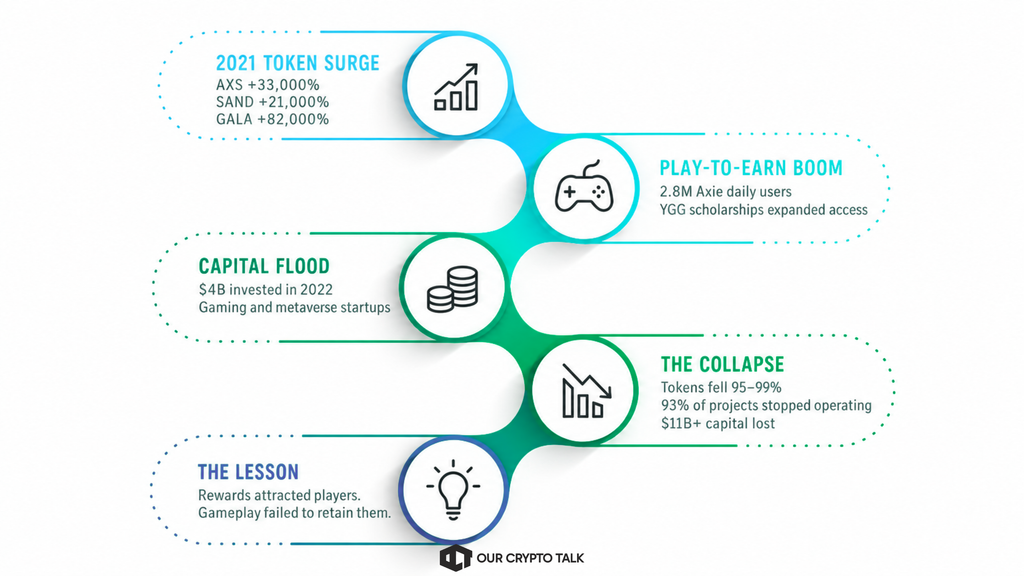
During the 2021 bull run, AXS climbed from roughly $0.50 to $165, a gain of about 33,000%. Meanwhile, SAND rose from $0.04 to $8.44, roughly 21,000%, and GALA jumped from $0.001 to $0.82, approximately 82,000%. Axie Infinity reached around 2.8 million daily active users, while Yield Guild Games scholarships helped players access the game and share token rewards. That momentum carried into 2022, when venture investors poured roughly $4 billion into gaming and metaverse startups.
However, the growth model struggled once token prices fell and new capital stopped flowing. Lower rewards pushed players away, weakening demand further. Gaming tokens subsequently lost 95–99% of their value. Later sector reviews estimated that 93% of gaming projects had effectively stopped operating and that capital losses exceeded $11 billion.
The lesson centres on what drove participation. Play-to-earn attracted users and capital, but many games failed to retain players without financial incentives. Consequently, when the earning narrative faded, underlying gameplay demand could not support token prices. For crypto readers, the key distinction remains whether people play because they enjoy the game or because they expect a payout.
November 2024 brought another sharp gaming-token rally. SAND gained 243% in one month, GALA jumped 21.8% in 24 hours, and MANA posted gains of 25–50% during the broader move. However, the rally reflected a rotation into speculative altcoins more than gaming-specific progress. Bitcoin ETF approval earlier that year had helped broaden institutional access and supported the market’s appetite for risk.
Meanwhile, airdrop farming temporarily increased total value locked on gaming chains as users chased points and potential rewards. That activity did not demonstrate lasting demand for the games themselves. Without stronger player retention or new gaming fundamentals, tokens surrendered most of their gains within two to three months.
The lesson is straightforward: macro rotation can lift gaming tokens temporarily, but liquidity alone cannot sustain a recovery. Developers need to attract real players and keep them engaged after incentives decline. Otherwise, rising prices and temporary TVL growth can disguise the same weak demand that undermined the previous cycle.
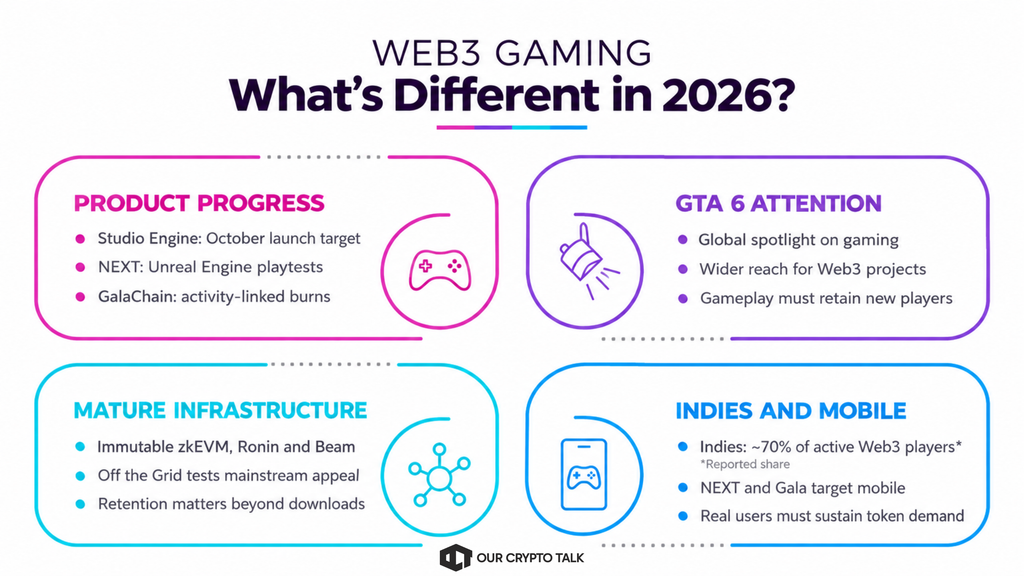
The 2026 bull case starts with tangible product progress. The Sandbox’s Studio Engine targets an October public launch, while its NEXT mobile game uses Unreal Engine and has entered playtesting. Meanwhile, GalaChain’s tokenomics overhaul introduces burn mechanics that link network activity to token supply. These developments give users tools and games to test, although the teams still need to demonstrate sustained adoption.
Alongside those releases, GTA 6 could bring global attention back to gaming. That creates an opportunity for Web3 projects to reach a wider audience, even without a Rockstar partnership. However, attention only opens the door. Developers still need compelling gameplay to turn curious visitors into returning players.
Infrastructure has also matured. Immutable zkEVM, Ronin, and Beam now operate as gaming-focused networks, giving developers more established rails for assets and transactions. Meanwhile, Off the Grid offers a practical test of whether a high-budget game can attract mainstream players while keeping its Web3 features in the background. Downloads provide an initial signal, but retention will determine whether that approach works over time.
Finally, independent games reportedly account for around 70% of active Web3 players, suggesting that smaller teams can compete through focused gameplay and lower operating costs. The Sandbox’s NEXT and Gala’s mobile push also target devices that gamers already use. Together, these shifts strengthen the product backdrop for 2026, but player retention and sustainable token demand must still validate the bull case.
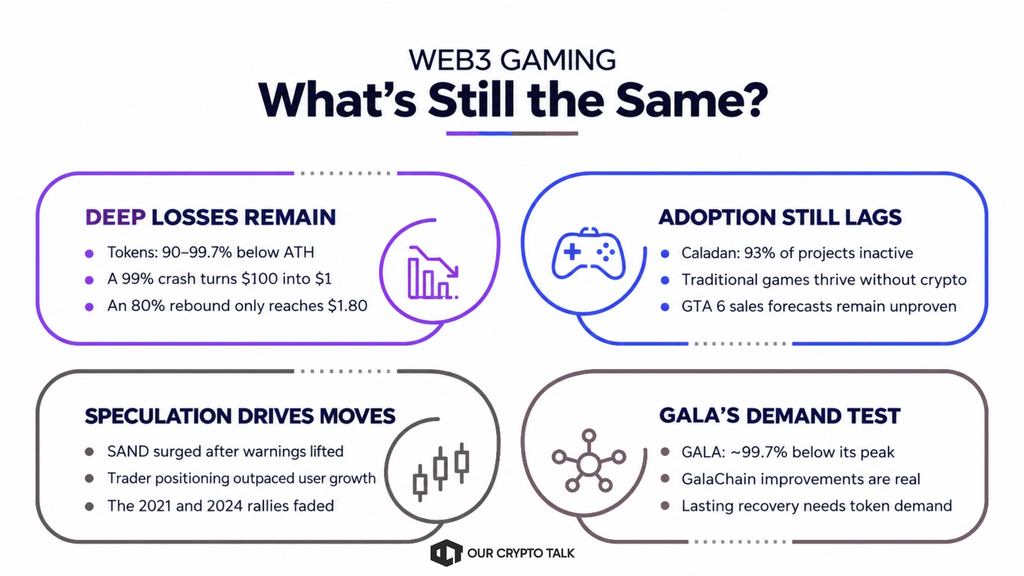
The bear case starts with the scale of the losses. Gaming tokens in this group still trade 90–99.7% below their all-time highs. An 80% rally cannot reverse a 99% crash: a token that falls from $100 to $1 only reaches $1.80 after that rebound. Consequently, sharp percentage gains can create excitement while leaving long-term holders deep underwater.
Meanwhile, Caladan’s report estimated that 93% of gaming projects had effectively stopped operating. Recent rallies do not change that finding or demonstrate a sector-wide recovery. Traditional gaming also continues to attract players without blockchain. If GTA 6 eventually exceeds 100 million sales, it would reinforce that point, although those sales remain a projection.
Speculation still drives the recent token moves more clearly than usage. Exchanges lifting trading warnings and traders adjusting positions drove SAND’s 80% surge, rather than comparable growth in Sandbox users. Similarly, the 2021 and 2024 rallies attracted capital before the sector established durable player demand. Both eventually faded.
Finally, GALA’s roughly 99.7% decline from its peak provides context for GalaChain’s progress. Tokenomics changes and working integrations can improve the network, but they have yet to support a lasting token-price recovery. Until activity creates sustained demand for GALA, product improvements alone cannot establish the investment case.
Mobile offers Web3 gaming its clearest route toward mass adoption. The Sandbox’s NEXT, Gala’s mobile push, and casual games target devices that players already use. Meanwhile, console and PC storefront restrictions complicate blockchain distribution. Mobile still brings platform rules and payment constraints, but it gives developers a broad audience to test whether their games can retain players beyond existing token holders.
Developers also stand a stronger chance when they keep blockchain in the background. Off the Grid’s marketing prioritises gameplay rather than its underlying network. That approach lets players judge the experience before engaging with wallets or tokenized assets. Ultimately, enjoyable games must sustain participation after token rewards decline.
GTA 6 presents two possible outcomes. If Rockstar integrates crypto, an unlikely and unconfirmed scenario, it could introduce tokenized assets to an enormous audience and create a major Web3 gaming catalyst. However, if the game succeeds without crypto, it will reinforce that great games do not require blockchain. Web3 developers would then need to compete through distinctive mechanics, useful asset ownership, and gameplay that meets mainstream expectations.
Finally, consolidation could leave the surviving teams with more focused products, including Sandbox Studio, GalaChain, and Immutable zkEVM. However, survival alone does not prove success. GTA 6’s scheduled November 19 launch could attract speculative buying into gaming tokens, but sustained gains will require more than attention. Sandbox Studio, Gala’s mobile releases, and other products must attract returning users and create lasting token demand.
This is analysis, not financial advice.


Web3 Gaming Comeback 2026: GTA 6 Hype vs 99% Crashes
Layer 2 Projects Shutting Down: Who’s Next After Blast?
Embodied Data Pyramid and Decentralized Data Layer for Robotics
DeFi Needs Better Liquidity. Can Ramses Deliver?
Web3 Gaming Comeback 2026: GTA 6 Hype vs 99% Crashes
Layer 2 Projects Shutting Down: Who’s Next After Blast?
Embodied Data Pyramid and Decentralized Data Layer for Robotics
DeFi Needs Better Liquidity. Can Ramses Deliver?