Embodied Data powers Physical AI by connecting robots to real-world actions, simulations, human video, and multimodal training data.
Embodied Data is essential for Physical AI and robotics, helping machines understand the physical world and perform real-world actions.
They remain powerful reasoning engines, yet they are fundamentally disconnected from the physical world. They cannot see, cannot predict how objects move under force, and cannot issue motor commands that a robot can execute.
Robotics and embodied AI therefore require specialized architectures that close the loop between perception, dynamics understanding, and action.
Today, the robotics data layer advanced significantly. The most prominent developments include Vision-Language-Action (VLA) models, World Models, World Action Models (WAMs), State-Space Models (SSMs), and modern diffusion/flow-matching generators.
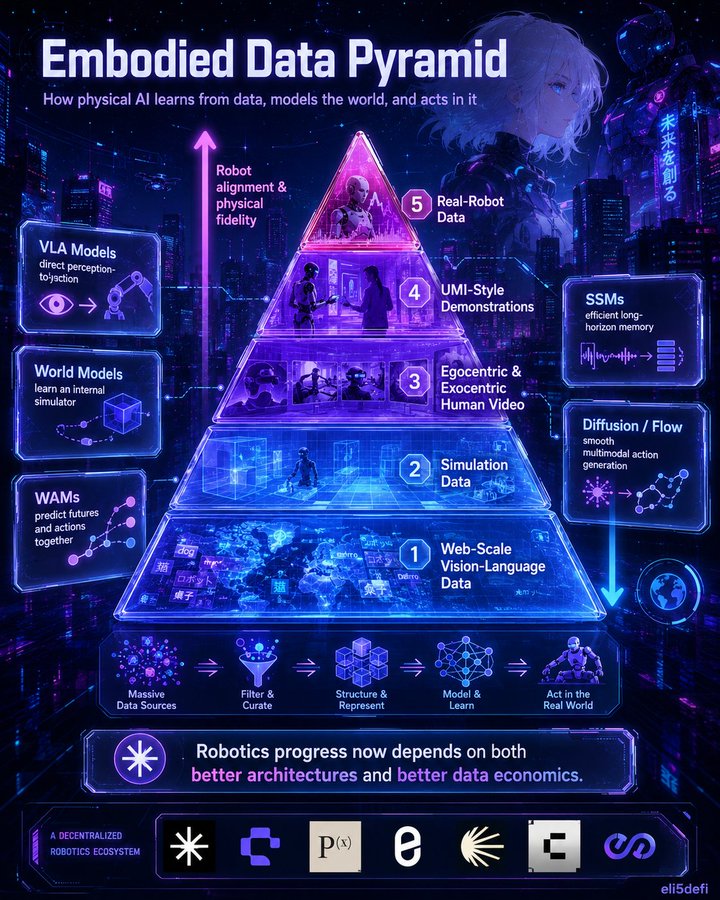
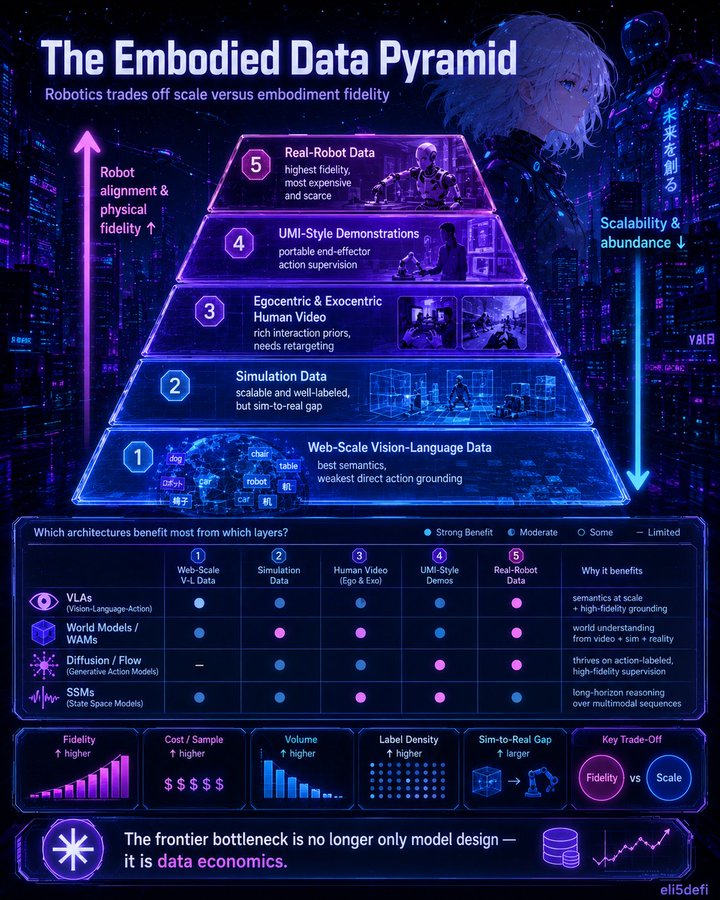
These methods sit on top of a structured data ecosystem now commonly described as the Embodied Data Pyramid. Together they form the practical intelligence layer for Physical AI.
This article provides a detailed, comparative explanation of each major approach, their strengths and limitations, how they relate to one another, and how they consume different layers of robotic data.
Definition A Vision-Language-Action model maps multimodal inputs, primarily camera images and natural-language instructions, often supplemented by proprioception, directly to robot actions.
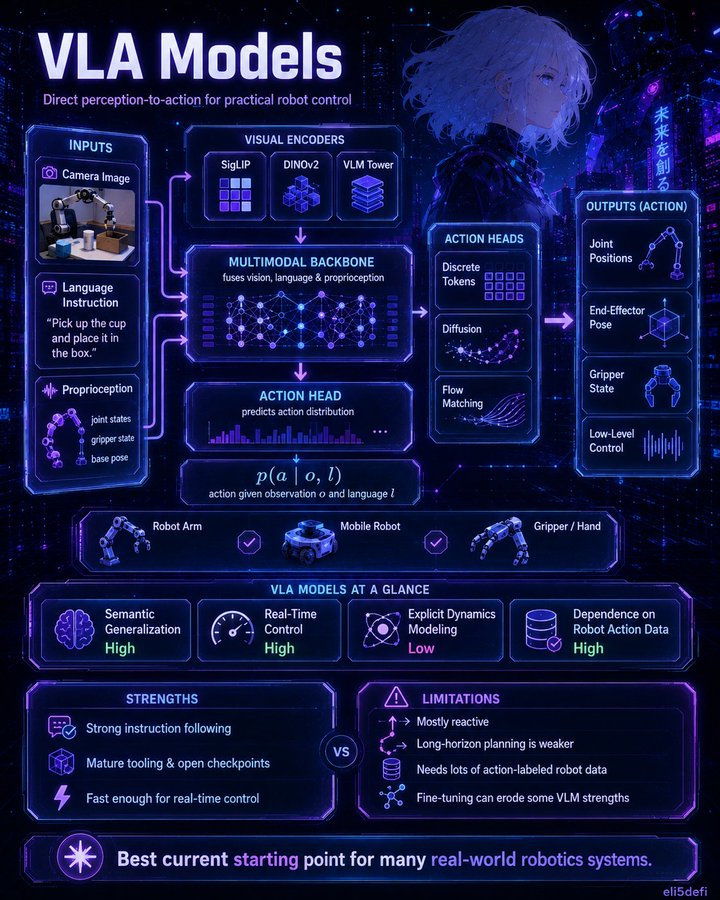
Architecture Most modern VLAs follow a common pattern:
Strengths
Limitations
VLAs remain the most widely deployed and practical starting point for many real-world systems today.
Core idea A world model learns an internal simulator of the environment. Given the current observation (and optionally an action), it predicts future observations or latent states. It answers the question “what will the world look like if I do X?”
The classic formulation (Ha & Schmidhuber, later refined in Dreamer, PlaNet, and RSSM) consists of:
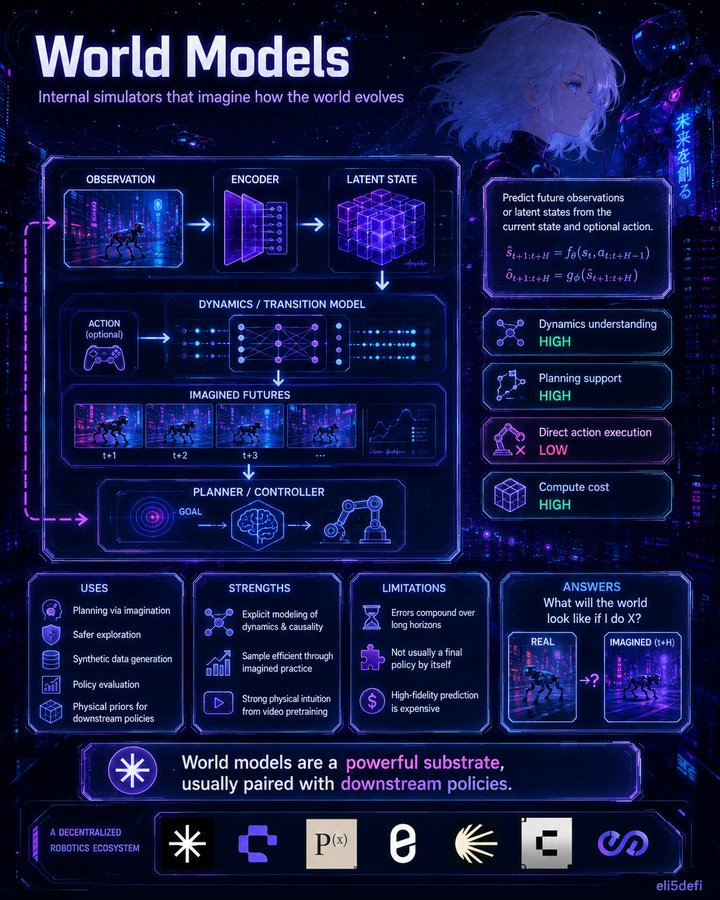
Role in robotics World models support planning via imagination, safer exploration, synthetic data generation, policy evaluation, and the injection of physical priors into downstream policies. They are rarely used alone as the final policy; instead they serve as a powerful substrate.
Strengths
Limitations
Definition and distinction
World Action Models predict future outcomes and actions together, aiming to model p(o′,a∣o,l) so the future prediction stays aligned with the action plan.
Three common design patterns have emerged:
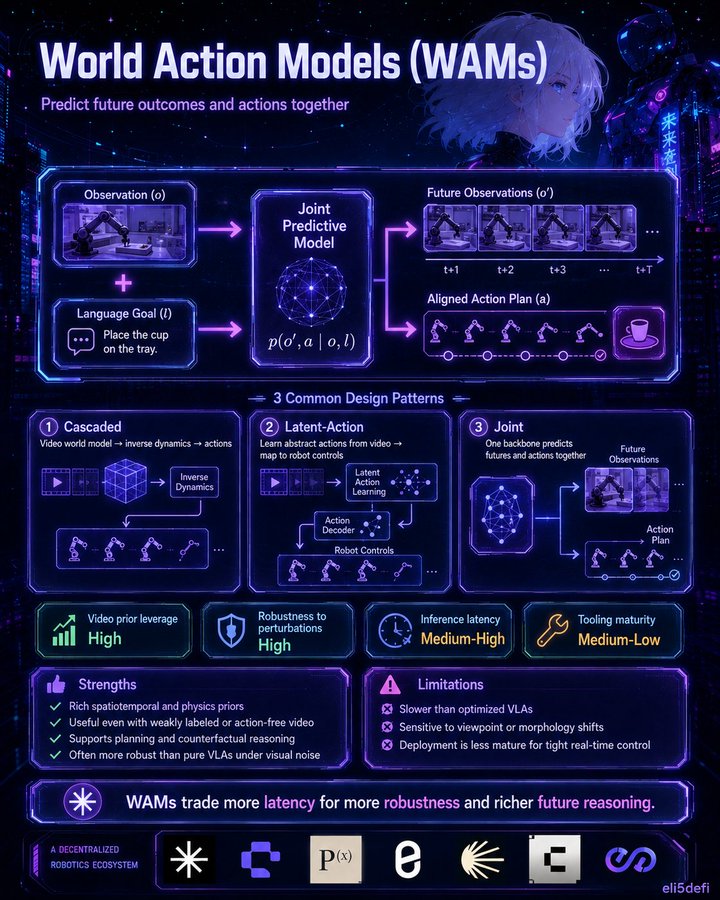
Many strong WAMs begin with large-scale video pretraining (human egocentric video + internet video) and only later incorporate robot demonstration data. This is the key architectural alternative that has gained substantial momentum in 2025–2026.
Strengths
Limitations
Core idea State-Space Models (exemplified by Mamba, S4, and related architectures) maintain a compact evolving hidden state that is updated with near-linear complexity and constant memory with respect to sequence length. They offer a computationally attractive alternative to the quadratic cost of standard Transformers.
Applications in robotics SSMs serve as efficient backbones for:
Strengths
Limitations
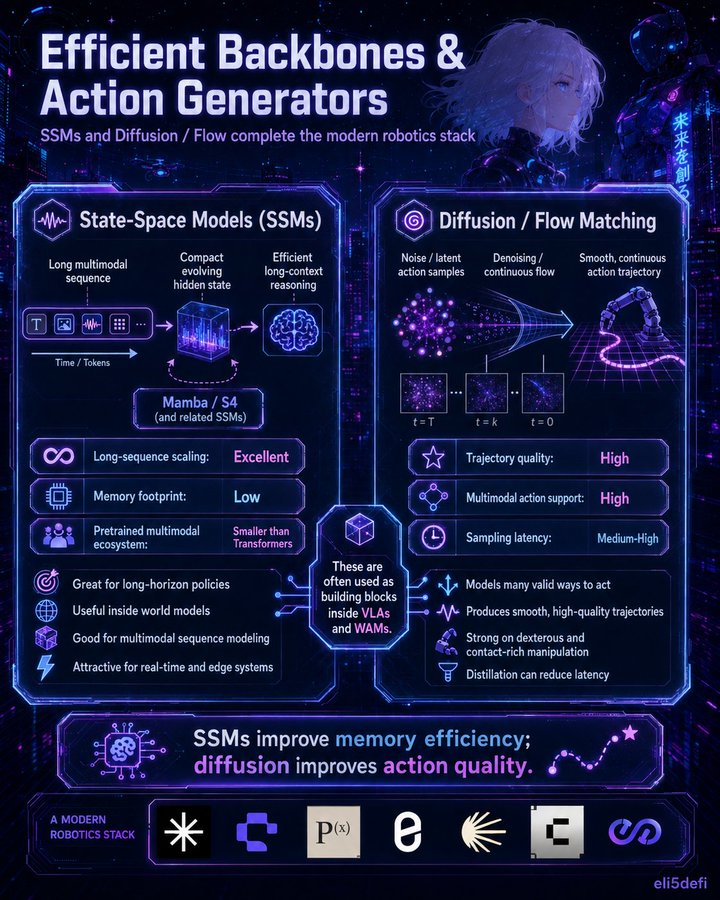
Core idea These models learn to reverse a gradual noising process (diffusion) or to transport noise to data via a continuous flow. In robotics they are used both as pure action policies and as generative components inside VLAs and WAMs.
Strengths
Limitations
All of the above architectures operate on a shared data substrate that researchers now organize as a pyramid ordered by the fundamental trade-off between scalability and robot alignment:
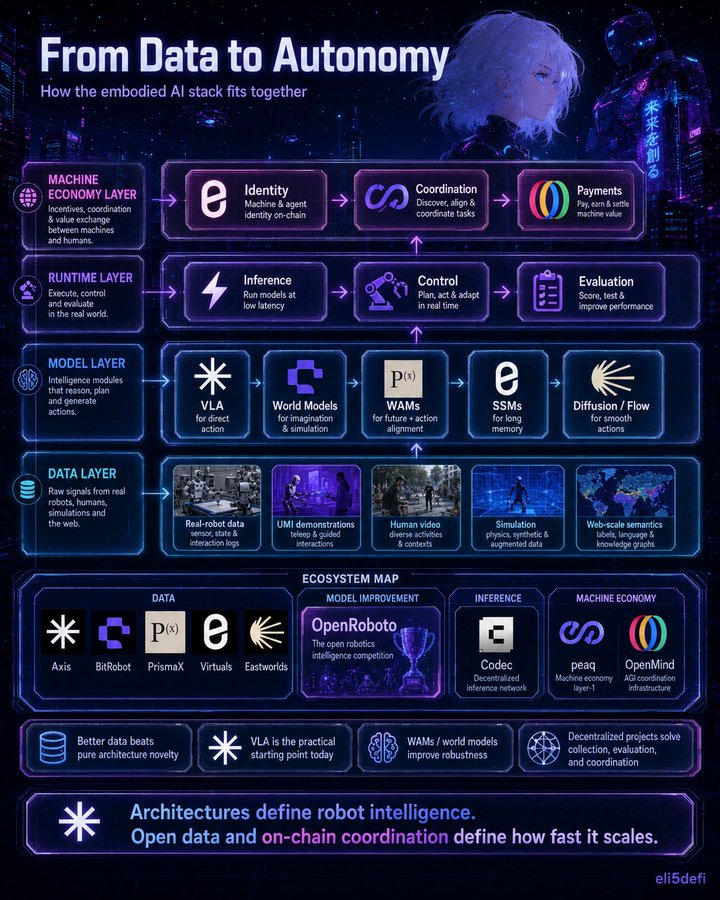
The space is still early (nascent product-market fit in most cases), but several projects explicitly target Physical AI / embodied intelligence data, model improvement, inference, or coordination infrastructure.
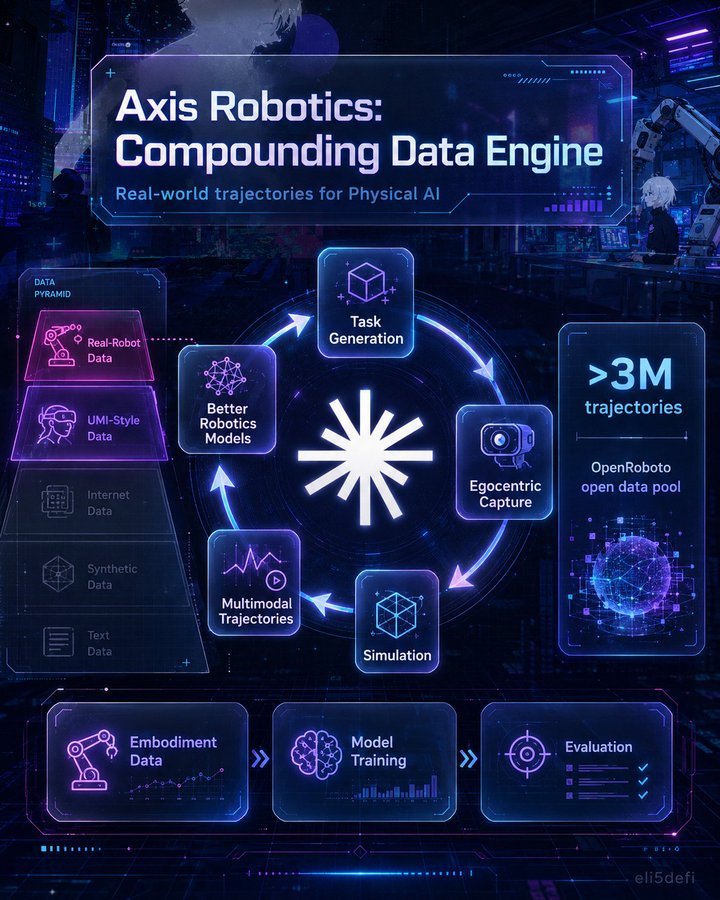
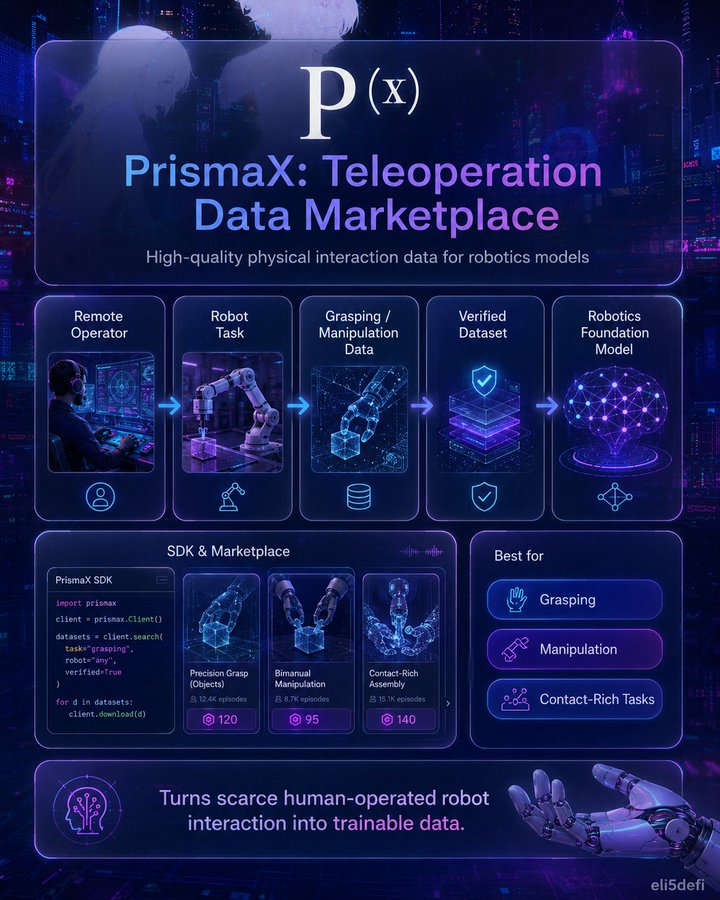
These focus on scalable, incentivized collection of real-robot trajectories, teleoperation, egocentric/human video, multimodal data, or simulation outputs — the scarce upper layers of the data pyramid.
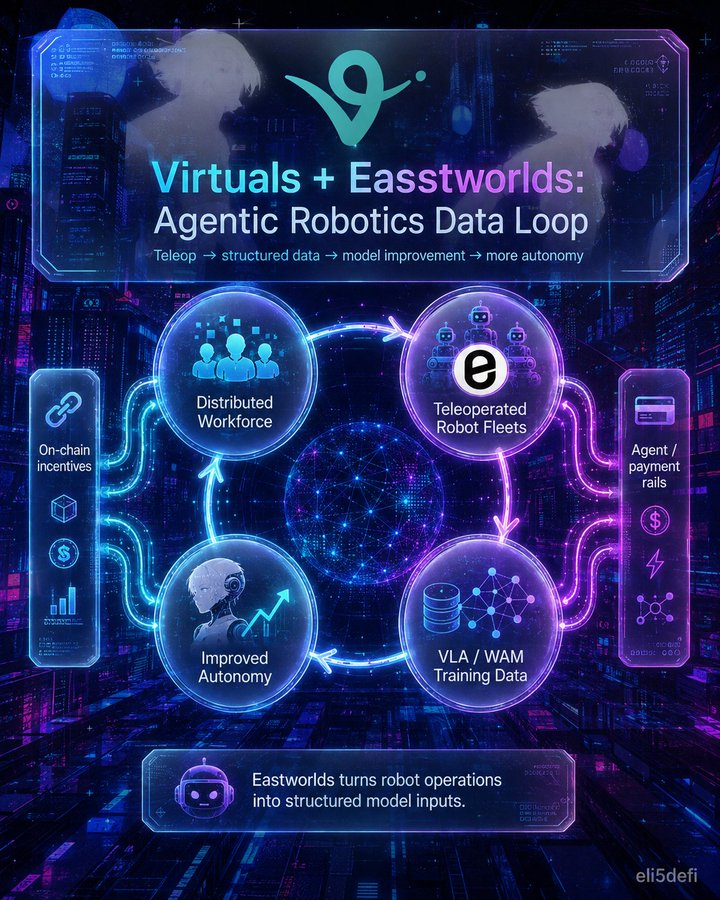
@virtuals_io Protocol / @eastworlds_io — Virtuals’ robotics division (Eastworlds) runs teleoperation and data collection (including Unitree fleets), with explicit pipelines that feed structured data into VLA and WAM training. Uses on-chain incentives and Virtuals’ agent/payment rails for a distributed workforce. Closes the loop from teleop -> model improvement -> more autonomy.
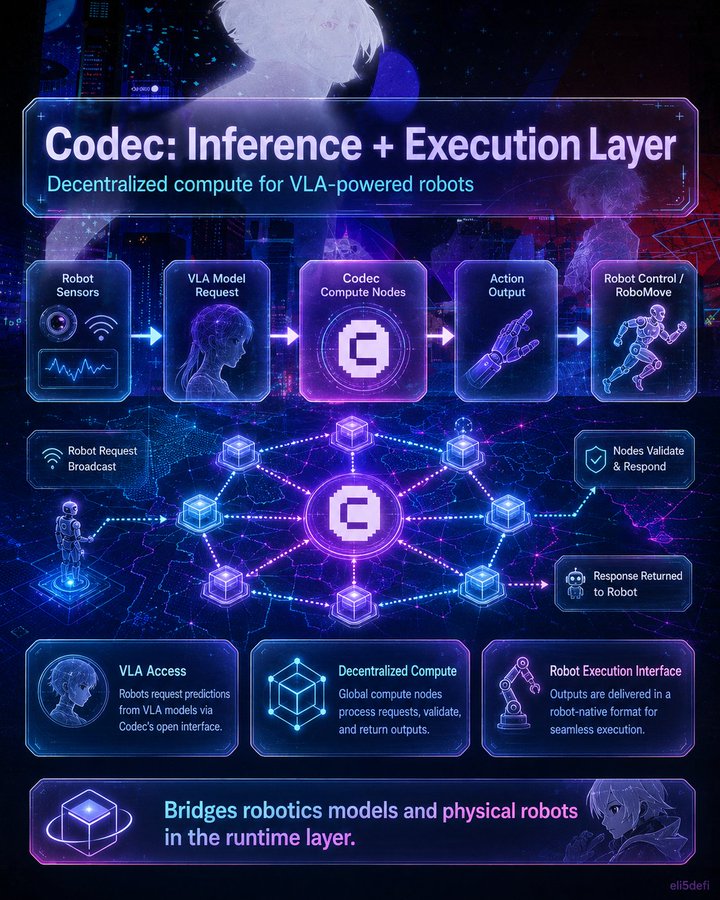
These enable the broader stack (robots as economic agents that can pay for data, models, compute, or services):
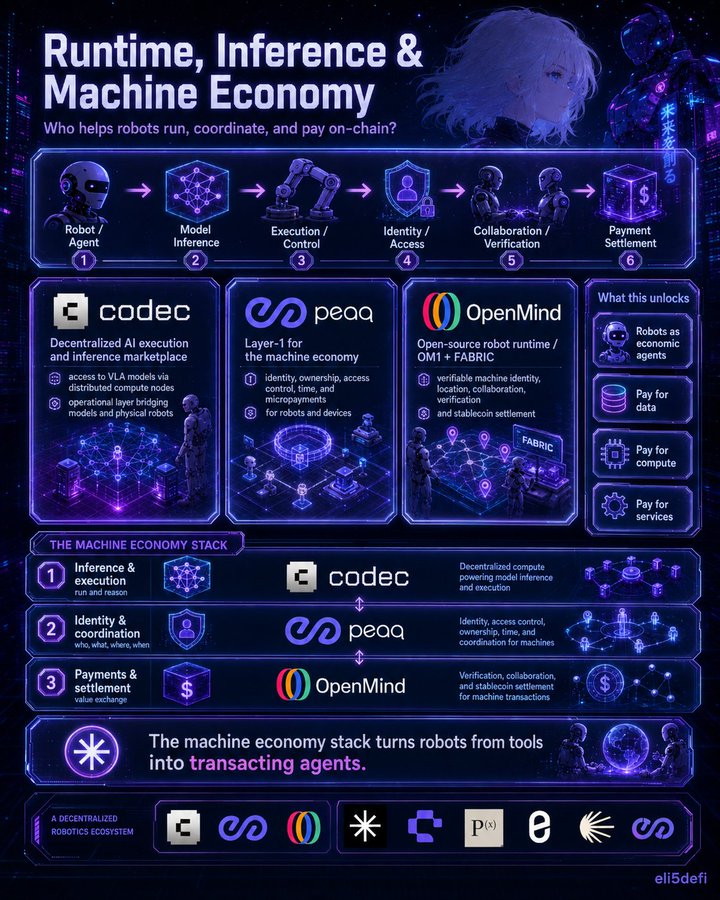
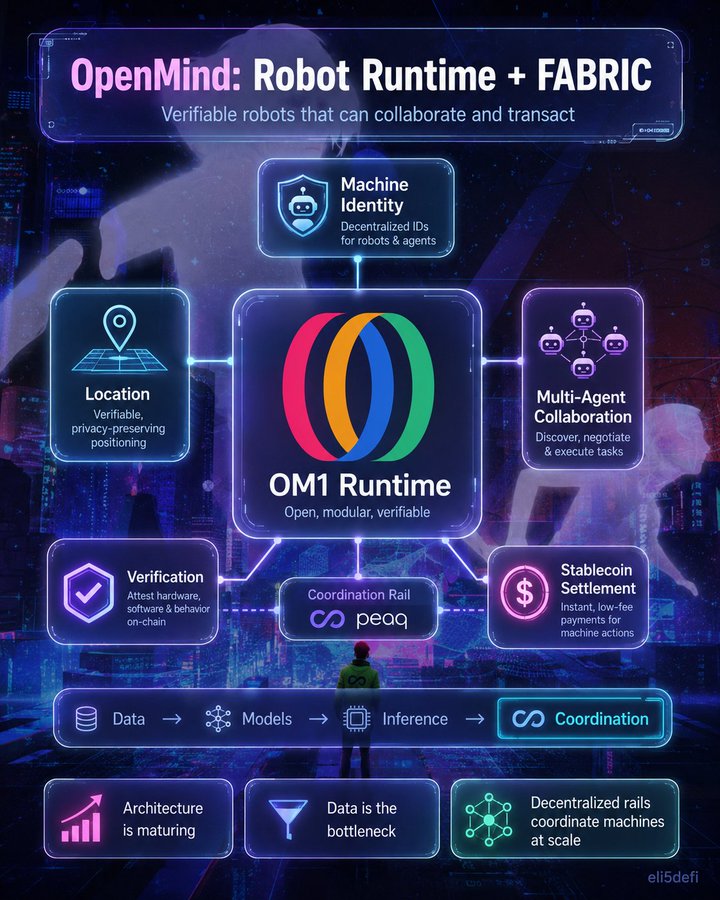
@openmind_agi — Building a decentralized “OS / runtime” for robots (open-source OM1) plus the FABRIC protocol. Focuses on verifiable machine identity, location, multi-agent collaboration, verification, and stablecoin settlement so robots can interact trustlessly and transact.
Most of these are early-stage. Data quality, verification of contributions, sim-to-real transfer, and actual model performance gains remain active challenges. Centralized labs (NVIDIA Cosmos, Physical Intelligence, etc.) still dominate frontier model quality, while the decentralized projects primarily attack the data bottleneck, open model improvement loops, and economic coordination for machines.
The technical stack has matured into specialized, complementary architectures (VLA for semantics and speed, WAM/world models for dynamics and robustness, hybrids for the best of both). Progress is now gated more by data economics and closed-loop improvement than by pure architecture novelty.
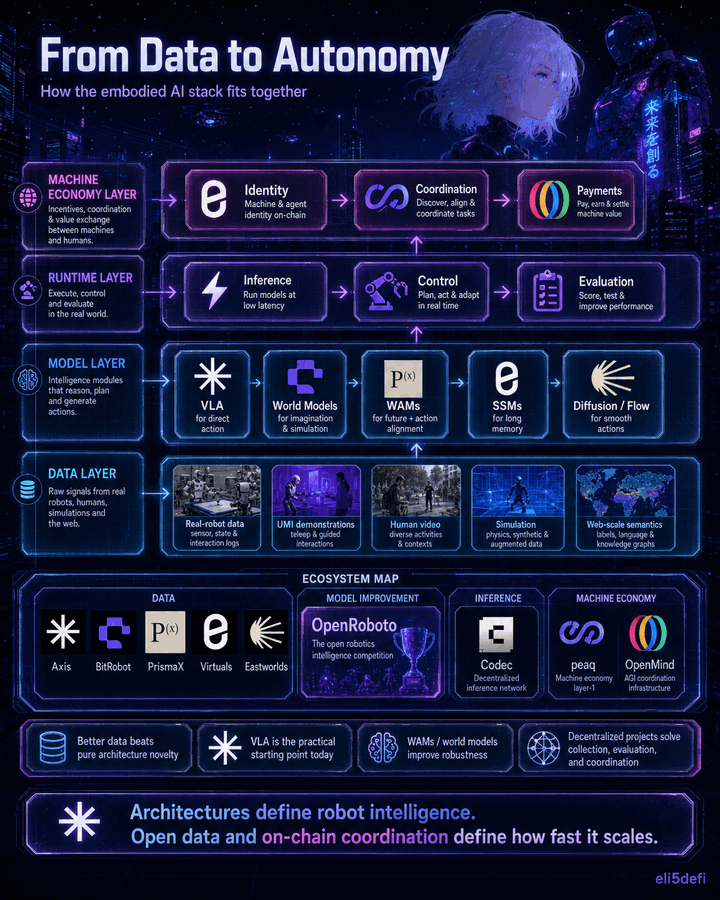
Decentralized projects are not yet producing the absolute frontier models, but they are building the missing Embodied Data and infrastructure the centralized stack needs most: scalable, incentivized, multi-source physical data; open evaluation and continuous fine-tuning loops for robotics policies; and economic infrastructure so machines can pay for data, compute, and skills.
In short: the architectures tell us what intelligence robots need; the decentralized layer is racing to solve how that intelligence gets the data and economic coordination required to scale.
NFA. DYOR.
Disclaimer: This information is for educational purposes only and does not constitute professional financial or tax advice. Some content may be developed in collaboration with third parties, and we may hold positions in the assets mentioned. We strongly recommend conducting independent research and consulting with a qualified professional before making any financial or tax-related decisions.


GEODNET Price Prediction: The $1B Thesis for GEOD
RWA Needs Better Access. Can NUVA Deliver?
Tokenization of RWA yields onchain might be the biggest opportunity that no one has noticed
Solana Ecosystem Projects: Top 10 to Watch in 2026
GEODNET Price Prediction: The $1B Thesis for GEOD
RWA Needs Better Access. Can NUVA Deliver?
Tokenization of RWA yields onchain might be the biggest opportunity that no one has noticed
Solana Ecosystem Projects: Top 10 to Watch in 2026