An in-depth guide to Bittensor subnets, how they work, key use cases, incentives, and why they are critical for scaling decentralized AI.

Author: Chirag Sharma
That design changes everything. It allows decentralized AI to scale horizontally instead of bottlenecking around a single model or company.
In simple terms:
Not all intelligence should be evaluated the same way. A financial prediction model should not compete against an image-generation model using identical metrics. Each requires different benchmarks, scoring systems, latency requirements, and incentive structures. Subnets allow every intelligence market to optimize for its own domain. That flexibility is why Bittensor has expanded rapidly across multiple AI verticals instead of becoming locked into a single use case.
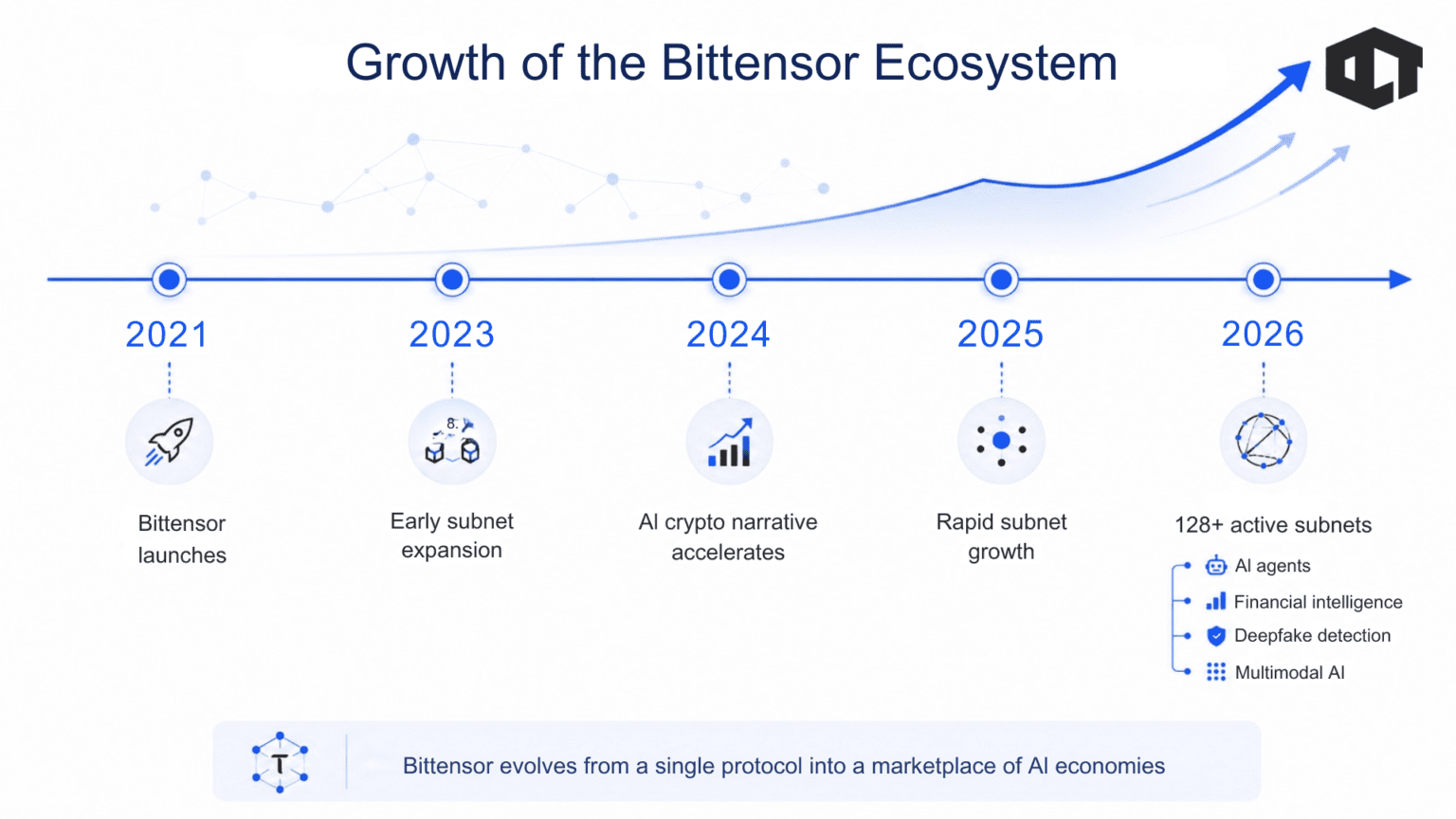
Today, the network supports more than 128 active subnets, each with:
Some subnets are experimental. Others are already supporting real applications and generating demand from developers.
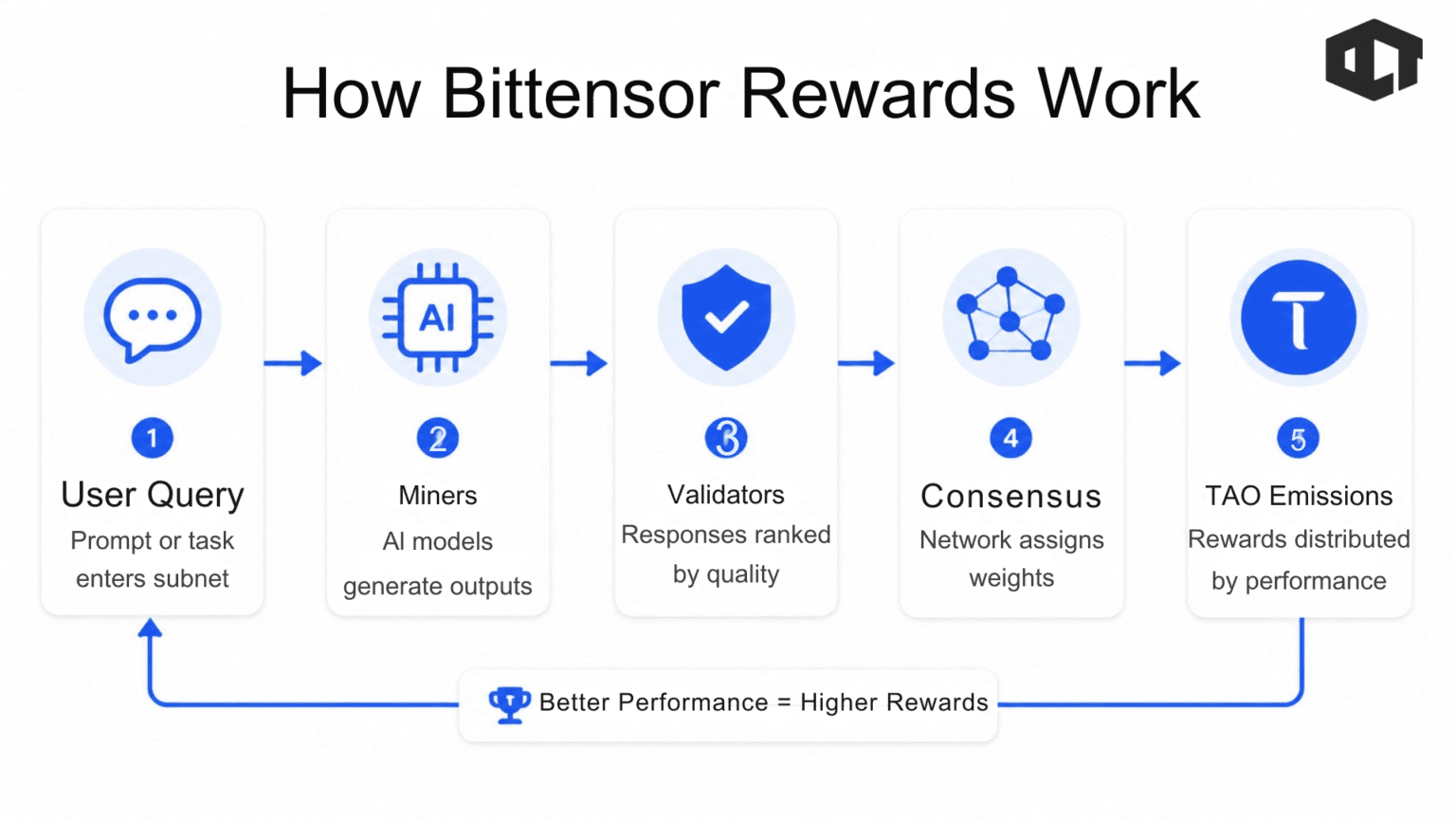
Miners run AI models and generate outputs.
Depending on the subnet, that output could be:
Miners compete against one another continuously. The better the output, the higher the rewards.
Validators evaluate miner performance. They send prompts, queries, or tasks to miners and score the responses based on subnet-specific metrics. That evaluation process determines which miners deserve larger shares of emissions. Validators are effectively the quality-control layer of the network.
Subnet owners create and manage subnet infrastructure.
They define:
The lifecycle looks like this:
This could be:
Multiple miners generate responses simultaneously. Each miner attempts to outperform competitors using better models, infrastructure, or optimization.
Validators evaluate outputs using subnet-specific criteria.
Depending on the subnet, scoring may focus on:
Bittensor uses validator consensus to assign weights across miners. High-performing miners gain influence and larger rewards. Poor performers lose emissions.
The subnet receives emissions from the broader Bittensor network.
Rewards flow to:
This process runs continuously. There is no permanent leaderboard. Models must constantly improve to maintain rewards. That constant pressure is what makes the network economically competitive instead of static.
Most AI systems are vertically integrated.
One company controls:
Bittensor takes the opposite approach. Subnets create independent intelligence markets that evolve separately while still sharing a common economic layer through TAO. This creates several advantages.
The network does not bottleneck around one intelligence market.
Hundreds of subnets can operate in parallel.
Builders can launch entirely new AI markets without changing the base protocol.
That lowers experimentation costs dramatically.
Subnets compete based on output quality.
If nobody values a subnet’s intelligence, emissions eventually decline.
Different AI domains require different evaluation systems.
Subnets allow deep optimization for each task.
This is why Bittensor increasingly resembles an open AI economy rather than a traditional blockchain protocol.
Every subnet competes for a share of total network emissions.
Higher-performing subnets generally attract:
That creates a feedback loop. Useful subnets grow stronger. Weak subnets lose relevance.
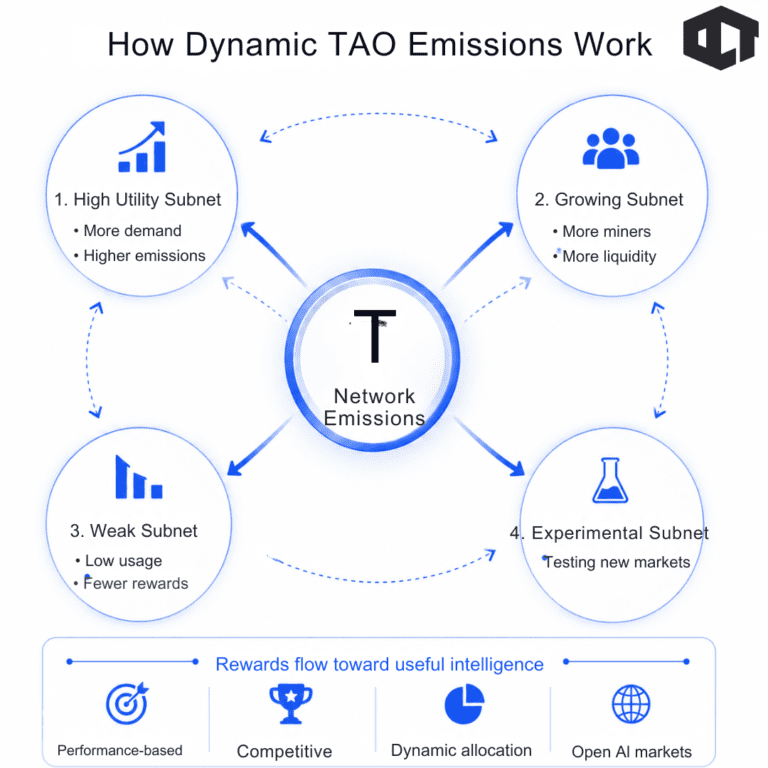
One of the biggest recent changes inside the Bittensor ecosystem is the rise of Dynamic TAO and subnet-specific economies. Instead of operating as isolated experiments, many subnets now function like miniature economies with their own liquidity dynamics, incentive structures, and market positioning. This matters because subnet demand is becoming increasingly important.
The number of subnets alone does not determine ecosystem value. What matters is whether those subnets produce intelligence people actually want to use.
Most crypto networks reward capital. Bittensor attempts to reward useful output. That distinction is critical. A miner cannot rely on hype alone.
If performance drops, rewards fall and validators misjudge quality consistently, their influence weakens. If subnet owners fail to attract useful activity, emissions eventually shrink. The system is imperfect, but the incentive alignment is far stronger than many passive staking models.
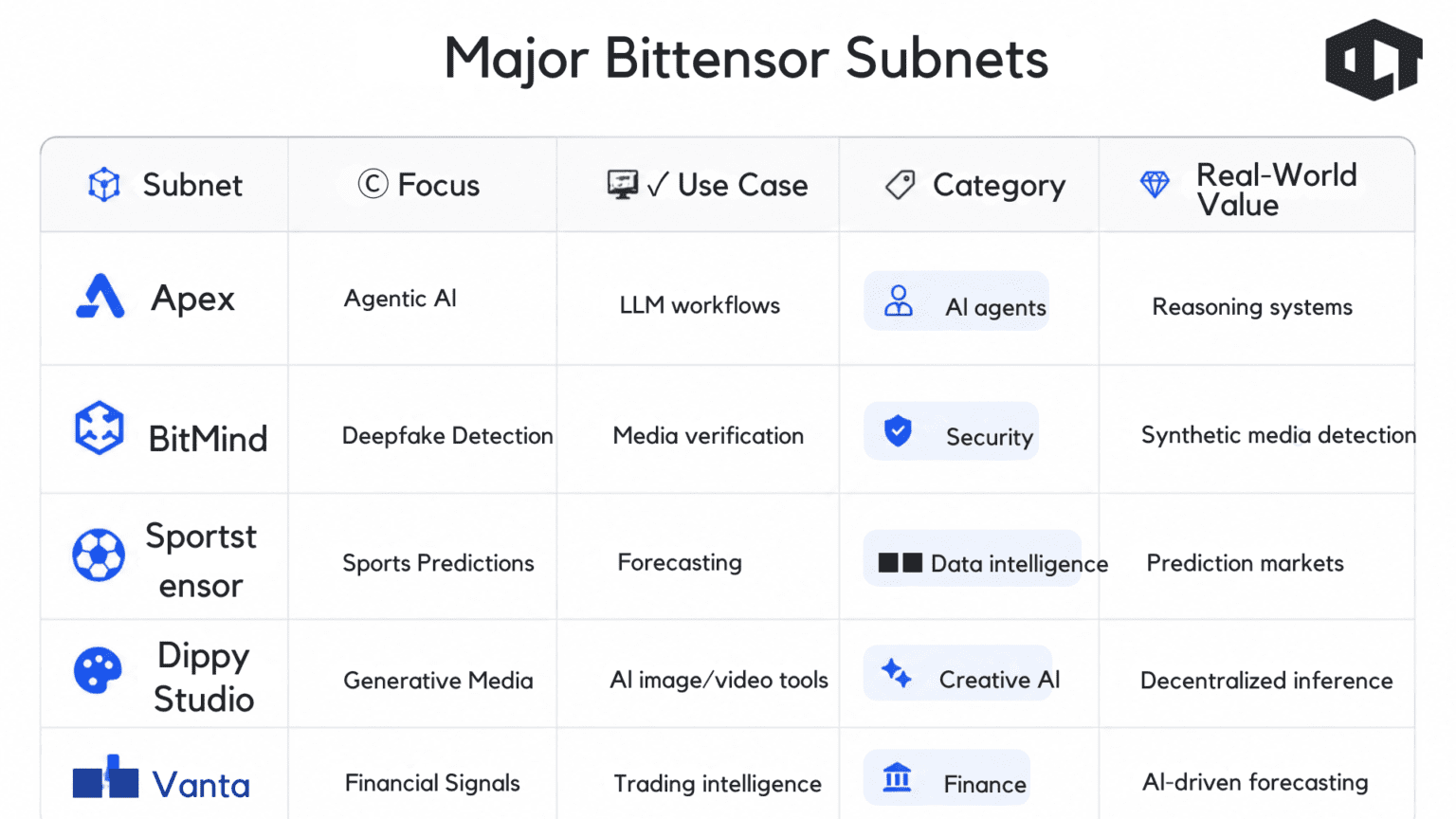
The diversity of subnets is one of Bittensor’s biggest strengths. While dozens of new subnets launch regularly, several have already emerged as major ecosystem players.
Built by Macrocosmos, Apex focuses on agentic workflows and fine-tuning infrastructure for large language models. Rather than building one massive centralized model, Apex incentivizes contributors to improve reasoning and execution incrementally. It represents one of the clearest examples of decentralized AI coordination inside the network.
BitMind specializes in detecting AI-generated images and deepfakes. As synthetic media becomes harder to distinguish from reality, systems capable of identifying manipulated content become increasingly valuable.
This subnet has clear applications in:
Dippy Studio focuses on generative media infrastructure including:
The subnet aims to provide decentralized AI generation without relying entirely on centralized providers.
Vanta operates as an AI-driven financial intelligence subnet. Miners compete to generate trading signals and predictive strategies while validators rank performance. This turns financial modeling into a transparent competition instead of a black-box product. These examples highlight an important reality. There is no single definition of a successful subnet. Each subnet succeeds by producing useful intelligence inside its niche.
Subnets can provide decentralized alternatives to traditional AI APIs. Instead of relying entirely on OpenAI or Anthropic infrastructure, developers can access competitive intelligence markets.
Prediction-focused subnets generate:
This creates an open competition for financial intelligence.
As AI-generated media becomes more convincing, verification infrastructure becomes increasingly valuable. Subnets focused on media analysis may eventually become critical trust layers across the internet.
Several subnets are exploring agentic reasoning and autonomous workflows. This could become a major narrative as AI agents evolve into economic participants.
Launching a subnet requires locking TAO. This discourages spam and low-effort deployments.
New subnets often receive temporary protection periods. This gives builders time to refine infrastructure before competing aggressively for emissions.
Subnets that fail to attract useful activity eventually lose relevance. Resources naturally shift toward more productive intelligence markets. This governance model is less political than many DAO systems. Performance matters more than voting theater.
As more subnets emerge, the value of the overall ecosystem increases. Miners gain more specialization opportunities. Validators improve through exposure to broader intelligence markets. Applications can combine outputs from multiple subnets simultaneously.
For example, a decentralized application could:
All within the same economic ecosystem.
This composability is one of Bittensor’s strongest long-term advantages.
Despite their potential, Bittensor subnets face serious challenges.
As the ecosystem grows, investors and builders need better frameworks for evaluating subnet quality. A strong subnet usually shows several characteristics.
Bittensor subnets are still early. But the direction of the ecosystem is becoming clearer.
Over the next several years, we will likely see:
The long-term vision is ambitious.
Instead of one centralized AI company controlling intelligence infrastructure, Bittensor attempts to create open markets where intelligence evolves competitively. That vision may not fully succeed. But subnets already represent one of the most credible experiments in decentralized AI.
Bittensor subnets are what make the network scalable in the first place. Without them, every AI model, validator, and workload would be forced into the same system, creating bottlenecks and slowing innovation. Instead, Bittensor turns AI into an open competition.
Each subnet operates like its own intelligence market with different goals, models, and reward systems. Miners compete to produce better outputs. Validators rank performance. Capital and emissions flow toward the subnets creating the most value. Some subnets will disappear. Others will evolve into critical infrastructure for decentralized AI.
That competitive structure is what separates Bittensor from most AI crypto projects. It is not trying to build one dominant model behind closed doors. It is building a decentralized marketplace where intelligence itself becomes the product.


Tokenization of RWA yields onchain might be the biggest opportunity that no one has noticed
Cold Wallet Safety 2026: Are Hardware Wallets Still Safe?
One Token, Multiple Products. Can Zylo Deliver?
The Rise of NEAR Protocol 2026: Inside the 530% Rally and the ETF
Tokenization of RWA yields onchain might be the biggest opportunity that no one has noticed
Cold Wallet Safety 2026: Are Hardware Wallets Still Safe?
One Token, Multiple Products. Can Zylo Deliver?
The Rise of NEAR Protocol 2026: Inside the 530% Rally and the ETF