
Author: Chirag Sharma
The cryptocurrency market has witnessed countless boom-and-bust cycles, but few examples illustrate the dangers of supply concentration as clearly as the SIREN token crash. In just a few months, SIREN transformed from one of the most talked-about AI-themed memecoins into a cautionary tale about whale control, narrative-driven speculation, and retail investors becoming exit liquidity.
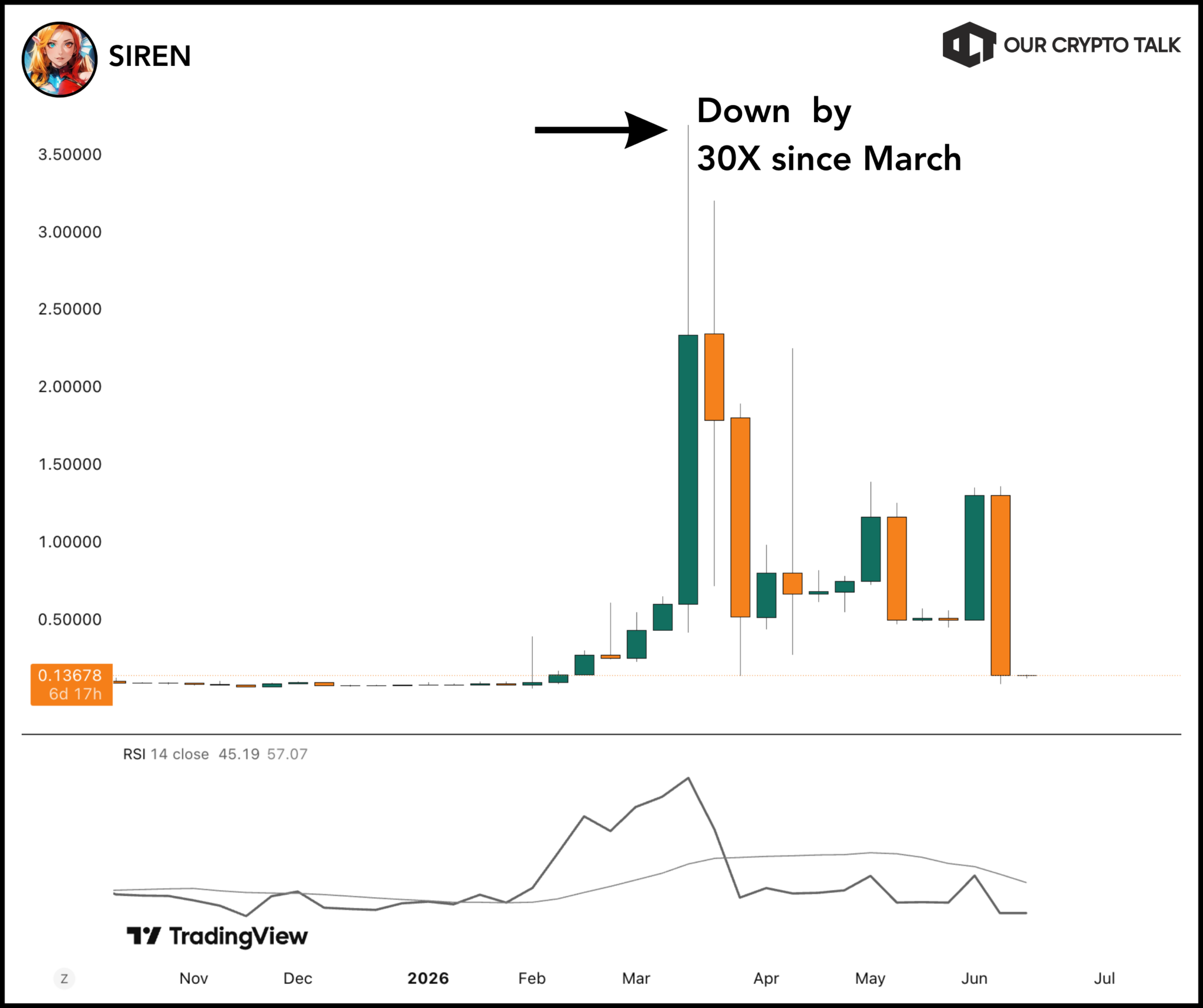
At its peak in March 2026, SIREN reached a valuation exceeding $2 billion and traded near $3.83 per token. The project attracted attention across Crypto Twitter thanks to its AI agent branding, aggressive marketing, and explosive price action. However, beneath the surface, on-chain analysts were raising serious concerns about the token’s ownership structure. A small group of wallets controlled the vast majority of the supply, creating a setup where a single coordinated distribution event could destroy the market.
Those warnings eventually became reality.
By June 2026, SIREN had collapsed by more than 98% from its all-time high after a massive whale distribution involving approximately 670 million tokens.
The event erased billions in market value and triggered one of the largest memecoin crashes of the year. Understanding how the SIREN token crash unfolded offers valuable lessons for anyone investing in low-float cryptocurrencies and narrative-driven assets.
SIREN launched in February 2025 on BNB Chain through the Four.meme platform. The project initially marketed itself as an AI-powered on-chain analyst, combining artificial intelligence narratives with Greek mythology themes. Its branding centered around two AI personas.
The first persona, known as the Golden Siren, focused on portfolio analysis and market intelligence. The second persona, the Crimson Siren, represented aggressive trading strategies and speculative opportunities. During the height of the AI agent narrative in late 2025 and early 2026, this positioning resonated strongly with retail traders searching for the next breakout project.
Timing played a major role in SIREN’s rise. The broader crypto market had already embraced AI-related tokens, with projects linked to machine learning, autonomous agents, and decentralized AI infrastructure attracting billions in market value. Investors were eager to find smaller-cap opportunities that could replicate the success of larger AI ecosystems.
SIREN benefited from this environment despite having very limited product development. The project’s narrative evolved much faster than its actual technology. Marketing materials referenced AI-powered analytics, intelligent trading systems, and future decentralized exchange capabilities, but tangible product releases remained scarce.
Perhaps the biggest warning sign emerged from the project’s online presence. Even as SIREN reached billion-dollar valuations, its official website provided little evidence of meaningful development progress. Unlike established AI projects with active repositories, developer communities, and released products, SIREN’s value increasingly depended on speculation rather than utility.
This gap between narrative and execution would later become one of the central themes of the SIREN token crash.
Most memecoin investors focus heavily on price action while ignoring supply distribution. The SIREN token crash demonstrates why that approach can be dangerous.
On paper, SIREN’s tokenomics appeared relatively straightforward. The token operated on BNB Chain, maintained a supply near one billion tokens, and avoided complicated tax structures. However, on-chain data revealed a much more concerning reality.
Multiple blockchain analytics platforms identified an extremely concentrated ownership structure. Investigations by Bubblemaps, Lookonchain, and other researchers suggested that a dominant wallet cluster controlled between 88% and 94% of the supply at various points during the token’s lifecycle. This level of concentration effectively gave one entity, or a coordinated group of entities, control over the market.
The implications were enormous.
During periods of excitement, the relatively small public float allowed modest buying pressure to drive massive price increases. Retail traders interpreted these moves as evidence of strong demand and growing adoption. In reality, the limited available supply amplified every purchase.
However, the same structure worked in reverse when large holders decided to sell.
This dynamic created a textbook setup for a pump-and-distribution cycle. Retail buyers saw explosive gains and growing momentum, while dominant holders accumulated unrealized profits worth billions of dollars.
The market’s vulnerability became increasingly obvious to on-chain analysts, but many traders ignored the warnings during the height of the rally.
The full SIREN token crash did not happen overnight. Instead, it unfolded through several distinct phases that followed a familiar pattern seen across many speculative crypto assets.
Timeline of the SIREN Token Crash
SIREN launches through Four.meme on BNB Chain at micro-cap valuations, while a large wallet cluster quietly accumulates a major share of supply before mainstream attention arrives.
As AI and autonomous agent narratives gain traction, SIREN builds awareness inside niche communities while whale-controlled wallets reportedly continue expanding positions.
SIREN becomes a major beneficiary of the AI agent rotation, surging toward multi-billion-dollar valuations as social media hype, influencer attention, and retail participation accelerate.
SIREN hits an all-time high near $3.83 and briefly exceeds a $2B market cap, while analysts and Bubblemaps flag extreme supply concentration as a major stability risk.
The token suffers a sharp selloff, losing more than 65% within days and eventually falling over 90% from peak as distribution pressure wipes out billions in market value.
SIREN sees multiple relief rallies after the initial crash, but on-chain data suggests large holders continue reducing exposure into temporary strength.
Roughly 670M tokens, around 92% of circulating supply, are reportedly sold for about $64.8M in USDT, overwhelming market demand and triggering another collapse of up to 90%.
SIREN launched through Four.meme on BNB Chain and initially traded at micro-cap valuations. During this period, a large wallet cluster quietly accumulated substantial portions of the supply while public interest remained minimal.
The token traded near fractions of a cent, attracting little mainstream attention.
While broader crypto narratives shifted toward AI and autonomous agents, SIREN continued building awareness within niche communities. On-chain reports later indicated that whale-controlled wallets continued expanding their positions during this period.
Development activity remained limited, but speculation around future products persisted.
The AI agent narrative reached peak popularity across crypto markets. Investors aggressively rotated into AI-themed tokens, searching for projects capable of delivering outsized returns.
SIREN became one of the biggest beneficiaries.
The token surged from relatively low levels toward multi-billion-dollar valuations within weeks. Social media engagement exploded, influencers promoted the project, and retail participation accelerated.
SIREN reached an all-time high near $3.83 and briefly exceeded a $2 billion market capitalization. At this point, analysts began publicly warning about supply concentration risks.
Bubblemaps highlighted the dominant wallet cluster and warned that the ownership structure represented a major threat to long-term price stability. Their conclusion was simple: extreme concentration rarely ends well.
The market experienced its first devastating selloff. Within days, SIREN lost more than 65% of its value. Additional distribution pressure pushed losses above 90% from peak levels.
Billions in market capitalization disappeared in less than two weeks.
Following the initial collapse, SIREN experienced several relief rallies. These temporary recoveries convinced some traders that the worst was over.
However, on-chain data suggested large holders continued reducing exposure into strength.
The defining moment of the SIREN token crash occurred between June 13 and June 15.
Reports indicated that approximately 670 million tokens, representing around 92% of circulating supply, were sold for roughly $64.8 million in USDT. The scale of the distribution overwhelmed market demand and triggered another violent collapse.
Prices plunged by as much as 90% in a matter of days. Despite enormous trading volume, buyers could not absorb the supply entering the market.
The most controversial aspect of the SIREN token crash involves the identity of the dominant wallet cluster.
Several on-chain researchers, including ZachXBT, linked certain wallet patterns to entities associated with previous token launches and market-making activity. Specifically, some analysts suggested connections to DWF Labs based on transaction histories and wallet relationships.
It is important to emphasize that these claims remain allegations rather than confirmed facts. No definitive public evidence has established ownership of the wallets, and no official confirmation has been provided by the parties involved.
Regardless of ownership, the economic reality remains unchanged.
The cluster controlled a substantial majority of the supply and repeatedly sold into periods of heightened retail enthusiasm. This pattern appeared throughout multiple cycles, suggesting coordinated distribution rather than random profit-taking.
The June 2026 distribution event demonstrated the consequences of this structure. When a small number of participants control most available tokens, market prices become highly vulnerable to their decisions.
In SIREN’s case, those decisions ultimately erased billions in market value.
One of the most important lessons from the SIREN token crash is that many warning signs were visible long before the final collapse.
First, the ownership concentration was unusually extreme. While many crypto projects have large holders, few operate with more than 90% of supply controlled by a single cluster.
Second, product development failed to keep pace with valuation growth. As market capitalization expanded into the billions, tangible utility remained limited. Investors were primarily buying a narrative rather than a functioning product.
Third, repeated warnings emerged from respected on-chain analysts. Bubblemaps, Lookonchain, and independent researchers consistently highlighted the concentration risks.
Fourth, trading activity increasingly resembled speculative behavior rather than organic adoption. Open interest surged, leverage increased, and social media hype dominated discussions.
Finally, the project lacked a fundamental anchor.
Successful long-term crypto assets typically derive value from network usage, developer activity, transaction demand, or revenue generation. SIREN relied heavily on momentum and attention. Once those factors weakened, there was little support beneath the price.
The result was a predictable cycle:
Accumulation -> Narrative Growth -> Retail FOMO -> Distribution -> Collapse
This pattern has appeared repeatedly throughout crypto history, and SIREN followed it almost perfectly.
The SIREN token crash offers several important lessons for investors.
The first lesson involves supply distribution. Before investing in any token, investors should examine ownership concentration. A project where a handful of wallets control most of the supply carries significantly higher risk than one with broad distribution.
The second lesson concerns fundamentals. Narratives can drive short-term gains, but sustainable value typically requires real products, active development, and growing adoption.
The third lesson relates to on-chain analysis. Modern blockchain data provides unprecedented transparency. Investors who ignored ownership warnings had access to the same information as professional analysts.
The fourth lesson involves risk management. Highly speculative assets should represent only a small portion of a portfolio. Even promising narratives can fail when structural risks emerge.
Finally, investors should distinguish between trading and investing. Momentum-driven assets may offer trading opportunities, but long-term investment decisions require stronger foundations.
The future of SIREN remains uncertain.
Short-term volatility will likely continue. Memecoins frequently experience relief rallies after major collapses, and speculative traders may attempt to capitalize on oversold conditions. Given the token’s history, sudden price spikes cannot be ruled out.
However, the long-term outlook remains challenging.
The project still faces questions about supply concentration, development activity, and sustainable demand. Without meaningful utility or major structural changes, the same issues that contributed to the SIREN token crash could continue affecting price performance.
Ultimately, SIREN serves as one of the clearest examples of how supply concentration can overwhelm even the strongest narratives. The project combined popular themes, explosive marketing, and viral momentum, yet none of those factors could overcome the risks created by centralized ownership.
For investors, the lesson is simple. Before believing the story, understand who controls the supply. In crypto, ownership structure often matters far more than marketing promises.
The SIREN token crash may be remembered as one of 2026’s biggest memecoin collapses, but it also provides a valuable case study in due diligence. Those who learn from it will be better prepared for the next narrative-driven cycle.