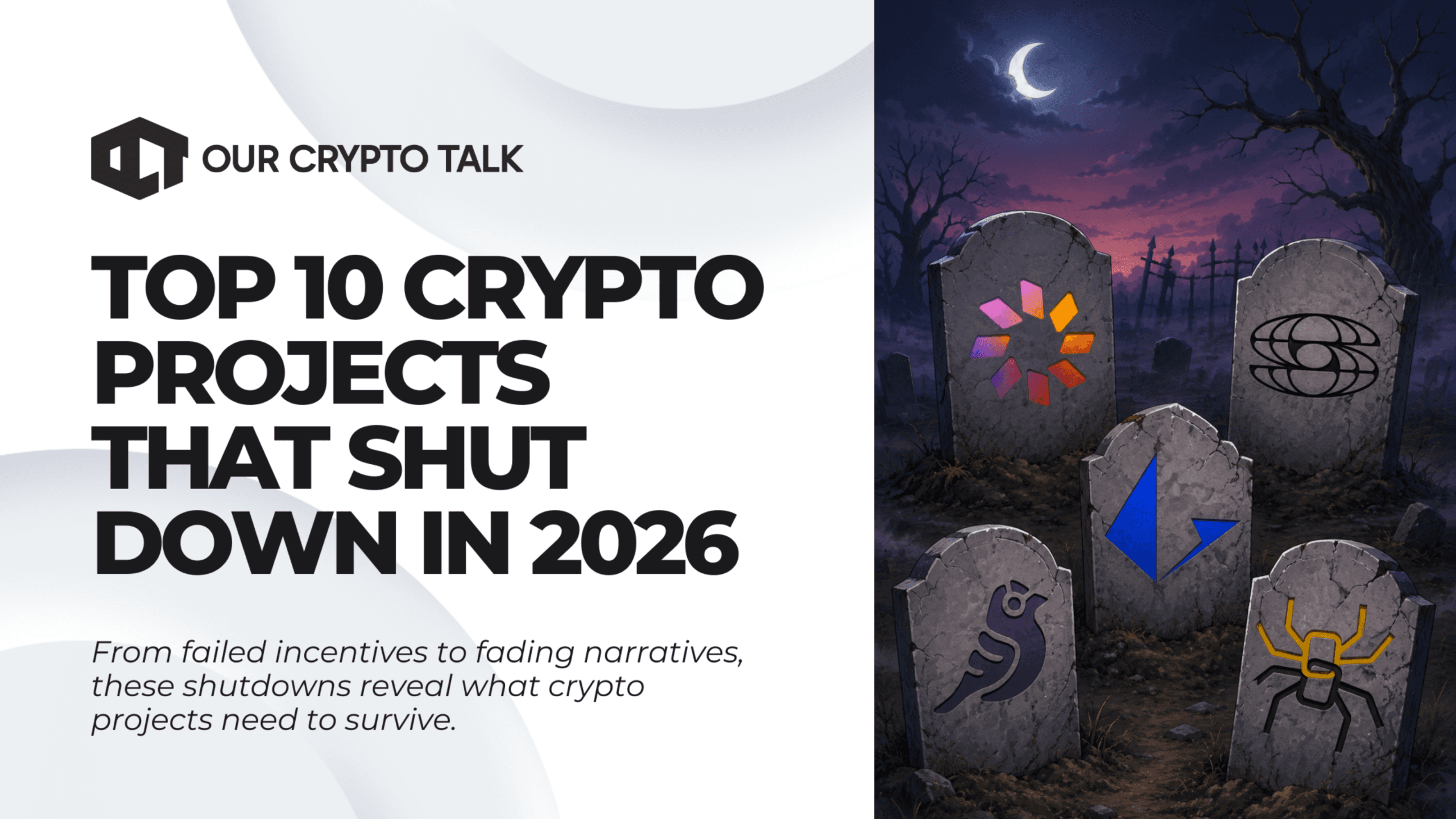
Crypto projects shut down 2026 at a record pace: 99 funded startups died, including a16z's $87M triple. See the 10 biggest failures and the red flags to watch

Author: Kritika Gupta
RootData’s 2026 Dead Projects List now counts 99 crypto projects that shut down in the first seven months of the year. These were not rug pulls or scams. Instead, the list includes real, funded projects with experienced teams, working products, and, in many cases, tens of millions of dollars in venture capital backing. Some entered 2026 with large user bases, recognizable investors, and strong market narratives. However, none of those advantages guaranteed survival.
The shutdowns also spread across nearly every major crypto sector. DeFi protocols, NFT marketplaces, Layer-2 networks, wallets, exchanges, AI-crypto platforms, DAO tooling, infrastructure projects, and crypto media companies all felt the pressure. Therefore, the market cannot blame one fading trend or one failed business model. The scale and diversity of the closures point to a broader industry-wide reckoning.
Meanwhile, the macro environment made survival even harder. Bitcoin fell roughly 23% during the first quarter of 2026, while venture capital firms became far more selective about where they deployed funds. As a result, investors stopped treating user growth, token incentives, and narrative momentum as sufficient proof of traction. Revenue became the primary survival metric. Projects that could not convert users, technology, or attention into sustainable income eventually exhausted their runway, setting the stage for some of the year’s most instructive crypto failures. Together, the a16z-backed trio of Yupp, Syndicate Labs, and Entropy raised roughly $87 million before shutting down, proving that elite funding cannot replace sustainable demand.
Common shutdown patterns across major crypto sectors in 2026
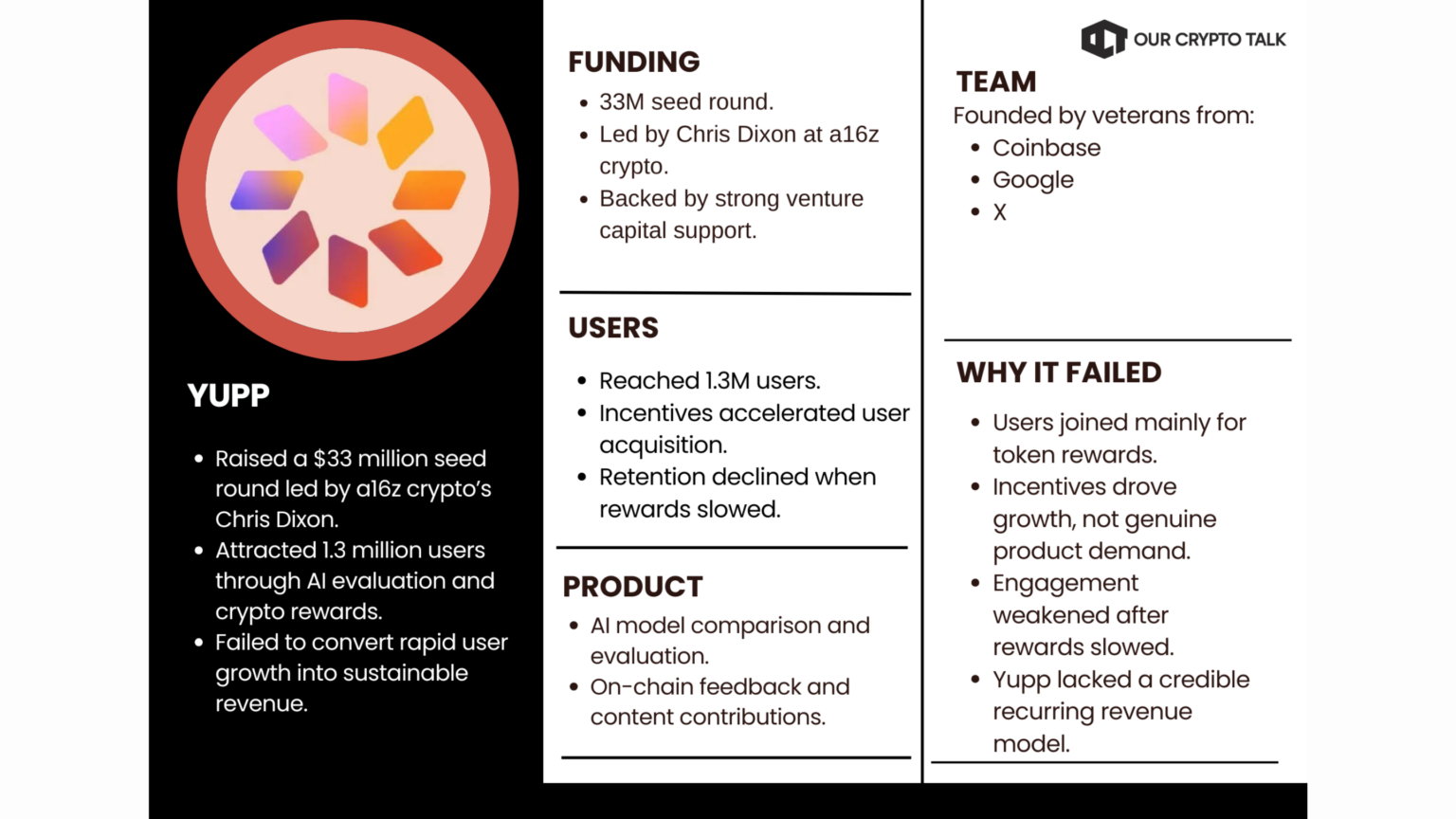
Yupp stands out as one of the most eye-catching crypto shutdowns of 2026, a $33 million seed round led by a16z crypto’s Chris Dixon. Moreover, veterans from Coinbase, Google, and X founded the company, giving Yupp the experience, funding, and investor backing that many early-stage crypto startups could only hope to secure.
The platform aimed to combine AI model evaluation with crypto incentives. Users could compare AI outputs, submit feedback, contribute content, and earn rewards for their activity. Initially, the strategy appeared to work. Yupp attracted 1.3 million users and quickly gained attention within the AI-crypto sector.
However, the headline user count masked a weak business model. Most users joined for token rewards and promotional incentives rather than the underlying product. As those incentives slowed, engagement and retention fell. More importantly, Yupp never developed a credible path to recurring revenue. The company proved that crypto incentives can generate rapid user acquisition, but they cannot guarantee product-market fit.
Ultimately, Yupp showed why users without revenue remain a vanity metric. A project cannot build a durable business when rewards provide the only reason for people to stay. Once the incentives stop or the token loses value, users leave and activity collapses. Despite raising $33 million and attracting 1.3 million users, Yupp could not convert attention into sustainable income.
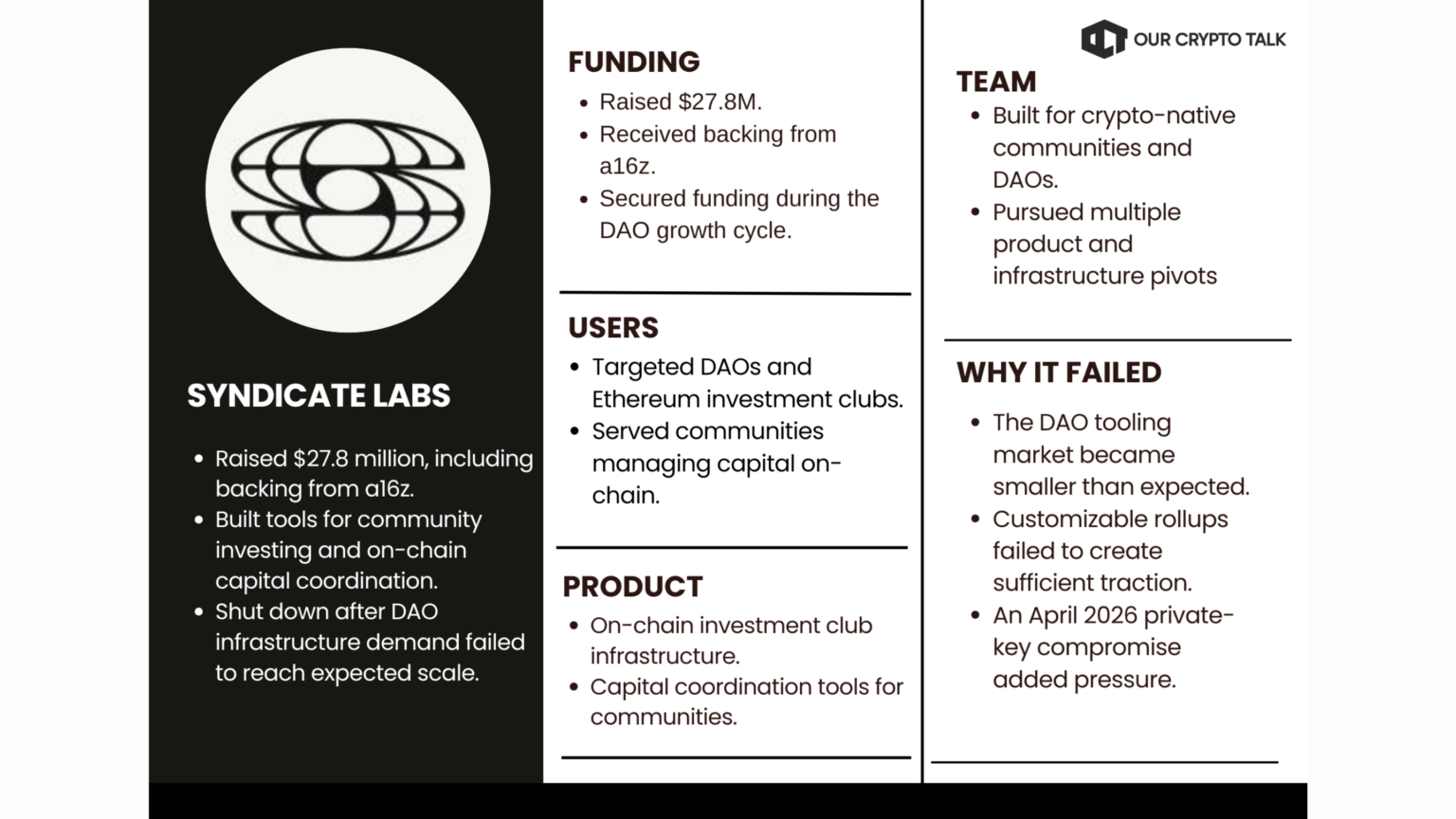
Syndicate Labs became another major crypto projects shut down of 2026 after raising $27.8 million, including backing from a16z, to build on-chain developer tools for DAOs and Ethereum investment clubs. Its products helped communities create investment vehicles, coordinate capital, and manage on-chain organizations. During the 2021 bull market, the potential market for DAO infrastructure appeared enormous.
However, demand never reached the scale investors and the team expected. As interest in DAOs faded, the addressable market for dedicated DAO tooling shrank with it. Syndicate expanded into customizable rollups and other infrastructure products, but those pivots failed to generate enough demand to support the company’s operating costs. In April 2026, a private-key compromise added further pressure before Syndicate announced its shutdown in May.
Ultimately, Syndicate showed that strong funding cannot save a project when its target market keeps contracting. Crypto products often depend on the narratives that surround them. When capital, users, and developers move to a different sector, demand can disappear quickly. Therefore, if the narrative a product serves fades, the product often fades with it.
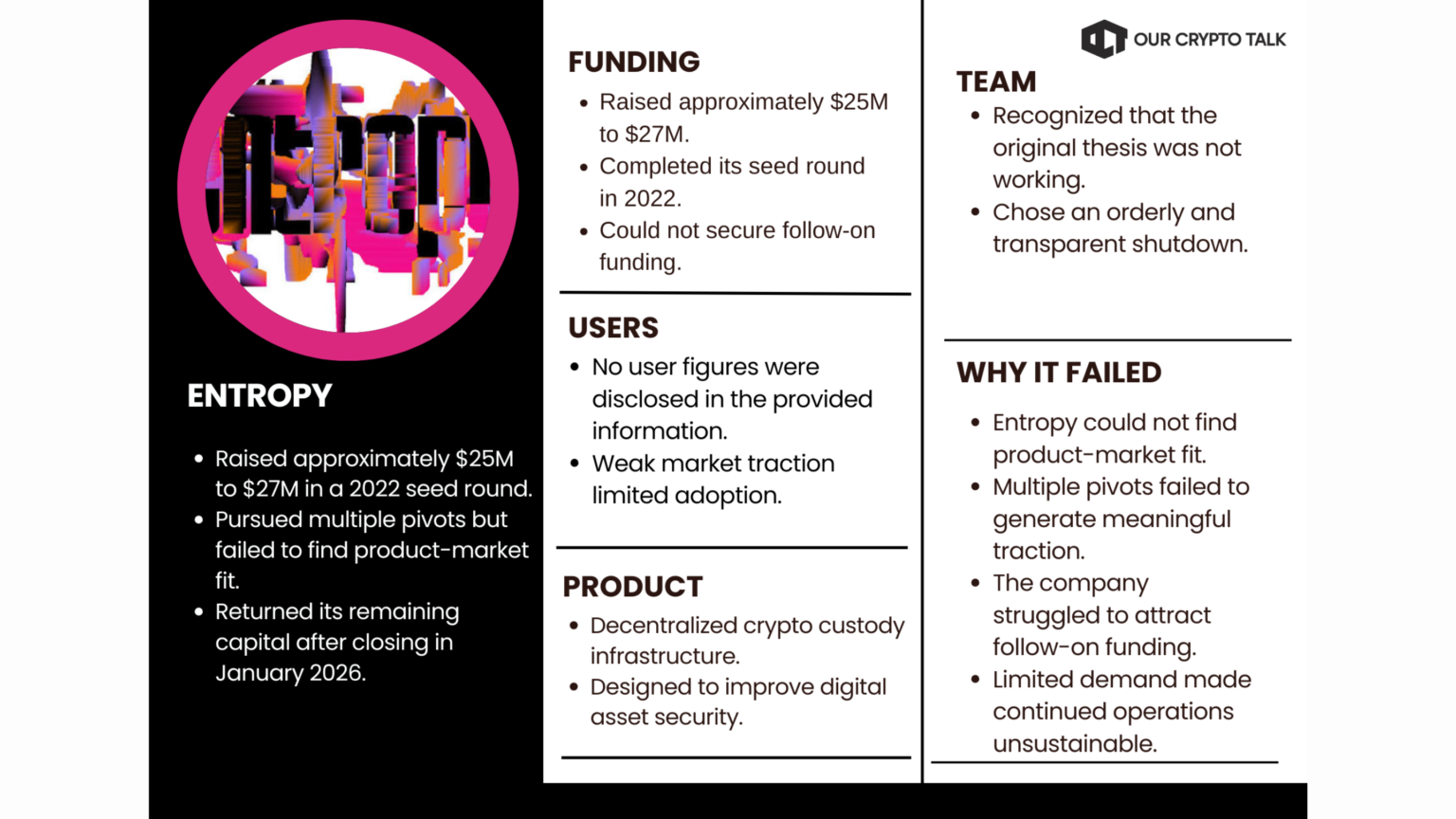
Entropy raised approximately $25 million to $27 million in a 2022 seed round to build decentralized crypto custody infrastructure. However, the team struggled to find product-market fit despite pursuing multiple pivots. Eventually, weak traction and the inability to secure follow-on funding forced Entropy to close in January 2026.
Still, Entropy handled its shutdown differently from most failed crypto projects. The founders returned the remaining capital to investors instead of spending every last dollar, earning praise across the industry for taking the responsible path. The case shows that not every startup failure needs to become a scandal. By closing transparently and returning unused funds, Entropy’s founders preserved trust and strengthened their credibility for whatever they build next.
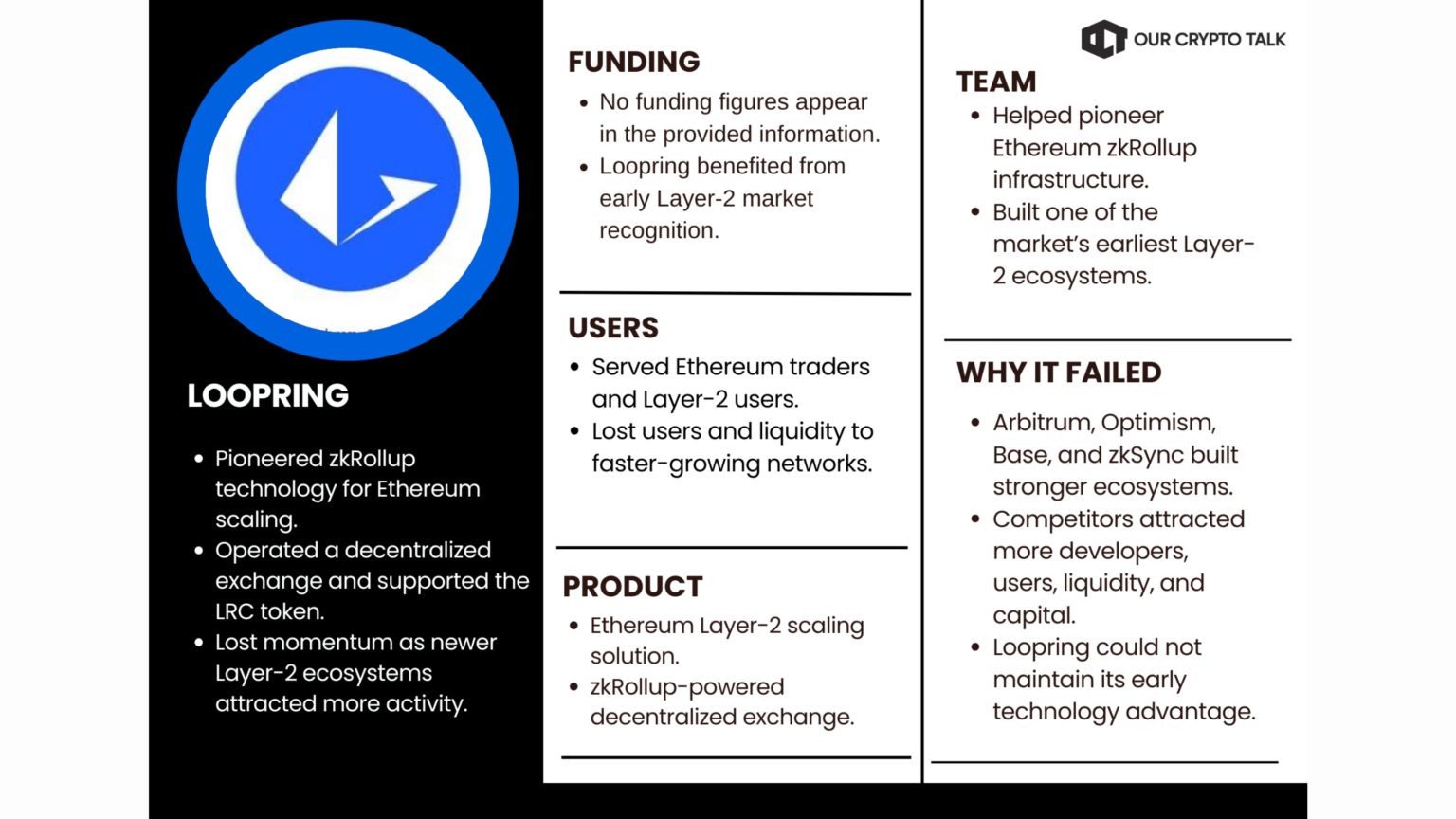
Loopring entered the market as one of Ethereum’s earliest Layer-2 solutions. It pioneered zkRollup technology, operated a decentralized exchange, and supported a publicly traded token, LRC. However, its early lead did not translate into lasting dominance. The project shut down its wallet in June 2025 and began winding down its remaining protocol services in 2026.
Meanwhile, Arbitrum, Optimism, Base, and zkSync attracted more developers, users, liquidity, and capital. These newer chains built stronger ecosystems and gave applications more reasons to launch on their networks. Loopring could not match that momentum, so its original technological advantage gradually lost relevance.
Ultimately, Loopring proved that being early does not guarantee victory. First-mover advantage in crypto remains temporary unless a project continues attracting developers, expanding liquidity, and improving its ecosystem. When faster-moving competitors execute better and secure more resources, they can quickly overtake an early leader.
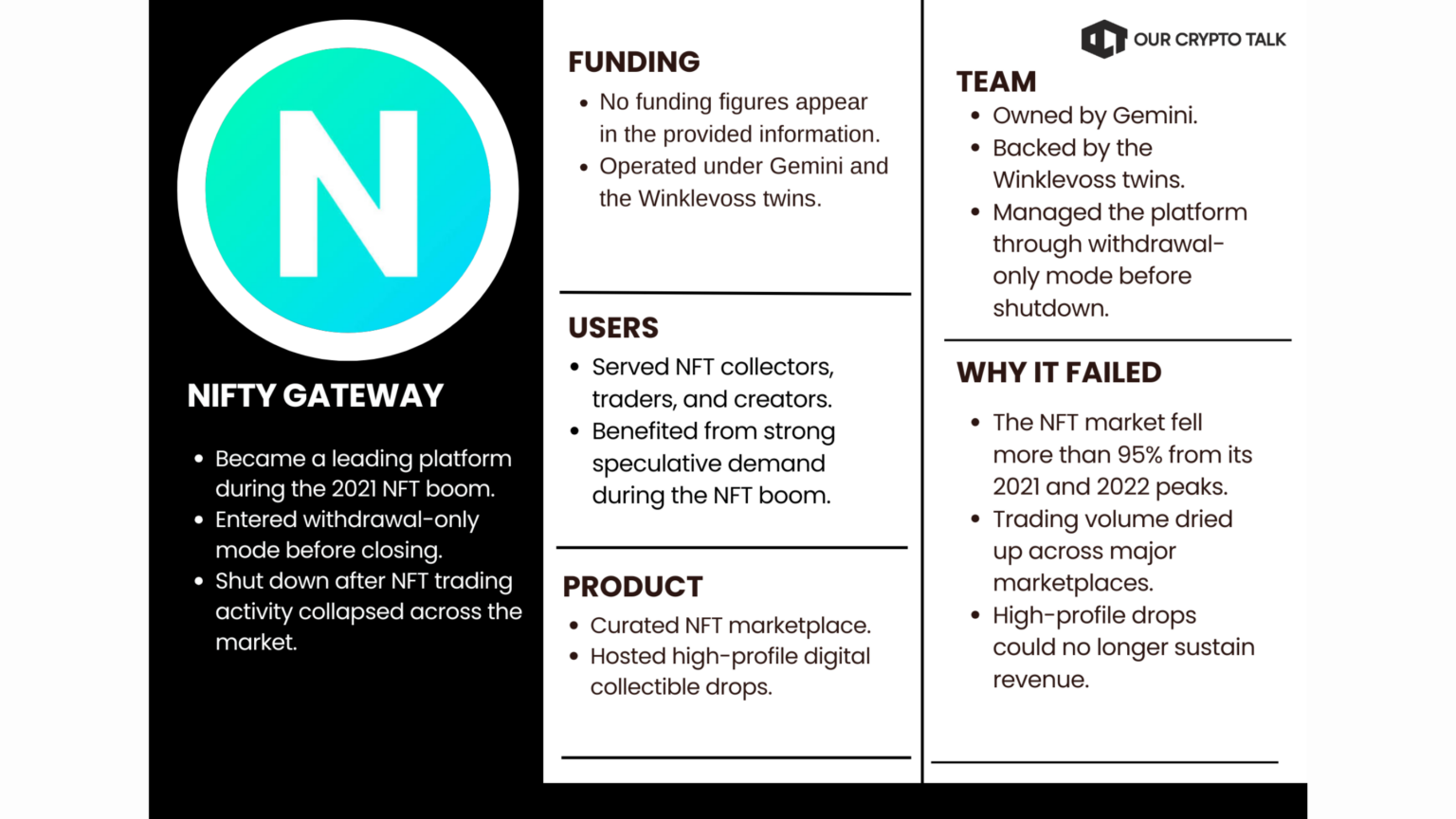
Nifty Gateway built a curated NFT marketplace under Gemini and the Winklevoss twins. After becoming one of the best-known platforms of the 2021 NFT boom, it announced that it would shut down on February 23, 2026. Before closing, the platform entered withdrawal-only mode so users could move their assets. However, by that point, the broader NFT market had already fallen more than 95% from its 2021 and 2022 peaks, while trading volume had dried up across nearly every major marketplace.
Ultimately, Nifty Gateway outlived the market it depended on. Its business model required constant speculative trading, high-profile drops, and active collector demand to generate revenue. Once the NFT mania ended, that revenue disappeared. Foundation faced the same pressure and also shut down after a potential acquisition failed. Together, both closures showed that a product built for a bubble rarely survives after the bubble pops.
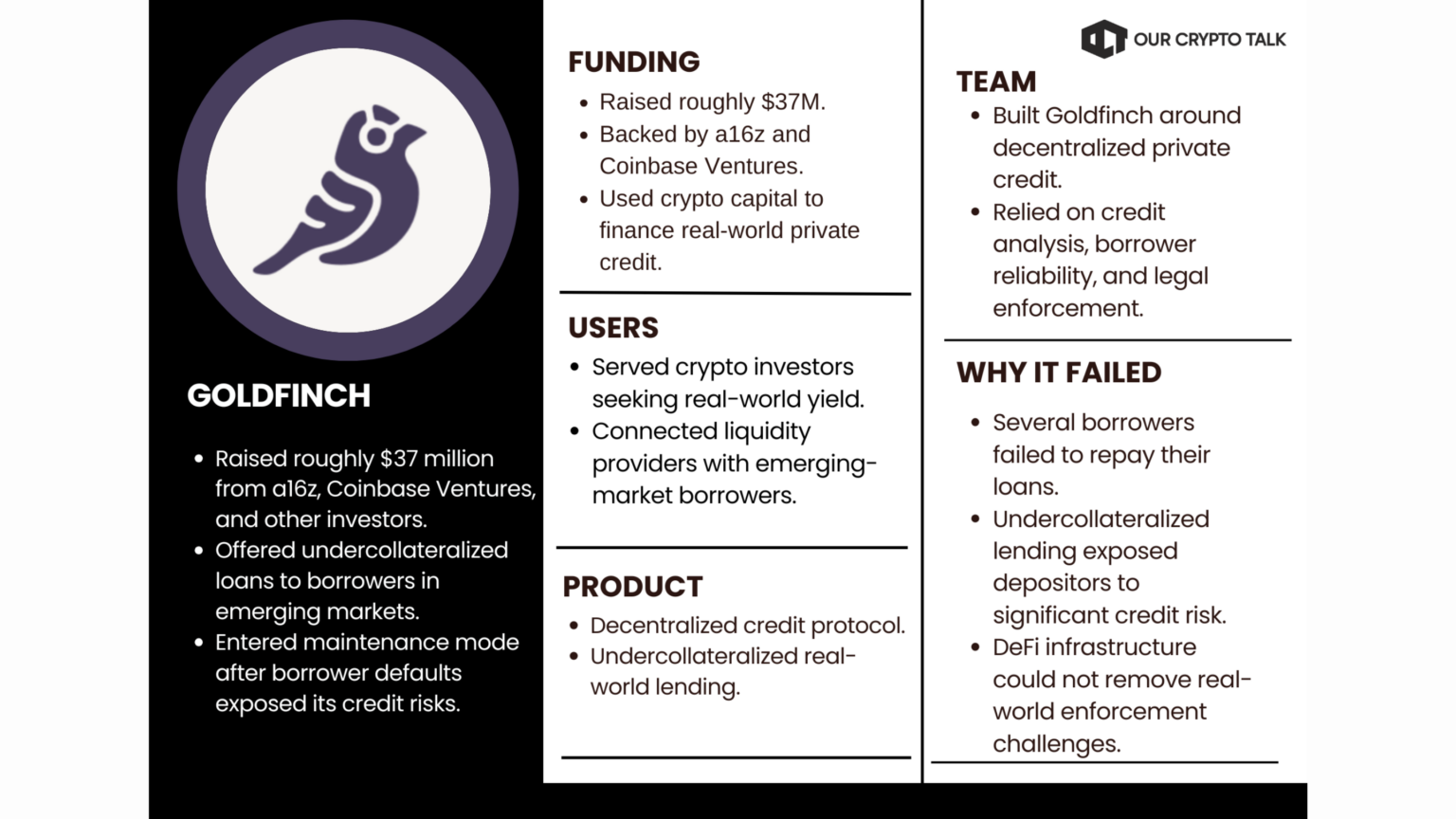
Goldfinch raised roughly $37 million from investors including a16z and Coinbase Ventures to build a decentralized credit protocol for real-world loans. The platform focused primarily on undercollateralized lending to borrowers in emerging markets. Its model promised to expand access to capital while giving crypto investors exposure to private credit and real-world yield.
However, real-world defaults exposed the limits of that model. Several borrowers failed to repay their loans, which left depositors facing lengthy recovery processes. By June 2026, the community approved a wind-down of new lending activity and moved the protocol into maintenance mode. Goldfinch showed that DeFi’s trustless infrastructure does not translate cleanly to loans that still depend on borrower reliability, credit analysis, and legal enforcement.
Ultimately, putting real-world credit on-chain does not remove default risk. It simply transfers that risk to token holders and liquidity providers who may not fully understand the underlying loans. Blockchain technology can improve transparency and settlement, but it cannot replace disciplined underwriting or guarantee repayment. The case carries an important warning for the wider RWA narrative, which OCT also explored in The Sub-100M RWA Race.
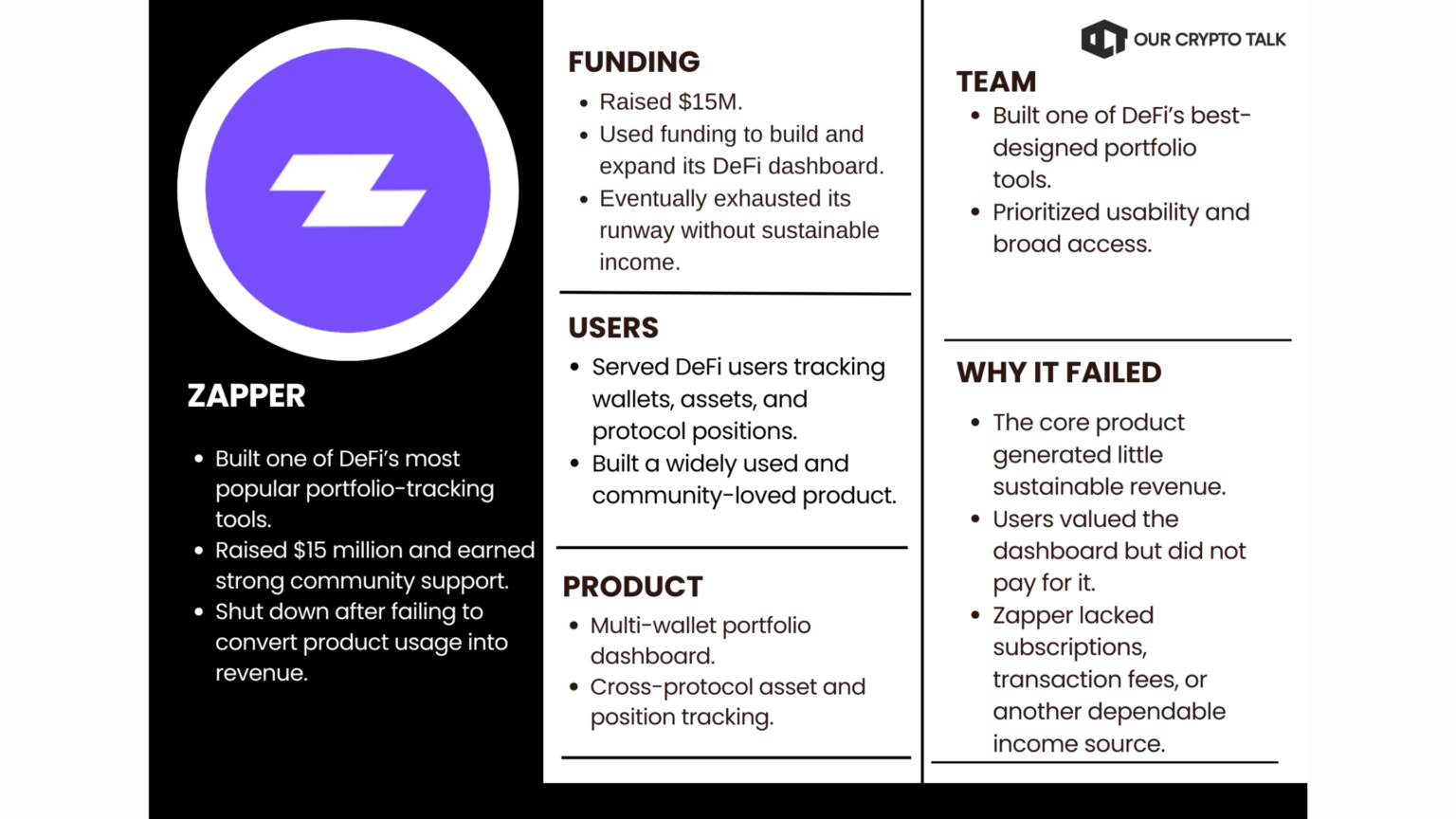
Zapper built one of DeFi’s most widely used and well-designed portfolio dashboards. The platform helped users track wallets, assets, and positions across multiple protocols, while its simple interface earned strong support from the crypto community. Zapper also raised $15 million. However, the company kept its core product free and never developed a sustainable revenue model. Meanwhile, competitors such as DeBank and Zerion targeted the same users and captured a growing share of the portfolio-tracking market.
Ultimately, Zapper proved that a great product does not automatically create a great business. Users may value a tool without showing any willingness to pay for it. Therefore, free crypto products need another reliable monetization path, such as subscriptions, transaction fees, premium analytics, or infrastructure services. Zapper never found one, and its popularity could not prevent the company from exhausting its runway.
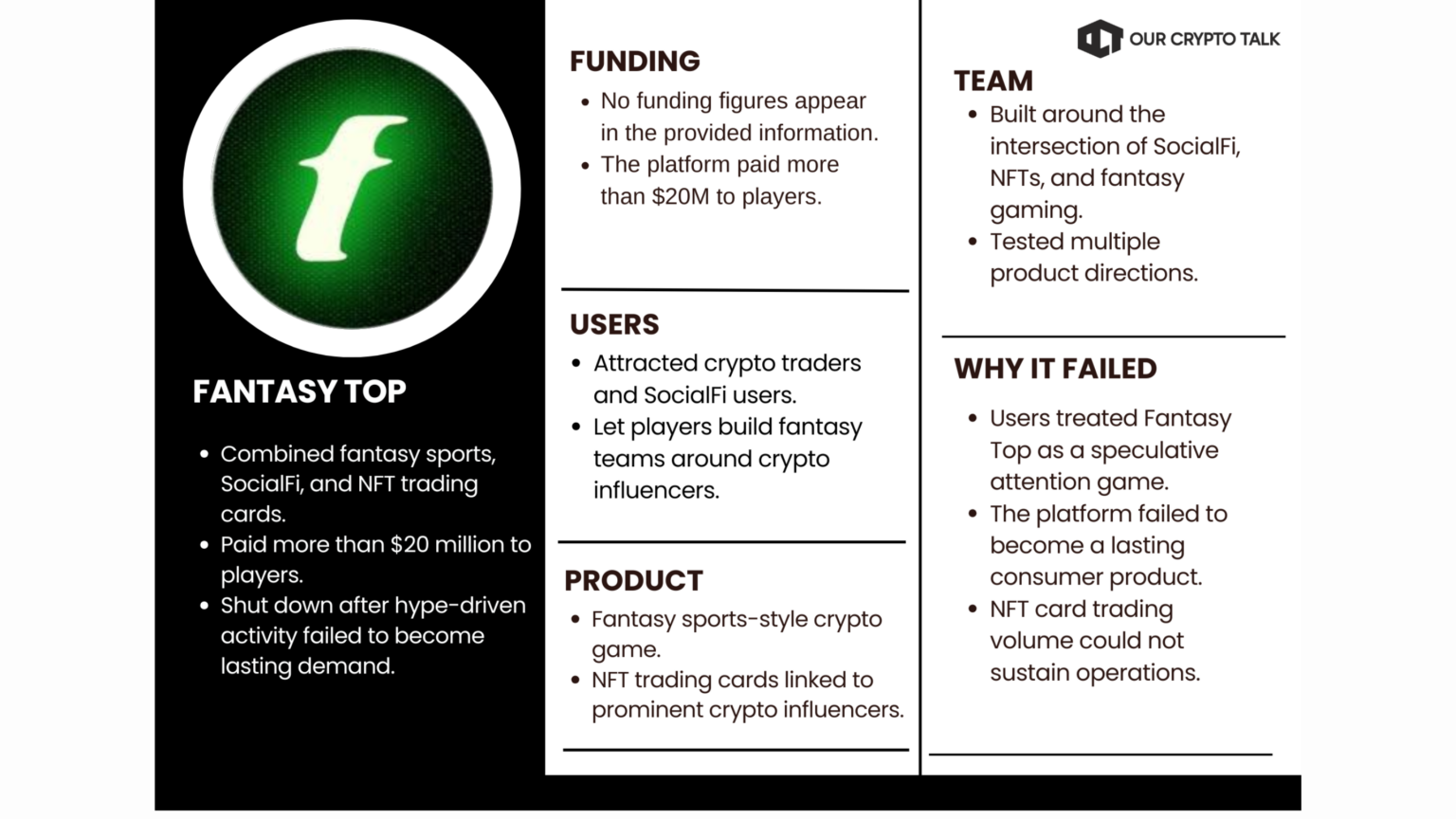
Fantasy Top combined fantasy sports, SocialFi, and NFT trading cards tied to prominent crypto influencers. Players built teams, while the platform scored each card using the influencer’s engagement on X. The game generated significant early attention and paid more than $20 million to players. However, users largely treated it as a speculative attention game rather than a lasting consumer product. The team concluded that NFT card trading volume could not support operations and failed to find durable product-market fit despite testing several adjacent products. Fantasy Top announced the closure on May 20, 2026. Its final fantasy competitions ended on June 18, and the website remained available for another seven days before the planned full shutdown at the end of June.
Ultimately, Fantasy Top showed that gamified social platforms live and die by hype cycles. These products can attract users quickly when rewards, speculation, and online attention align. However, activity collapses once the novelty fades and users move toward the next opportunity.
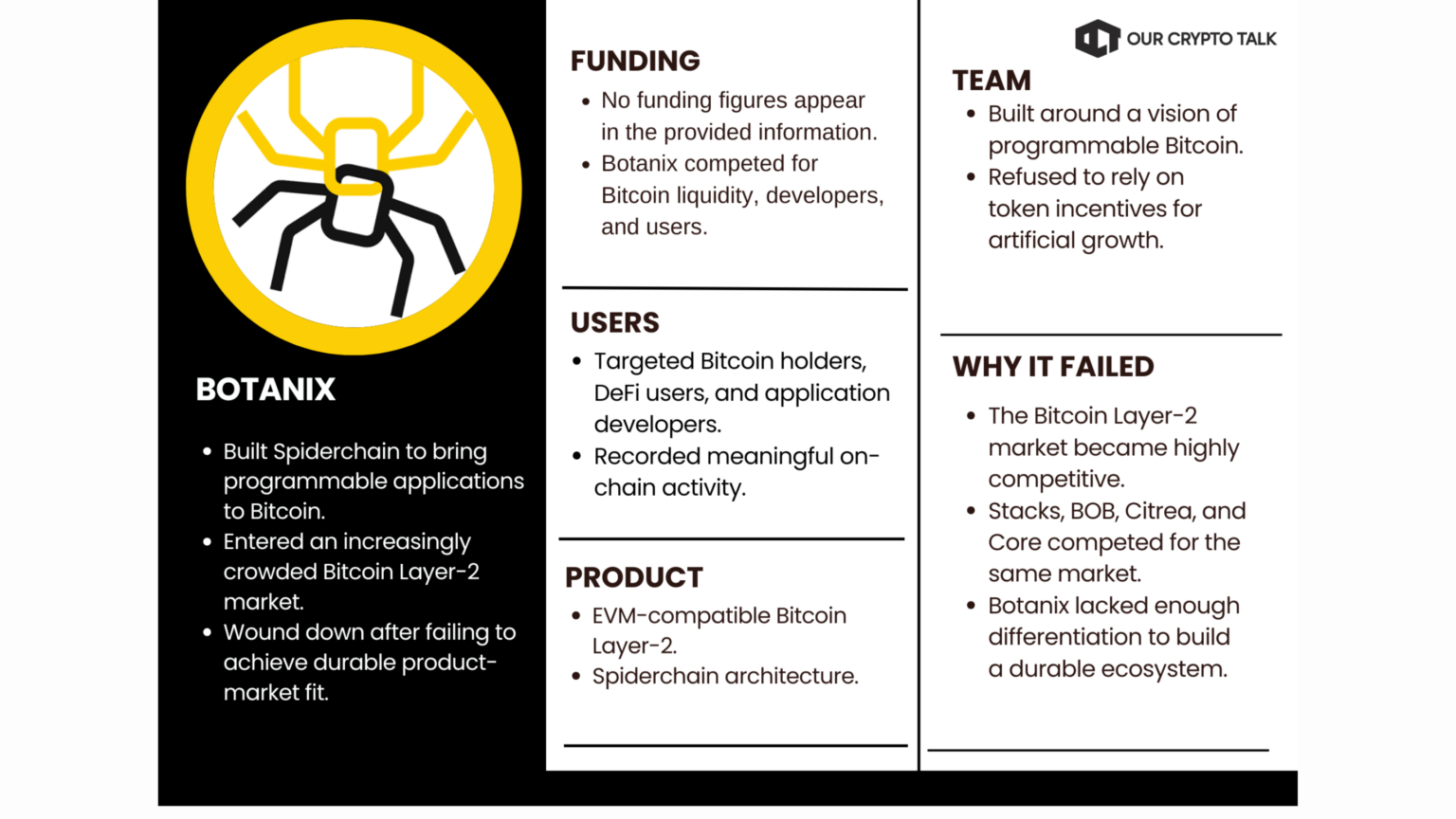
Botanix built Spiderchain, an EVM-compatible Bitcoin Layer-2 designed to bring smart contracts and DeFi applications to BTC. However, the Bitcoin L2 market became increasingly crowded, with projects such as Stacks, BOB, Citrea, Core, and Botanix competing for the same developers, users, and Bitcoin liquidity. Although Botanix recorded meaningful on-chain activity, it could not convert that activity into durable product-market fit. The team also refused to use token incentives to manufacture growth and ultimately concluded that the market was not ready for its vision of programmable Bitcoin.
Botanix announced its wind-down on June 5, 2026. The team targeted July 1 for the first shutdown stage, followed by a grace period through July 15 and a possible final network shutdown by August 1. The lesson remains clear: entering a popular narrative does not guarantee demand. In an overcrowded sector, projects need clear differentiation and a use case that users actively want. Otherwise, even strong technology can struggle to build a sustainable ecosystem.
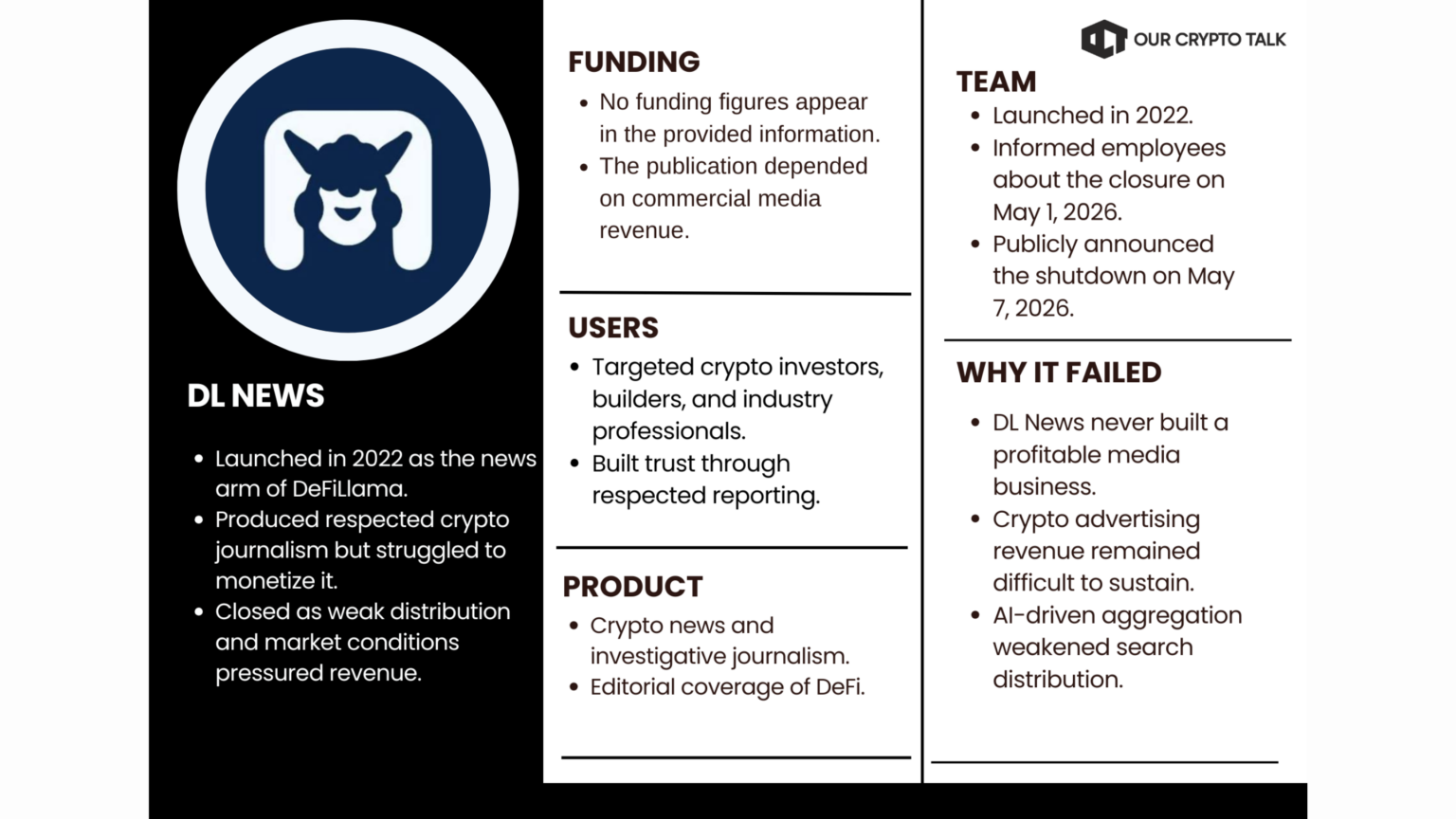
DL News launched in 2022 as the news arm of DeFiLlama, although an internal conflict effectively separated the publication from the data platform in early 2023. On May 7, 2026, DL News announced that it would close at the end of May after informing employees on May 1. The publication produced respected journalism, but it never developed a profitable business. Meanwhile, AI-driven aggregation weakened search distribution, audience growth remained limited, and the broader downturn made commercial sustainability increasingly difficult.
DL News proved that crypto media remains an extraordinarily difficult business. Publications need consistent advertising, subscriptions, sponsorships, or other reliable revenue streams. However, crypto’s boom-and-bust cycles make those income sources difficult to sustain. Strong reporting can build trust and industry influence, but neither guarantees a viable media business.
Funding, shutdown dates, sectors, and the primary causes behind each project’s closure.
Across the major crypto projects shut down 2026, one pattern appears repeatedly: users did not translate into revenue. Yupp attracted 1.3 million users, while Zapper built one of DeFi’s most popular portfolio dashboards. However, neither project created a sustainable business model. In 2026, venture capital firms stopped rewarding growth for its own sake. Instead, they demanded recurring revenue, credible monetization, and evidence that users valued the product beyond token incentives or free access.
Narrative dependence created the second major failure mode. Syndicate Labs built for the DAO tooling boom, Nifty Gateway depended on NFT speculation, and Botanix entered an increasingly crowded Bitcoin Layer-2 market. Each project tied its growth prospects to a sector narrative that eventually lost momentum. Once investors, developers, and users moved elsewhere, the addressable market shrank. In crypto, a strong narrative can accelerate adoption, but it can also hide weak underlying demand.
At the same time, many projects exhausted the capital they raised during 2021 and 2022. These teams spent heavily on hiring, incentives, infrastructure, and expansion while assuming they could raise another round later. However, the prolonged downturn changed investor expectations. By the time these projects needed follow-on capital, VCs had become more selective and wanted clear proof of product-market fit. Teams that still depended on future funding suddenly found the market closed.
Competitive displacement also punished early leaders. Loopring helped pioneer Ethereum Layer-2 technology, but Arbitrum, Base, Optimism, and other networks built larger ecosystems and attracted more liquidity. Similarly, Zapper faced direct competition from DeBank and Zerion. Being first can create an early advantage, but it offers little protection when a better-funded or better-executed competitor ships faster, captures developers, and builds stronger distribution.
Finally, Goldfinch exposed the limits of bringing real-world risk on-chain. Tokenizing loans can improve transparency and settlement, but it cannot make weak borrowers repay their debts. Defaults still happen, and investors still absorb losses. In this case, blockchain infrastructure changed how the market distributed and tracked credit risk, but it did not remove that risk. Goldfinch showed that crypto can modernize financial rails without changing the underlying economics of lending.
Crypto projects rarely shut down without warning. In most cases, the problems appear months before the official announcement. Investors can often spot those risks by tracking revenue, team activity, funding, token incentives, and product development.
Investors should combine these warning signs instead of relying on a single metric. RootData tracks formal shutdown status, DeFiLlama highlights falling TVL and protocol activity, while GitHub reveals whether developers continue shipping code. Together, these tools can help holders evaluate whether a project still has active development, sustainable demand, and enough runway to survive.


Tokenization of RWA yields onchain might be the biggest opportunity that no one has noticed
Cold Wallet Safety 2026: Are Hardware Wallets Still Safe?
One Token, Multiple Products. Can Zylo Deliver?
The Rise of NEAR Protocol 2026: Inside the 530% Rally and the ETF
Tokenization of RWA yields onchain might be the biggest opportunity that no one has noticed
Cold Wallet Safety 2026: Are Hardware Wallets Still Safe?
One Token, Multiple Products. Can Zylo Deliver?
The Rise of NEAR Protocol 2026: Inside the 530% Rally and the ETF