Robinhood Chain Projects worth watching in 2026: Pons, NetNet, Longbow, and more, plus the gas-subsidy cliff that will test which ones actually survive.

Author: Kritika Gupta
Robinhood Chain Projects have moved beyond the network’s early memecoin boom. In just 10 weeks, the ecosystem attracted over $400 million in TVL and produced major platforms across launchpads, lending, RWAs, and AI agents. Here are the seven projects defining what Robinhood Chain could become after the hype fades.
Robinhood Chain launched on July 1, 2026. Ten weeks later, the ecosystem has more than $400 million in TVL, while its dominant launchpad, Pons, has processed over $4 billion in volume. Developers have also launched NetNet, an OHM-style reserve protocol that briefly reached a $117 million market cap, alongside a lending protocol, an AI agent platform, an RWA aggregator, and infrastructure that rivals chains several years older.
This is what developers built during the chain’s first 10 weeks. These seven projects now define the Robinhood Chain ecosystem beyond CASHCAT and memecoins.
However, every project faces the same approaching stress test. Robinhood’s 90-day gas subsidy expires around the end of September, which means users will begin paying transaction fees in early October. The projects that retain activity after free transactions end will reveal whether Robinhood Chain has built a sustainable ecosystem or simply benefited from temporary incentives.
Seven Robinhood Chain projects beyond meme coins
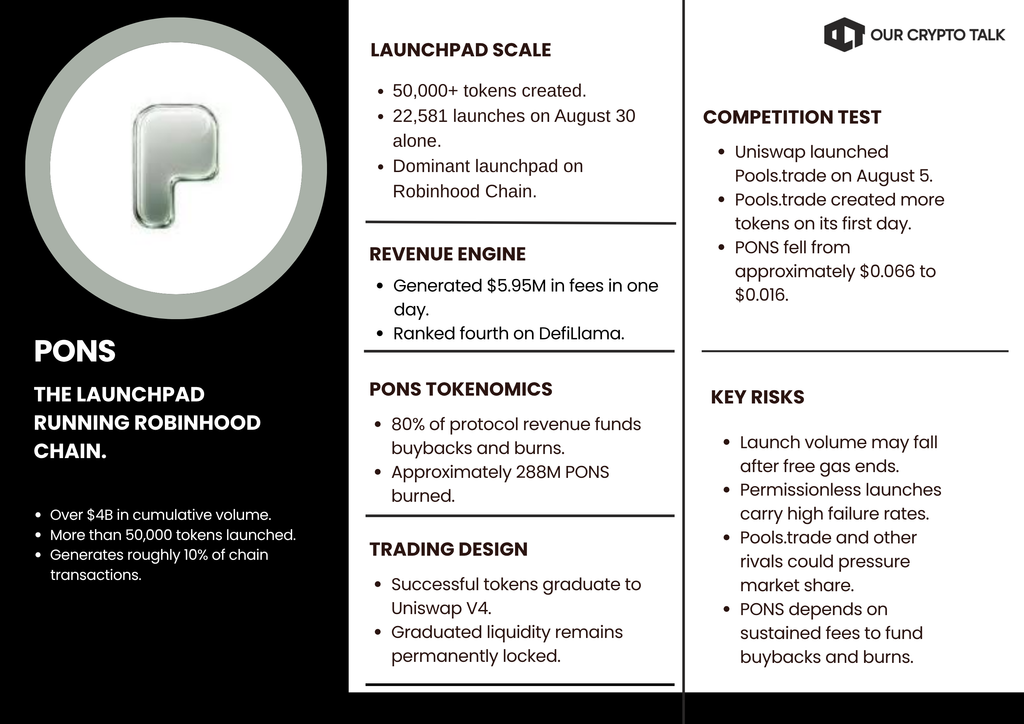
Pons ranks as Robinhood Chain’s most documented project and its dominant token launchpad. The platform has processed more than $4 billion in cumulative volume and launched over 50,000 tokens. On August 30 alone, users created 22,581 tokens through Pons. As a result, the platform now generates roughly 10% of all transactions on Robinhood Chain.
The protocol has also built one of the ecosystem’s strongest revenue engines. Pons generated $5.95 million in fees during a single day, ranking fourth across all protocols tracked by DefiLlama at the time. It directs 80% of protocol revenue toward PONS buybacks and burns. So far, the mechanism has removed approximately 288 million PONS, or 29% of the original one billion-token supply.
Meanwhile, Pons moves successful launches to Uniswap V4 and permanently locks their liquidity. The platform also uses wallet caps and a decaying launch tax to limit sniping during a token’s earliest trading period. These features helped Pons build a stronger trading and liquidity model than a basic permissionless token generator. For a broader comparison, read OCT’s existing analysis of crypto launchpads.
However, Pons has already faced serious competition. Uniswap launched Pools.trade on August 5, and the platform created more tokens than Pons on its first day. During this period, PONS collapsed from approximately $0.066 to $0.016 before recovering as Pons retained activity and fee revenue. The community now places Pons in its Blue Chip tier, but the end of Robinhood’s gas subsidy will test whether its launch volume can survive once users must pay for every deployment.
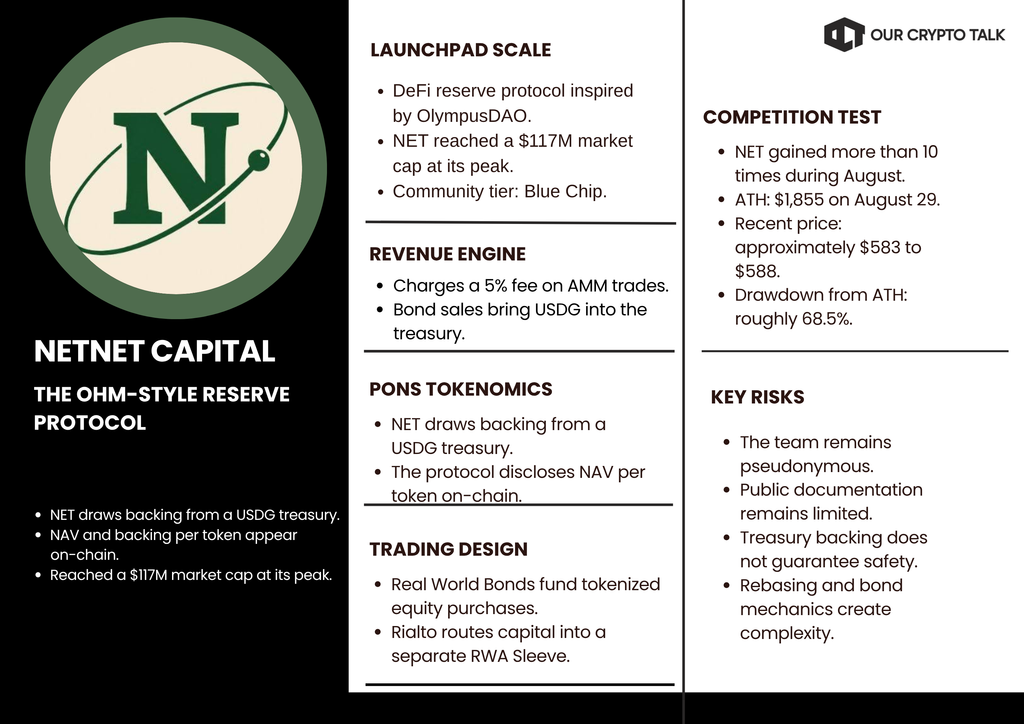
NetNet Capital is a DeFi reserve protocol inspired by OlympusDAO. Its native token, NET, draws its backing from a USDG treasury, while the protocol discloses its net asset value and backing per token on-chain. NetNet charges a 5% fee on automated market maker trades and uses a combination of sNET staking rebases, bond sales, and token buybacks to manage its treasury and supply.
However, NetNet extends the OHM model through its Real World Bonds desk. Subscribers deposit USDG and receive vested NET, while NetNet routes the capital through Rialto into tokenized equities held in a separate RWA Sleeve. This strategy supports the founder’s “RW-Play” thesis, which argues that tokenized real-world assets should offer interactive and gamified stock exposure. Its products include stock-based games through play.netnet.capital, turbo cards through turbo.netnet.capital, and margin trading through trading.netnet.capital. NetNet also integrates with Morpho through its Lombard Credit Facility and operates as a Delaware-registered entity.
NET became one of the biggest winners during Robinhood Chain’s August infrastructure rotation. The token gained more than 10 times alongside Delta and UP as capital moved from memecoins into utility projects. NET reached an all-time high of $1,855 on August 29 and briefly commanded a $117 million market cap. It now trades around $583 to $588, placing it approximately 68.5% below that peak. CryptoRank reported a price of $582.67 and a 68.6% drawdown, while CoinGecko showed NET near $587 at the time of verification.
The Robinhood Chain community places NetNet in its Blue Chip tier because it helped lead the shift toward infrastructure and RWA-focused projects. Still, “treasury-backed” does not guarantee safety. NetNet’s team remains pseudonymous, and the protocol provides limited public documentation for a system that combines rebasing incentives, bond sales, leveraged products, and tokenized equities. Investors should verify the treasury, NAV, and RWA Sleeve directly on-chain before treating the backing as protection.
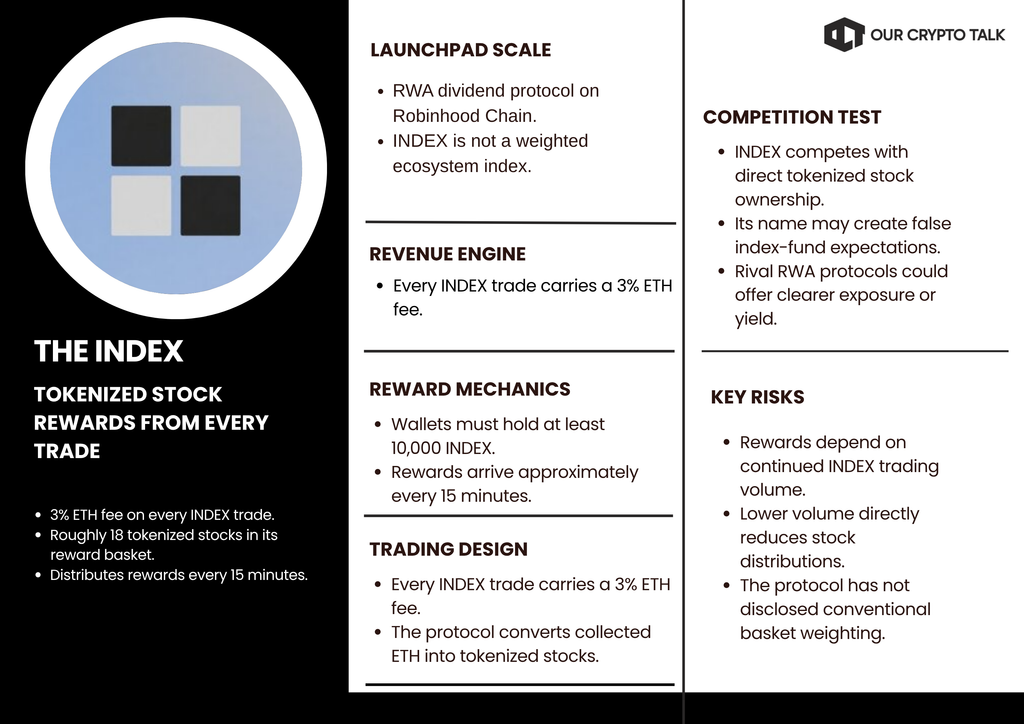
Despite its name, The Index does not appear to track a weighted basket of Robinhood Chain tokens such as PONS, NET, or CASHCAT. Instead, it operates as an RWA dividend protocol. Every INDEX trade carries a 3% fee paid in ETH, which the protocol uses to buy a basket of roughly 18 tokenized stocks. The basket includes AAPL, NVDA, TSLA, AMD, PLTR, and SPCX. It then distributes those assets proportionally every 15 minutes to wallets holding at least 10,000 INDEX, with no staking or manual claims. Because INDEX does not track an ecosystem basket, the protocol has not disclosed a conventional weighting or rebalancing methodology. New stocks reportedly enter the reward basket after reaching sufficient on-chain liquidity. Bitget Wallet describes the fee and distribution structure.
Therefore, INDEX does not directly fill the “I’m bullish on Robinhood Chain but do not know which ecosystem token to buy” gap. Instead, it gives holders exposure to a fee-funded stream of tokenized equities, while the INDEX token itself remains a standalone community token rather than a basket, synthetic index, or clearly DAO-governed fund. At the time of verification, INDEX traded near $0.027 with a market cap of approximately $26.8 million and a circulating supply of around 980.5 million tokens. However, limited public documentation makes the project’s stock-selection rules and governance structure difficult to assess. Moreover, rewards depend on INDEX trading activity, so lower volume directly reduces the stock distributions. DropsTab provided the live price, market cap, supply, and available structural details.
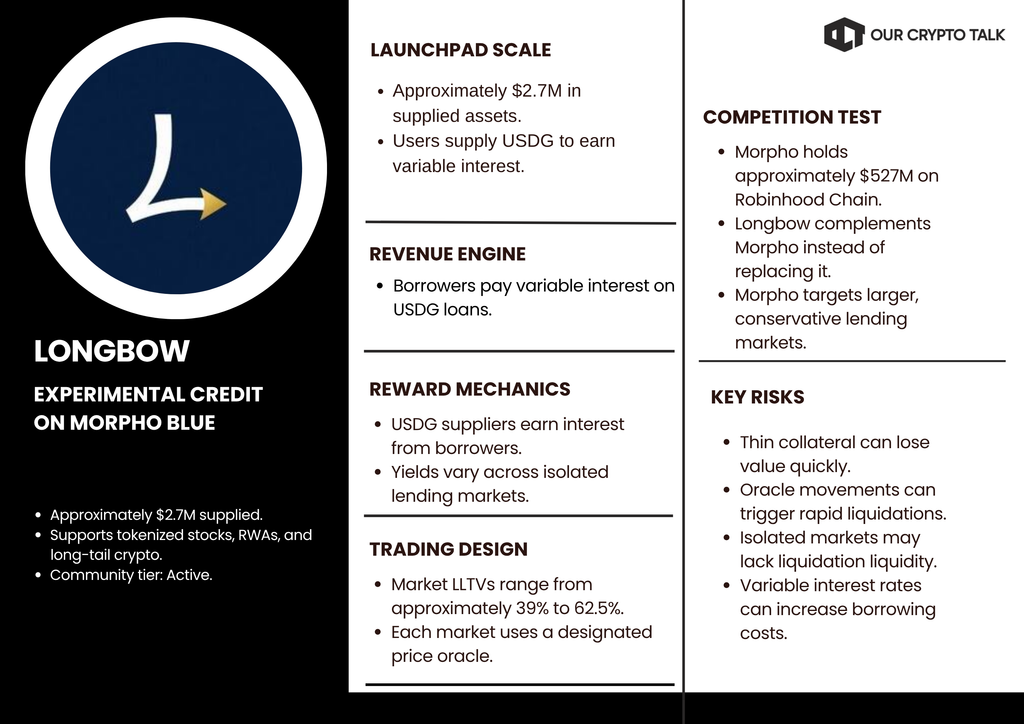
Longbow is an isolated lending and borrowing protocol built on Morpho Blue. Users can supply USDG and borrow against tokenized stocks, RWAs, and long-tail crypto assets such as PONS. Independent reviewer Bakas Media completed a full borrow-and-repay loop using PONS as collateral, borrowing USDG and monitoring the position’s liquidation price. Longbow’s dashboard has recently shown approximately $2.7 million in supplied value, although the figure changes with deposits and withdrawals. Individual markets set their own variable interest rates, oracle, and loan-to-liquidation value threshold. Examples include markets with LLTVs ranging from 39% to 62.5%. If a position’s loan value crosses its market’s LLTV because the collateral falls or the debt grows, liquidators can sell the collateral to repay the loan. Longbow’s live dashboard provides market-level metrics.
Longbow complements Morpho rather than competing with it directly. Morpho provides the underlying institutional-grade lending infrastructure, while Longbow creates smaller and more experimental markets for assets that conservative vaults may avoid. Notably, the earlier $133 million Morpho TVL figure is outdated. DefiLlama currently shows approximately $527 million in Morpho Blue TVL on Robinhood Chain. DefiLlama also places total chain lending near the same level. However, Longbow carries additional risk because thin collateral can fall quickly, oracle prices can move sharply, and isolated markets may have limited liquidity during liquidations. The team also remains pseudonymous, with one visible operator but no disclosed legal identities. The community currently places Longbow in its Active tier.
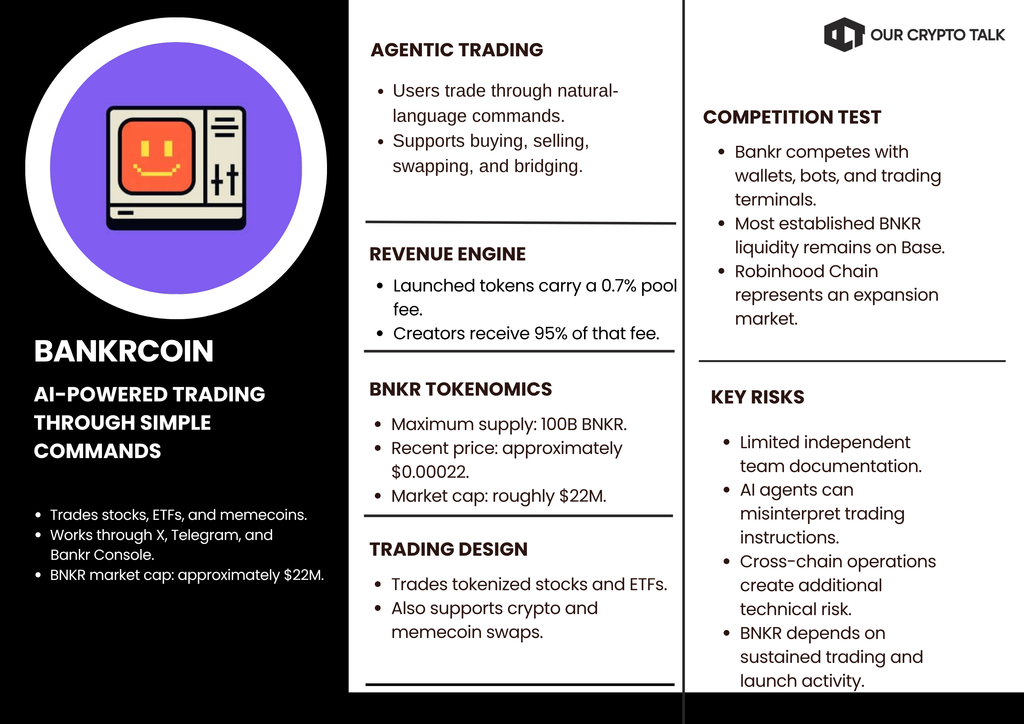
Despite its banking-themed name, BankrCoin is not primarily a payments token. BNKR is the ecosystem token for Bankr, an AI-powered trading agent that lets users buy, sell, swap, bridge, and place advanced orders through natural-language commands. On Robinhood Chain, users and AI agents can trade tokenized stocks, ETFs, and memecoins through X, Telegram, or the Bankr console. Bankr also supports token launches on Robinhood Chain, while 95% of each launched token’s 0.7% pool fee goes to its creator or agent. Additional protocol fees support BNKR buybacks and permanently locked liquidity. These live features give Bankr clearer utility than a simple banking-adjacent narrative. Bankr’s documentation explains the agent and fee mechanics.
BNKR operates across multiple chains, with most of its established liquidity and value still concentrated on Base. At the time of verification, the official 100 billion-supply BNKR token traded near $0.00022 with a market cap of approximately $22 million. CoinGecko provides the current market data. Public sources identify Igor Yuzovitskiy as a visible Bankr representative, although the project provides limited independent documentation about its broader team and corporate structure. Robinhood’s fintech identity gives Bankr strong narrative alignment, but the project must show that agent activity, order flow, and token-launch fees create sustained demand for BNKR rather than temporary attention.
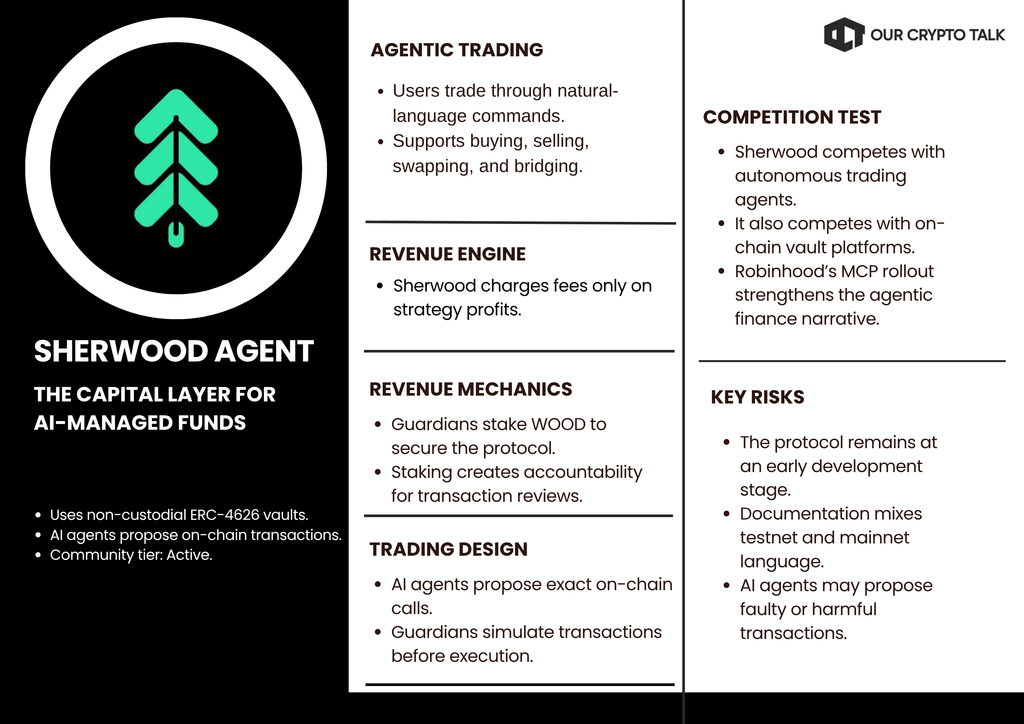
Sherwood Protocol does not operate as a single autonomous trading bot or a standalone analytics tool. Instead, it aims to provide a capital layer for AI-managed investment strategies. Each fund uses a non-custodial ERC-4626 vault, where depositors supply assets and receive shares. AI agents propose specific on-chain transactions, while depositors can vote on fund decisions. Meanwhile, guardians stake WOOD to simulate proposed calls and block potentially malicious transactions. The protocol charges performance fees only when a strategy generates profits. Therefore, Sherwood functions more like infrastructure for transparent, agent-managed funds than a traditional portfolio-management chatbot.
Sherwood fits Robinhood Chain’s wider AI narrative alongside projects such as Artificially Inu, which the community places in its Blue Chip tier. Robinhood announced its MCP-based Agentic Trading system in May 2026 before rolling out crypto trading to eligible US users in mid-August. The system lets third-party agents access a separately funded account and place supported trades through Robinhood’s MCP server. Robinhood’s official guide explains the account controls and limitations. However, Sherwood still appears early, and its documentation mixes testnet and mainnet language. Users should verify its active vaults and WOOD contract on-chain. The community places Sherwood in its Active tier, while its Sherwood Forest branding gives it a natural connection to Robinhood’s identity.
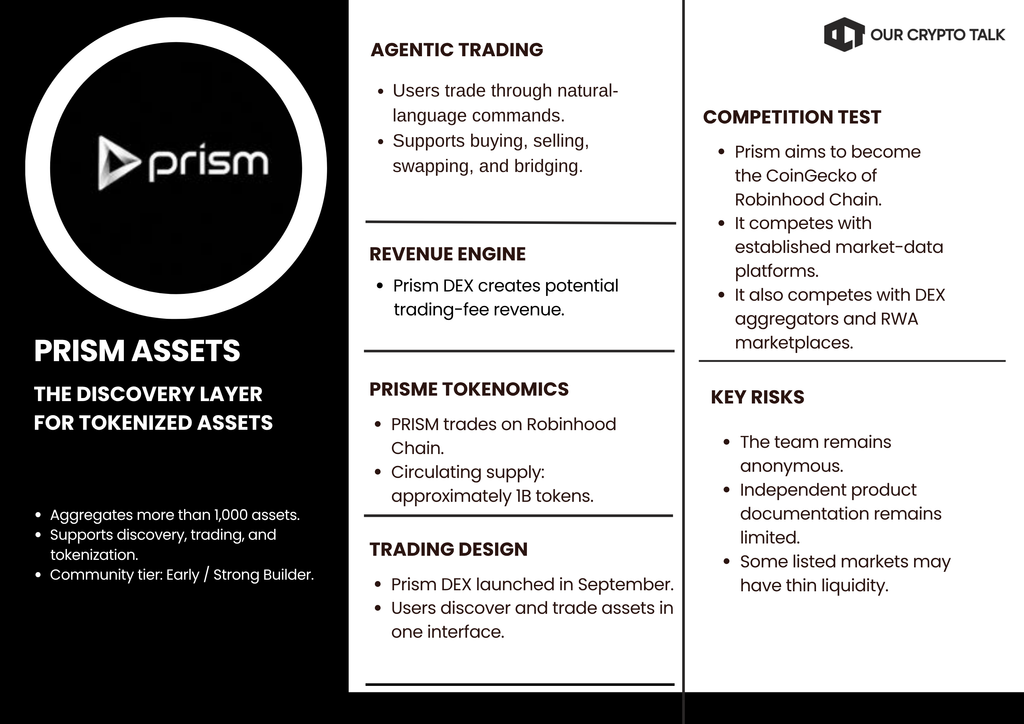
Prism Assets is building a discovery, trading, and issuance layer for tokenized real-world assets. Bakas Media’s review referenced more than 1,000 aggregated assets, while Prism describes a broader multi-issuer and multi-chain catalogue. The interface aims to help users discover and manage tokenized stocks, ETFs, private-market assets, DeFi tokens, and other RWAs without searching across separate platforms. The project has moved beyond a static catalogue. It launched an RWA and small-business tokenization platform in August, followed by the live Prism DEX in September. Prism has also introduced Premium Radar, which highlights tokenized assets trading below the value of their underlying instruments. Prism’s official account publishes its live product updates.
If Prism can maintain accurate asset data and reliable trading routes, it could become the “CoinGecko of Robinhood Chain” while adding execution and tokenization tools. The PRISM token trades on Robinhood Chain, with CoinGecko reporting a market cap of approximately $4.4 million and a one billion-token circulating supply at the time of verification. However, Prism remains an early-stage product with an anonymous team, limited independent documentation, and some thin-liquidity markets. The community therefore places it in the Early / Strong Builder tier rather than treating it as established infrastructure.
Every project on this list faces the same stress test. Robinhood Chain launched with a 90-day gas subsidy that made eligible transactions free for Robinhood Wallet users. However, the subsidy expires around the end of September, so early October 2026 will reveal how much activity came from genuine demand and how much came from temporary incentives.
Once gas fees return, the ecosystem may lose casual users who only traded, launched tokens, or tested applications because transactions cost nothing. Launchpads will face the clearest test. Pons created 22,581 tokens on August 30 alone, but how many users will continue launching tokens when every deployment carries a real gas cost? Lending protocols, RWA platforms, and AI agent products must answer the same question through sustained deposits, trading volume, and active users.
The gas subsidy cliff is the single most important event for the Robinhood Chain ecosystem in Q4 2026. Every project on this list must prove it can survive without free transactions. Ultimately, the projects that retain users after gas fees return will emerge as the ecosystem’s real winners.
This article is for information only and is not financial advice. Every project here is under 10 weeks old and highly experimental.