StonkFun launchpad hit a $200M market cap in 5 weeks, flipped Pump.fun on daily revenue, and minted a $6.2M trade. See how stock-pairing works and the risks.

Author: Kritika Gupta
The StonkFun launchpad turned a new token-pairing mechanic into one of Solana’s fastest-growing crypto narratives. Within five weeks, STONK crossed a $200 million market capitalization, protocol revenue reached $1.355 million in a single day, and one early trader turned a $431,000 position into an unrealized $6.2 million.
However, StonkFun offers more than another memecoin factory. The platform lets creators launch tokens against tokenized stocks, ETFs, commodities, and cryptocurrencies instead of relying only on SOL or USDC. This article examines how stock pairing works, why the Raydium LaunchLab integration accelerated growth, how STONK compares with PONS, and which risks could challenge the platform’s momentum.
StonkFun launched on Solana in early August 2026. Five weeks later, its STONK token crossed a $200 million market cap, while daily protocol revenue overtook PONS at $1.355 million versus $1.21 million on September 10. Meanwhile, one trader turned $431,000 into $6.2 million. On September 6, STONK surged 250% in a single day after StonkFun integrated with Raydium LaunchLab. Pump.fun, Solana’s dominant launchpad for two years, quickly copied the feature but failed to recapture the market’s attention.
Also known as LaunchOnSF, StonkFun operates a permissionless token launchpad that lets creators pair new coins with almost any supported asset. Instead of limiting launches to SOL or USDC pairs, the platform supports tokenized stocks, ETFs, commodities, currencies, cryptocurrencies, and other StonkFun tokens. Therefore, a memecoin can trade against tokenized Apple, Tesla, gold, Bitcoin, or SPYx, Backed’s tokenized S&P 500 tracker.
Several catalysts drove the rapid growth. The Raydium LaunchLab integration reduced token deployment costs from 0.29 SOL to 0.03 SOL, opened access to custom quote assets, and routed more volume into Raydium pools. At the same time, StonkFun used about 60% of platform fees to buy and burn STONK, linking protocol activity to a shrinking token supply. As a result, StonkFun challenged the standard SOL-paired launchpad model and showed that smaller platforms can compete with Pump.fun by offering differentiated markets, and new trading narratives.
StonkFun (LaunchOnSF): Key Platform and Token Metrics
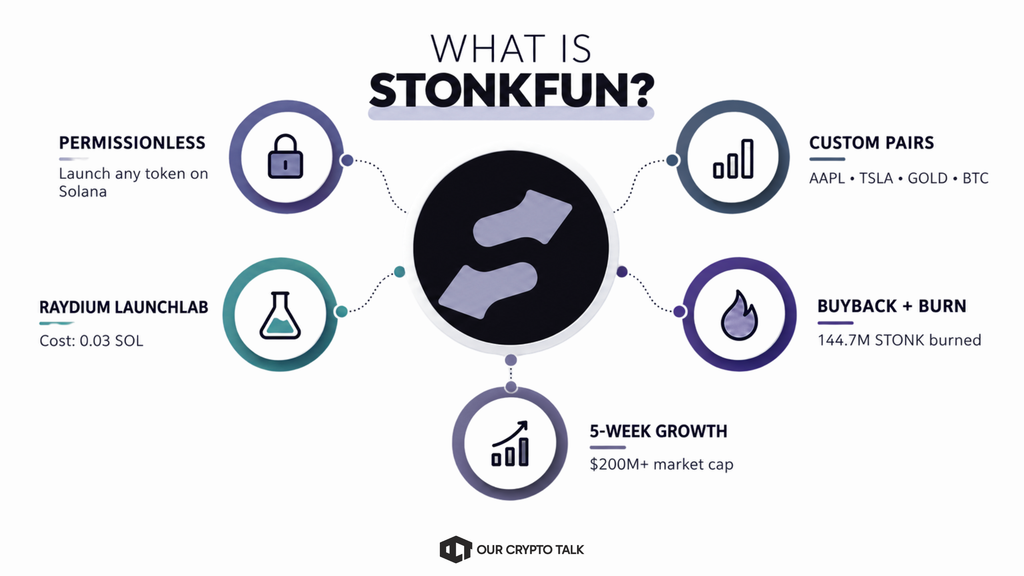
LaunchOnSF, also known as StonkFun, is a permissionless token launchpad built on Solana. Anyone can use the platform to create and launch a token. However, StonkFun changes the standard launchpad model by allowing creators to pair new tokens with tokenized stocks, ETFs, pre-IPO assets, commodities, currencies, and cryptocurrencies instead of limiting them to SOL or USDC.
Creators can choose from supported quote assets such as tokenized AAPL, TSLA, gold, or BTC. Meanwhile, STONK itself trades against SPYx, Backed’s tokenized S&P 500 tracker. As a result, STONK’s market price reflects its value relative to SPYx rather than a conventional dollar or SOL pair.
On September 5, StonkFun integrated with Raydium LaunchLab. The integration lowered the token deployment cost from 0.29 SOL to 0.03 SOL and gave new launches access to Raydium’s bonding curves and liquidity infrastructure. In addition, StonkFun uses protocol revenue to buy STONK from the open market and permanently burn the purchased tokens. By mid-September, the protocol had burned 144.7 million STONK, equal to 14.4% of the original 1 billion supply and approximately $46.8 million at the reported valuation. Reports also placed the daily burn rate near 0.55%.
On Pump.fun, a memecoin trades against SOL. On StonkFun, that same memecoin can trade against Apple stock. That is the platform’s entire pitch, and it helped STONK reach a $200 million market capitalization within five weeks.
Traditional launchpads usually create Token/SOL pairs. Therefore, two forces influence the token’s market value: demand for the token and changes in SOL’s price. When SOL rises, the quote asset can support the pair’s dollar value. When SOL falls, it can add further downside pressure. StonkFun replaces SOL with assets such as SPYx, AAPL, or TSLA. As a result, each pair combines two independent price feeds: demand for the launched token and price movements in the underlying tokenized stock or ETF.
This structure creates a hybrid instrument that combines memecoin speculation with stock-linked exposure. For example, a trader who buys a token paired with TSLA expresses a view on both the memecoin and Tesla’s market performance. However, the pairing does not give the trader ownership of Tesla shares, nor does a TSLA rally guarantee that the memecoin will rise. Instead, the underlying asset influences the pair’s liquidity dynamics and reference value while the token follows its own supply and demand.
For creators, stock pairing gives every launch an immediate narrative anchor. Traders can identify and remember “the TSLA memecoin” more easily than another generic Solana token. Meanwhile, the additional price reference can provide stronger value support within the liquidity pool and create cross-market arbitrage opportunities when the tokenized stock, its traditional-market counterpart, and the paired memecoin move out of alignment. StonkFun did not simply create another launchpad. It created a new asset class: memecoins with stock exposure.
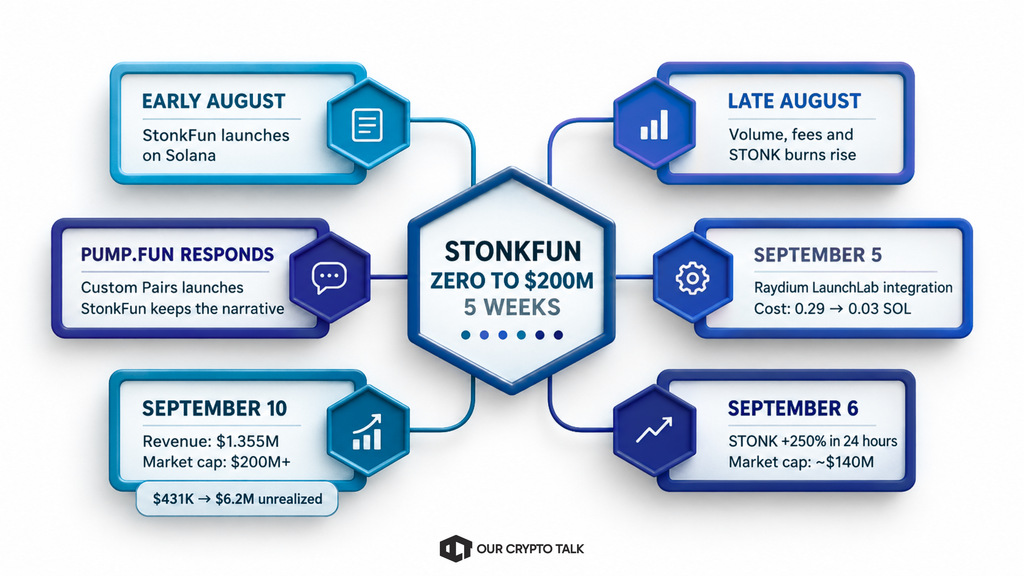
StonkFun launched on Solana in early August 2026 and introduced STONK as its native token. During late August, trading volume and fee revenue began to climb as more creators launched tokens against custom quote assets. At the same time, the protocol activated its buyback-and-burn mechanism, using platform revenue to purchase STONK from the open market and permanently remove it from circulation.
The key catalyst arrived on September 5, when StonkFun announced its integration with Raydium LaunchLab. The upgrade reduced token deployment costs from 0.29 SOL to 0.03 SOL and triggered a wave of new launches. One day later, STONK surged 250% within 24 hours and reached a market capitalization of approximately $140 million. The integration also benefited Raydium, with RAY gaining about 90% over the week as StonkFun routed more launches, volume, and fees through its infrastructure.
By September 10, StonkFun generated $1.355 million in daily revenue, overtaking PONS at $1.21 million. Meanwhile, STONK’s market capitalization crossed $200 million. One wallet captured the rally early by buying $431,000 worth of STONK when the token held a market cap near $10 million. When STONK reached approximately $166 million, the wallet’s unrealized position had grown to $6.2 million.
Pump.fun responded by adding “Custom Pairs,” which allowed creators to pair new tokens with tokenized stocks and other supported assets. However, the feature failed to shift market attention away from StonkFun. Although Pump.fun retained its larger user base and long-term revenue lead, StonkFun controlled the narrative by introducing stock-paired launches first and linking them to a rapidly shrinking STONK supply.
PONS launched on Robinhood Chain in July 2026, while STONK followed on Solana in August. Both tokens gained traction during the same period, and both platforms use protocol fees to fund buybacks and permanently burn their native tokens. Moreover, each platform surpassed Pump.fun in daily revenue during its respective surge. Their parallel growth placed them at the center of the stock-paired memecoin narrative, where creators launch tokens against tokenized equities instead of standard crypto assets. OCT previously explored how quickly leadership can shift within this sector in its Pump.fun vs Lets Bonk launchpad comparison.
However, the two platforms offer different core mechanics. Pons sends graduated tokens into permanently locked Uniswap liquidity pools, making its anti-rug structure the main selling point. By comparison, StonkFun lets creators pair tokens with stocks, ETFs, commodities, and other assets, which gives traders cross-asset exposure. PONS leads in supply reduction and cumulative revenue, with more than 29% of its supply burned compared with 14.4% for STONK. Meanwhile, STONK leads in market capitalization and short-term momentum, crossing $200 million while PONS traded closer to the $30 million to $40 million range.
The chain split creates practical friction for traders. STONK lives on Solana, while PONS lives on Robinhood Chain, so users may need separate wallets and gas tokens to trade both. As AirdropAlert noted, managing those requirements quickly becomes inconvenient, while multichain trading apps can simplify discovery and execution. OCT’s FOMO vs Pump.fun comparison explains how the FOMO app approaches multichain token discovery and trading. Ultimately, STONK and PONS express the same market narrative through different chains and product designs.
STONK vs PONS: Two Launchpads, Two Chains, One Narrative
On September 5, StonkFun began routing every new deployment through Raydium LaunchLab. The integration reduced token deployment costs by approximately 90%, from 0.29 SOL to 0.03 SOL, and triggered a wave of new launches. As StonkFun activity moved through Raydium’s infrastructure, the decentralized exchange collected more trading fees. Meanwhile, LaunchLab climbed to ninth place among all token launchpads tracked by DefiLlama.
The additional volume also supported RAY’s market momentum. Raydium’s native token gained approximately 90% during the week as StonkFun launches generated more volume, liquidity, and fees across Raydium pools. At the same time, more than 15 tokenized U.S. stocks went live on the exchange, including Boeing, Costco, Reddit, Roblox, and Lululemon. Backpack Securities issued the assets through Sunrise, giving StonkFun creators a broader selection of stock-based quote assets.
One tokenized Grindr stock generated approximately $11 million in trading volume during its first hour, demonstrating the demand for 24/7 onchain equity markets. StonkFun then turned those assets into quote pairs for new token launches, creating another source of activity for Raydium. StonkFun did not just grow itself. It grew Raydium. That symbiosis makes the integration structural rather than cosmetic.
StonkFun launchpad had operated publicly for only five weeks by mid-September 2026. Therefore, the market has not tested the protocol through multiple cycles, prolonged volatility, or sustained declines in user activity. Its revenue data also requires context. StonkFun surpassed PONS in daily revenue on one day, but a single result does not establish a lasting trend. PONS still leads in cumulative and 30-day revenue, so traders should not treat StonkFun’s short-term spike as a sustainable run rate.
Furthermore, StonkFun depends heavily on the stock-paired memecoin narrative. That trend could lose attention as quickly as it gained it. The model also introduces counterparty risk because assets such as SPYx rely on centralized issuers like Backed. If an issuer encounters custody, liquidity, or redemption problems, the affected quote asset could destabilize every token paired with it. In addition, stock pairing does not change the underlying launchpad math. Most newly launched tokens will still lose nearly all their value, regardless of whether they trade against SOL, SPYx, or tokenized Apple stock.
The wallet that turned $431,000 into an unrealized $6.2 million position also represents survivorship bias. For every early buyer who captures a return of that size, hundreds of traders may enter later and lose most of their capital. Finally, StonkFun still operates at a much smaller scale than Pump.fun. Pump.fun has generated approximately $1.22 billion in cumulative revenue and maintains a market capitalization near $1.1 billion. By comparison, STONK’s $200 million valuation makes it more than five times smaller. Pump.fun also controls deeper liquidity, a larger user base, established trading tools, and two years of network effects. StonkFun captured the narrative, but it has not displaced the market leader.
This article is analysis, not financial advice.