Understanding protocol mechanism and liquidity shaping in DeFi, covering AMMs, LP risks, liquidity strategies, and capital allocation.
Understanding protocol mechanism in DeFi can give a clearer picture of how liquidity pools work, the risks involved, and how different protocols use various liquidity approaches. This article provides a friendly yet detailed comparison of DeFi pool mechanisms and liquidity strategies.
It’s been a while since I first try sorting out the various ways liquidity can be provided. Along the way, I realized it’s not really about “liquidity shaping” but more about how liquidity set up its structure ” LP mechanism structure “. It might seem like a small diff, but it’s actually on a whole other lens.
Here’s the glitch:
Mechanism structure is all about how the pool is put together; think multi asset or single-asset pools (like Curve’s TriPool), how rewards get shared, and how funds are balanced inside the pool (most go with a 50/50 split, but not always). Basically, it’s the set of tools a protocol hands to liquidity providers (LPs) so they can customize their strategies, aligning their contributions with their comfort level for market risks and their investment plans.
Understanding protocol mechanisms is important because each structure gives liquidity providers different ways to manage capital, exposure, and market risk.
Meanwhile, liquidity shaping is just about how prices are laid out across different ranges. A structure like the “Concentrated Liquidity Market Maker (CLMM)” can offer lots of shaping options, while a “Constant Product Automated Market Maker (CPAMM)” sticks to one shaping style.
Understanding protocol design makes it easier to see why different AMMs use different approaches to liquidity and price distribution.
“Here I only explain the most used / harder one to understand”
🔹 Discrete Liquidity Market Maker (DLMM):
The Liquidity is provided at specific price points rather than across a continuous range, allowing for targeted liquidity placement
🔹 Constant Product Automated Market Maker (CPAMM):
It uses the formula x * y = k, where x and y are the reserves of two tokens, and k is a constant. This ensures that any trade maintains the product of the reserves, facilitating continuous liquidity.
🔹Constant Sum Automated Market Maker (CSAMM):
It maintains a constant sum of reserves (x + y = k), ideal for assets with stable values, as it offers zero slippage for trades at the same price.
🔹Hybrid Automated Market Maker (Hybrid AMM):
It combines features of CPAMM and CSAMM to optimize trading between assets with different volatility, balancing between constant product and constant sum formulas.
🔹Concentrated Liquidity Market Maker (CLMM):
It enables liquidity providers to allocate funds within specific price ranges, enhancing capital efficiency by concentrating liquidity where it’s most needed.
Here is a comprehensive table I made which associate every type of liquidity structure to liquidity shaping :
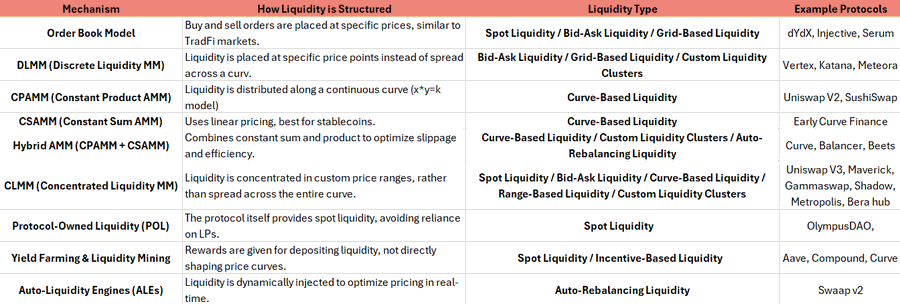
What’s misleading is that the opposite classification is also possible but makes less sens. Because a protocol is usually based on one mechanism and can use multiple liquidity shaping type !
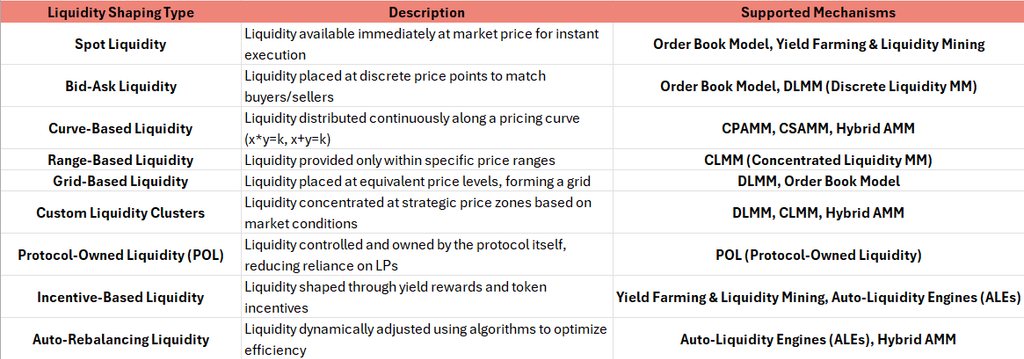
Here is one of the well explain old post on AMM :
Understanding protocol structures also matters when evaluating liquidity provider risks, because the mechanism and liquidity shape can determine how those risks appear.
Risk is one of the biggest factors guiding liquidity providers’ choices. I’ll admit, I block quite a bit here myself at first, unsure where to focus or what really mattered. For a while, I thought every protocol carried the same risks. But that’s exactly why these different mechanisms exist; the whole idea is to keep risks low while maximizing liquidity, all while reducing slippage as much as we can. Here’s the trick to figuring out LP trading risks: they don’t pile up the same way for every liquidity shape; there’s a key difference to spot.
Risks split into two types: the “core risk,” which comes from how the liquidity pool is built, and the “add-up risk,” tied to how the liquidity is shaped across price ranges.
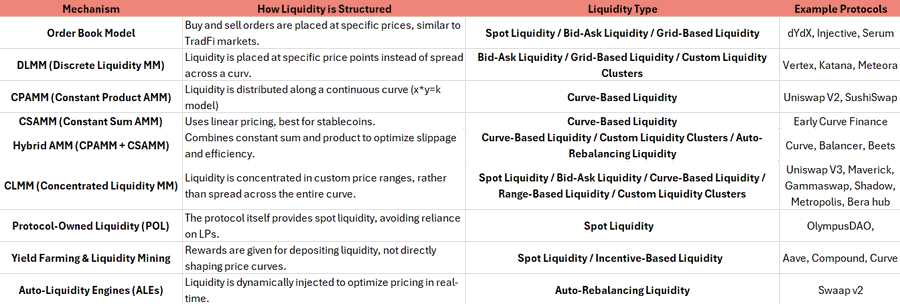
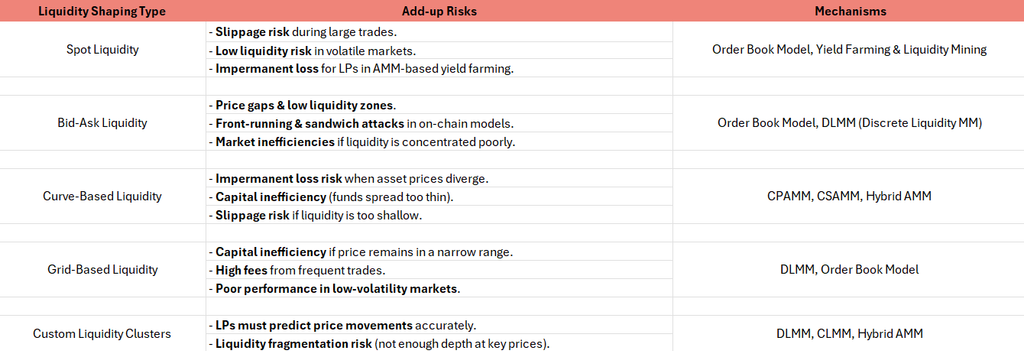
Again, notice that only specific Liquidity shaping type do add up risks to the core risk. Also Impermanent loss risks is the harder risks to bear.
The more “free” the liquidity shaping will be the more risk and monitoring will be.
The risks also depend on the pair you are choosing, the more volatile the pair the riskier it is.
The LP (Liquidity Provider) would have been better off holding the assets separately instead of providing liquidity.
Constant Product AMMs (CPAMM) use the formula x * y = k, meaning price changes cause an imbalance in token reserves. Thus Traders arbitrage the pool, forcing LPs to sell the underperforming asset at a worse price.
Understanding protocol mechanisms helps explain why these reserve changes can create impermanent loss for liquidity providers.
How to mitigate?
The difference between the expected price of a trade and the actual price executed. It happens when liquidity is too low or a large order significantly impacts price.
How to mitigate?
🔹Use limit orders instead of market orders (Order Book Model, DLMM).
🔹Trade in high-liquidity pools (e.g., Ethereum mainnet vs. smaller chains).
🔹Use CLMMs to concentrate liquidity in relevant price ranges.
Bots detect pending transactions and submit their own trades first, profiting from predictable price movements.
How to mitigate?
Occurs when liquidity is split across multiple pools or price levels, making it harder to execute large trades without moving the price. It happen because too many AMM versions ( Uniswap V2 vs. Uniswap V3 vs. SushiSwap).
Also could be that Order Books & DLMMs distribute liquidity at discrete price levels instead of a smooth curve.
How to mitigate?
🔹Use aggregators (1inch, Paraswap, CoWSwap).
🔹Trade on platforms with deep liquidity (dYdX, UniswapX).
Exploits in DeFi smart contracts lead to hacks, liquidity drains, or rug pulls.
How to mitigate?
🔹Use audited protocols (CertiK, Trail of Bits audits).
🔹Verify timelocks & multisigs before trusting a project.
Happens when too many people join a liquidity mining program, reducing rewards per LP. Once incentives end, LPs withdraw liquidity, causing a crash.
How to mitigate?
🔹Pick sustainable yield protocols ( GMX, Curve with veCRV model).
🔹 Watch emission schedules (high emissions = short-term farming only).
It dynamically move liquidity across price ranges to optimize efficiency. If the algorithm over-adjusts, liquidity may be placed at unprofitable price levels.
It happens because of a Bad algorithm design = liquidity wasted in low-activity price zones.
Or
Frequent rebalancing = high gas costs & inefficiencies.
How to mitigate?
🔹Choose ALEs with transparent optimization models.
🔹Use hybrid strategies (manual + auto rebalancing).
RECAP :
CPAMM Risks -> Impermanent loss, slippage
CLMM Risks -> Out-of-range liquidity, requires active management
DLMM Risks -> Liquidity fragmentation, front-running
Order Book Risks -> MEV attacks, high gas costs on-chain
Yield Farming Risks -> Dilution, exit liquidity risk
POL Risks -> Protocol mismanagement, rug pulls
Auto-Liquidity Risks -> Smart contract bugs, over-adjustment
Understanding protocol risks helps liquidity providers choose a mechanism and liquidity structure that better matches their capital and risk tolerance.
Every yield farmer has their own risk aversion, coin preference, and agility with market trends. Here are some main strategy drivers according to portfolio size and risk aversion:
🔹The smaller the portfolio is, the riskier you’ll want to be. That’s a bit counterintuitive since smaller holders are often the least skilled. A small portfolio could go on a DLMM, allocate to a stable coin pool, and use a spot-type liquidity shape, concentrating the liquidity in a very small range, which could mitigate the risk.
🔹For a heavy portfolio, playing it safe sounds like the best alternative. Look for old, highly capitalized protocols like Uniswap or Curve on a yield farming mechanism or hybrid AMM and allocate your capital in a stable coin pool.
🔹For a low risk aversion profile, the strategy would be to allocate liquidity on CLMM or DLMM mechanism-type protocols and use a bid-ask liquidity shaping type.
But again, this also depends on market trends!
🔹During low volatility times, you can try riskier pools with high APY; the price won’t move much. While during high volatility times, you would focus more on stable coin pools. But again, you’ll be tempted to go full risk when volatility is high to benefit from the rewards.
The choice is hard to make; there isn’t a good or bad strategy, the combinations are infinite
Understanding protocol mechanisms and liquidity structures is therefore essential before choosing a DeFi liquidity strategy.
RECAP on what you want to do :
✅Find a suitable protocol, mechanism adapted to the size of the wallet
✅Anticipate market trend to mitigate risks
✅Target a suitable pair according to the market trend, volatility and APY
✅Choose adequately the liquidity shaping type
✅Monitor

https://t.co/VWkqvH2cBB