Explore the rise and quiet death of 368 neobanks, hidden banking risks, AI adoption, infrastructure failures, and the industry's future.

Author: Akshay
Everyone counted the funding rounds. Nobody counted the funerals. So I did both. That’s the story of the rise and quiet death of the modern neobank industry.
Six months ago I started counting neobanks, because I realized nobody could tell me how many actually exist. Not the analysts charging $4,000 for a PDF. VCs funding them couldn’t answer either. Nor could the founders competing with them.
The answer, as of July 2026: 368 verified-active neobanks. I track every one of them, with open data, at neobankbeat.com.
But the number that changed how I see this industry isn’t 368. It’s what I had to delete to get there.
368 verified-active neobanks
The rise was real. Let’s start there.
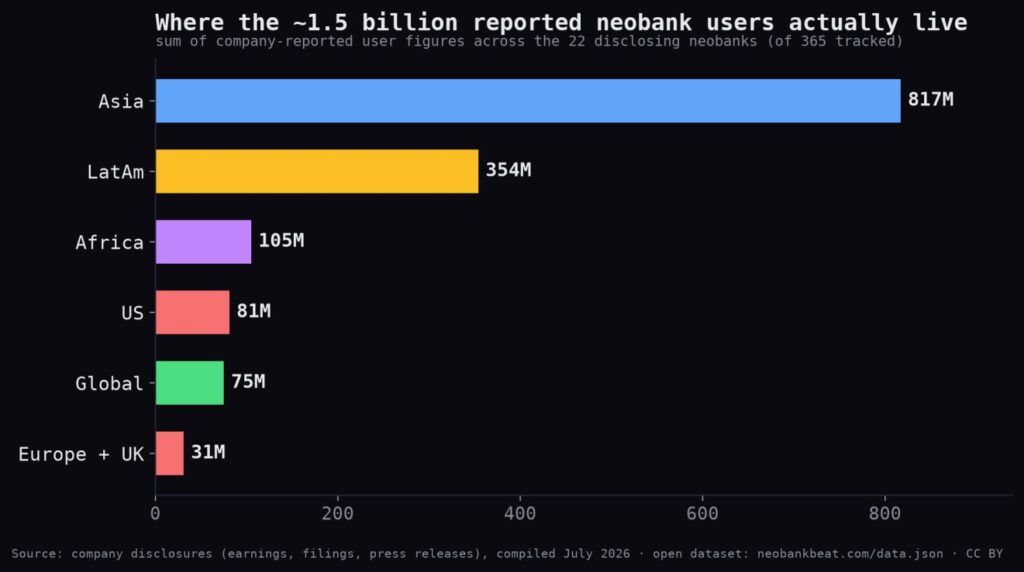
Summing every company-reported user figure in the dataset: roughly 1.46 billion people use the neobanks we track. That’s not a projection or a TAM slide. That’s reported customers.
And the geography will surprise anyone who reads Western fintech media:
The industry’s marginal energy has moved too. Of the neobanks founded in the 2020s that survive today, 30% are web3-native self-custodial apps where no company holds your balance at all. In the 2010s cohort, that figure was 4%. Whatever you think of crypto, the builders have voted.
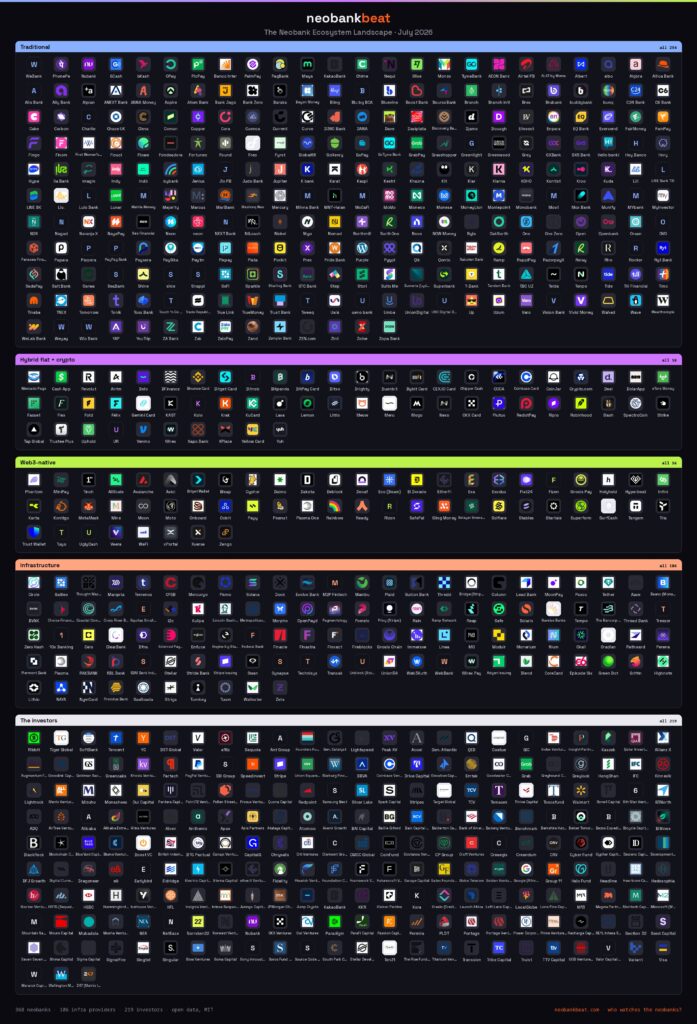
So yes: the rise is real. 368 companies, three structurally different waves (254 traditional challengers, 58 hybrid fiat-crypto apps, 56 web3-native), 106 infrastructure providers underneath them, 219 investors behind them. It’s all on the map.
Now the part nobody puts in a pitch deck.
Only 127 of the 368 hold a full banking license.
Read that again. Two thirds of the “banks” in your app store are not banks. They rent their right to exist from a sponsor bank, an e-money licence, or a card issuer you’ve never heard of. Their customers almost never know which side of that line they’re standing on, a hidden reality behind The Rise and Quiet Death of the neobank industry.
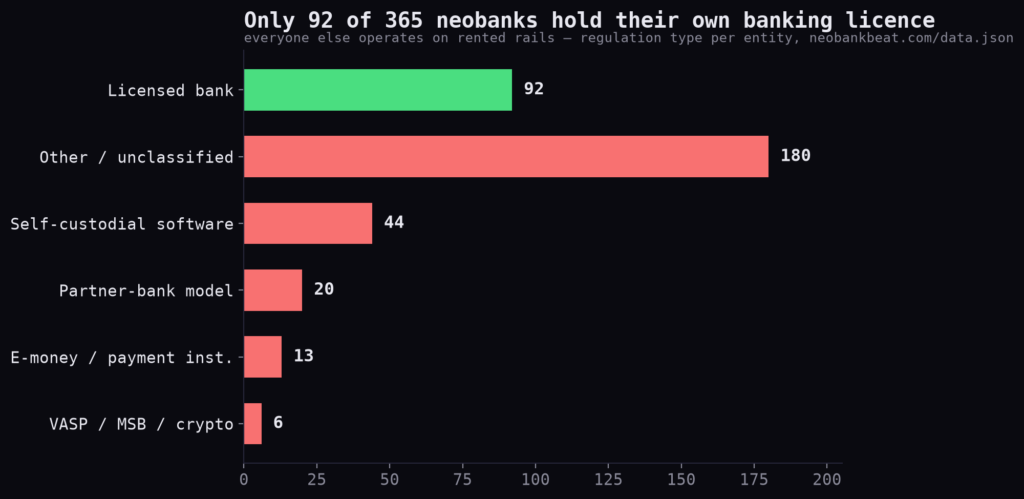
This isn’t a technicality. It’s the industry’s central structural risk, and it has a body count:
When a real bank fails, deposit insurance pays out. When a neobank’s infrastructure fails, customers get a queue number in a bankruptcy proceeding.
Death in this industry is silent. That’s the scandal.
This is the hidden side of The Rise and Quiet Death that rarely makes headlines or investor presentations.
Here’s what I didn’t expect when I started maintaining the dataset: the deletions never stop.
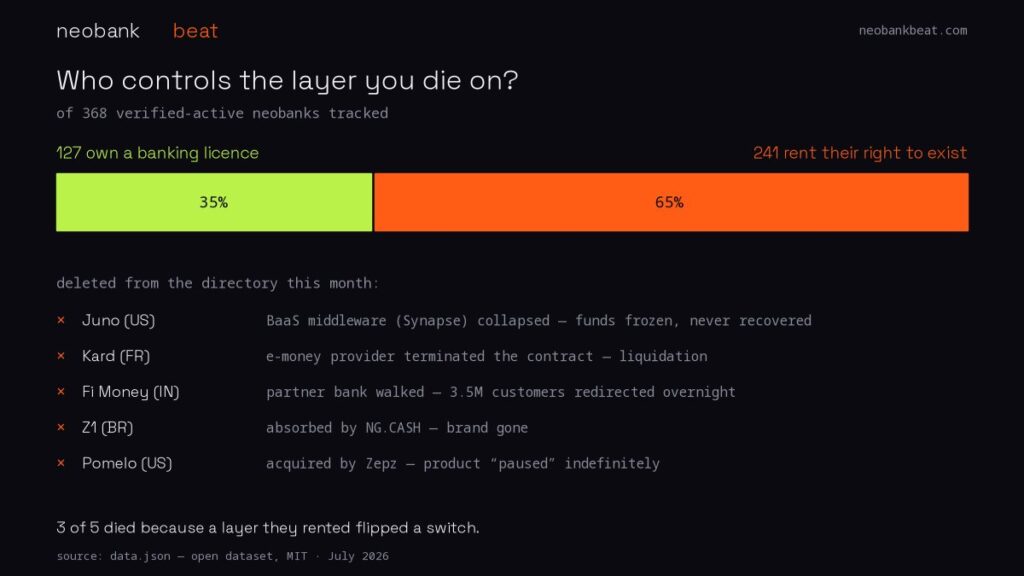
This month alone, five entities came off the list liquidated, absorbed, or quietly pivoted into something else. No press releases. No post-mortems. Neobanks don’t die loudly like FTX. The app just stops updating. Support stops answering. Then one day the domain redirects to a partner’s landing page, and a few hundred thousand customers migrate or evaporate.
Nobody writes obituaries for neobanks. Fintech media covers launches and funding rounds, because that’s where the ad money and access are. So the graveyard stays invisible, and every new founder walks into the same five traps believing they’re the first to see them.
That’s why we track exits as carefully as entries. Failure data is worth more than funding data. You can’t learn anything from a press release.
“But AI will fix the economics.” Will it?
Every neobank pitch deck now says AI. So we audited all 368, name by name, against filings, regulator disclosures and production evidence not marketing pages.
67 passed. Eighteen percent. The other 300+ are either piloting, “exploring”, or claiming a partner’s model as their own.
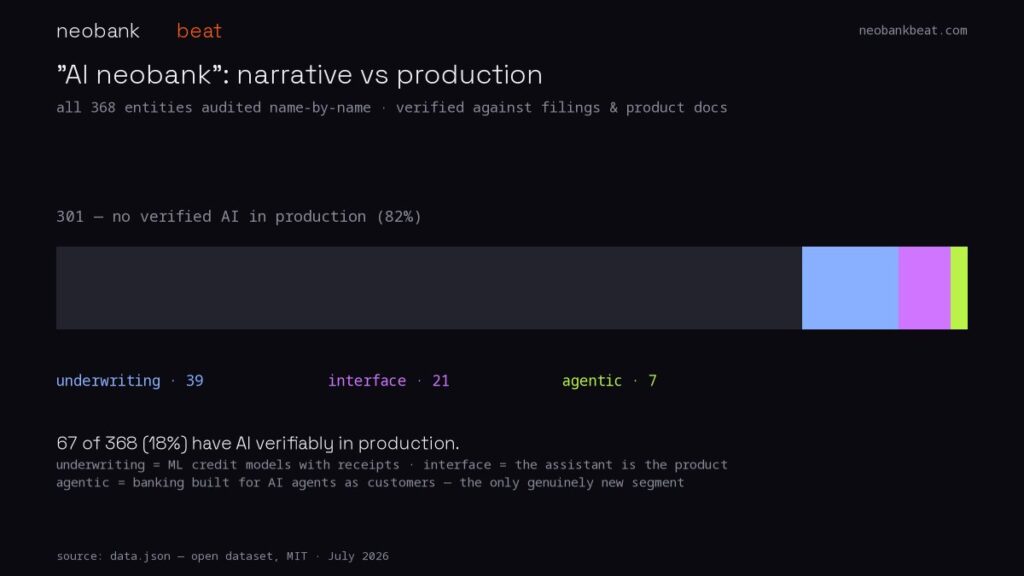
And here’s the twist: the AI leaders mostly aren’t the famous names. They’re emerging-market lenders in Nigeria, the Philippines, Mexico, Bangladesh where credit bureaus are useless and a model underwriting thin-file borrowers isn’t a feature, it’s the entire reason the business can exist. The West talks about AI banking. The Global South ships it, because it has to.
It also reinforces that The Rise and Quiet Death of modern neobanks is shaped as much by execution as by funding.
What the map really shows
Look at the infrastructure box on the map: 106 providers carrying 368 consumer brands. Inside that box, a handful of sponsor banks, BaaS platforms and card processors each carry dozens of the logos above them. The concentration you can’t see from the consumer side is exactly the concentration that produces the next Synapse.
That’s the honest picture of this industry in 2026: a spectacular, genuinely world-changing rise 1.5 billion people banked through an app, many for the first time in their lives built on a load-bearing layer most customers have never heard of, by companies two thirds of which could not survive their landlord’s bad quarter.
Both things are true at once. That’s what makes it interesting.
Three predictions I’m willing to be wrong about
See for yourself
Everything above is reproducible from the open dataset. No paywall, no email gate, MIT licence:


Tokenization of RWA yields onchain might be the biggest opportunity that no one has noticed
Cold Wallet Safety 2026: Are Hardware Wallets Still Safe?
One Token, Multiple Products. Can Zylo Deliver?
The Rise of NEAR Protocol 2026: Inside the 530% Rally and the ETF
Tokenization of RWA yields onchain might be the biggest opportunity that no one has noticed
Cold Wallet Safety 2026: Are Hardware Wallets Still Safe?
One Token, Multiple Products. Can Zylo Deliver?
The Rise of NEAR Protocol 2026: Inside the 530% Rally and the ETF