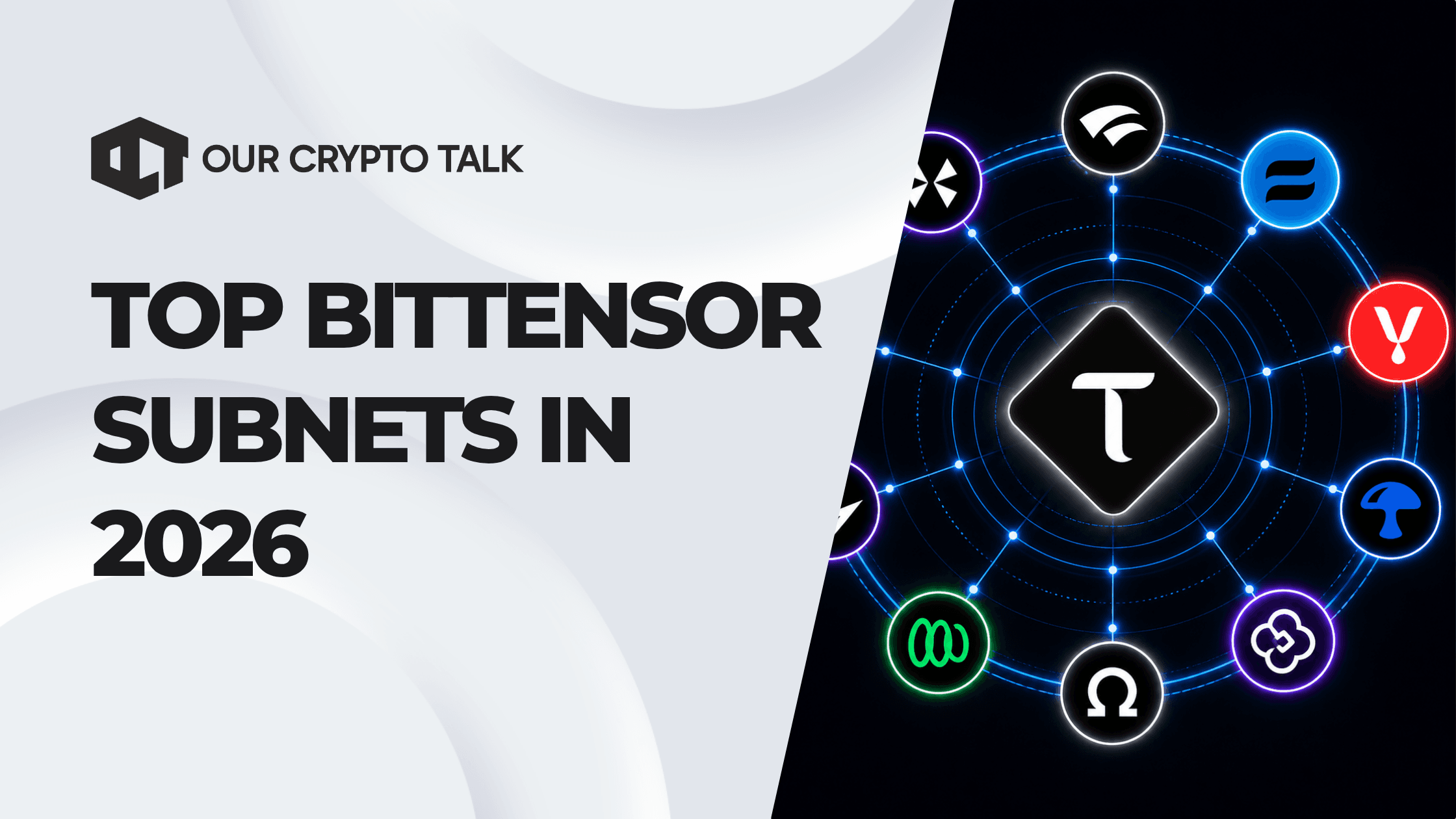
Discover the top Bittensor subnets in 2026 powering the TAO ecosystem across AI, data, compute, and infrastructure.

Author: Arushi Garg
Metrics verified where possible via taostats.io and public disclosures. Rankings are a snapshot and may change rapidly. The race for the top Bittensor subnets in 2026 is no longer theoretical. This ecosystem has crossed $1.5B in combined subnet market cap, generated over $43M in real AI usage revenue in Q1 alone, and attracted institutional attention from players like NVIDIA and Grayscale Investments.
Two subnets have already broken the $100M mark. Several others are generating real revenue, not emissions farming. This is the first time decentralized AI markets are behaving like actual businesses. This article ranks the best Bittensor subnets based on real data: revenue, activity, market cap, and ecosystem importance. It is not a generic explainer. If you need fundamentals, see our Bittensor subnets explainer and TAO case study.
Bittensor is a decentralized machine learning network where independent participants contribute compute, models, or data in exchange for TAO rewards. Instead of one monolithic system, Bittensor is divided into subnets, each focused on a specific AI task like inference, training, or compute. Each subnet operates as its own micro-economy. The key mechanism is dTAO (Dynamic TAO). Every subnet has an Alpha token, paired with TAO in a liquidity pool. When users stake TAO into a subnet, they receive Alpha tokens, and emissions flow toward subnets with the most demand.
This creates a subnet flywheel:
The December 2025 halving cut emissions from 7,200 to 3,600 TAO per day, tightening supply dynamics. Max supply remains fixed at 21 million, similar to Bitcoin. Bittensor currently supports 128 subnets, expanding to 256 in 2026. That expansion alone doubles competition and opportunity.
This ranking is based on four core factors that reflect real performance, not speculation. First, revenue. The most important signal is whether a subnet is generating actual income from AI usage. Subnets that rely purely on emissions or speculative staking without real demand rank lower.
Second, market cap. The valuation of a subnet’s Alpha token acts as a proxy for market confidence. Higher market caps generally indicate stronger belief in long-term viability, though they can also reflect hype, so this metric is weighed alongside others. Third, activity. We look at usage data such as number of users, tokens processed, API calls, and active nodes. High activity suggests real adoption and network effects rather than idle infrastructure.
Finally, ecosystem impact. Some subnets play a more critical role in the Bittensor stack than others. Infrastructure layers like compute, inference, training, and verification carry more weight because other subnets and applications depend on them. Together, these criteria provide a balanced view of which subnets are actually gaining traction. This is a snapshot of commercial momentum, not a prediction or endorsement.
What it does
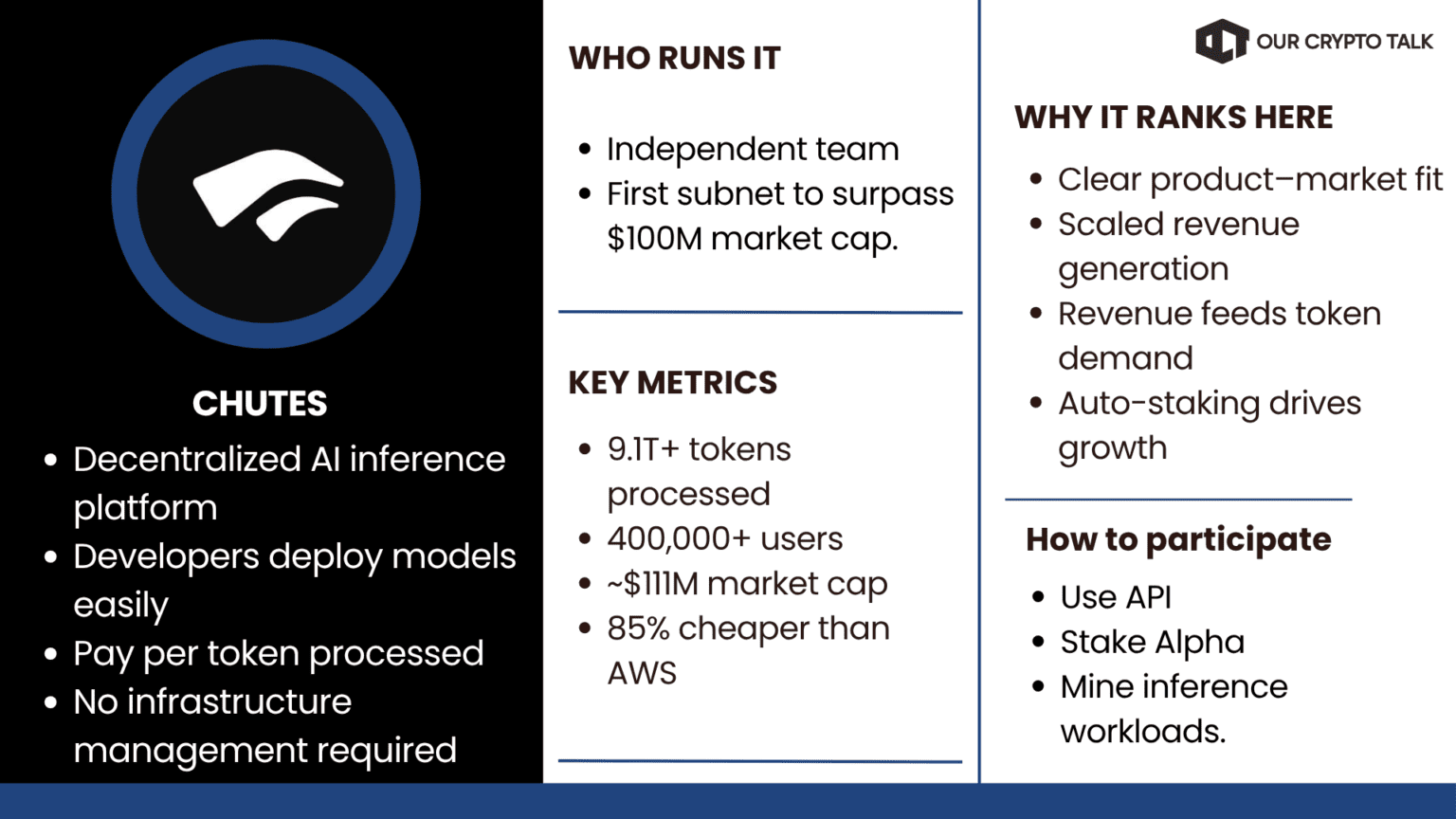
Chutes is a decentralized AI inference platform. Developers deploy models and pay per token processed, without managing infrastructure.
Who runs it
Independent team. First subnet to surpass $100M market cap.
Key metrics
Why it ranks here
Chutes is the clearest example of real product-market fit. It generates revenue at scale and feeds that revenue directly back into token demand via auto-staking.
How to participate
Use API, stake Alpha, or mine inference workloads.
What it does
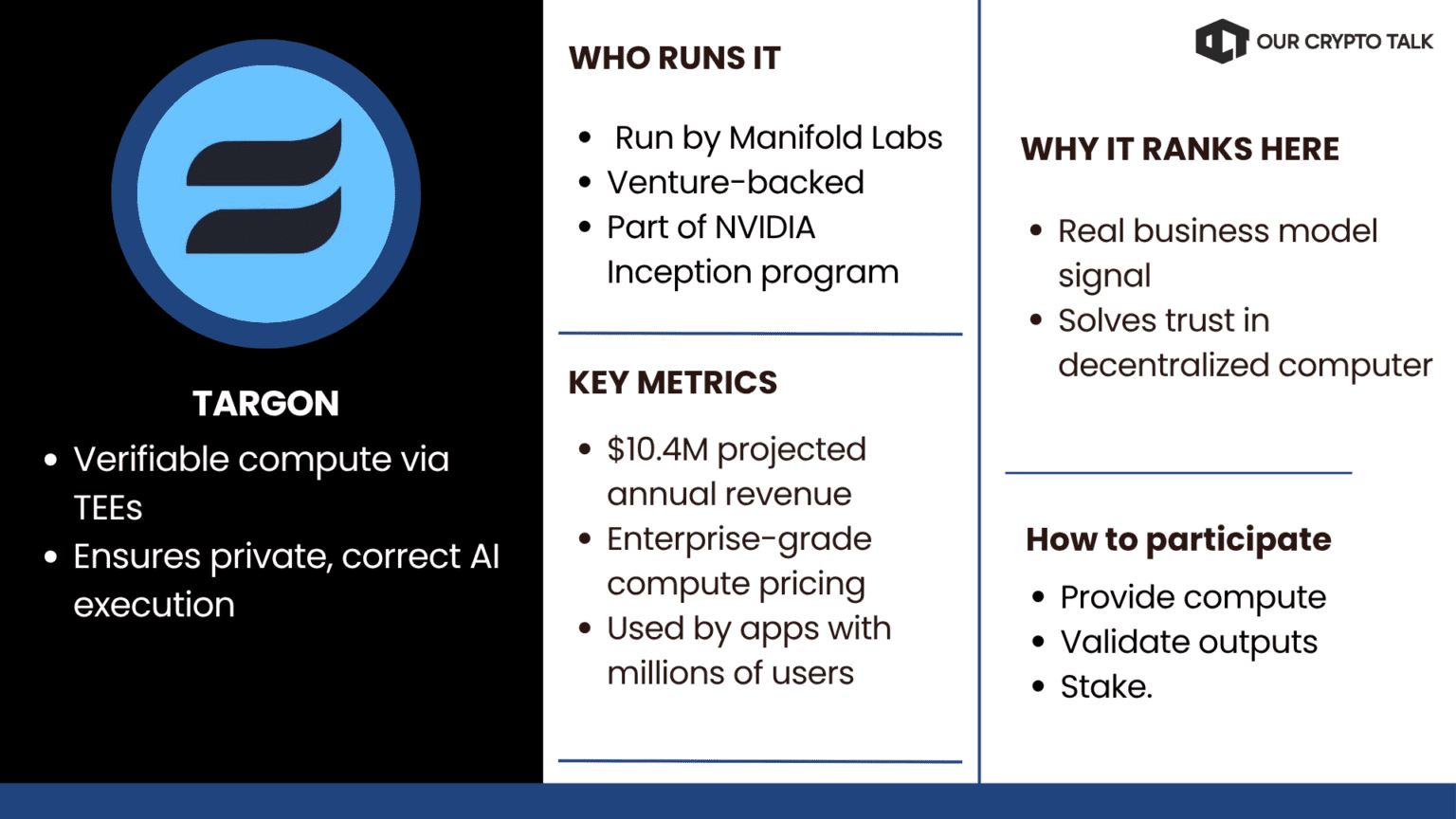
Targon provides verifiable compute using Trusted Execution Environments. It ensures AI workloads are executed correctly and privately.
Who runs it
Manifold Labs. Backed by venture funding and part of the NVIDIA Inception program.
Key metrics
Why it ranks here
Targon looks like a real business. It solves a core problem: trust in decentralized compute.
How to participate
Provide compute, validate outputs, or stake.
What it does
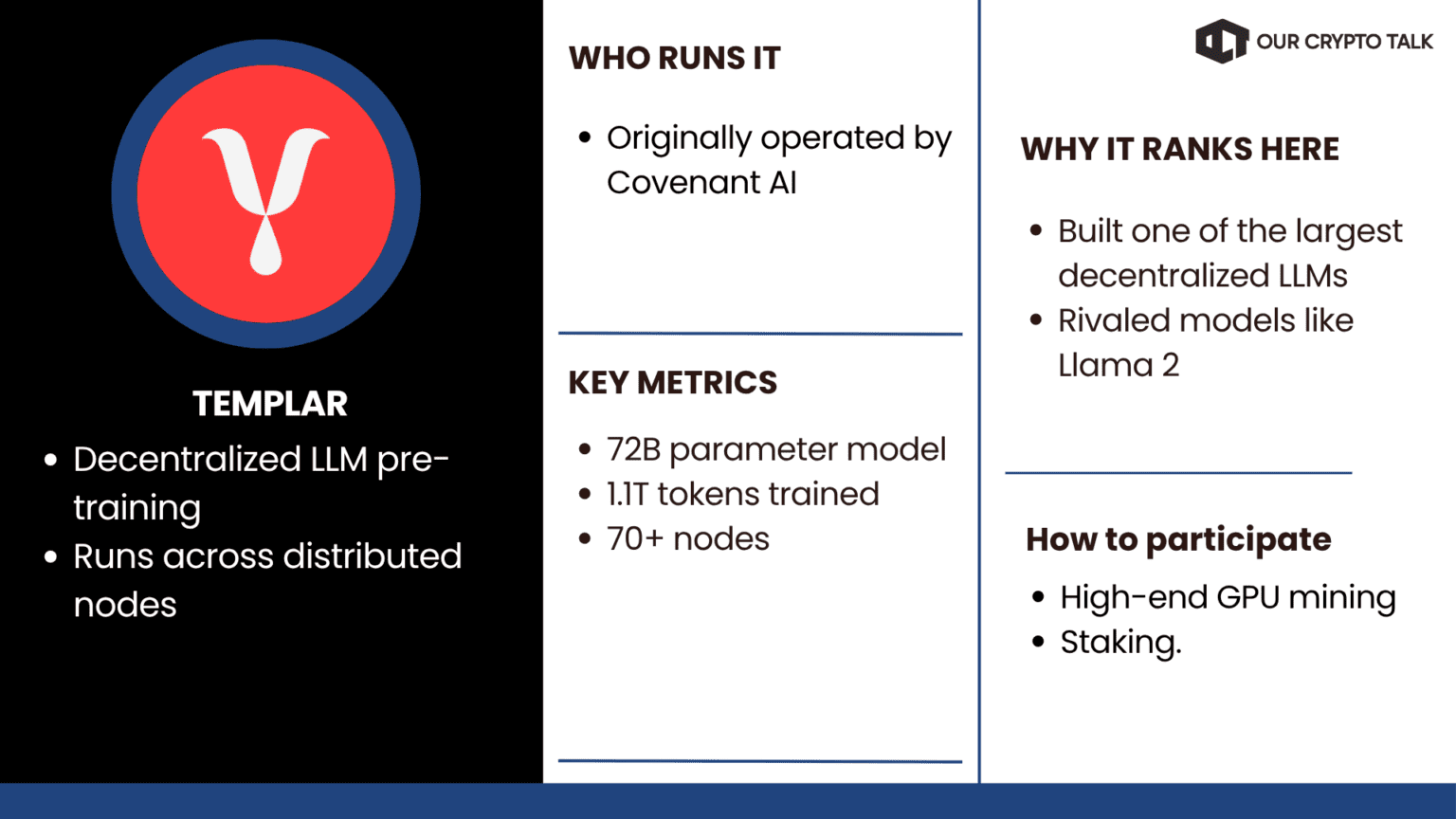
Templar focuses on decentralized LLM pre-training across distributed nodes.
Who runs it
Originally operated by Covenant AI.
Key metrics
Why it ranks here
Templar achieved something significant: one of the largest decentralized LLMs ever built, rivaling models like Llama 2.
However, this comes with risk.
Covenant AI Exit (Critical Event)
On April 10, 2026, Covenant AI exited Bittensor and sold ~$10M in TAO. The market reacted sharply, with TAO dropping 20-25%.
This exposed a structural weakness: reliance on a single operator.
How to participate
High-end GPU mining or staking.
What it does
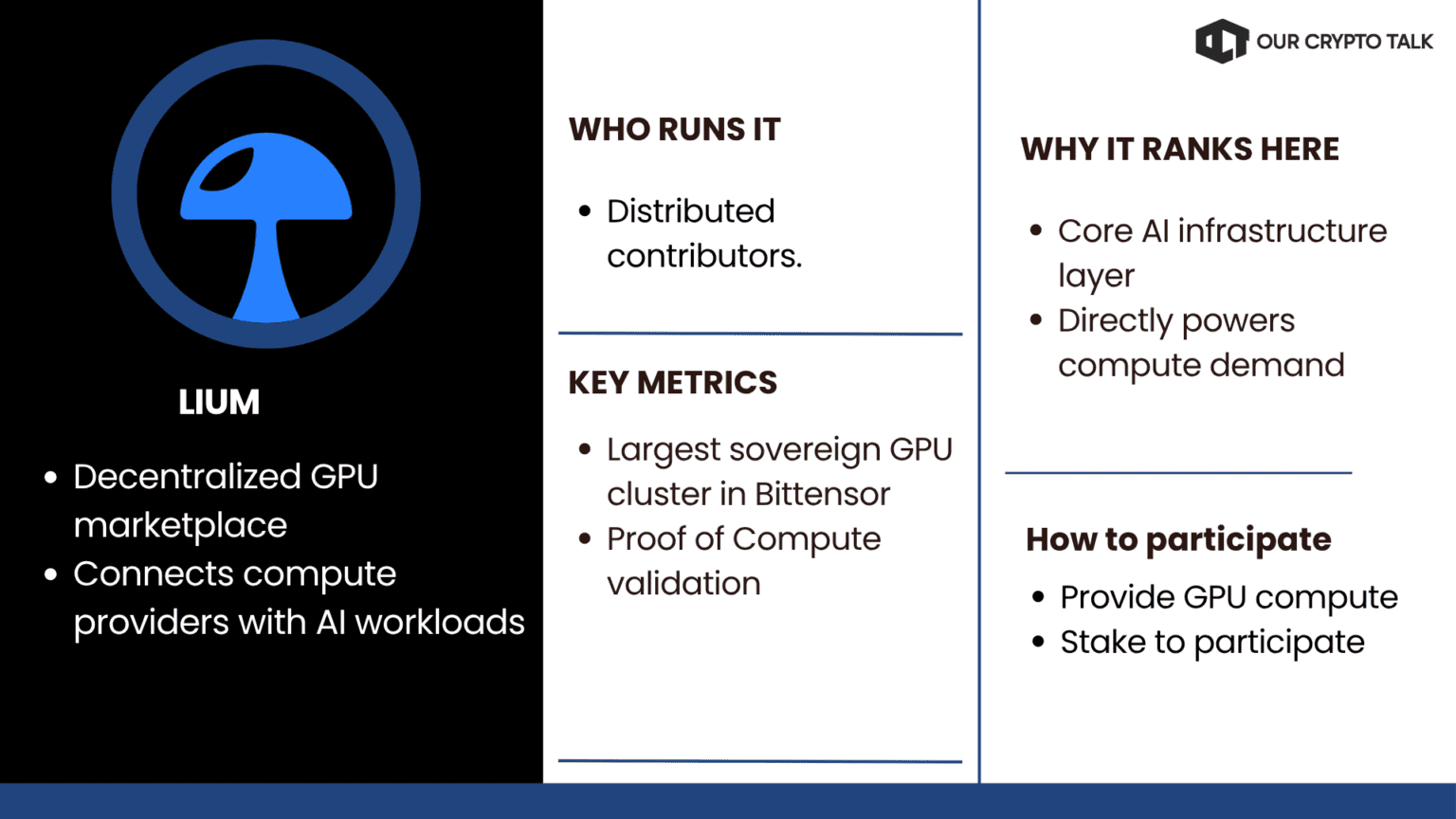
A decentralized GPU marketplace connecting compute providers with AI workloads.
Who runs it
Distributed contributors.
Key metrics
Why it ranks here
Compute is the backbone of AI. Lium fills that role directly.
How to participate
Provide GPU compute or stake.
What it does
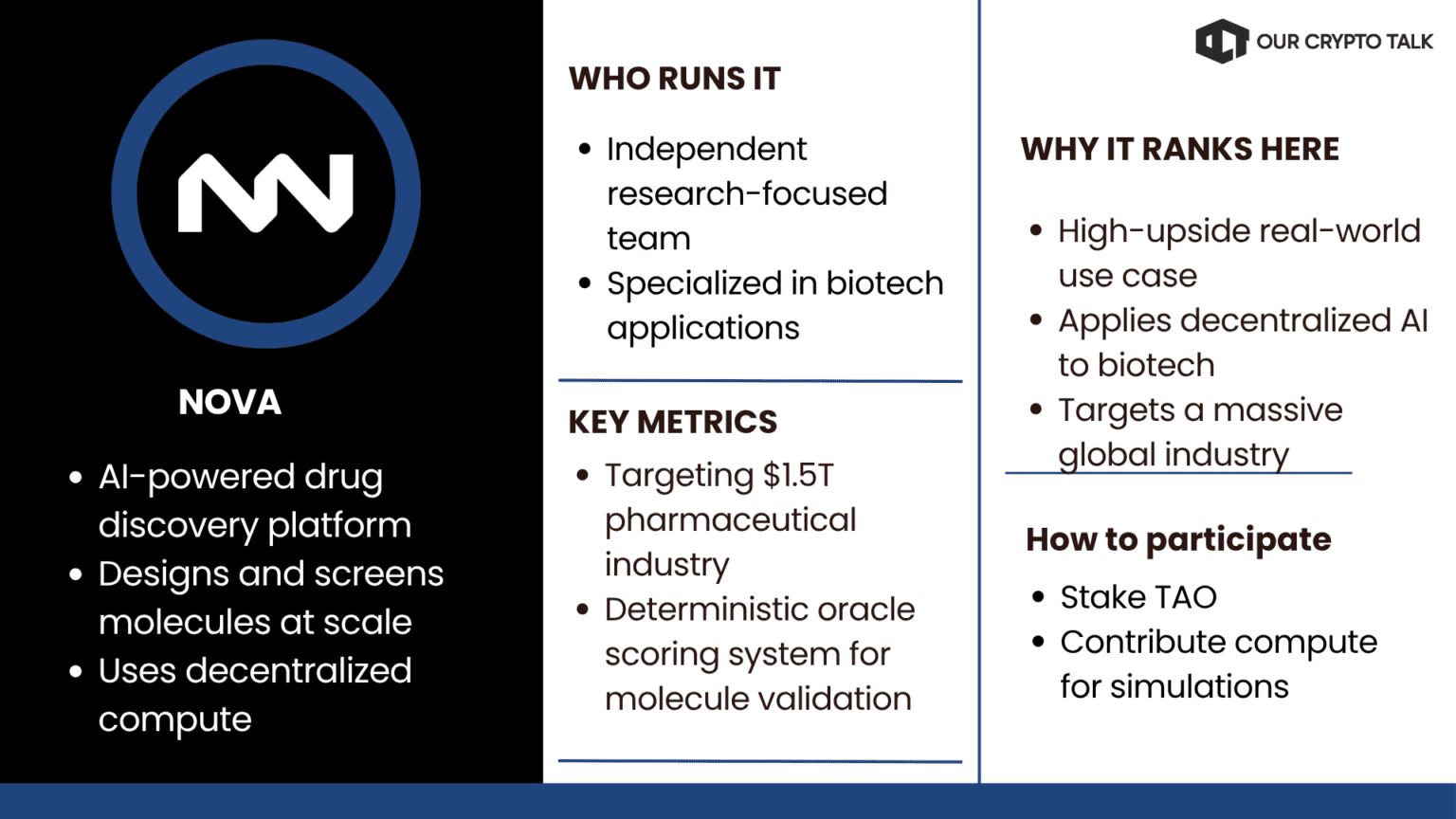
AI-powered drug molecule discovery platform that uses decentralized compute to screen and design new pharmaceutical compounds at scale.
Who runs it
Independent research-focused team specializing in biotech applications.
Key metrics
Why it ranks here
NOVA brings a high-upside, real-world use case to Bittensor by applying decentralized AI to one of the largest traditional industries on earth.
How to participate
Stake TAO or contribute compute resources for molecular simulations.
What it does
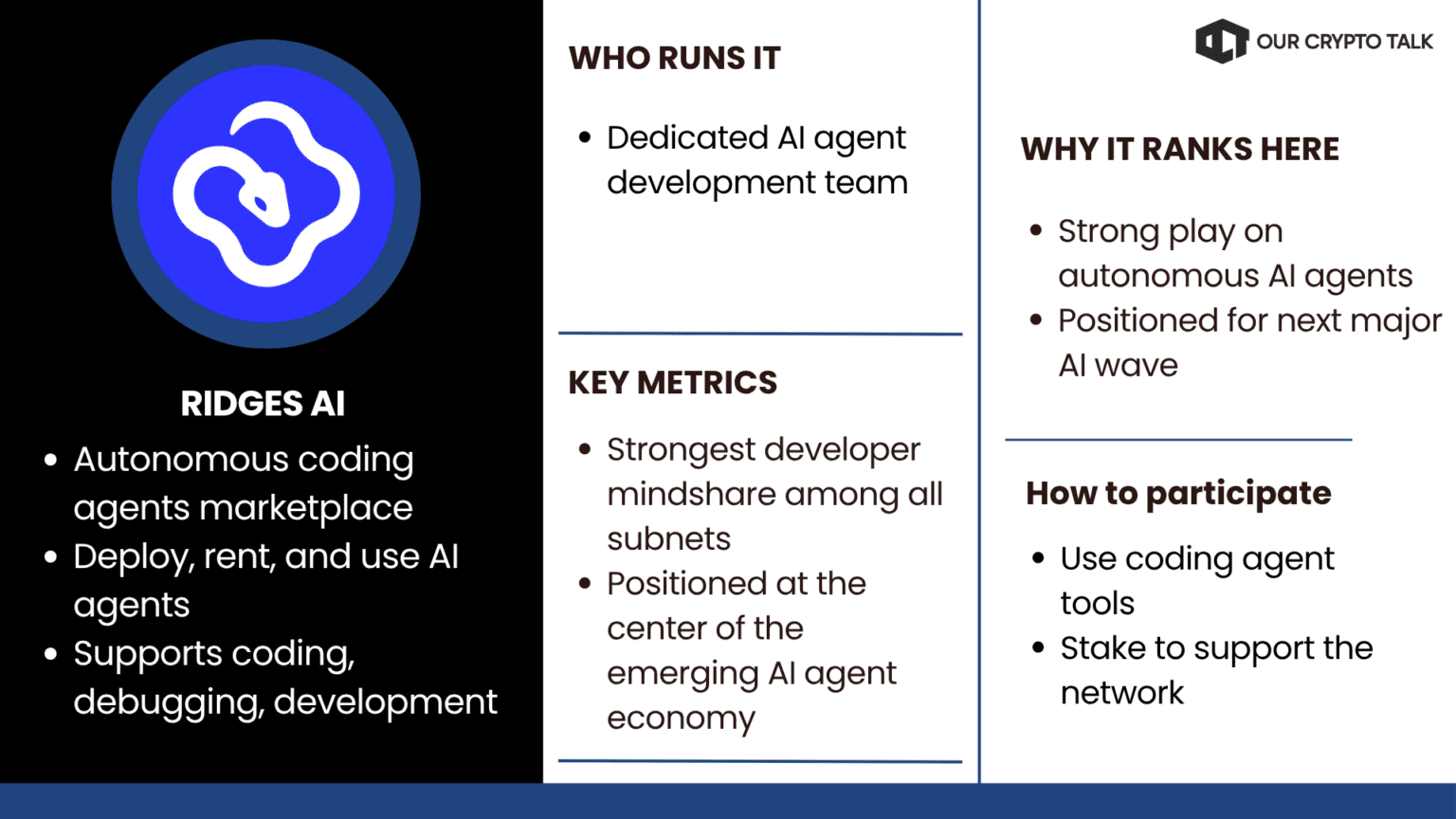
Autonomous coding agents marketplace where developers can deploy, rent, and use AI agents for code generation, debugging, and software development.
Who runs it
Dedicated AI agent development team.
Key metrics
Why it ranks here
Ridges AI is one of the clearest plays on the autonomous AI agent narrative, which many believe will be the next major wave after inference and compute.
How to participate
Use the coding agent tools or stake to support the network.
What it does
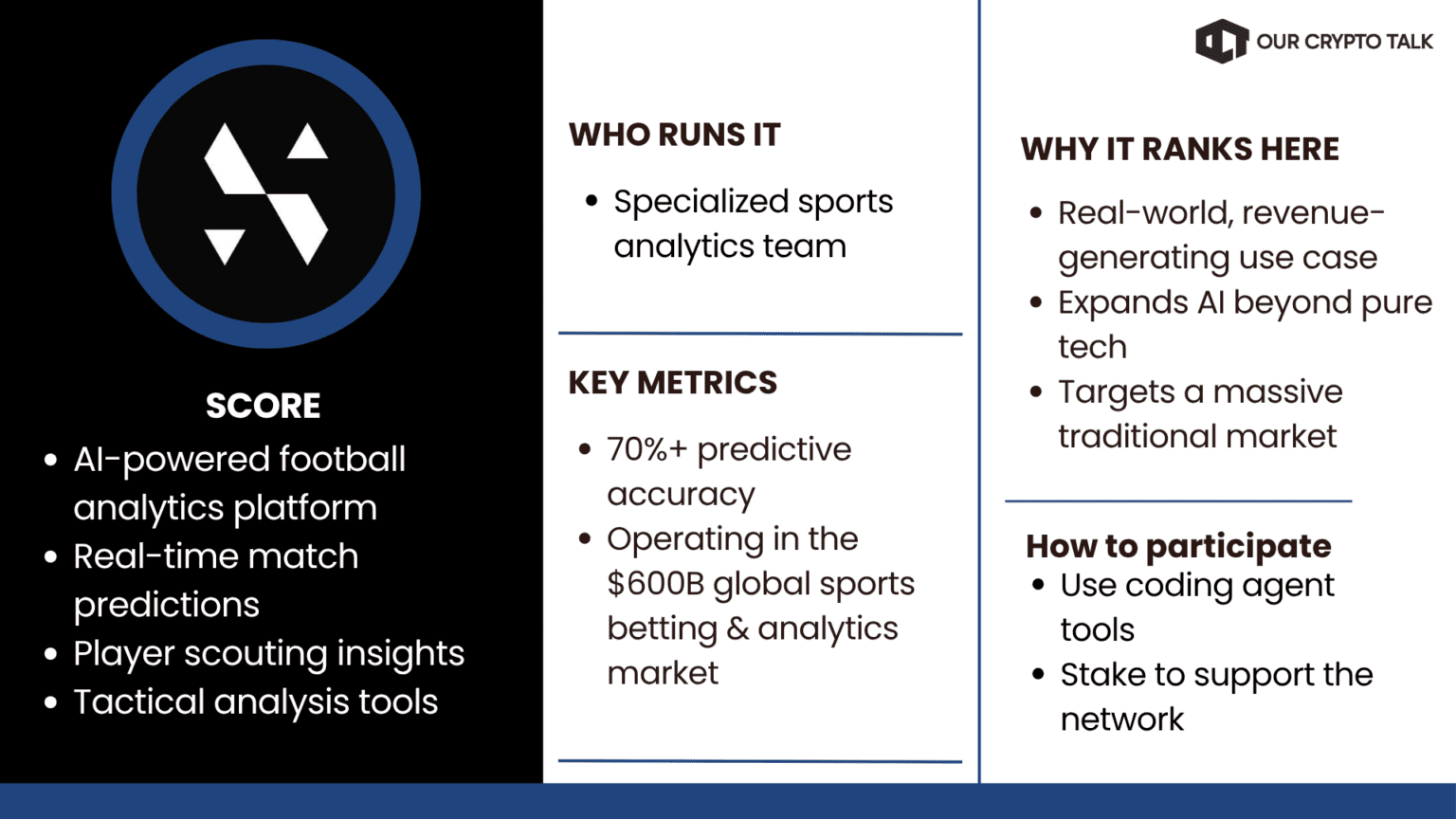
AI-driven football (soccer) analytics platform that delivers real-time match predictions, player scouting, and tactical insights.
Who runs it
Specialized sports analytics team.
Key metrics
Why it ranks here
Score proves Bittensor can deliver practical, revenue-generating AI applications in massive traditional verticals beyond pure tech.
How to participate
Stake TAO or contribute AI models for match analysis.
What it does
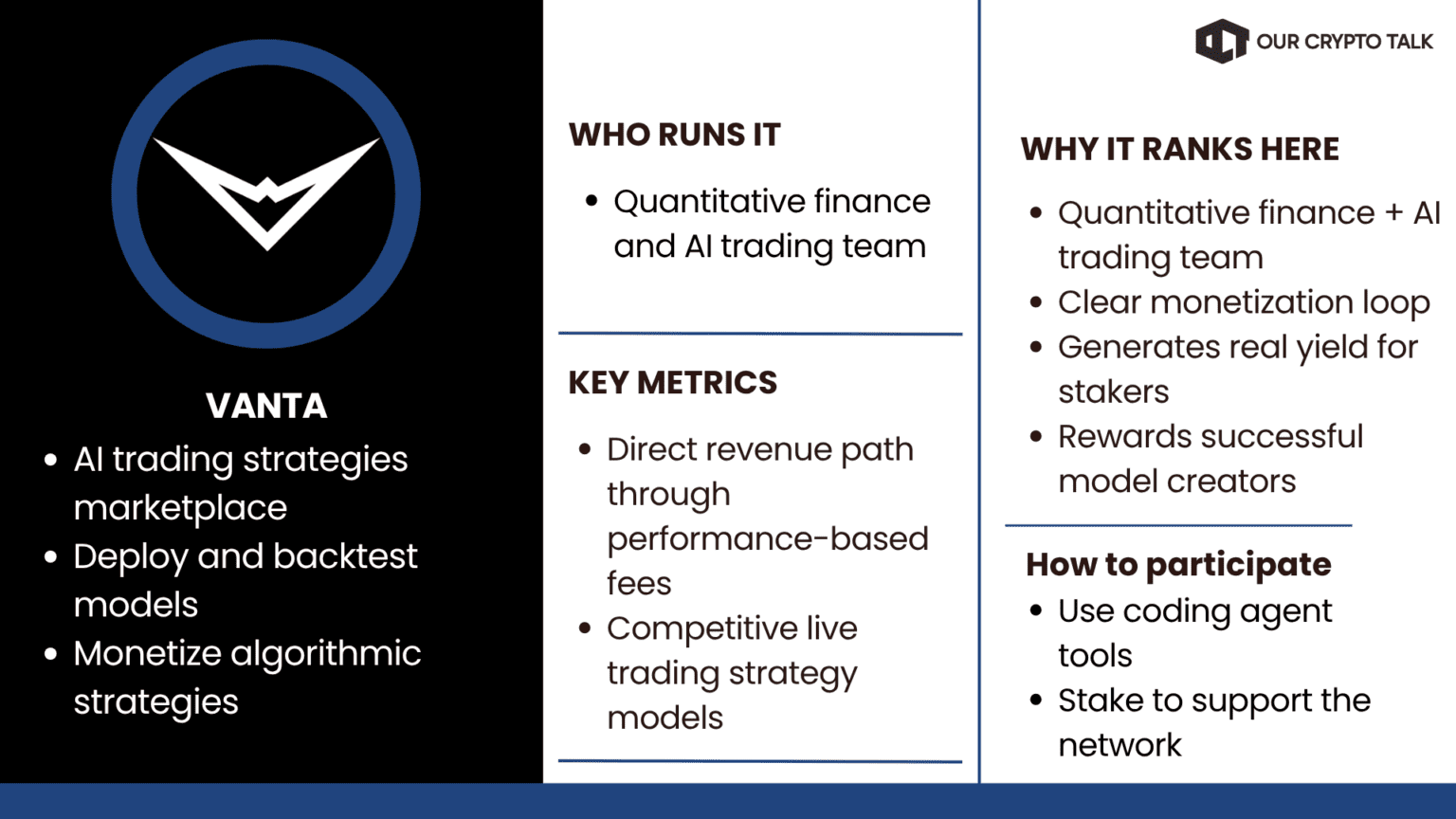
AI trading strategies marketplace that allows users to deploy, backtest, and monetize algorithmic trading models.
Who runs it
Quantitative finance and AI trading team.
Key metrics
Why it ranks here
Vanta is one of the few subnets with a clear, built-in monetization loop where successful strategies generate real yield for stakers and model creators.
How to participate
Stake TAO or deploy/use trading strategy models.
What it does
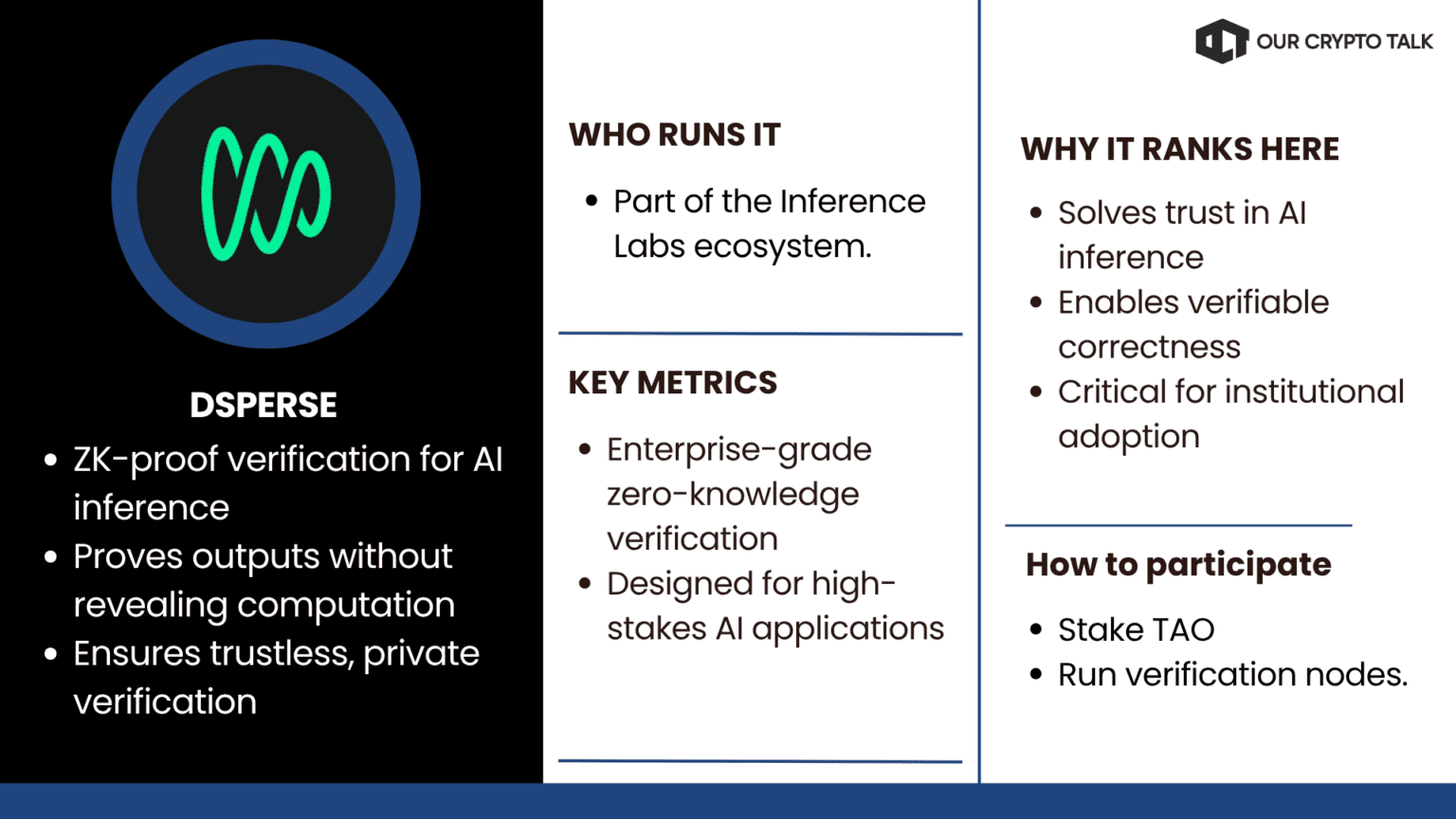
ZK-proof verification layer for AI inference that cryptographically proves model outputs are correct without revealing the underlying computation.
Who runs it
Part of the Inference Labs ecosystem.
Key metrics
Why it ranks here
DSperse solves one of the biggest trust problems in decentralized AI, verifiable correctness of inference making it essential infrastructure for institutional adoption.
How to participate
Stake TAO or run verification nodes.
What it does
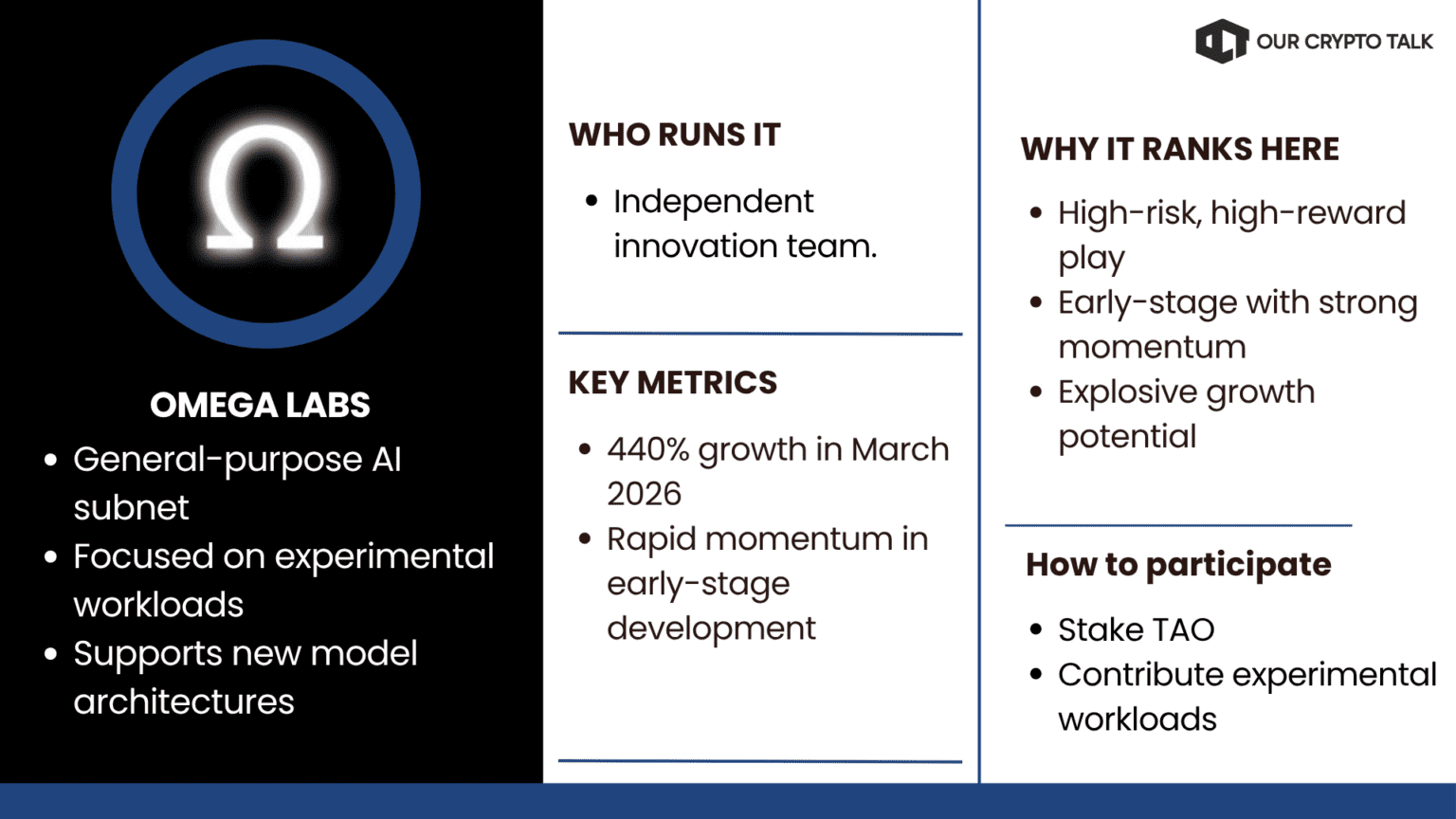
Emerging general-purpose AI subnet focused on high-growth experimental workloads and new model architectures.
Who runs it
Independent innovation team.
Key metrics
Why it ranks here
OMEGA Labs represents the high-risk, high-reward momentum play in the current top 10 — still early but showing explosive growth potential.
How to participate
Stake TAO or contribute experimental compute workloads.
There are four primary ways to participate in Bittensor, each with a different level of technical complexity, capital requirement, and risk exposure.
Miners contribute GPU compute, data, or model outputs to a specific subnet. In return, they earn TAO rewards based on the quality and usefulness of their contributions, as judged by validators. Hardware requirements vary widely. Some subnets can run on consumer GPUs, while others require high-end infrastructure like A100s or H100s. Mining is the most direct way to earn from the network, but it is also competitive and performance-driven.
Validators play a coordination role. They stake TAO and evaluate the outputs produced by miners, determining how rewards are distributed. This role requires both technical understanding and significant capital, since validator slots are limited and competitive. In many ways, validators act as the quality control layer of the network.
Token holders can participate by staking TAO into subnet-specific Alpha tokens through dTAO pools. This is the most accessible entry point for most users. Instead of running hardware, stakers allocate capital to subnets they believe will perform well. Returns depend on emissions, subnet activity, and Alpha token performance, which means yields are variable and can change quickly.
Developers and users interact with subnets at the application layer. Instead of staking or mining, they simply use the services provided. For example, inference subnets allow developers to run AI models via API and pay per usage. This is where real revenue is generated, and it is increasingly the most important layer in the ecosystem.
Despite the growth, Bittensor carries meaningful risks that should not be ignored.
On April 10, 2026, the team behind Templar, Covenant AI, exited the network and sold roughly $10 million worth of TAO. The market reacted immediately, with TAO dropping between 20 and 25 percent. This event exposed a key structural risk: some subnets depend heavily on a single operator or team. When that operator leaves, the subnet’s value proposition can weaken quickly.
Most subnets will not succeed. The ecosystem behaves more like a startup environment than a mature protocol layer. New ideas are constantly being tested, but only a small percentage will achieve sustained usage or revenue. Concentrating exposure in a single subnet increases risk significantly.
Subnet Alpha tokens often have limited liquidity compared to major crypto assets. While it may be easy to enter a position, exiting at scale without impacting price can be difficult. This becomes more pronounced in smaller or newer subnets.
The dTAO system dynamically allocates emissions based on staking behavior. If capital flows out of a subnet, its share of emissions can drop quickly. This creates rapid shifts in yield and can impact both miners and stakers in short timeframes.
Subnet Alpha tokens exist in a gray area from a regulatory perspective. There is currently no clear framework defining how these assets should be classified. If regulators treat them as securities, it could impact accessibility, liquidity, and participation across the ecosystem. Taken together, these risks highlight an important point: while the upside is significant, the system is still early and highly experimental.
The top Bittensor subnets in 2026 are no longer just experiments. They are early-stage AI businesses competing for real revenue and capital. Chutes leads with clear traction. Targon follows with enterprise-grade infrastructure. Templar proves what is possible but also highlights risk. This ecosystem is evolving fast. Rankings will change. Most subnets will fail. But the core thesis remains intact: decentralized AI markets are starting to work.