Explore the x402 ecosystem, Coinbase’s open protocol powering autonomous payments and machine to machine finance across 170+ chains.

Author: Tanishq Bodh
x402 is an open payment protocol from Coinbase and Cloudflare that uses HTTP status code 402 to let apps, APIs, and AI agents pay instantly using USDC without accounts, cards, or humans. A server requests payment, software signs it, settlement happens onchain, and the requested data returns automatically.
That entire loop can complete in seconds. This is the simplest answer to “what is x402” and the clearest version of the x402 protocol explained.
Recent usage suggests this is no longer an experiment. Official ecosystem dashboards show more than 75.4 million transactions and $24.2 million in payment volume in the last 30 days alone. Earlier ecosystem tracking reported:
These figures indicate one thing: machine payments already exist at scale. The debate is shifting from “Will agents pay?” to “Which infrastructure will agents use?

Image Credits : Suhail Kakar
HTTP became the backbone of the internet in 1991. Every webpage, API request, and software interaction depends on it. Yet HTTP only solved information exchange. It never solved payments.
Developers filled that missing layer with workarounds. Subscription models, API keys, OAuth permissions, monthly invoices, and payment gateways became standard. Humans adapted because humans tolerate friction. Autonomous systems do not.
An AI agent may need one sports score update, one weather query, and one GPU inference request from three different providers. Traditional payment systems assume persistent accounts and long-term billing relationships. Autonomous agents increasingly operate in short bursts, making tiny payments across multiple services. That model breaks under subscription-heavy infrastructure.
This challenge becomes more relevant as AI expands. Research from BCG estimates artificial intelligence could influence more than $1 trillion in economic activity, while investors at Andreessen Horowitz (a16z) AI research argue autonomous systems may eventually drive trillions in machine-executed transactions, with some projections discussing a potential $30 trillion autonomous transaction economy by 2030.
The interesting part is x402’s approach. It does not create a new communication standard. Instead, it revives HTTP status code 402, “Payment Required,” a feature that existed for years but rarely saw practical adoption.
That design choice feels less revolutionary than delayed. Infrastructure supporting machine to machine payments crypto may simply be catching up to AI capabilities already here. The autonomous agent economy is expanding faster than payment systems designed for humans.
The beauty of the x402 ecosystem lies in its simplicity. It builds directly on top of the existing web protocol, HTTP requiring no new wallets, plugins, or APIs. Instead, it activates the 402 status code, long reserved but never standardized, as the universal signal for payment-required requests.
When a client for example, an AI agent requests access to a paid resource, the server can respond with an HTTP 402 and a WWW-Authenticate: x402 header. Inside that header are four key details:
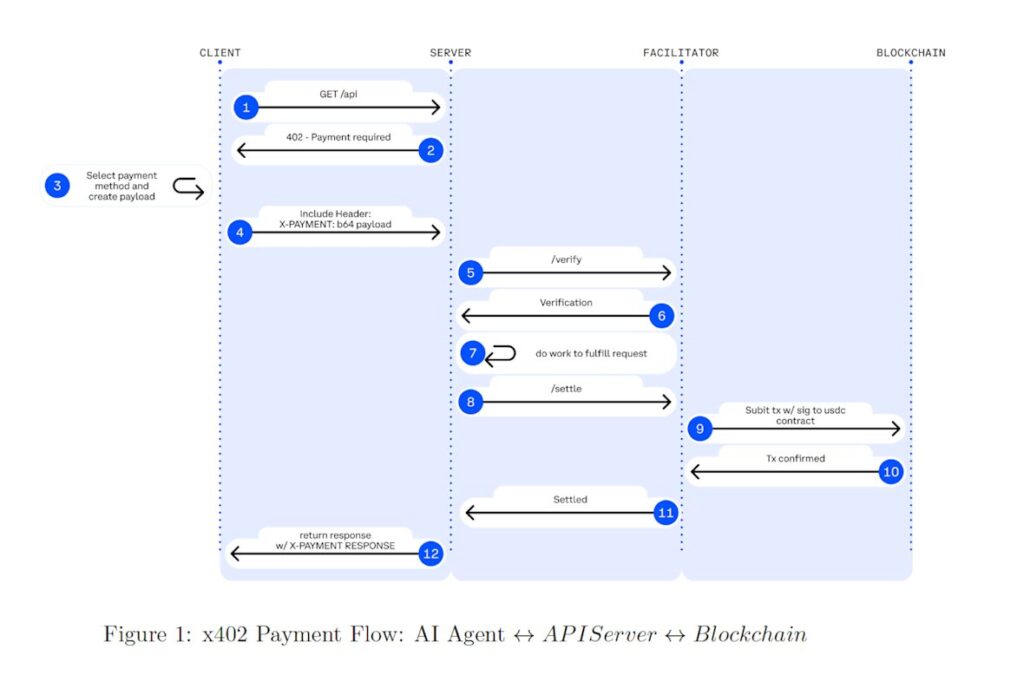
The process unfolds within milliseconds:
/verify endpoint to confirm payment before delivering the resource.This design supports 170+ blockchains and 4,000+ tokens, while favoring stablecoins to minimize volatility. Developers can extend it using the “scheme” parameter, enabling recurring payments, batched settlements, or privacy-protected transactions using zero-knowledge proofs.
The key innovation is the facilitator layer. It hides the complexity of wallets, RPC calls, and gas optimization letting developers integrate payments as simply as an HTTP request. Cloudflare calls it “the first protocol where the internet pays itself.”
Integration is seamless. One line of server code
res.status(402).set('WWW-Authenticate', 'x402 …')and one SDK call from the client are enough. No API keys, no custody issues, no OAuth tokens just pure HTTP magic.
However, decentralization remains an open debate. Relying on centralized facilitators like Coinbase introduces trust assumptions, prompting alternative builds such as ChaosChain-x402, which uses Chainlink oracles for Byzantine fault tolerance. Privacy solutions like Brevis ZK integrate encrypted proofs, ensuring AI agents can transact anonymously under ERC-8004 agent standards.
In essence, x402 turns the web into a payment rail where value transfer becomes as natural as loading a webpage. It is minimal by design but massive in impact: a universal micro-economy for the machine age.

The strongest signal around x402 is no longer transaction count. It is who started building around it. Payment companies, cloud providers, AI infrastructure firms, and blockchain networks increasingly treat x402 as production infrastructure rather than an experiment. Coinbase created the protocol, but the ecosystem now extends far beyond one company.
Official ecosystem dashboards have reported more than 75 million transactions and over $24 million in payment volume within a 30-day period. That pace suggests autonomous payments are already happening instead of remaining a future AI narrative.
Coinbase built the original x402 specification and remains the dominant facilitator today. Facilitators verify payments, settle transactions, and help applications receive funds automatically. Current ecosystem estimates suggest Coinbase controls roughly 70% of facilitator market share, while providers such as PayAI and x402.rs each account for around 10%. The remaining share is distributed among newer entrants.
That concentration exists partly because Coinbase shipped first and provides one of the simplest developer experiences. Developers receive free transaction quotas before moving into low-cost settlement tiers, making micropayments economically practical.
A larger shift happened in April 2026 when Coinbase contributed x402 governance toward the Linux Foundation ecosystem through the x402 Foundation. Founding support reportedly includes companies such as Cloudflare, Stripe, Google, AWS, Shopify, Visa, Solana Foundation, Circle, and others.
Coinbase still leads execution through facilitators, but governance increasingly moves toward an open standard. Historically, internet protocols survive longer when no single company controls them.
Cloudflare’s involvement may become one of the ecosystem’s most important advantages because the company already sits between applications and the internet itself.
By integrating x402 into Workers and agent tooling, developers can deploy paid endpoints with minimal additional infrastructure. That effectively combines edge computing with payment settlement. APIs no longer need separate monetization systems layered on top.
Cloudflare’s bet appears straightforward: if autonomous agents become common, payments should happen as close to requests as possible.
The broader implication is that x402 begins looking less like crypto infrastructure and more like standard internet middleware.
Google introduced AP2, or Agent Payments Protocol, as an authorization framework designed around agent-to-agent commerce.
AP2 and x402 solve different problems.
AP2 focuses on identity, permissions, and spending policies. x402 handles payment execution using HTTP 402 flows. Together they create a stack where agents can verify whether spending is allowed before settling transactions.
Identity -> Authorization -> Payment -> Resource Delivery
That separation may matter as enterprises increasingly deploy autonomous systems requiring compliance controls.
Stripe’s support provides another indicator that machine payments are moving toward mainstream infrastructure.
Developers already using Stripe for traditional billing can experiment with x402 payment flows without rebuilding entire monetization systems. Existing dashboards, merchant relationships, and payment infrastructure become compatible with autonomous transactions.
Stripe adopting support may not guarantee x402 wins. Payment companies rarely integrate standards they believe have no long-term demand.
Much of today’s x402 activity concentrates around Base and Solana, though each serves different needs.
Solana’s advantage comes from speed. Near 400ms finality and transaction costs around $0.00025 make repeated machine payments economically efficient. Agents making dozens of API calls per minute benefit immediately.
Base remains attractive because of USDC liquidity depth and tighter integration with Coinbase infrastructure.
The interesting outcome is that debates around x402 Solana vs Base often assume a winner must emerge. x402 was designed to remain chain-agnostic. Agents increasingly choose settlement rails dynamically depending on cost, latency, and liquidity.
Payments alone do not create an ecosystem. Discovery does.
Bazaar acts as a discovery layer indexing x402-enabled services, supported chains, pricing, trust signals, and API metadata. Instead of hardcoding integrations, autonomous agents can search for services, compare costs, and purchase access automatically.
In simple terms, Bazaar attempts to do for paid APIs what search engines did for websites.
Without discovery layers, autonomous systems remain trapped inside fixed integrations. With Bazaar, agents gain access to an open marketplace of machine-priced services.
That may become one of the least discussed but most important parts of the x402 ecosystem.
The broader picture is becoming clearer. Coinbase still dominates settlement today, Cloudflare pushes distribution, Stripe lowers adoption friction, Google builds policy layers, and chains like Solana and Base compete on performance. Together they form infrastructure around a single idea: software paying software may become normal internet behavior.
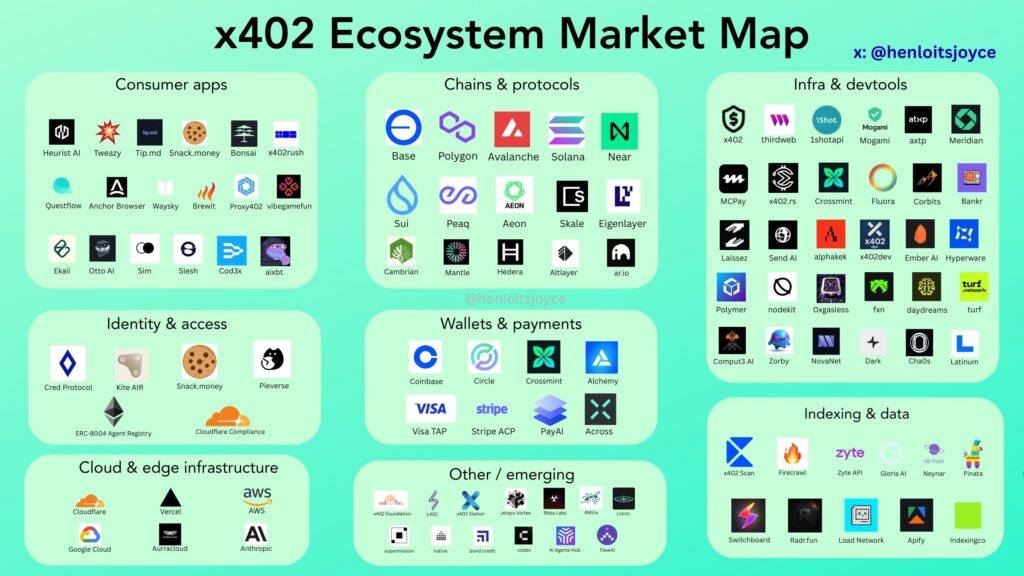
Image Credits : @henloitsjoyce
The AI layer is where x402 shines. Virtuals Protocol leads the charge with a thriving network of on-chain agents. Its lineup includes:
The protocol’s latest upgrade, ACP V2, boosts execution speed by tenfold.
Other standout players include:
Supporting these are niche projects such as Roba Labs for robotics, Hive Intelligence for on-chain analytics, Firecrawl for paid web scraping, and VPAY Global for global tipping.
The easiest mistake in the x402 market is assuming protocol adoption automatically creates token value.
x402 itself has no native token. Payments settle in USDC. The protocol works without governance coins, staking assets, or emissions schedules. Servers request payment. Clients pay. Data returns. Nothing in that loop requires a token.
That changes how ecosystem assets should be evaluated.
Most crypto infrastructure eventually asks investors to believe two stories at once: the protocol will grow, and the token will capture that growth. Those are separate questions. Many projects achieve the first and fail the second.
A stricter framework helps filter noise:
Those questions matter more than narratives around “AI” or “agent economies.”
The broader x402-related token category expanded rapidly during late-2025 AI enthusiasm before contracting alongside the market. Combined ecosystem valuations vary depending on classification, though pure x402-adjacent tokens remain relatively small compared with larger AI infrastructure assets.
The table below separates infrastructure exposure from speculation.
The uncomfortable conclusion is simple: most x402 ecosystem tokens to buy discussions focus on narrative exposure, not infrastructure ownership.
PAYAI comes closest to a real infrastructure bet.
The project operates as an alternative facilitator, processing transactions across multiple networks and reportedly accounting for around 10% of historical facilitator activity. That makes it one of the few names competing directly with Coinbase, which still controls roughly 70% of settlement volume.
The distinction matters because facilitators sit near the payment flow itself.
PAYAI token utility includes governance, fee reductions, staking, and visibility benefits for agents using its network. Unlike pure narrative assets, some value links back to actual usage.
The limitation is equally important.
x402 does not require PAYAI.
Developers can route through Coinbase, another facilitator, or future providers. The token benefits only if PAYAI captures larger market share through better tooling, lower latency, or pricing advantages.
That creates exposure to execution rather than protocol growth.
HEU belongs to Heurist AI, which positions itself around AI compute, services, and marketplaces.
The token functions across staking, governance, gas, and service payments. Heurist also experimented with x402-compatible vending systems intended to connect USDC flows with ecosystem usage.
The investment case sounds attractive: autonomous agents need compute, therefore compute networks gain value.
The weaker assumption sits underneath. Agents do not specifically need HEU. They need services.
If similar services become available elsewhere, payment routing changes quickly. That makes HEU partly infrastructure and partly AI narrative.
The token has utility. Defensibility remains less clear.
Meridian focuses on interoperability and payment abstraction between AI systems.
The pitch is straightforward: developers integrate once and support multiple payment environments.
That solves a real problem. The challenge is whether solving friction automatically creates token demand.
MRDN offers rewards, incentives, and ecosystem participation, but little evidence currently suggests protocol-level fee capture. If the token vanished, much of the underlying service could continue operating.
That lowers role clarity. Projects built around convenience often struggle converting usage into durable token value.
Among all assets discussed here, VIRTUAL commands the largest market cap by a wide margin. The reason is narrative strength. Virtuals Protocol built around AI agents, ownership, deployment, monetization, and marketplaces. Investors are effectively buying exposure to a possible agent economy rather than direct x402 infrastructure.
That distinction matters.
VIRTUAL captures some marketplace activity and ecosystem participation, which gives stronger value links than meme assets. But x402 payments themselves do not depend on VIRTUAL.
If autonomous agents become a meaningful economy, platforms enabling creation and distribution may capture value.
PING may be the clearest lesson in how crypto narratives behave.
The token gained attention as an early x402-related launch and surged aggressively during peak excitement. Reports around the period described sharp appreciation followed by equally sharp corrections. Market capitalization briefly expanded before collapsing back toward low single-digit millions.
The pattern was familiar:
Novelty -> Attention -> Momentum -> Speculation -> Correction
PING never captured protocol fees. It never secured settlement. It never became required infrastructure.
The token functioned mostly as culture and community.
That does not automatically make it worthless. Meme assets often hold value through attention. It does make role clarity extremely low.
The easiest way to analyze any x402-related asset is ignoring price first.
Ask two questions:
Can the protocol function without this token?
Does the token capture economic activity generated by the protocol?
Those questions eliminate most narratives quickly.
Take PAYAI. The token has stronger positioning because the project operates facilitator infrastructure and captures value through ecosystem services. Remove PAYAI tomorrow and x402 still works, but PayAI’s own network becomes weaker.
Take VIRTUAL. The token benefits if agent creation, marketplaces, and monetization expand. It does not own x402 settlement itself.
Take PING. Remove the token and almost nothing changes.
That difference separates infrastructure exposure from speculation.
Investors interested in broader AI payment narratives often make the same mistake seen across earlier AI cycles.
Comparing these projects with larger autonomous-agent sectors helps show why distribution and fee capture matter more than branding, something explored in this analysis of AI agent tokens.
The same principle applies across crypto generally: token utility sounds valuable until measured against actual cash flow, a framework covered well in this crypto token evaluation guide.
The uncomfortable conclusion is that x402’s greatest strength may be the absence of a native token. The protocol works because payments settle in USDC and HTTP remains the standard. Most ecosystem assets compete for attention around that infrastructure rather than owning the infrastructure itself.
That does not mean opportunities do not exist. It means investors need to know whether they are buying rails or narratives. Those are rarely priced the same way.
The first version of x402 proved something important: AI agents and applications would actually pay for APIs using HTTP 402 flows. The second version focused on a harder problem. Could that payment system scale without depending heavily on Coinbase, one blockchain, or fixed integrations?
That is where x402 V2 changed direction.
Early x402 implementations leaned toward chain-specific assumptions. V2 introduced support for standardized identifiers such as CAIP formats, allowing assets and networks to be referenced consistently across ecosystems.
The practical effect is simple. Developers no longer build separate logic for Base, Solana, Polygon, or future chains.
Agents can route based on cost, latency, or liquidity.
If Solana settles faster at roughly 400ms and lower transaction costs, traffic can move there. If Base offers stronger stablecoin liquidity, agents can prefer Base instead.
This makes x402 increasingly chain-neutral instead of ecosystem-specific.
V1 behaved like repeated checkout pages. Every request often required fresh authorization and payment.
V2 introduced wallet hooks and reusable identity patterns, reducing repeated signing requirements for trusted sessions. High-frequency AI systems benefit immediately because thousands of small requests no longer create the same overhead.
The difference sounds minor. For autonomous agents making hundreds of API calls, it changes economics.
This may be the most important V2 update.
Earlier adoption patterns concentrated around Coinbase infrastructure because developers defaulted to existing facilitators. V2 expanded support for pluggable facilitators, meaning applications can choose settlement providers dynamically.
Cost, geography, compliance, or latency become selection variables.
That reduces dependence on Coinbase. It does not eliminate it.
Current estimates still suggest Coinbase controls around 70% of facilitator activity, while providers such as PayAI and x402.rs remain closer to 10% each. But V2 lowers barriers for alternatives.
Open standards become stronger when switching costs stay low.
Bazaar attempts to solve discovery. Payments only matter if agents can find services worth paying for.
The layer indexes x402-enabled endpoints, pricing, metadata, supported chains, and reputation signals. Instead of hardcoding integrations, autonomous systems can search, compare, and purchase access automatically.
In simple terms, Bazaar behaves more like a search engine for paid APIs.
That may become one of V2’s most important additions because infrastructure without discovery rarely scales.
The broader pattern behind x402 V2 new features is clear: the protocol moved away from tightly coupled infrastructure and toward modular infrastructure.
That matters because payment standards usually fail when one company controls routing, governance, and discovery.
Further ecosystem changes around governance appeared after the x402 Foundation launch under Linux Foundation stewardship, covered in the x402 Foundation announcement. More recent reporting on x402 V2 adoption and ecosystem changes has also appeared through CryptoSlate coverage of x402 updates.
The strongest takeaway is not technical. V2 made x402 look less like Coinbase infrastructure and more like public internet infrastructure.
x402’s biggest strength is simplicity. Its biggest weakness may be concentration.
The protocol appears decentralized on paper because anyone can implement HTTP 402 payments. Real usage remains far more centralized.
Most payment flows still rely on facilitators verifying settlement and responding to requests. That creates an obvious failure point.
If dominant facilitators experience downtime, censorship issues, or incorrect verification behavior, large portions of x402 traffic become affected.
This risk increases because Coinbase remains the largest facilitator by a wide margin.
The second issue is economic.
Coinbase offers low-cost or free usage tiers. Competing facilitators struggle to monetize because developers already default toward established infrastructure.
That creates what some researchers describe as a zero facilitator revenue problem.
Open participation exists technically. Economic incentives remain weaker.
Analysis around these risks appeared in March 2026 research from Tangle.tools investigations discussing centralization and facilitator assumptions.
Discovery layers create another bottleneck. If one index controls most discovery, ranking systems influence traffic.
Recent ecosystem discussions placed reference Bazaar concentration near 77.5%, raising concerns around censorship, ranking manipulation, and traffic steering.
Search infrastructure often becomes power infrastructure. The internet learned that lesson before. Agent economies may relearn it.
Most x402 ecosystem tokens do not secure the protocol.
They do not validate payments. They do not control settlement.
Many capture attention rather than infrastructure value.
That distinction matters because speculation around AI and autonomous systems often expands faster than actual usage.
The protocol works without most attached tokens. That should remain the starting point for evaluation.
Stablecoin payments, AI agents, and automated settlement touch multiple regulatory areas simultaneously.
Payment compliance. Identity rules. AI governance. Cross-border settlement.
The protocol itself remains neutral. Service providers and facilitators may not.
As enterprise adoption increases, regulated facilitators likely gain market share because businesses prefer compliance guarantees over pure openness.
Security researchers increasingly study these trade-offs. A May 2026 arXiv paper on agent payment risks and infrastructure concentration discussed attack surfaces including manipulation, routing risks, and unsafe assumptions in autonomous payment systems.
The uncomfortable conclusion is that x402 facilitator centralization risk is real even if the protocol remains open.
That does not invalidate x402.
It suggests the ecosystem still carries Web2 habits inside Web3 infrastructure.
The question is less “what are risks of x402” and more whether decentralization arrives before concentration hardens.
Comparisons around x402 often miss an important point. x402, Google AP2, and Stripe Machine Payments are not exact competitors. They solve different layers of the same problem.
x402 focuses on execution. An agent requests a resource, pays instantly, and receives data.
Google AP2 focuses on permission. Should this agent be allowed to spend at all?
Stripe focuses on monetization. How do existing merchants accept machine payments without changing infrastructure?
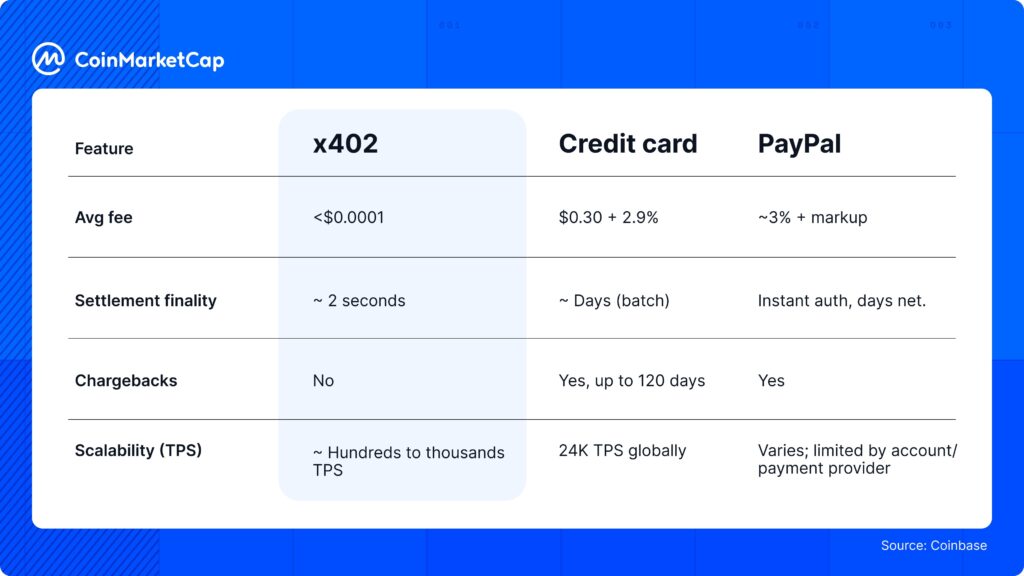
Still, builders choosing tooling need practical answers around cost, settlement speed, and readiness. The table below compares the trade-offs.
The strongest argument for x402 vs Stripe machine payments is speed. x402 removes most assumptions around accounts, billing relationships, and recurring contracts.
The strongest argument for Stripe is distribution. Millions of merchants already use Stripe.
The strongest argument for Google AP2 is governance. Enterprises prefer permission systems.
That means the likely outcome may not be one winner replacing others. Builders increasingly combine them.
Google AP2 handles authorization. x402 settles payments. Stripe captures revenue.
Google’s work around agent payments and permissions appears throughout AP2 references and ecosystem material, while Stripe continues expanding machine-payment support through its official Stripe documentation.
The easiest way to understand x402 is ignoring protocols and focusing on products.
Developers already have enough infrastructure to build paid internet services without subscriptions or API keys.
Five use cases stand out today.
Featured snippet answer:
Pay-per-query APIs let applications charge small amounts for every request instead of requiring subscriptions. An AI agent requests data, receives HTTP 402 payment terms, pays instantly using USDC, and gets a response.
Examples include:
Usage scales naturally because customers pay only for consumption.
Autonomous systems increasingly need services from other autonomous systems.
One agent buys compute. Another sells proprietary data. A third provides execution.
x402 enables direct transactions between them.
This may become one of the most important long-term use cases because machine commerce grows faster when humans leave the loop.
Storage providers can gate uploads or retrievals behind payments.
Instead of subscriptions:
Upload -> Pay -> Receive CID
Retrieval -> Pay -> Access content
The model fits decentralized storage well because usage becomes granular.
AI inference is expensive.
Many workloads do not need monthly GPU subscriptions. Providers can expose inference endpoints charging fractions of a cent per request.
Request model -> Receive HTTP 402 -> Pay -> Get output
That reduces wasted infrastructure spending.
Traditional subscriptions assume long billing cycles. Agents often need access for hours rather than months.
Wallet sessions introduced through newer x402 patterns allow temporary authorization windows.
Access begins. Usage continues. Authorization expires.
No recurring billing failures. No forgotten subscriptions.
This may eventually replace parts of API pricing models.
Developers exploring implementation details increasingly rely on examples from the official Coinbase x402 documentation, while teams wanting existing merchant infrastructure often build through patterns described in Stripe docs.
The broader pattern across all five use cases looks identical:
Request -> Payment -> Resource
That simplicity is probably x402’s strongest advantage. The protocol changes less than most people expect. It mainly removes billing systems humans accepted for years.
The x402 ecosystem thrives in the emerging agent economy, where software and machines exchange value directly. Through frameworks like Anthropic’s MCP, AI agents can “tip” content creators in USDC, pay servers for data, or rent compute time.

On the FABRIC network, OpenMind AGI integrates x402 for drone mapping payments, allowing autonomous drones to buy map data mid-flight. In robotics, Roba Labs enables devices to pay each other for maintenance requests, ushering in a machine-to-machine economy that operates 24/7.
x402 extends beyond intelligent agents. Pinata lets users upload to IPFS without accounts, while Firecrawl charges per web-scraped page using x402 micropayments. Enterprise deployments include Cloudflare’s deferred schemes, which batch settlements for corporate clients like Google Cloud. Visa’s TAP primitives now bridge TradFi rails to stablecoins for hybrid settlements.
A standout case study is Virtuals Protocol, whose ecosystem generates measurable on-chain GDP, dubbed aGDP. Its Butler agent trades 70+ digital assets autonomously, contributing to a fivefold expansion in x402 micropayments this quarter. Both Delphi Digital and Messari call it
“The trillion-dollar agent engine.”
Challenges persist. Deepfake fraud has prompted experiments with Kraken’s AI-proof ID tests, while compliance-focused solutions like Brevis ZK and Tria’s zkKYC aim to balance privacy with regulation.
x402 is no longer an experiment, it is the transaction rail for autonomous everything.
By 2030, analysts from Ribbit Capital project that AI agents will operate as autonomous economic participants, transacting trillions of dollars annually. The x402 ecosystem provides the payment spine for that transformation – fast, neutral, and programmable.
Upcoming expansions include integration with Sui, Ethereum mainnet, and DePIN-based robotics systems via peaq. Neo-banks like Tether’s toolkit are preparing agent wallets to process micro-transactions at scale.
Bullish catalysts: BitMart’s x402 Spaces launch (Nov 6) and LBank’s 27% market share in token volume. Bearish risks: market corrections if the AI narrative cools or if regulatory bottlenecks slow facilitator approvals.
At its core, x402 positions crypto as Web3’s universal payment layer, borderless, frictionless, and agent-native.
The x402 ecosystem represents more than a technical upgrade, it is the next phase of the internet’s evolution. From Coinbase’s spark to a $928 million network of agents, it proves that open standards always win.
Developers should start building with x402 SDKs; investors must look beyond meme cycles and toward genuine utility. In a world where bots pay, work, and collaborate, this protocol makes value transfer as native as HTTP itself.
The future of finance is autonomous. Embrace x402 now, before your AI agent does it for you.
All the opinions in this article are that of the author and in no way are financial advice. Our Crypto Talk and the author always suggest you do your own research in crypto and to never take anything as financial advice that you read on the internet. Check our Terms and conditions for more info.