Physical AI crypto projects are tokenizing robots, chips, and data. See which tokens have real traction, why Tether is investing $1.4B, and the risks.

Author: Kritika Gupta
Physical AI Crypto is emerging as one of the most important new intersections between artificial intelligence, robotics, and blockchain. Unlike software-based AI, Physical AI operates in the real world through robots, drones, autonomous vehicles, sensors, and industrial machines that can make decisions and complete physical tasks.
Physical AI refers to artificial intelligence that operates in the real world through robots, drones, autonomous vehicles, and industrial machines. NVIDIA CEO Jensen Huang helped popularize the term at CES in January 2025 as robotics and autonomous systems moved closer to mainstream adoption.
However, intelligence alone cannot make a machine economically autonomous. Robots need a way to receive payments, verify their identities, purchase services, and execute agreements without relying on constant human approval.
In practical terms, physical AI crypto projects tokenize the ownership, operation, and economic activity of real-world machines, including robots, drones, sensors, and autonomous vehicles, using blockchain for identity, payments, and decentralized coordination. For a deeper explanation of how this sector works, read our complete DePAI explainer.
Key projects building the autonomous robot and machine economy
Fabric Protocol builds the blockchain coordination layer for the robot economy, while OpenMind develops intelligence and infrastructure for autonomous robots. Together, the stack aims to give machines verifiable identities, wallets, payment access, and systems for coordinating work.
More importantly, the strongest proof of concept came from Bits, OpenMind’s robot dog. During a public demonstration, Bits detected that its battery was running low, located a charging station, connected itself, and paid for the electricity with USDC. As a result, the robot completed the entire payment process without direct human approval.
However, one successful demonstration does not prove that Fabric can support a large-scale robot economy. Moreover, the token’s market performance shows that investors remain cautious. As of July 13, 2026, the $ROBO token traded near $0.0134, with a market capitalization of approximately $29.8 million. By comparison, it reached an all-time high of $0.06071 on March 2, 2026. Therefore, the token now trades about 78% below its peak.
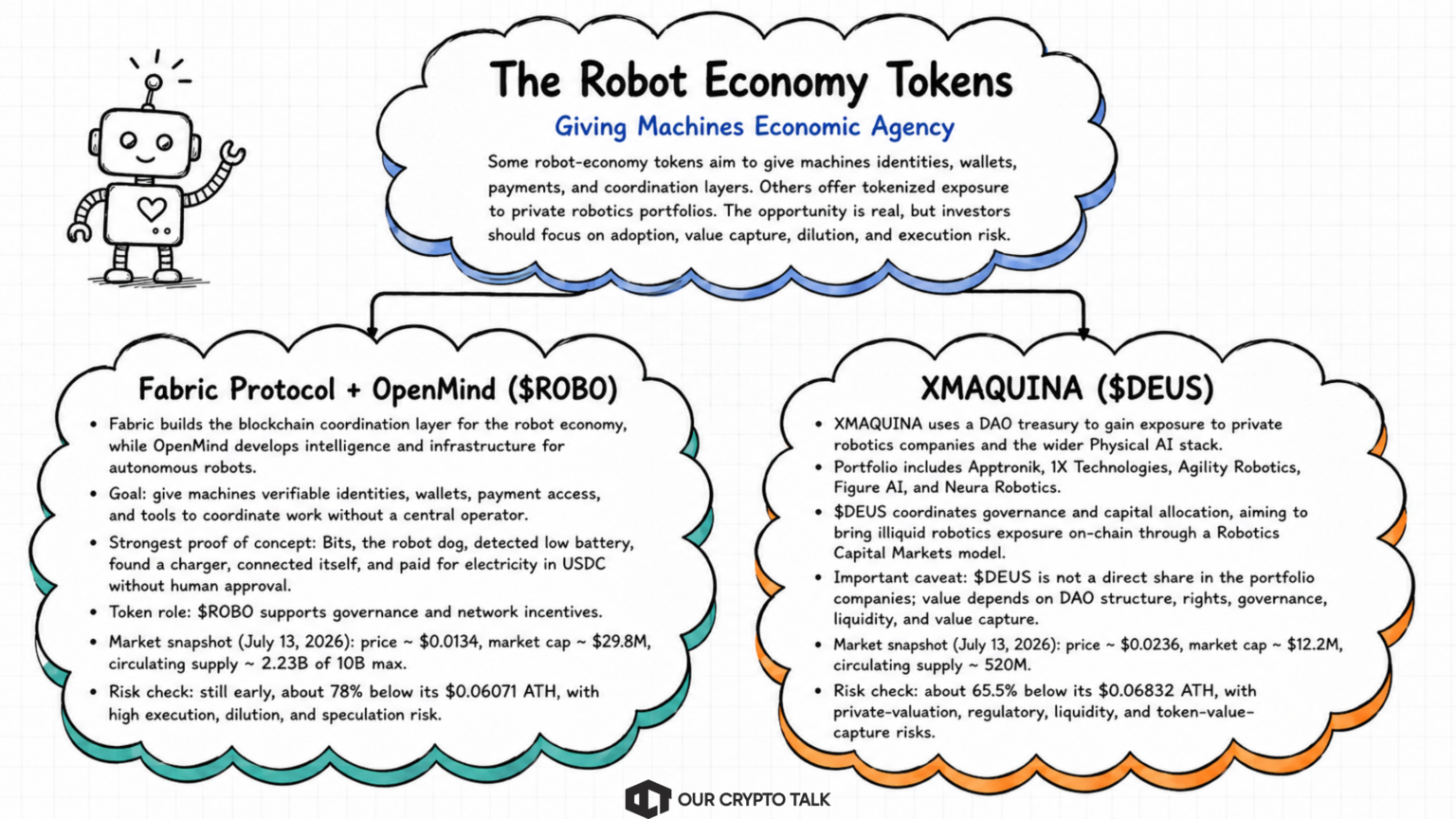
XMAQUINA takes a different approach to the robot economy token sector. Instead of manufacturing robots, the DAO uses its treasury to acquire exposure to private robotics companies and other parts of the Physical AI stack. Its portfolio includes Apptronik, 1X Technologies, Agility Robotics, Figure AI, and Neura Robotics. These companies develop humanoid robots for manufacturing, logistics, industrial work, and household applications.
The $DEUS token coordinates governance and capital allocation across this portfolio. Through its Robotics Capital Markets model, XMAQUINA aims to bring traditionally illiquid private robotics investments on-chain and give crypto participants access to a sector that public markets rarely offer.
Still, investors should not treat $DEUS like a direct share in Apptronik, Figure AI, or any other portfolio company. Its value depends on the DAO’s legal structure, treasury rights, governance rules, liquidity, and ability to turn private positions into value for token holders.
Early DePIN networks used token incentives to deploy static hardware such as wireless hotspots, sensors, cameras, and mapping devices. Robotics represents the next stage of that model. Instead of only collecting data or providing connectivity, machines can now move, complete tasks, coordinate with other devices, and generate revenue.
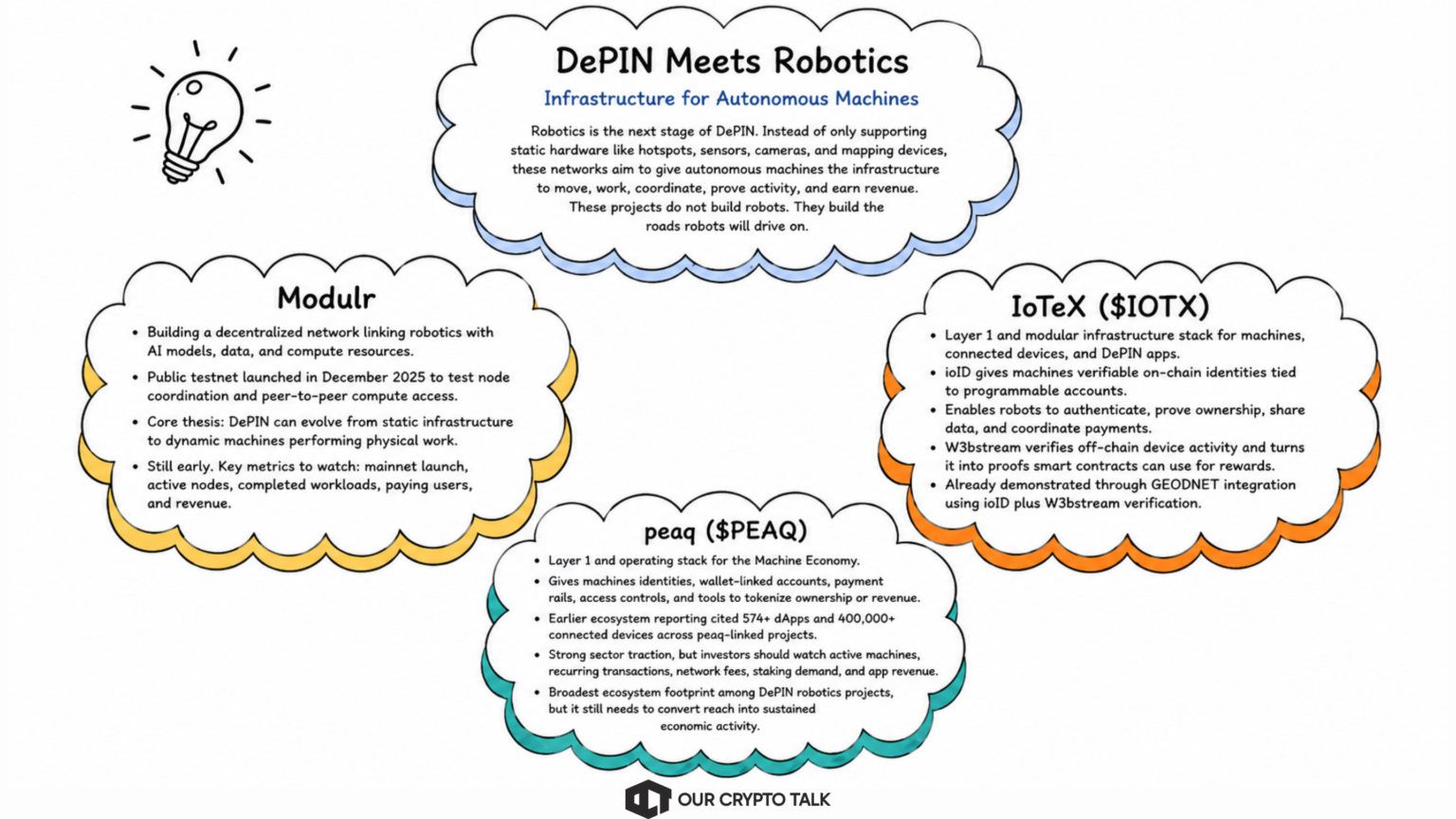
These projects do not build robots. They build the roads robots will drive on.
Modulr is developing a decentralized network that connects robotics with AI models, data, and computing resources. Its public testnet launched in December 2025 to test node coordination and peer-to-peer access to compute. The broader thesis is straightforward: DePIN began with static infrastructure. Robotics extends that model to dynamic machines that perform physical work.
However, Modulr remains in an early testing phase. The project still needs to prove that developers, robot operators, and customers will use its network at scale. Investors should track mainnet delivery, active nodes, completed robotics workloads, paying users, and revenue rather than testnet participation alone. Read OCT’s coverage of the Modulr testnet launch for a deeper breakdown.
IoTeX provides a Layer 1 and modular infrastructure stack for machines, connected devices, and DePIN applications. Its ioID system assigns machines verifiable on-chain identities linked to programmable accounts. As a result, robots can authenticate themselves, prove ownership, exchange data, and coordinate payments without depending on a centralized database.
Meanwhile, W3bstream verifies data and activity that originate outside the blockchain. It processes device information off-chain and produces proofs that smart contracts can verify before distributing payments or rewards. This plumbing layer matters because robots need more than wallets.
peaq builds a Layer 1 and operating stack for the Machine Economy. Its infrastructure gives robots and connected devices decentralized identities, wallet-linked accounts, payment functions, access controls, and tools for tokenizing machine ownership or revenue. Therefore, a machine can establish an identity, receive funds, pay for services, and operate as an on-chain economic actor.
Earlier ecosystem reporting cited more than 57 dApps and over 400,000 connected devices across peaq-linked projects. These figures give peaq some of the clearest traction metrics in the DePIN robotics sector, although investors should distinguish cumulative ecosystem totals from devices that actively generate on-chain transactions.
Still, ecosystem size does not automatically create value for the $PEAQ token. Investors should monitor active machines, recurring transactions, network fees, staking demand, application revenue, and the percentage of reported devices that regularly interact with the chain.
Physical AI crypto still carries heavy speculation, but capital allocation gives the sector credibility. Tether does not manufacture robots. Instead, the company backs robotics firms and develops the financial and AI infrastructure that autonomous machines could use. With USDT’s market capitalization now near $184 billion, Tether brings more financial weight to the sector than a typical crypto venture fund or narrative-driven token launch.
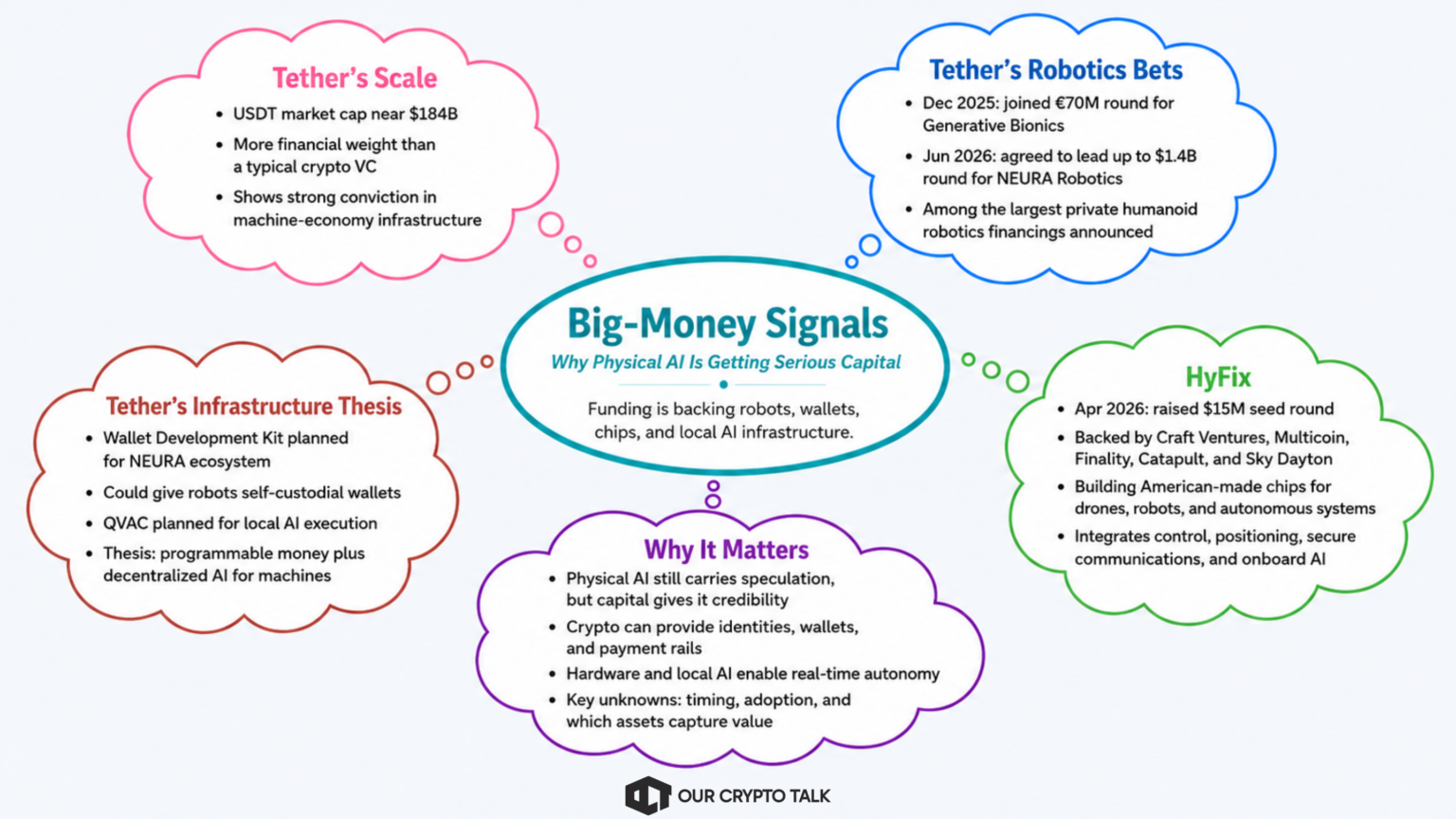
Tether has made two direct investments in humanoid robotics. In December 2025, it joined a €70 million funding round for Generative Bionics, an Italian company developing intelligent humanoid robots. Then, in June 2026, Tether Investments agreed to lead a financing round of up to $1.4 billion for Germany-based NEURA Robotics.
More importantly, Tether plans to contribute infrastructure rather than capital alone. For instance, the company intends to integrate its Wallet Development Kit into NEURA’s robotics ecosystem. This integration could give machines self-custodial wallets and the ability to transact independently. In addition, Tether plans to deploy QVAC, its edge-focused AI runtime, so robots can run models locally instead of relying entirely on remote cloud servers.
Tether’s involvement does not validate every Physical AI token. Nevertheless, it shows that a major crypto company views autonomous machines as a serious future market. In other words, investors should follow the money. Tether is not investing in robotics simply because robots are trending on Crypto Twitter.
Meanwhile, HyFix Spatial Intelligence targets the hardware layer that makes autonomous machines possible. In April 2026, the semiconductor startup raised a $15 million seed round led by Craft Ventures, with participation from Catapult Ventures, Multicoin Capital, Finality Capital, and Sky Dayton. With this funding, HyFix plans to develop American-made chips for drones, robots, and other autonomous systems.
Specifically, the company is building a system-on-a-chip that combines flight control, high-precision positioning, secure communications, and onboard AI computing. As a result, this integrated design could replace the fragmented collection of components that many drones and smaller robots currently use.
HyFix does not issue a crypto token. Even so, its funding strengthens the broader Physical AI thesis. Crypto networks can provide machines with identities, wallets, and payment rails. However, robots still need efficient chips to navigate, process sensor data, and execute decisions in real time. Therefore, HyFix is building a critical hardware foundation for the emerging machine economy. Read OCT’s full HyFix funding coverage for additional details.
Taken together, Tether and HyFix answer the skeptic’s central question. Physical AI has attracted significant speculation, but the sector is not driven by hype alone. Instead, investors are funding the robots, chips, wallets, and local AI systems that a functional machine economy will require.
Before a robot can transact, it first needs to know where it is and what surrounds it. Autonomous vehicles, delivery robots, and drones depend on accurate maps, real-world visual data, and precise positioning to navigate safely. Together, NATIX and GEODNET build this spatial-awareness layer.
NATIX operates a crowdsourced camera network that collects real-world driving data for autonomous vehicles and Physical AI models. By April 2026, the network had attracted more than 270,000 drivers and mapped over 250 million kilometres. Moreover, NATIX formally expanded into DePAI in June 2025, combining decentralized data collection with AI training for robotics, autonomous driving, and smart-city applications. Since then, the project has shifted its focus from the Drive& smartphone app toward VX360, which captures multi-camera vehicle footage for model training, simulation, and edge-case analysis.
Meanwhile, GEODNET builds a decentralized network of satellite reference stations that provides centimetre-level RTK positioning. Standard GPS can miss a location by several metres, which creates serious problems for drones, autonomous vehicles, agricultural machines, and robots that require lane-level or object-level accuracy. To address this limitation, GEODNET stations produce correction data that helps nearby machines determine their precise position in real time.
Therefore, the two networks support different but complementary functions. NATIX helps machines understand what surrounds them, while GEODNET helps them determine exactly where they are.Read OCT’s full GEODNET review for a deeper analysis of the network and $GEOD token.
As Physical AI attracts more attention, low-effort tokens will inevitably copy the narrative without building meaningful technology. However, a robot-themed website, a whitepaper, and an active Telegram group do not prove that a project has any real connection to robotics. Therefore, investors need to verify what exists beyond the token.
First, does the project have real hardware, equity, or partnerships? XMAQUINA provides a useful benchmark because its public treasury shows positions in robotics companies such as Apptronik, Figure AI, 1X Technologies, Agility Robotics, and NEURA Robotics. By contrast, a hypothetical token called $ROBODOGE with no hardware, equity, customers, or verifiable partnerships only sells exposure to a narrative.
Next, can the project prove traction? Investors should look for active machines, completed tasks, verified devices, data customers, transactions, or revenue. For example, peaq launched with ecosystem projects that collectively represented more than two million devices, while NATIX reported more than 270,000 drivers by April 2026. Nevertheless, investors should separate registered or ecosystem-wide totals from devices that actively use the network and generate economic activity. If a project only reports followers, Discord members, or Telegram users, treat those figures as marketing metrics rather than evidence of adoption.
Equally important, where does the revenue come from? A credible robotics crypto project should earn money from machine payments, data sales, hardware usage, mapping services, positioning data, subscriptions, or infrastructure fees. In contrast, if token emissions and new investor inflows sustain the entire economy, the model remains speculative. Investors should also determine whether customers pay for the service because they need it or simply because the protocol rewards them with tokens.
Furthermore, who is building the project? Robotics requires expertise in hardware, artificial intelligence, manufacturing, safety, logistics, and enterprise deployment. As a result, named founders with verifiable employment histories, technical research, shipped products, and industry partners provide stronger evidence than anonymous teams. An anonymous team does not automatically indicate fraud. Even so, it creates additional execution and accountability risks in a capital-intensive sector.
Finally, does the token need to exist? Many robotics businesses can operate without a crypto asset. A legitimate token may secure a network, coordinate payments, govern shared infrastructure, reward data providers, or provide access to machine services. However, if the token only funds development and gives traders something to speculate on, it functions as a fundraising instrument rather than useful infrastructure.
Use these signals to evaluate whether a robotics crypto project has real infrastructure or relies mainly on speculation.
Investors should also examine token unlocks, insider allocations, treasury control, smart-contract activity, and the link between product growth and token demand. A project can build valuable robotics technology while its token captures none of that value.
The Physical AI narrative is real. Most Physical AI tokens will not be. Apply the same skepticism you would apply to any early-stage investment.
Physical AI crypto represents a real technological trend, but it remains an early investment thesis. Jensen Huang brought Physical AI into the mainstream at CES 2025, while companies such as Tether have committed substantial capital to robotics and supporting infrastructure. Tether’s planned investment of up to $1.4 billion in NEURA Robotics shows that major crypto companies expect autonomous machines to become an important economic sector. However, funding and technological progress do not guarantee that every related token will succeed.
For now, investors should pay closer attention to the infrastructure layer. Networks such as peaq, IoTeX, and GEODNET provide machine identities, payments, data verification, and precise positioning. These systems could support many robotics applications rather than relying on the success of one robot or product. Infrastructure usually develops before applications reach mass adoption, which may give these projects broader exposure to the growth of the machine economy.
However, investors should not buy tokens simply because the narrative sounds exciting. Fabric Protocol demonstrated a credible use case, but $ROBO still trades approximately 78% below its March 2026 all-time high. The project can continue developing while the token performs poorly. Therefore, investors must separate sector growth from token performance and examine revenue, token unlocks, circulating supply, network usage, and value capture before taking a position.
Physical AI crypto is a three-to-five-year thesis, not a three-week trade. The sector still needs larger machine fleets, paying customers, sustainable network activity, and clearer token economics. Position accordingly, avoid narrative-driven FOMO, and prioritize projects that can prove real adoption over those that only market a futuristic vision.
Disclaimer: This is not investment advice. All projects mentioned are early-stage and high-risk.


Web3 Gaming Comeback 2026: GTA 6 Hype vs 99% Crashes
Layer 2 Projects Shutting Down: Who’s Next After Blast?
Embodied Data Pyramid and Decentralized Data Layer for Robotics
DeFi Needs Better Liquidity. Can Ramses Deliver?
Web3 Gaming Comeback 2026: GTA 6 Hype vs 99% Crashes
Layer 2 Projects Shutting Down: Who’s Next After Blast?
Embodied Data Pyramid and Decentralized Data Layer for Robotics
DeFi Needs Better Liquidity. Can Ramses Deliver?