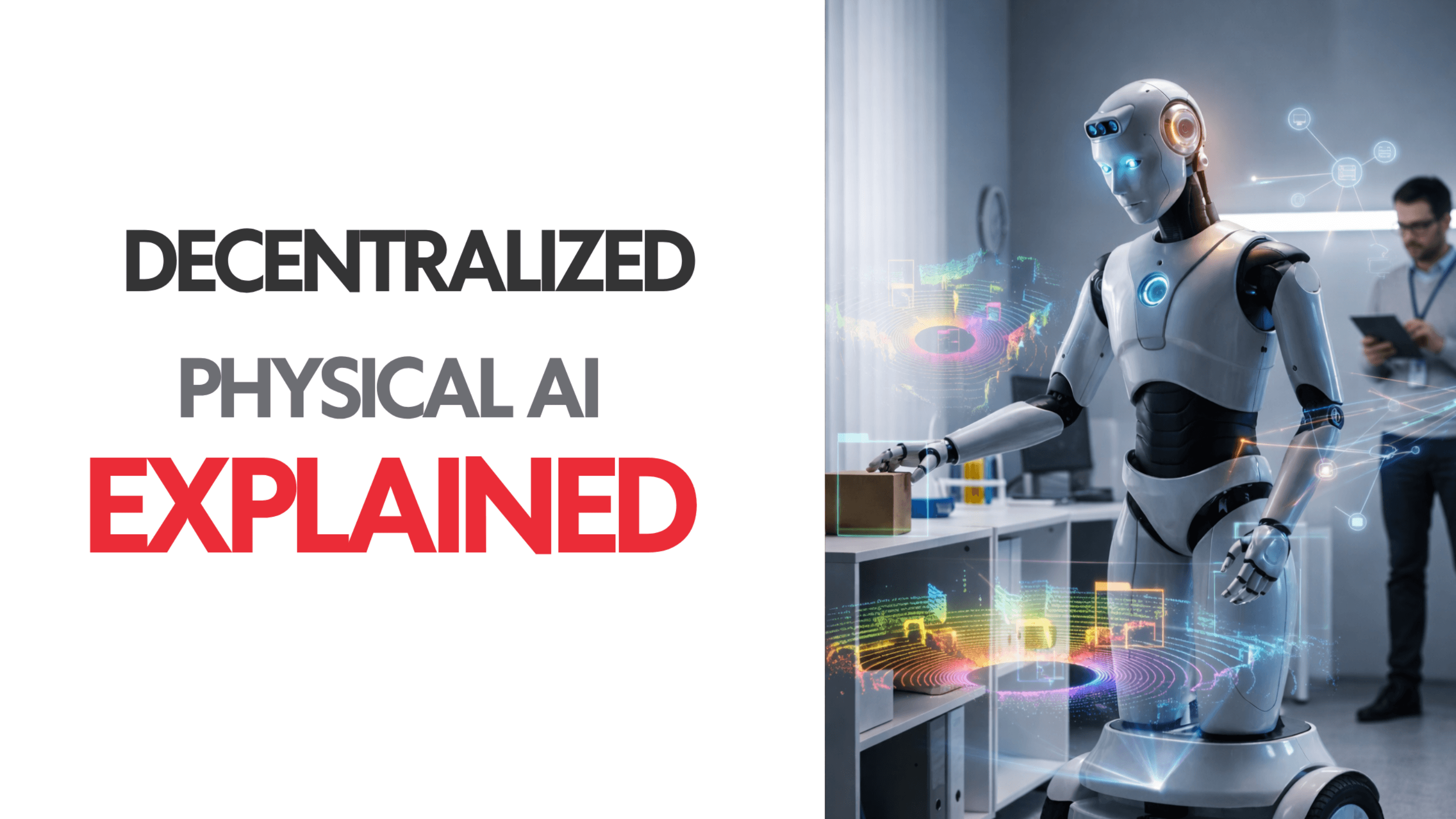
DePAI merges autonomous AI robots with blockchain infrastructure. Learn what Decentralized Physical AI means, which projects are building it, and why it matters in 2026.

Author: Kritika Gupta
Artificial intelligence and crypto infrastructure are beginning to converge in a way that could reshape how machines interact with the real world. While most investors already understand narratives such as AI tokens and DePIN, a new category is now emerging at the intersection of both: DePAI, or Decentralized Physical AI. A robot dog named Bits recently detected that its battery was running low, located a charging station, plugged itself in, and paid for the electricity using USDC, all without any human touching anything. That is DePAI in action.
At its core, DePAI moves beyond software-only intelligence and into the physical world. Instead of limiting AI agents to chat interfaces, trading bots, or cloud-based systems, this model extends intelligence into robots, drones, autonomous vehicles, and other machines that can perceive, decide, and transact independently. More importantly, blockchain infrastructure gives these machines wallets, identity layers, and payment rails, allowing them to participate directly in economic activity.
As a result, the conversation is shifting from “Can AI think?” to “Can machines operate as economic agents?” This distinction matters because it introduces an entirely new framework for ownership, coordination, and machine-to-machine commerce.
Although the narrative is gaining momentum through 2026, the sector remains early, experimental, and highly speculative. Therefore, this article breaks down what DePAI actually means, how it differs from DePIN and AI tokens, which projects are building the stack, and why the opportunity, as well as the risks, deserve serious attention.
DePAI stands for Decentralized Physical AI.
Messari, a leading crypto research firm, coined the term shortly after Jensen Huang popularized the idea of “Physical AI”during his CES keynote in January 2025. Therefore, the naming follows the now-familiar DePIN pattern, where the prefix “De”signals decentralization. At its core, DePAI is what happens when you give a robot a crypto wallet and let it run a business.
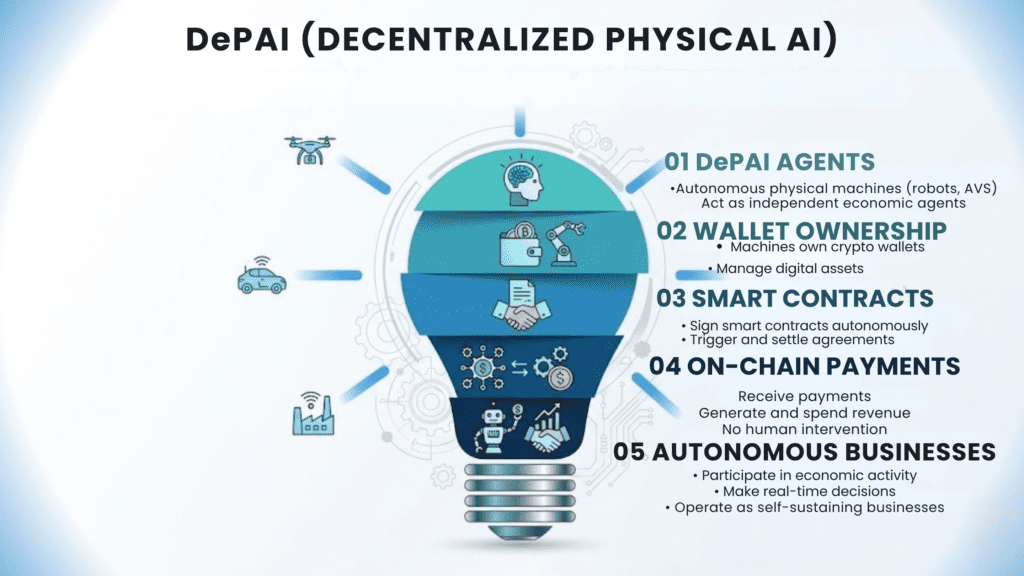
In practical terms, DePAI refers to autonomous physical machines such as robots, and autonomous vehicles that operate as independent economic agents on blockchain networks. Therefore, These machines can own wallets, sign smart contracts, receive payments, generate revenue, and spend crypto assets without any human intervention.
Unlike traditional robotics systems that simply execute programmed commands, DePAI-enabled machines can participate directly in economic activity. However, they can make decisions, settle transactions, and interact with decentralized infrastructure in real time.
DePAI (Decentralized Physical AI) is what happens when you give a robot a crypto wallet and let it run a business. In fact, it is where autonomous physical machines operate as independent economic agents with their own wallets, contracts, and on-chain payment capabilities.
DePAI is not just another crypto buzzword. In fact, there is a real technical reason this category exists. Software-only AI agents, such as chatbots, research copilots, and trading bots, remain confined to digital environments. They can read data, process information, and interact with APIs or financial systems. However, they cannot directly perceive or act in the physical world. As a result, they do not have access to space, motion, location, or environmental context.
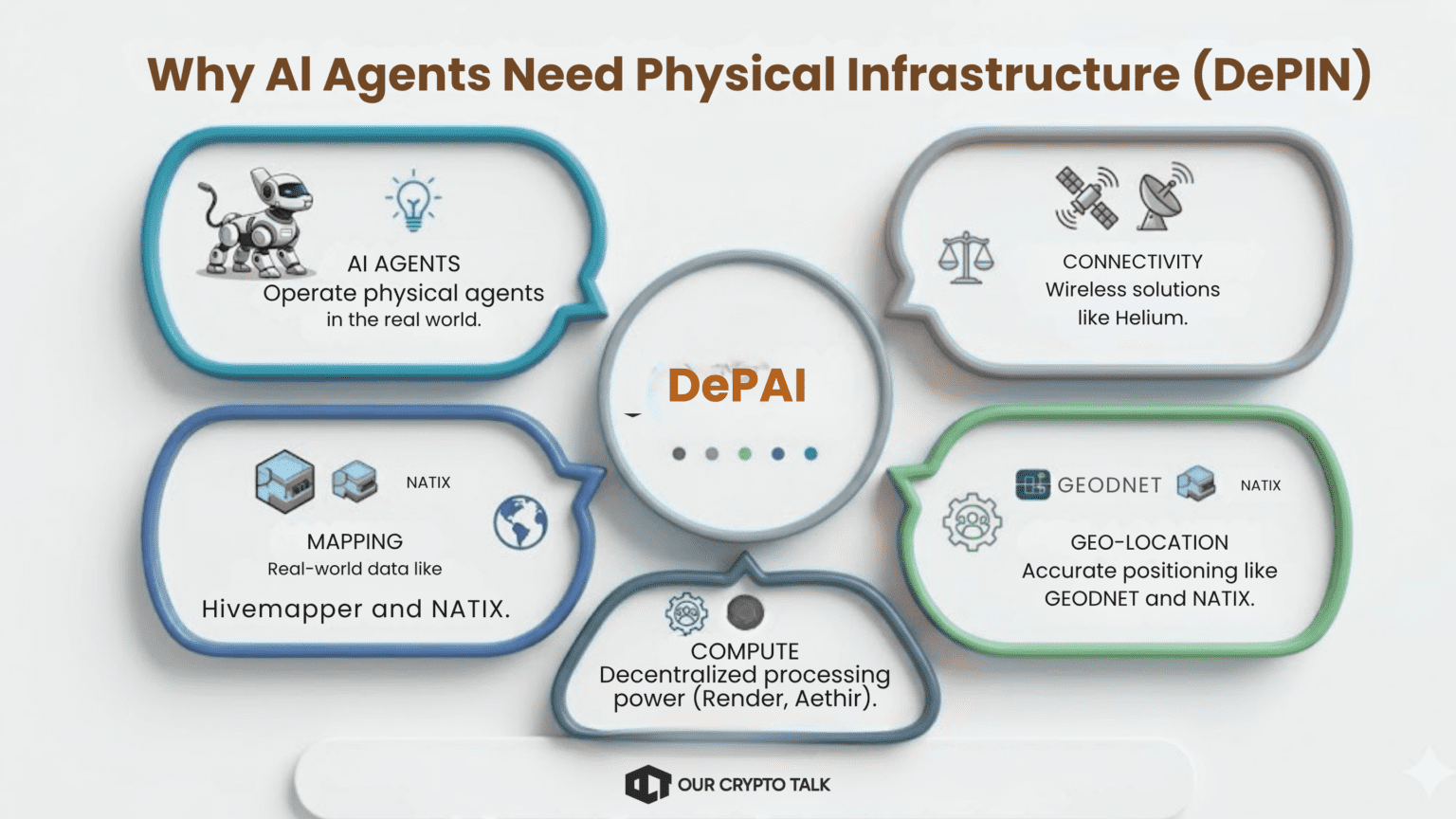
Beyond data, physical AI also demands serious compute infrastructure. These systems cannot rely entirely on cloud round-trips because latency becomes a critical bottleneck in real-world environments. Instead, they need models to run on-device or at the edge, where inference can happen locally with faster response times. At the same time, they require low-latency connectivity so multiple machines can coordinate in real time, whether that means a fleet of delivery robots, autonomous vehicles, or industrial drones. This is exactly where decentralized infrastructure becomes essential.
Apart from that, the bridge between concept and execution already exists through DePIN. Helium provides decentralized wireless connectivity. Render and Aethir provide compute infrastructure. Also, Hivemapper and NATIX support real-world mapping and spatial data, while GEODNET strengthens decentralized GPS and positioning layers. DePIN provides the pipes. AI provides the intelligence. DePAI fuses both. Without DePIN infrastructure, DePAI cannot scale.
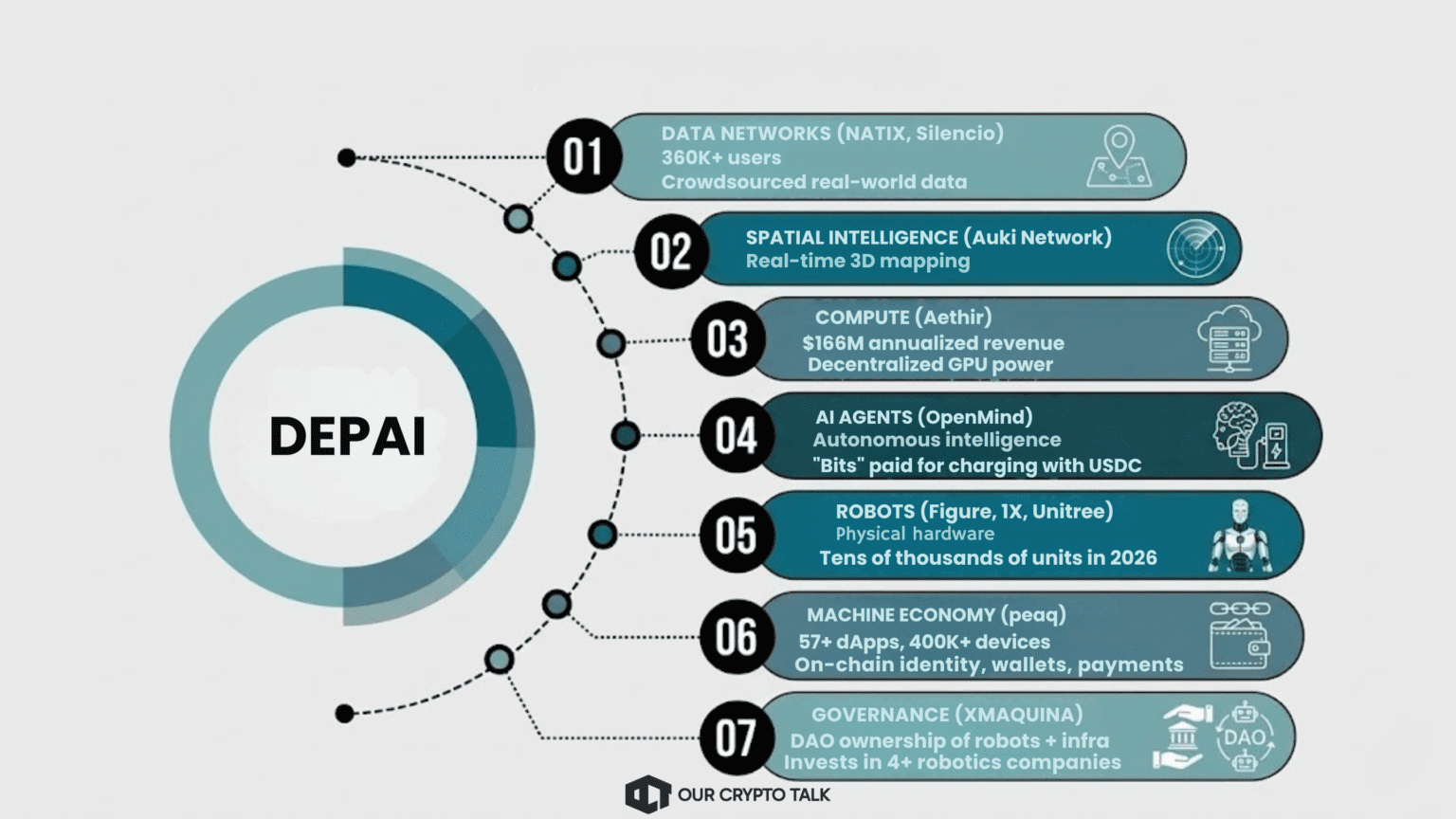
Messari’s seven-layer framework for decentralized physical AI offers one of the clearest ways to understand how the ecosystem fits together. Instead of looking at DePAI as a single token narrative this framework presents it as a full-stack ecosystem. Additionally, it spans real-world data, machine intelligence, economic rails, and governance.
Messari’s seven-layer DePAI stack, simplified for article readers
Key DePAI projects across machine economy, robotics, compute, and data infrastructure
Note: This is not an endorsement. Most DePAI projects are early-stage and high-risk. Always do your own research.
This is where the DePAI vs DePIN discussion becomes most useful for readers, because the categories often overlap in market narratives.
At a high level, DePIN focuses on static infrastructure, AI tokens focus on software intelligence, and DePAI focuses on embodied machines that act as economic agents. In other words, while the boundaries are not always perfectly clean, this framing helps clarify where each thesis sits in the broader crypto and robotics stack.
To begin with, the key insight is that DePIN provides the infrastructure rails. These are the static systems that support connectivity, compute, positioning, and sensor data. For example, think wireless networks, decentralized GPU clouds, mapping infrastructure, and GPS layers. By comparison, AI tokens represent the software intelligence layer. In fact, they focus on model training, inference markets, autonomous software agents, and machine-learning services.
DePAI moves one step further. That means robots, drones, and autonomous systems can hold wallets, sign contracts, receive payments, spend crypto, and potentially coordinate economic activity without human intervention.
Therefore, this overlap is important because the sectors should not be viewed as mutually exclusive silos. Instead, they often exist on a spectrum where infrastructure, intelligence, and physical agency converge.
Core framework comparison: DePIN vs AI Tokens vs DePAI
The timing for DePAI feels unusually important in 2026 because several macro trends are now converging at the same time.
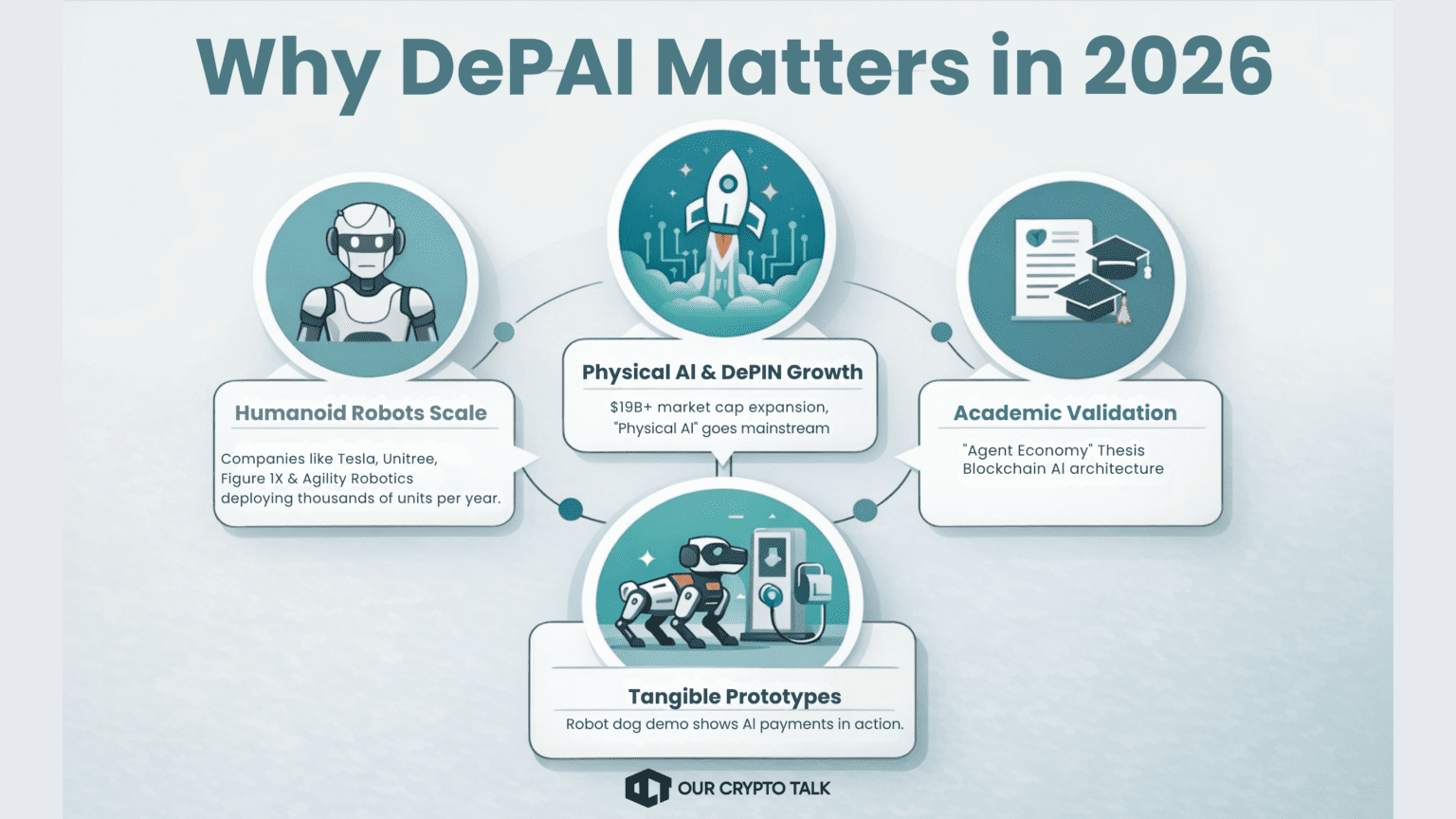
First, humanoid robot production is no longer a distant concept. Companies such as Tesla, Unitree, Figure, 1X, and Agility Robotics are all accelerating development, with the sector increasingly talking in terms of tens of thousands of units annually rather than isolated prototypes. However, the broader robotics race has moved from lab demos toward real industrial and logistics deployments.
Second, the market narrative around physical AI has gained real institutional momentum. Jensen Huang pushed “Physical AI” into the mainstream during CES 2025, framing it as one of the next major computing shifts. More importantly, the DePIN sector has already demonstrated that infrastructure narratives can scale quickly, growing from roughly $5.2 billion to over $19 billion in market capitalization, a roughly 3.7x expansion in one year. That growth matters because DePAI builds directly on those infrastructure rails.
Academic research is also beginning to formalize the thesis. The February 2026 arXiv paper “The Agent Economy”proposed a five-layer architecture for autonomous AI agents operating on blockchain networks, directly reinforcing the machine-economy narrative that DePAI is built around. Therefore, it explicitly frames machines as economic peers capable of identity, settlement, and governance, which strongly overlaps with the DePAI stack.
At the same time, the proof-of-concept layer is becoming tangible. OpenMind’s robot dog paying for electricity remains a small demo, but it is still important because it moves the conversation beyond theory. Apart from this, it shows that machine wallets, autonomous settlement, and real-world interaction are technically possible today.
That said, this section needs to stay grounded. The trend is real. The scale is not yet there.
This is the section that needs the most honesty because, without it, the DePAI narrative can quickly start to read like a marketing pitch.
First, there is the risk of narrative inflation. It is entirely possible that “DePAI” becomes a rebranding exercise rather than a genuinely distinct sector. In fact, Crypto has a long history of creating new acronyms around adjacent themes, and in many cases, the market prices the story long before the technology proves itself. In practice, several so-called DePAI projects today still look like a blend of existing DePIN infrastructure and AI-token narratives, repackaged under a new label. Moreover, many of them remain pre-revenue, early-stage, or still in pilot mode, which means token valuations can move far ahead of actual adoption.
Second, latency remains a serious risk, and this is not a minor technical issue. Decentralized networks, by design, introduce coordination overhead. While that may be acceptable for payments, data marketplaces, or periodic machine-to-machine settlement, it becomes far more problematic in real-time physical systems. For example, in autonomous driving, robotics fleets, or drone coordination, latency can become dangerous. A few hundred milliseconds may not matter in DeFi. However, in robotics, it can mean a collision, a failed navigation decision, or even a safety-critical error. Another example is the Lobster AI Agent Accident.
Third, scalability presents another structural challenge. Both AI inference and blockchain systems are already computationally expensive on their own. When combined, they significantly compound the demand profile. Physical AI requires edge inference, continuous sensor processing, real-time decision loops, and secure transaction settlement. As a result, scaling this across thousands of machines remains a major engineering challenge. This is precisely why the gap between prototype demos and real-world deployment remains so wide.
DePAI is real as a concept, and for that reason, it deserves serious attention. The convergence of robotics, AI agents, machine payments, and decentralized infrastructure is no longer theoretical. The building blocks already exist across DePIN, edge compute, mapping networks, and on-chain machine identity. That said, as an investment thesis, it remains very early. The technology stack is still forming, standards remain immature, and most projects are closer to infrastructure buildout than mass-scale application deployment.
For now, the infrastructure layer deserves far more attention than the application layer. Projects such as peaq, Aethir, and GEODNET sit closer to the core rails that every future DePAI use case will depend on. History across both Web2 and crypto repeatedly shows that infrastructure tends to get built first, while consumer-scale applications arrive later. In this cycle as well, the same pattern is likely to hold. Additionally, compute, connectivity, positioning, and machine identity should mature before autonomous machine economies become commercially meaningful.
At the same time, the narrative around DePAI will almost certainly continue to strengthen as humanoid robot production scales through 2026 and 2027. Additionally, companies such as Tesla, Figure, Unitree, and 1X push further into real-world deployments, the market will increasingly connect those developments with on-chain coordination and payment systems.
However, investors need to remain disciplined. Much of the sector has already seen its first speculative wave. Tokens such as ROBO already experienced a major spike into their March 2026 highs before correcting sharply, with the token dropping 69 percent from its peak. Therefore, investors should avoid chasing narrative momentum alone. DePAI is worth understanding. It’s not yet worth betting the farm on. Watch the infrastructure, follow the builders, and let the technology prove itself.


Web3 Gaming Comeback 2026: GTA 6 Hype vs 99% Crashes
Layer 2 Projects Shutting Down: Who’s Next After Blast?
Embodied Data Pyramid and Decentralized Data Layer for Robotics
DeFi Needs Better Liquidity. Can Ramses Deliver?
Web3 Gaming Comeback 2026: GTA 6 Hype vs 99% Crashes
Layer 2 Projects Shutting Down: Who’s Next After Blast?
Embodied Data Pyramid and Decentralized Data Layer for Robotics
DeFi Needs Better Liquidity. Can Ramses Deliver?