Learn how Nesa uses encrypted computation and verifiable AI inference to build a decentralized privacy-focused AI network.

Author: Akshat Thakur
Nesa is a purpose-built Layer-1 for privacy-preserving, verifiable AI inference. It aims to keep models and user data confidential while allowing results to be verified on-chain, without relying entirely on centralized cloud APIs.
The problem it targets is growing. Most AI services operate as black boxes. Users cannot independently verify which model processed a request, sensitive inputs leave their environment, and model outputs can change without clear accountability. Enterprises need stronger privacy and verification as AI adoption increases.
Existing decentralized AI projects approach this problem differently. Some focus on GPU marketplaces, others rely on Trusted Execution Environments (TEEs), while fully homomorphic encryption can introduce significant performance overhead.
Nesa is building around Equivariant Encryption (EE), Homomorphic Secret Sharing over Encrypted Embeddings (HSS-EE), model sharding through BSNS and its MetaInf scheduler. The goal is to make private inference practical at larger model sizes while allowing off-chain computation to be verified on-chain.
The project also offers a broader product layer through Decentralized AI applications (DAIs), a model playground and AI Link, a cross-chain inference interface.
Nesa’s mainnet launched on May 9, 2026, followed by its token generation event and exchange listings around June 24. The infrastructure and token are already live.
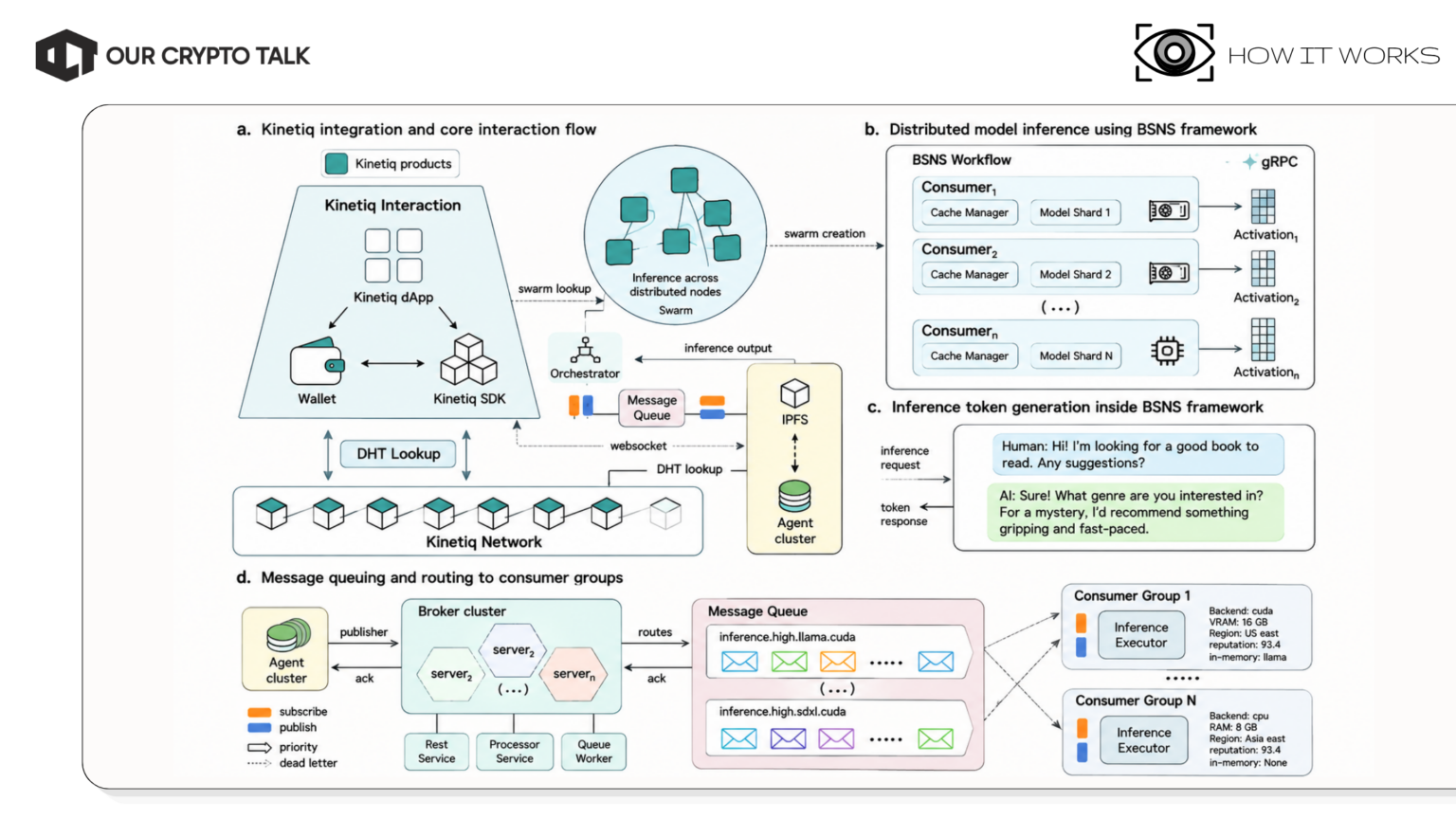
Nesa operates in a crowded decentralized AI market, but its focus differs from several established competitors.
Bittensor leads the incentive-driven intelligence market through subnets that evaluate model outputs. Ritual focuses on bringing AI calls into smart contracts. Gensyn targets decentralized machine learning coordination and verification.
Akash, io.net, Render and Aethir compete in decentralized GPU and compute infrastructure. Meanwhile, OpenAI, Anthropic and other centralized providers retain advantages in model quality, usability and distribution.
Nesa is not positioning itself as another GPU rental marketplace. Its focus is private and verifiable AI execution, supported by a model marketplace and application layer.
Its main technical differentiator is the combination of Equivariant Encryption and Homomorphic Secret Sharing over Encrypted Embeddings. Nesa claims this can support private inference without relying entirely on TEEs or paying the full performance cost of FHE.
Model sharding is designed to let mid-tier hardware participate, while on-chain verification provides a way to check off-chain inference. AI Link extends access to other chains, and DAIs give users applications beyond raw infrastructure.
The research background adds credibility. MetaInf was presented at COLM 2025, while Nesa also cites model-sharding research and conference work.
However, the competitive challenge is significant. Bittensor already has strong mindshare and liquidity, compute networks have established hardware supply, and Ritual has a clear on-chain AI proposition.
Nesa’s research thesis is credible, but its moat depends on production latency, model coverage, reliability and paid query volume. Those metrics matter more than claims of being the only secure real-time inference framework.
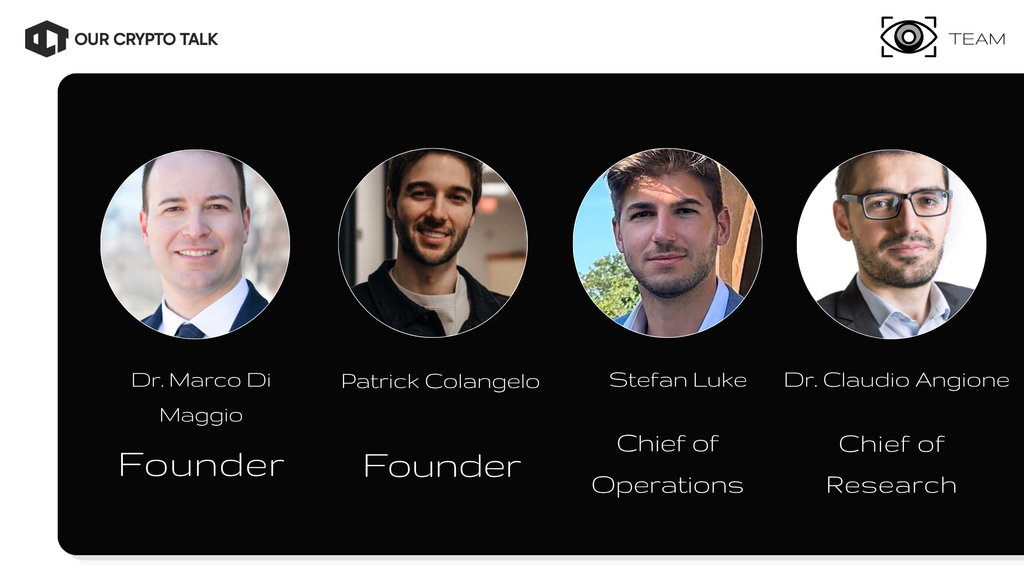
Nesa has a publicly identified, research-heavy team with experience across cryptography, machine learning, enterprise systems and decentralized finance.
Founder Dr. Marco Di Maggio leads the project and is associated with Harvard’s Crypto and Web3 Lab. He previously held an academic position at Harvard Business School and has a PhD from MIT. Co-founder Patrick Colangelo brings software and hardware scaling experience.
The technical leadership includes Dr. Hongyang Zhang, Chief of Security, whose work covers ZKML and projects such as zkLLM, ZKDL and EAGLE. Chief Scientist Dr. Yue Zhao created PyOD, a widely used anomaly-detection library, and holds a PhD from Carnegie Mellon University.
Chief of Research Dr. Claudio Angione has a Cambridge PhD and previously worked with Microsoft Research. Chief of Innovation Dr. Junyu Liu has a Caltech PhD and experience with IBM Quantum and PsiQuantum.
The team also includes Alan Boehme as Chief of Platform, bringing experience as former CTO of H&M and work with P&G and Coca-Cola. COO Stefan Luke adds experience across traditional finance, DeFi and tokenized credit.
Other contributors include Dr. Yuzhe Yang, Dr. James Buban, Ahmad Farhan and Seyfal Sultanov. Dr. Hao Li is listed as an advisor.
The strongest signal is the combination of published ML research, cryptography expertise and experience operating large-scale systems. The team’s academic depth is relevant to Nesa’s technical ambitions.
The risk is translating that research into a competitive commercial product. Strong papers and credentials do not guarantee affordable inference, reliable execution or enterprise adoption.
Nesa’s publicly available funding information is limited. The project has disclosed credible investor names, but funding amounts and detailed round terms remain largely unavailable.
YZi Labs, formerly Binance Labs, provided accelerator or early-stage support. MH Ventures and Selini Capital are associated with its seed funding. Foresight Ventures also appears in some investor listings.
Available funding records point to an accelerator around March 2024 and a seed round around August 2025. However, the amounts have not been consistently disclosed in public sources.
The investor list provides some confidence in the project’s early backing. YZi Labs, MH Ventures and Selini Capital are established names in crypto investment, giving Nesa access to more than retail speculation.
There is still limited visibility into its total funding and financial runway. Unlike projects with publicly announced large funding rounds, Nesa’s balance-sheet strength is difficult to assess from available information.
The project has moved beyond the initial survival stage. Mainnet launched on May 9, 2026, and NES began trading around June 24.
Nesa has already secured enough support to reach mainnet and listings. Now, inference revenue and ecosystem demand need to support the token’s circulating supply and ongoing emissions.
The research team and investor backing make the project worth watching. But the investment case ultimately depends on production performance and paid usage, not funding names alone.
Nesa mainnet has been live since May 9, 2026. The project has moved beyond research and testnet development, with an active inference network, model playground and node infrastructure.
Users can explore models through the Nesa Playground, run inference requests and access the model catalog. The platform lists more than 120,000 models, with some examples showing fees around 0.001 NES and average latency claims below five seconds.
The infrastructure is also publicly accessible. Nesa provides Docker-based miner software, CPU and GPU hardware tiers, a node dashboard, network explorers and a TypeScript SDK for inference requests. Its official GitHub repository has around 3,200 stars and 245 forks, alongside public bootstrap, miner-rewards and SDK repositories.
The NES token is live following its June 2026 TGE. It supports network gas, staking and inference payments.
Nesa has also reported more than 8.5M daily on-chain inference requests and over 170,000 miners. These are project-reported figures, and independent breakdowns of paid requests, unique users and retention remain limited.
The product is real. The remaining question is whether reported activity represents valuable, fee-paying inference demand or mostly subsidized and test traffic.
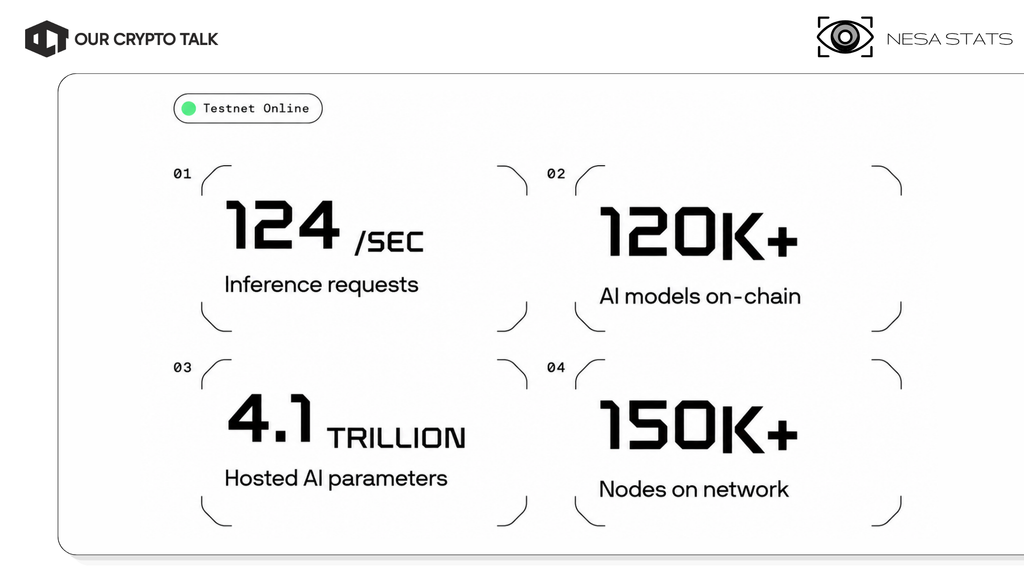
Nesa has an active token market and a growing network footprint.
The network also has a direct fee path. Users pay NES for inference requests, while miners and validators stake tokens to participate in network operations. Model owners can also receive rewards when their models are used.
Nesa has reported more than 8.5M daily inference requests and over 170,000 miners. Its model catalog lists more than 120,000 models. These figures suggest activity, but they do not establish how many users pay for inference or how much revenue the network generates.
Other attention signals include more than 340,000 social followers and futures open interest in the low millions across trading venues. These indicate market interest rather than product-market fit.
The distinction matters. A large model catalog does not prove that those models receive meaningful paid usage. Miner counts do not establish active, independent hardware participation. High request volume does not automatically translate into sustainable fee revenue.
Third-party holder analysis also points to significant wallet concentration after excluding labelled exchange and liquidity addresses. This is a structural risk for token distribution, although it is not evidence of misconduct.
Nesa has demonstrated network activity and market interest. The missing proof is recurring paid inference demand strong enough to support the token economy.
NES is already trading, so entry is through the open market rather than an upcoming TGE.
Nesa launched with a 1B token genesis supply in May 2026. Its inflation model starts around 8% annually and gradually declines toward a 1.8% floor. There is no hard maximum supply under this design.
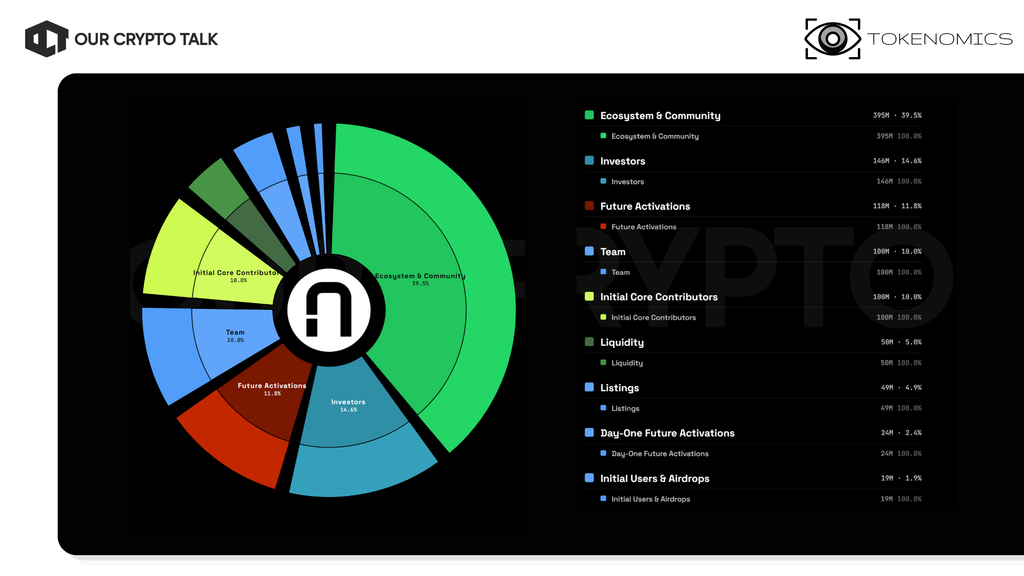
The reported allocation is approximately 39.5% for ecosystem and community, 14.6% for investors, 11.8% for future activations, 10% for the team, 10% for initial core contributors, 5% for liquidity, 4.9% for listings, 2.4% for day-one future activations and 1.9% for initial users and airdrops.
Team and core contributor allocations reportedly follow multi-year vesting, often described as a 12-month cliff followed by linear unlocks over around 36 months. Some ecosystem and community allocations also have cliffs and linear release schedules.
The next notable unlock is cited around December 24, 2026, involving approximately 20.8M NES. That represents roughly 2.1% of total supply. Vesting trackers suggest further releases will continue toward 2030.
NES has several designed utility sinks. Users pay for inference and gas, miners and validators stake tokens, model owners receive rewards, and holders participate in governance.
The free airdrop and testnet-points opportunity is largely over. Nesa’s incentivized testnet and genesis distributions ran into the June 2026 TGE. Late participants should not expect to recover the early farming returns.
The remaining routes require either capital or active participation.
Buying NES on the open market provides direct token exposure. However, investors need to account for the December 2026 unlock window and the network’s ongoing inflation.
Running a miner or node offers another route. Nesa provides an official bootstrap script and supports CPU and GPU hardware tiers. Participants can earn NES for inference work, but this requires suitable hardware, uptime and operational effort. Some setups may also require Hugging Face API access.
Users can stake NES to participate in network security and miner economics where delegation is supported. This ties up capital and carries the opportunity cost of holding or using those tokens elsewhere.
Developers have another option: upload models or build DAIs. Model owners can enter the reward path when users query their models. This requires more technical work, but it is directly connected to actual network usage.
The playground and API are also open for inference. Using them supports the network’s fee activity, but it is not an early allocation strategy.
The original points opportunity has passed. What remains is capital exposure through buying or staking, or operational participation through mining and building. The potential reward depends on private, verifiable inference demand growing faster than token unlocks and inflation.
The free farming opportunity is largely over. Nesa’s incentivized testnet, genesis distributions and June 2026 TGE have already happened. Late participation in residual quests is unlikely to offer the same returns as early AI and DePIN campaigns.
The remaining options are different: buy or stake NES, or run infrastructure and earn tokens through mining. Mining should be treated as operational income, not a free airdrop. Hardware costs, electricity, uptime and time all affect the actual return.
The upside depends on fee-paying inference demand and adoption of models and DAIs. The downside includes dilution, concentrated token ownership and competition from established AI infrastructure projects.
Nesa offers plausible asymmetric exposure, but the risk is substantial. Mining only makes sense if expected NES rewards justify the operating costs. For investors, any position should be sized around the possibility that usage fails to catch up with supply.
Nesa faces competition from several directions. Bittensor already has strong liquidity and mindshare in decentralized AI markets. Ritual has a clear on-chain AI proposition, while Akash, io.net and Render have established compute networks. Centralized providers still lead in user experience and model quality.
The bigger risk is the gap between network activity and actual revenue. Millions of daily requests mean little if traffic is subsidized, low-value or non-recurring. With inflation starting near 8% and additional unlocks ahead, weak fee generation could create persistent selling pressure.
Token concentration adds another concern. A relatively small effective float, large locked allocations and concentrated top wallets can make price discovery fragile. Even strong technology may struggle against repeated unlocks and emissions. This is the $STRC-style risk: token structure can dominate product fundamentals for an extended period.
The technology itself also faces execution risk. Private inference at real model scale requires reliable latency, correct sharding and robust verification under adversarial conditions. Research papers do not guarantee production performance. A serious exploit or failure in the verification system could undermine the entire trust proposition.
Regulatory exposure is another challenge. Private AI workloads, encrypted compute, token incentives and cross-border model distribution bring data protection, securities and compliance questions. Enterprise adoption could increase scrutiny rather than remove it.
Finally, Nesa must prove that its encryption and verification approach offers a meaningful advantage. If EE and HSS-EE fail to deliver measurable benefits, the project risks becoming another DeAI infrastructure token without a must-have use case.
Nesa has already passed its two major launch milestones. Mainnet went live on May 9, 2026, followed by the TGE and exchange listings around June 24.
The next notable calendar event is the December 24, 2026 unlock. Trackers cite approximately 20.8M NES, equivalent to around 2.1% of total supply. This creates a direct test of market demand and could influence sentiment heading into 2027.
The more important catalyst is sustained paid inference activity. Public revenue figures, recurring paid queries, DAI adoption and enterprise customers would provide stronger evidence of product-market fit than model counts or miner registrations.
Technical progress also matters. Independently validated benchmarks for MetaInf, model sharding and encrypted inference could strengthen Nesa’s research premium if they demonstrate improvements in latency, reliability and cost.
Exchange expansions and deeper liquidity may support trading, but they cannot fix weak network demand.
There is no upcoming TGE to front-run. The decision now is whether paid usage can improve before the December unlock. Without transparent revenue data, waiting for the unlock to pass and observing how the market absorbs the supply may be the lower-risk approach.
WATCH
Nesa is a live AI Layer-1 with a credible research team and a differentiated approach to privacy-preserving, verifiable inference.
The project has already shipped its mainnet, miner infrastructure, model playground and AI SDK. It also reports millions of daily inference requests and a large miner base. However, the quality of that activity remains unclear. Publicly verifiable paid inference revenue is the missing piece.
Tokenomics also need close attention. Only around 30% of supply is circulating, inflation starts near 8%, and the December 2026 unlock adds further supply pressure. Competition from Bittensor, Ritual, established compute networks and centralized AI providers makes adoption harder.
The next milestone is clear: sustained paid inference revenue that can support network rewards and absorb future emissions. Independent production benchmarks and growing DAI usage would strengthen the case.
Until those signals emerge, Nesa deserves monitoring rather than an aggressive position. The technology is worth watching, but the token still needs to prove that network activity can translate into lasting value.
All the opinions in this article are that of the author and in no way are financial advice. Our Crypto Talk and the author always suggest you do your own research in crypto and to never take anything as financial advice that you read on the internet. Check our Terms and conditions for more info.