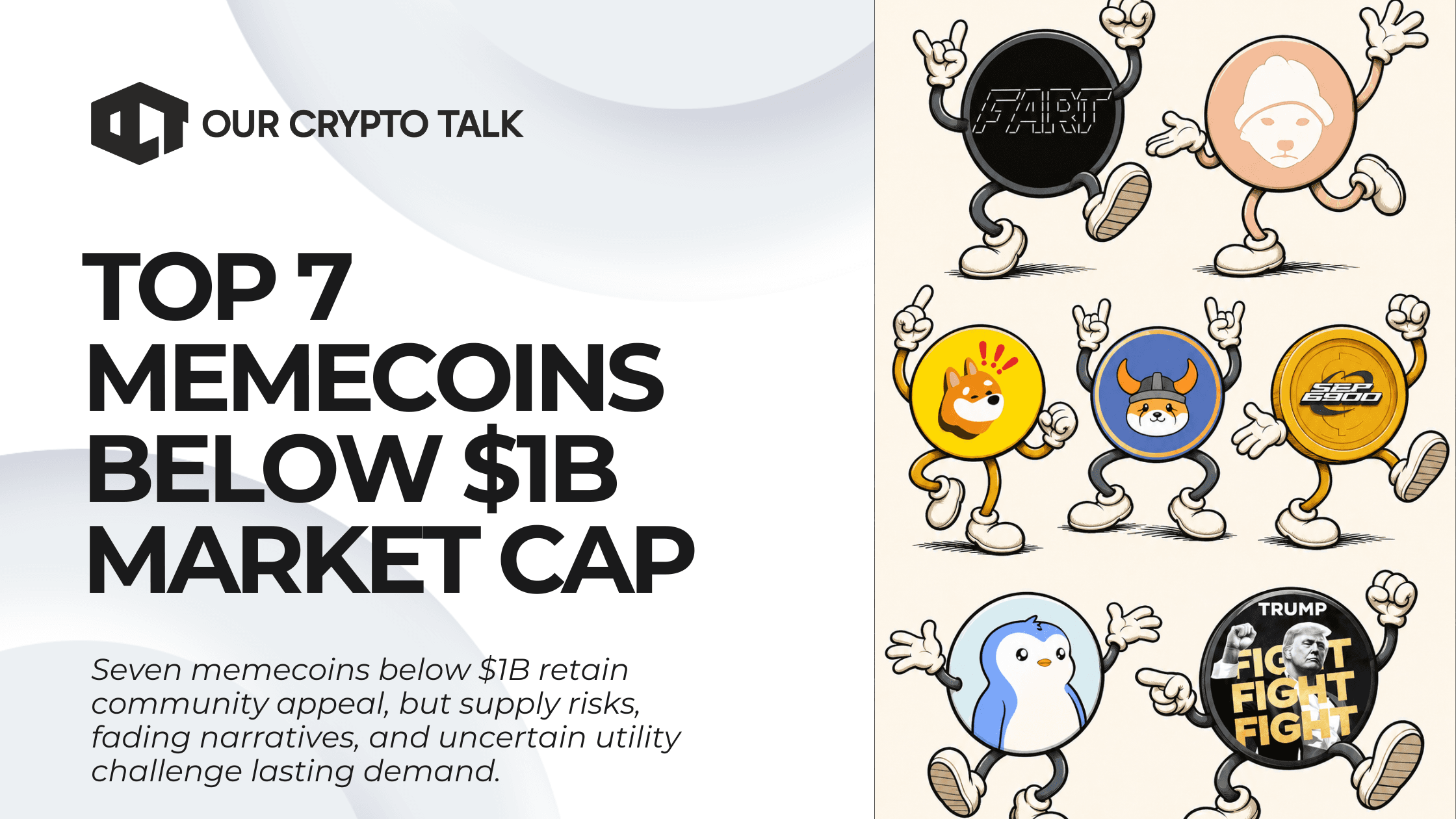
Explore seven memecoins below $1B, including TRUMP, PENGU, BONK and WIF, with insights into token supply, utility and key risks.

Author: Kritika Gupta
Memecoins below $1B offer a snapshot of which projects still attract traders after the sector’s sharp downturn. While thousands of tokens have faded, a smaller group continues to maintain active communities, exchange listings, and liquidity.
From TRUMP’s political appeal to PENGU’s consumer brand and BONK’s Solana ecosystem, these seven tokens follow different paths to staying relevant. This article examines their narratives, supply structures, and utility, alongside the risks that could limit a recovery.
The memecoin sector’s total market cap now stands near $38 billion, down roughly 62 percent from its late-2024 peak near $100 billion. Meanwhile, the broader crypto market stayed above $3 trillion and briefly touched $4 trillion. Trading volume followed a similar path. Daily turnover peaked near $20 billion during mid-2025 before falling below $3 billion by December. By late 2026, the sector’s total market cap stands in the high-$20 billion range, far below its late-2024 peak near $150 billion.
However, that contraction does not spell the end of memecoins. Most of the 13 million-plus tokens that launched during the frenzy failed or lost nearly all their value. As a result, a much smaller group still maintains meaningful liquidity, exchange listings, and recognizable communities. Among them, memecoins below a $1B market cap occupy a distinct position. They lack the established status of Dogecoin or Shiba Inu, but they still attract holders and trade on major venues. Those characteristics could matter if attention and liquidity return to the sector.
The following profiles cover seven such survivors. Each represents a different memecoin thesis: celebrity exposure, consumer-brand crossover, financial satire, Solana ecosystem utility, a utility pivot, an image-led meme, or an AI-agent experiment. These profiles do not recommend purchases. Instead, they examine how each project has retained market relevance after the downturn.
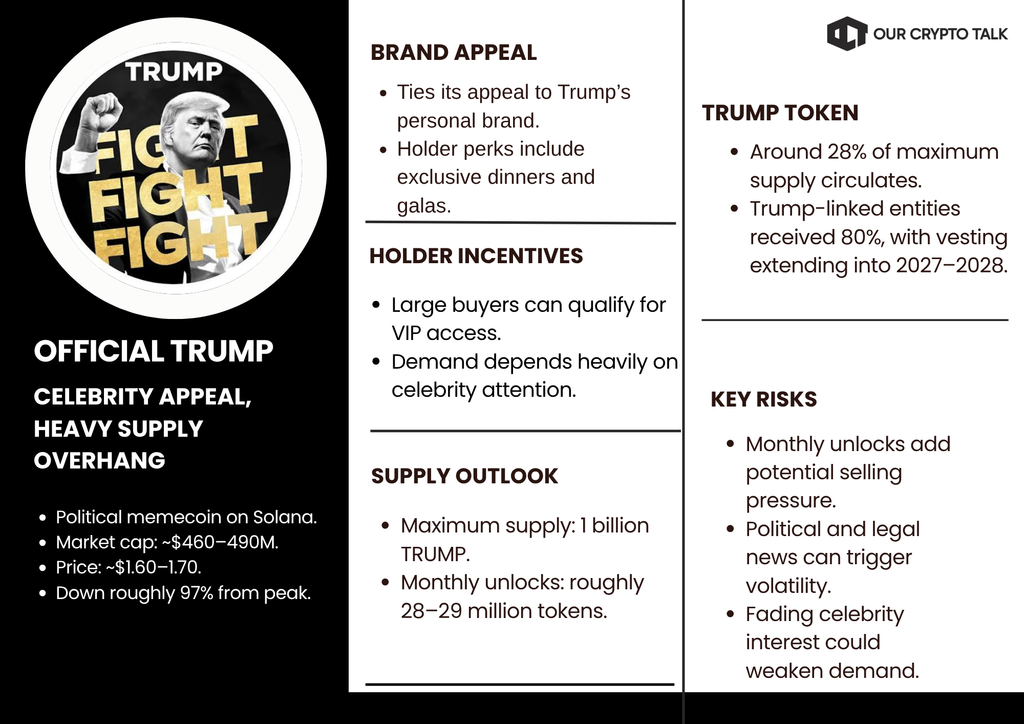
Official Trump ranks as the largest political memecoin ever launched. The token debuted on Solana in January 2025, briefly traded above $70, and reached a fully diluted valuation in the tens of billions of dollars before collapsing. As of early November 2026, it trades near $1.60–1.70, with a circulating market cap of approximately $460–490 million. Despite a roughly 97 percent drawdown from its peak, it retains one of the largest market caps among memecoins below $1B.
The thesis centers on the president’s personal brand and supporters’ willingness to treat token holdings as a route to access. For example, holder perks have included exclusive dinners and galas at Trump properties. Organizers promoted one late-2026 event with VIP reception seats for the largest buyers and watches for the top handful. These incentives tie the token’s appeal closely to celebrity access.
However, the supply structure creates substantial dilution risk. Only about 20 percent of the 1 billion maximum supply entered circulation at launch. Trump-linked entities hold the remaining 80 percent under staggered cliffs and linear vesting schedules that extend into 2027 and 2028. Recurring monthly unlocks release roughly 28–29 million tokens, or about 2.9 percent of maximum supply. Meanwhile, circulating supply still represents only around 28 percent of the total, leaving fully diluted valuation several times above circulating market cap. Political developments, legal news, and fading attention add further volatility. Consequently, TRUMP combines celebrity exposure with a large insider supply overhang.
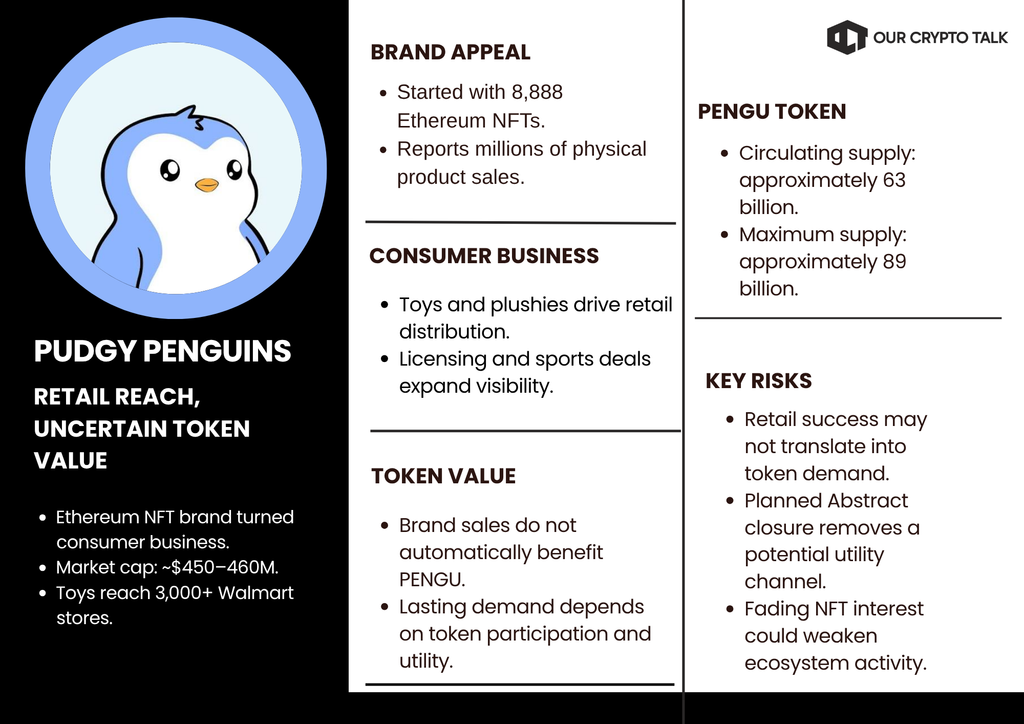
Pudgy Penguins began as an 8,888-piece Ethereum NFT collection in 2021 and has since expanded into consumer products. More than 3,000 Walmart stores and thousands of other retail locations stock its toys and plushies. In addition, the brand has reported millions of unit sales and tens of millions of dollars in retail revenue. Few NFT-origin projects have achieved comparable physical distribution.
The project later launched PENGU to give its broader fan base a way to participate in the ecosystem. Approximately 63 billion tokens circulate against a maximum supply near 89 billion, supporting a market cap of around $450–460 million. The project also launched Abstract Chain, a consumer-oriented Layer-2, as a potential source of ecosystem utility for the token and related applications. However, in October 2026, the parent company announced plans to shut Abstract down by mid-December after 18 months of funding and tens of millions of dollars in losses. The company now plans to redirect resources toward the core brand, merchandise, NFTs, and PENGU.
NFT-to-token projects often struggle to sustain independent token demand once interest in the collection fades. By comparison, PENGU benefits from a physical product business and broader cultural reach, including billions of social views, sports partnerships, and licensing deals. Even so, brand growth does not automatically create token demand. The planned Abstract shutdown also removes one potential utility channel. Therefore, the key question concerns how the consumer business translates its reach into lasting value for PENGU holders.
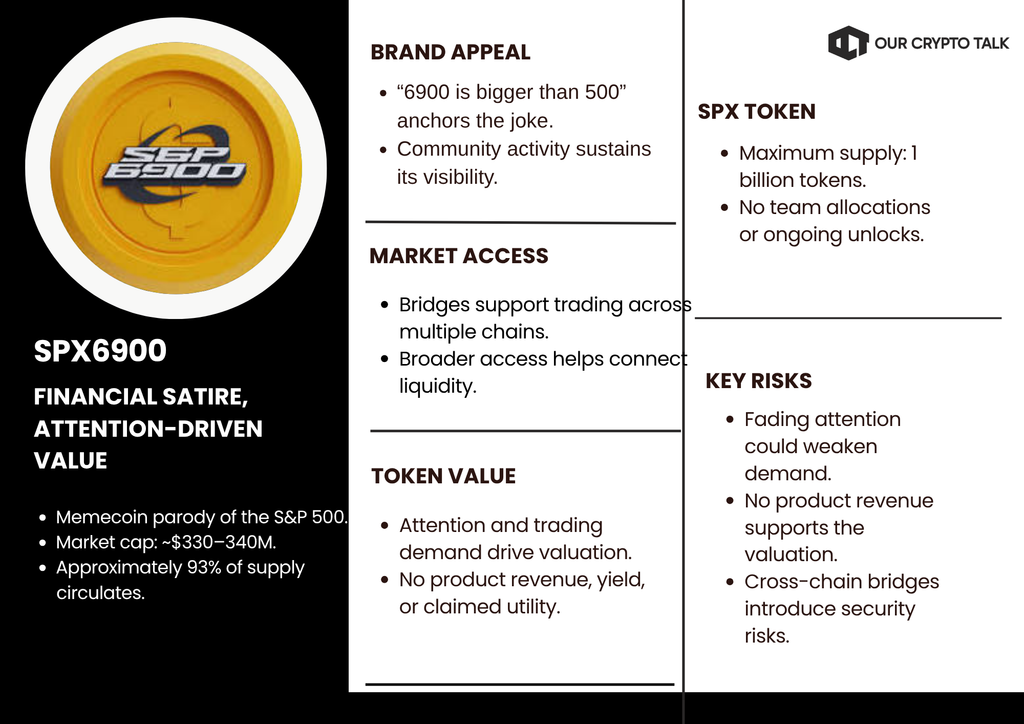
SPX6900 packages financial satire as a memecoin. Its name and branding parody the S&P 500 through the slogan “6900 is bigger than 500.” The project makes no claim to utility, yield, or fundamental value. Nearly 93 percent of its 1 billion maximum supply already circulates, and no team allocations or ongoing unlocks create a scheduled dilution overhang. In addition, bridges make the token available across multiple chains and broaden access to liquidity.
Its appeal rests on a simple combination: a recognizable meme, fixed maximum supply, and grassroots distribution. Among memecoins below $1B, the absence of team tokens helps distinguish SPX from projects with large insider allocations. A market cap near $330–340 million reflects a community that has sustained interest through market swings. Nevertheless, its valuation still depends on attention and trading demand rather than product revenue.
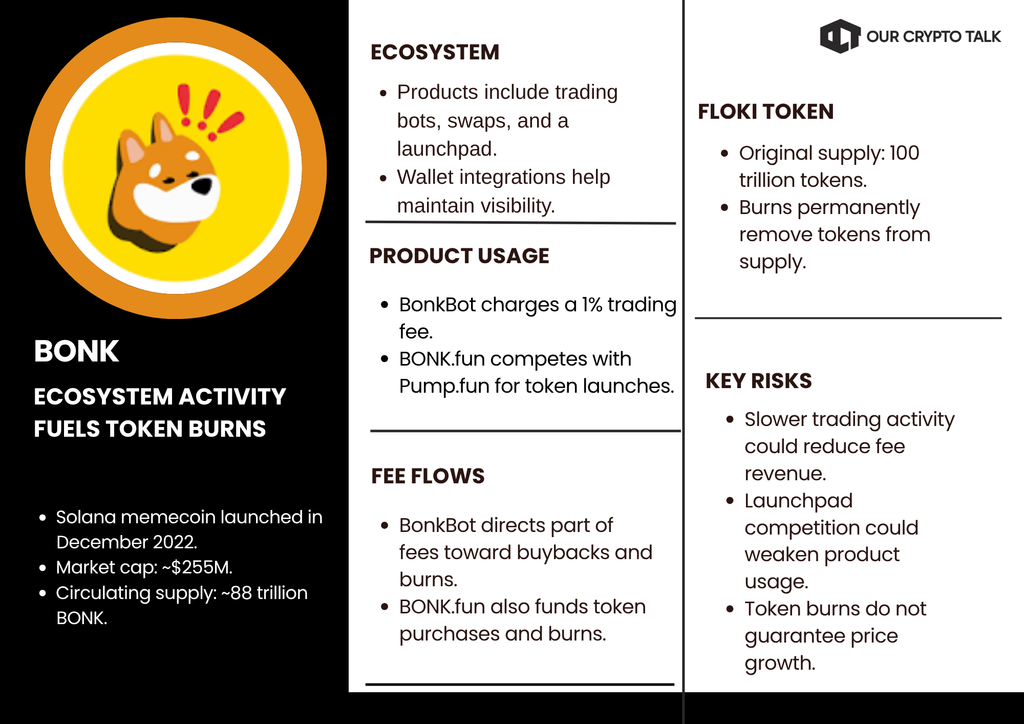
Bonk emerged as Solana’s original large-scale memecoin after a December 2022 airdrop sought to lift community morale following the FTX collapse. Since then, the project has developed one of the chain’s broader memecoin ecosystems. Burns have reduced total supply from the original 100 trillion tokens, while circulating supply now stands near 88 trillion. BONK’s market cap of approximately $255 million places it among memecoins below $1B.
Compared with image-led memecoins, BONK offers a more developed product network. BonkBot, a Telegram trading bot, charges a 1 percent fee and uses a portion of fee revenue to buy and burn BONK. Reports have placed that burn allocation in the 10–20 percent range. Similarly, BONK.fun, a launchpad that competes with Pump.fun, has directed substantial fee revenue toward buybacks and burns. Other products, including swaps and a later casino offering, add further fee-funded burn mechanisms. Meanwhile, wallet integrations and Solana ecosystem activity help maintain visibility. The thesis therefore centers on product usage generating fees that fund token purchases and burns. However, the strength of that mechanism depends on whether activity can sustain meaningful revenue during quieter markets.
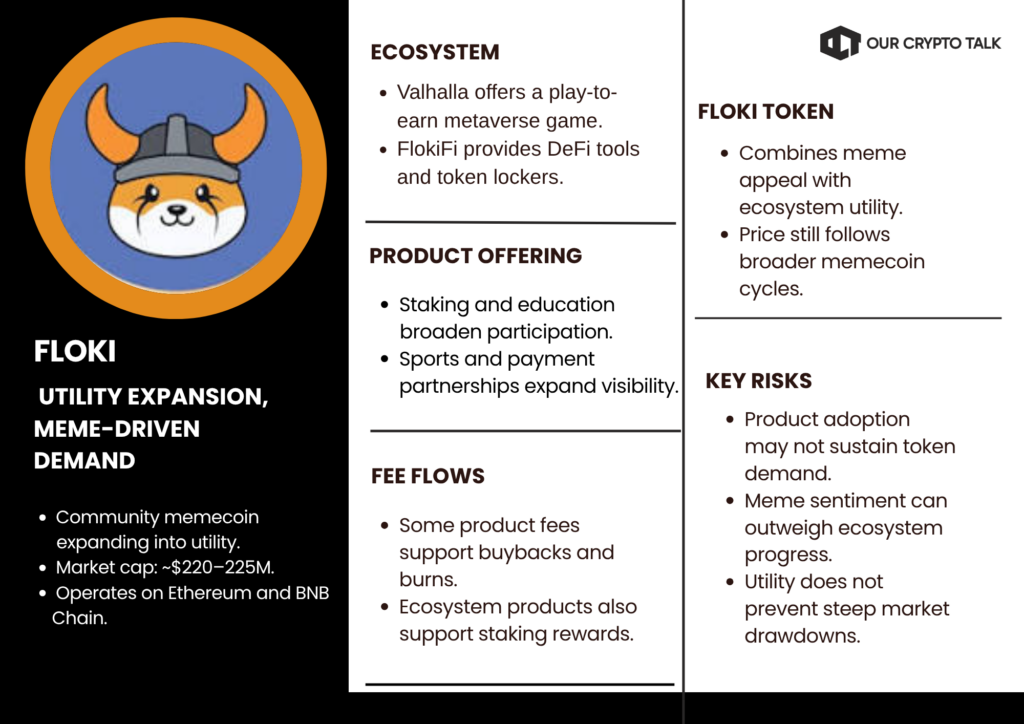
FLOKI began as a Shiba Inu-inspired community coin that took its name from Elon Musk’s dog. Since then, the project has spent years expanding into utility. Its ecosystem includes Valhalla, a play-to-earn metaverse game that reached mainnet; FlokiFi, a suite of DeFi tools with fee-funded token buybacks and burns; staking; and an education platform. The project has also explored sports partnerships and debit-card-style products. FLOKI operates on Ethereum and BNB Chain, where it maintains a visible memecoin presence. Its market cap near $220–225 million places it among memecoins below $1B.
However, the central question concerns whether these products create lasting token demand. The evidence remains mixed. Some products generate fees that support burns or staking rewards, but FLOKI’s price has continued to follow broader memecoin cycles more closely than product metrics. As a result, many holders still treat it primarily as a meme with additional features. The utility pivot has helped the project maintain activity and listings, although it has not protected holders from sector-wide drawdowns.
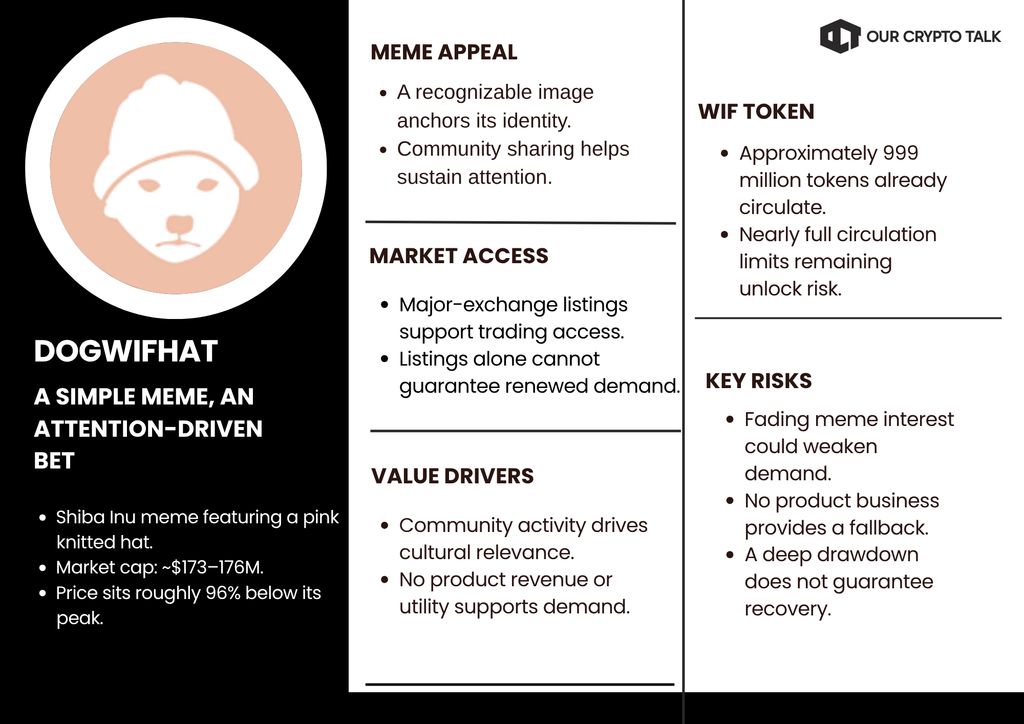
Among memecoins below $1B, dogwifhat represents the clearest image-led meme: a Shiba Inu wearing a pink knitted hat. The project has no roadmap, no team allocation of consequence, and no utility beyond the meme itself. Nearly all of its approximately 999 million tokens already circulate, so holders face little remaining unlock risk. Its market cap stands near $173–176 million, while its price sits roughly 96 percent below the March 2024 peak near $4.83.
For traders, the question concerns whether WIF can regain attention during another memecoin cycle or whether its cultural relevance has already peaked. Full circulation and major-exchange listings support market access, but neither guarantees renewed demand. Furthermore, WIF has no product revenue to support its thesis if users stop sharing the image. Community activity and the meme’s staying power therefore remain its main sources of appeal.
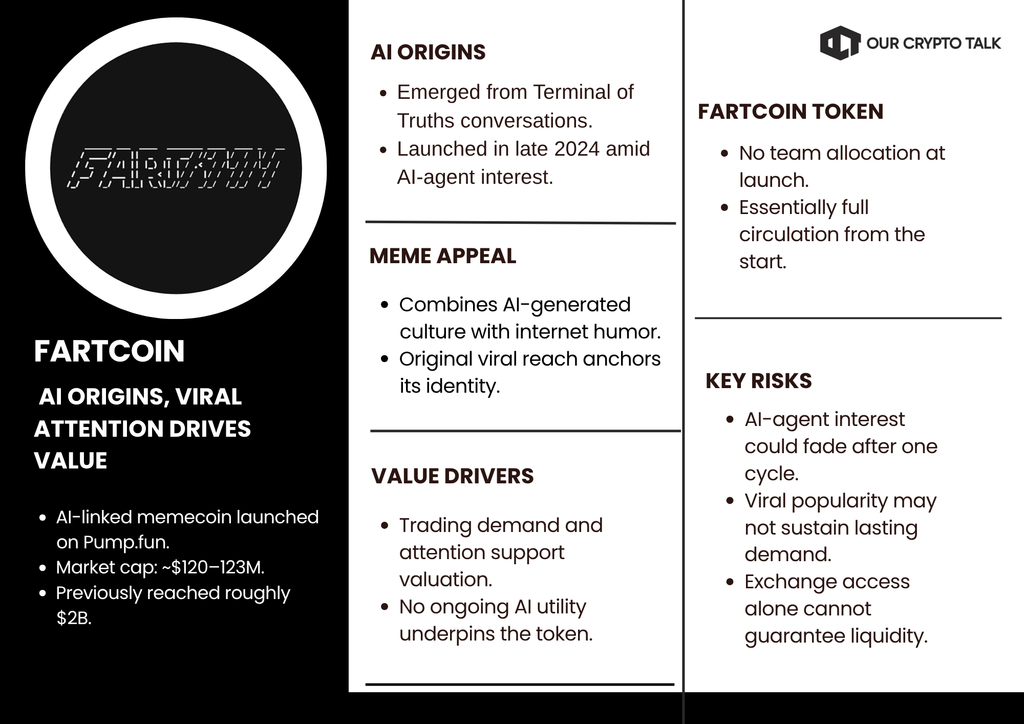
Fartcoin illustrates the AI-agent memecoin wave and features among memecoins below $1B. It emerged in late 2024 from conversations involving the Terminal of Truths AI experiment, an autonomous agent that repeatedly discussed flatulence and token concepts. The token launched on Pump.fun with no team allocation and essentially full circulation from the start. It then briefly reached a market cap of roughly $2 billion in January 2025 before falling sharply. Its current market cap stands near $120–123 million.
The narrative combines AI-generated culture with memecoin speculation. An AI agent helped originate or popularize the concept, and traders treated that connection as a new category. However, the market has yet to establish whether AI-agent tokens can sustain demand beyond a single cycle. Most similar experiments have faded. Fartcoin’s remaining valuation reflects its original viral reach, continued liquidity, and exchange access rather than ongoing AI utility.
APEPE (Ape and Pepe), a Polygon-based hybrid meme, carries a market cap near $250 million. Meanwhile, COCO trades around $143 million with limited volume, and NPC (Non-Playable Coin) stands near $137 million. BRETT, formerly a leading Base memecoin, has fallen to roughly $43 million, while MOG sits near $37 million. Each retains some community activity or chain-specific recognition. However, none currently matches the selected seven’s overall combination of liquidity, listings, market presence, and distinct narrative. Sustained volume growth, a clearer identity, or broader exchange access could strengthen their case for inclusion in a future list.
Other memecoins to watch
The survivors share several traits. First, their communities continue posting and holding through deep drawdowns. Second, they have secured and retained major-exchange listings. Third, each offers a narrative that users can explain quickly, whether celebrity access, consumer branding, satire, ecosystem utility, an image, or AI origins. Finally, their supply structures offer some visibility. Most tokens already circulate, or public vesting schedules show when additional supply will enter the market.
By contrast, the launch environment produces far more tokens than the market can support. Users have created millions of tokens on Pump.fun alone. Recent measurements place graduation rates in the low single digits, often around 1–3 percent depending on the period and filters. Graduation means a token completes its bonding curve and moves to an automated market maker, or AMM. Even among those tokens, most fail to maintain meaningful trading beyond the first day or week. Consequently, projects that retain nine-figure market caps years later represent a small minority.
These seven profiles do not constitute buy recommendations. Memecoins carry extreme risk: most tokens lose nearly all their value, liquidity can disappear, and narratives can fade overnight. Nevertheless, each project has captured attention at scale, retained some community support, and maintained exchange access through severe drawdowns. If the sector regains a meaningful share of its previous attention and trading volume, these established names could compete for that activity. Their ability to turn renewed interest into sustained demand remains uncertain.