BNB Chain now holds $5.5B in DeFi TVL. See the 7 BNB ecosystem projects, from PancakeSwap to Aster, leading DeFi and bridges into 2027.

Author: Kritika Gupta
For years, many crypto users viewed BNB Chain primarily as Binance’s high-throughput side chain. By late 2026, however, BNB Ecosystem Projects support roughly $5.5 billion in DeFi total value locked (TVL). Meanwhile, the network records daily active addresses in the low millions and has generated hundreds of billions of dollars in annual decentralized exchange (DEX) volume during strong periods.
In Q3 2026 alone, BNB Chain recorded $75.7 billion in spot DEX volume, $25.6 billion in tokenized-equity trading, and $54.2 million in network revenue. Its tokenized-equity volume represented more than half of the tracked cross-chain activity in that category. Meanwhile, BNB Chain and YZi Labs back a $1 billion Builder Fund to support ecosystem development.
The network combines low fees, high throughput, and a large user base with growing DeFi and real-world asset (RWA) activity. Against this backdrop, these seven BNB Ecosystem Projects stand out for their potential to support yield.
BNB Chain: Key Metrics
We considered TVL and revenue alongside user traction, multi-chain expansion, and growth potential for 2027. We also looked at each project’s role in yield generation, cross-chain infrastructure, and user onboarding.
The list does not simply rank the seven largest protocols by TVL. Instead, it focuses on projects that could remain relevant as BNB Chain expands through networks such as opBNB and attracts activity beyond speculation.
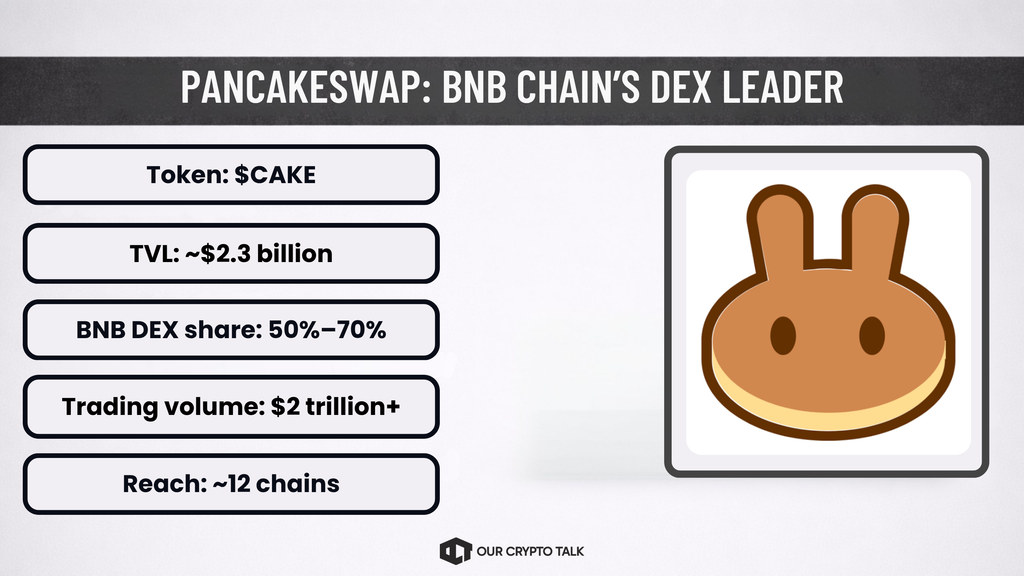
PancakeSwap remains a central spot trading and liquidity venue on BNB Chain. The DEX holds nearly $2.07 billion in TVL across roughly a dozen chains and continues to capture a large share of BNB Chain’s DEX volume. In recent weeks, its share has ranged from 50% to 70%, depending on the period.
The protocol has also surpassed $2 trillion in cumulative trading volume. Its Infinity upgrade, which introduced concentrated liquidity features, has processed more than $150 billion. During peak periods in 2025, PancakeSwap recorded multi-trillion-dollar activity.
Meanwhile, protocol fees and revenue remain significant. Recent 30-day revenue has reached the low millions, while annualized rates have climbed much higher during periods of strong trading activity. PancakeSwap also uses fee-funded CAKE burns as part of its tokenomics and offers staking yields to holders.
Its expansion across Ethereum, Base, Arbitrum, Solana, Monad, and other networks gives it reach beyond BNB Chain. Prediction markets and tokenized-asset pairs add further use cases. In 2027, PancakeSwap’s liquidity depth and established user base could help it remain a core venue for trading and earning across the ecosystem.
PancakeSwap metrics
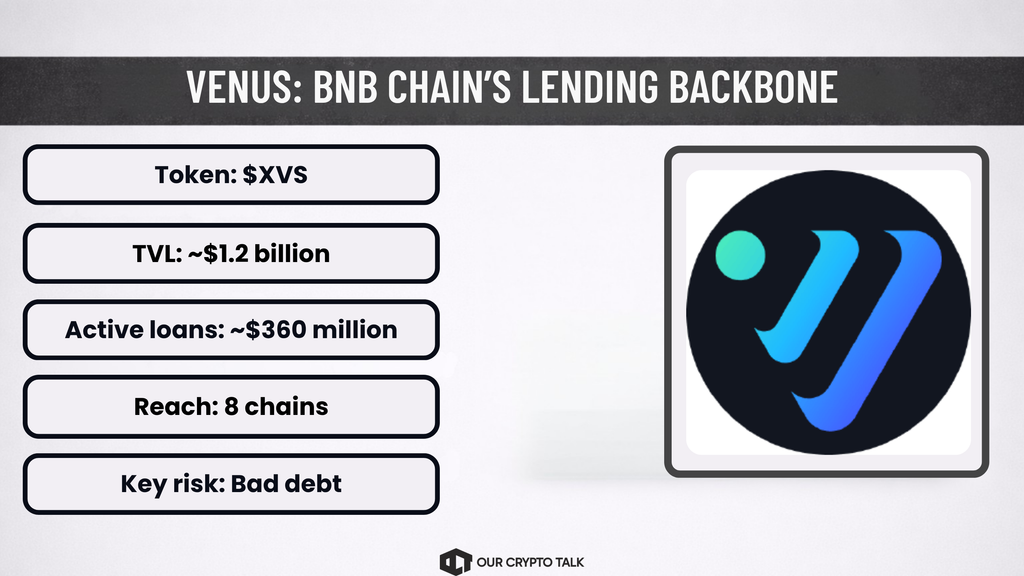
Venus is a leading money market on BNB Chain, with approximately $1.2 billion in TVL and nearly $360 million in active loans. The protocol has expanded to eight chains, although BNB Chain still holds most of its liquidity.
Venus operates a Compound-style lending market and includes a native synthetic stablecoin component. It has also added specialized markets, including early tokenized-ETF-style products that use hub-and-spoke designs.
However, a March 2026 incident in the THE market exposed a known donation and supply-cap bypass associated with Compound-style protocols. The incident left roughly $3.7M donation attack. Venus’s treasury, which held around $20 million in recent snapshots, and its work on risk parameters provide context for assessing that exposure.
Compared with Aave, Venus remains smaller and more focused on BNB Chain. Nevertheless, it offers lower transaction fees and deeper native BNB liquidity. Its ability to manage bad-debt risk and expand specialized RWA-linked markets will influence its position in 2027.
Venus Protocol metrics
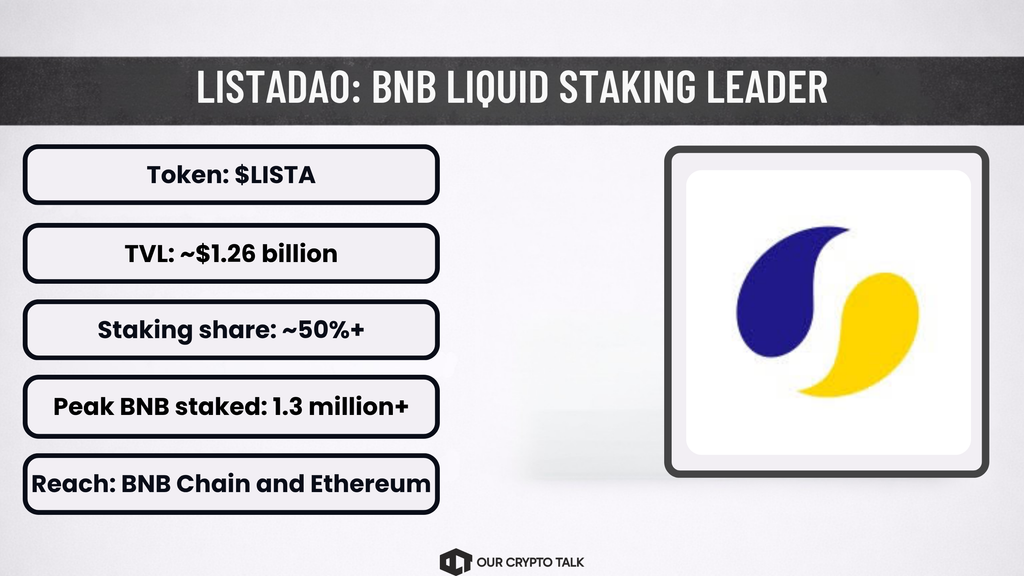
ListaDAO is a leading BNB liquid-staking and capital-routing protocol. It has historically held roughly 50% or more of the BNB liquid-staking market, with peak figures exceeding 1.3 million BNB staked. Its TVL has reached several billion dollars at past highs, while current overall protocol TVL sits near $1.26 billion.
Its slisBNB token gives users a way to combine staking rewards with DeFi activity. Users can also access Binance ecosystem incentives, including eligible Launchpool opportunities and HODLer airdrops. In addition, ListaDAO’s Smart Lending product lets collateral generate trading fees while users borrow against it.
The protocol has expanded its lending markets to include RWAs and tokenized assets. It also operates on Ethereum alongside BNB Chain and continues to develop its liquidity-routing products. ListaDAO’s press releases and annual reports have highlighted its market share and product roadmap, although readers should consider the source when evaluating those claims.
In 2027, ListaDAO gives users a way to access BNB staking yield while using liquid-staked BNB as collateral across DeFi.
ListaDAO metrics
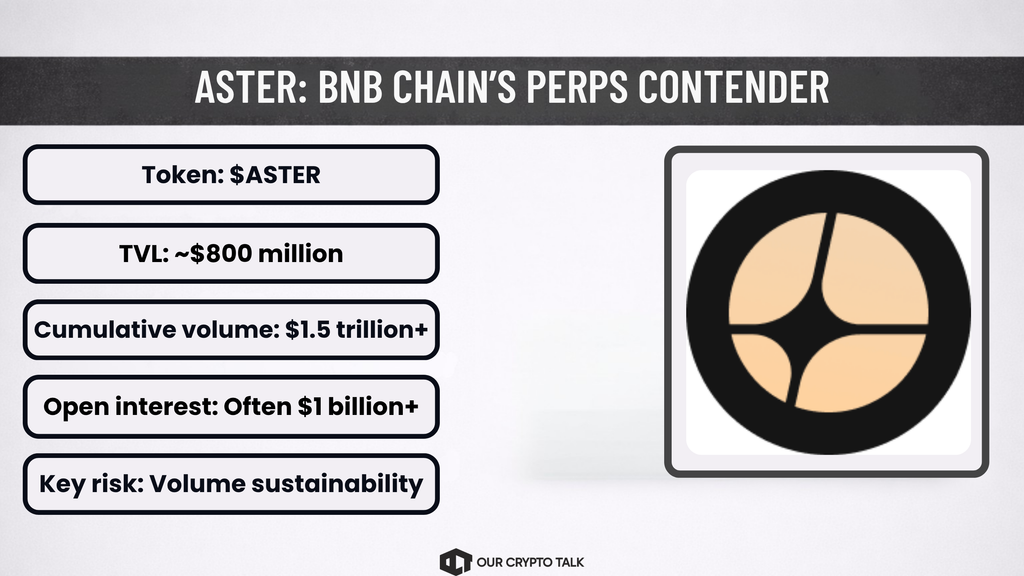
Aster, which has historical ties to ApolloX, has emerged as a major BNB-native perpetual futures exchange. Its ASTER token has a market cap of around $1.76 billion, while DeFiLlama data shows more than $1.5 trillion in cumulative perpetuals volume.
Recent 30-day trading volumes have reached tens of billions of dollars, and open interest has often exceeded $1 billion. Aster’s TVL has fluctuated, but recent snapshots put it near $800 million.
Aster offers leveraged perpetuals trading and competes with Hyperliquid for on-chain derivatives activity. Hyperliquid still leads on absolute volume and open interest across many recent periods. Meanwhile, Aster’s high volume relative to TVL and its history of TVL volatility raise questions about sustainability.
Even so, Aster’s scale, YZi Labs backing, and multi-chain presence make it a significant BNB ecosystem competitor in derivatives. In 2027, the key tests will be whether trading volume holds as incentives normalize and whether TVL stabilizes.
Aster Protocol metrics
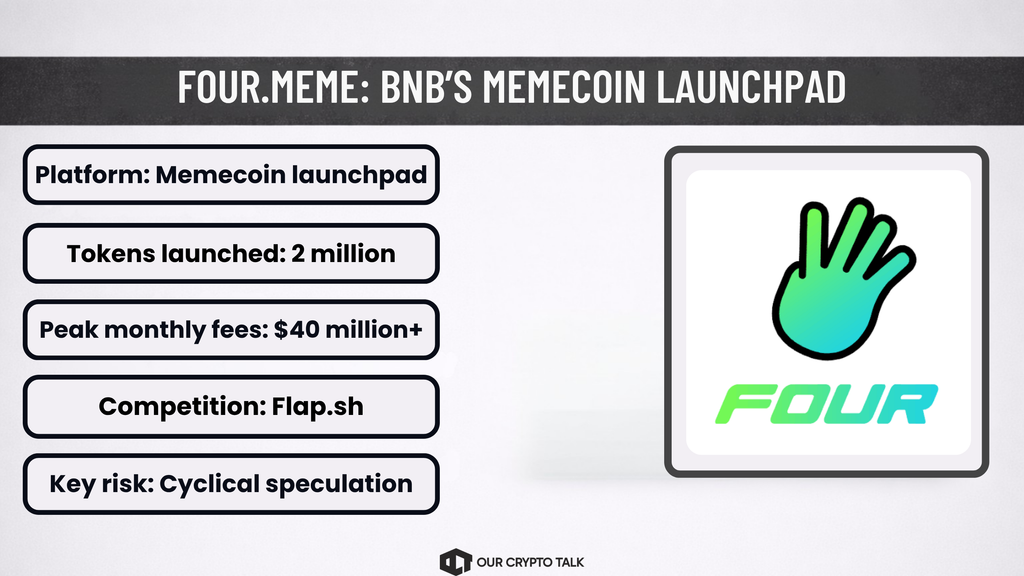
Four.meme is a major bonding-curve memecoin launchpad on BNB Chain. The platform has facilitated the launch of well over a million unique tokens, with Dune dashboards showing figures above 2 million at certain points.
During periods of strong activity, the platform generated 52,000+ in monthly revenue. Some individual months produced more than $40 million in fees. Activity has since declined amid competition from platforms such as Flap.sh. However, BNB Chain’s low gas costs continue to support low-cost token launches and trading.
Changpeng Zhao’s public “meme szn” comments have also periodically drawn attention to the ecosystem. Four.meme uses a model similar to Pump.fun on Solana, while operating within BNB Chain’s lower-cost environment.
Sustainability remains the main question. Revenue depends heavily on retail speculation, and many newly launched tokens fail quickly. For 2027, Four.meme represents BNB Chain’s retail trading culture and token distribution activity. Its fortunes will likely depend on whether traders remain active through weaker market cycles.
Four.meme metrics
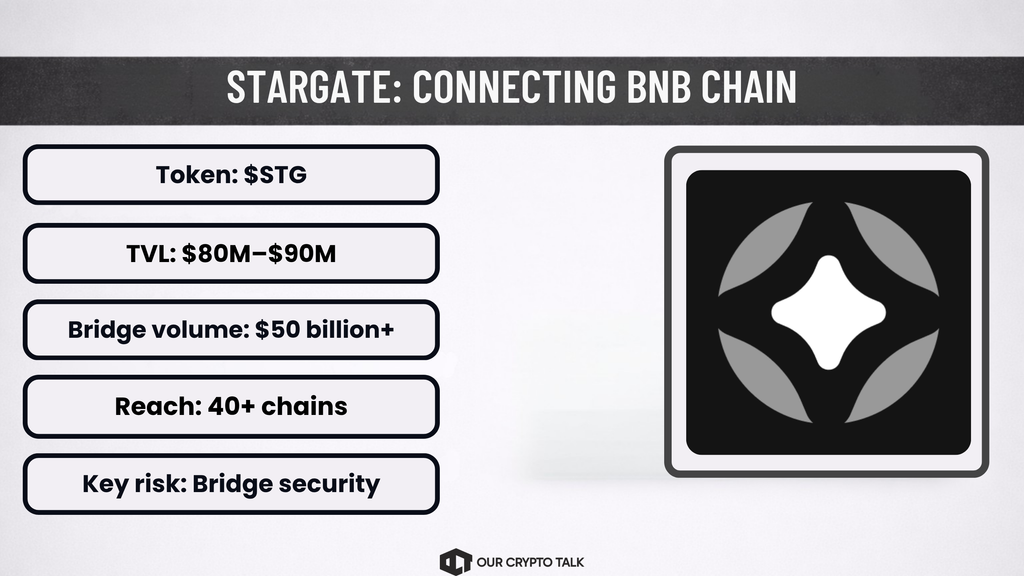
Stargate, which uses LayerZero’s technology, has processed more than $50 billion in cumulative bridge volume over its history. It supports more than 40 chains and provides liquidity for users moving assets across networks.
Its TVL has fallen sharply from earlier peaks and recently stood between $80 million and $90 million. Nevertheless, Stargate continues to process hundreds of millions of dollars in monthly bridge volume.
As BNB Chain and opBNB expand their multi-chain strategies, users need reliable ways to move assets and liquidity. However, Stargate faces competition from newer bridges, aggregators, and more specialized or canonical bridging solutions.
Bridge users must also consider smart-contract, liquidity, and operational risks. In 2027, Stargate’s relevance will depend on whether it can retain users and volume as demand for interoperability grows.
Stargate Finance metrics
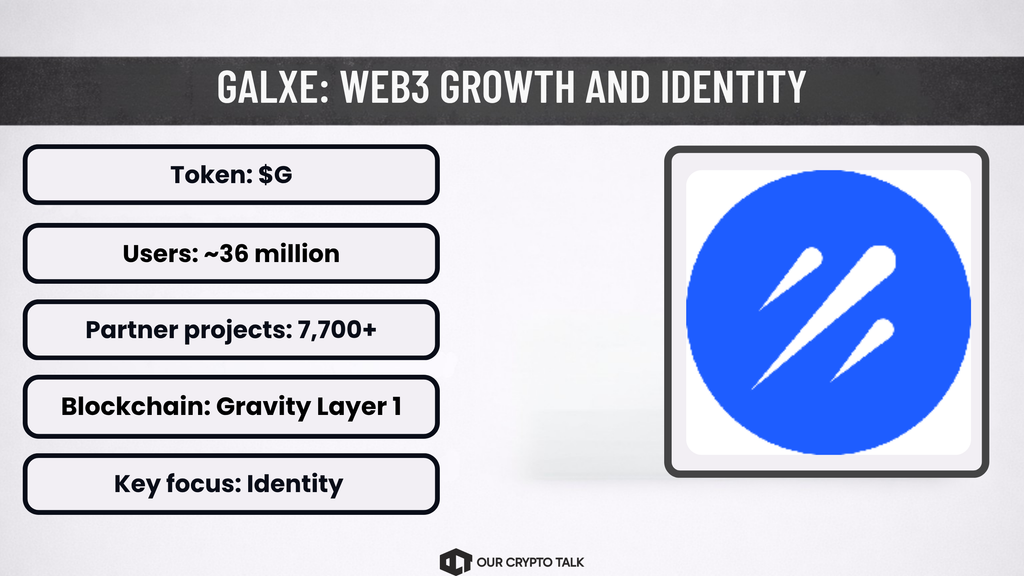
Galxe provides Web3 projects with growth, identity, and community-engagement tools. Reports cite roughly 36 million users and more than 7,700 partner projects. Its quests and airdrop campaigns have also attracted hundreds of millions of participations and distributed hundreds of millions of dollars in value over time.
Galxe’s Gravity Layer 1 is live, while its earlier Alpha mainnet is winding down. Products such as Galxe Passport and its credential system give projects tools for identity verification and reputation.
Although Galxe’s DeFi metrics remain modest, its identity and compliance products could attract attention as institutional and regulated activity expands on-chain. Projects need ways to onboard, verify, and retain users at scale. Galxe also offers token-distribution tools that support those goals.
For 2027, Galxe offers exposure to a different part of the BNB ecosystem. Its outlook depends on whether projects continue to use its infrastructure to reach and engage users.
Galxe metrics
BNB Chain faces several risks alongside its growth opportunities. Centralization remains a common concern. The chain uses a Proof-of-Staked-Authority model with a small active validator set: 45 validators win election, while 21 produce blocks per epoch. Critics also point to Binance-related influence over the broader ecosystem.
Regulatory pressure on Binance has historically affected BNB sentiment and liquidity. Meanwhile, Solana, Base, and Ethereum Layer 2 networks continue to compete for users, developers, and capital.
Smart-contract exploits present another risk, as the March 2026 Venus incident demonstrated. Finally, memecoin activity can rise and fall quickly with retail speculation. These risks do not remove the ecosystem’s opportunities, but they can affect protocol revenue, user activity, and token prices.
BNB Chain combines low fees, high throughput, millions of active addresses, multi-billion-dollar DeFi TVL, and growing RWA activity. Those features make it an important ecosystem to watch in 2027.
The seven projects cover different parts of that ecosystem. PancakeSwap supports spot trading and liquidity, while Venus provides lending markets. ListaDAO focuses on liquid staking and capital efficiency, and Aster serves perpetuals traders. Four.meme supports token launches, Stargate connects networks, and Galxe offers identity and user-engagement tools.
However, investors and users must also weigh centralization, regulation, smart-contract exploits, and speculative cycles. The outlook for each project will depend on its ability to retain users and liquidity while managing those risks.
This is not financial advice. Do your own research before interacting with any protocol.