Can Hyperliquid flip Binance? We break down the 10x volume gap, the ICE/trade.xyz deal and HIP-3 growth, then give a clear probability verdict and the risks.

Author: Kritika Gupta
Can Hyperliquid flip Binance? The question reflects a growing debate over how crypto traders will access derivatives. Hyperliquid offers on-chain trading and a non-custodial model, while Binance brings a broad product range and an established global user base. Beyond these differences, the competition also raises questions about transparency, execution quality and trader control over funds. However, challenging an industry leader takes more than rapid growth. Hyperliquid must attract lasting liquidity, retain traders and expand access while managing operational and regulatory risks. With these factors in mind, this comparison examines trading volume, liquidity, token economics and the challenges Hyperliquid must overcome to close the gap.
Eleven people. Zero venture capital. More than $4 trillion in cumulative notional trading volume, approaching $5–6 trillion by late 2026. A native token that broke into the top 10 by market capitalization. In roughly two years, Hyperliquid has reached these milestones as an on-chain perpetual futures exchange.
Jeff Yan and his engineering team built Hyperliquid on a custom Layer 1 blockchain. As of November 2, 2026, DeFiLlama tracked $1.387 billion in cumulative protocol revenue and $65.11 million over the preceding 30 days. Those figures distinguish protocol revenue from gross trading fees. Meanwhile, an SEC-filed Hyperliquid Strategies annual report states that the Assistance Fund allocation rose from 97% to 99% in August 2025. This allocation supports HYPE purchases, although it does not mean every dollar of gross venue fees reaches token holders.
Meanwhile, Hyperliquid has gained perpetual futures market share and built substantial open interest relative to major centralized exchanges. Open interest measures the value of outstanding derivatives positions. Beyond crypto trading, HIP-3 lets builders launch perpetual markets that offer equity, index and commodity exposure, creating another growth channel. Alongside this expansion, HYPE has overtaken Dogecoin and now ranks in or near the top 10 by circulating market capitalization. However, its fully diluted valuation already reflects expectations for substantial growth.
Against this backdrop, the question extends beyond Hyperliquid’s ability to compete. Can it overtake Binance, the dominant centralized derivatives exchange, in trading volume? Separately, can HYPE eventually challenge Ethereum’s market capitalization? Although Hyperliquid’s growth supports the debate, major structural gaps still separate it from both targets.
Hyperliquid’s growth becomes clearer when readers separate trading periods and market-share denominators. The Block’s June 3, 2026 analysis put its May monthly perpetual volume at 6.63% of centralized-exchange perpetual volume and 14.4% of Binance’s volume. These ratios describe May 2026, rather than a November snapshot. Separately, Hyperliquid Strategies’ SEC filing reported a 40.1% share of on-chain 24-hour perpetual volume and 62.5% of on-chain perpetual open interest as of August 23, 2026.
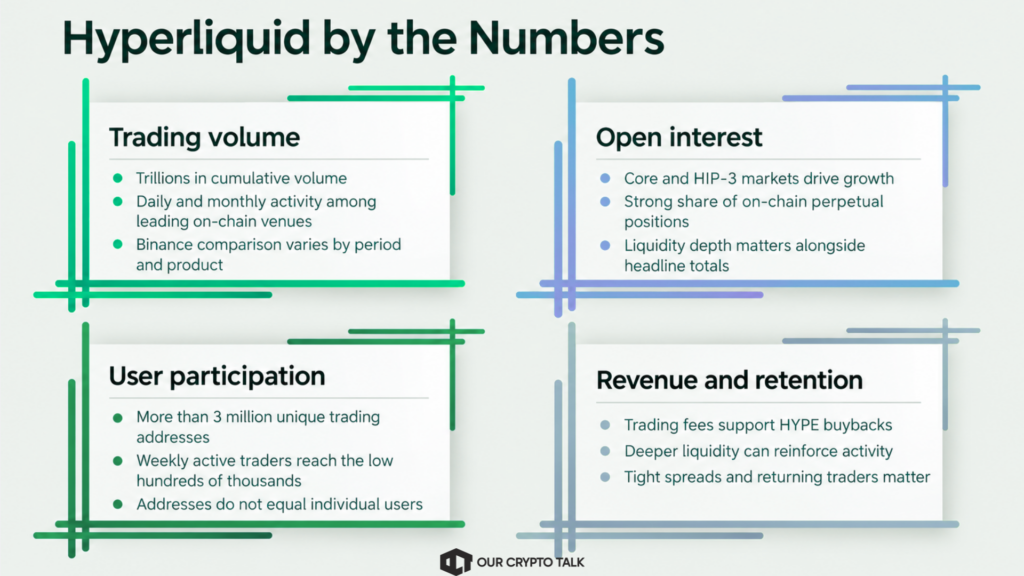
As trading activity has grown, user participation has also expanded. More than three million unique addresses have traded on the platform, although addresses do not necessarily represent individual users. In addition, active traders and open positions have grown several-fold over the past year. Meanwhile, weekly active participation has reached the low hundreds of thousands during stronger periods. Similarly, Hyperliquid’s volume relative to Binance has climbed from low-single-digit percentages into the high-single-digit to low-teens range during 2025–2026. However, the exact ratio depends on the measurement window and whether the comparison covers perpetual futures alone. For that reason, readers should compare equivalent products and periods when assessing its market-share gains.
Beyond these totals, the pace of growth matters equally. Deeper liquidity, HIP-3 launches and demand for non-custodial trading after FTX have helped accelerate volume and open interest. Alongside this expansion, fee revenue has also grown. In turn, the protocol directs a large share of that revenue toward buybacks. Nevertheless, sustained competitiveness also requires tight spreads, reliable execution and returning traders. Therefore, readers should assess revenue and volume alongside trading quality and retention. Together, these indicators provide a broader view of whether Hyperliquid can maintain its momentum.
Hyperliquid metrics | November 2, 2026
On October 29, 2026, Intercontinental Exchange (ICE), the parent company of the New York Stock Exchange, announced a definitive agreement with trade.xyz. Under the agreement, ICE will exclusively operate trade.xyz’s regulated U.S. markets and invest in the company. Meanwhile, the planned venue, often called ICE[XYZ], would offer 24/7 perpetual futures across equities, indices, commodities, foreign exchange and crypto. To support these markets, it would use Hyperliquid’s infrastructure through HIP-3, subject to approval from the Commodity Futures Trading Commission (CFTC).
To reach customers, the venture plans to use futures commission merchants and ICE’s joint venture with OKX, which brings substantial retail reach. In addition, Stan Druckenmiller has publicly invested in trade.xyz and expressed interest in using the product. Separately, ICE CEO Jeff Sprecher previously described Hyperliquid’s trading activity as “bigger than Nasdaq” and highlighted its small team. Together, these arrangements would complement ICE’s existing futures business.
For Hyperliquid, the agreement could open a regulated route into the U.S. derivatives market. Until now, the platform has largely operated outside U.S. retail markets. Consequently, ICE’s involvement, alongside broker and OKX-linked distribution, could substantially expand its potential user base. In turn, broader access could help Hyperliquid attract additional traders and liquidity.
However, the companies have not confirmed a launch timeline, and regulators have yet to grant approval. Furthermore, ICE has raised broader concerns about market manipulation and sanctions risks at crypto venues. The relationship therefore combines commercial cooperation with competitive interests. Ultimately, CFTC approval and operational readiness will determine whether the agreement generates meaningful trading activity.
Seven arguments support the case for Hyperliquid overtaking Binance.
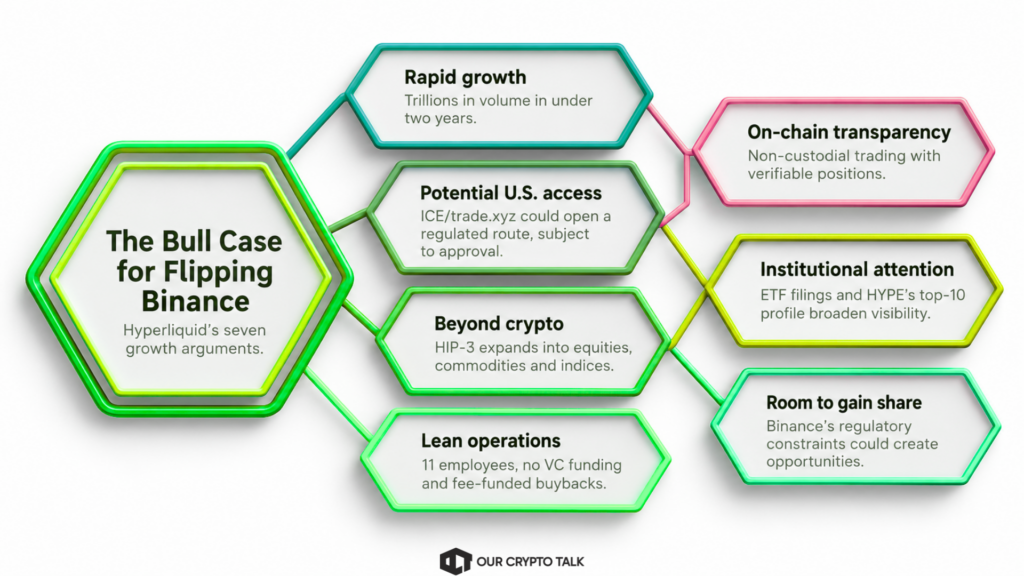
First, Hyperliquid has generated trillions of dollars in cumulative volume in under two years. During 2025 alone, its volume relative to Binance rose from roughly 8% toward the mid-teens in some measurement windows. Alongside this growth, weekly active traders expanded several-fold.
Second, the ICE/trade.xyz partnership could create a regulated U.S. entry point. By combining ICE’s market infrastructure, futures broker distribution and the OKX joint venture, the proposed arrangement could help Hyperliquid reach a major derivatives market.
Third, HIP-3 expands the opportunity beyond crypto perpetuals. It generated more than $62 billion in May 2026 volume, while open interest stood at $3 billion when The Block published its June 3 analysis. These historical figures show that traditional-asset exposure already contributes material activity.
Fourth, fee generation supports recurring buybacks. DeFiLlama recorded $65.11 million in trailing 30-day protocol revenue as of November 2, 2026. The SEC filing reports the 99% Assistance Fund allocation. However, the brief’s employee-efficiency calculation needs an independently verified headcount.
Fifth, its non-custodial design appeals to traders who prioritize transparency after FTX. Users retain custody, while on-chain records allow observers to verify positions and liquidations. Consequently, this model gives risk-conscious traders another reason to consider Hyperliquid.
Sixth, HYPE has overtaken Dogecoin and entered the top 10 by market capitalization. Meanwhile, ETF filings from major issuers and public triple-digit price targets signal growing institutional attention. However, neither guarantees future demand.
Seventh, Binance’s growth has slowed into the mid-single digits as compliance demands and regulatory friction increase in the U.S. and Europe. If those constraints persist, Hyperliquid could therefore find more room to gain market share.
Together, these factors strengthen Hyperliquid’s competitive case by combining low operating overhead with several routes to expansion.
However, Hyperliquid still faces substantial obstacles.
First, the volume gap remains large. Hyperliquid’s annualized trading volume runs into the low trillions of dollars, while Binance handles roughly an order of magnitude more. Even if Hyperliquid reaches a mid-teens share of Binance’s volume, it would still need to grow several-fold to overtake it. Moreover, that scenario assumes Binance stays flat or declines. Otherwise, Hyperliquid would face an even higher target.
Second, Binance operates a broad ecosystem. It offers hundreds of spot pairs, options, earn products, launchpools, institutional APIs, fiat entry points and debit cards, alongside its links to BNB Chain. In addition, it generates revenue beyond trading. By comparison, perpetual futures still dominate Hyperliquid, while its spot business remains small. Consequently, Hyperliquid must broaden its offering to compete across more business lines.
Third, bots and market makers generate a substantial share of Hyperliquid’s trading activity. Therefore, reaching Binance’s retail scale requires broader mobile access, fiat funding options and an easier user experience. Although Hyperliquid continues to develop these capabilities, it still needs to convert those improvements into wider adoption.
Fourth, oracle and security risks could become more consequential as activity grows. Specifically, oracles supply external price data and therefore create a potential attack surface. During the 2025 JELLY incident, Hyperliquid intervened manually. In turn, such interventions raise questions about how the platform handles stressed markets.
Fifth, the ICE deal still lacks a firm launch timeline and requires regulatory approval. Furthermore, ICE has raised concerns about manipulation and sanctions compliance across crypto markets. Together, these concerns add complexity to the relationship and uncertainty to the expansion timeline.
Sixth, Binance can respond quickly. For example, it has already introduced equity and pre-IPO perpetuals. Meanwhile, its existing distribution network helps it bring new products to a large user base. As a result, Hyperliquid must compete against an incumbent that can adapt its offering.
Seventh, HYPE’s fully diluted valuation already sits around $80–90 billion. That valuation assumes strong future growth. At the same time, assets such as BNB support comparable or higher valuations through broader products and ecosystem activity. Therefore, slower growth could put substantial pressure on HYPE, even if the platform continues to expand.
Taken together, these challenges highlight differences in scale, product breadth, infrastructure and valuation. Ultimately, Hyperliquid will need sustained execution to overcome them and maintain its competitive momentum.
HIP-3 strengthens the case for Hyperliquid expanding beyond crypto perpetuals. Through this framework, builders can stake HYPE, deploy their own perpetual markets on Hyperliquid’s trading engine and share fees. In turn, this structure has accelerated the growth of markets that offer synthetic exposure to traditional assets. However, traders gain price exposure through derivatives rather than direct ownership of the underlying shares or commodities.
Meanwhile, HIP-3 markets have recorded increases of hundreds of percent in volume and open interest over relatively short periods. Cumulative volume has reached hundreds of billions of dollars, while monthly volume has reached tens of billions. Alongside this growth, open interest has fluctuated from roughly $2 billion to more than $4 billion. Furthermore, traditional assets, including S&P 500 proxies, individual stocks, oil, gold, silver and Nasdaq-style indices, account for a large majority of leading HIP-3 markets by open interest. Within this segment, trade.xyz dominates activity. Consequently, its ability to retain traders will help shape HIP-3’s continued expansion.
Looking ahead, regulated partners could help Hyperliquid become a credible 24/7 venue for equity and commodity exposure with on-chain settlement. If so, it could compete for part of the much larger global derivatives market. Traditional venues generally do not combine continuous equity perpetual trading with crypto-native settlement. As a result, that gap creates an opportunity for Hyperliquid. Its expansion therefore does not depend solely on winning more crypto pairs. Instead, it could also capture new demand for traditional-asset derivatives.
HIP-3 trading activity and market expansion
HYPE’s circulating market capitalization sits near $29 billion, compared with roughly $275–280 billion for Ethereum, using the brief’s snapshot. Meanwhile, HYPE’s fully diluted valuation stands around $80–90 billion. Therefore, if ETH’s market capitalization stays flat, HYPE would need to grow to approximately 9.5–9.7 times its current circulating market capitalization to close the gap. However, changes in circulating supply mean HYPE’s price would not necessarily need to rise by the same multiple.
To achieve that scale, Hyperliquid would first need to sustain market-share gains over multiple years. In addition, it would need to enter regulated U.S. markets and attract substantial equity and commodity derivatives activity through HIP-3. Alongside that expansion, it would also need to maintain strong revenue generation and buybacks. At the same time, Hyperliquid would need to outpace Ethereum’s market-cap growth while demand absorbs HYPE unlocks. Even then, the outcome remains uncertain because unlocks increase potential selling pressure. Furthermore, Ethereum retains substantial network effects, developer activity and monetary appeal. Together, these advantages make it a difficult target to overtake.
HYPE supply, buybacks, staking and unlocks
BNB presents a closer intermediate target in the Hyperliquid Binance comparison. Currently, HYPE has a circulating market capitalization near $20–21 billion, while BNB sits around $85–95 billion. Meanwhile, their fully diluted valuations lie closer together. Despite that narrower valuation gap, BNB benefits from a broader ecosystem that includes spot trading, earn products, blockchain activity and institutional services.
At the same time, Hyperliquid’s revenue per employee and fee allocation toward buybacks support its efficiency case. By comparison, Binance and the BNB ecosystem span more business lines, although exchange revenue does not automatically accrue to BNB holders. Consequently, overtaking BNB in market capitalization would still require substantial growth in Hyperliquid’s trading and ecosystem activity. Even so, the smaller circulating market-cap gap makes BNB a more attainable target than Ethereum.
Our base case assumes Hyperliquid continues to gain share in on-chain perpetuals and selected traditional-asset markets. In addition, it assumes the platform maintains strong capital efficiency and benefits from the ICE pathway if regulators approve the venture. Against this backdrop, we assign a rough, subjective 15–20% probability to Hyperliquid overtaking Binance in trading volume over the next several years. However, that outcome would require sustained growth, continued constraints on Binance and meaningful traction in regulated U.S. and HIP-3 markets. Accordingly, this estimate reflects our editorial judgment rather than a statistical model.
Meanwhile, we assign a lower, subjective 10–15% probability to HYPE overtaking Ethereum in market capitalization over a comparable multi-year horizon. Despite Hyperliquid’s momentum, the market-cap gap, token unlocks and Ethereum’s established ecosystem create major obstacles. Consequently, HYPE could reach the top five or even the top three without surpassing ETH. Instead, a more plausible path involves further market-share gains and, if revenue growth remains exceptional, a potential challenge to BNB. Even then, protocol growth alone does not guarantee token outperformance.
Several indicators will help readers assess the Hyperliquid Binance rivalry. First, CFTC approval and a launch timeline for the ICE/trade.xyz U.S. venue would clarify the near-term expansion path. Next, HIP-3 volume and open interest, especially in equities and commodities, will show whether Hyperliquid can sustain demand beyond crypto. Alongside these metrics, readers should monitor liquidity, spreads and trader retention to assess the quality of that growth. Additionally, investors should track HYPE unlocks against buybacks and new demand to evaluate supply pressure. Meanwhile, U.S. regulatory policy will influence both the ICE venture and Binance’s ability to compete. Finally, Binance’s product launches, fee changes and equity perpetuals will test whether Hyperliquid can defend its market-share gains.
So far, Hyperliquid has shown how much a small team can achieve with a non-custodial trading platform. However, overtaking Binance in volume still depends on years of execution, regulatory progress and deeper traditional-asset markets. Therefore, the nearer-term opportunity centers on further market-share gains and a durable position among leading derivatives venues. At the same time, sustained fee generation and buybacks could support HYPE’s investment thesis, although token supply and valuation will also shape returns. Ultimately, Hyperliquid can make substantial progress even if it never completes a full flip.
This article is not financial advice. It contains opinion and probability estimates; do your own research.