The state of play for crypto cards, stablecoin payments, rewards, deposits, credit, and global financial accounts.
The state of play for crypto cards is changing fast, with monthly spending hitting ~$759M, up ~19% MoM.
But the more interesting number, imo, is that monthly inflows into stablecoin neobanks reportedly crossed $1B for the first time.
Because those two numbers measure very different things.
Card volume measures spending. Deposits measure financial relationships.
If I deposit $2,000 into a crypto neobank and spend $200 through its card, the $200 payment isn’t necessarily the valuable part.
The remaining $1,800 is.
It can potentially become deposits, collateral, yield-bearing assets, liquidity, or the basis for additional financial products.
That’s why I think we’re entering the second phase of the crypto-card market.
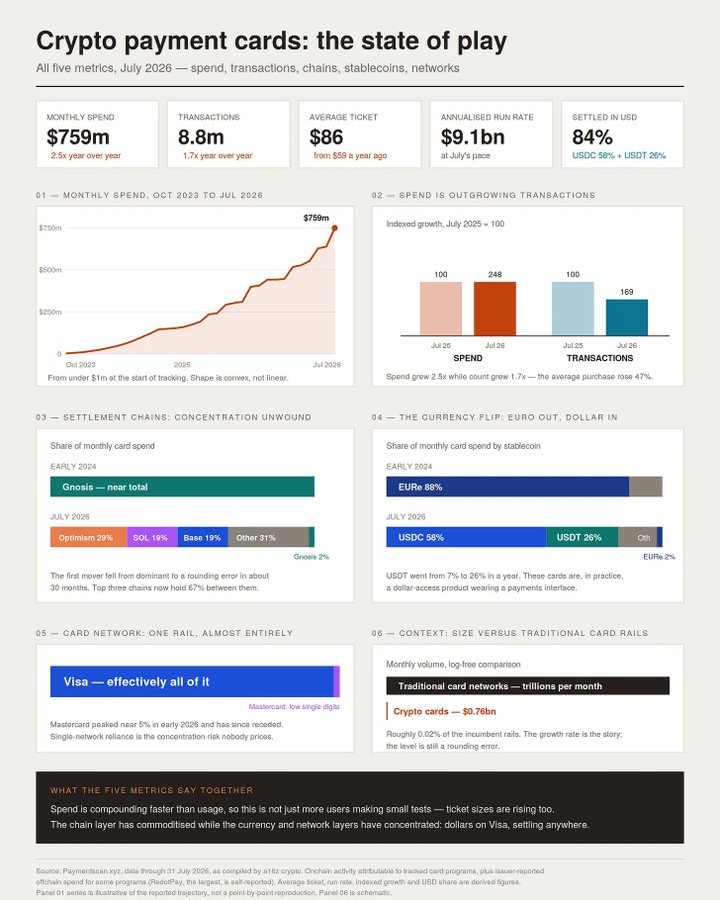
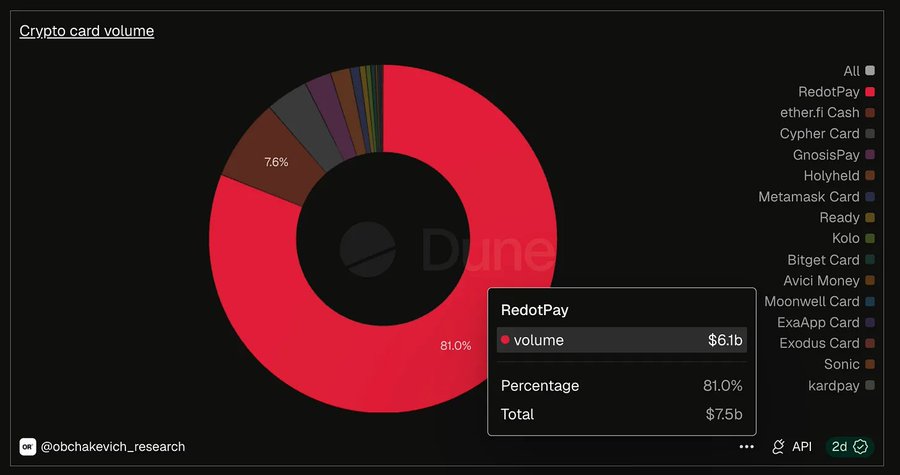
So RedotPay alone represents >50% of tracked volume.
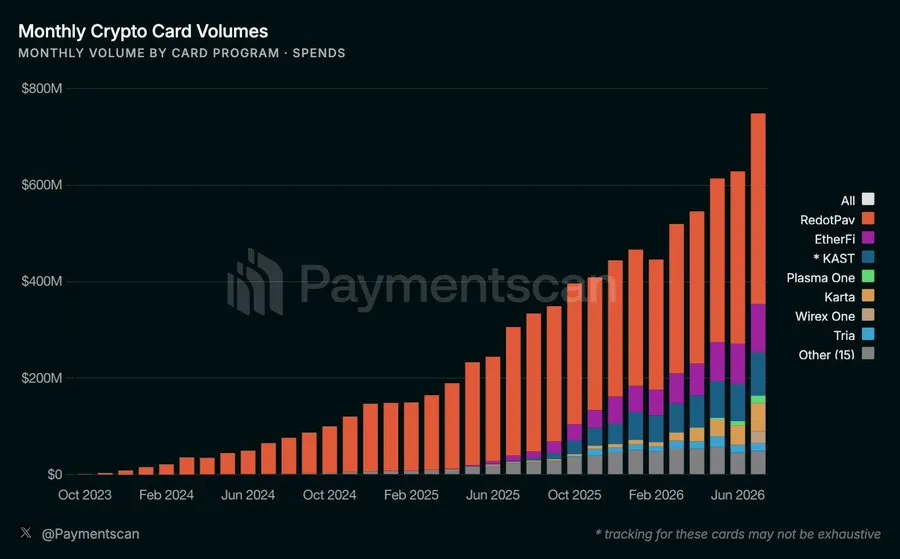
July card volume reportedly looked roughly like:
And the top three represent roughly three quarters.
This doesn’t look like a market where 30 interchangeable crypto cards all win.
It looks more like the beginning of consolidation around a few distribution platforms.
But what’s interesting is that they’re increasingly competing on completely different things.
The state of play is shifting from simple card adoption toward competition between broader financial platforms.
Put the major products side-by-side and they’re not really selling the same product anymore.
The state of play becomes clearer when you look at what each platform is actually trying to build.
@RedotPay = distribution / accessibility
Its advantage appears to be scale.
RedotPay says its cards can be used across 130M+ merchants, and its ~$395M July volume is miles ahead of everyone else.
It isn’t necessarily trying to build the most sophisticated DeFi product.
It has become one of the clearest examples of crypto, where we see everyday payment infrastructure reaching meaningful scale.
–
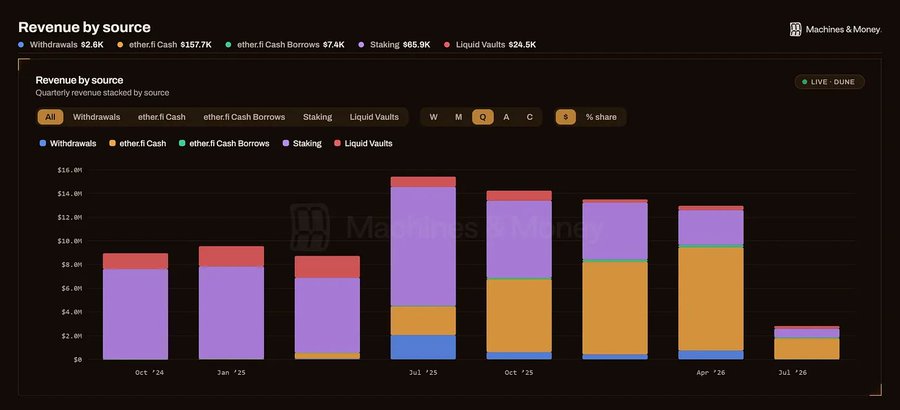
@ether_fi cash = DeFi account + credit
Ether fi has probably the most interesting architecture to me.
If you still remember they started with liquid restaking, which gave it something most standalone crypto cards don’t have from day one: distribution, liquidity, and a base of users already keeping meaningful assets inside the ecosystem.
Cash builds on top of that rather than replacing it. Users can spend supported stablecoins directly or use ETH, BTC-related assets, stablecoins and other supported assets as collateral for card spending, so those assets can remain in the vault while the card becomes the spending interface.
That’s fundamentally different from the usual flow: crypto -> sell -> fiat -> debit card
It’s closer to a flow like: crypto assets -> yield/collateral -> credit -> payments
This is where the fat-app thesis starts to make sense:
Instead of being a single-purpose restaking protocol, ether.fi is stacking more financial services around the same user and the same capital. Restaking gets users in; Cash gives them more reasons to stay by letting them earn, borrow and spend without moving elsewhere.
So the card is really just the last 5% of a much larger financial stack. Distribution brings the user in, the broader product stack retains them, and each additional service captures more of their financial activity.
The state of play gets even more fragmented as other platforms take different routes to the same broader financial relationship.
@KASTxyz = stablecoin neobank / global money account
It’s Revolut/Wise-style global banking.
KAST took almost the opposite route to ether.fi. It started with the card as the wedge, then expanded into USD accounts, salary deposits, transfers and savings.
The interesting part is its progression through: card -> payments -> salary/deposits -> savings -> broader financial services
Each step increases retention. A card user can easily switch providers; a user receiving their salary, holding savings and moving money through the same account is much harder to displace.
Stablecoins also give KAST a distribution advantage. Instead of rebuilding banking relationships market by market, it can use stablecoin rails as a common settlement layer while plugging into local payment and banking infrastructure where needed. That makes the addressable market much broader than crypto-native users, particularly for global workers, travelers and users in markets where access to dollar accounts is limited.
So KAST increasingly looks less like another crypto card and more like a stablecoin-native Revolut/Wise. The card is the acquisition wedge, global dollar access is the distribution advantage, and salary/deposits are the retention layer.
@BleapApp = consumer fintech / rewards / invisible crypto
Bleap is f by former Revolut employees, it started with the idea of building a bank account onchain, using a self-custodial wallet underneath but making the experience look increasingly like normal fintech.
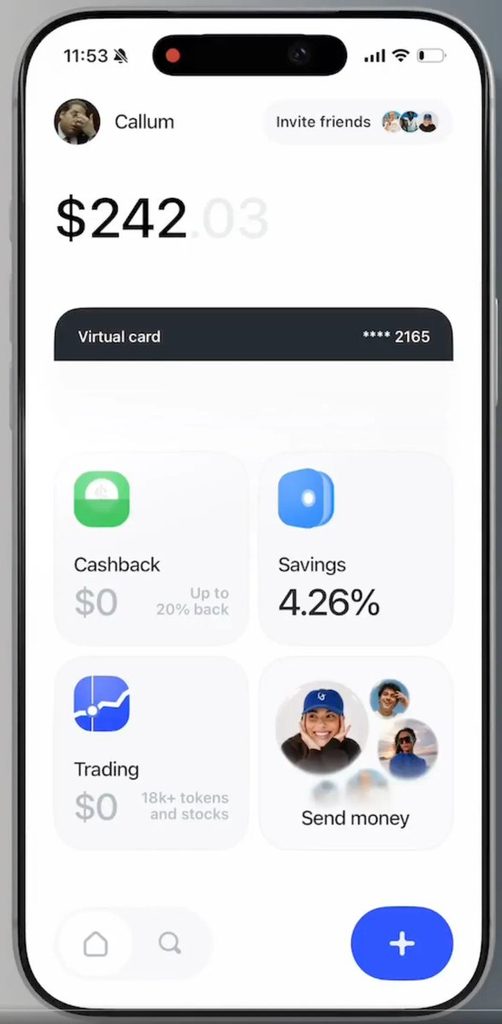
The UX, the card its their GTM strength.
Cashback gives 1% base, higher rewards across everyday categories and up to 20% on selected subscriptions and gives mainstream users an immediate reason to try it, while zero Bleap card fees and FX markups reduce friction.
But the more interesting strategy is what happens after acquisition. Bleap is bundling card spending, fiat transfers, on/off ramps, direct debits and self-custody into one account, while abstracting away much of the crypto complexity.
So unlike ether.fi, which starts with crypto-native capital, or KAST, which starts with global dollar access, Bleap starts with familiar consumer fintech UX and pushes the blockchain into the background.
The long-term bet is that users don’t choose Bleap because it’s a better crypto card. They choose it because it’s a better everyday financial product where rewards acquire the user, UX retains them, and crypto becomes invisible infrastructure underneath.
The state of play around rewards shows another way crypto cards are being used to acquire users.
@useTria = rewards + onchain account + highest spend per transaction
Tria is probably the outlier worth watching here. Tria is pushing harder on reward tiers.
Their base cashback ranges from 1.5% to 6%, depending on card tier, with additional staking-based boosts.
Paymentscan puts its average purchase at $180, the highest of the 16 cards tracked and more than 3x the $56 market average.
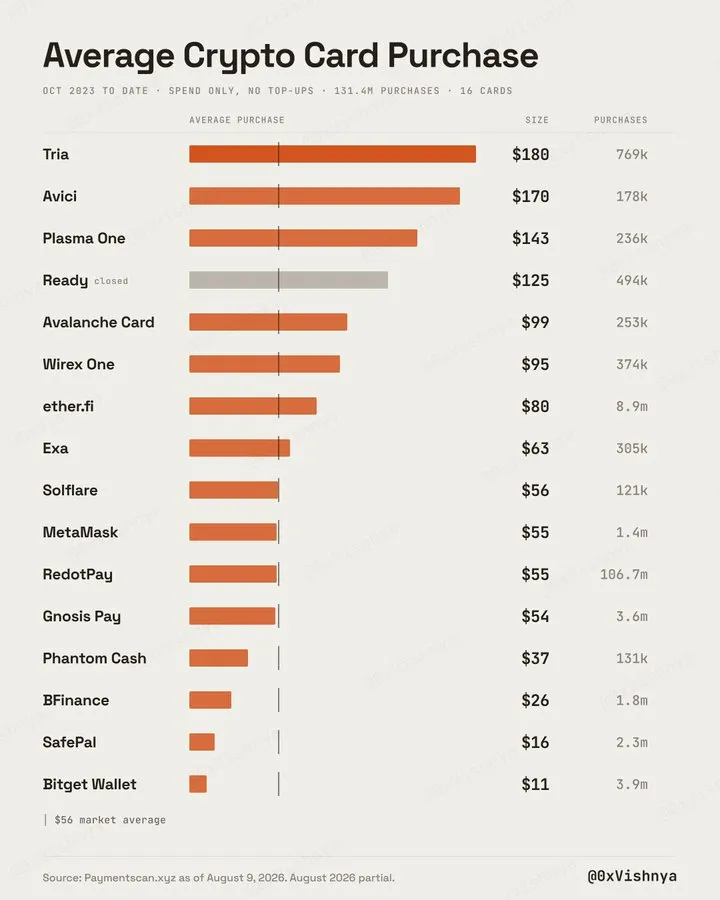
For comparison, ether.fi sits at $80, RedotPay at $55, while Tria is even above Plasma One at $143 and Avici at $170.
The interesting part is that Tria isn’t winning on raw transaction count. It seems to be attracting users who are comfortable making much larger purchases through an onchain card.
Pair that with its 1.5–6% base cashback tiers and staking boosts, and the strategy starts to look clear by using aggressive rewards to attract higher-value spenders, then pull more of their financial activity into the broader Tria ecosystem.
The bigger question is whether those high-value transactions eventually translate into higher deposits and sticky balances. That matters much more than having the highest average swipe size today.
This is another example of card economics becoming a user-acquisition mechanism for a broader onchain financial account.
@Plasma = chain-native distribution + highest cashback paid
Plasma’s strategy was centered around stablecoin infrastructure, building a chain around moving and using digital dollars, then moved downstream with Plasma One to give that infrastructure a direct consumer endpoint.
Plasma already has an ecosystem of lending, DEX and yield applications from protocols including Aave, Uniswap, Fluid and Pendle. Then, the card extends that stack into real-world spending.
stablecoin -> DeFi/yield -> deposit -> card -> merchant
The GTM is also heavily subsidized. Since March, Plasma One has reportedly paid ~$866K in XPL cashback to 21.4K addresses, equivalent to ~2.7% of the $32.4M processed through the cards, plus another ~$141K in stablecoin incentives.
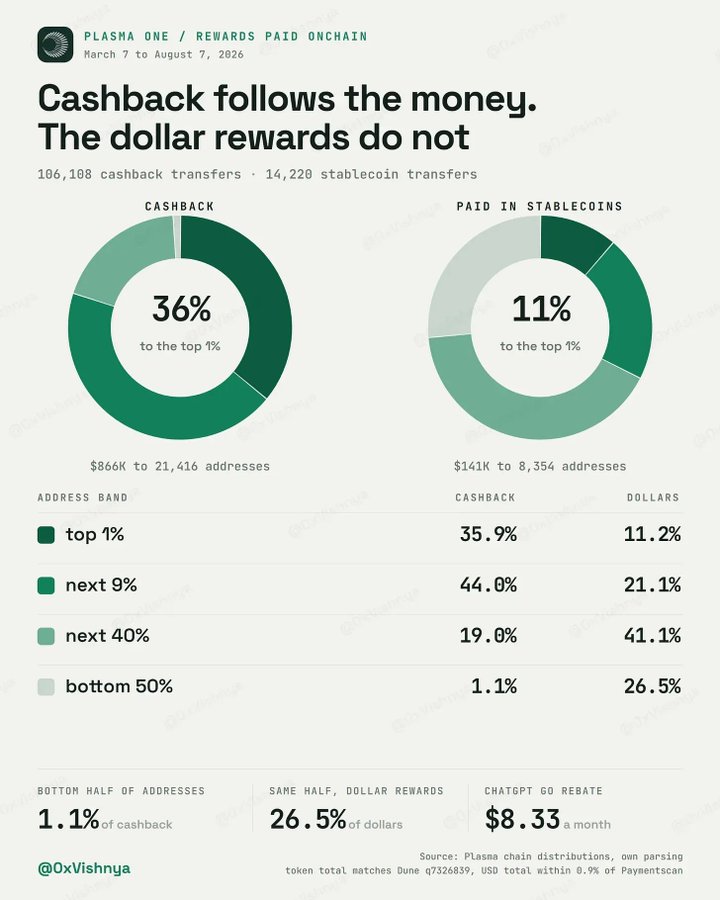
But that spend makes more strategic sense when viewed as ecosystem acquisition rather than card cashback. Plasma can subsidize the card to acquire users who may eventually hold stablecoins, use DeFi, generate transactions and keep more activity on Plasma.
So while KAST uses the card to build a neobank and ether.fi uses it to retain existing DeFi capital, Plasma uses the card to create distribution for the chain itself.
The card gets users in, incentives bootstrap behavior, and the broader ecosystem gives that activity somewhere to go. Plasma is essentially trying to close the loop between onchain stablecoin liquidity and everyday spending.
The state of play also includes established exchanges using cards to deepen relationships with existing customers.
@OKX = exchange account -> payment account
Exchange cards have another advantage entirely by relying on their existing distribution.
OKX already owns the customer relationship, liquidity and trading account.
Its card can turn assets already sitting inside that ecosystem into payment balances.
Depending on region and user tier, OKX currently advertises cashback starting around 2%, with substantially higher VIP rates, while its Singapore card lists zero issuance, recurring and crypto-to-fiat conversion fees for supported stablecoins.
For exchanges, cards aren’t necessarily standalone businesses.
They’re retention products.
Every additional reason not to withdraw assets makes the exchange account more valuable.
–
@krakenfx = simplicity
Kraken is approaching it much more like a conventional consumer card.
Its current European offering advertises:
Crypto increasingly becomes invisible infrastructure rather than the product itself.
The state of play is increasingly about making crypto work quietly in the background while the financial experience feels familiar.
Much like users don’t think about TCP/IP when browsing the internet or email protocols when sending a message, they shouldn’t need to think about stablecoins, wallets, chains, or settlement when paying for something. The winning products may simply feel like better financial accounts, with crypto quietly handling the infrastructure underneath.
The real competition is increasingly happening around:
Distribution = acquiring users efficiently at scale
Deposits = becoming the place users actually keep stablecoins
Yield = generating returns on idle balances
Credit = turning crypto holdings into usable collateral
FX = reducing the cost of cross-border spending
Rewards = using incentives without destroying unit economics
On/off ramps = making money easy to move in and out
Reliability = delivering consistent acceptance and payment execution
Financial products per user = expanding the relationship beyond the card
That’s exactly how neobanks evolved.
The state of play suggests that crypto cards are following a broader financial-services playbook rather than remaining standalone payment products.
There’s another reason I’m skeptical of ranking these cards purely by cashback from a long term perspective point of view.
Some require VIP tiers, monthly caps, depend on staking or token holdings, offer unusually high rates only for particular merchants and compensate for fees elsewhere.
And cashback itself is trivial for competitors to subsidize.
Competitors can subsidize higher cashback to acquire users, but unless the underlying economics support it, those rates eventually get capped, repriced, or removed.
Over time, the market should converge toward an equilibrium where sustainable rewards ≈ revenue generated per user minus the margin the platform needs to retain.
The real advantage, then, isn’t offering 5% instead of 3%. It’s building enough revenue around deposits, yield, credit, FX, and other financial services to sustain better rewards without subsidizing them indefinitely.
The more interesting metric would be look at net user economics = yield + cashback + credit value – FX – conversion fees – subscription/card fees
That’s what actually determines whether one account is better than another.
Privacy cards sit in a different part of the market because they optimize around a different constraint about identity and regulatory friction rather than yield, rewards or deposits.
That distinction becomes more important as jurisdictions tighten crypto regulation.
@ahboyash talked about recent MAS regulations here:
Singapore is a good example. MAS regulates digital-payment-token services under its payments framework, with licensed providers subject to requirements around areas such as AML/CFT and customer safeguards. Major Payment Institutions providing DPT services operate inside that regulated perimeter.
This creates an interesting market split. Regulated stablecoin neobanks can compete on trust, deposits and deeper financial services, while privacy-focused products compete on minimizing the amount of identity and financial information exposed through the user experience.
The trade-off is that privacy, compliance, reliability and access are increasingly intertwined. As regulation tightens, the demand for privacy doesn’t necessarily disappear, it may become a more distinct product segment.
@Nikitont shared a good list of web3 private cards here:
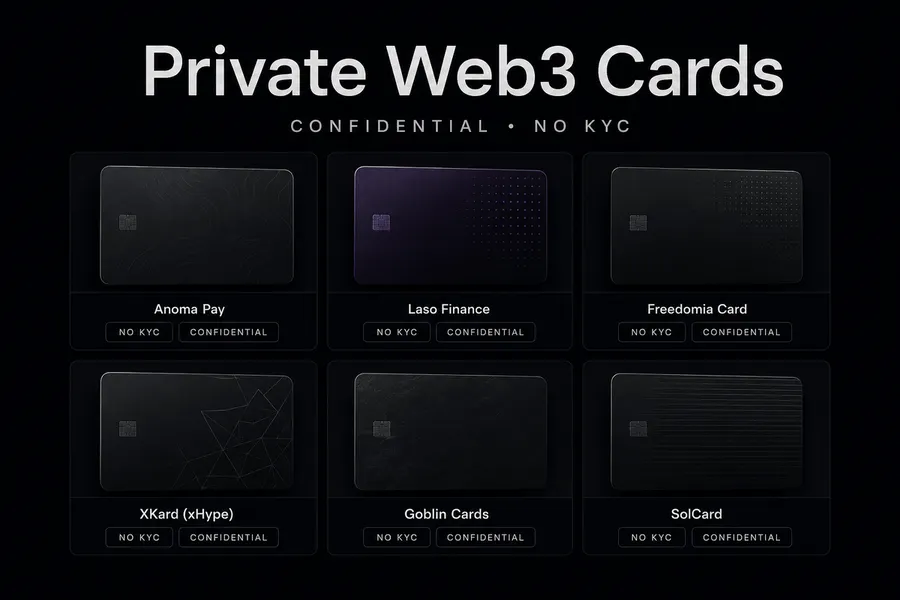
6. The next phase of crypto card: July’s numbers matter because deposits and spending are growing together
The numbers now look something like:
~$759M monthly card spend
+19% MoM
>$1B monthly stablecoin-neobank inflows
~489K tracked addresses
~132M cumulative transactions
That brings the state of play into focus: spending is growing, but the bigger opportunity is turning card users into long-term financial customers.
The first wave proved that crypto could be spent through cards. The next phase is about whether these platforms can become places where users actually keep capital.
If spending grows without deposits or retained balances, crypto cards remain payment products. If deposits, credit, yield and other financial activity grow with card volume, they start to look more like stablecoin-native financial accounts.
The card is only the interface. The real value is the financial ecosystem behind it.

Slumbered into the depths of 🥩 | 🍄 | 🧠 12% more points boost + bronze tier: https://t.co/Wie7T3kzJC TG: https://t.co/LZey0AcSFc
https://t.co/Jxx6fg5hsp


Tokenization of RWA yields onchain might be the biggest opportunity that no one has noticed
Cold Wallet Safety 2026: Are Hardware Wallets Still Safe?
One Token, Multiple Products. Can Zylo Deliver?
The Rise of NEAR Protocol 2026: Inside the 530% Rally and the ETF
Tokenization of RWA yields onchain might be the biggest opportunity that no one has noticed
Cold Wallet Safety 2026: Are Hardware Wallets Still Safe?
One Token, Multiple Products. Can Zylo Deliver?
The Rise of NEAR Protocol 2026: Inside the 530% Rally and the ETF