Arc blockchain mainnet launched with record activity before a meme coin crash exposed racism, team shilling, and trust concerns.

Author: Kritika Gupta
Circle’s Arc blockchain launched its public mainnet on September 16, 2026. By midnight, the chain had processed $410.8 million in DEX volume, 7.76 million transactions, and 97,025 newly minted tokens. For context, Robinhood Chain recorded $14.74 million on its opening day. Arc’s debut was 28 times larger.
However, meme coin launchpads generated 82% of all trading volume. Arguspad alone processed $202.35 million and minted 83,751 tokens, accounting for 86% of every new token created on Arc. Meanwhile, Minara.fun generated $36.41 million, while Tollylabs handled $19.65 million.
Launchpad tokens also surged immediately. ARGUS climbed 10.25x, TOLLY rose 9.26x, and LONG gained 4.51x. Demand had already intensified before the mainnet opened. In the days leading up to the launch, traders paid premiums as high as 1.8x to bridge USDC into the Arc ecosystem.
Moreover, the supporting infrastructure arrived from day one. The FOMO app integrated Arc at launch, while SushiSwap deployed its launchpad, AMM, and swap products. Circle built Arc for institutional stablecoin finance. Yet traders adopted it on day one as the hottest meme coin casino in crypto.
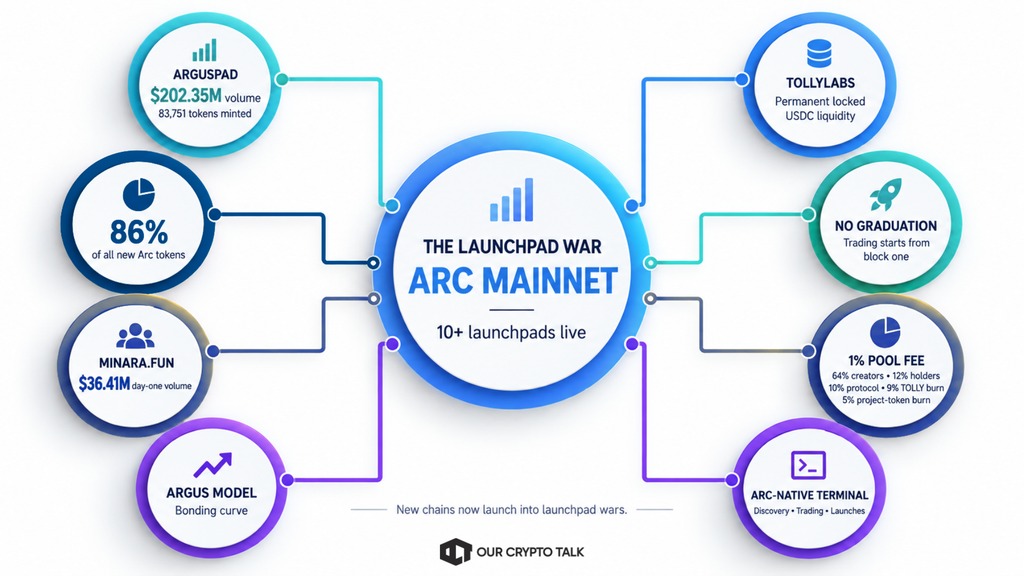
Arguspad dominated Arc’s opening day. The bonding curve launchpad generated $202.35 million in volume and minted 83,751 tokens, accounting for 86% of all new tokens created on the chain. Minara.fun ranked second with $36.41 million in day-one volume. Meanwhile, ArcPad, Lift, Parabola, Meme Arc, Sashimi, Ubi, Archemist, Zyora, and several others pushed the total number of active launchpads above 10.
However, TollyLabs chose a different model. Instead of using a bonding curve with a graduation step, Tolly launches tokens with permanently locked USDC liquidity from the first block. Each pool charges a 1% trading fee. On buys, the platform allocates 64% to creators, 12% to holders, 10% to the protocol, 9% to TOLLY buybacks and burns, and 5% to project-token burns. Tolly is also building an Arc-native terminal that combines token discovery, trading, and launches in one interface.
Arc’s competition follows a familiar pattern. Robinhood Chain launched into a battle between Pons and Pools.trade, while Solana now hosts an ongoing rivalry between Pump.fun and StonkFun. New chains no longer receive a quiet period for infrastructure development. Instead, launchpad wars begin on day one because that is where traders, liquidity, fees, and attention arrive first.
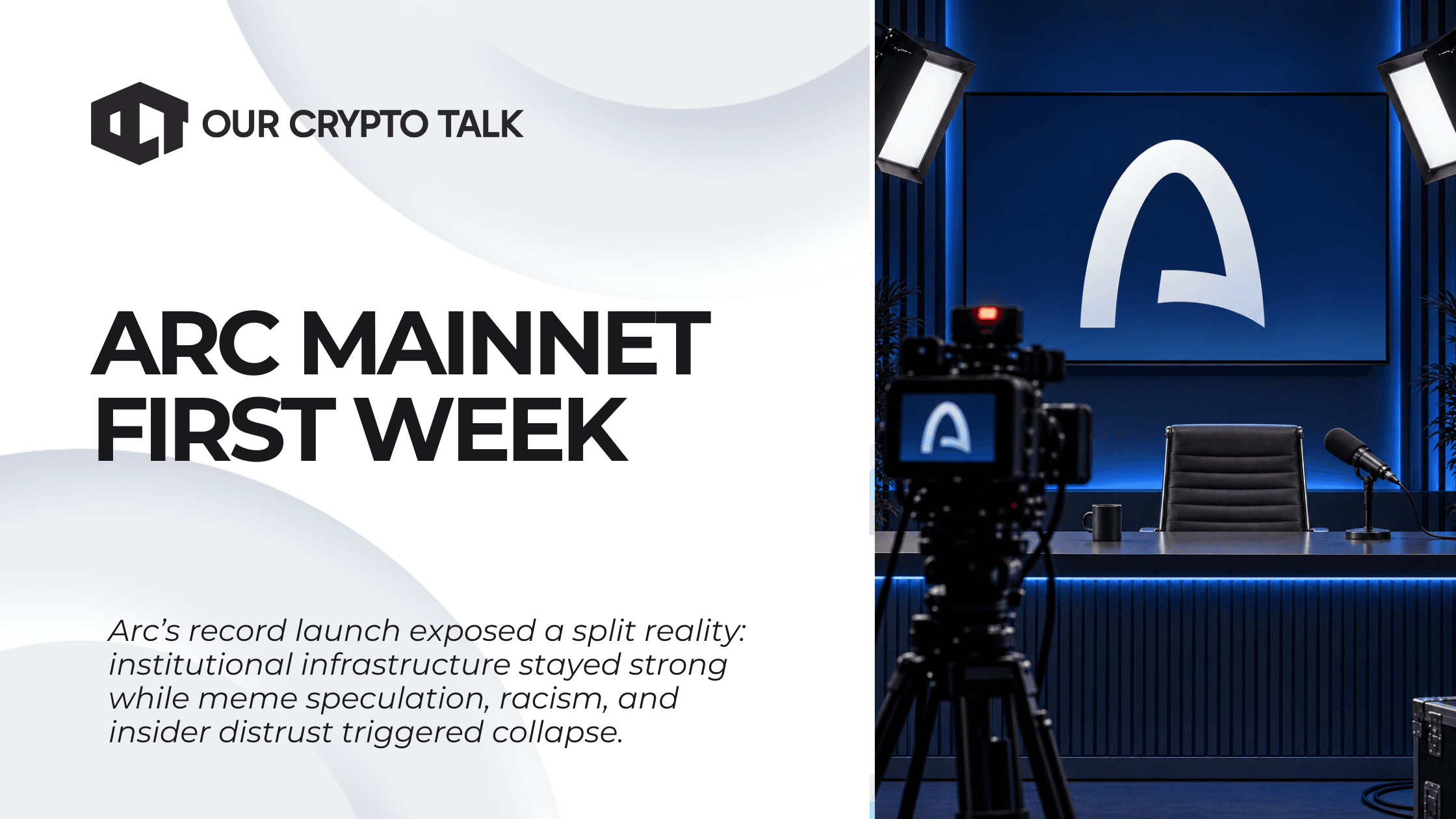
On September 17, the Arc mainnet team held a mainnet launch livestream. When the camera showed the developer team, community members circulated screenshots and focused on the apparent South Asian identity of several people on screen. Viewers also criticized the livestream’s background as disorganized and unprofessional. Within minutes, traders began selling meme coins and launchpad tokens across the Arc ecosystem.
The losses spread quickly through Arc’s thin liquidity pools. TOLLY dropped roughly 68%, while ARGUS fell about 50%. Several other tokens lost between 40% and 75% within 12 hours. No protocol failure or security exploit triggered the move. Instead, traders reacted to the livestream and amplified the sell-off across shallow markets.
Wizard of SoHo summarized the reaction on X: “everyone dumped every coin on arc chain the moment their live stream started.” Another user wrote: “I just sold everything I had on Arc. After seeing this live. Goodnight.” These posts captured how quickly appearance and presentation replaced technical fundamentals in the market’s decision-making.
However, the replies soon moved beyond criticism of the production quality. Users escalated from mockery to dehumanizing slurs aimed at Indians as a group. As BeInCrypto observed, “The first selling wave arrived over a face rather than a fundamental.” The episode exposed how rapidly prejudice can become a market catalyst when speculation, thin liquidity, and social media collide.
Arc Mainnet Launch Timeline
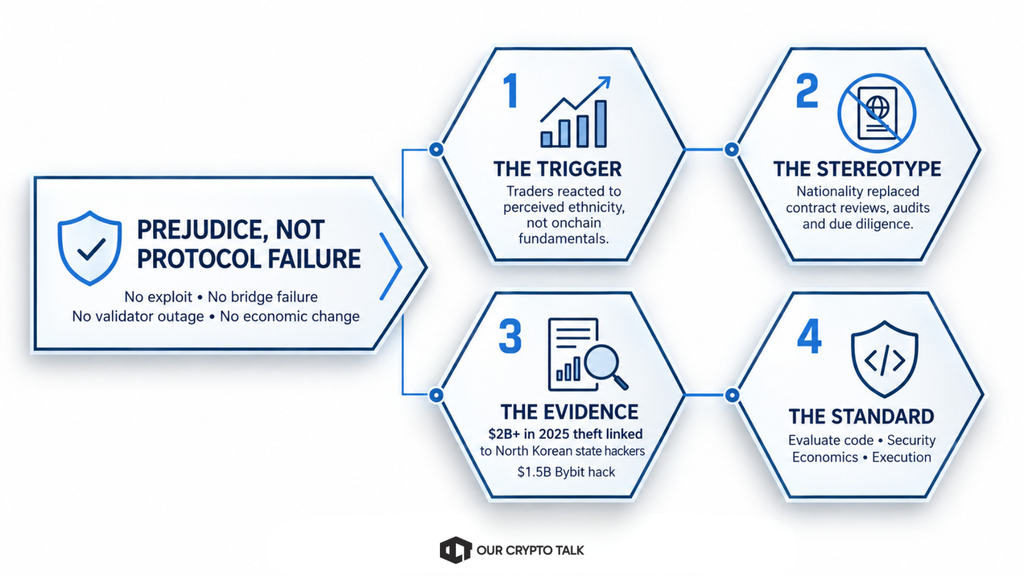
No technical failure triggered the sell-off. Arc mainnet did not suffer an exploit, bridge failure, validator outage, or sudden change in its economics. Instead, traders publicly linked their decision to sell with the perceived ethnicity of people shown during the livestream. The market reacted to who appeared on camera, not to what happened onchain.
That reaction exposed a persistent stereotype in crypto culture: Indian teams supposedly carry a higher risk of rug pulls. Similar rhetoric has historically targeted Nigerian and Southeast Asian developers. These assumptions turn ethnicity into a substitute for due diligence. Instead of reviewing contracts, liquidity structures, team histories, and security audits, traders reduce risk assessment to a person’s appearance or nationality.
However, the pushback arrived quickly. “Crypto with Khan” highlighted Indian-born leaders at Google, Microsoft, IBM, and Adobe, including Sundar Pichai and Satya Nadella. He then asked: “If Indians are scammers, why do they run the world’s biggest tech companies?” Alphractal founder Joao Wedson also published a rebuttal, arguing that crypto often grants Western teams automatic credibility while treating Asian builders with suspicion.
The available crime data also contradicts the stereotype. Chainalysis’s 2026 Crypto Crime Report attributed more than $2 billion in 2025 crypto theft to North Korean state hackers, including the Lazarus Group. North Korean attackers also carried out the $1.5 billion Bybit hack. Meanwhile, investigators have traced many pig-butchering operations to criminal compounds in Cambodia and Myanmar. Geography can shape specific risks, but ethnicity cannot identify whether a developer writes secure code or intends to steal funds.
KuCoin summarized the correct standard: “A blockchain should be evaluated through its code, security, economics and execution, not the ethnicity of its builders.” A passport is not a risk score. The data does not support the stereotype, and the market had no technical evidence to justify its reaction. That first wave of selling reflected prejudice, not analysis.
Racism did not explain every concern. On launch day, multiple Arc mainnet team members and early partners promoted different meme coins at the same time. Rachel Mayer, a member of the Arc team, posted about a specific token. As a result, parts of the community interpreted the post as the team teasing or supporting an insider launch. When people close to a new chain promote competing tickers, traders naturally question who received early access and who may become exit liquidity.
Those concerns grew because Arc had operated a private mainnet for months before opening to the public. Early partners had time to deploy products, seed liquidity, and build positions before retail traders arrived. That preparation forms part of a normal network launch. However, once team-adjacent accounts began promoting tokens, community analysts argued that those early positions looked “primed for exit liquidity.”
Therefore, team promotion, possible insider positioning, and the livestream created a perfect storm of distrust. The racism was wrong, but the shilling was real. Both contributed to the crash, and the distinction matters. One reflected prejudice against builders based on their ethnicity. The other exposed a legitimate trust failure involving transparency, neutrality, and conflicts of interest.
As of September 22, TOLLY and ARGUS remain well below their day-one peaks, while liquidity across many Arc meme coin pools remains shallow. However, the assets that crashed were third-party launchpad and meme tokens. Circle did not issue them. Circle has minted the 10 billion ARC genesis supply, but ARC mainnet has not entered public circulation or trading. Therefore, traders should not confuse unofficial tokens using the Arc name with the network’s native asset. (geckoterminal.com)
More importantly, the meme coin decline did not change Circle’s institutional thesis. Arc still uses USDC for transaction fees, offers sub-second finality, and relies on a founding validator group that includes BlackRock, Visa, Mastercard, and DTCC. The network continues to target stablecoin payments, credit, tokenized assets, and financial settlement. That infrastructure operates separately from the speculative launchpad ecosystem that suffered the sell-off. (circle.com)
Meanwhile, developers continue expanding Arc’s retail layer. Launchpads such as Sashimi and Ubi have joined a growing field, although Chaos could not yet be independently confirmed as live. XyloNet also launched on Arc despite the controversy. Circle had previously featured XyloNet among the founder-led projects building on the network, so its deployment shows that the livestream backlash did not stop the underlying product rollout. (fomotrading.radio.fm)
The meme coin crash did not damage Arc’s institutional foundation. BlackRock, Visa, Mastercard, and DTCC remain part of the validator cohort, while the network continues to use USDC for gas. Arc still offers the same settlement infrastructure for stablecoins, tokenized assets, and credit markets. Those fundamentals did not change because speculative launchpad tokens collapsed.
However, the meme layer must rebuild trust. Launchpad competition will continue, but Arc now needs to prove that traders will return instead of moving to the next chain with fresh liquidity. Robinhood Chain followed a similar pattern. It experienced an explosive meme coin launch before activity normalized, yet its TVL later climbed from roughly $39 million to more than $400 million. Arc could follow the same path if its institutional liquidity remains active and its retail ecosystem matures.
Still, Arc must address the token-promotion problem. If team members and early partners continue promoting individual meme coins, traders will question every future community campaign. Neutral infrastructure requires neutral behavior. A public ARC token launch, if Circle proceeds with one, could provide the network’s next major catalyst. However, the racism controversy and legitimate concerns about team shilling will continue to create headwinds until Arc rebuilds credibility.


Tokenization of RWA yields onchain might be the biggest opportunity that no one has noticed
Cold Wallet Safety 2026: Are Hardware Wallets Still Safe?
One Token, Multiple Products. Can Zylo Deliver?
The Rise of NEAR Protocol 2026: Inside the 530% Rally and the ETF
Tokenization of RWA yields onchain might be the biggest opportunity that no one has noticed
Cold Wallet Safety 2026: Are Hardware Wallets Still Safe?
One Token, Multiple Products. Can Zylo Deliver?
The Rise of NEAR Protocol 2026: Inside the 530% Rally and the ETF