Crynux brings verifiable AI compute to edge GPUs. Explore CNX, vssML, traction, tokenomics, risks, and growth potential.

Author: Akshat Thakur
Crynux is a permissionless DeAI network that turns edge GPUs into shared compute infrastructure for LLM and VLM inference, image generation, and fine-tuning.
Its main difference is verification.
Most decentralized compute networks face a trade-off. Verify every task and costs rise quickly. Trust node operators and the network becomes more centralized. Crynux uses vssML, which combines secret random sampling, VRFs, deterministic execution, and cryptography to verify only a portion of workloads.
The project says roughly 10% of tasks need full validation under its design. That could reduce verification costs while keeping dishonest nodes accountable.
The network is already live. Lithium mainnet launched on June 17, 2026. Recent stats showed around 292 nodes, 23,910 TFLOPS, and 2,009,030 tasks on the relay. Its earlier Helium testnet reached roughly 1,860 active nodes and 55 million tasks.
CNX is also live and used for gas and node rewards across its multi-chain setup.
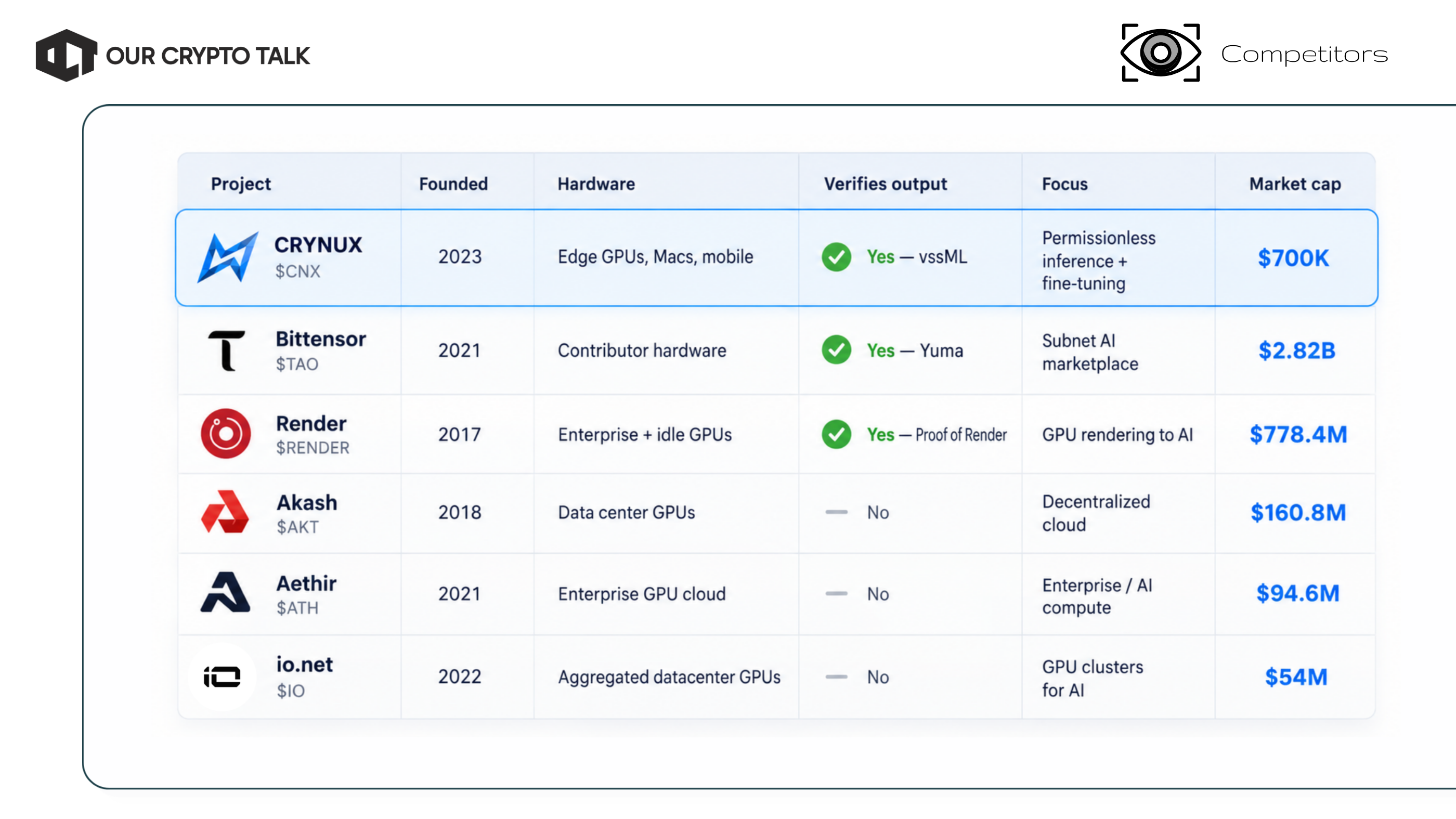
The timing matters because decentralized AI compute has moved from an experiment into a competitive market. Bittensor, io.net, Render, Akash, and Nosana are already building networks around distributed compute.
Crynux is therefore not entering an empty category. Its bet is narrower: make permissionless edge compute verifiable without requiring every job to run multiple times.
That thesis is interesting, but the next stage is harder.
Node counts and testnet activity can prove that infrastructure works. They do not prove that developers will pay for it. Crynux ultimately needs application demand and task fees to become more important than bootstrap rewards.
Crynux enters a crowded decentralized AI market.
Bittensor has built a large ecosystem around subnet-based incentives. io.net, Render, and Akash focus heavily on distributed GPU marketplaces. Nosana targets AI workloads and inference. Gensyn is also working on decentralized machine learning infrastructure.
Then there are centralized providers such as OpenAI, Anthropic, and open-weight model hosts. These platforms still define the performance, latency, and reliability standards that applications have to meet.
Crynux is taking a different route. Instead of competing purely on GPU capacity, it is building around verifiable edge compute.
The core technology is vssML. Crynux uses secret random sampling and VRFs to select workloads for verification, while deterministic execution makes the results reproducible. The idea is that the network does not need to fully validate every task to maintain accountability.
That gives Crynux a specific technical wedge.
Its stack also supports OpenAI-compatible access, delegated staking, multi-chain CNX infrastructure, and a longer-term AI-Fi vision around models and data.
But the advantage is not permanent.
Sampling, staking, verification, and API compatibility are all features competitors can potentially adopt. Crynux does not have an obvious structural moat that prevents larger networks from implementing similar mechanisms.
That makes execution important.
Lithium being live gives Crynux something tangible to build on. The question is whether vssML can translate into cheaper, reliable compute that developers actually use.
If most network rewards still come from bootstrap emissions rather than application fees, the verification system remains an interesting piece of infrastructure rather than a proven commercial advantage.
Crynux has less public team information than some better-known DePIN projects.
Public materials identify Aarox Yu as a founder, while community contributors such as Luke have appeared in AMAs and DAO discussions. The project also points to roughly six years of work around verification technology.
The more important signal is the development history.
Crynux has moved through multiple network stages, from earlier Stable Diffusion workloads to GPT and LLM-focused testnets, before launching Lithium mainnet with vssML and its broader infrastructure.
Its open-source repositories include the Crynux node, bridge, relay, and documentation. The project also operates through the Crynux DAO, which uses an elected seven-member council and a convener.
That structure matters because Crynux is not presenting itself as a conventional startup with a large corporate management layer. Tokenomics and emissions changes are designed to move through the DAO rather than a traditional VC-controlled board.
Crynux is not a fully doxxed team with extensive public executive histories and a long list of previous exits. That makes it harder to evaluate the people behind the network compared with projects such as Acurast.
Still, the project has a tangible development record.
Shipping multiple testnet phases and reaching Lithium mainnet is more meaningful than a long roadmap with no working network. The open-source stack also gives developers a way to inspect and build around the infrastructure.

Crynux does not appear to be built around a large Tier-1 VC funding story.
Public fundraising information is limited. Available data points to an accelerator relationship with Beacon AI around September 2024 rather than a major priced equity round.
Its tokenomics also emphasize a different structure. The project states that CNX has no traditional VC allocation, pre-mine, or founder allocation. Early developer compensation comes through part of the Year 0 treasury emissions, while the remaining emissions support nodes and the DAO treasury.
That creates a different set of incentives.
Crynux does not have the same investor overhang that can come with heavily funded token launches. There is less evidence of a large group of early investors waiting for liquidity.
The trade-off is capital.
Running a decentralized AI network requires more than code. Enterprise sales, developer acquisition, security, infrastructure, exchange liquidity, and ecosystem partnerships all require resources.
A large funding round can provide that runway. Crynux appears to be taking a more bootstrap-oriented approach instead.
The token is already live, and the network is already operating. Its economic model is designed to direct emissions toward compute providers and the DAO while gradually tying rewards more closely to network usage.
That could work if task demand grows alongside the infrastructure.
If it does not, the lack of substantial external capital could become a constraint. The network would then depend heavily on emissions to keep operators participating.
So the backing story is relatively straightforward. Crynux looks more like a bootstrapped DePIN network than an institutionally financed AI cloud.
The key question is not who funded it. It is whether the network can generate enough real demand to sustain itself.
Crynux is past the whitepaper stage. Lithium mainnet went live on June 17, 2026, after the project moved through Hydrogen and the Helium incentivized testnet.
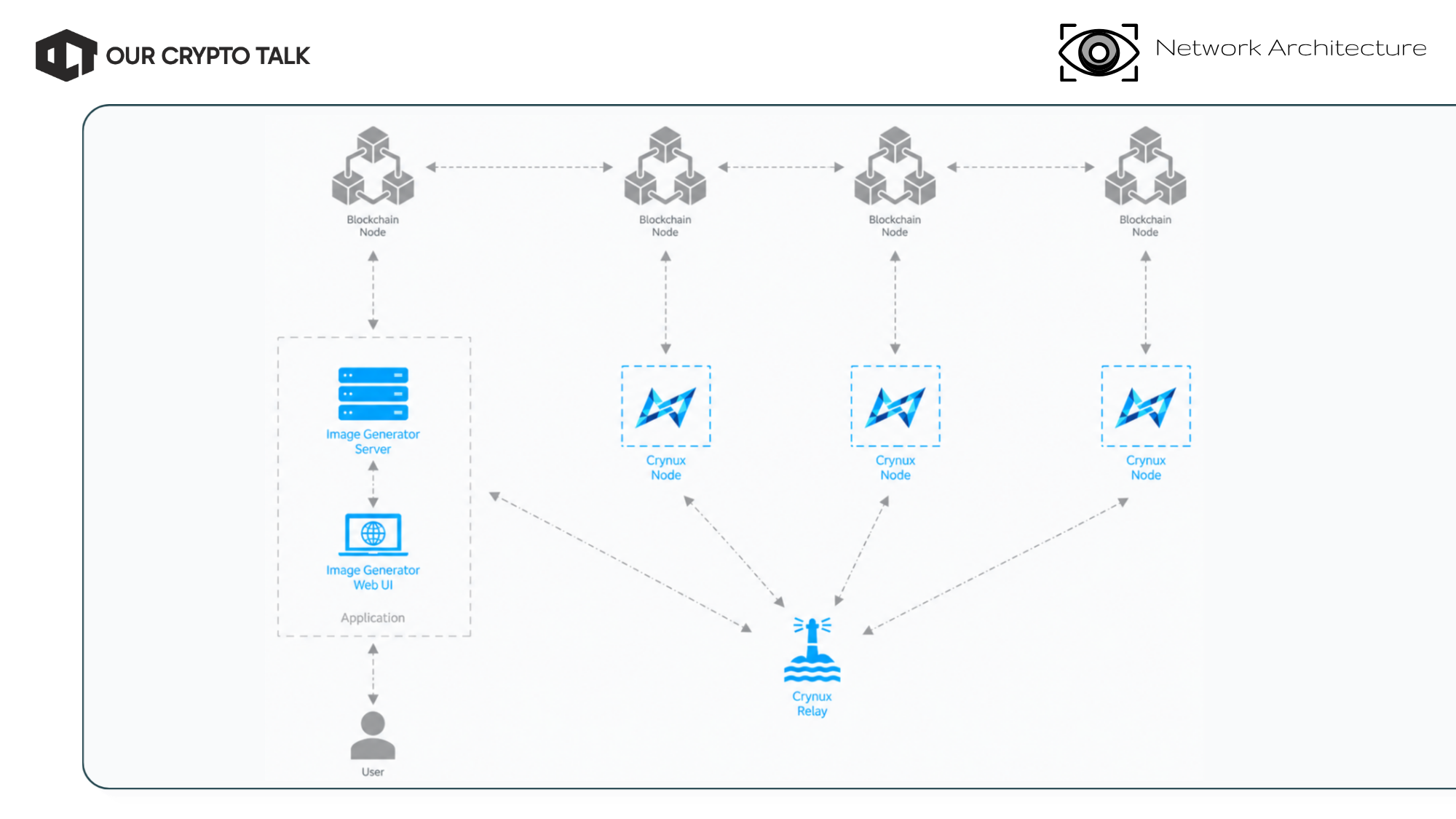
The network now has working infrastructure for node operators, staking, delegation, task dispatch, and AI workloads. Developers can also access Crynux through its bridge and OpenAI-compatible paths.
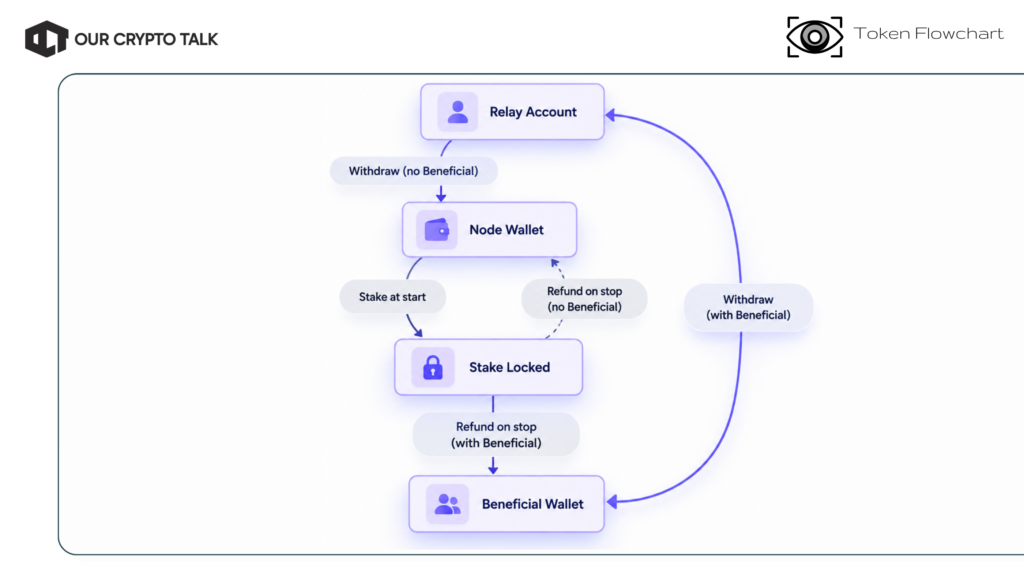
The node software runs on supported NVIDIA GPUs. Operators stake CNX, receive tasks, and earn rewards based on network participation and quality of service. Holders can delegate stake through the Crynux Portal without running hardware themselves.
The broader stack is also live. CNX exists natively on Ethereum, with bridges to Base, Robinhood, and Near. Crynux also operates dedicated L2 infrastructure where CNX functions as gas.
Its GitHub activity adds another layer of evidence. The project has active repositories covering the node, bridge, relay, documentation, and DAO infrastructure. That is materially different from a project that only has a roadmap and testnet screenshots.
Crynux has meaningful infrastructure activity, but the numbers need to be separated carefully.
The Helium testnet reportedly reached around 1,860 active nodes, 55 million tasks, and roughly 230 million CNX paid to operators. That shows significant participation, although much of it was incentivized.
Lithium now has a live fleet, around 292 nodes, 23,910 TFLOPS, and 2,009,030 tasks on the relay. The public task counter has also crossed 235,000, although the exact figure changes with each snapshot.
The token provides another data point. CNX is live and tradeable, but recent market prints put it around $0.001, with roughly $0.9 million market capitalization and about $13 million FDV.
Staking provides another form of participation. Node operators need to stake CNX, while other holders can delegate to operators. Both involve capital rather than simply joining a Discord or collecting points.
DAO activity also gives Crynux a functioning governance layer, with tokenomics changes and council elections handled through the project’s governance process.
Still, the most important metric is missing.
Node count does not equal paid demand. Task count does not necessarily equal paid demand either, especially when heartbeat tasks can support bootstrap reward mechanisms.
The metric to watch is application fees versus bootstrap and heartbeat emissions. Until developers generate meaningful paid workload, Crynux has proven its supply-side incentive system more clearly than its demand-side business.
Crynux has already passed its TGE with Lithium, so new participants are entering the live network rather than buying into a future launch.
The maximum supply is 8,617,333,262 CNX. Recent self-reported circulation was around 592 million tokens, or roughly 7% of maximum supply. At around $0.001, that put the market cap near $0.9 million and FDV around $13 million.
The allocation structure is unusual.
Year 0 and testnet activity account for 9% of supply. Bootstrap mining receives 20%, while task mining receives the remaining 71%.
Bootstrap mining releases tokens according to a calendar-based schedule over Years 1 to 20. Task mining is tied to application-task progress, meaning emissions are designed to respond to actual network usage rather than simply passing time.
The bootstrap and task-mining pools split emissions 80% to nodes and 20% to the treasury. Node rewards from these pools also carry six-month linear vesting.
Crynux does not disclose a traditional VC tranche, large founder allocation, or classic pre-mine. Around 35% of the 6% Year 0 treasury allocation, roughly 2% of total supply, is earmarked for early developers.
That removes one common token-launch risk, but it does not remove dilution.
CNX has genuine sinks through AI task payments, staking, L2 gas, and governance. The question is whether those sinks can grow faster than emissions.
If application fees remain small, CNX behaves more like an emission-driven work token. If paid workloads scale, the usage-linked task-mining design becomes much more relevant.
Crynux no longer has a traditional points campaign to farm. The network is already live, so early participation now comes through operating infrastructure, delegating stake, building on the network, or buying CNX on the secondary market.
The most direct route is running a node. Operators need a supported NVIDIA GPU, Crynux Node software, CNX stake, and sufficient uptime and quality of service. Rewards can come from task fees as well as bootstrap and task-mining emissions.
Delegation provides another route. Users can stake CNX to existing operators through the Crynux Portal without owning or running a GPU. The trade-off is that capital remains exposed to the operator and network economics.
Developers can approach the network from the other side. Crynux provides bridge and SDK infrastructure for inference and fine-tuning workloads. Actual paid application usage is particularly important because it creates demand for the network rather than simply increasing the supply of compute providers.
The final option is simply buying CNX on the secondary market. That is not a presale allocation or guaranteed early-user advantage. It is exposure to a low-cap, thinly traded work token whose future value depends heavily on application demand.
Existing testnet operators also received Year 0 conversion with 12-month vesting, so new participants cannot replicate those historical terms.
For new users, the economics matter more than the word “early.” Running a GPU makes sense only if hardware, electricity, expected rewards, and token emissions justify the cost.
The bigger opportunity to watch is whether Crynux shifts from emission-driven participation toward paid compute demand.
Crynux no longer has a points campaign for new users. The economics now come down to GPU costs, staked CNX, emissions, and liquidity.
For node operators, the setup only makes sense if you already have suitable NVIDIA hardware and relatively cheap power. Buying a new GPU purely to farm CNX adds another layer of risk, especially with the token trading around $0.0015 and a reported market cap near $0.9 million.
The token itself trades at roughly $13 million FDV based on the 8.62 billion maximum supply. Year 1 bootstrap emissions are still running at around 1.8 million CNX per week before task-mining emissions. Reported daily volume has also remained thin, often around $6,000 to $12,000.
That makes liquidity a major part of the thesis.
Crynux is cheaper than larger decentralized compute networks such as Bittensor, Render, io.net, and Akash. But a low valuation does not automatically make the token cheap. If the roughly 300-node network remains heavily dependent on bootstrap and heartbeat rewards, the current valuation can still be difficult to justify.
The key metric is application demand.
Positive economics require real API and bridge usage to grow faster than emissions and vesting. The underlying infrastructure is live, vssML provides a clear technical thesis, and the tokenomics avoid a traditional VC overhang.
Crynux faces the same structural problem as most decentralized compute networks: getting enough real demand to justify the supply being onboarded.
Competition is already strong. Bittensor has a large incentive-driven ecosystem, while io.net, Render, and Akash have established GPU marketplaces. Centralized providers still offer developers predictable performance and latency.
Crynux therefore needs to win a specific segment of the market: workloads that benefit from permissionless, verifiable edge compute.
The second risk is utilization quality.
A large node count does not necessarily mean a healthy network. Operators can generate heartbeats and low-value workloads while waiting for real application demand. Staking and quality-of-service requirements can discourage bad behavior, but they do not automatically create production-grade workloads.
There is also regulatory uncertainty. Consumer devices processing third-party AI workloads can raise questions around data protection, model distribution, export controls, and liability. Crynux’s global, permissionless structure makes those questions harder to standardize across jurisdictions.
The token introduces another risk. CNX rewards are still heavily influenced by emissions, while task mining depends on application progress. If real applications remain limited, most rewards can continue coming from token issuance rather than economic activity.
Execution is another variable. GPU compatibility, relay infrastructure, bridges, slashing mechanisms, and developer experience all need to work reliably as the network grows.
Crynux is not a fork of Bittensor or Akash. Its vssML verification system gives it a specific technical angle. But the broader loop remains familiar: onboard hardware, distribute rewards, and wait for demand.
Without that final step, the network can have working technology without developing a sustainable compute marketplace.
Crynux has already cleared its biggest technical milestone with the Lithium mainnet and live CNX token. The next catalysts are therefore more about usage than launch events.
The most important one is application fee growth.
If Crynux starts reporting a rising share of node income from genuine application tasks rather than heartbeats or bootstrap rewards, it would provide stronger evidence that developers are actually paying for the network.
The emission schedule is another observable factor. Bootstrap releases and task-mining emissions will continue affecting the circulating supply. Increasing application demand alongside those releases would matter more than another headline node milestone.
Future roadmap development could also expand the addressable market. Beryllium is expected to bring areas such as model tokenization, broader multimodal workloads, and an AI workflow layer. Shipping those features would expand the product surface, although their importance ultimately depends on actual usage.
Negative catalysts are equally important. A sustained decline in active nodes, another infrastructure or wallet incident, exchange delisting, or worsening Base liquidity could make the token harder to trade and weaken operator incentives.
For someone evaluating Crynux today, the key question is whether to wait for more evidence.
Three months of data showing application fees consistently exceeding bootstrap-driven rewards would tell investors far more than another increase in node count or TFLOPS.
The main catalyst is therefore simple: paid compute.
WATCH
Crynux has several things that are difficult to dismiss. Lithium mainnet is live, vssML gives the network a specific verification approach, node software is open, and CNX is already integrated into the network’s staking and compute economy.
Its token structure also avoids some common launch risks. There is no traditional VC tranche or large founder allocation, while 71% of supply is assigned to task mining tied to application progress.
But the token and the technology need to be viewed separately.
CNX remains a roughly $13 million FDV asset with a reported sub-$1 million circulating market cap, thin trading volume, and ongoing bootstrap emissions. The network has demonstrated that operators will provide compute when incentives exist.
It has not yet demonstrated that developers will pay enough for that compute to support the network without those incentives.
That is the milestone that matters.
Sustained, disclosed application-task revenue from third-party apps, excluding heartbeat activity, should exceed bootstrap-driven node income for more than one quarter.
Until that happens, Crynux is an interesting live experiment in verifiable edge AI compute, but the token remains heavily tied to emissions.
The network is real. The verification thesis is real. The commercial demand still needs to prove itself.
All the opinions in this article are that of the author and in no way are financial advice. Our Crypto Talk and the author always suggest you do your own research in crypto and to never take anything as financial advice that you read on the internet. Check our Terms and conditions for more info.