NEAR Protocol 2026 is up 530% from its February low. See how NEAR Intents $33B volume, the Bitwise ETF, and lower inflation drive the rally.

Author: Kritika Gupta
NEAR Protocol has staged a strong recovery in 2026 as traders reassess its role in cross-chain trading and AI infrastructure. February low near $0.84 and early-October reference price of $5.28, the token gained roughly 530%. Meanwhile, growing Intents activity and Bitwise’s U.S. ETF launch have strengthened the investment case. The key question now is whether adoption and token demand can sustain the rally.
NEAR Protocol entered 2026 after a weak 2025, then recovered from its February lows. The rally accelerated through late summer and September as investors focused on cross-chain trading, institutional access, and the network’s AI ambitions. At the October 12 research check, DeFiLlama displayed a NEAR price of $5.85 and a market capitalization of approximately $7.66 billion.
Like Hyperliquid and Zcash, NEAR has attracted traders looking for assets with distinct growth narratives. However, NEAR’s investment case combines several drivers: Intents adoption, an exchange-traded product, lower token issuance, and infrastructure upgrades. To maintain momentum, the ecosystem needs to translate those developments into recurring activity and sustained demand for NEAR.
Price, adoption, tokenomics, and ecosystem development
Illia Polosukhin and Alexander Skidanov co-founded NEAR, a proof-of-stake Layer-1 blockchain that uses Nightshade sharding to distribute workloads across the network. Polosukhin also co-authored the 2017 paper “Attention Is All You Need,” which introduced the Transformer architecture.
NEAR Protocol prioritizes usability through human-readable accounts, account abstraction, sponsored transactions, and low fees. More recently, the ecosystem has focused on chain abstraction, which lets users request an outcome without manually coordinating bridges, wallets, and gas tokens. Alongside that effort, NEAR has expanded its AI infrastructure and introduced automatic shard splitting through the nearcore 2.13 upgrade.
NEAR Intents gives the ecosystem a practical cross-chain use case. A user or AI agent signs a request, such as swapping an asset on one chain for an asset on another. Competing solvers then arrange execution, while a verifier contract on NEAR checks settlement. Consequently, users can complete swaps without choosing every bridge or managing each step themselves.
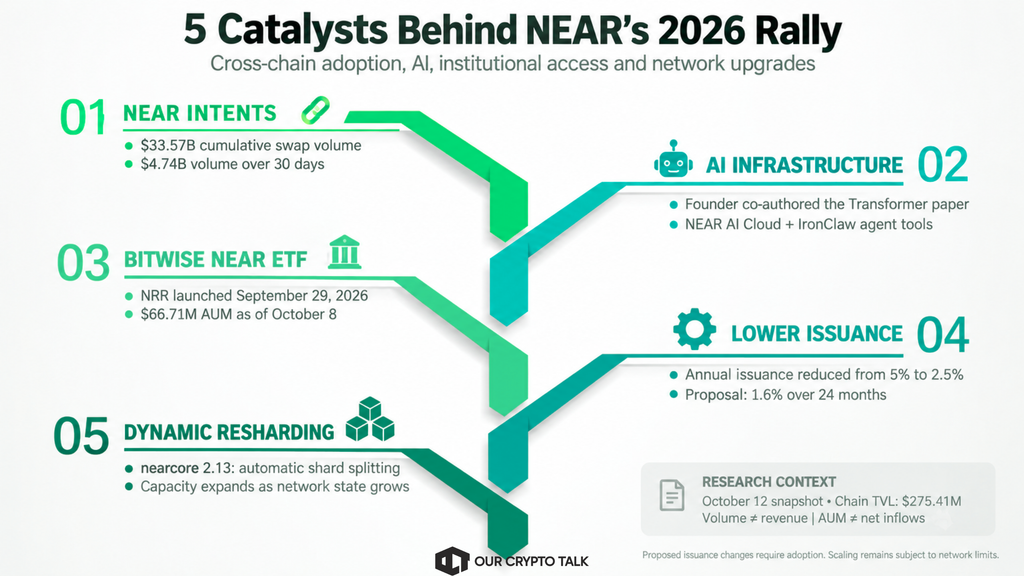
At the research check, DeFiLlama showed approximately $33.57 billion in cumulative Intents volume and $4.74 billion over the preceding 30 days. These figures measure trading activity, rather than revenue or capital permanently committed to NEAR. Nevertheless, they demonstrate substantial demand for the service
Intents also connects usage to token demand through revenue-funded NEAR buybacks. However, cross-chain infrastructure carries operational risk. DeFiLlama records an October 1, 2026 security incident involving approximately $3.8 million. Investors should assess security and revenue capture alongside swap volume when judging the product’s durability.
Polosukhin’s role in the Transformer paper gives NEAR a credible connection to foundational AI research. That background supports the ecosystem’s positioning, although it cannot establish commercial demand on its own.
NEAR’s AI strategy focuses on tools that agents may need to operate independently. NEAR AI Cloud offers confidential inference through trusted execution environments, while IronClaw provides an agent runtime with permission controls. Together with cross-chain settlement, these tools aim to help agents compute, transact, and manage access to resources.
As a result, investors increasingly assess NEAR as infrastructure for an emerging agent economy. Still, the investment case needs paying customers and repeat usage. Intents already provides a measurable activity signal; the AI products need to demonstrate comparable commercial traction.
Bitwise launched its NEAR ETF on NYSE Arca on September 29, 2026, under the ticker NRR. The product holds NEAR and charges a 0.75% management fee. Bitwise also intends to stake the fund’s holdings through its institutional staking team, with rewards increasing the fund’s net asset value.
The ETF gives investors brokerage access to NEAR without requiring them to manage a crypto wallet. Bitwise’s fund page reported approximately $66.71 million in assets under management as of October 8. However, AUM reflects both investor flows and changes in the value of the holdings, so it does not establish cumulative net inflows.
The launch added a new access channel during NEAR’s September rally. Going forward, sustained creations and asset growth would strengthen the institutional-demand argument. The launch alone cannot establish how much of the price advance ETF buyers drove.
NEAR’s governance discussion identifies the current maximum annual issuance rate as 2.5%, following the reduction from 5% in October 2025. A newer proposal would gradually lower issuance to 1.6% over 24 months. The proposal still requires governance and validator adoption, so investors should distinguish the proposed target from the live rate.
Meanwhile, transaction fee burns and Intents-funded buybacks can offset some new issuance. These mechanisms affect supply differently: burns destroy tokens, while buybacks create market demand and depend on how the ecosystem subsequently handles the purchased tokens.
Lower issuance reduces dilution, but it also reduces the token rewards available to stakers and validators. Therefore, the long-term benefit depends on whether growing revenue and adoption support network security as emissions decline. Lower inflation improves the supply side of the investment case without guaranteeing a higher price.
NEAR’s nearcore 2.13 release introduced automatic shard splitting at epoch boundaries when runtime state reaches the relevant thresholds. Previously, the network needed a protocol upgrade to introduce a new hard-coded shard layout. The new mechanism removes that requirement for supported shard splits.
For developers, this upgrade creates a more flexible path to additional capacity as applications grow. It also supports NEAR’s ambition to handle larger trading and agent workloads on its Layer-1.
However, “unlimited scalability” describes an ambition rather than a demonstrated performance guarantee. Validator hardware, networking, and cross-shard coordination still constrain throughput. The release supports automatic splitting; it does not establish automatic shard removal or infinite transaction capacity. Nevertheless, the upgrade addresses a practical scaling bottleneck.
NEAR gave back much of May’s advance before rebuilding momentum in late summer. September then delivered the largest gain, alongside the ETF launch and expanding Intents activity. This timing supports a catalyst-based explanation, although it does not prove that either development caused the rally.
Meanwhile, DeFiLlama’s research snapshot showed approximately $275.41 million in chain TVL. Readers should distinguish this measure from individual protocol totals, liquid staking balances, and cross-chain Intents volume because each tracks a different part of the ecosystem.
NEAR Intents connects cross-chain liquidity and execution, while HOT Wallet simplifies consumer access and transactions. Aurora adds EVM compatibility, allowing Solidity developers to bring familiar tools into the ecosystem.
Within DeFi, Rhea Finance supports trading and lending. Meanwhile, Meta Pool and LiNEAR offer liquid staking, allowing holders to access staking rewards while retaining tokens they can use in supported applications. NEAR AI Cloud and IronClaw extend the ecosystem into confidential computation and agent tooling.
Front ends such as near.com bring these services closer to users by routing Intents orders. Together, the projects connect wallets, liquidity, staking, and emerging AI applications. However, cumulative wallet registrations cannot establish current adoption. Active users, repeat transactions, and revenue offer stronger measures of sustained demand.
Projects across chain abstraction, AI, DeFi, payments, and privacy
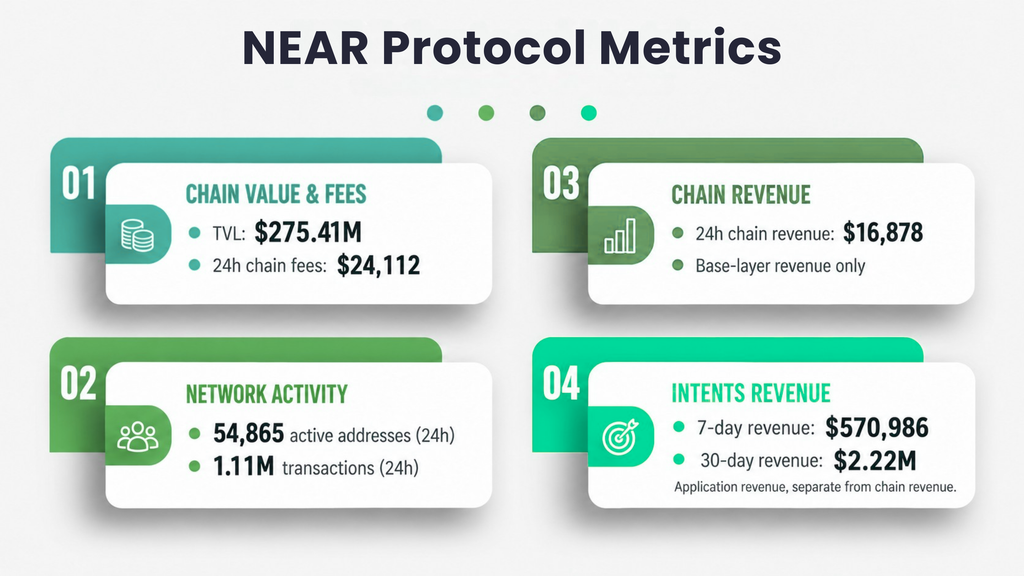
At the October 12 research check, DeFiLlama displayed approximately $275.41 million in NEAR chain TVL, $24,112 in 24-hour chain fees, and $16,878 in 24-hour chain revenue. The dashboard also showed 54,865 active addresses and 1.11 million transactions over 24 hours. These rolling figures can change throughout the day.
Separately, the Intents dashboard showed $570,986 in seven-day protocol revenue and approximately $2.22 million over 30 days. Those figures describe Intents revenue, not NEAR’s seven-day chain revenue. The distinction matters because application fees, application revenue, and base-layer revenue measure different cash flows.
Historical high of approximately $20.44, a $5.85 NEAR price sits about 71% below that peak. Returning to the same token price would require roughly a 3.5-fold advance. However, supply growth means the same price would imply a different market capitalization today.
A sustained recovery would need several drivers to reinforce one another. Intents must retain trading activity and capture revenue, AI products must attract paying users, and the ETF must build durable investor demand. At the same time, the broader crypto market needs to support risk appetite.
Risks remain substantial. Cross-chain systems introduce security dependencies, AI adoption may take longer than investors expect, and lower issuance can pressure validator economics. Meanwhile, competing blockchains and intent platforms can challenge NEAR’s growth.
NEAR’s 2026 recovery combines practical cross-chain usage, broader investment access, and improvements to network capacity and token issuance. The next stage depends on whether the ecosystem converts those advantages into sustained revenue and demand for NEAR.
This article is analysis, not financial advice. Crypto assets are volatile; do your own research.