Zylo connects trading, gaming, and VPN services through its $ZYLO token. Can its ecosystem drive lasting demand?

Author: Akshat Thakur
Zylo is a Solana-based ecosystem that connects Telegram gaming, binary-options trading, VPN services, and upcoming mobile games through one token, ZYLO. Its goal is to let users carry spending power, access, and rewards across different products instead of managing separate accounts and balances.
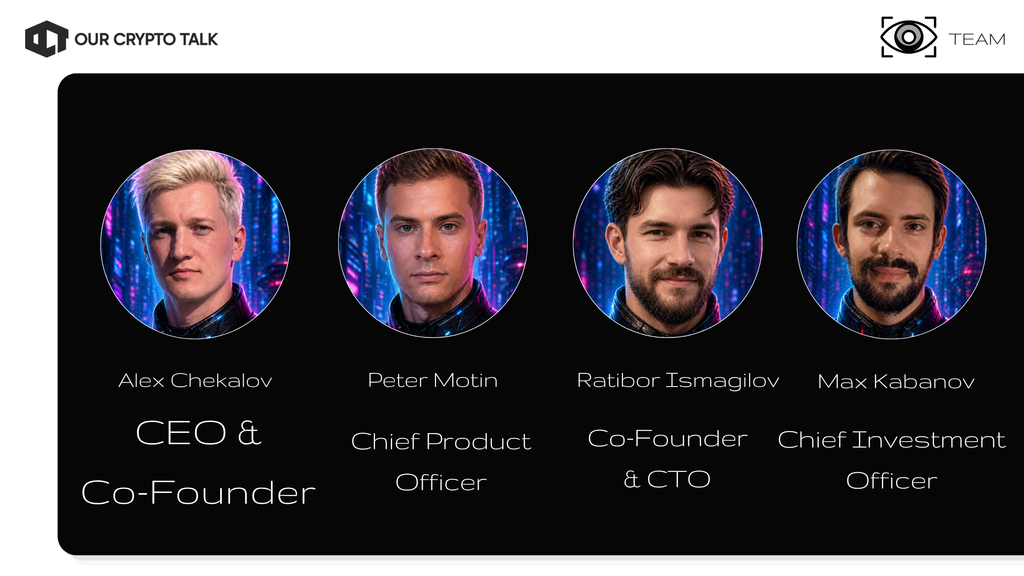
The ecosystem currently includes CosmoFox, a Telegram game, intrade.bar, a binary-options trading platform, and Granny VPN. Zylo wants ZYLO to connect these products through in-app payments, premium features, staking, and cross-product bundles such as VPN access tied to gaming events.
The pitch targets a familiar problem. Consumer apps usually operate independently, so users have little reason to move between them. Zylo wants one shared economy to encourage that movement and give the token a role beyond speculation.
The project reports more than 10 years of real-money trading experience through intrade.bar and over 50,000 monthly active users across its products. ZYLO already trades on Solana through the Token-2022 standard.
The timing fits continued interest in Telegram mini-apps, play-to-earn games, and consumer crypto products with practical utility. Zylo also has a stronger starting point than a project that only promises future products because several parts of its ecosystem already operate.
However, operating multiple products does not automatically create one unified economy. Zylo still needs to show that users move between its trading platform, games, and VPN because ZYLO offers meaningful benefits. Until it demonstrates cross-product retention and organic token spending, the shared economy remains a promising thesis rather than a proven advantage.
Zylo competes across several established markets, which gives it multiple potential revenue sources but also creates a difficult positioning challenge.
Telegram gaming projects, including the wave of clicker and token-based games that followed Notcoin, already compete for the same users. Binary-options platforms operate in a separate market with established competitors and significant regulatory concerns. Consumer VPN brands such as NordVPN and ExpressVPN also compete on price, reliability, and privacy. Accepting a crypto token alone does little to distinguish a VPN service.
Multi-product crypto ecosystems face an additional problem: users often adopt one application without ever touching the others. A game audience may have little interest in trading, while VPN customers may not care about token rewards.
Zylo’s proposed advantage is a shared account and token economy. Users could access gaming benefits, trading incentives such as enhanced payouts when using ZYLO, VPN services, staking, and partner integrations through the same ecosystem. Activity-related burns could also connect product usage to token supply.
The project has some tangible foundations. CosmoFox provides a gaming entry point, intrade.bar brings an established trading operation, and Granny VPN adds a consumer utility. The listed Solana token and reported burns give the ecosystem an operating structure beyond a pitch deck.
However, Zylo has not established an uncopyable advantage. Other operators can accept a shared token across several applications, and existing platforms can introduce similar incentives. Combining binary-options trading with gaming and VPN services also creates a more complicated brand than focusing on one consumer category.
Zylo’s strongest potential advantage lies in combining an existing trading audience with new gaming distribution. Whether that advantage translates into lasting demand depends on measurable cross-product activity, user retention, and organic ZYLO spending.
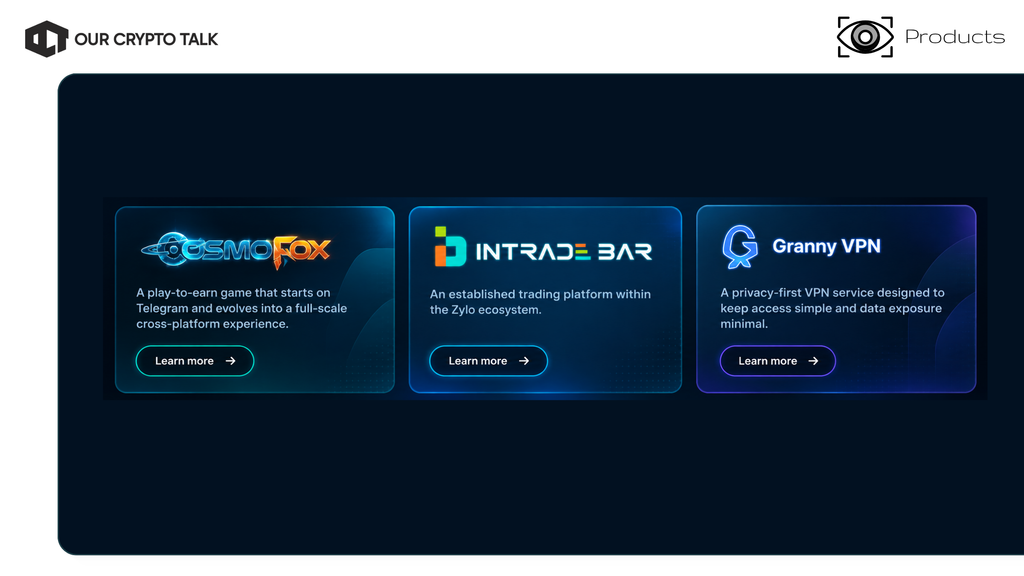
Zylo has a four-person core team covering executive leadership, technology, product development, and community operations. The team page names Alex Chekalov as co-founder and chief executive officer, Ratibor Ismagilov as co-founder and chief technology officer, Peter Motin as chief product officer, and Max Kabanov as chief community officer.
Chekalov leads the business alongside Ismagilov, who oversees the technical side. Motin handles product development, while Kabanov focuses on community growth and engagement. These roles cover the main functions Zylo needs to manage as it expands its trading, gaming, and VPN products.
The team’s structure also reflects Zylo’s broader challenge. The company operates across different product categories, each with its own users and expectations. Intrade.bar serves real-money traders, CosmoFox targets Telegram gamers, and Granny VPN addresses privacy and connectivity needs. Connecting these audiences through one token requires more than maintaining separate products. The team must give users clear reasons to adopt ZYLO across the ecosystem.
The key test is execution. Zylo already has live products, but it still needs to demonstrate that the team can increase cross-product usage, build recurring demand for ZYLO, and manage the business and regulatory risks tied to its trading platform.
Zylo has not disclosed a major institutional crypto venture round led by firms such as a16z or Paradigm. Instead, the project emphasizes its existing product operations, user base, token distribution, and exchange listings.
The team claims more than 50,000 monthly active users across its products and points to intrade.bar’s operating history as evidence that the ecosystem has a foundation beyond token trading. If the trading platform and paid services generate sustainable revenue, those businesses could help fund Zylo’s development.
Some secondary reports describe token allocations that include 15% for the team, 10% for early buyers, 15% for the presale, 20% for marketing and community, and 10% for liquidity. Those figures should be treated cautiously until the project publishes a complete, verifiable allocation and vesting schedule. The reported burns also affect supply calculations, so investors should distinguish original supply from current circulating supply.
Exchange listings and token burns can improve visibility and influence market sentiment, but neither proves institutional backing or sustainable business revenue.
Without a disclosed large-scale funding round, Zylo’s runway likely depends on a combination of trading and service revenue, token treasury resources, and access to market liquidity. The available information does not establish the size of its operating reserves or how long the team could continue development if token activity declines.
That makes non-token revenue the central question. If intrade.bar and paid services generate sufficient cash flow, Zylo could continue building even during a weaker crypto market. If the ecosystem relies heavily on ZYLO trading activity, lower volume and weaker sentiment could constrain its expansion.
The distinction matters because a shared token can connect products, but it cannot replace a sustainable operating business.
Zylo has several live products, although its vision of one unified economy remains incomplete.
CosmoFox runs on Telegram and offers clicker-style, mine-to-earn gameplay. Project claims have cited roughly 70,000 to 100,000+ players across different reporting periods. Intrade.bar provides real-money binary and digital-options trading. Its documentation claims the platform launched in January 2016, operates from Saint Vincent and the Grenadines, and has more than 850,000 registered accounts.
Granny VPN adds a privacy utility that historically targeted intrade.bar users. Meanwhile, Fox Survival remains in development as a mobile game for app stores. ZYLO trades on Solana through Token-2022 under mint address HnGCbLLonRzNRAFHqv5AbvZ4FixMkUQztE2egh4sAmqZ.
These products give Zylo more substance than a project that relies entirely on a roadmap. However, the team has acknowledged changes to its product direction. For example, it reconsidered forcing intrade.bar users into zylo.io accounts after testing the user journey. That decision suggests the team recognizes the friction involved in combining separate businesses under one interface.
The engineering story also differs from an open-source blockchain project. Zylo’s public evidence rests mainly on its consumer products, token listings, Jupiter Lock vesting records, and published burns rather than a large open-source development footprint.
The distinction is important. Zylo has working products, but it has not yet proved that those products form a cohesive ecosystem. The central question is whether users will move between trading, gaming, and VPN services because ZYLO provides meaningful benefits.
For now, the trading platform, Telegram game, and VPN offer real entry points. The unified economy remains the part Zylo still needs to prove.
Zylo’s traction depends on whether its existing products convert users into recurring ZYLO demand. Registered accounts, token trading, and actual product usage measure different things.
Intrade.bar claims more than 850,000 to 900,000 registered accounts and over a decade of operating history. Its documentation advertises payouts up to 5% higher for accounts denominated in ZYLO rather than USD. If existing traders actively adopt those benefits, the platform could provide Zylo with its strongest source of token demand.
Zylo has published multi-million-token burns, including batches of 16.67M ZYLO and combined sale-related burns of around 22.2M. These burns reduce supply, although their long-term impact depends on continued demand and future token unlocks.
The project also advertises paid use cases through binary-options trading, VPN subscriptions, and in-game spending. These activities offer more meaningful evidence than social engagement if users repeatedly pay to access the products.
However, the available figures leave a significant gap. Intrade.bar’s registered accounts do not establish how many users remain active, while Zylo’s stated 50,000+ monthly active users across products offer a more relevant measure of current reach. Token-holder counts in the low thousands also contrast with the much larger registered-user claims.
ZYLO launched with a maximum supply framework of 1 billion tokens on Solana’s Token-2022 standard. Published burns have reduced the effective maximum, with post-burn figures around 916.8 million cited in project materials.
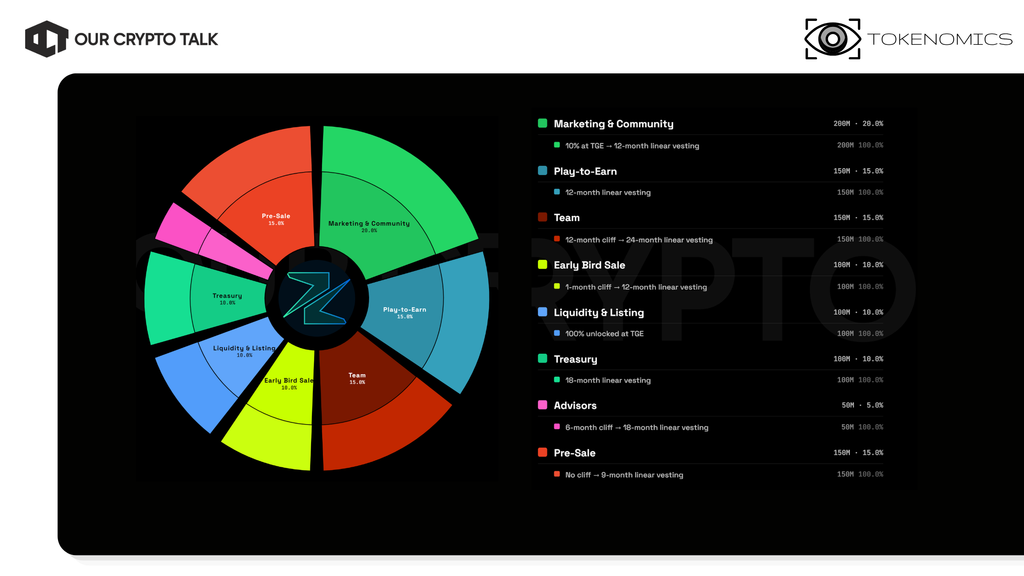
Zylo’s published allocation assigns 15% to the team, 10% to early-bird sales, 15% to the presale, 20% to marketing and community, 10% to liquidity and listings, 10% to the treasury, 15% to play-to-earn rewards, and 5% to advisors.
The schedule spreads several allocations over time. Team tokens face a 12-month cliff followed by 24 months of linear vesting. Early-bird tokens have a one-month cliff and 12-month vesting, while presale tokens vest linearly over nine months. Marketing receives 10% at TGE and unlocks the remainder over 12 months. Treasury tokens vest over 18 months, P2E tokens unlock linearly over 12 months, and advisor tokens follow a six-month cliff and 18-month vesting schedule. Liquidity and listing tokens unlock fully at TGE.
Jupiter Lock provides a way to verify major locked allocations, while published burns account for some unsold sale tokens.
ZYLO does not face the classic low-float launch problem. Instead, its high circulating supply and ongoing unlocks create potential sell pressure in a market with roughly $200K in daily volume.
The token has several proposed sinks, including trading-related burns, marketplace fees directed toward buybacks or burns, in-game purchases, VPN access, staking, and partner settlement. However, the 15% P2E allocation and marketing unlocks create a counterweight.
Those sinks matter only if trading and in-app spending grow enough to absorb supply. Otherwise, ZYLO remains a high-float access token with scheduled emissions and uncertain cross-product demand.
ZYLO’s pre-TGE opportunity has passed. The token already trades on secondary markets, and its market cap reached roughly $20M in early October 2026. New participants must evaluate the live token and products rather than look for a hidden presale.
The first route is the secondary market. ZYLO has appeared on venues such as MEXC and Solana decentralized exchanges. Buyers should verify the mint address, check current liquidity, and account for slippage before trading.
The second route is product usage. Intrade.bar advertises benefits for accounts that use ZYLO, while CosmoFox offers Telegram-based gameplay and its available earning mechanics. Users can also investigate whether Granny VPN currently accepts ZYLO for subscriptions.
Staking provides another option. Project documentation describes staking thresholds tied to benefits such as loot and VPN discounts. Those benefits depend on the active rules and should not be treated as guaranteed airdrops or investment returns.
Token holders should also monitor Jupiter Lock for upcoming team, marketing, treasury, and P2E unlocks. Those releases can affect circulating supply and market liquidity, particularly when daily trading volume remains modest.
Builders and partners can explore integrations that use ZYLO for settlement across the ecosystem. That route requires development effort and a genuine product use case, rather than simply completing quests.
The important distinction is that Zylo no longer offers a pre-launch entry point. Its opportunity now depends on whether existing traders and gamers adopt the token across multiple services.
Spending hours on a Telegram clicker may not justify the time if rewards remain small or token prices fall. Likewise, buying ZYLO purely because the project reports hundreds of thousands of registered accounts ignores the difference between signups and active users.
Zylo deserves attention from people who already use its products and can benefit from the token’s utility. For everyone else, the key question is whether cross-product adoption can sustain demand against the circulating supply and future unlocks.
ZYLO’s early-sale opportunity has passed. The token now trades on the open market at roughly $0.023, with a $20M to $21M market cap, a high circulating float, and around $200K in daily volume.
That leaves three ways to approach it: buy the token, use it across intrade.bar, CosmoFox, and Granny VPN, or spend time grinding the game’s reward loops. Each has a different risk profile.
CosmoFox is the weakest option if the goal is purely financial. Telegram clicker games face intense competition, and post-listing rewards often lose value once the initial distribution ends. Unless you already enjoy playing, grinding for marginal ZYLO or loot offers little obvious advantage over avoiding the token altogether.
Buying ZYLO presents a different trade-off. The circulating supply already represents a large share of the remaining maximum, so this is not a typical low-float token with a massive FDV hanging over it. The bigger concern is ongoing linear unlocks meeting a market with limited liquidity. Daily volume around $200K leaves little room to absorb significant selling without price impact.
Tokens in the mid-tier consumer and gaming category can trade in the $5M to $30M range when market attention fades, although these comparisons do not establish a fair value for ZYLO. Its presale phases reportedly offered prices near $0.009, giving early buyers a more asymmetric entry than the roughly $0.023 market price.
The investment case now depends on conversion. Intrade.bar’s claimed 850,000 to 900,000 registered accounts mean little unless active traders adopt ZYLO and generate sustained token-denominated volume. Game spending, VPN payments, and activity-linked burns must also contribute meaningful demand.
ZYLO may justify a small, tactical position for someone who understands its products and accepts the regulatory and unlock risks. Its ecosystem branding alone does not support treating it as a core holding.
Zylo faces three structural challenges: intense competition, uncertain cross-product adoption, and regulatory exposure from its real-money trading business.
Telegram gaming is crowded, VPN services compete on price and performance, and binary-options platforms face established rivals. Another trading desk could add token incentives, while another mini-app could copy CosmoFox’s reward loops. Zylo needs customer loyalty and measurable product advantages to defend its position.
Its unified-economy thesis also remains unproven. The team has acknowledged that it moved away from forcing intrade.bar users into zylo.io accounts after testing the user journey. That decision may improve the trading experience, but it also shows why users might continue treating each product separately. If players do not move between gaming, trading, and VPN services, the ecosystem offers less value than its branding suggests.
Activity figures require similar caution. Telegram games can attract bots and short-term reward seekers, while registration totals can remain high even when active usage declines. Independent evidence of recurring users and actual ZYLO spending would provide a stronger signal.
Regulation presents a more serious threat. Binary and digital options face restrictions in several major jurisdictions, particularly for retail customers. A company’s registration in Saint Vincent and the Grenadines does not establish permission to serve customers globally. Enforcement action, payment-processor restrictions, or advertising and app-store bans could weaken intrade.bar’s business and the revenue narrative behind ZYLO.
Scaling real-money trading also brings KYC, anti-money-laundering, and geographic compliance costs. Those requirements could limit the user base that Zylo hopes to convert into token demand. Combining game rewards with options trading adds another layer of scrutiny in stricter markets.
Token structure creates a separate risk. Zylo promotes burns, improved payouts, and product utility, but high circulation, scheduled team and marketing unlocks, P2E distributions, and limited daily volume can leave holders exposed to supply pressure. If token incentives drive activity more than genuine product demand, usage and price could weaken together when promotions fade.
The remaining execution risks include partial team transparency, uncertain standalone VPN adoption, and the development of Fox Survival. Business and regulatory risks appear more consequential than the token contract alone.
ZYLO’s token generation event and initial listings are already behind it. The next meaningful catalysts concern product adoption, supply management, and the durability of its trading business.
The strongest positive signal would be sustained ZYLO-denominated activity on intrade.bar. Trading volume, repeat usage, and the value of tokens spent or burned would help establish whether the legacy platform creates durable demand. Registration totals alone cannot answer that question.
The unlock calendar also deserves close attention. Team, marketing, treasury, advisor, and P2E allocations can add supply over time. Jupiter Lock offers a way to track major locked allocations, although actual market impact will depend on unlock timing, selling behavior, and available liquidity.
Fox Survival could expand Zylo’s reach if its launch attracts paying users rather than short-lived reward hunters. A standalone VPN offering could also help if it develops a meaningful customer base beyond existing intrade.bar users. Further burns would be more compelling if recurring product activity funded them, rather than burns coming mainly from unsold sale tokens.
Negative catalysts include regulatory action against the binary-options business, payment-processor disruptions, falling game engagement, or substantial selling into thin liquidity.
For investors who already accept the risks, a tactical position rests on the possibility that product usage translates into recurring token demand. Those who need proof of that conversion may prefer to wait and assess the next three months of activity, unlocks, and product launches.
Zylo has more substance than a token supported by a roadmap alone. Intrade.bar, CosmoFox, and Granny VPN provide live product surfaces, while public allocation details, Jupiter Lock records, and published burns offer some visibility into token supply.
The central weakness is that a collection of products does not automatically create one economy. Zylo still needs to show that users move between those products and generate recurring demand for ZYLO.
The token also trades with a high circulating float and relatively thin daily volume. That makes scheduled unlocks important, while the binary-options business introduces regulatory risks that ordinary gaming tokens may not face.
The milestone that would change this assessment is sustained, transparent ZYLO-denominated trading, in-app spending, and activity-linked burns at a scale that matters relative to market cap and scheduled unlocks. Regulatory action or a liquidity shock could push the thesis in the opposite direction.
Until that evidence appears, Zylo belongs on a watchlist. Use its products if they serve a genuine need, but do not treat the ecosystem narrative as proof of durable token value.
All the opinions in this article are that of the author and in no way are financial advice. Our Crypto Talk and the author always suggest you do your own research in crypto and to never take anything as financial advice that you read on the internet. Check our Terms and conditions for more info.