Orbio turns ORBIO trading fees into AI inference credits. Explore its product, tokenomics, traction, risks, and growth potential.

Author: Akshat Thakur
Orbio is a marketplace on Robinhood Chain that converts ORBIO trading fees into discounted, transferable AI inference credits. Holders can use these credits to access AI models through a routed API marketplace, while autonomous agents can use the same system to cover their inference costs.
The problem Orbio targets is straightforward. AI inference creates recurring expenses for developers and agents. Meanwhile, most crypto trading fees do little to support useful products. Orbio connects these two markets by directing part of its trading fees toward AI usage.
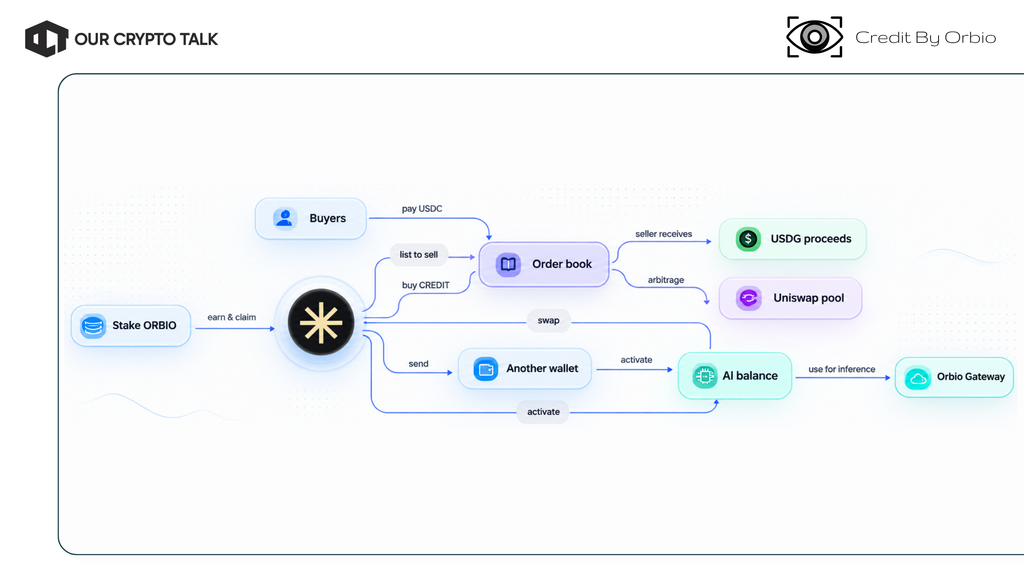
Every ORBIO trade incurs a 1.5% fee. Orbio converts roughly half of that fee revenue into dollar-denominated inference credits and distributes them to stakers and holders as CREDIT. Each CREDIT represents approximately $1 of Orbio usage. Users can activate credits to fund their API balance or sell them through an order book.
The gateway supports more than 400 models and claims to add less than 50 milliseconds of latency while retaining no prompt data.
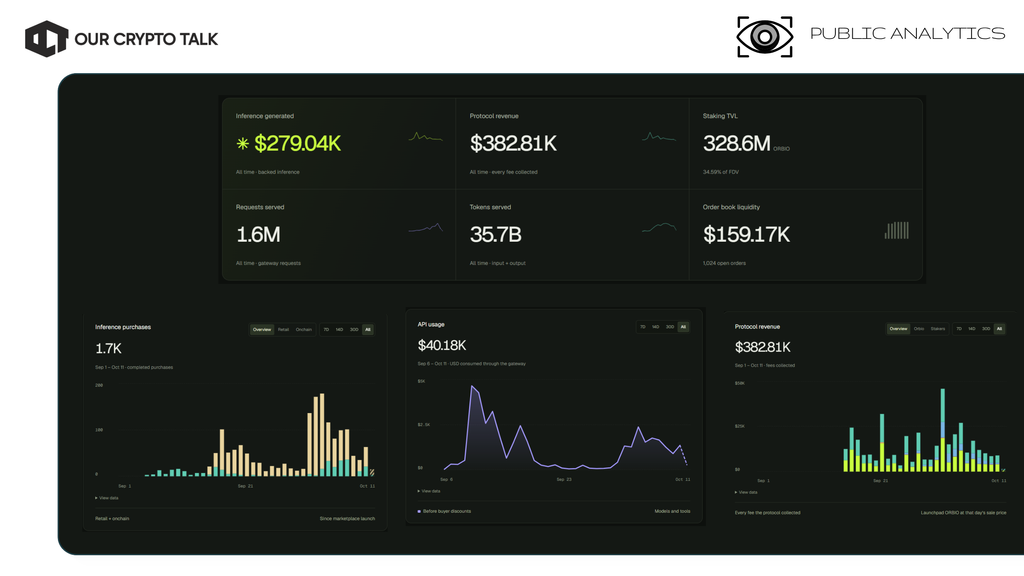
Official analytics from early October 2026 report around $279K in cumulative inference generated, $382K in protocol revenue, 1.6 million requests, and 35.7 billion tokens served. Around 328 million ORBIO, or 35% of the supply, sits in staking. The CREDIT order book holds approximately $159K in liquidity.
Orbio launched through Pons around August 31, 2026, with a fixed supply of 950 million ORBIO and no mint function.
The timing fits two active narratives: autonomous AI agents and Robinhood Chain’s expanding ecosystem. Orbio is betting that speculative trading can subsidize real AI usage. However, cumulative inference still measures in hundreds of thousands of dollars, leaving a considerable gap between demonstrated product demand and the token’s peak valuation.
Orbio competes in a crowded market, but its business model differs from traditional inference providers and decentralized compute networks.
OpenRouter, Together, Fireworks, and official model APIs provide the underlying inference infrastructure. Orbio routes requests across models rather than developing or owning those models. Render, Akash, io.net, and other GPU-focused DePIN projects compete from the supply side by connecting users with computing resources.
Agent launchpads and token-based product platforms create another competitive front. Many platforms already package tokens, bots, and AI functionality without Orbio’s specific fee-to-credit mechanism. Yield-focused products also compete for staked capital, particularly as ORBIO holders explore Pendle-style markets.
Orbio’s main differentiator is its economic model. Trading activity generates fees, part of those fees funds inference credits, and holders can spend or trade those credits. Its agent launchpad extends the model by allowing project creator fees to automatically stake ORBIO and generate CREDIT. In theory, this lets an agent cover some of its own operating costs.
The proposition is clear: token activity can help pay for AI usage instead of relying entirely on direct payments from developers.
However, Orbio does not own the underlying models or control the wider inference market. Its competitive edge depends on its Robinhood Chain deployment, Pons distribution, credit marketplace, and agent launchpad. Competitors could replicate the fee-funded credit model without building comparable infrastructure from scratch.
The biggest weakness is the connection between speculation and utility. If ORBIO trading volume falls, the fee pool available to fund inference could shrink. Holders need to track credit activation, actual spending, and order-book liquidity rather than relying on market capitalization alone.
Orbio has built a coherent product loop, but it has not established a durable moat. The key question is whether developers continue using its gateway when token speculation cools. Repeat inference demand will matter more than short-term trading activity.
Orbio has not publicly identified its founders. Its website, protocol pages, and secondary coverage describe an anonymous team. The project’s public presence centers on its website and the X account @orbiodotso, which reportedly joined the platform around August 29, 2026.
The team has not published named executive roles or detailed founder biographies. That makes it difficult to assess its previous projects, AI infrastructure experience, and record of building production systems.
Its shipping record offers the clearest evidence of its capabilities so far. Within a short period, the team launched an inference gateway, staking, the CREDIT token, credit activation and burning, an SDK and MCP integration, public analytics, and an agent launchpad. The dashboard also lists hundreds of projects, while the team has promoted integrations with Pendle-style markets.
These releases show that Orbio has moved beyond a token-only concept. Users can access a working system that connects trading activity, credit generation, and AI inference.
However, shipping quickly does not eliminate the risks of operating an anonymous project. Orbio collects trading fees, routes inference requests, and issues credits that users can treat as dollar-denominated balances. Users need confidence in the system’s accounting, security, and ability to remain operational.
Without public identities, users have fewer ways to assess accountability if the gateway fails, credit redemption becomes difficult, or the team stops maintaining the protocol. They also cannot independently evaluate the founders’ experience with production AI infrastructure.
For now, Orbio’s strongest evidence comes from its live product and rapid execution on a new chain. Its founders’ backgrounds, long-term operating capacity, and ability to maintain user trust remain open questions.
Orbio has not announced a major institutional equity round or disclosed funding from top-tier venture capital firms. Instead, the project entered the market through a Pons bonding-curve launch on Robinhood Chain, with a fixed supply of 950 million ORBIO and no mint function, according to the available project descriptions.
That makes on-chain activity and protocol revenue more useful indicators of Orbio’s progress than investor logos.
ORBIO’s market cap reportedly climbed to around $90M within roughly 20 days of launch. Staking figures have also placed approximately 35% of the supply in staking. These numbers point to early market interest and a meaningful amount of tokens committed to the staking mechanism.
However, neither metric proves that Orbio has secured substantial financial backing.
Official analytics from early October 2026 report approximately $382K in cumulative protocol revenue and $279K in inference generated. Those figures show that the project has built an operating economic loop, but the reported revenue remains small relative to ORBIO’s peak market valuation.
Without disclosed institutional funding, Orbio must rely more heavily on fee income, available treasury resources, any team-held supply, and continued trading activity to support operations. The available information does not establish how much capital the project has reserved for development or how long that capital could sustain the team during a prolonged downturn.
This creates a direct test for Orbio’s business model. If speculative trading weakens while developer demand remains limited, the protocol could struggle to generate enough fees to keep subsidizing inference.
The key signal is whether fee-funded credits continue to support recurring AI usage without depending on persistent token speculation. A high market cap and a large staking ratio cannot prove that the model works sustainably.
Orbio has a live product on Robinhood Chain, where users can stake ORBIO, trade CREDIT, access AI models, and launch agent tokens.
The inference gateway offers an OpenAI-compatible API and MCP integration with access to 400+ models. Orbio claims less than 50 ms of added latency and zero prompt data retention. Developers can also use the @orbiodotso/sdk package to integrate its services.
Orbio connects trading activity to AI access through a 1.5% fee on ORBIO trades. Roughly half of collected fees fund CREDIT, where one CREDIT represents approximately $1 of Orbio usage. Users can transfer or sell credits, then burn them to activate their API balance.
Stakers earn CREDIT through hourly reward periods. The order book lets users buy or sell credits, with a recent snapshot showing around $159K in listed liquidity, roughly 900 open orders, and discounts of up to 60%.
The agent launchpad adds another use case. Creators can launch tokens paired with ORBIO and route creator fees toward agent staking, CREDIT balances, or treasury funding.
Official analytics report approximately $279K in cumulative inference generated, $382K in protocol revenue, 1.6M requests, and 35.7B tokens served. Gateway API usage reached around $14.3K over the previous 14 days.
These figures confirm that Orbio has moved beyond a whitepaper. However, it routes inference through upstream providers rather than owning its own AI models or GPU infrastructure.
The product works. The bigger question is whether developers will keep spending on inference after ORBIO’s launch excitement fades.
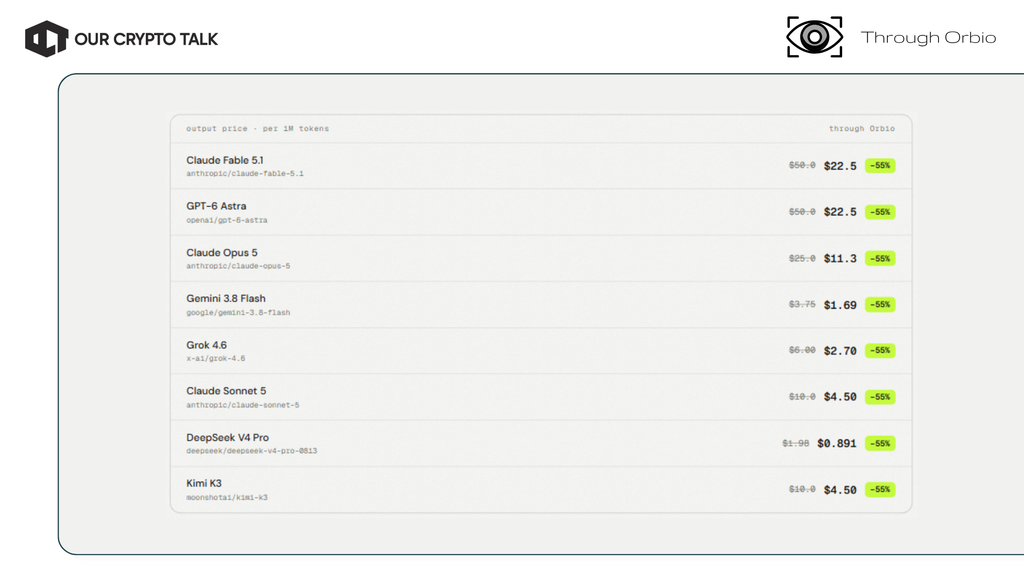
ORBIO’s early performance shows strong speculative interest, but investors need to separate token activity from actual AI demand.
The token’s market cap reportedly reached $100M within roughly 20 days of launch. By early October 2026, ORBIO traded around $0.04 to $0.045, implying a market cap of approximately $50M. Its reported all-time high approached $0.12 around October 4.
Several metrics show real activity. Orbio reports around $279K in cumulative inference generated and $14.3K in gateway API usage over 14 days. Protocol revenue reached approximately $382K cumulatively.
Around 328M ORBIO, or 34.5% of supply, sits in staking. The CREDIT order book lists approximately $159K in credits, and some listings offer discounts of up to 60%. The launchpad has also displayed more than 600 agent projects in public dashboard snapshots.
However, a large model catalogue and high request counts do not necessarily indicate strong customer spending. Token trading volume, which often reaches $1M to $3M or more over 24 hours, also helps fund the credit system.
That creates the central concern: Orbio has demonstrated speculative demand, but it has not yet demonstrated comparable recurring AI demand.
At a $50M-plus market cap, investors need to see API spending and CREDIT activation grow substantially. Until then, ORBIO remains heavily dependent on trading activity.
Orbio has a fixed supply of 950M ORBIO, with approximately 100% circulating. The token launched through Pons on Robinhood Chain, and available project descriptions report no mint function.
This structure avoids one common launch risk: a low circulating supply paired with a much larger fully diluted valuation. At around $0.057, ORBIO’s market cap and FDV both sit near $57M.
However, a fully circulating supply creates its own risks. Early buyers can sell at any time, and Orbio has not published a clear allocation breakdown for team holdings, insiders, or early curve participants. Unknown wallet concentrations could create selling pressure without any scheduled unlocks.
The fee mechanism drives the token’s economic model. Orbio charges 1.5% on both sides of ORBIO trades and directs roughly half of collections toward inference credits for eligible holders and stakers.
CREDIT offers more direct utility. Each CREDIT represents approximately $1 of Orbio usage, and users burn it when activating their API balance. This creates a sink for CREDIT, but it does not reduce ORBIO supply.
ORBIO itself has a weaker structural sink. Staking commits tokens to earn CREDIT, while the agent launchpad could generate additional demand if creators route fees into ORBIO staking.
The main risk is that rewards depend on trading activity. Falling ORBIO volume could reduce credit generation even if users still need AI inference.
Orbio’s fully circulating supply simplifies its token structure, but it does not justify its valuation on fundamentals alone. With roughly $382K in reported lifetime protocol revenue, the token remains a high-beta bet on trading volume and future AI adoption.
Orbio’s pre-launch window has closed. Since the token launched around August 31, 2026, new participants must use the live product or buy ORBIO on the secondary market.
Users can buy ORBIO through supported Robinhood Chain trading venues. They should verify the official contract and check liquidity, fees, and slippage before trading.
The second route is staking. Holders stake ORBIO to earn CREDIT over hourly reward periods. Recent analytics show around 328M ORBIO in staking, although actual rewards depend on the current rules and fee activity.
Some legacy holder-credit rules reference a minimum balance of 1,000 ORBIO. Users should check current documentation before relying on that threshold, as staking offers the clearer route described in Orbio’s product model.
Users who want AI access rather than token exposure can buy CREDIT through the order book. Recent snapshots showed discounts of up to 60%. Buyers can activate credits into their API balance and spend them on inference, subject to the platform’s terms and available services.
Developers can launch agent tokens paired with ORBIO and route creator fees toward staking, CREDIT, or treasury funding. They can also build integrations through Orbio’s MCP, SDK, and API.
These routes require different commitments. Buying ORBIO creates direct token exposure. Staking ties rewards to the fee engine. Building an agent requires real development and user demand.
The supplied information confirms no second airdrop or ongoing points campaign with a defined token reward.
Orbio may suit users who want discounted inference or speculative exposure to its fee-funded model. However, anyone buying ORBIO for rewards should account for full circulation, volatile trading activity, and the risk that credit generation falls when volume declines.
Orbio offers three ways to participate: stake ORBIO for CREDIT rewards, buy discounted credits for actual inference, or build agents that use its launchpad. Each route has a different risk profile.
At roughly $0.57, ORBIO carries a $57M market cap, with all 950M tokens circulating. The token reached around $0.12 near October 4. Meanwhile, Orbio reports approximately $382K in lifetime protocol revenue, $279K in inference generated, and $14.3K in gateway API usage over 14 days.
That valuation prices in substantial future growth. Orbio avoids the classic low-float problem and looming VC unlock cliffs, but investors still depend on trading activity to fund its credit system. A fully circulating supply does not prevent early holders from selling or the market from repricing the token.
The expected-value case depends on how you participate. Staking makes sense only if CREDIT rewards justify ORBIO’s volatility and the opportunity cost of locking capital. Buying CREDIT at a 30% to 60% discount offers a clearer use case if you already need AI inference and can spend the credits. Building agents could create value if users adopt them and generate recurring API demand.
Pure social farming offers little upside now. Orbio has no confirmed second airdrop, and the early Pons launch window has passed.
The main risk is that the market values ORBIO like a growing AI business before its usage supports that valuation. ORBIO has already suffered drawdowns of more than 60% from local highs, showing how quickly sentiment can reverse.
Orbio may suit a small, tactical position for users who understand its risks or want discounted inference. However, its current fundamentals do not justify treating it as a core AI holding.
Orbio’s biggest weakness is its dependence on ORBIO trading volume. If volume falls, the fee pool shrinks, CREDIT rewards weaken, and staking demand may decline. That feedback loop could put pressure on both the token and the product.
Competition creates another threat. OpenRouter, official model APIs, and inference resellers can compete on price without relying on speculative token fees. GPU-focused DePIN networks and rival agent launchpads also compete for developer attention. If users bypass Orbio and access models directly, its gateway could struggle to retain demand.
The fee structure also creates incentives for circular trading. Users might trade ORBIO repeatedly to generate rewards rather than because they want the token. If wash-like activity dominates, the system could report impressive turnover without attracting meaningful AI customers.
Regulatory uncertainty adds risk. Authorities could scrutinize staking rewards funded by trading fees, dollar-denominated inference credits, and the legal status of the anonymous team. Routing prompts through third-party models also creates potential compliance and sanctions issues, even when Orbio claims zero data retention.
Orbio faces operational risks as well. Its anonymous operators, upstream model dependencies, smart contracts, and CREDIT order book could all create problems. Gateway outages or policy changes from model providers could interrupt access, while thin liquidity could make selling credits difficult.
The economic structure resembles other fee-sharing launchpad tokens, but Orbio adds a usable inference product. That product gives the token more utility than a pure meme, yet it does not create a structural monopoly.
The decisive risk is a gap between speculative turnover and independent AI demand. If developers do not generate enough recurring usage to sustain the credit system, Orbio could lose both its utility narrative and its market premium.
Orbio’s token launch and mainnet activity began around August 31, 2026. The next catalysts depend on whether the team can turn early speculation into recurring AI usage.
The first signal is gateway spending. Orbio reports around $14.3K in API usage over 14 days. Sustained growth from that baseline would provide stronger evidence of demand than token volume alone.
CREDIT activation also matters. More users burning credits to access inference would show that holders consume the product rather than simply farm rewards. Tighter order-book spreads and continued liquidity would make credits easier to trade and use.
The agent launchpad offers another potential growth driver. If launched agents attract users and keep trading, creator fees could generate more staking and CREDIT activity. However, the number of listed projects matters less than the fees and inference those projects actually generate.
Additional exchange listings or structured markets could increase ORBIO liquidity and attract new participants. They could also amplify speculation without improving the underlying business, so investors should track usage alongside price and volume.
Negative catalysts remain equally important. A sharp decline in ORBIO turnover could reduce credit rewards. Gateway failures, credit liquidity problems, or regulatory action against fee-funded staking could damage confidence.
Users seeking discounted inference can evaluate the product now. Investors who need evidence of a stronger business should wait roughly three months and check whether API spending and CREDIT activations grow materially without depending on elevated ORBIO trading.
The next milestone is not another listing or market-cap spike. It is proof that external developers and agents generate recurring inference demand at a scale that matters to the token’s valuation.
VERDICT: WATCH
Orbio has shipped a working product that connects ORBIO trading fees to AI inference. Its gateway, CREDIT market, staking system, and agent launchpad distinguish it from projects that offer only a token and a roadmap.
The early metrics show activity: approximately $279K in cumulative inference generated, $382K in protocol revenue, more than 1.6 million requests, and around 35% of supply staked. However, the token still carries a $57M-plus market cap while the reported inference business remains relatively small.
That makes ORBIO a high-beta bet on Robinhood Chain trading activity and future AI adoption. Its fully circulating supply removes the conventional unlock cliff, but anonymous operators, limited transparency around insider holdings, and reliance on trading fees leave meaningful risks.
There is no confirmed second airdrop worth grinding for. Users who need multi-model access can evaluate CREDIT discounts and the live API. Token buyers should avoid confusing staking rewards with sustainable business revenue.
The milestone that would change this rating is sustained growth in gateway consumption and CREDIT activations from external developers and agents, without dependence on unusually high ORBIO turnover. A lasting collapse in trading fees that starves the credit engine would strengthen the bearish case.
Until Orbio proves that real AI demand can support its valuation, it remains a watchlist project rather than a core AI investment.
All the opinions in this article are that of the author and in no way are financial advice. Our Crypto Talk and the author always suggest you do your own research in crypto and to never take anything as financial advice that you read on the internet. Check our Terms and conditions for more info.


AI Needs Cheap Inference. Can Orbio Deliver?
Web3 Gaming Comeback 2026: GTA 6 Hype vs 99% Crashes
Layer 2 Projects Shutting Down: Who’s Next After Blast?
Embodied Data Pyramid and Decentralized Data Layer for Robotics
AI Needs Cheap Inference. Can Orbio Deliver?
Web3 Gaming Comeback 2026: GTA 6 Hype vs 99% Crashes
Layer 2 Projects Shutting Down: Who’s Next After Blast?
Embodied Data Pyramid and Decentralized Data Layer for Robotics