DEX vs CEX : Which One To Choose?
DEX vs CEX: Explore the key differences, advantages, and risks between Decentralized and Centralized Exchanges.


Author: Chirag Sharma
The world of crypto trading has evolved rapidly, with exchanges playing a central role in this growth. Among the many options available, DEX vs CEX stands out as a key decision point for traders. Both decentralized and centralized exchanges have distinct characteristics, making them suitable for different types of users. Understanding these differences is essential for navigating the crypto space effectively.
This article explores the fundamental features, advantages, and challenges of DEXs (Decentralized Exchanges) and CEXs (Centralized Exchanges). By the end, you’ll know which option suits your trading preferences and goals.

What Are CEXs and DEXs?
Centralized Exchanges (CEXs)
Centralized exchanges, or CEXs, are platforms managed by centralized organizations. Popular examples include Binance, Coinbase, MEXC and Kraken. These exchanges act as intermediaries, matching buyers and sellers while offering custodial services for user assets.
CEXs have been the backbone of the cryptocurrency market since Bitcoin’s inception. They provide a seamless experience for users, particularly those new to crypto. By simplifying processes like registration, wallet management, and fiat-crypto conversions, CEXs attract millions of users globally.
Despite their convenience, centralized exchanges operate under regulatory scrutiny and require users to comply with KYC (Know Your Customer) and AML (Anti-Money Laundering) procedures. While this increases trust, it also compromises user privacy.
Decentralized Exchanges (DEXs)
Decentralized exchanges, or DEXs, operate without intermediaries. Instead, they rely on blockchain technology and smart contracts to facilitate peer-to-peer trading. Examples of popular DEXs include Uniswap, PancakeSwap, and dYdX.
Unlike CEXs, DEXs do not require users to deposit funds on the platform. Instead, transactions occur directly between wallets, giving users full control over their assets. This autonomy aligns with the core principles of blockchain technology: decentralization and transparency.
However, DEXs come with a learning curve. Users need to manage their wallets, understand blockchain networks, and navigate higher risks, such as smart contract vulnerabilities. Despite these challenges, DEXs are gaining popularity, especially in regions with strict financial regulations.
Key Features Comparison
Custody and Control
One of the most significant differences between DEX vs CEX is custody.
- CEXs: These platforms hold user funds in custodial wallets. While this ensures convenience, it also exposes users to risks like hacks or asset freezes.
- DEXs: In contrast, decentralized exchanges are non-custodial, meaning users retain control of their private keys. This reduces third-party risk but demands greater responsibility from the user.
Ease of Use
- CEXs: Centralized exchanges are designed for user-friendliness. Features like customer support, simple interfaces, and fiat gateways make them ideal for beginners.
- DEXs: Decentralized exchanges can be intimidating for new users. Setting up a wallet, understanding transaction fees, and dealing with blockchain confirmations require technical know-how.
Security
Security is a vital aspect when comparing DEX vs CEX.
- CEXs: Despite offering robust security measures, centralized exchanges remain vulnerable to hacks. High-profile incidents like the Mt. Gox and FTX breaches highlight these risks.
- DEXs: Decentralized exchanges are less prone to direct attacks due to their distributed nature. However, vulnerabilities in smart contracts or user errors can lead to significant losses.
Liquidity
Liquidity determines how easily users can trade assets without affecting prices.
- CEXs: Centralized exchanges generally offer higher liquidity, attracting institutional investors and high-volume traders.
- DEXs: Liquidity in decentralized exchanges depends on liquidity pools and Automated Market Makers (AMMs). While DEXs are improving, they still lag behind CEXs in this regard.
Accessibility
- CEXs: Centralized exchanges require users to comply with regulations, including identity verification. This restricts access in regions with strict crypto laws.
- DEXs: Decentralized exchanges are permissionless, allowing anyone with a compatible wallet to trade. This feature is crucial for users in countries with limited financial freedoms.

Advantages and Disadvantages
Centralized Exchanges: Pros and Cons
Pros
- User-Friendly Interface: CEXs simplify the trading process, offering easy navigation and tools for beginners.
- High Liquidity: Deep order books ensure minimal slippage during trades, even for large volumes.
- Fiat Integration: Seamless conversion between fiat currencies and cryptocurrencies.
- Customer Support: Dedicated teams help users resolve issues quickly.
Cons
- Custodial Risks: Funds stored on the exchange can be lost in case of hacks or mismanagement.
- Regulation and Censorship: Compliance requirements reduce privacy and can lead to account freezes.
- Downtime: Centralized servers can experience outages, halting trading activities.
Decentralized Exchanges: Pros and Cons
Pros
- User Autonomy: Users retain control of their private keys and funds.
- Anonymity: No KYC requirements ensure greater privacy.
- Censorship Resistance: DEXs operate on blockchain networks, making them less susceptible to government intervention.
Cons
- Complexity: Navigating wallets, gas fees, and blockchain confirmations can be challenging for newcomers.
- Smart Contract Risks: Vulnerabilities in code can lead to asset loss.
- Limited Fiat Integration: DEXs often require users to convert fiat outside the platform, adding extra steps.
Security: Centralized Safeguards vs Decentralized Autonomy
One of the most crucial aspects of choosing between DEX vs CEX is security. Both platforms offer unique approaches, but each has its vulnerabilities and strengths.
CEX Security Measures
Centralized exchanges prioritize securing their infrastructure through methods like cold storage, two-factor authentication (2FA), and anti-phishing mechanisms. For instance, major platforms such as Binance and Coinbase store the majority of user funds offline, reducing exposure to hacking attempts.
However, no system is foolproof. High-profile hacks, including the infamous Mt. Gox breach, have resulted in billions of dollars in losses. Additionally, custodial risks persist. If an exchange mismanages funds or declares bankruptcy, users’ assets may be locked or lost. Read more about it here
DEX Security Features
Decentralized exchanges mitigate risks by eliminating intermediaries. Users maintain control of their private keys, ensuring funds are not held in custodial wallets. This autonomy significantly reduces exposure to centralized failures, making DEXs more resilient to hacks targeting platform-held funds.
Yet, smart contracts underpinning DEX operations present vulnerabilities. Poorly coded contracts can be exploited, leading to substantial losses. High-profile cases like the Poly Network hack highlight this risk. To minimize exposure, users should choose DEXs audited by reputable firms and practice caution when interacting with unknown protocols.
Regulatory Landscape: Challenges and Opportunities
Cryptocurrency regulations are evolving, with governments worldwide implementing frameworks to oversee the industry. This regulatory scrutiny heavily influences DEX vs CEX dynamics, shaping their adoption and accessibility.
CEXs and Compliance
Centralized exchanges often align with regulatory requirements to maintain legitimacy. They implement Know Your Customer (KYC) and Anti-Money Laundering (AML) procedures, ensuring users are verified before accessing services. These measures increase trust among institutional investors and foster compliance with global standards.
However, regulation comes with drawbacks. Mandatory KYC reduces privacy, potentially deterring users prioritizing anonymity. Moreover, centralized exchanges operating in multiple jurisdictions face challenges adhering to diverse legal requirements.
DEXs and Regulation
Decentralized exchanges, by design, operate outside traditional regulatory frameworks. Users can trade without identity verification, making DEXs appealing to privacy-conscious traders. However, this freedom raises concerns among regulators, as DEXs can facilitate illicit activities like money laundering.
To address this, emerging solutions such as on-chain identity verification aim to balance compliance with user autonomy. These developments could bridge the gap between regulators and decentralized platforms, fostering broader adoption while maintaining privacy principles.
Costs and Fees: Comparing CEX and DEX Expenses
The cost of trading is another critical factor when evaluating DEX vs CEX. Both platforms charge fees, but their structures differ significantly, impacting user preferences.
Transaction Fees on CEXs
Centralized exchanges typically charge trading fees based on volume and tiered structures. For example, Binance’s fees range from 0.02% to 0.10% per transaction, with discounts for high-volume traders or native token holders.
CEXs also impose withdrawal fees, which vary depending on the cryptocurrency. While these fees are transparent, they can add up for frequent traders. Additionally, hidden costs like spreads (the difference between buying and selling prices) may affect overall expenses.
Gas Fees on DEXs
Decentralized exchanges rely on blockchain networks for transactions, making gas fees a significant cost component. These fees are influenced by network congestion, with popular blockchains like Ethereum experiencing spikes during high activity. For instance, during market surges, gas fees can exceed $50 per transaction.
However, newer blockchains and Layer-2 solutions, such as Polygon and Arbitrum, offer lower fees, making DEXs more accessible. Some platforms also implement fee-sharing mechanisms, rewarding liquidity providers and incentivizing ecosystem participation.
Hidden Costs to Consider
Both DEXs and CEXs come with hidden costs beyond visible fees.
- CEXs: May charge deposit fees, fiat conversion costs, or penalties for inactivity.
- DEXs: Require users to pay for failed transactions due to insufficient gas or failed smart contract execution.
Understanding these costs helps traders make informed decisions, optimizing their expenses based on trading frequency and asset choices.
Future Trends: The Convergence of DEX and CEX
As the crypto ecosystem evolves, the lines between decentralized and centralized exchanges are blurring. The future of DEX vs CEX may lie in hybrid solutions that combine the strengths of both models.
CEXs Embracing Decentralization
To address user demands for greater transparency and control, some CEXs are exploring decentralized features. For example, Binance introduced Binance DEX, allowing users to trade on-chain while leveraging the liquidity of its centralized counterpart. This approach aims to attract users seeking decentralization without sacrificing liquidity.
DEXs Incorporating Centralized Features
On the other hand, DEXs are adopting centralized elements to enhance user experience and accessibility. Features like fiat on-ramps, cross-chain compatibility, and improved customer support mimic traditional financial systems while retaining decentralization principles.
The Rise of Hybrid Platforms
Hybrid platforms that merge decentralized autonomy with centralized efficiency are gaining traction. These solutions aim to deliver the best of both worlds, providing liquidity, security, and user control. Projects like Thorchain and Injective Protocol exemplify this trend, enabling cross-chain swaps and seamless trading experiences.
Learn more about such hybrid platforms in this video :
Which Is Better for Beginners?
Navigating the crypto space can be overwhelming for newcomers. Deciding between DEX vs CEX depends on a trader’s experience, goals, and risk tolerance.
Why Beginners Favor CEXs
Centralized exchanges cater to beginners with user-friendly interfaces and comprehensive customer support. Features like guided tutorials, fiat gateways, and instant buy/sell options simplify the learning curve.
For instance, platforms like Coinbase offer educational resources, helping new users understand cryptocurrency basics before diving into trading. Additionally, the safety net of custodial wallets appeals to those unfamiliar with private key management.
Challenges for Beginners on DEXs
Decentralized exchanges require a higher level of technical knowledge. Users must set up wallets, manage private keys, and navigate blockchain fees. Mistakes, such as sending funds to the wrong address, can result in irreversible losses.
While DEXs empower users with autonomy, this responsibility can be daunting for beginners. Educational initiatives and user-friendly DEX interfaces are bridging this gap, but CEXs remain the preferred starting point for most newcomers.
Liquidity and Trading Pairs: Volume vs Accessibility
The availability of liquidity and diverse trading pairs is critical when evaluating DEX vs CEX, especially for active traders. Both platforms cater to this need differently, and their approaches influence user experiences significantly.
CEXs: High Liquidity and Popular Trading Pairs
Centralized exchanges typically dominate the market in terms of liquidity. They aggregate buy and sell orders into centralized order books, ensuring minimal price slippage even for large trades. For instance, platforms like Binance and Coinbase boast billions in daily trading volumes, providing ample liquidity for popular cryptocurrency pairs like BTC/USDT or ETH/USD.
Additionally, CEXs often list fiat-to-crypto trading pairs, enabling users to purchase cryptocurrencies directly using fiat currencies like USD or EUR. This seamless integration appeals to new traders transitioning from traditional financial systems.
DEXs: Accessibility to Emerging Tokens
While DEXs may not match CEXs in liquidity for mainstream assets, they excel in offering access to emerging tokens and niche markets. Traders looking to invest in newly launched tokens often turn to platforms like Uniswap or PancakeSwap, where these assets are first listed.
However, the liquidity of smaller tokens on DEXs can vary. Trades involving low-liquidity tokens may experience high slippage, affecting overall profitability. Liquidity pools mitigate this issue, but their effectiveness depends on user participation and total locked value (TVL).
User Experience: Ease of Use vs Advanced Features
When deciding between DEX vs CEX, the user experience is a crucial factor. It impacts how traders interact with the platform and manage their investments.
CEXs: User-Friendly Interfaces
Centralized exchanges prioritize ease of use, making them ideal for users of all experience levels. Features like one-click buying, mobile apps, and intuitive dashboards simplify trading. For instance, exchanges like Kraken offer tailored interfaces for beginners and advanced traders, ensuring accessibility across the spectrum.
Customer support is another advantage. Many CEXs provide live chat or ticket systems to address issues promptly. This support reduces the frustration of navigating unfamiliar platforms, particularly for new users.
DEXs: Autonomy at the Cost of Complexity
Decentralized exchanges focus on empowering users with control over their assets. However, this autonomy often comes with a steeper learning curve. Users must set up non-custodial wallets, manage private keys, and interact with blockchain networks.
Despite these challenges, innovations like wallet-integrated DEXs and Layer-2 solutions are improving usability. Platforms such as MetaMask Swap and SushiSwap integrate seamlessly with wallets, simplifying the process for those willing to learn.
TL;DR
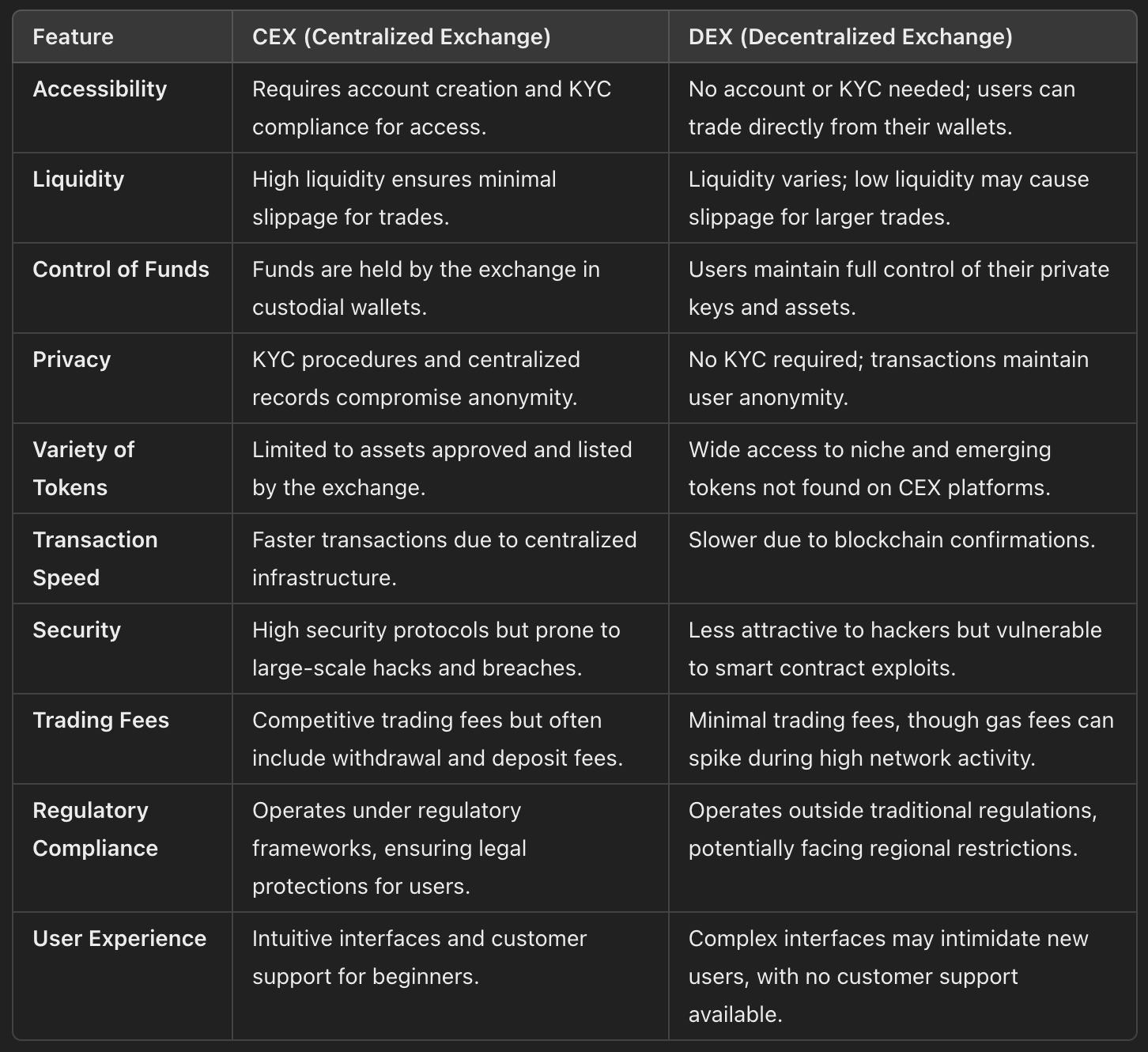
- CEXs (Centralized Exchanges): Offer high liquidity, user-friendly interfaces, and robust customer support but require trust in the platform.
- DEXs (Decentralized Exchanges): Provide greater autonomy, privacy, and access to niche tokens but can be complex and lack fiat support.
- Security: CEXs face hacking risks due to custodial wallets, while DEXs mitigate these risks with non-custodial setups but are vulnerable to smart contract exploits.
- Liquidity: CEXs dominate with large trading volumes, whereas DEXs excel in emerging token accessibility but may face slippage issues.
- User Experience: CEXs prioritize simplicity, while DEXs focus on user control, which can involve a steep learning curve.
- Future Trends: Hybrid models blending decentralization and centralization are emerging, promising the best of both worlds.
Conclusion
The debate between DEX vs CEX is far from one-size-fits-all. Centralized exchanges remain dominant for their liquidity, user-friendly experience, and seamless fiat integration, making them the go-to choice for beginners and large-scale traders. Conversely, decentralized exchanges empower users with privacy, control, and access to emerging tokens, appealing to those prioritizing independence and innovation.
As the crypto space evolves, hybrid platforms are beginning to bridge the gap, combining the efficiency of centralized systems with the autonomy of decentralized protocols. Whether you choose a DEX, CEX, or a hybrid depends on your trading goals, risk tolerance, and the level of control you desire over your assets.
Ultimately, both models contribute to the growth of the cryptocurrency ecosystem, ensuring diverse options for traders and investors worldwide.
Frequently Asked Questions
What is the main difference between DEX and CEX?
Which is safer, DEX or CEX?
Which is better for beginners, DEX or CEX?
How do fees compare between DEX and CEX?
What does the future look like for DEX and CEX?
In this article
What Are CEXs and DEXs?Key Features ComparisonAdvantages and DisadvantagesSecurity: Centralized Safeguards vs Decentralized AutonomyRegulatory Landscape: Challenges and OpportunitiesCosts and Fees: Comparing CEX and DEX ExpensesFuture Trends: The Convergence of DEX and CEXWhich Is Better for Beginners?Liquidity and Trading Pairs: Volume vs AccessibilityUser Experience: Ease of Use vs Advanced FeaturesTL;DRConclusionFrequently Asked Questions