Gold-backed crypto projects hit $4.85B in 2026. Compare XAUT, PAXG, KAU and 4 more by backing, fees, regulation and redemption to pick the right token.

Author: Kritika Gupta
Gold-backed crypto projects are not another speculative bet on a crypto narrative. Properly structured products represent claims on real physical bullion held by custodians. The blockchain is the ledger, while gold remains the underlying asset. That distinction matters more in 2026 because gold has already reached record territory above $5,300 per ounce and currently trades around $4,391. Meanwhile, tokenized gold has developed into a multi-billion-dollar crypto sector. Its market capitalization approached $6 billion earlier this year and currently sits near $4.85 billion.
Two different investor groups are pushing these markets together. Traditional gold investors want easier settlement, fractional ownership, 24/7 transferability, and access without moving physical bars. At the same time, crypto investors want a store of value that does not depend on a dollar peg or carry the same beta as most crypto assets. Tokenized gold sits between those two markets. It gives investors exposure to physical gold while making that exposure transferable on blockchain rails.
That also makes gold one of the more mature parts of the real-world asset, or RWA, market. XAUT and PAXG alone represent more than 1.05 million troy ounces of circulating tokenized gold, based on their current supplies, before counting smaller products. CoinGecko also reported that tokenized commodities reached $5.5 billion by the end of Q1 2026, with gold-backed XAUT and PAXG driving most of that value. In other words, tokenized gold has moved beyond a proof of concept and into an RWA market with meaningful liquidity and trading activity.
For the broader RWA landscape, see OCT’s Top RWA Assets Across Different Ecosystems.
Then there is DeFi. A physical gold bar can sit in a vault, but it cannot plug directly into an on-chain money market. A gold token can. Investors can use tokenized gold as collateral, borrow against it, provide liquidity, or deploy it through yield strategies while retaining exposure to gold. Aave, for example, has been working to onboard PAXG as collateral within Aave V4 on Ethereum. That programmability is the real crypto-native upgrade. Tokenization does not change what gold is. It changes what holders can do with it.
Top Gold-Backed Crypto Projects Compared
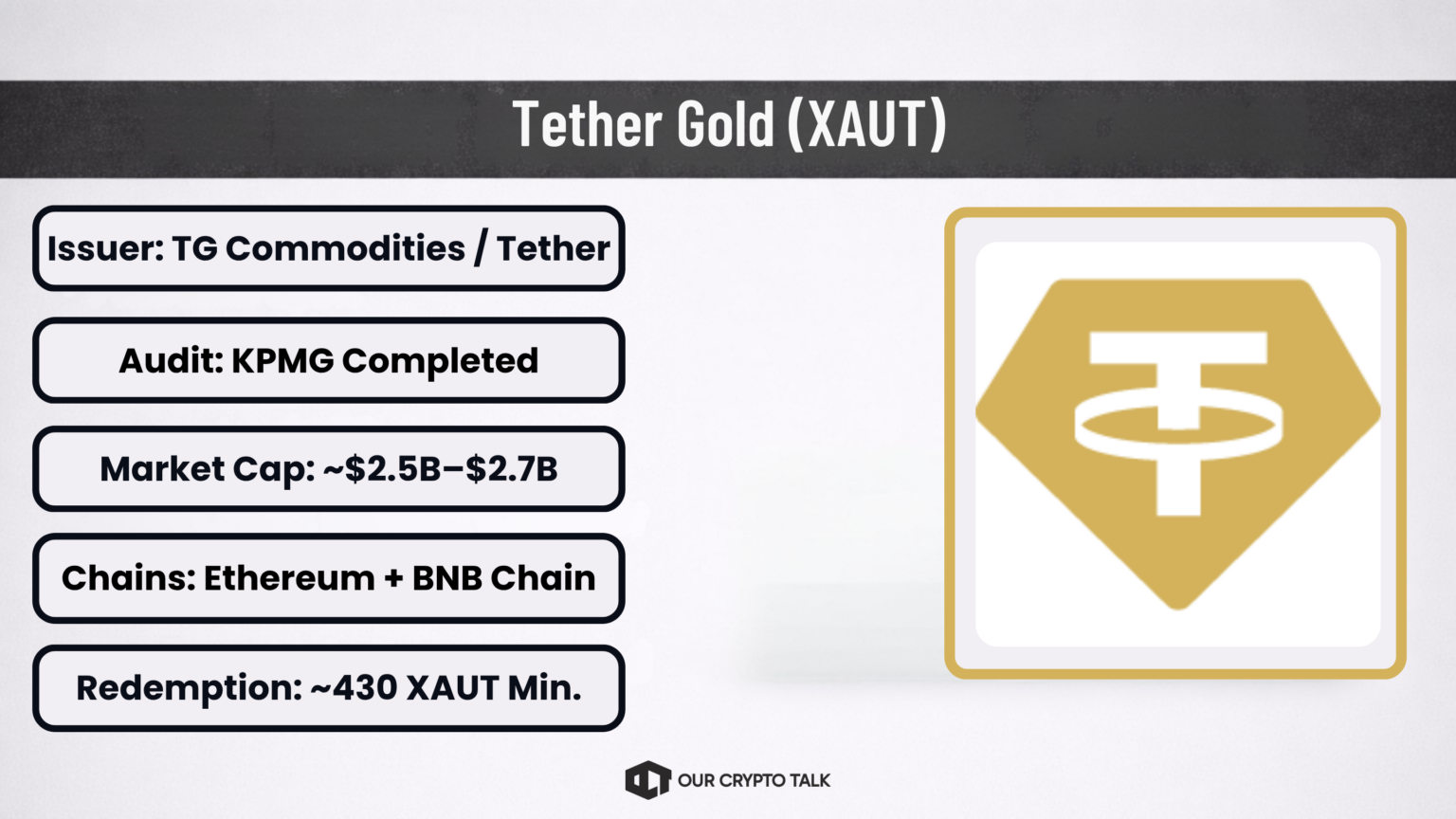
Tether Gold is the largest tokenized gold product among gold backed crypto projects. TG Commodities, S.A. de C.V., a Tether company registered and regulated in El Salvador, issues XAUT. Each token represents ownership of one fine troy ounce of physical gold held in Swiss vaults and meeting LBMA London Good Delivery standards. Tether’s latest formal reserve disclosure reported 707,747 fine troy ounces of gold backing 707,747 XAUT as of March 31, 2026. XAUT represented roughly 60% of the gold-backed stablecoin market at the end of 2025, although its share has since moved as the broader sector expanded. Its current circulating market cap sits closer to $2.5 billion to $2.7 billion, rather than the $3.3 billion recorded at the end of Q1 when gold traded at higher levels.
Distribution is one of XAUT’s biggest advantages. Tether originally launched XAUT on Ethereum and TRON, but its current product documentation lists Ethereum and BNB Chain as supported networks. The 2026 BNB Chain expansion also connects XAUT to Tether’s XAUT0 infrastructure, which extends unified liquidity across more than a dozen chains. On the trading side, XAUT has listings across venues including Bitfinex, Binance, OKX, and Gate, alongside on-chain trading through decentralized markets. That gives it a broader crypto distribution footprint than most competing gold tokens.
However, direct redemption still targets large holders. Tether requires enough XAUT to redeem one complete London Good Delivery bar and recommends depositing around 430 XAUT, although the exact amount depends on the weight of the allocated bar. At current gold prices, that puts a typical physical redemption near $1.9 million. Tether does not charge an annual custody or storage fee. Instead, TG Commodities charges a one-time 0.25% fee on direct purchases and redemptions, with additional delivery, brokerage, or dealer costs potentially applying during redemption. Therefore, most retail holders will find secondary-market trading far more practical than taking delivery of the underlying bullion.
Transparency remains the main area to watch. Tether publishes regular XAUT reserve reports and says each token enters circulation only after the corresponding physical gold completes the custodian’s intake process. More importantly, KPMG U.S. completed Tether’s first full independent audit of its 2025 financial statements in August 2026, moving the company beyond the attestations it had relied on for years. However, Tether has not publicly released the full audit results. That makes the KPMG audit a meaningful step forward, but it does not eliminate the issuer, custody, and regulatory risks that come with holding tokenized gold through a Tether-controlled structure.
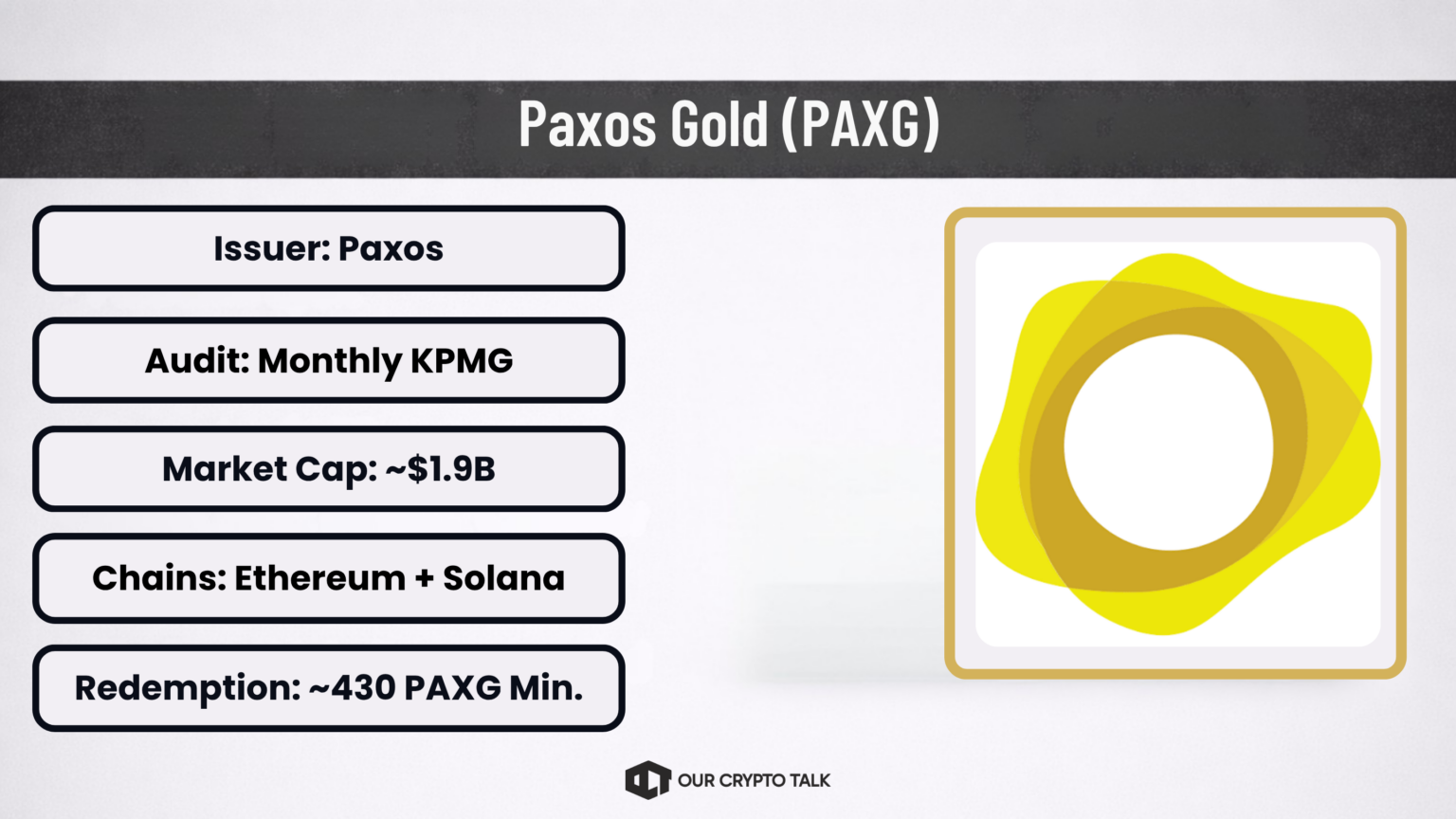
Paxos Gold is the compliance-first alternative to XAUT and currently accounts for roughly 37% of the tokenized gold market. PAXG has a market capitalization of around $1.8 to $1.9 billion, with more than 436,000 tokens in circulation. Each PAXG represents one fine troy ounce of London Good Delivery gold held in LBMA-accredited vaults in London. Paxos holds that gold on a segregated basis for token holders.
Regulation is PAXG’s biggest differentiator. Paxos originally launched PAXG under approval from the New York Department of Financial Services, but that structure changed in December 2025. Paxos converted its NYDFS limited-purpose trust charter into a national trust charter regulated by the U.S. Office of the Comptroller of the Currency (OCC). As a result, PAXG now operates under federal regulatory oversight rather than simply NYDFS supervision. Paxos also publishes independent reserve attestations every month, with KPMG LLP issuing PAXG attestations since February 2025.
PAXG is no longer Ethereum-only either. Paxos expanded the token to Solana in June 2026, making Solana the first step in its broader multi-chain rollout. Ethereum remains its original and most established network, while Solana gives PAXG access to another active DeFi ecosystem. The token also trades on major centralized exchanges, including Binance, Kraken, and Coinbase. On the DeFi side, Aave Labs proposed onboarding PAXG to Aave V4’s Ethereum Global Dollar Hub in July 2026, while Solana protocols have also started building PAXG-backed markets.
Redemption requires an important distinction. Paxos lets verified customers convert PAXG into USD, unallocated gold, or allocated physical gold, but taking delivery of a full London Good Delivery bar still requires at least 430 PAXG, similar to XAUT’s institutional-scale physical redemption threshold. So PAXG does not offer one-token physical-bar delivery. However, converting PAXG into cash or unallocated gold provides a more accessible exit route. Paxos currently charges no storage fee, although creation and redemption fees apply depending on transaction size. Combined with federal oversight, monthly attestations, and segregated bullion custody, that regulatory structure remains PAXG’s clearest advantage over less regulated gold tokens.
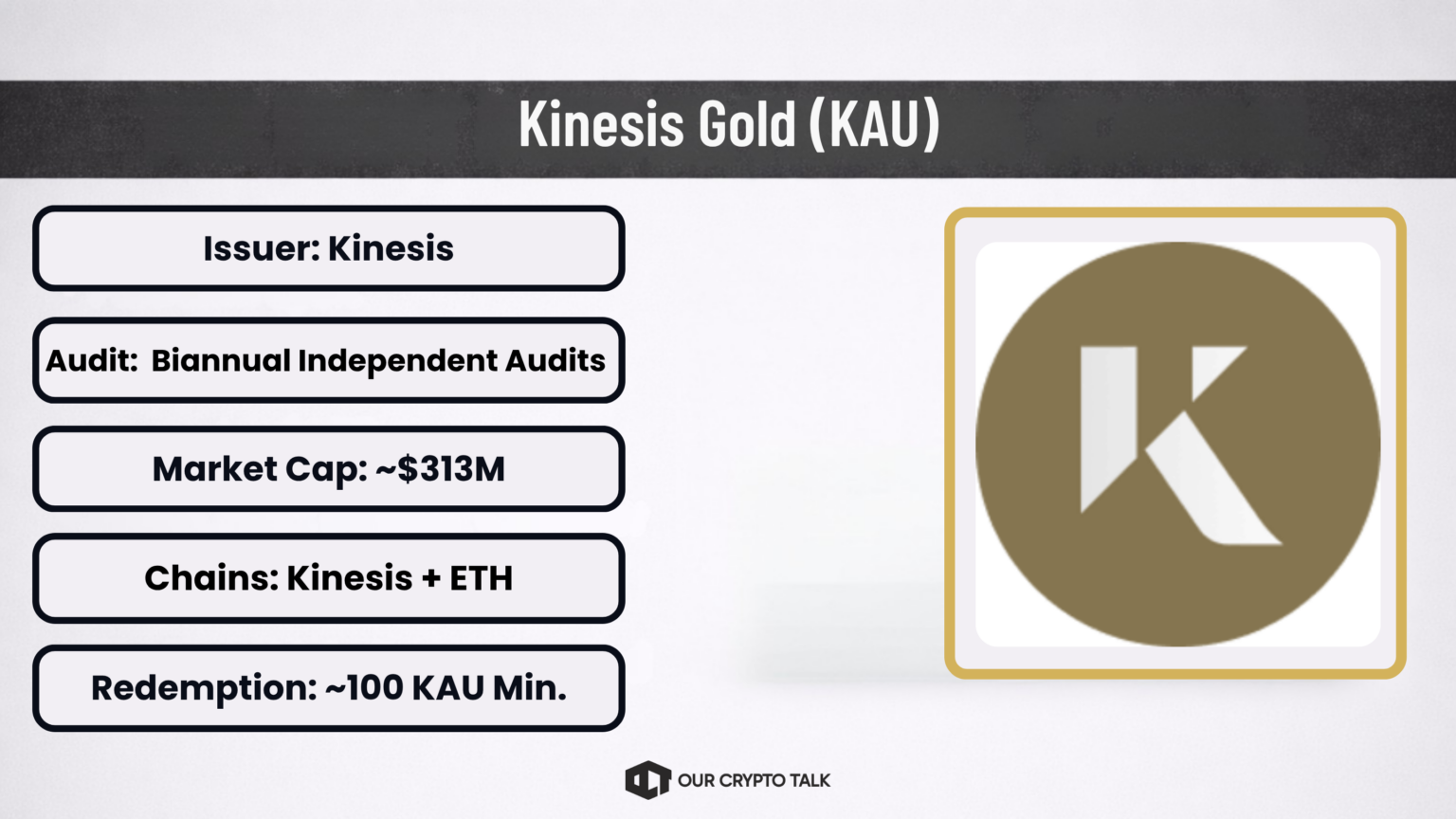
Kinesis Cayman issues KAU, and each token represents one gram of allocated physical gold held in fully insured, independently audited vaults across Kinesis’ global custody network. KAU currently has a market capitalization of roughly $313 million, with about 2.4 million tokens in circulation. That makes it much smaller than XAUT and PAXG, but considerably larger than the ~$30 million figure in the original outline. KAU runs natively on the proprietary Kinesis Currency Network, a bespoke fork of Stellar, while Kinesis also offers an ERC-20 representation on Ethereum.
What makes KAU interesting is the yield model. Physical gold normally sits in a vault and generates nothing. Kinesis instead distributes 15% of its global transaction-fee revenue to eligible KAU and KAG holders through its Holder’s Yield. The return comes from activity across the Kinesis ecosystem, including transfers, trading, minting, and card transactions, rather than lending out the underlying gold. Kinesis states that it does not lend holders’ metals. As a result, users can earn a monthly return simply by holding their allocated gold, with the yield itself paid in gold.
Kinesis also tries to make gold spendable rather than just investable. Its payment card lets users spend KAU anywhere the supported card network is accepted, with the gold converted for merchant settlement. However, KAU still has far less external liquidity and DeFi integration than XAUT or PAXG. The Ethereum version improves composability, but most of the token’s liquidity and utility still sit inside the Kinesis ecosystem. That makes KAU less compelling as a pure DeFi asset, but its fee-funded yield on allocated gold gives it a use case the larger gold tokens do not currently replicate in the same way.
Beyond XAUT and PAXG, several smaller gold backed crypto projects target specific jurisdictions, custody preferences, or investor groups. They do not compete with the two market leaders on liquidity or distribution. Instead, their value comes from specialization.
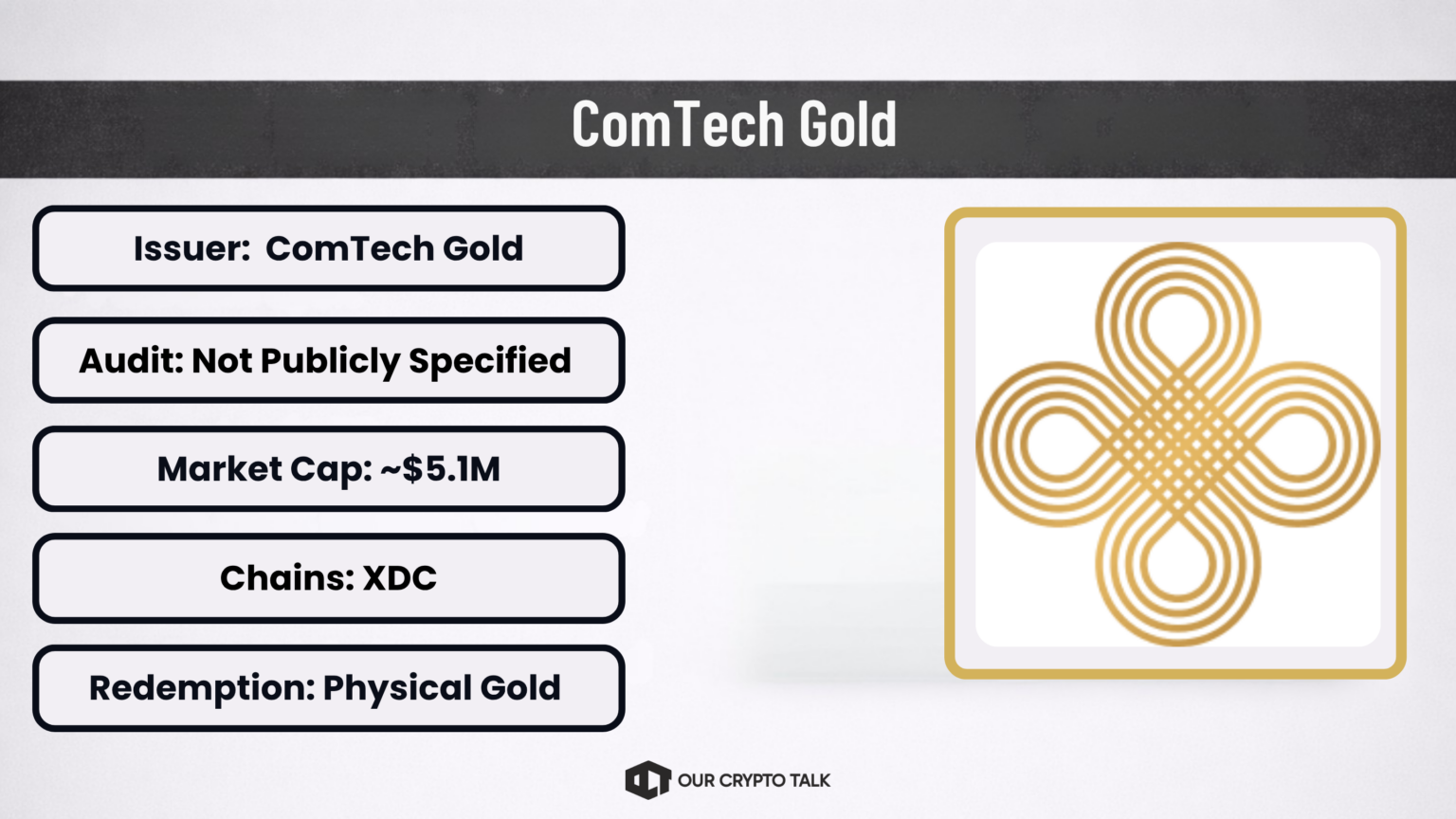
Comtech Gold is the clearest niche option for investors seeking Shariah-compliant tokenized gold. The Dubai-based project issues CGO on the XDC Network, with each token representing one gram of physical gold. Comtech backs the supply with 1-kilogram bars of 999.9 purity held in DMCC-approved vaults, while DMCC Tradeflow warrants provide a record linking the underlying bullion to the tokenized supply. The product has also received Shariah certification.
CGO remains much smaller and less liquid than XAUT or PAXG. However, it does not need to beat them on scale to serve its target market. For investors who specifically require Shariah-compliant gold exposure on-chain, CGO offers a structure the market leaders do not.
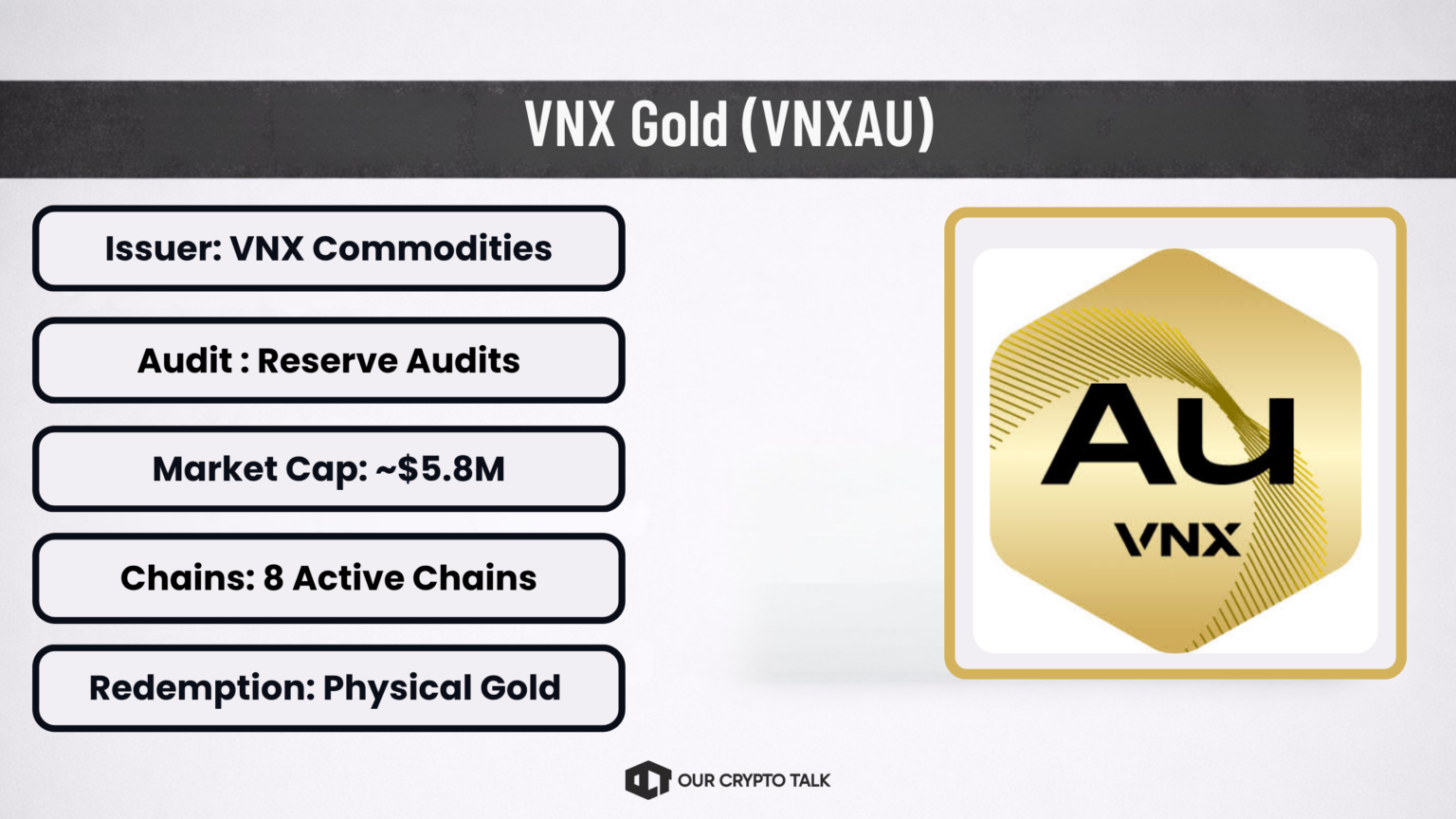
It is one of the gold backed crypto projects taking a Europe-focused approach. VNX Commodities AG operates under a licence from Liechtenstein’s Financial Market Authority under the country’s Blockchain Act. Importantly, each VNXAU represents one gram of LBMA-certified physical gold, not one troy ounce. VNX stores the underlying bullion in segregated high-security custody in Liechtenstein. VNXAU is also multi-chain rather than Ethereum-only. As of May 2026, VNX maintained active support across Ethereum, Solana, Stellar, ICP, Base, Celo, Etherlink/Tezos, and Q.
However, its current operating status matters. VNX suspended exchange operations on its own platform on June 30, 2026, and subsequently ended the platform withdrawal window on July 31. Therefore, readers should verify current secondary-market liquidity and accessibility before treating VNXAU as an easily purchasable alternative. Its main differentiator remains its Liechtenstein regulatory framework, but today that comes with a meaningful distribution caveat.
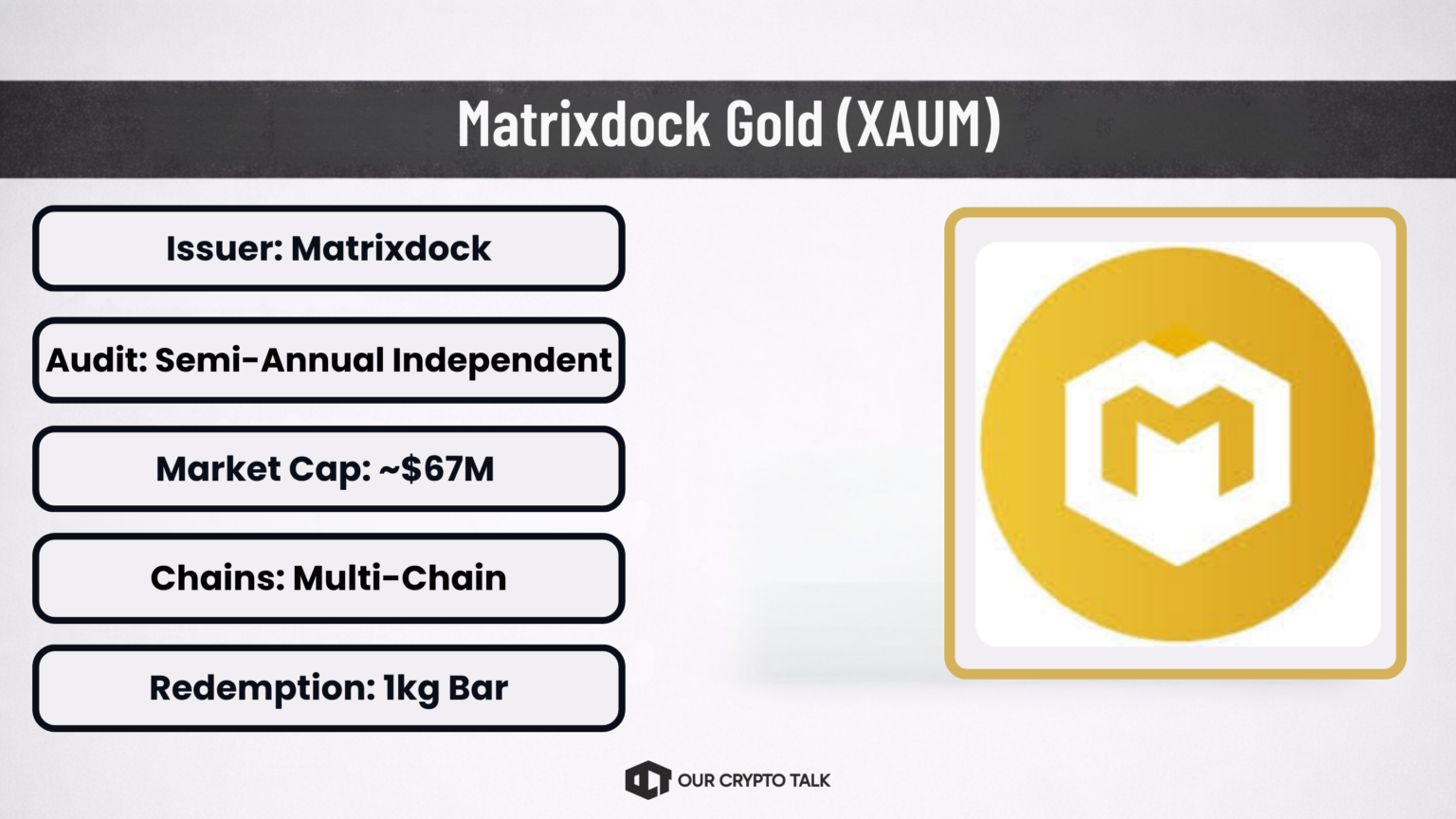
XAUm targets a different market. Matrixdock launched the token through a business historically connected to Matrixport and built its custody infrastructure around Hong Kong and Singapore. Each XAUm represents one fine troy ounce of 99.99% pure LBMA-accredited gold. Brink’s and Malca-Amit provide vaulting across the two jurisdictions, while independent physical audits verify the underlying bars.
XAUm also takes a multi-chain approach. Matrixdock says the token now operates across eight networks and supports cross-chain issuance while maintaining physical redemption in Hong Kong and Singapore. The company has increasingly pushed XAUm toward institutional and accredited investors through OTC trading, collateralized lending, and other on-chain financial infrastructure. That makes Asian custody, physical redemption, and institutional distribution its clearest differentiators.
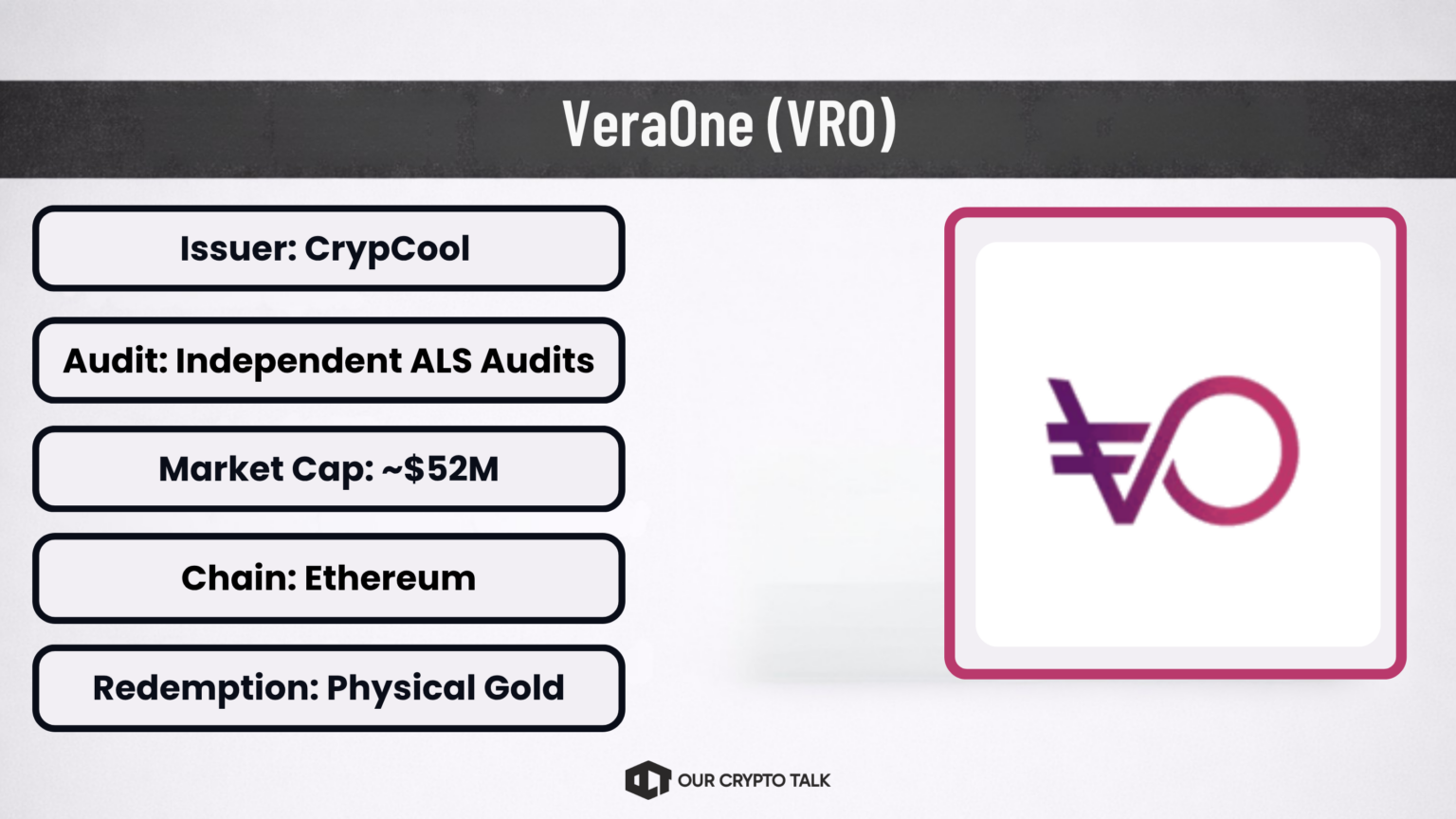
VeraOne also targets European users, but its current structure differs from older descriptions of the project. Older VeraOne documentation referenced British company LinGOLD, while the current website says CrypCool, a registered French PSAN, issues VeraOne’s precious-metal tokens. VeraOne stores the underlying metal in Geneva’s free ports, and each VRO gives the holder access to one gram of LBMA gold. VRO operates as an ERC-20 token on Ethereum.
VeraOne focuses heavily on reserve transparency and redeemability. It publishes third-party custody audits and allows verified holders to redeem tokens against physical LBMA-accredited metal, including smaller quantities through its retailer network. However, its scale and crypto-market liquidity remain far below the category leaders.
These tokens make more sense as specialized regional options than replacements for XAUT or PAXG. If you need Shariah-compliant exposure, look at CGO. If a Liechtenstein-regulated structure matters, VNXAU is the relevant name, although its current trading access needs verification. For most investors simply looking for deep liquidity and broad exchange access, XAUT and PAXG remain in a different tier.
For most investors comparing gold backed crypto projects, the decision eventually comes down to XAUT or PAXG. Both give holders exposure to physical gold on-chain, and both back each token with one fine troy ounce of London Good Delivery-standard gold. However, they differ where it actually matters: regulation, liquidity, redemption options, chain support, and transparency. XAUT remains the larger product, with a market capitalization around $2.5 billion compared with roughly $1.8 billion for PAXG.
XAUT vs PAXG: Head-to-head comparison
For a U.S. or compliance-sensitive investor, PAXG has the clearer edge. Paxos originally operated under NYDFS oversight. However, in December 2025, it converted its New York trust charter into an OCC-regulated national trust charter. That puts PAXG under U.S. federal prudential oversight. Coinbase also lists PAXG directly. Therefore, investors who prioritize a clearly defined U.S. regulatory structure have a stronger reason to choose PAXG.
For investors who prioritize market size, liquidity, and global distribution, XAUT has the advantage. It remains substantially larger than PAXG and historically generates deeper trading activity. Tether also has a broader cross-chain strategy. XAUT operates on Ethereum and TRON, while Tether has expanded the product through BNB Chain and its XAUT0 infrastructure. This connects tokenized gold liquidity across more than a dozen networks. PAXG is no longer Ethereum-only, however. Paxos expanded it to Solana in June 2026 as the first step in a wider multi-chain rollout.
Physical redemption does not give PAXG the advantage the headline numbers suggest. Paxos requires at least 430 PAXG to redeem a London Good Delivery bar. Tether similarly recommends roughly 430 XAUT because users must redeem a complete gold bar. However, PAXG offers more flexible exits because verified Paxos customers can convert their holdings into USD or unallocated gold without taking delivery of a full bar. In DeFi, both tokens can operate on Ethereum. PAXG currently has an active proposal and technical assessment for onboarding into Aave V4 on Ethereum, while XAUT’s advantage comes more from its wider cross-chain distribution.
Finally, PAXG still wins on recurring reserve transparency. Paxos publishes monthly PAXG attestations, with KPMG LLP issuing them since February 2025. Tether has also moved forward significantly. KPMG U.S. completed Tether’s first full independent audit of its 2025 financial statements in August 2026, although Tether has not made the full audit public. Therefore, the choice between these two leading gold backed crypto projects is fairly straightforward. PAXG makes more sense if regulation, recurring attestations, and flexible redemption matter most. XAUT makes more sense if liquidity, market size, and cross-chain availability come first. Both provide 1:1 exposure to physical gold, but they package that exposure differently. Pick based on your jurisdiction and how you actually plan to use the token.
For traditional gold investors comparing gold backed crypto projects, tokenized gold sits somewhere between holding bullion and buying a gold ETF. Physical gold gives you direct possession of the metal. ETFs such as GLD and IAU give you liquid exposure through a brokerage account. Gold tokens add a third option: ownership or a claim on allocated bullion that can move on-chain 24/7 and interact with crypto applications. Major products such as XAUT and PAXG also support fractional ownership, so investors do not need to buy an entire ounce at today’s roughly $4,400 spot price.
Gold Tokens vs Physical Gold vs Gold ETFs
The crypto-native advantage is programmability. XAUT and PAXG can trade around the clock and support fractional ownership, while tokenized gold can also plug into DeFi. That means holders can potentially use gold as collateral, borrow against it, or deploy it into liquidity and yield strategies without first selling the underlying exposure. By comparison, U.S. ETF trades generally settle on T+1, and retail ETF holders own shares in a trust rather than individual bars they can freely move or deploy on-chain.
However, tokenization adds another risk layer. A holder must trust the token issuer, the bullion custodian, and the smart contract or blockchain infrastructure. Physical gold held directly removes most of those intermediaries but creates storage, insurance, theft, and liquidity problems. ETFs remove most of the operational burden for investors, but they still depend on a trust and custodians. GLD, for example, lists JPMorgan and HSBC as gold custodians, while charging a 0.40% expense ratio; IAU currently charges 0.25%. So the trade-off is straightforward: physical gold maximizes direct control, ETFs maximize traditional-market convenience, and gold tokens maximize transferability and on-chain utility.
The tokenized gold sector has already had its shakeout, showing that not all gold backed crypto projects can survive on bullion backing alone. DigixDAO was one of the earliest examples. Digix launched DGX as a gold-backed Ethereum token alongside DGD, a separate governance token used to fund and govern ecosystem initiatives. However, the governance layer never achieved its full vision. In January 2020, DGD holders voted to dissolve DigixDAO, return the remaining ETH treasury to token holders, and deprecate DGD. Importantly, DGX itself did not immediately shut down with the DAO. Still, the episode showed how adding a separate governance economy around a relatively simple product like tokenized gold can create complexity without necessarily driving adoption.
CACHE Gold Token (CGT) eventually went further and shut down entirely. CACHE had backed each CGT with one gram of physical gold and even used on-chain proof-of-reserve infrastructure. Yet the company ultimately wound down operations. On September 30, 2025, remaining CGT tokens stopped representing gold, and CACHE converted eligible holdings into PAXG.
CGT was not an isolated case either. Industry observers note that dozens of tokenized-metal projects have appeared and disappeared as smaller products struggled to build meaningful adoption. The pattern is straightforward: gold backing alone is not enough. A viable gold token also needs liquidity, reliable custody, transparent reserves, regulatory clarity, and distribution. XAUT and PAXG have survived because they built several of those advantages at scale. But even with the survivors, counterparty risk never disappears. The gold may sit safely in a vault, but token holders still depend on an issuer and custodian to honor the claim.
Gold-backed crypto projects carry less price volatility than most crypto assets because their value tracks physical gold, but that does not make them risk-free. The biggest risk is counterparty and custody risk. You still depend on an issuer to hold the promised bullion, and honor your ownership or redemption rights. If something goes wrong at the issuer or custodian level, recovering the underlying gold becomes a legal and contractual question. Reuters has highlighted this exact issue, noting that investor protections and legal claims to underlying bullion can vary between token structures.
There is also blockchain and regulatory risk. PAXG operates as an ERC-20 token, and Paxos explicitly warns that Ethereum can experience network failures, forks, congestion, or other technical problems. Its smart contract also includes issuer-controlled freeze and upgrade functions, which means tokenized gold is not decentralized in the same way as an asset like Bitcoin. Regulation adds another layer. XAUT operates through TG Commodities under an El Salvador framework, while Paxos issues PAXG with specific approval from the U.S. Office of the Comptroller of the Currency (OCC). Changes in regulation, sanctions, or compliance requirements can therefore affect who can access, transfer, or redeem these products.
Concentration compounds those risks. XAUT and PAXG currently represent roughly 89% of the $4.85 billion tokenized-gold market, so serious problems at either issuer would hit a large share of the sector at once. Redemption also remains impractical for many retail XAUT holders. Tether recommends depositing about 430 XAUT because physical redemption requires enough tokens for a complete London Good Delivery bar. Finally, tokenized gold has no FDIC backstop. The FDIC explicitly excludes crypto assets and other non-deposit investment products from deposit insurance. Gold-backed tokens remove some of the friction of owning physical bullion, but they replace it with issuer, custodian, regulatory, and blockchain risk. Physical gold in your own possession does not carry those same dependencies.
There is no single gold token that works best for every investor. The right choice of gold backed crypto projects depends on where you live, how much liquidity you need, whether you plan to use the token in DeFi, and whether features such as yield, local regulation, or physical redemption matter to you.
Do not simply buy the biggest token. Choose the product that matches your jurisdiction, liquidity requirements, redemption needs, and risk tolerance. For most investors, XAUT and PAXG remain the most established starting points because they dominate tokenized gold trading and market capitalization. Everything else serves a more specialized use case. That specialization can be useful, but it usually comes with trade-offs in liquidity, distribution, or ecosystem support.
This is not investment advice. Gold-backed tokens carry counterparty, custodial, and smart contract risks. Physical gold in personal custody remains the lowest-risk form of gold ownership.


Tokenization of RWA yields onchain might be the biggest opportunity that no one has noticed
Cold Wallet Safety 2026: Are Hardware Wallets Still Safe?
One Token, Multiple Products. Can Zylo Deliver?
The Rise of NEAR Protocol 2026: Inside the 530% Rally and the ETF
Tokenization of RWA yields onchain might be the biggest opportunity that no one has noticed
Cold Wallet Safety 2026: Are Hardware Wallets Still Safe?
One Token, Multiple Products. Can Zylo Deliver?
The Rise of NEAR Protocol 2026: Inside the 530% Rally and the ETF