Monero Ring Signatures power untraceable transactions by hiding sender identity. Explore how they ensure privacy and real-world use.

Author: Chirag Sharma
Monero was built around one idea most blockchains still struggle with: financial privacy.
Bitcoin transactions are public. Wallet balances can be tracked. Trading activity can be mapped. Chain analysis firms can often follow funds across exchanges, wallets, and services with surprising accuracy. Monero takes the opposite approach.
Instead of making privacy optional, Monero hides transaction senders, receivers, and amounts by default. The system relies on several layers of cryptography working together, but the core privacy engine is something called ring signatures. That single feature changed how crypto privacy works.
This guide breaks down how Monero ring signatures work, why they matter, how Monero compares to Bitcoin and Zcash, and whether XMR transactions can actually be traced.
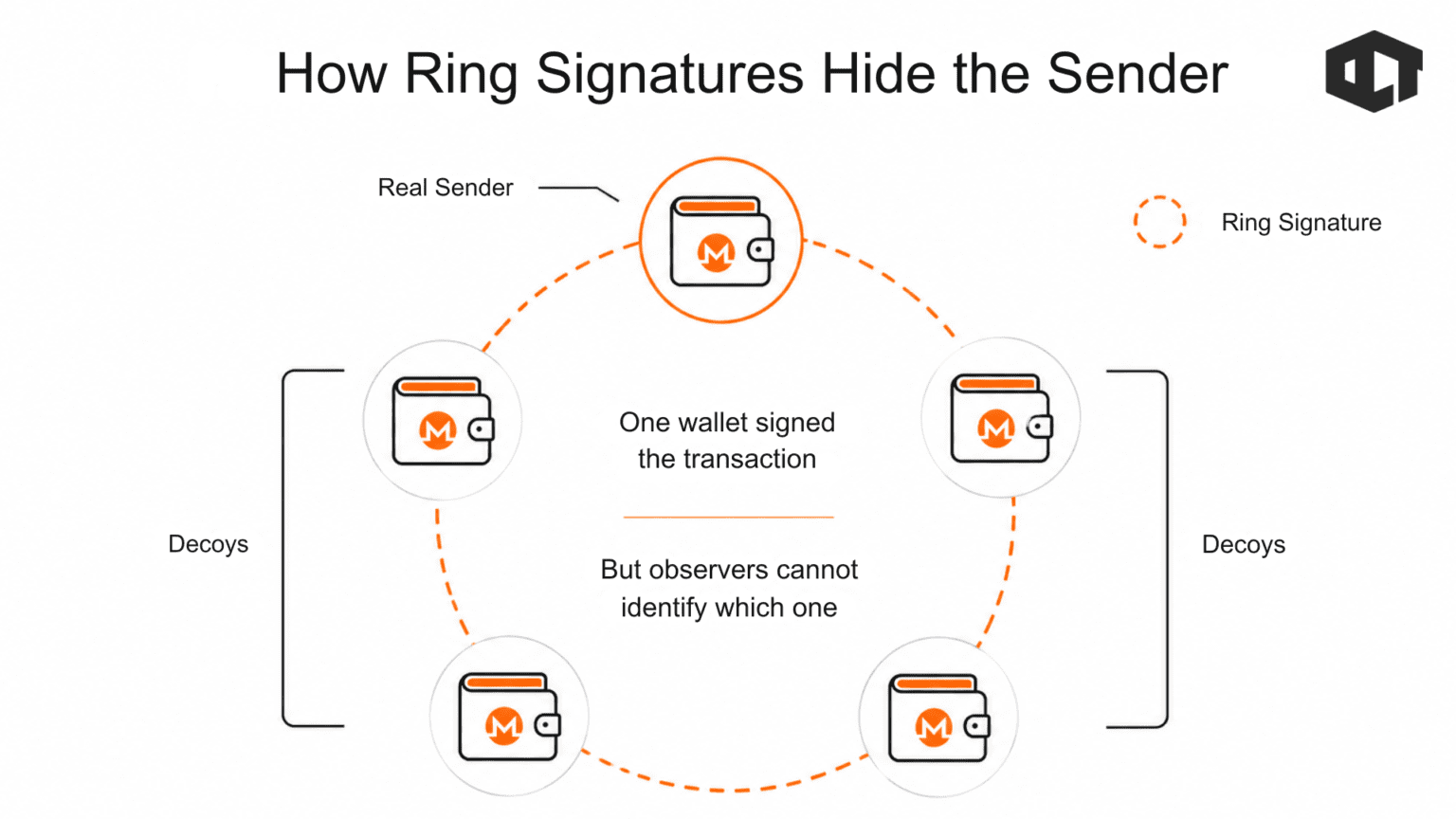
A ring signature is a cryptographic method that hides the real sender of a transaction inside a group of possible senders. Instead of signing a transaction with a single visible wallet, Monero mixes the real transaction with decoy outputs pulled from the blockchain.
To outside observers, all participants in the group look equally likely to be the real sender. That group is called a ring.
Imagine five people standing in a circle.
One person secretly signs a document, but the signature is designed so outsiders can only verify that someone inside the group signed it.
They cannot determine who.
That is the basic idea behind Monero ring signatures.
The result is sender ambiguity.
Unlike Bitcoin, where wallet flows can often be followed publicly, Monero transactions intentionally blur the origin of funds.
A common misconception is that Bitcoin is anonymous. It is not. Bitcoin is pseudonymous. Wallet addresses are public, transaction histories are public, and balances are visible on-chain forever.
If a wallet becomes linked to a real identity through:
then large portions of transaction history can potentially be reconstructed. This creates a fungibility problem. In traditional cash systems, one dollar is interchangeable with another. On transparent blockchains, coins can develop transaction histories that make some units more “acceptable” than others. That creates surveillance risks.
Monero was designed specifically to prevent this.
Monero privacy does not rely on ring signatures alone.
The network combines three separate technologies:
Together, these systems make Monero transactions difficult to analyze using standard blockchain surveillance techniques.
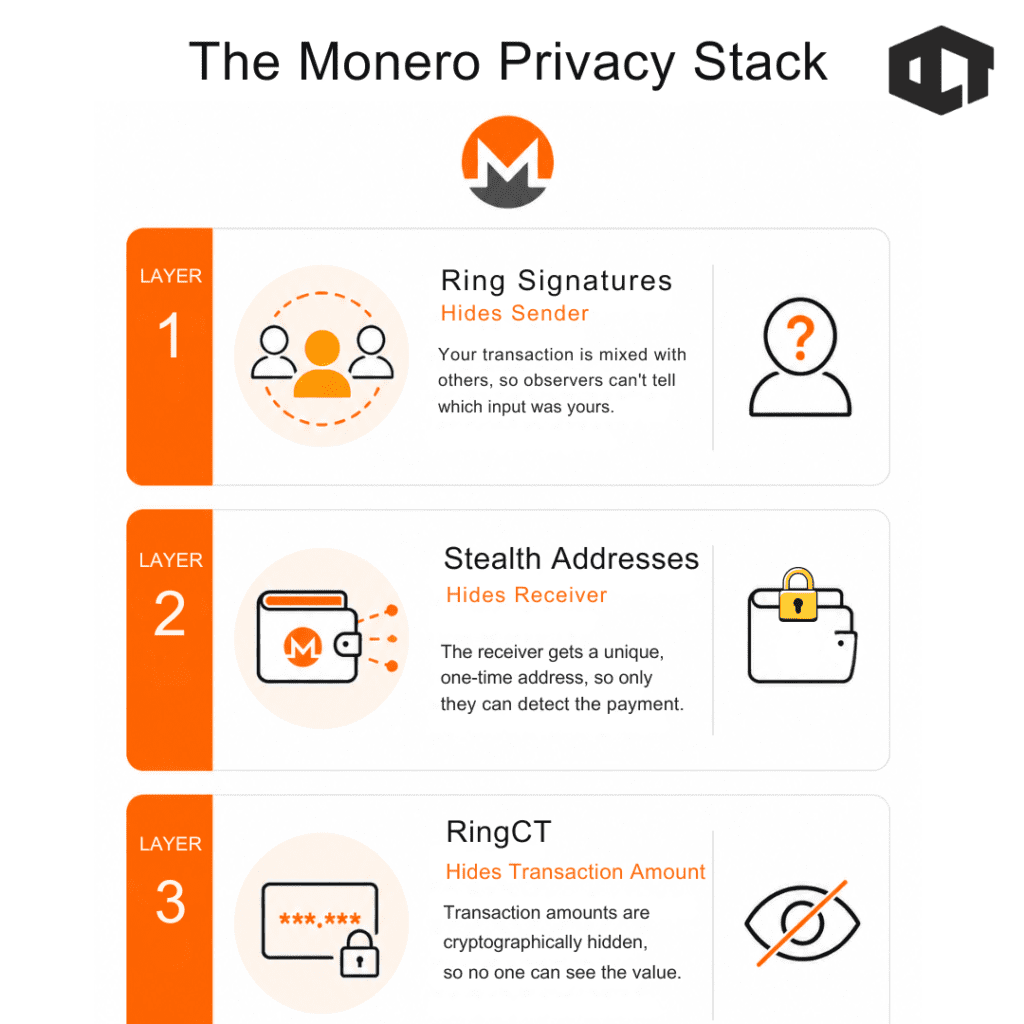
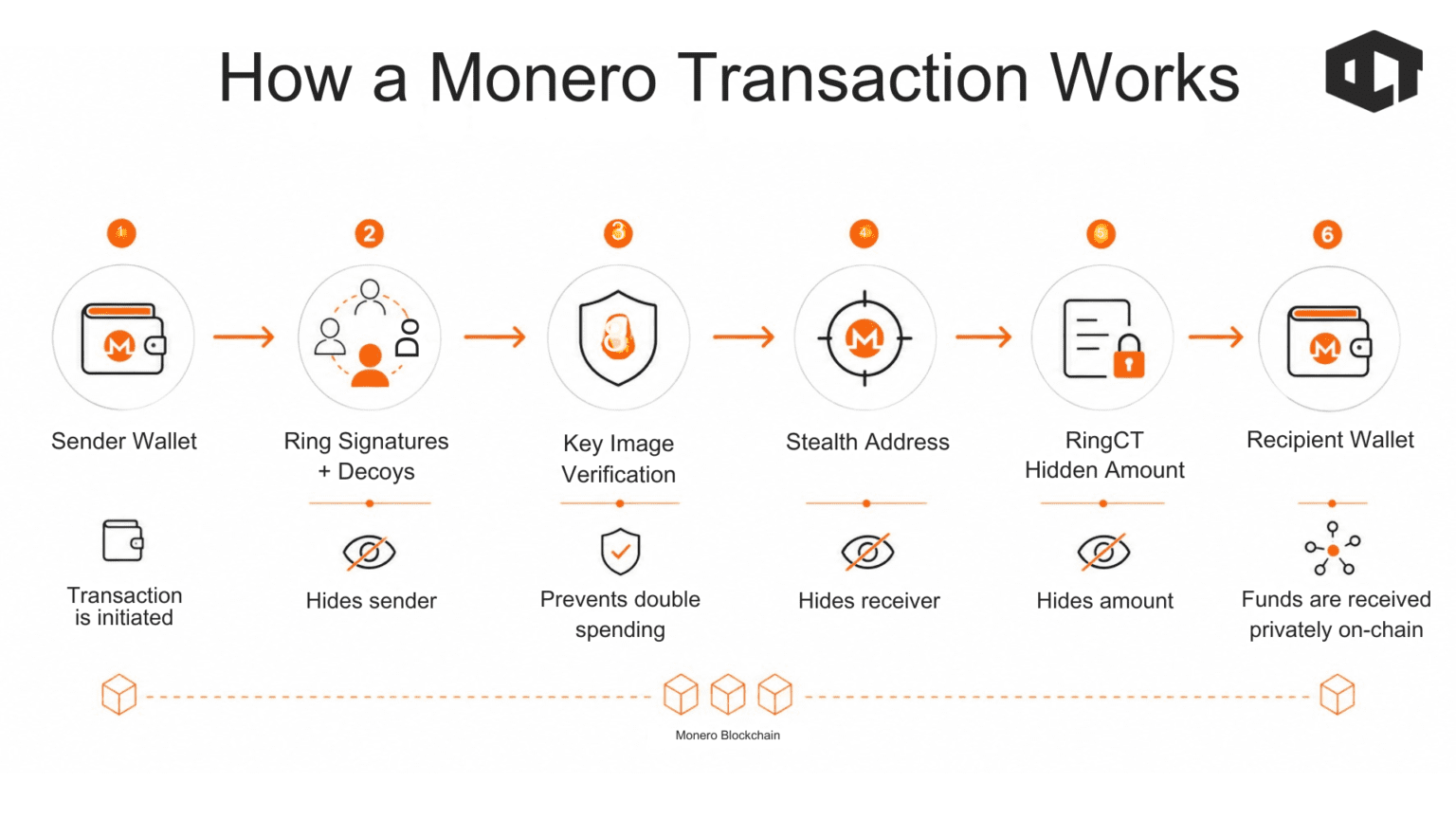
When a Monero user sends funds, the wallet selects decoy outputs from previous transactions on the blockchain. The real output is mixed with these decoys to form a ring. Observers can verify that one member of the ring signed the transaction, but they cannot determine which one. This creates plausible deniability for every transaction.
Modern Monero transactions use mandatory ring sizes, which means every transaction includes decoys automatically. That matters because optional privacy systems often leak information when users fail to enable privacy settings consistently. Monero avoids that problem by making privacy the default.
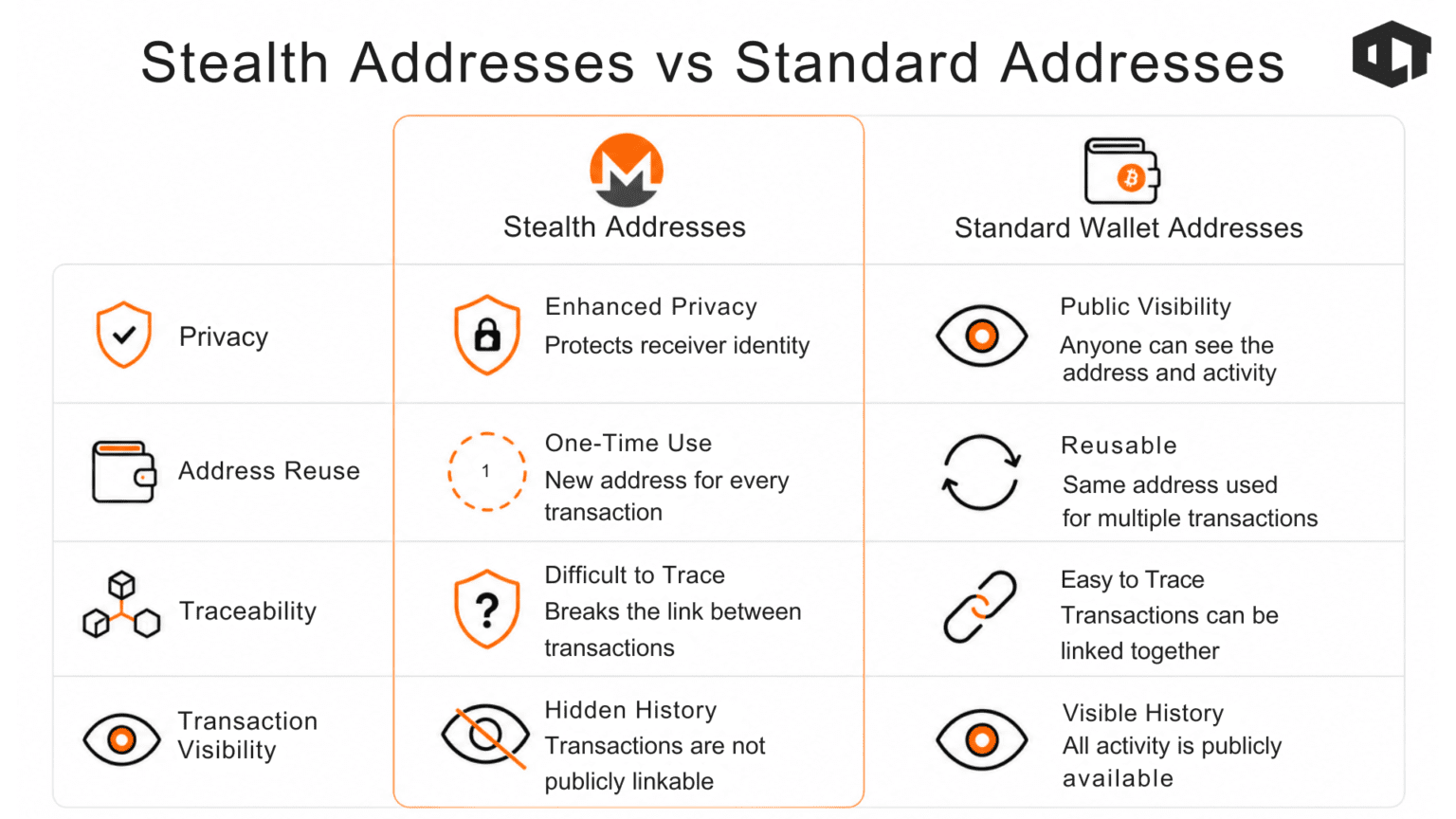
Even if sender privacy exists, public recipient addresses would still expose transaction relationships. Monero solves this using stealth addresses.
Instead of sending funds directly to a visible wallet address, the sender generates a one-time destination address for every transaction.
That means:
Only the recipient can detect and spend the funds.
Early Monero transactions still exposed payment amounts. That changed with Ring Confidential Transactions, commonly called RingCT.
RingCT hides transaction amounts while still allowing the network to verify that no coins were created from nothing. Monero accomplishes this using cryptographic commitments.
The blockchain can confirm:
without revealing the actual transaction value.
This was one of the biggest privacy upgrades in Monero’s history.
A hidden sender system creates another challenge: how does the network stop users from spending the same coins twice without revealing who actually made the transaction? Monero solves this using key images. A key image is a unique cryptographic fingerprint generated from the real output being spent. It proves that a transaction output has already been used while still keeping the sender anonymous inside the ring signature. In practice, this allows Monero to prevent double spending without exposing which participant in the ring was the real spender. The network can verify the transaction is legitimate while preserving privacy at the same time.
Privacy coins are often discussed only in the context of criminal activity, but that framing ignores how financial privacy works in everyday life. Most people would never publicly share their bank balance, salary history, business invoices, investment activity, medical payments, or donation records online. Transparent blockchains expose much of this information by default, making financial surveillance easier than many users realize. Monero was created to restore cash-like privacy to digital transactions by hiding sensitive payment data from public view. Legitimate use cases include journalists operating in hostile environments, activists and dissidents protecting themselves from surveillance, businesses securing supplier relationships, donors supporting sensitive causes, and individuals who simply want to avoid financial profiling. Privacy itself is not inherently suspicious. For many users, it is a basic expectation.
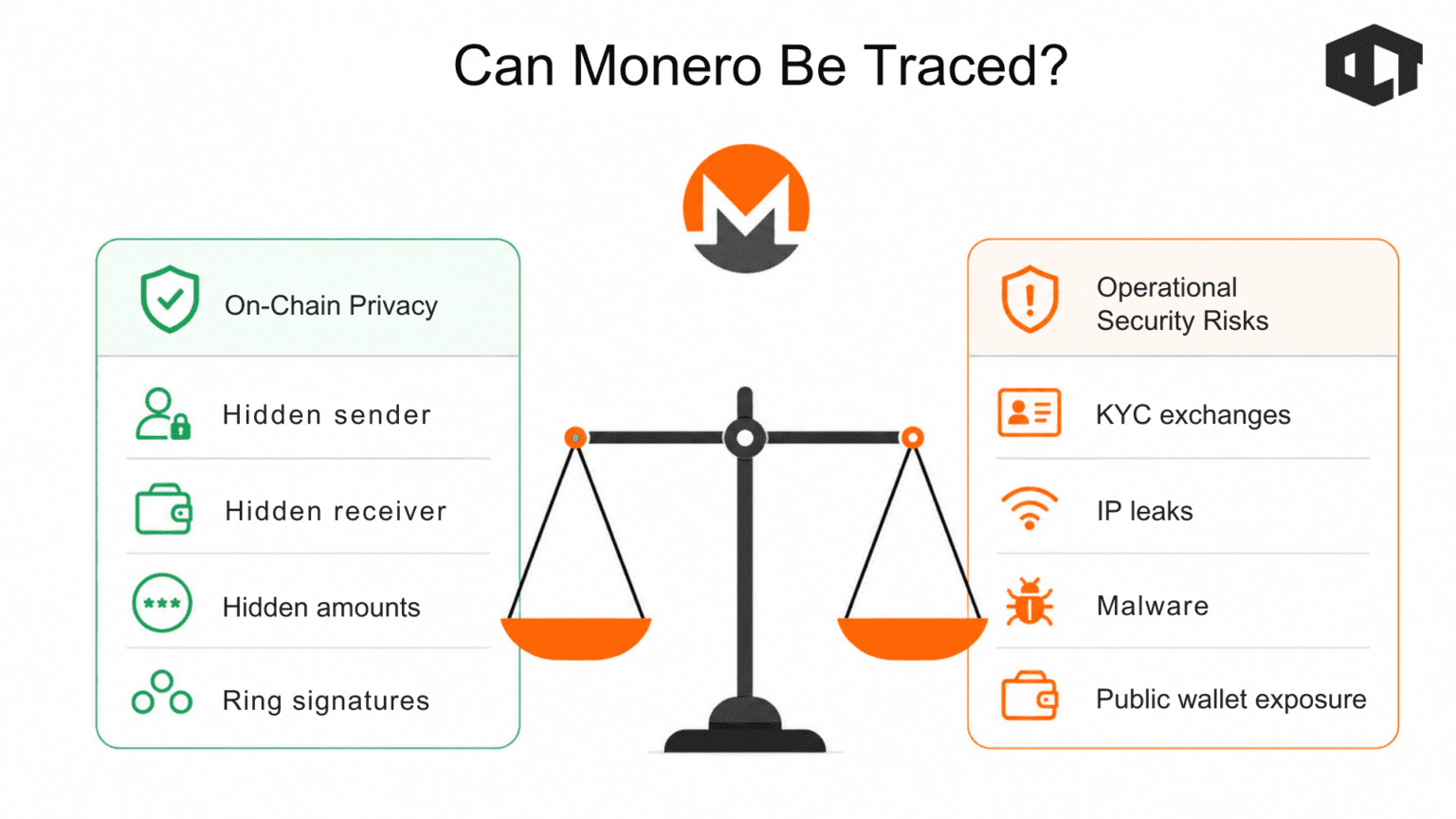
This is one of the most debated questions surrounding Monero, and the honest answer is nuanced. Monero transactions are significantly harder to trace than Bitcoin transactions because the network hides sender identities, recipient addresses, transaction amounts, and wallet balances by default. These privacy protections dramatically reduce the effectiveness of traditional blockchain analysis techniques. Unlike Bitcoin, where analysts can often map wallet flows publicly, Monero intentionally obscures those relationships.
That said, privacy is never absolute. Operational security mistakes can still expose users even if the blockchain itself remains private. Examples include leaking IP addresses, interacting with KYC exchanges, reusing personal information, publicly posting wallet activity, malware infections, or poor wallet security practices. Monero protects on-chain privacy, but it cannot eliminate every off-chain risk tied to user behavior.
There have also been research attempts targeting older Monero transaction patterns. Earlier versions of Monero used weaker decoy selection methods that created statistical weaknesses researchers could analyze under certain conditions. However, the network has continuously upgraded its privacy model to reduce those risks over time. Modern Monero privacy is substantially stronger than early implementations, and no public system currently exists that can reliably trace modern Monero transactions at scale.
One reason Monero remains the leading privacy coin is its aggressive approach to continuous development. The protocol has evolved significantly since launch, with researchers and developers regularly upgrading its privacy systems to strengthen resistance against blockchain analysis.
One of the most important upgrades was Ring Confidential Transactions, or RingCT, which introduced hidden transaction amounts. Before RingCT, payment values were still visible on-chain. The addition of RingCT allowed Monero to hide transaction amounts while still verifying network balances cryptographically.
Monero later introduced Bulletproofs, a major efficiency upgrade that dramatically reduced transaction sizes and lowered fees. This improved scalability without weakening privacy protections. Bulletproofs+ further optimized the system by reducing verification costs and improving transaction performance even more.
The network also repeatedly upgraded its decoy selection algorithms. Earlier transaction patterns created statistical weaknesses that researchers could potentially exploit, so Monero improved how decoys are chosen to make transaction analysis more difficult and increase anonymity reliability.
Research continues today through initiatives like FCMP++ and Seraphis, which explore next-generation privacy upgrades such as Full Chain Membership Proofs, larger anonymity sets, improved transaction efficiency, and stronger resistance to future analysis techniques. Privacy in Monero is not static. It is an actively researched and continuously evolving system designed to adapt as surveillance tools become more advanced.
While Monero has been linked to illicit activity, the same is true for cash, Bitcoin, and encrypted communication tools. Supporters argue that financial privacy itself is not criminal and that most privacy technologies can be used for both legitimate and illegal purposes depending on the user.
Bitcoin and Monero were built around very different philosophies. Bitcoin prioritizes transparency and auditability, which makes every transaction publicly visible on the blockchain. Wallet balances, transaction histories, and payment flows can often be analyzed using blockchain explorers and chain analysis tools. Monero takes the opposite approach by prioritizing privacy and fungibility. Instead of exposing transaction data publicly, Monero intentionally obscures sender identities, recipient addresses, and transaction amounts through ring signatures, stealth addresses, and RingCT. As a result, Bitcoin transactions are generally much easier to trace, while Monero transactions are designed to resist blockchain surveillance by default.
Monero and Zcash are both privacy-focused cryptocurrencies, but they use very different technologies to achieve privacy. Zcash relies on zero-knowledge proofs known as zk-SNARKs, while Monero uses a combination of ring signatures, stealth addresses, and Ring Confidential Transactions. The biggest distinction between the two projects is how privacy is implemented. Monero privacy is mandatory for all users and transactions, meaning every transaction contributes to the same anonymity pool. Zcash privacy, on the other hand, is optional. Users can choose between transparent and shielded transactions. That difference matters because optional privacy systems often create smaller anonymity sets when most users transact publicly instead of privately. Monero’s approach forces consistency across the network, which strengthens overall privacy protections.
Privacy coins create major challenges for regulators and centralized exchanges because modern financial surveillance systems rely heavily on transaction traceability. Monero complicates that process by hiding transaction participants and payment amounts from public view. Over the past few years, several major exchanges have delisted XMR in certain regions due to anti-money laundering concerns, compliance pressure, travel rule requirements, and growing regulatory uncertainty surrounding privacy-focused assets. Binance, Kraken, OKX, and other exchanges have all faced pressure related to supporting privacy coins in various jurisdictions.
Governments and regulators argue that privacy technologies can potentially be abused for money laundering, ransomware activity, darknet markets, and sanctions evasion. Monero supporters counter that financial privacy is a fundamental right and that transparent financial systems create long-term surveillance risks for ordinary users. They argue that privacy should not automatically be treated as criminal simply because bad actors may also use the technology. That tension between compliance and financial privacy remains one of the biggest ongoing debates in crypto.
Even strong supporters of Monero acknowledge the project comes with tradeoffs. One of the biggest concerns is scalability. Privacy systems add additional cryptographic complexity, making Monero transactions heavier than standard Bitcoin transactions and increasing storage and verification requirements over time.
Exchange liquidity is another challenge. Because of regulatory pressure surrounding privacy coins, Monero has more limited exchange access than many mainstream cryptocurrencies. This can reduce liquidity and make onboarding more difficult for new users.
Merchant adoption also remains relatively limited. Many businesses prefer cryptocurrencies with broader exchange integrations, regulatory clarity, and easier accounting processes. Institutional adoption faces similar barriers as global regulators continue tightening compliance and reporting standards for digital assets.
These limitations are real, but they also exist because Monero prioritizes privacy more aggressively than most blockchain networks. Its design choices intentionally favor confidentiality over maximum institutional compatibility.
Most crypto networks optimize for speed, scalability, speculation, or expanding token ecosystems. Monero stayed focused on a much narrower mission: private digital cash. That focus gave the project one of the strongest identities in crypto and helped it remain relevant through multiple market cycles.
While newer privacy technologies continue to emerge, Monero is still widely viewed as the benchmark for default on-chain privacy. Few major cryptocurrencies treat financial confidentiality as core infrastructure instead of an optional feature layered on top later. Monero’s consistent commitment to privacy is what continues to separate it from most of the industry.
Monero ring signatures fundamentally changed blockchain privacy by making sender anonymity practical at scale. Combined with stealth addresses and RingCT, they form one of the most advanced privacy systems currently used in cryptocurrency.
Monero is not perfect. The project faces regulatory pressure, liquidity limitations, scalability tradeoffs, and constant scrutiny from governments and exchanges. But despite those challenges, no major cryptocurrency has committed more aggressively to default financial privacy.
Bitcoin is pseudonymous. Monero is private by design.