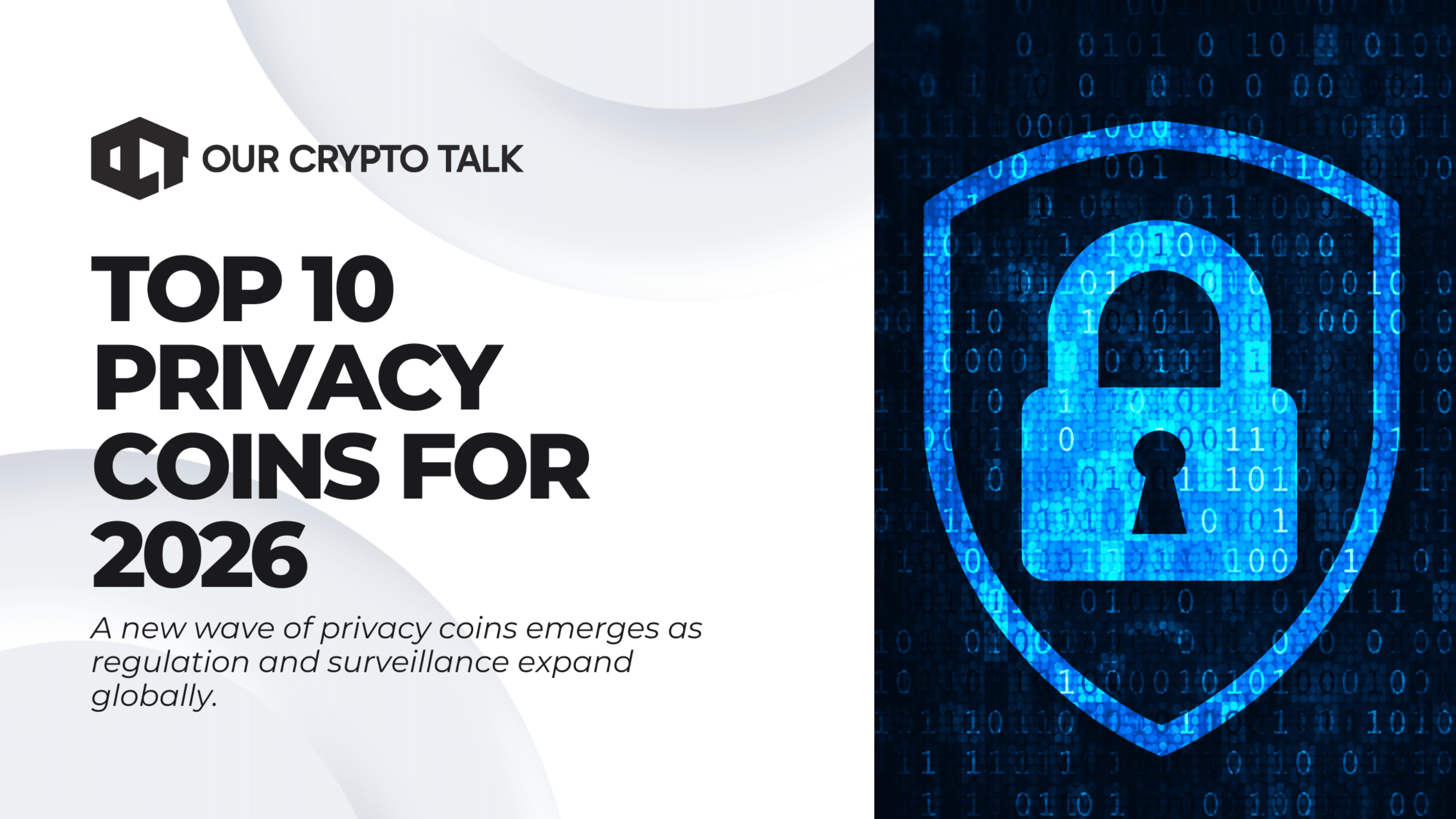
The 10 best privacy coins in 2026 ranked: Monero, Zcash, Firo,Secret Network and more. Compare tech, market cap, and exchange availability.

Author: Chirag Sharma
In 2026, financial privacy stands as a core battleground in crypto. As global regulations intensify, including MiCA in Europe and stricter AML and KYC rules across APAC and the US, demand for privacy-focused assets continues to rise. Consequently, users increasingly seek privacy coins that shield transactions from surveillance while still remaining usable and compliant when required.
Moreover, privacy coins have evolved beyond simple anonymity tools. Today, they operate as sophisticated ecosystems that support private payments, DeFi, and even institutional use cases. As a result, these projects now balance untraceability with real-world utility, especially as concerns around data breaches and centralized control grow.
This updated guide ranks the top 10 privacy-focused cryptocurrencies for 2026. It evaluates technology, adoption metrics, market resilience, developer activity, and regulatory adaptability. At the top, battle-tested leaders like Monero and Zcash continue to dominate. Meanwhile, newer innovators such as Firo push the boundaries further. In addition, hybrid and application-layer projects now extend privacy into smart contracts, staking, and beyond. Therefore, whether you are a user seeking censorship-resistant payments or a builder exploring private DeFi, these projects represent the cutting edge of financial sovereignty in an increasingly surveilled digital world.
The privacy coin sector has staged a strong resurgence in 2026, driven by macro, regulatory, and user-level shifts. Notably, Monero reached a new all-time high near $799 in January 2026, while Zcash delivered roughly 900 percent plus gains over the past year, rallying from sub-$20 levels in 2024 to peaks in the $600 to $700 range. As a result, the broader privacy coin category now commands an estimated market capitalization of around $13.8 to $13.9 billion, reflecting renewed capital inflows and sustained user interest.
Several structural forces continue to drive this momentum. First, rising global financial surveillance and increasing data breaches have pushed users toward tools that protect transactional privacy. At the same time, central bank digital currency rollouts have intensified concerns around state-level monitoring of financial activity. Interestingly, exchange delistings have created a paradoxical effect. Instead of reducing demand, they have strengthened conviction among privacy-focused users and shifted activity toward decentralized and peer-to-peer channels.
Meanwhile, regulatory pressure has created a clear split within the sector. Mandatory privacy coins such as Monero face increasing delistings and liquidity constraints on regulated platforms. In contrast, optional privacy coins like Zcash maintain listings on major exchanges due to features such as selective disclosure and view keys. Therefore, these assets attract both retail users and potential institutional interest.
This divergence highlights why privacy coins remain highly relevant in 2026. As governments push for greater transparency and control, these networks offer a counterbalance by giving users choice over how they transact. Consequently, the sector now represents not only a speculative opportunity but also critical infrastructure for financial privacy in an increasingly monitored digital economy.
Fundamentals:
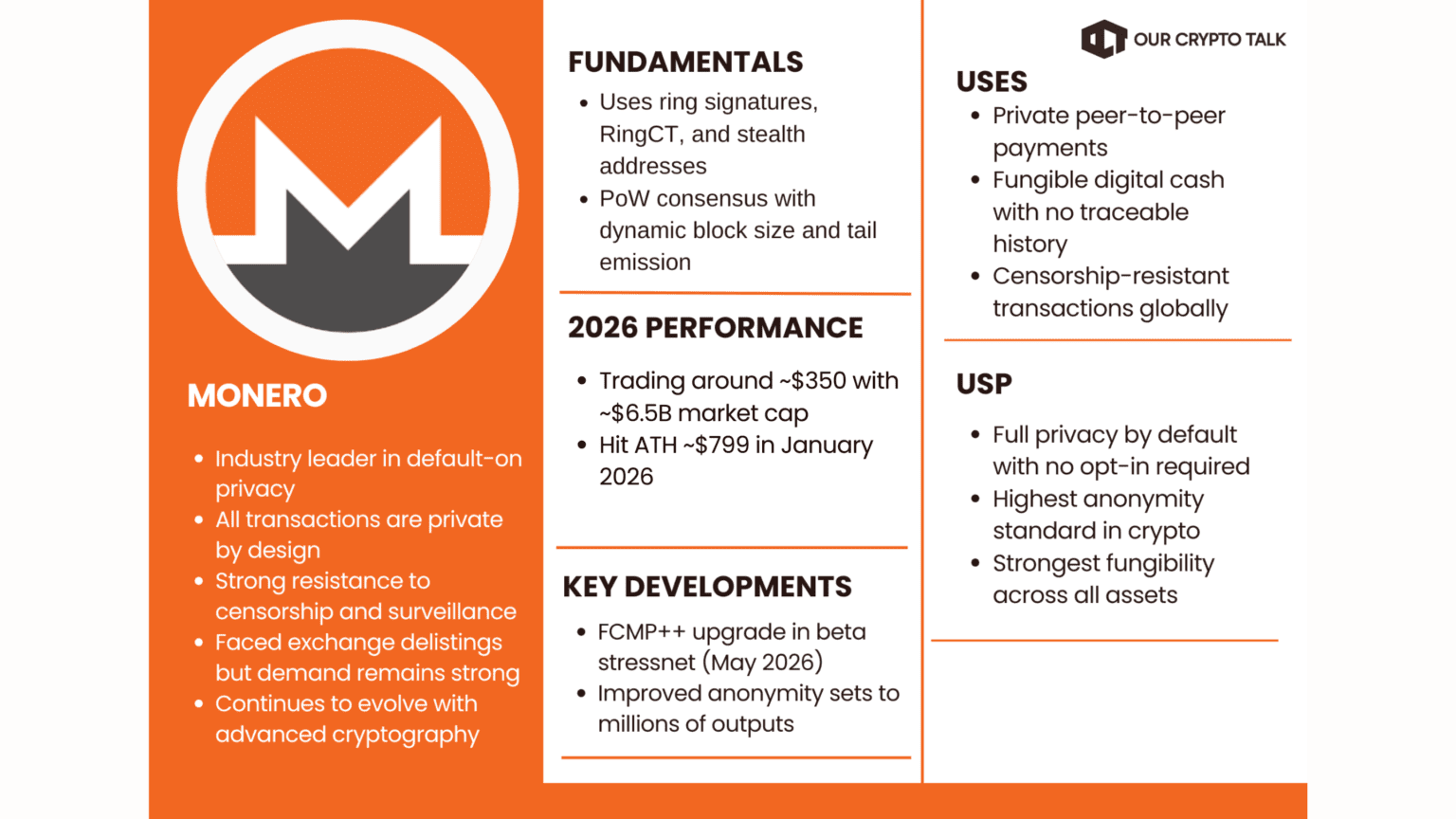
Monero launched in 2014 as a fork of Bytecoin and quickly established itself as the benchmark for default-on privacy in crypto. It uses a combination of ring signatures, RingCT, and stealth addresses to ensure that every transaction remains private by design. As a result, sender identity, receiver identity, and transaction amounts stay fully obfuscated on-chain.
Monero operates on a proof-of-work consensus mechanism with a dynamic block size, which allows the network to scale based on demand. In addition, it uses a tail emission model to ensure long-term miner incentives even after the main issuance phase ends.
Key Development: FCMP++
FCMP++ represents a significant leap in privacy technology. Instead of proving transaction validity within a small ring of decoys, it allows proofs against the entire blockchain. As a result, anonymity sets expand dramatically from dozens of outputs to potentially millions.
Consequently, this reduces traceability risks and strengthens privacy guarantees at a fundamental level. In addition, the upgrade improves efficiency and scalability alongside related cryptographic enhancements. Therefore, FCMP++ positions Monero for long-term dominance in the privacy-first segment.
Uses:
Monero primarily serves as a tool for private, censorship-resistant payments. Since every transaction is private by default, users do not need to make trade-offs between usability and anonymity.
In addition, Monero ensures true fungibility. Each unit of XMR remains indistinguishable from another, which prevents blacklisting or transaction history-based discrimination. Therefore, it functions as digital cash in its purest form.
USP:
The core strength of Monero lies in its uncompromising privacy model. Unlike other projects, it does not offer optional transparency. Instead, it enforces privacy across all transactions by default.
As a result, Monero delivers the highest level of anonymity available in the crypto market. However, this same feature also drives regulatory scrutiny and exchange delistings. Therefore, its design prioritizes privacy over accessibility.
Relative positioning against privacy technologies in Monero
Fundamentals:
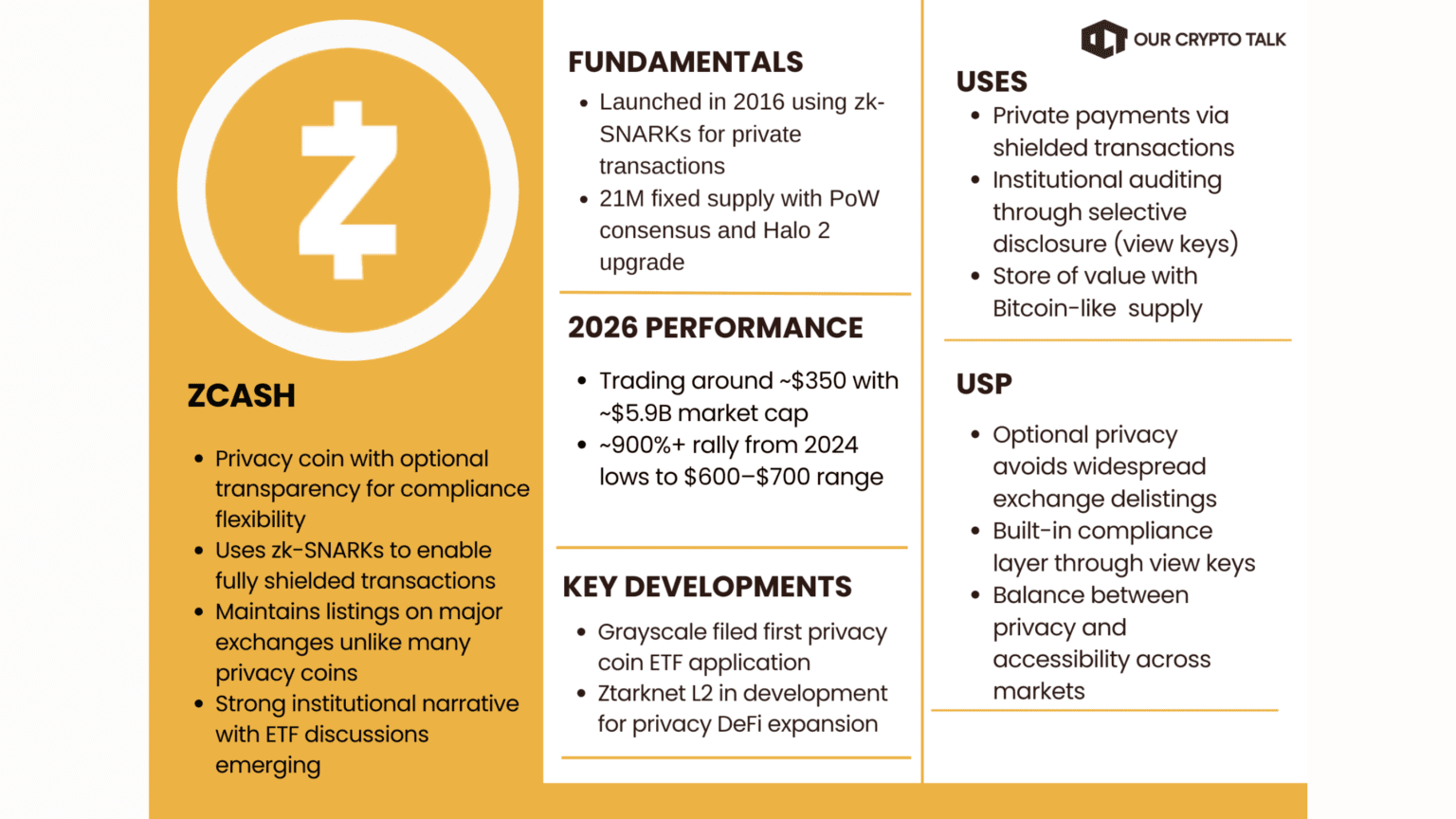
Zcash follows a fixed supply model similar to Bitcoin, with a maximum cap of 21 million ZEC. It operates on a proof-of-work consensus mechanism, which ensures network security through mining. Initially, the protocol required a trusted setup. Currently, around 16.6 million ZEC circulate, which represents roughly 79 percent of total supply.
2026 Performance
Zcash has delivered one of the strongest rebounds in the privacy coin sector in 2026. The asset trades around the mid-$350 range, with a market capitalization near $5.9 billion. It has rallied sharply from sub-$20 lows in 2024 to peaks in the $600 to $700 range, marking roughly 936% gains over the past year.
A major signal of real privacy adoption comes from Zcash’s shielded pool. In 2026, the shielded pool hit an all-time high, with more than 30% of total ZEC supply, worth roughly $5.18 billion, now fully shielded.
Key Developments
Several developments have strengthened Zcash’s market position. First, the Halo 2 upgrade removed the need for a trusted setup, making Zcash’s zero-knowledge architecture more trustless and transparent. Second, the November 2024 halving reduced block rewards, tightening supply dynamics.
Institutional momentum has also increased. Grayscale filed the first privacy-coin spot ETF application, while Foundry launched a compliant US-based Zcash mining pool that accounts for roughly 29% of network hash rate .
Uses
Zcash supports multiple real-world use cases. First, it enables private payments through shielded transactions, which protect financial data on-chain. Second, it provides institutional-grade privacy through selective disclosure.
USP
Zcash stands out due to its optional privacy model. Users can choose between transparent addresses and shielded addresses depending on their needs. As a result, the network balances usability with privacy.
Fundamentals:
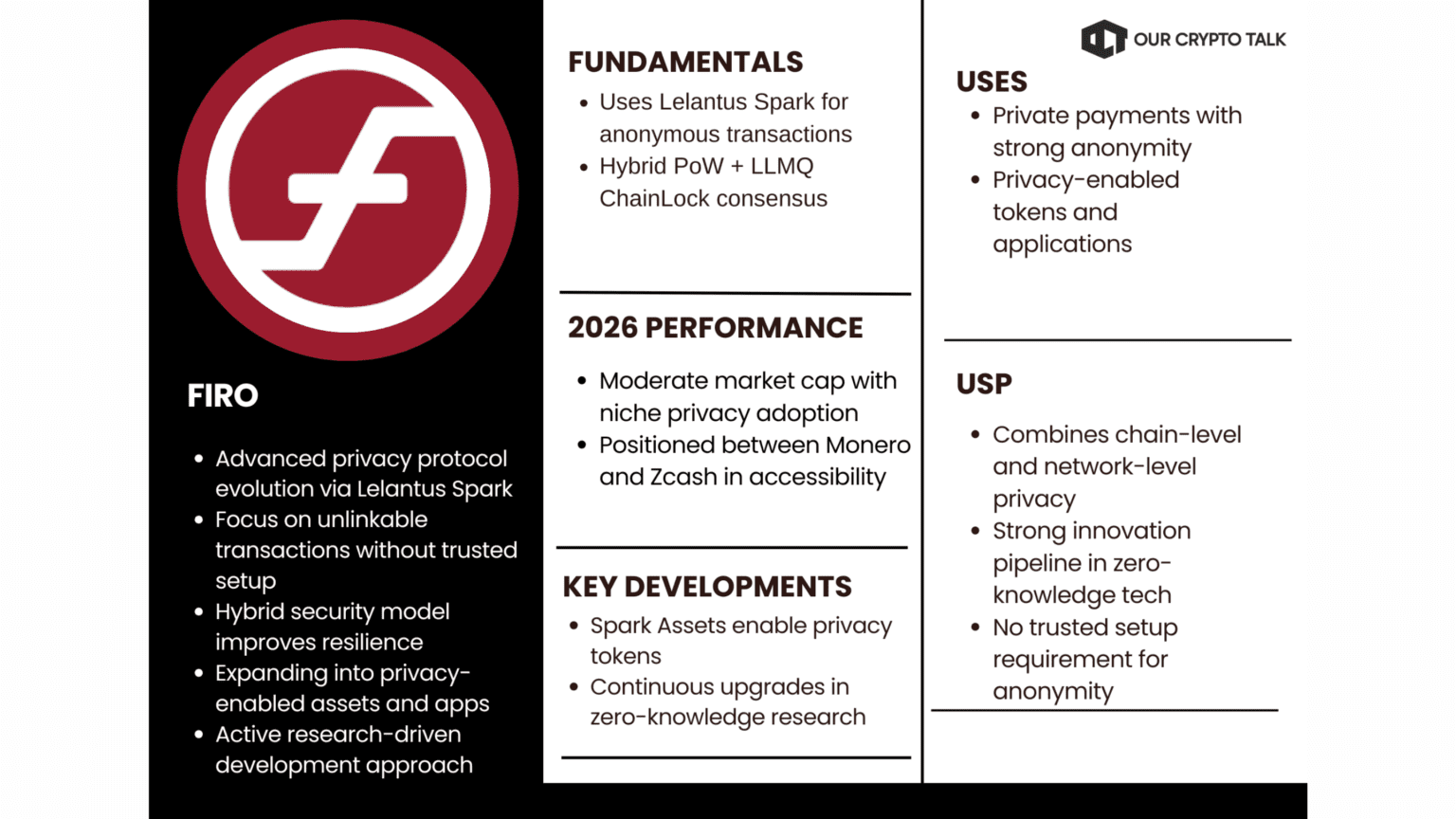
Firo, formerly known as Zcoin, introduced the Lelantus protocol, later upgraded to Lelantus Spark, which enables anonymous transactions without trusted setups. Additionally, it uses a hybrid PoW and LLMQ Chainlock consensus, combining decentralization and security.
Uses:
Firo supports multiple use cases within the privacy ecosystem. First, it enables shielded transactions that offer strong anonymity for everyday payments.
Second, developers can build privacy-focused applications using Spark Assets. This includes tokens, financial tools, and communication layers that require confidentiality.
Furthermore, its integration of network-layer privacy makes it suitable for secure communication and privacy-preserving applications. Therefore, Firo goes beyond payments and supports a wider range of private digital interactions.
Firo has delivered moderate but steady growth in 2026, positioning itself as a mid-tier privacy coin with a focus on Lelantus-based anonymity. The asset currently trades around $2.00 to $2.50.
Price action has remained relatively stable compared to larger privacy assets, with periodic spikes driven by updates in its privacy protocol and exchange listings. However, liquidity remains thinner than top-tier assets like Monero and Zcash.
Overall, Firo’s performance reflects a niche but stable position in the privacy ecosystem, with gradual adoption rather than explosive growth.
USP:
Firo stands out for continuous innovation in privacy protocols. Its transparent roadmap and dedicated research team push the frontier in zero-knowledge tech. The combination of chain-level and network-level privacy makes it one of the most complete privacy solutions in the space.
Fundamentals:
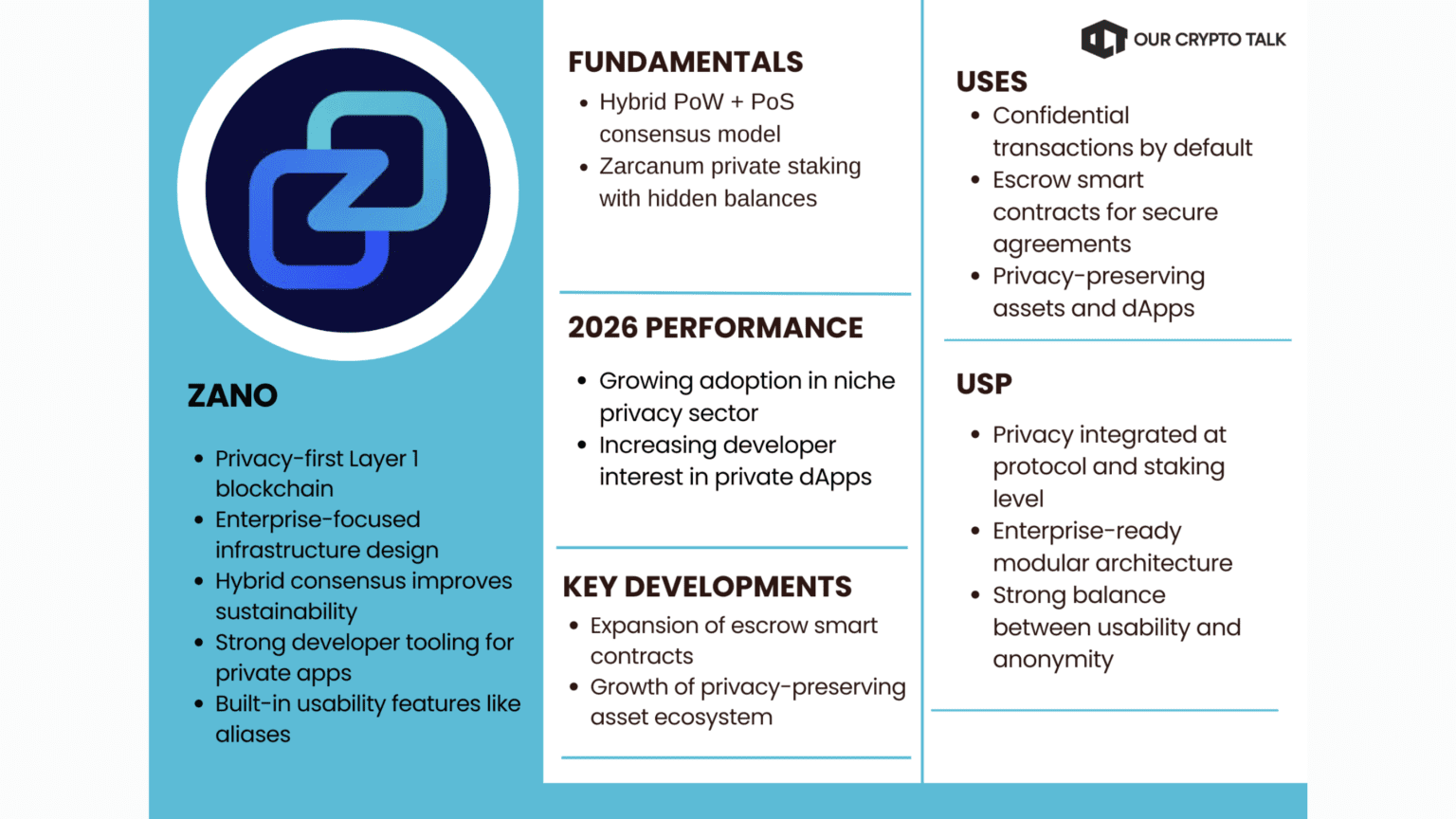
Zano is a privacy-first Layer 1 blockchain that launched in 2019 with a focus on secure, scalable, and enterprise-ready infrastructure. It uses a hybrid proof-of-work and proof-of-stake consensus model, which balances decentralization with long-term economic sustainability.
A key innovation within Zano is Zarcanum, its private staking mechanism. Unlike traditional staking systems, Zarcanum hides both balances and staking rewards. As a result, users can participate in securing the network without exposing financial data.
Zano has emerged as one of the stronger-performing privacy infrastructure projects in 2026. The token currently trades in the $8.00 to $10.00 range, with a market capitalization between $110 million and $140 million.
The project has gained traction due to its hybrid architecture that supports both privacy and smart contract functionality. As a result, Zano has benefited from the broader narrative shift toward privacy-enabled ecosystems rather than standalone payment coins.
Uses:
Zano supports a wide range of privacy-focused use cases. First, it enables confidential transactions where sender, receiver, and amount remain hidden by default. Second, it introduces escrow smart contracts, which allow users to conduct trustless agreements while preserving transaction privacy. This feature expands Zano’s utility beyond payments into real-world contract execution.
Moreover, developers can build privacy-preserving assets and decentralized applications directly on the network. These applications inherit Zano’s native privacy features without requiring additional layers.
USP:
Zano stands out due to its modular privacy architecture and strong protocol-level anonymity. Unlike many privacy coins that focus solely on payments, it provides a full-stack environment for building private applications.
Furthermore, its privacy-by-default model ensures that all transactions remain confidential without requiring user intervention. At the same time, its hybrid consensus model strengthens network security while maintaining economic balance between miners and stakers.
Fundamentals:
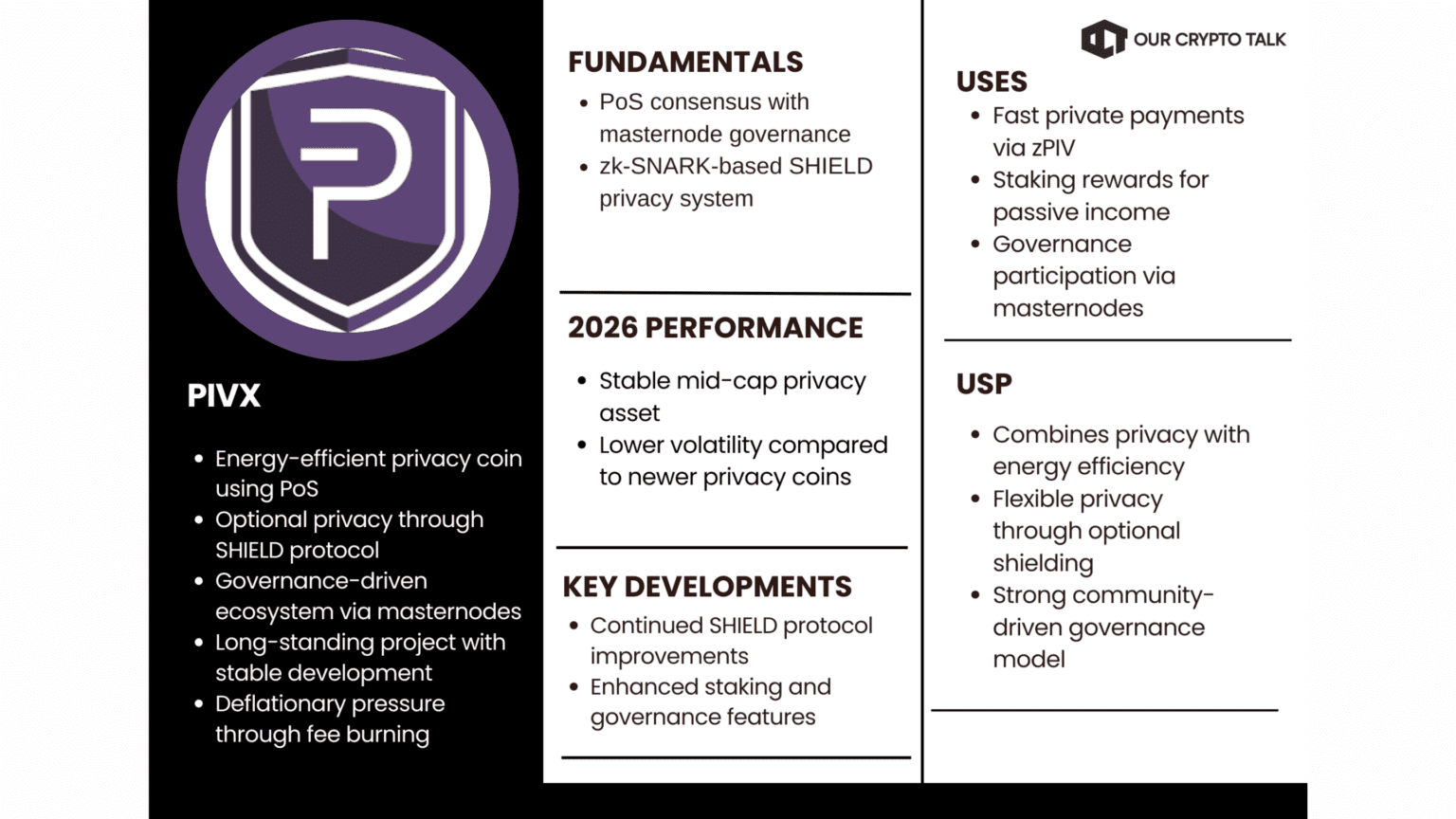
PIVX launched in 2016 as a privacy-focused digital asset built on a proof-of-stake consensus model. Unlike proof-of-work systems, it relies on staking rather than mining, which significantly reduces energy consumption.
PIVX offers optional privacy through its SHIELD protocol, which is based on zk-SNARKs. As a result, users can choose between transparent and fully private transactions depending on their needs. In addition, the network uses masternodes to support governance, validate transactions, and enhance overall security. PIVX has maintained a steady but subdued presence in 2026. The token trades around $0.25 to $0.35, with a market capitalization in the $20 million to $30 million range.
Uses:
PIVX primarily focuses on fast and private payments. Users can convert their standard balance into shielded zPIV to enable private transfers. As a result, they gain flexibility in choosing when to prioritize privacy.
In addition, the network supports staking, which allows users to earn rewards while helping secure the blockchain. Masternodes further enhance this system by enabling governance participation. Therefore, holders can actively vote on proposals and influence the future direction of the network.
Moreover, its fast transaction speeds and low fees make it suitable for everyday use cases. Consequently, PIVX positions itself as a practical privacy coin for both payments and participation.
USP:
PIVX stands out by balancing optional privacy with energy efficiency. Unlike many privacy coins that rely on energy-intensive mining, it uses a proof-of-stake model that supports sustainability.
At the same time, it gives users full control over their privacy. They can choose between transparent and shielded transactions without sacrificing usability. In addition, the masternode system strengthens decentralization while enabling community-driven governance.
Fundamentals:
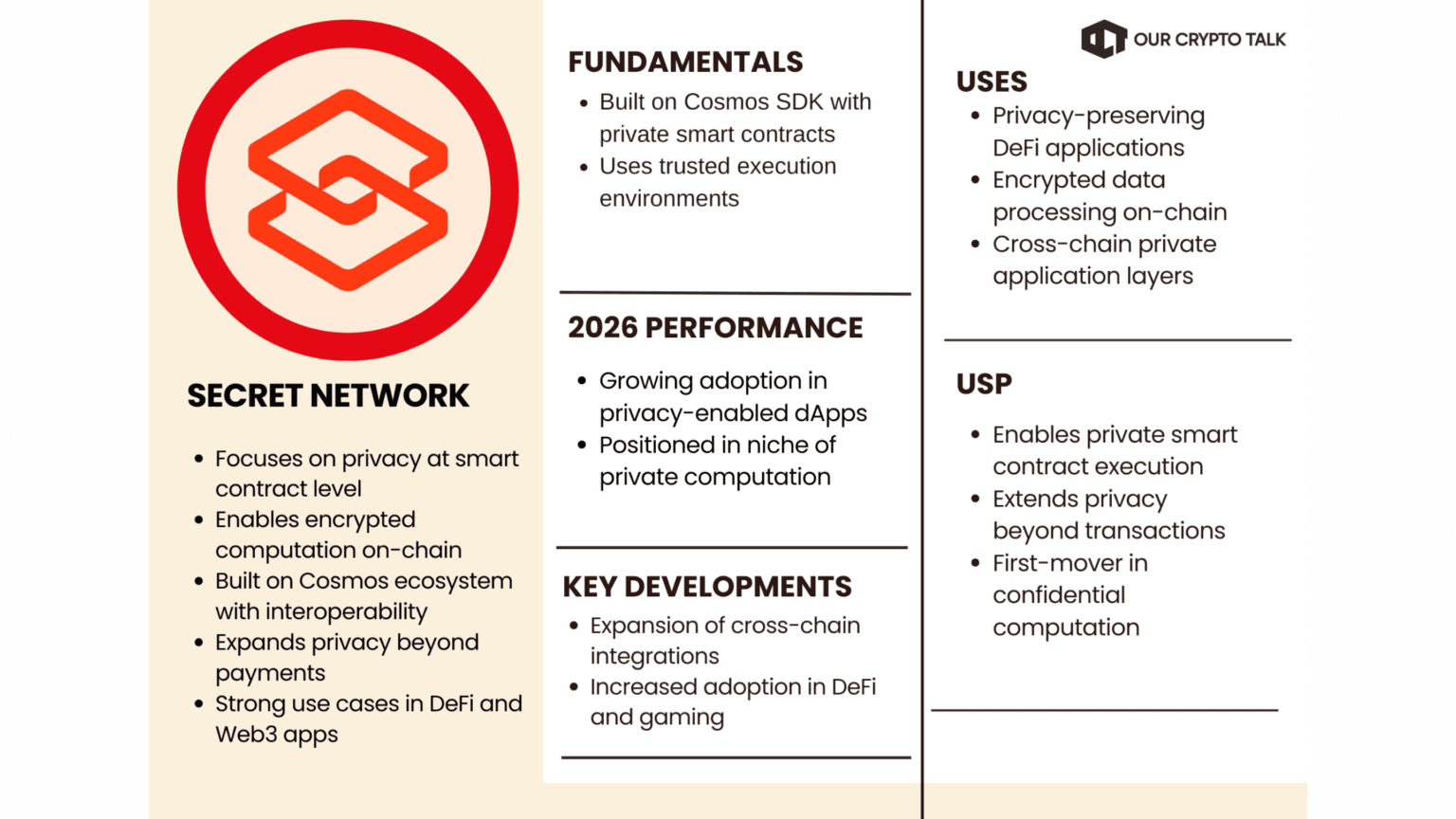
Secret Network was developed on the Cosmos SDK and launched in 2020. It supports encrypted computation through private smart contracts. Transactions and on-chain data are protected using trusted execution environments.
Secret Network enables a wide range of privacy-preserving applications. First, developers can build decentralized finance protocols where transaction data, balances, and strategies remain confidential
Second, it supports privacy-focused gaming and social applications. For example, game logic or user data can remain hidden while still interacting with public blockchain infrastructure.
USP:
Secret Network stands out due to its application-layer privacy model. Unlike most privacy projects that focus only on hiding transaction details, it enables encrypted logic within smart contracts.
This capability allows developers to build fully private decentralized applications where both data and computation remain confidential. In addition, trusted execution environments ensure that sensitive information never becomes publicly visible during execution.
Fundamentals:
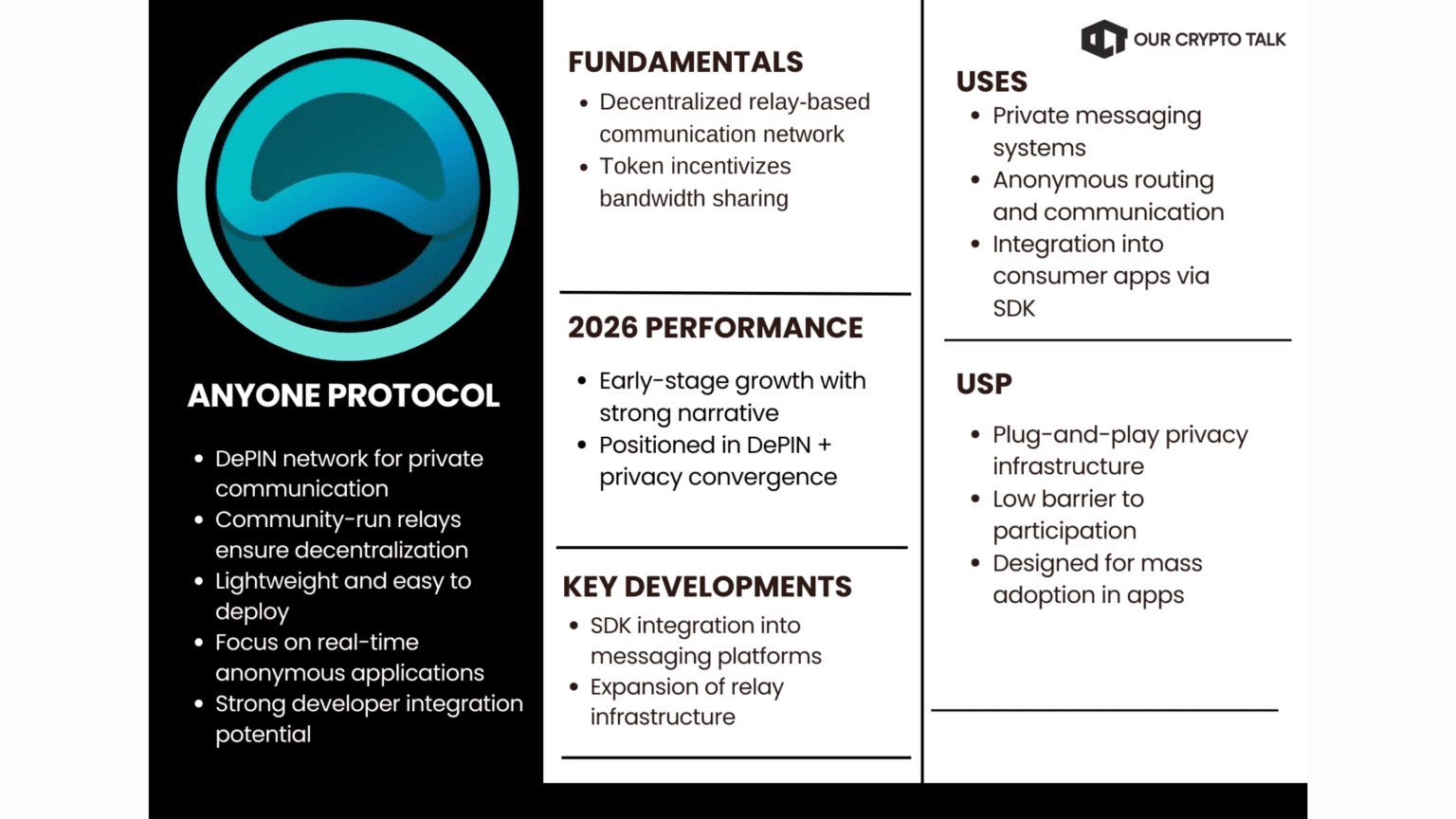
AnyOne Protocol operates as a decentralized physical infrastructure network that focuses on enabling private communication through community-run relay nodes. Instead of relying on centralized servers, it distributes network traffic across independent participants. As a result, it enhances censorship resistance and reduces single points of failure.
The protocol uses its native token, ANYONE, to incentivize users to contribute bandwidth and run relays. This creates a self-sustaining ecosystem where participants secure and scale the network. In addition, its lightweight architecture lowers the barrier to entry. Therefore, users can join and contribute without requiring specialized hardware or complex configurations.
Uses:
AnyOne is built for real-time anonymous applications, such as private messaging and routing. Its SDK can be integrated into messaging platforms like Telegram, ensuring secure user experiences without changing interfaces.
USP:
AnyOne Protocol stands out due to its simplicity and developer-first design. Unlike many privacy infrastructures that require complex setups, it allows anyone to participate with minimal friction.
Furthermore, its plug-and-play architecture makes it highly adaptable for consumer-facing applications. Developers can integrate privacy features quickly, which accelerates adoption across mainstream platforms.
Fundamentals:
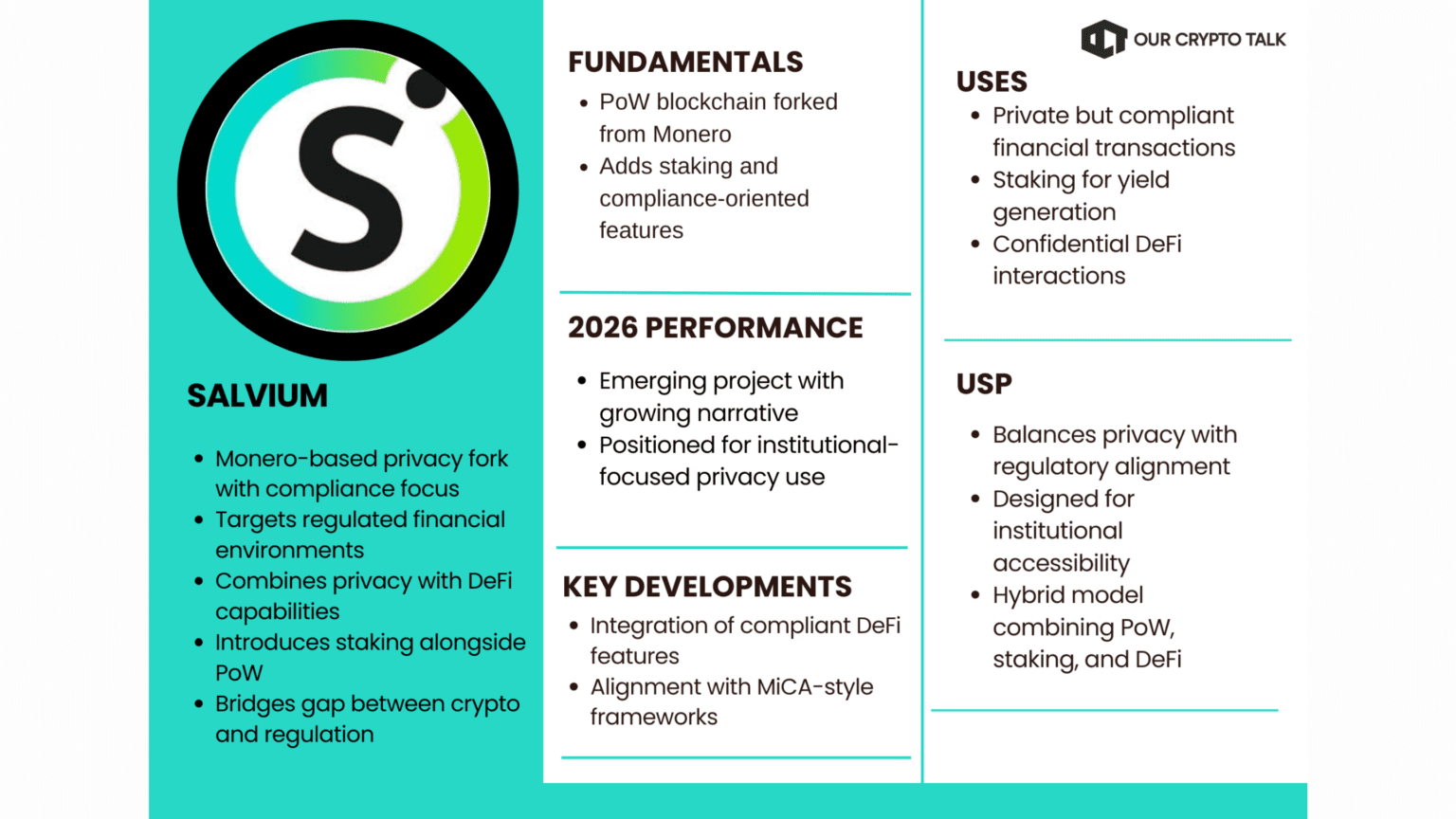
Salvium is a proof-of-work privacy blockchain forked from Monero and it incorporates compliance features and is aimed at privacy within a regulated framework. It supports native staking and DeFi functionality.
Uses:
Salvium focuses on enabling confidential finance within a regulated framework. It allows users to conduct private transactions while aligning with compliance standards similar to MiCA-style regulations. As a result, it becomes more accessible in jurisdictions where strict oversight exists.
In addition, users can stake tokens to earn rewards, which adds an income layer to its ecosystem. This makes it attractive not only for privacy-focused users but also for yield-seeking participants..
USP:
Salvium’s core innovation lies in balancing privacy with compliance. Unlike most privacy coins that prioritize anonymity above all else, it proactively integrates regulatory alignment into its architecture.
As a result, it can appeal to both institutions and users operating in legally constrained environments. This approach reduces the risk of widespread delistings while still preserving core privacy features.
Fundamentals:
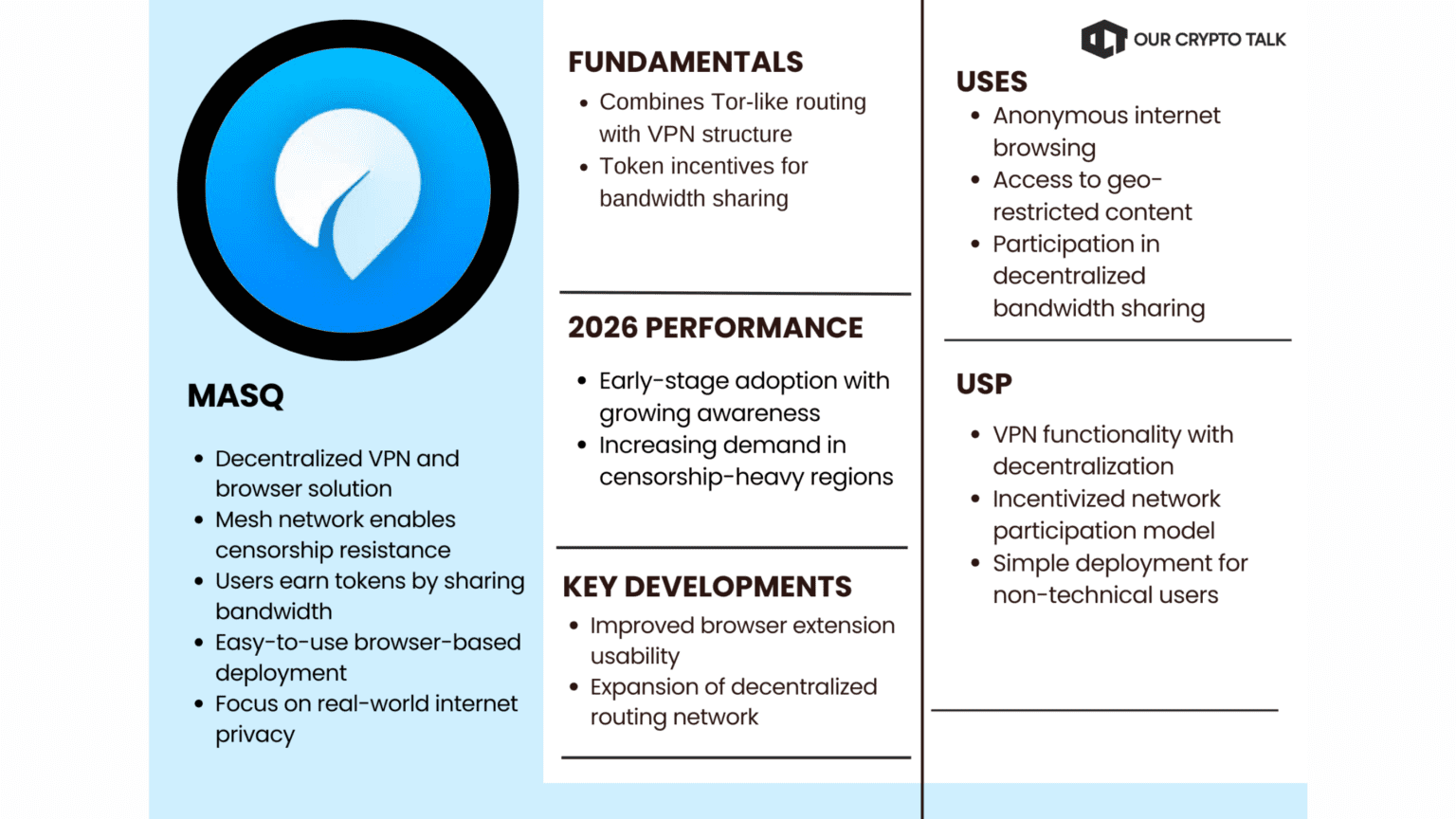
Masq is a decentralized VPN and browser, combining elements of Tor and traditional VPNs. Users who share bandwidth earn MASQ tokens. It operates as a mesh network to bypass censorship.
Uses:
MASQ enables censorship-resistant internet access and anonymous browsing. Users can bypass geo-restrictions and access blocked content by routing traffic through the decentralized network. Moreover, it supports private browsing by masking user identity and location. This makes it useful in regions with heavy internet restrictions or surveillance.
In addition, MASQ allows users to actively contribute to the network by sharing unused bandwidth. As a result, participants not only protect their own privacy but also strengthen the broader ecosystem.
USP:
MASQ stands out by bringing VPN-like functionality into a decentralized crypto-native model. Unlike traditional VPNs that depend on centralized providers, it distributes trust across a network of participants.
At the same time, its reward mechanism incentivizes network growth. Users earn tokens for contributing bandwidth, which aligns economic incentives with network expansion.
Fundamentals:
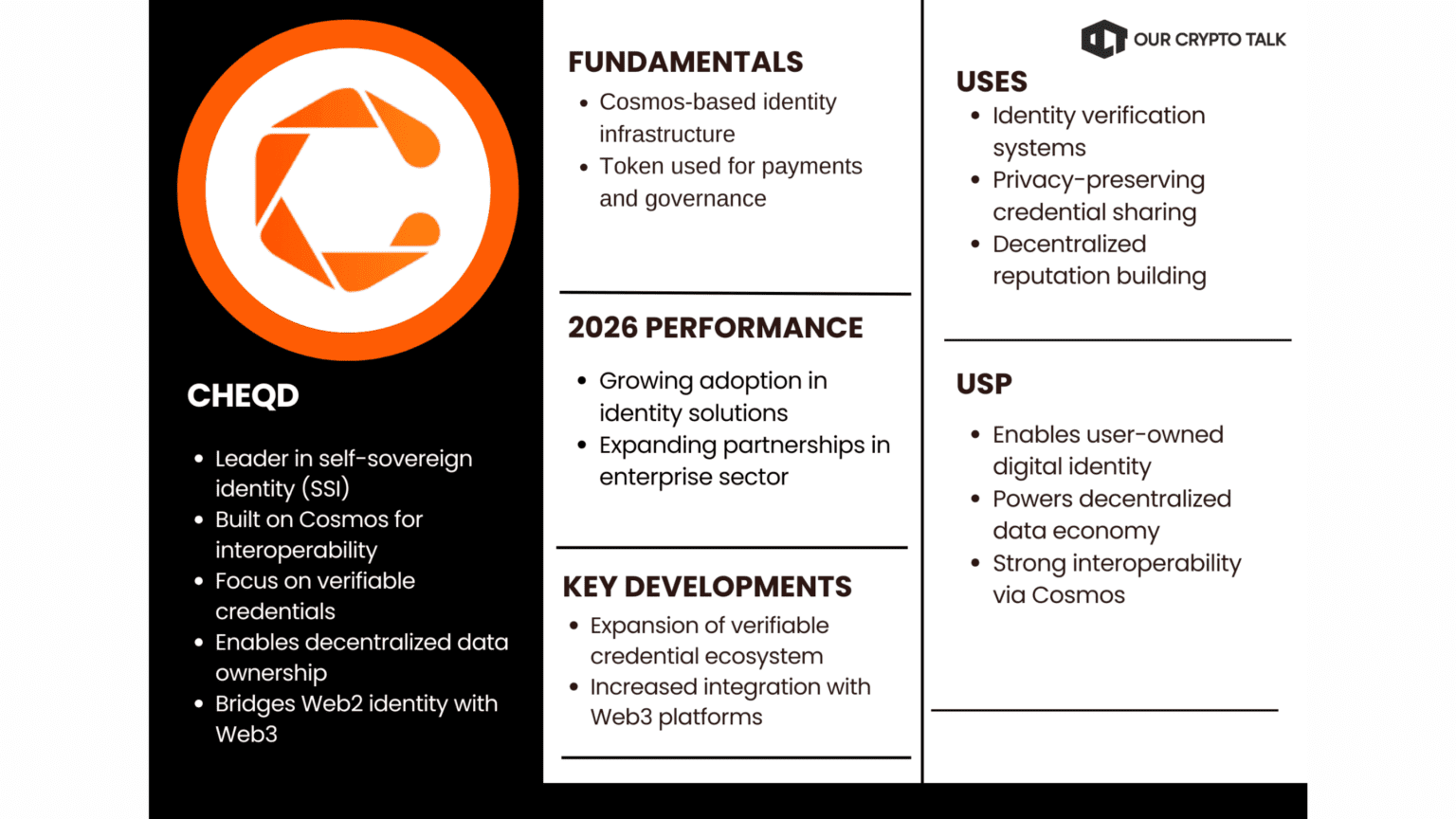
cheqd.io focuses on self-sovereign identity (SSI) and is built on Cosmos. It allows users to issue, verify, and monetize Verifiable Credentials. Its token, CHEQ, is used for payments and governance.
Uses:
cheqd.io enables a wide range of identity and data management use cases. First, users and organizations can issue and verify credentials such as IDs, certifications, and proofs of reputation. Second, it supports privacy-preserving data sharing. Users can selectively disclose information without revealing full datasets. As a result, it improves both privacy and efficiency in verification processes.
In addition, cheqd.io plays a key role in reputation systems. Individuals can build portable, verifiable reputations across platforms while maintaining control over their data.
USP:
cheqd.io stands out as a leading infrastructure provider in the self-sovereign identity sector. Unlike traditional identity systems, it gives users ownership over their personal data and credentials.
At the same time, its integration with the Cosmos ecosystem enhances scalability and interoperability. This allows identity solutions to function across multiple networks.
Regulatory pressure continues to reshape the privacy coin landscape in 2026, creating both constraints and new pathways for adoption. Notably, Monero has faced widespread delistings across centralized exchanges. Consequently, platforms such as Binance in EU regions and OKX have removed support in response to tightening AML and KYC requirements. As a result, liquidity has shifted toward decentralized exchanges and peer-to-peer channels.
In contrast, Zcash has largely maintained listings on regulated platforms such as Coinbase and Gemini. This difference stems from its optional privacy model, which allows selective disclosure through view keys. Consequently, Zcash remains accessible to both retail users and institutions, while mandatory privacy assets face increasing restrictions.
Looking ahead, the European Union’s Anti-Money Laundering Regulation will play a critical role. By July 2027, AMLR will restrict licensed exchanges from supporting anonymity-enhancing assets. Therefore, coins with mandatory privacy features will likely face near-total exclusion from regulated EU platforms. However, projects with optional privacy and audit capabilities may continue operating within compliant frameworks. This creates a structural advantage for flexible privacy models.
In the United States, regulators have not imposed a blanket ban. Zcash continues trading on Coinbase and Gemini, while Monero remains available on Kraken in limited jurisdictions. The Internal Revenue Service has increased investment in blockchain analytics and tracing tools.
Relative positioning of privacy coins across exchange access in 2026
Relative positioning of top privacy coins in 2026
Privacy coins have re-emerged as a critical pillar of the crypto ecosystem in 2026. While regulators continue to tighten oversight, user demand for financial privacy continues to grow. As a result, the sector now sits at the intersection of technology, policy, and personal sovereignty.
At the same time, a clear divide has formed within the market. On one hand, assets like Monero deliver uncompromising, default-on privacy but face increasing exchange restrictions. On the other hand, projects like Zcash balance strong privacy with compliance features, which allows them to retain broader market access. Therefore, each approach serves a distinct user base rather than competing directly.
Looking ahead, this regulatory and technological divergence will likely define the next phase of growth. As governments push for transparency through surveillance tools and CBDCs, privacy coins will continue to act as a counterbalance. Consequently, their relevance extends beyond speculation and into real-world financial infrastructure.
Ultimately, whether users prioritize maximum anonymity or flexible compliance, privacy coins provide essential options in an increasingly monitored digital economy.