Learn how to use DeFiLlama AI to analyze on-chain data, track protocol revenue, and identify early crypto opportunities before the market.
Here’s a painful truth about crypto research: most people don’t know how to use DeFiLlama AI effectively.
They open Twitter, see a protocol trending, Google “is [X] legit?”, read a Medium post written by the protocol’s own marketing team, and call that due diligence. Then they’re shocked when the token dumps 70% after they ape in. The few who consistently make money don’t have better instincts; they have better data pipelines.
They analyze on-chain metrics before narratives form, prioritize fee charts over price charts, and identify revenue-generating protocols before any token is announced.
For years, doing this well required you to be a data scientist. You needed to know how to pull from Dune Analytics, stitch together DeFiLlama API calls, cross-reference Messari reports, and somehow synthesise it all into a coherent thesis. The barrier was technical, not intellectual.
Think of DeFiLlama AI as having a team of expert crypto researchers at your fingertips. Instead of spending hours digging through data yourself, you just ask a question in the chat.
It gives you the kind of high-level insights that professional investors use, helping you spot opportunities before everyone else does.
This article is going to show you exactly how to build that edge using Sui blockchain as a live, real-data case study that you can replicate on any ecosystem.
DeFiLlama is the most trusted on-chain analytics platform in crypto. It tracks 6,000+ protocols across 400+ blockchains’ TVL, fees, revenue, DEX volume, stablecoin flows, yield pools, token unlocks, hacks, and fundraising data. If it happens on-chain, DeFiLlama probably tracks it.
LlamaAI is DeFiLlama’s AI-powered research layer built on top of this dataset, launched in November 2025. It lets you ask questions in plain English and get back ranked tables, custom charts, deep research reports, and structured insights without writing a single line of SQL.
Most AI tools work from training data information frozen at some point in the past. LlamaAI is different in a critical way: it queries live on-chain data in real time. When you ask about Sui’s TVL, it pulls the current number from DeFiLlama’s live database, not a months-old snapshot.
The system translates your natural language prompt into a structured query, runs it against DeFiLlama’s dataset (plus optional web search), and synthesizes results into human-readable analysis. This eliminates the #1 failure mode of AI crypto research: confident hallucination of stale or invented data.
Pricing & Access
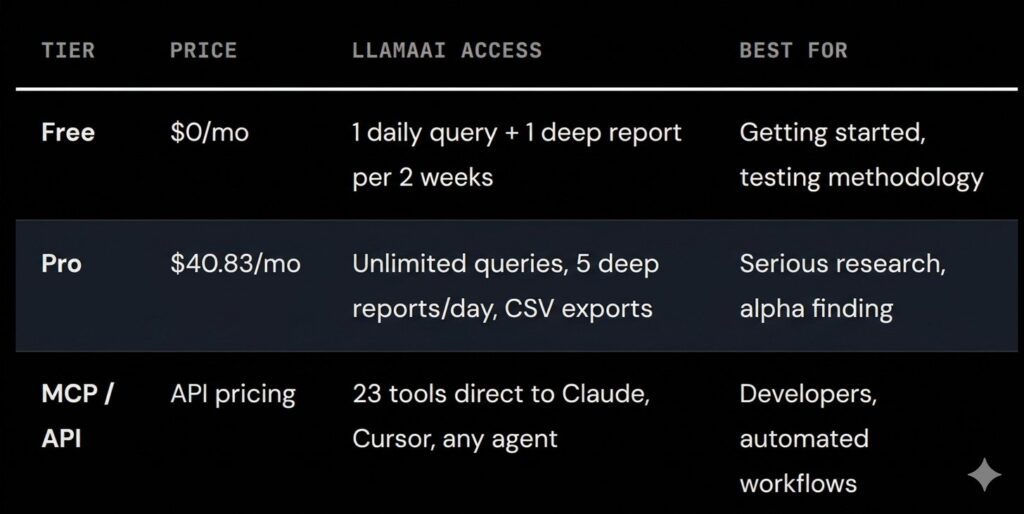
One good trade thesis pays for months of subscription. The Pro tier is table stakes for serious research.
This is where most beginners fail before they’ve typed a single prompt. Vague questions produce vague answers.
Bad: “Tell me about Sui.”
Good: “Is Sui’s DeFi ecosystem growing or contracting? What are the strongest signal protocols, and where is capital concentrating right now?”
Before touching LlamaAI, write your research question in one sentence. If you can’t, you’re not ready to research.
Prompting LlamaAI is different from casual chatting. The more structured your input, the more actionable your output. Use this template:
You are a senior crypto research analyst specialising in Layer 1 ecosystems, on-chain data, and early-stage opportunity discovery.

Your task is to conduct a deep, data-driven research report on [INSERT PROJECT / ECOSYSTEM / NARRATIVE].

The report must go beyond surface-level explanations and focus on extracting alpha, identifying growth signals, and uncovering asymmetric opportunities.

Structure your research as follows:

1. Executive Summary
- What is [PROJECT]?
- Key thesis: Why it matters right now
- One-paragraph investment or ecosystem insight

2. Core Architecture & Differentiation
- Explain the underlying technology and design
- Compare with key competitors or alternatives
- Strengths vs weaknesses

3. On-Chain Data Analysis (CRITICAL)
- TVL trends (growth/decline patterns)
- Volume trends (DEX, protocol, or relevant activity)
- Active users / addresses growth
- Liquidity flows (inflows/outflows)
- Developer activity (if available)

Highlight anomalies, sudden spikes, or early signals.

4. Ecosystem / Product Breakdown
Break down into key sectors relevant to the subject:
- (e.g., DeFi, NFTs, Gaming, Infrastructure, AI, etc.)

For each sector:
- List top projects
- Explain what they do
- Identify rising or underrated projects

5. Key Projects / Components Deep Dive
Select 5–10 important or high-potential elements within the ecosystem:

For each:
- Overview
- Traction metrics (users, volume, TVL, adoption)
- Unique edge
- Risks

6. Capital Flow & Narrative Analysis
- Where is liquidity or attention flowing?
- What narratives are forming?
- Are whales or smart money accumulating?

7. Risks & Weaknesses
- Technical risks
- Ecosystem or adoption risks
- Tokenomics or structural concerns

8. Alpha Section (MOST IMPORTANT)
- Undervalued projects or sectors
- Early trends before mainstream attention
- Opportunities for builders, investors, or airdrop farmers

9. Forward Outlook (3–12 months)
- Growth catalysts
- Potential adoption drivers
- What could drive success or failure

Requirements:
- Be analytical, not descriptive
- Avoid generic explanations
- Use data wherever possible
- Think like a hedge fund analyst looking for edge
- Highlight insights that are not obvious to the average user

Output format:
Clean, structured, and written like a professional research report.

After completing the report, include:
- 3 contrarian insights most people are missing
- 3 high-risk, high-reward bets
- A one-line “alpha thesis” summarizing the biggest opportunity
Ask for comparisons – “compare Sui to Solana on these metrics” forces context, not isolated numbers. Request the bear case – “what are the top 3 reasons this thesis fails?” is one of the most valuable prompts you can write. Chain your queries – start broad, then drill down: “now go deep on the top 3 lending protocols.”
LlamaAI will hand you data. Your job is to find the meaning inside it. Three mental models that work:
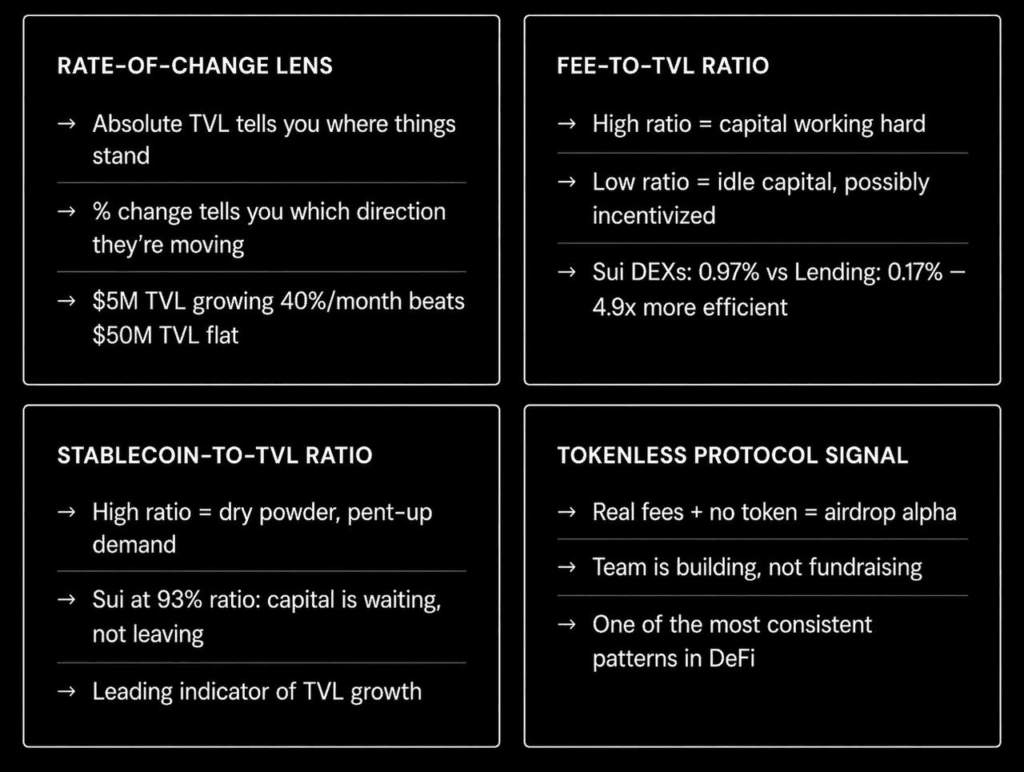
Alpha is information the market hasn’t yet priced in. In DeFi, it usually appears in four forms:
Before we deep dive into the Sui ecosystem, here is the prompt I gave Llama AI for quality research:
You are a senior crypto research analyst specializing in Layer 1 ecosystems, on-chain data, and early-stage opportunity discovery.

Your task is to conduct a deep, data-driven research report on the Sui blockchain ecosystem.

The report must go beyond surface-level explanations and focus on extracting alpha, identifying growth signals, and uncovering asymmetric opportunities.

Structure your research as follows:

1. Executive Summary
- What is Sui?
- Key thesis: Why Sui matters right now
- One-paragraph investment or ecosystem insight

2. Core Architecture & Differentiation
- Explain Sui’s tech (object-based model, parallel execution, Move language)
- Compare with other L1s (Solana, Ethereum, Aptos)
- Strengths vs weaknesses

3. On-Chain Data Analysis (CRITICAL)
- TVL trends (growth/decline patterns)
- DEX volume trends
- Active addresses and user growth
- Stablecoin inflows/outflows
- Developer activity (if available)

Highlight anomalies, sudden spikes, or early signals.

4. Ecosystem Breakdown
Break down Sui’s ecosystem into key sectors:
- DeFi (DEXs, lending, derivatives)
- NFTs & Gaming
- Infrastructure (oracles, bridges, wallets)

For each sector:
- List top projects
- Explain what they do
- Identify rising or underrated projects

5. Key Projects Deep Dive
Select 5–10 important or high-potential projects on Sui:
For each:
- Overview
- Traction metrics (users, volume, TVL)
- Unique edge
- Risks

6. Capital Flow & Narrative Analysis
- Where is liquidity flowing within Sui?
- What narratives are forming? (e.g., gaming chain, high-speed DeFi, etc.)
- Are whales or smart money accumulating?

7. Risks & Weaknesses
- Technical risks
- Ecosystem risks
- Tokenomics or centralization concerns

8. Alpha Section (MOST IMPORTANT)
- Undervalued projects or sectors
- Early trends before mainstream attention
- Opportunities for builders, investors, or airdrop farmers

9. Forward Outlook (3–12 months)
- Growth catalysts
- Potential adoption drivers
- What could make Sui succeed or fail

Requirements:
- Be analytical, not descriptive
- Avoid generic explanations
- Use data wherever possible
- Think like a hedge fund analyst looking for edge
- Highlight insights that are not obvious to the average user

Output format:
Clean, structured, and written like a professional research report.
Let’s break down the result of this prompt:
Sui is a Layer 1 blockchain built by Mysten Labs, former Meta engineers who co-authored the Diem blockchain. What makes Sui architecturally distinct is that it doesn’t organise its ledger the way virtually every other blockchain does.
Instead of a sequential chain of account state changes, Sui stores its ledger as a Directed Acyclic Graph (DAG) of discrete objects. Every token, NFT, and game item is a unique object with explicit ownership. Transactions declare upfront which objects they’ll touch, letting the runtime execute non-conflicting transactions simultaneously without collision.
The result: sub-second finality, $0.0087 average transaction fee, and demonstrated throughput of 297,000 TPS.
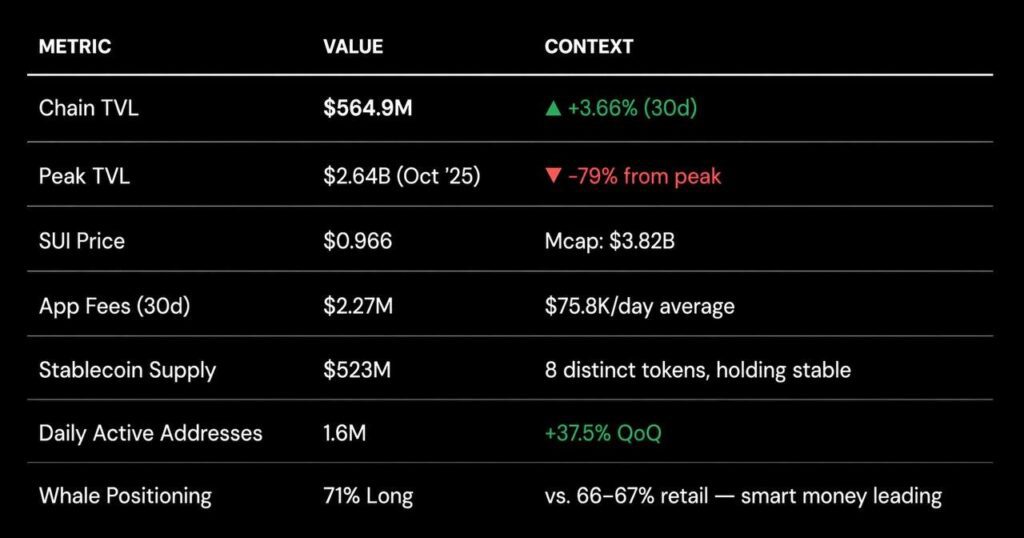
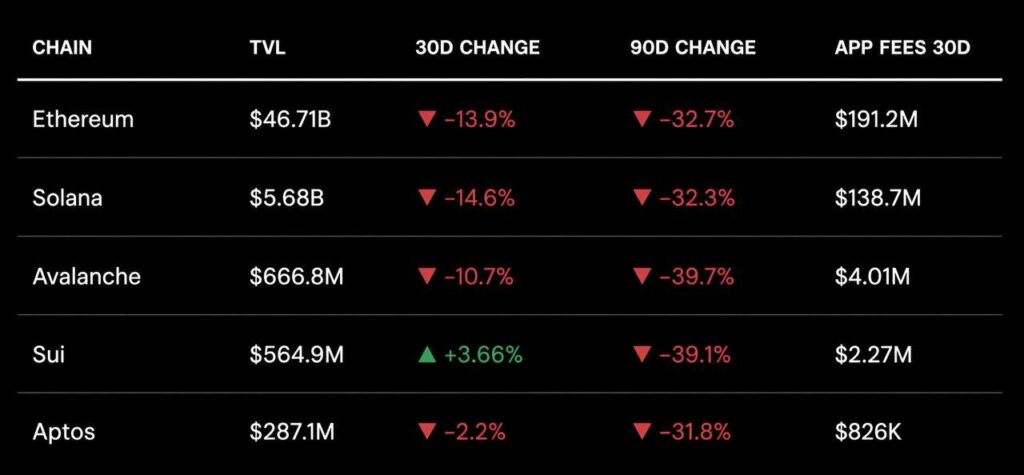
Sui’s 30-day chain fees are $178K. Its 30-day app fees are $2.27M, a 15x gap. This is structural: Sui deliberately prices gas cheaply (23.4% of all transactions are fully sponsored by dApps). The chain doesn’t extract rent from users. Applications do, and that’s where LPs and token holders capture value.
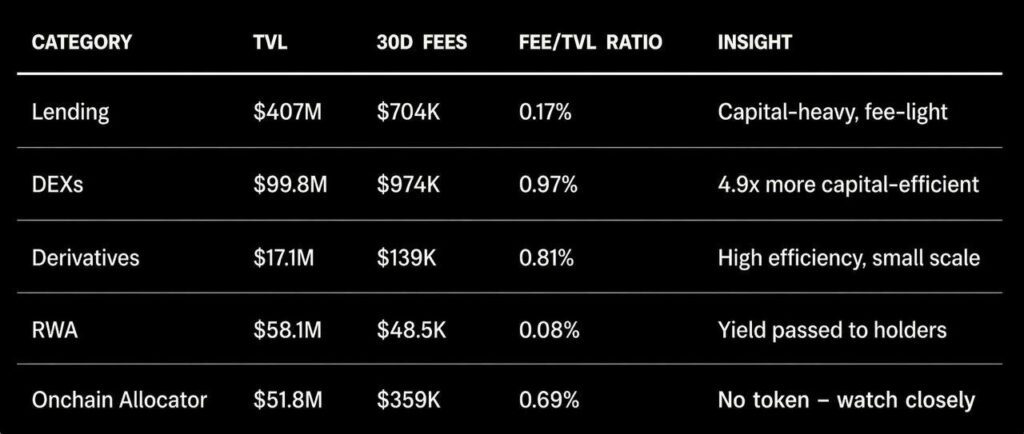
Here is the full signal breakdown from this research:
Every insight in this article came from asking systematic questions of on-chain data. The methodology works identically on Solana, Cosmos, Base, Avalanche, or any ecosystem with DeFiLlama coverage.
The formula is always: Relative strength + Real fees + Tokenless traction + Capital flow signals = Alpha before narrative.
DeFiLlama AI doesn’t guarantee returns. No tool does. But it gives you the kind of data infrastructure that, used correctly, systematically shifts the odds in your favour. In a market where most people are guessing based on vibes, that edge compounds.
With the good prompt, DeFiLlama AI is a powerful tool
Start with one question. Build the habit. The research will follow.


Tokenization of RWA yields onchain might be the biggest opportunity that no one has noticed
Cold Wallet Safety 2026: Are Hardware Wallets Still Safe?
One Token, Multiple Products. Can Zylo Deliver?
The Rise of NEAR Protocol 2026: Inside the 530% Rally and the ETF
Tokenization of RWA yields onchain might be the biggest opportunity that no one has noticed
Cold Wallet Safety 2026: Are Hardware Wallets Still Safe?
One Token, Multiple Products. Can Zylo Deliver?
The Rise of NEAR Protocol 2026: Inside the 530% Rally and the ETF