Tokenization of RWA brings real-world asset yields onchain, creating new opportunities for fixed income and DeFi investors.
Tokenization of RWA is emerging as a major opportunity in onchain finance, bringing real-world asset yields into DeFi. As the $140 trillion global fixed income market moves onchain, major institutions, including Apollo, BlackRock, and Paxos, are converging on Pendle to access and trade fixed-yield opportunities.
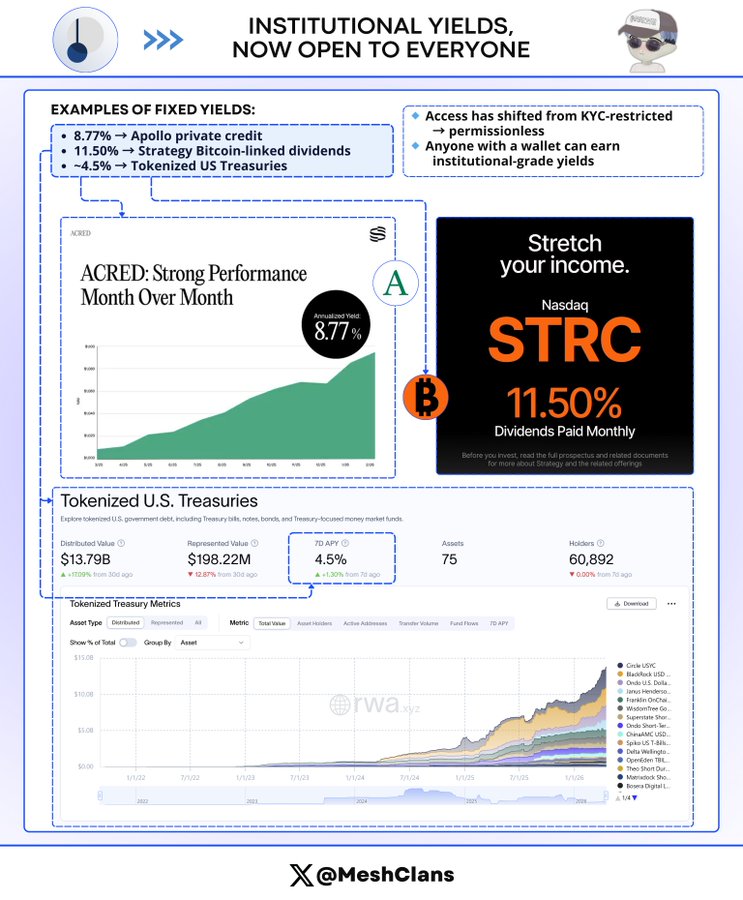
The shift here is significant imo, Institutional-grade yields that used to require KYC are now accessible to anyone with a wallet. because, you can now lock in 8.77% fixed on Apollo’s private credit fund, secure 11.50% on Strategy’s Bitcoin-linked dividends, or as well capture about 4.5% on tokenized US Treasuries
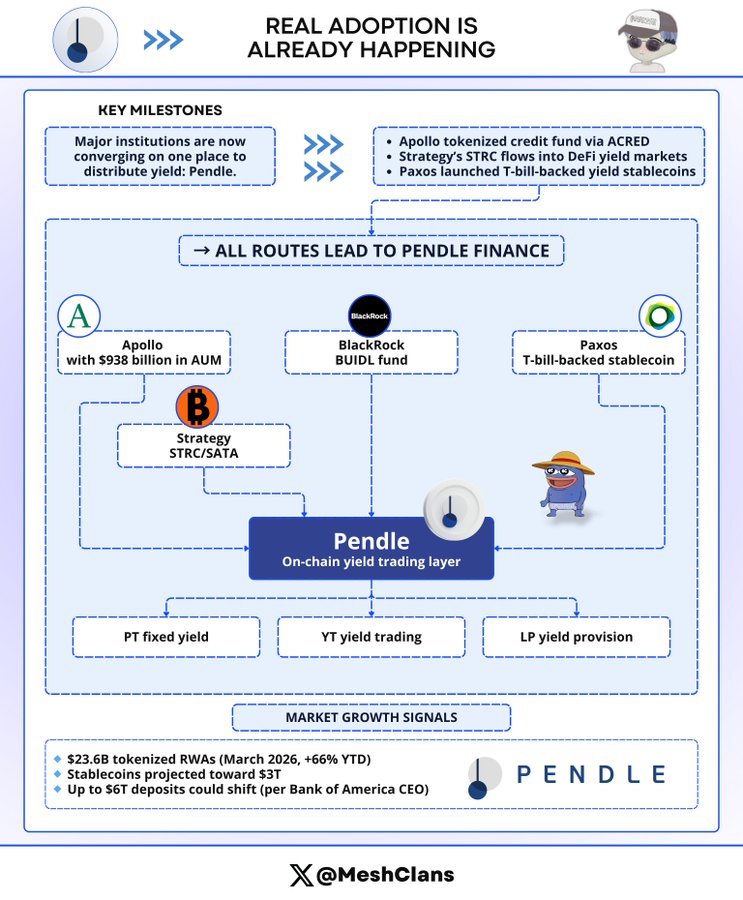
In recent months, we’ve witnessed Apollo tokenize its credit fund through ACRED, Strategy’s STRC preferred stock flow into DeFi yield markets, and Paxos launched the first regulated T-bill-backed stablecoin with fixed-rate yield instruments. Each of these watershed moments shares one common thread -> they all route through Pendle
The pattern becomes clearer as Pendle still remains the center for tokenization of RWA yields onchain, providing high fixed yield for anyone.
The numbers shows how evident and true the theoritical arguments are, As tokenized real-world assets on public blockchains hit $23.6 billion in March 2026, up about 66% since the start of the year. Treasury Secretary Scott Bessent called $3 trillion in stablecoin market cap “reasonable,” which tells a projection that seemed aggressive just months ago but now feels conservative given the trajectory
Also, the Bank of America CEO Brian Moynihan delivered perhaps the most telling signal around January this year, telling that up to $6 trillion in bank deposits could shift to stablecoins if traditional institutions don’t adapt
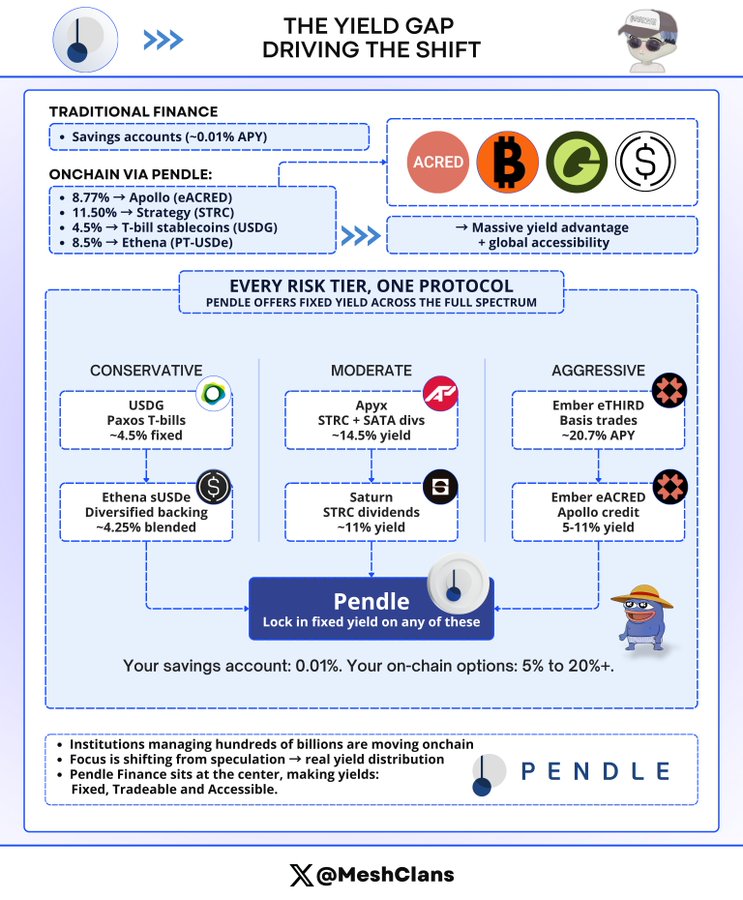
The yield gap explains why this matters. Chase’s standard savings accoun sits around 0.01% annual percentage yield, compared that to what Pendle users are locking in:
-> 8.77% fixed on Apollo’s private credit (eACRED)
-> 11.50% on Strategy’s STRC dividends (Saturn/Apyx)
-> 4.5% on T-bill backed stablecoins (USDG)
-> 8.5% on Ethena’s delta-neutral strategy (PT-USDe)
Most sustainable and highly efficient fixed yields on institutional-grade assets, direclty accessible to anyone. Not promotional rates or limited-time offers
Lets say we keep experimental protocols or speculative tokens aside. Apollo, BlackRock, Paxos, and Strategy these are institutions managing hundreds of billions in real capital, and are building onchain infrastructure to distribute yield. They’re all choosing Pendle as the venue to make that yield accessible and tradeable
Understanding Pendle’s position requires understanding what it does and who it serves. Pendle doesn’t issue stablecoins, manage credit funds, hold Bitcoin, or tokenize treasuries. They democratize access to institutional-grade fixed income
When Apollo offers ACRED (its private credit fund), traditional access requires:
-> Accredited investor status ($1M+ net worth or $200K+ annual income)
-> Minimum investments of $50k – $250k
-> Geographic restrictions mostly US-only in many cases
-> Lengthy KYC processes taking weeks
When Apollo’s ACRED came to Pendle through Ember Protocol, anyone could now:
-> Access the same 8.77% yield with as low as $10
-> Lock in fixed rates for 3-12 months
-> Trade positions instantly without redemption delays
-> Maintain complete anonymity (no KYC on Pendle)
The transformation happens through Pendle’s PT/YT mechanism, which sounds complex but is simpler than it looks. The protocol splits any yield-bearing asset into two tradeable components:
🔶Principal Tokens (PT) – Redeemable for the underlying asset at maturity. Trades at a discount that reflects the fixed yield you’re locking in
🔶Yield Tokens (YT) – Captures all future yield generated until maturity. A leveraged bet on yield rates staying high
Taking Paxos ($USDG) as an example. When Paxos issues USDG backed by US Treasuries generating 4-5% yield, you have options:
-> Buy PT-USDG and lock in 4.2% fixed for six months
-> Buy YT-USDG to speculate on yields rising above 4.5% (for leveraged upside)
-> Sell your YT-USDG to collect upfront capital on future dividends
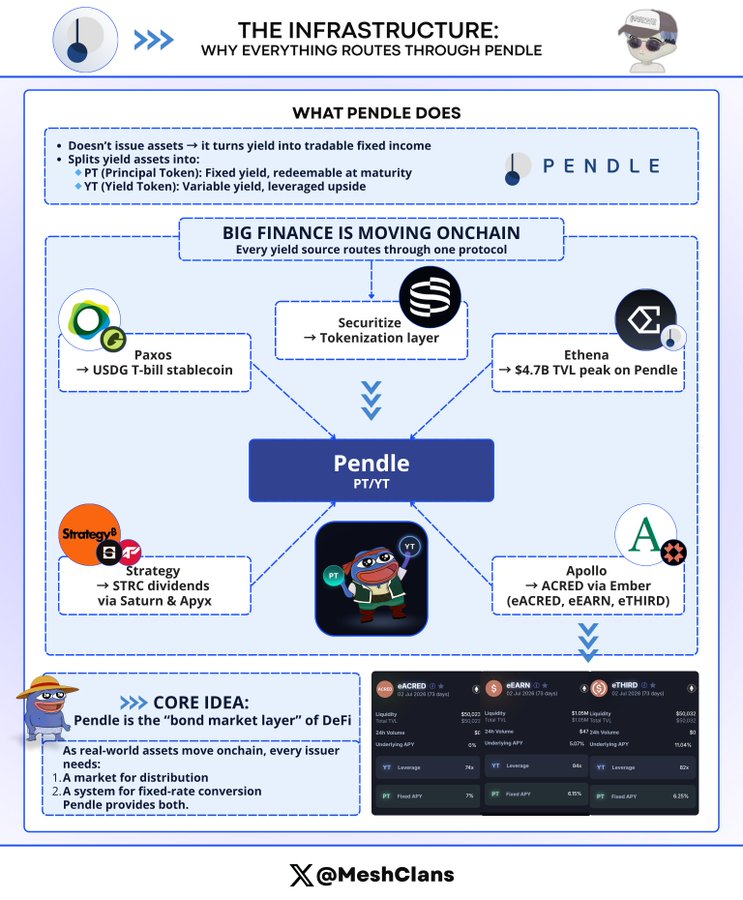
Every RWA issuer eventually finds their way to Pendle for a simple reason: the protocol isn’t competing with them but provides the infrastructure layer that makes their offerings accessible to everyone while giving institutions the fixed-rate instruments they need
Apollo Global Management, with $938 billion in AUM, represents old-guard institutional finance at its peak. For decades, Apollo’s credit funds were exclusively available to ultra-high-net-worth individuals and institutional investors. The financial barrier was high, but the structural barrier was even higher
When Apollo tokenized its diversified credit fund through ACRED in partnership with Securitize, it opened the door. ACRED crossed $100 million in assets under management by September 2025, which demonstrated the institutional appetite for onchain private credit
But tokenization alone doesn’t solve accessibility. Buying ACRED directly still requires accredited investor status and substantial minimums. Ember Protocol and Pendle changed everything
@EmberProtocol created three wrapped instruments now trading on Pendle, w/ each nreaking through traditional access barriers:
1️⃣ eACRED – This packages Apollo’s private credit fund into a fixed-rate tradeable instrument. For the first time a retail investor in Nigeria can lock in 8.77% fixed yield on the same corporate credit portfolio that Apollo manages for sovereign wealth funds w/ zero minimums, zero KYC + instant settlement
2️⃣ eEARN – Wraps Ember’s managed stablecoin strategy, giving anyone fixed-rate access to professional yield farming without active management
3️⃣ eTHIRD – Leverages cross-chain basis trades currently delivering 20%+ APY on USDC, creating arbitrage opportunities between funding rates across different protocols and chains
FYI, each instrument represents a different risk/return profile and generates variable yield. Pendle multiplies the utility, allowing anyone trade on Pendle to lock in fixed rates
The relationship between Pendle and Ethena has become one of the most significant protocol-to-protocol partnerships in DeFi. Ethena’s USDtb was launched and backed by BlackRock’s BUIDL fund w/ $500 million in tokenized US Treasuries providing baseline yield
Ethena’s innovation goes deeper by combining T-bill yield with crypto market funding rates, generating returns that shift based on market conditions where positive crypto funding drives yields higher while negative funding is cushioned by T-bill backing
This creates exactly the kind of yield volatility that makes Pendle valuable. Treasury managers wouldnt like want to wake up wondering if today’s funding rate is +15% or -3%. They would prefer a contract that guarantees 8.5% for the next 90 days, regardless of what crypto markets do
Interestingly not only has Pendle met this demand but around September last year, Ethena represented over $4.7 billion in TVL on Pendle, making it the single largest yield source in the protocol’s history. Monthly trading volume also hit $5.54 billion during the peak of the Sats airdrop campaign, driven by institutional PT-USDe demand from Aave collateral looping strategies
Plus, peak swap fees reached $3.6 million in a single month, when implied yields were volatile and the Shards campaign drove speculative YT buying. Those fees showed and represented the demand for yield price discovery and fixed-rate conversion
What If Feels Like When Regulated Stablecoins Meet DeFi Yield
@Paxos Global Dollar (USDG) launched with something most stablecoins lack: regulatory compliance from day one. Overseen by the Monetary Authority of Singapore and compliant with the EU’s MiCA framework, USDG checked every box that institutional compliance officers care about
Paxos launched USDG integration on Pendle in March 2026, creating the first high-fidelity fixed income markets for T-bill backed assets in DeFi.
And the response was almost immediate w/ $46 million in TVL within the first month, prompting Paxos and the Global Dollar Network to increase USDG incentives on Pendle from $150k to $390k
@Strategy has spent years converting corporate treasury into Bitcoin. The company holds over 500,000 BTC, making it the largest corporate Bitcoin holder on the planet. In February 2025, Strategy innovated again with STRC, a Nasdaq-listed perpetual preferred stock paying monthly cash dividends funded by the company’s operations
STRC launched with a 9% dividend yield. Strategy’s board increased the rate seven consecutive months, reaching 11.50% by March 2026. This created something the market had never seen, in a way to earn yield on Bitcoin exposure without lending your coins or using derivatives
But STRC trades on Nasdaq in traditional stock markets with five-day trading weeks, settlement delays, and no composability with DeFi protocols
Two projects emerged to solve this bottleneck, Saturn and Apyx
@saturn_credit launched on Ethereum mainnet, with a dual-token model designed to channel STRC dividends into DeFi. The protocol mints USDat and sUSDat (the staked, yield-bearing version)
When users stake USDat, saturn reallocates reserves from Treasuries into STRC, capturing those 11.50% monthly dividends and passing them through to sUSDat holders. The yield chain flows: Bitcoin -> MSTR stock -> STRC preferred stock -> sUSDat holders
Saturn crossed $40 million in TVL within 24 hours of launch. They integrated with Pendle, creating PT-sUSDat and YT-sUSDat pools that reached $5 million in less than a day
The real shift here is the democratization of Bitcoin-linked yield:
>> Traditional STRC access:
– Purchase through brokerage account (US-only)
– Minimum 100 shares ($10,000+ investment)
– Monthly dividends paid in USD to brokerage
– Five-day trading week, settlement delays
– Capital gains taxes on every trade
>> Pendle PT-sUSDat access:
– Connect wallet (global and permissionless)
– Invest any amount ($1 minimum)
– Lock in 11.50% fixed for six months
– 24/7 trading, instant settlement
– Tax efficiency of holding until maturity
@apyx_fi launched with a similar but distinct model, creating apxUSD (non-yielding) and apyUSD (yield-bearing) backed by variable rate perpetual preferred stocks like STRC, with a team composed of Kraken veterans who built the protocol through DeFi Development Corp (Nasdaq: DFDV), giving it institutional credibility
The growth curve tells the story as Apyx went from zero to $82.6 million in combined TVL across Pendle pools in 47 days, representing roughly $1.76 million in average daily TVL accumulation, with the apyUSD pool alone sitting at $44.7 million, making it one of the larger dividend-backed stablecoin pools on Pendle.
Both Saturn and Apyx prove the same thesis: when you create novel yield sources in crypto, Pendle is the natural venue to make that yield tradeable, hedgeable, and fixed-rate accessible.
Since inception, Pendle has processed $69.8 billion in yield trading volume. This represents the actual notional value of yield that have been bought, sold, and settled through the protocol
The infrastructure is already in place, the institutional partnerships are forming, and the regulatory frameworks create structural demand for secondary yield trading venues
TradFi spent decades building futures exchanges, options markets, and interest rate swap infrastructure because yield volatility creates hedging demand
That same dynamic is emerging in DeFi. As yield sources proliferate the need for yield price discovery and fixed-rate conversion accelerates
The democratization is already happening:
-> Apollo’s private credit (8.77% fixed) – previously $250K minimum, now accessible with $10
-> Strategy’s STRC dividends (11.50% fixed) – previously US brokerage only, now global and permissionless
-> Paxos T-bill yields (4.5% fixed) – previously institutional only, now open to all
-> Ethena’s delta-neutral strategy (8.5% fixed) – previously hedge fund territory, now retail accessible
As more institutions tokenize real-world assets (private credit, commercial real estate, commodities, structured products) each new yield source amplifies Pendle’s value proposition because every tokenized asset needs both a market where anyone can access it and a mechanism to convert variable yield into fixed rates, and Pendle provides both of these critical functions.
This explains why Pendle has settled $69.8 billion in yield trading volume, why Apollo routes through it, why MicroStrategy’s dividends flow through it, why BlackRock-backed stablecoins trade on it, and why Paxos integrated it. Pendle isn’t just protocol infrastructure. It’s the bridge making the $140 trillion fixed income market accessible to anyone with a wallet
Real World Asset tokenization is happening now with hundreds of billions in institutional capital deployed. Apollo ($938B AUM) is tokenizing credit funds. BlackRock is backing stablecoins with T-bills. Paxos is launching regulated digital dollars. Strategy’s dividends are flowing on-chain through Saturn and Apyx.
Each brings different assets, different risk profiles, different yield characteristiTokenization of RWA yields onchain might be the biggest opportunity that no one has noticed
The breakthrough: yields that required accredited investor status, six-figure minimums, and geographic restrictions are now available to anyone with just an internet connection at minimum cost
-> Want 8.77% fixed on Apollo’s private credit fund? — $10 gets you started.
-> Want 11.50% on Strategy’s Bitcoin dividends? pendle serves you literally with no brokerage account needed
-> Want 4.5% on tokenized US Treasuries? No KYC required
-> Want to lock in these rates for 3, 6, or 12 months? you can Trade PT tokens on Pendle
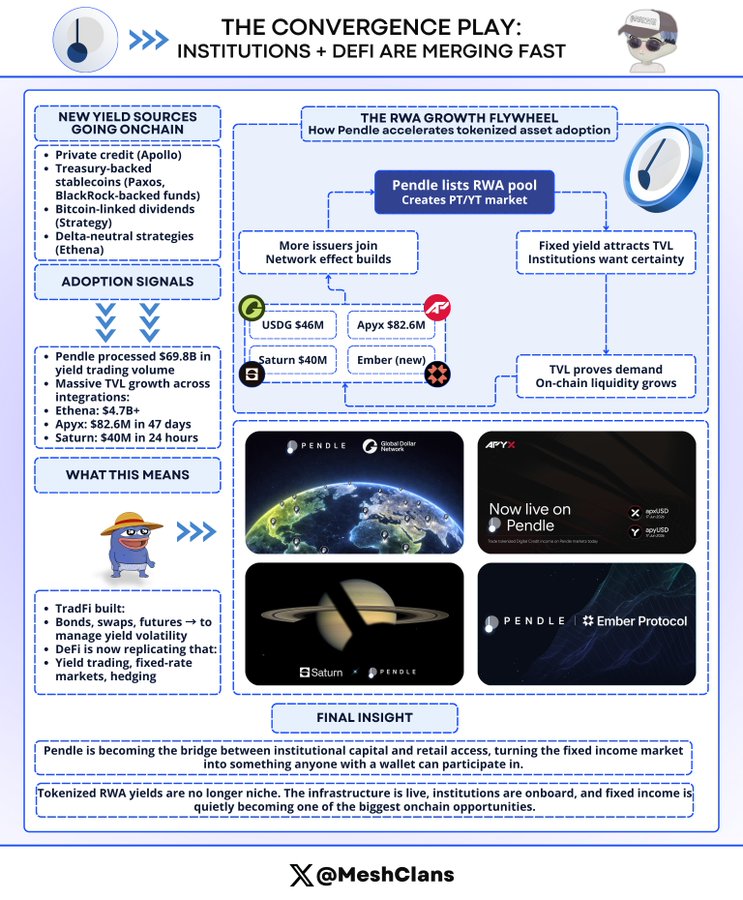
Traditional finance doesn’t realize it needs this onchain bond market yet. Bank of America CEOs warn about deposit flight. Treasury Secretaries project trillion-dollar stablecoin markets. The GENIUS Act creates regulatory gaps that DeFi fills. The convergence is accelerating toward a future where Pendle has become the center for tokenization of RWA yields on-chain, providing high fixed yield for anyone
And this is just the beginning, Job’s not done yet, but it will!cs. But they all converge on Pendle when they need to make that yield accessible to everyone and tradeable in fixed-rate formats
The breakthrough: yields that required accredited investor status, six-figure minimums, and geographic restrictions are now available to anyone with jjust an internet connection at minimum cost
-> Want 8.77% fixed on Apollo’s private credit fund? — $10 gets you started.
-> Want 11.50% on Strategy’s Bitcoin dividends? pendle serves you literally with no brokerage account needed
-> Want 4.5% on tokenized US Treasuries? No KYC required
-> Want to lock in these rates for 3, 6, or 12 months? you can Trade PT tokens on Pendle
Traditional finance doesn’t realize it needs this onchain bond market yet. Bank of America CEOs warn about deposit flight. Treasury Secretaries project trillion-dollar stablecoin markets. The GENIUS Act creates regulatory gaps that DeFi fills. The convergence is accelerating toward a future where Pendle has become the center for tokenization of RWA yields on-chain, providing high fixed yield for anyone
And this is just the beginning, Job’s not done yet, but it will!

Research Analyst & Writer | DeFi • RWAs • Stablecoins • Onchain Analysis | @pendle_fi evangelist | @redstone_defi advocate
https://t.co/fLKbtmzxvv


Tokenization of RWA yields onchain might be the biggest opportunity that no one has noticed
Cold Wallet Safety 2026: Are Hardware Wallets Still Safe?
One Token, Multiple Products. Can Zylo Deliver?
The Rise of NEAR Protocol 2026: Inside the 530% Rally and the ETF
Tokenization of RWA yields onchain might be the biggest opportunity that no one has noticed
Cold Wallet Safety 2026: Are Hardware Wallets Still Safe?
One Token, Multiple Products. Can Zylo Deliver?
The Rise of NEAR Protocol 2026: Inside the 530% Rally and the ETF