Credible Finance is building T+0 global payments with stablecoins and local rails. Explore CRED, PayFi, real payment volume, and risks.

Author: Akshat Thakur
Credible Finance is building a payment orchestration platform that combines local fiat payment rails with stablecoin liquidity. It gives businesses access to T+0 pay-ins and payouts, even when traditional payment providers reject or underserve them.
The platform targets a major problem in global payments. Traditional rails can take one to three days to settle and often carry high fees and hidden FX spreads. Businesses operating in emerging markets or higher-risk sectors also struggle to access reliable payment infrastructure.
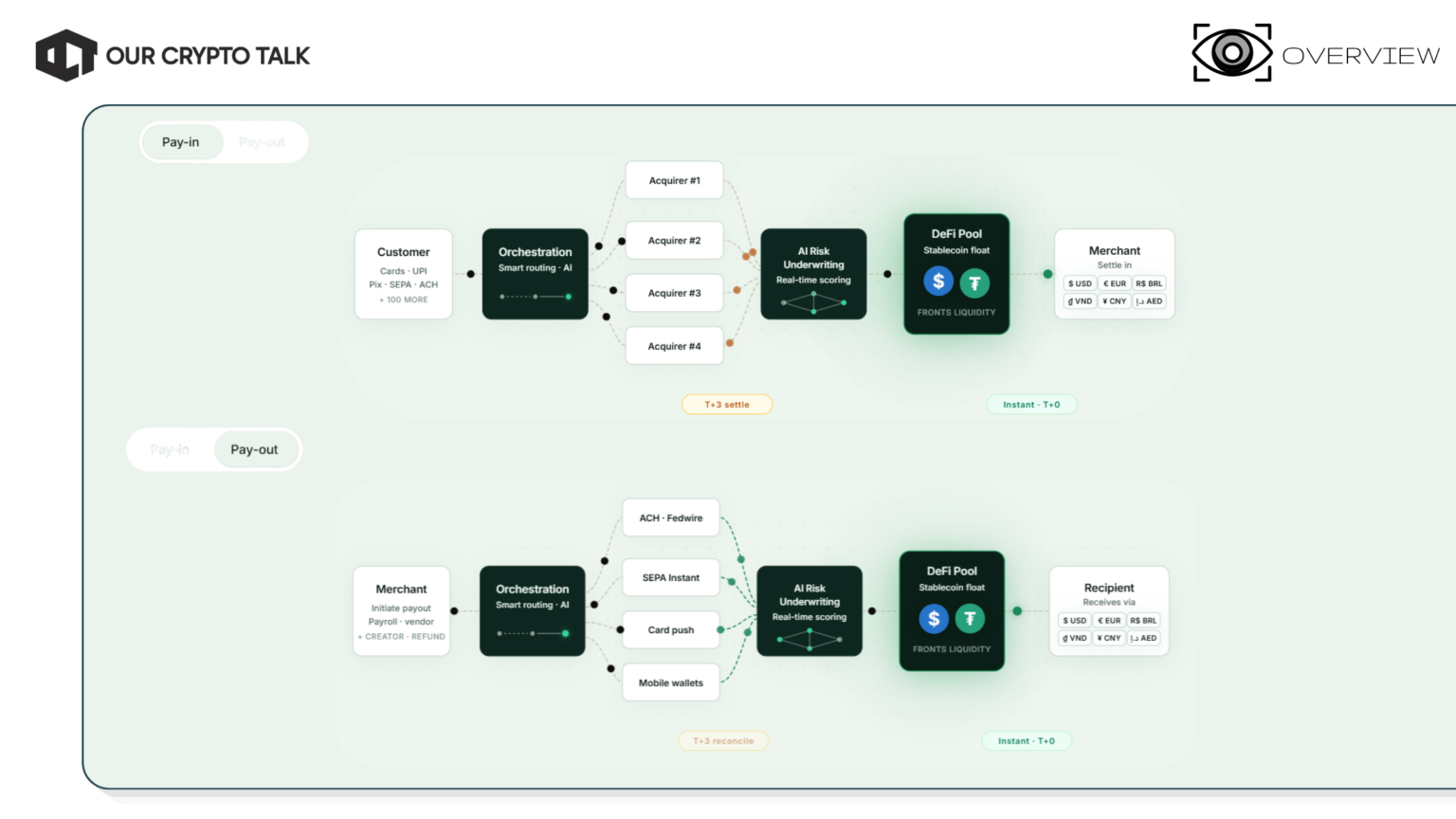
Credible solves this by separating payment settlement from traditional clearing. Merchants can receive stablecoins or local fiat instantly while the underlying payment rails settle later. A PayFi credit layer advances the settlement using short-duration liquidity backed by actual payment receivables.
The timing is important. Stablecoin payments have moved from an experiment into a growing part of global commerce. Businesses now want faster cross-border settlement without relying entirely on traditional banking infrastructure.
Credible is entering that market with real activity already underway. The platform has processed hundreds of millions of dollars in payment volume and is approaching the $1 billion mark in cumulative volume based on recent updates. It also reports around $3.5 million in annualized revenue at a blended take rate of roughly 0.2%.
That gives Credible a stronger starting point than a typical PayFi project. It is already processing payments while building the stablecoin liquidity layer around them.
Credible Finance operates in a crowded payments market. Traditional providers such as Stripe, Adyen, and Checkout.com already serve millions of businesses. Crypto-native payment providers also offer stablecoin settlement and cross-border payment solutions.
The difference is the segment Credible targets. Many traditional payment providers avoid prediction markets, gaming, creators, AI startups, remittance businesses, and other higher-risk or emerging-market sectors. Credible specifically builds infrastructure for these underserved businesses.
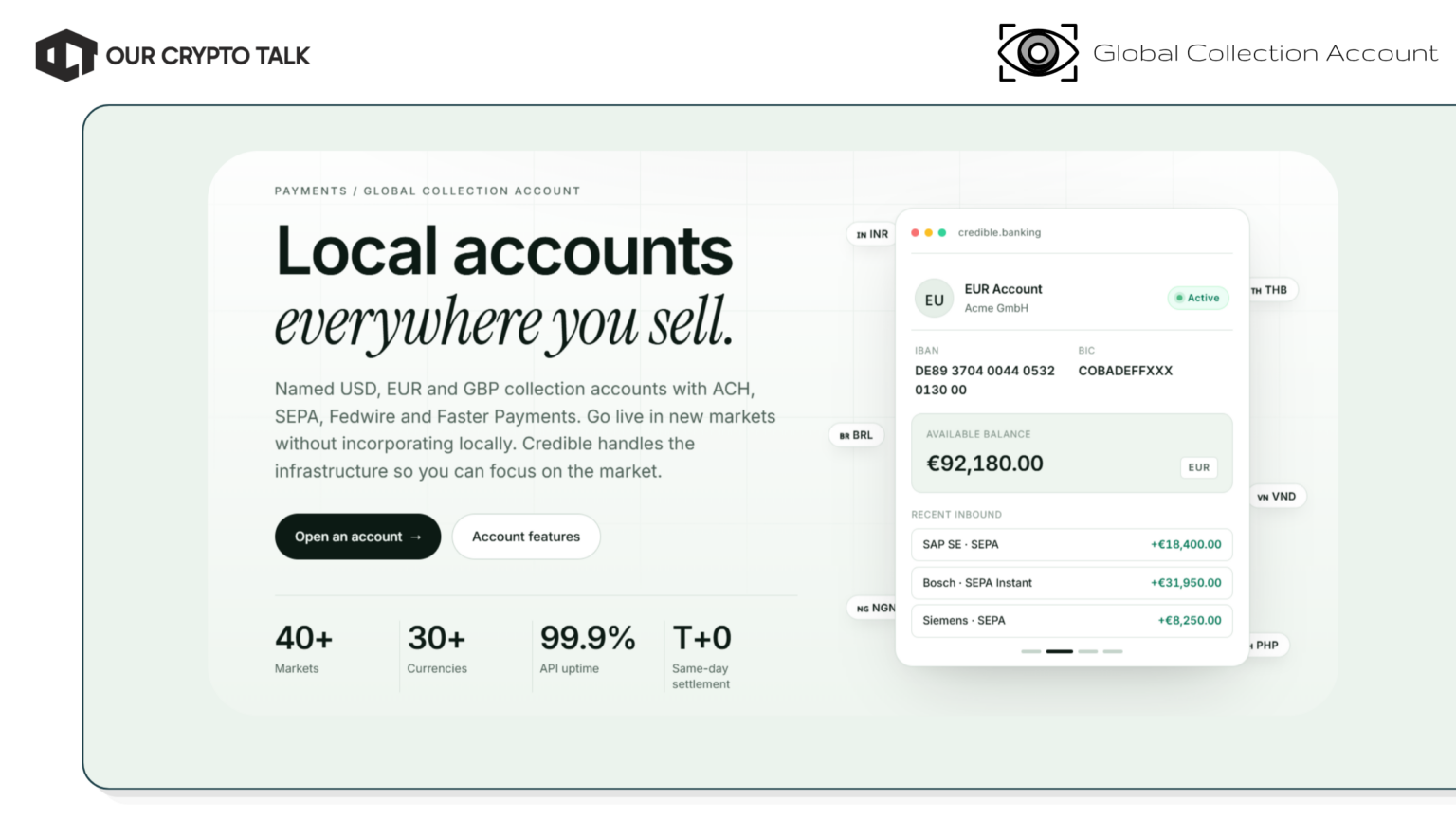
Its platform combines local collections, global payouts, stablecoin settlement, and liquidity into one system. Businesses can access more than 40 markets and 86 payment methods through a single integration.
The PayFi layer adds another part to the model. Liquidity providers fund short-duration advances against payment receivables. Merchants receive settlement immediately, while LPs earn yield from the underlying payment activity.
This gives Credible a different position from a standard stablecoin payment gateway. It does not simply move stablecoins between wallets. It connects local fiat rails, stablecoin liquidity, payment receivables, and credit into one payment stack.
The model still faces serious competition. Larger payment companies have deeper banking relationships and compliance infrastructure. Crypto-native providers can also expand into the same markets. Credible’s advantage therefore comes from execution, local payment relationships, risk management, and its focus on businesses that traditional providers often avoid.
Credible Finance was founded by operators with backgrounds in payments, fintech, and financial infrastructure.
CEO and co-founder Shrikant Bhalerao brings more than 14 years of experience across payments and fintech. His previous roles include card acquiring and issuing at Gemalto, payment orchestration at CellPoint Digital, enterprise infrastructure at Oracle, and crypto-backed credit at Nexo. He also previously co-founded Kiwimoney, a healthcare financing company that was acquired.
Co-founder and CTO Akshay Soam brings more than a decade of experience across fintech, gaming, and payments. His background includes roles at YooZoo Games and HSBC, along with a master’s degree in AI and machine learning.
This background fits the problem Credible is trying to solve. Payment infrastructure requires more than smart contracts. It requires banking relationships, compliance, fraud controls, payment operations, and liquidity management.
The team is fully doxxed and has stronger traditional payments experience than most early PayFi projects. Its previous work also gives Credible relevant experience across both fintech and crypto.

Credible Finance has raised support from investors, accelerators, and the broader crypto ecosystem.
Outlier Ventures provided the project’s first institutional cheque in 2024 through its RWA Base Camp. Credible later participated in Colosseum’s Solana-focused accelerator and received support from Circle, Superteam, and other ecosystem players.
The biggest funding event came in July 2026 through a MetaDAO curated ownership raise for $CRED. The raise attracted approximately $32.7 million to $32.8 million in commitments against a $4 million hard cap. Around 790 contributors participated, while roughly $2.3 million in institutional soft commitments were allocated on the same terms.
That makes the raise more than a typical community token sale. It showed strong demand for ownership in a live payments business and gave Credible additional capital to scale its infrastructure.
The project’s backing does not match the massive institutional funding of major global payment companies. However, the combination of accelerator support, Circle involvement, a live revenue-generating product, and the MetaDAO raise gives Credible a credible funding base for its current stage.
The bigger question now is whether the company can turn growing payment volume into durable revenue while controlling fraud, credit, liquidity, and regulatory risk.
Yes. Credible Finance runs live payment infrastructure that businesses can use today.
Merchants can create an account, complete async KYB verification, access the APIs, and set up prefunding pools without a sales call or NDA in the standard flow. The platform supports local fiat collections across 86+ payment methods in 40+ markets, T+0 payouts, global collection accounts, and settlement in USDC, USDT, USD, EUR, and GBP.
Credible uses stablecoin liquidity to advance settlement. Merchants receive funds immediately while the underlying fiat rails settle asynchronously, usually within one to seven days. Liquidity providers supply stablecoins to prefunding pools and earn yield against the short-term payment receivables.
The platform supports multiple chains, with Solana handling most recent settlement activity alongside Polygon and other networks. Credible also provides public API documentation and integration support for larger merchants.
The product has processed close to $1 billion in cumulative payment volume. Recent updates put cumulative volume above $990 million, while July alone contributed around $162 million.
This is not a testnet or a concept. Real payment flows from remittances, creators, dropshipping, gaming, and other businesses already run through the platform.
The strongest traction signal is payment volume. Credible has grown from tens of millions in processed volume in late 2025 to more than $990 million in 2026.
July alone generated around $162 million in payment volume. The company also reported around $324,000 in gross revenue for July at a blended take rate of roughly 20 basis points. Earlier updates put its annualized revenue run rate near $3.5 million.
The July 2026 MetaDAO ownership raise provides another strong signal. The raise attracted around $32.7 million to $32.8 million in commitments against a $4 million hard cap. Around 790 contributors participated, while roughly $2.3 million in institutional soft commitments joined on the same terms.
The raise was more than eight times oversubscribed. Credible only accepted the capped amount and refunded excess commitments.
The PayFi model also requires liquidity providers to deploy stablecoins into prefunding pools. That creates real capital commitment behind the platform’s financing layer.
Social metrics matter less here. A large follower count or community campaign cannot prove payment demand. Sustained payment volume, revenue, and merchant usage provide much stronger evidence.
The main caveat is that rapid volume growth does not automatically mean strong long-term economics. Credible still needs to show that it can maintain growth, control fraud and receivables risk, and convert payment volume into durable margins.
CRED is the ownership and governance token of Credible Finance. It launched through MetaDAO on July 17, 2026.
The token has a total supply of approximately 22.66 million CRED. It launched at $0.40, giving the project an implied FDV of roughly $9.1 million.
Around 57% of the supply, or approximately 12.9 million CRED, was liquid at launch. That gives CRED a much higher initial circulating percentage than many recent low-float token launches.
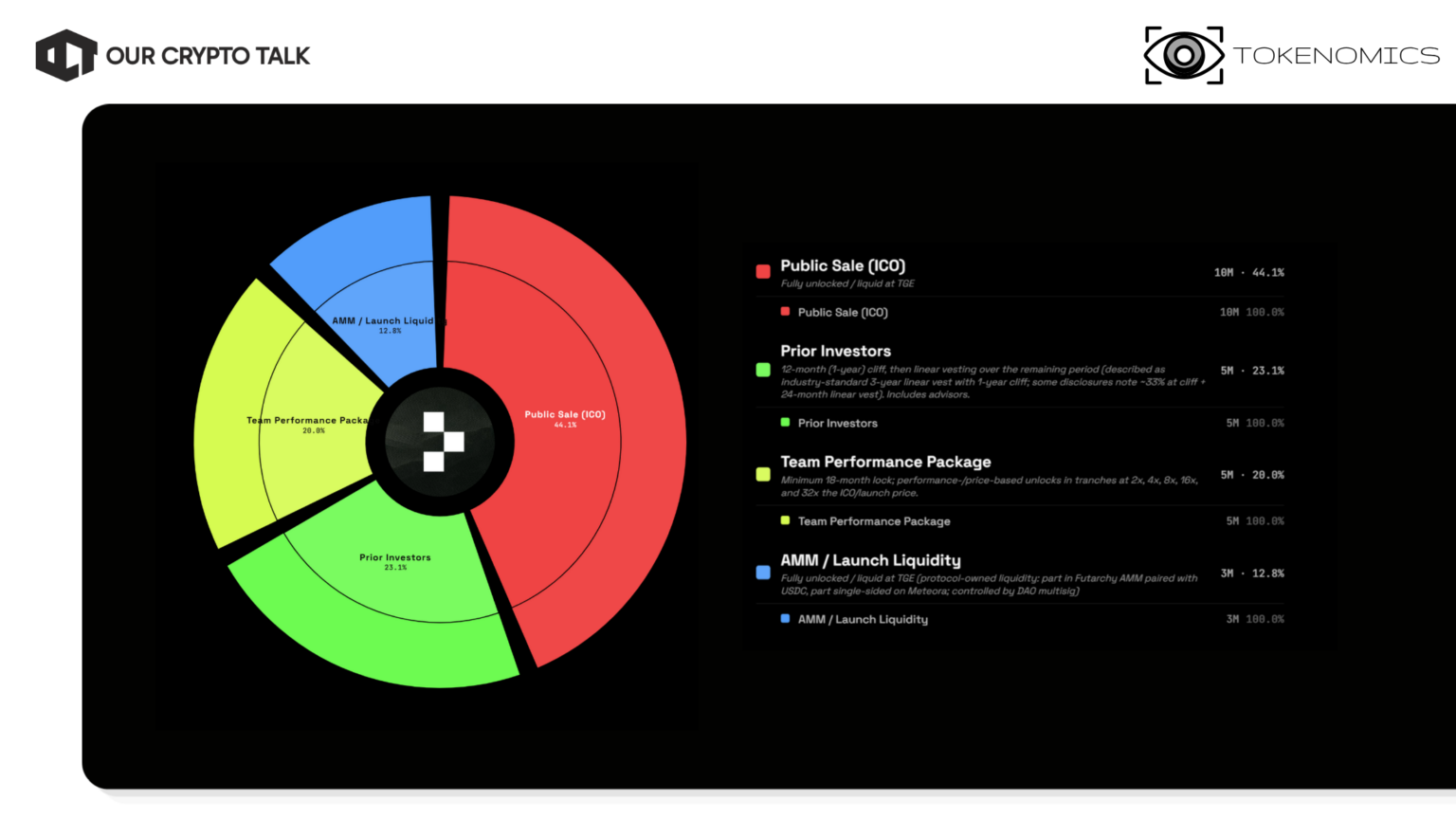
The public sale received 10 million CRED, representing about 44.1% of supply. Another 2.9 million CRED, or 12.8%, went toward AMM liquidity and remained liquid at launch.
Previous investors received around 5.23 million CRED, representing 23.1% of supply. These tokens follow a three-year linear vesting structure with a one-year cliff.
The team and performance allocation accounts for another 4.53 million CRED, or 20%. These tokens have a minimum 18-month lock before performance-based unlocks begin. The unlocks depend on price multiples ranging from 2x to 32x the ICO price.
This structure puts most of the liquid supply with the public and liquidity pools while keeping investor and team allocations locked behind longer-term conditions.
CRED does not function like a typical emissions token. It represents ownership and governance rights through MetaDAO’s futarchy structure. Holders can participate in decisions around the entity that owns Credible’s intellectual property, treasury, growth, and potential capital-return policies.
The token’s long-term value therefore depends on the underlying payments business. More payment volume can generate more revenue, while effective governance can determine how that value benefits token holders.
The main early-access window has already closed. The MetaDAO raise and CRED TGE took place in July 2026.
CRED is now available on the secondary market, making direct token purchases the main route for investors. The entry valuation will depend on the current market price rather than the $0.40 TGE price.
Users can also participate directly in Credible’s PayFi infrastructure by supplying stablecoins to prefunding pools. These pools finance short-term payment receivables and offer yield, although they carry smart-contract, liquidity, and receivables risk.
Businesses can also become merchants or integrate Credible’s APIs for T+0 global payment collections and payouts. This represents the strongest form of product usage because it creates actual payment demand.
Governance participation is another potential route. MetaDAO decision markets are expected to give CRED holders a role in ownership and strategic decisions as the governance system becomes active.
There is no major points farm left to chase. Credible has moved beyond its pre-TGE phase. The opportunity now depends on the underlying payment business, CRED’s valuation, PayFi activity, and whether token holders gain meaningful value from ownership governance.
Credible Finance is one of the cleaner real-business and ownership-token setups in the current PayFi sector. The key question is whether its live payment volume and revenue justify the current CRED valuation.
The main capital opportunity has already passed. The MetaDAO raise in July 2026 was the primary early-entry window. Residual community campaigns and governance activity offer limited value compared with direct exposure to the business.
The original $0.40 entry price implied an FDV of around $9.1 million. Only $4 million of the roughly $32.7 million to $32.8 million in commitments was accepted. Around 57% of the total supply was liquid at TGE.
That valuation looked attractive against nearly $1 billion in cumulative payment volume and roughly $3.5 million in annualized revenue. The situation is different on the secondary market. As CRED trades above its launch price, the margin of safety depends more heavily on continued volume and revenue growth.
The strongest case for CRED comes from the underlying business. Credible already processes real payments, generates revenue, and serves businesses that traditional payment providers often reject. Its ownership model also gives the token a more tangible role than a standard governance token.
The main risks are clear. Payments is a low-margin and operationally demanding business. Credible must manage fraud, liquidity, chargebacks, regulatory requirements, and corridor-specific risks while maintaining its growth rate.
CRED also has no automatic value accrual. Its long-term value depends on the business growing and governance eventually creating meaningful economic benefits for token holders.
Overall, CRED is worth considering for investors who believe stablecoin-native T+0 payments will keep expanding. It is less attractive as a pure momentum trade or farming opportunity. The current valuation matters much more than the original $9.1 million launch FDV.
Credible operates in a difficult market where regulation, competition, and operational execution can matter more than technology.
Larger payment providers could eventually target the same emerging-market and high-risk corridors. Stablecoin payment companies and regional fintechs already compete across markets such as India, Brazil, Africa, and Southeast Asia. Credible’s willingness to serve underserved businesses is an advantage, but competitors can copy that strategy.
Regulation is an even bigger risk. Cross-border payments, stablecoin settlement, money transmission, AML requirements, and high-risk verticals all face regulatory scrutiny. Losing banking or payment-processor relationships could directly affect volume and revenue.
The PayFi model also creates operational risk. Credible advances settlement before traditional payment rails complete their clearing process. That requires careful management of liquidity, fraud, chargebacks, and timing mismatches.
Transparency is another factor to monitor. Earlier metrics from the project’s lending period have faced questions from independent observers. Current payment activity is more observable through Dune and company updates, but continued reporting will be important.
The core model is not technically revolutionary. Its advantage comes from combining local fiat payment rails with stablecoin liquidity and T+0 settlement. Distribution, risk management, and regulatory execution will determine whether that advantage lasts.
The biggest milestone is reaching and sustaining more than $1 billion in cumulative payment volume.
Continued monthly volume growth would provide stronger evidence that Credible is building a durable payments business. Revenue growth matters just as much because high payment volume alone does not guarantee attractive economics.
Governance activation is another important catalyst. Community proposals are expected around October 2026, roughly three months after the MetaDAO raise. Meaningful decisions around treasury and value allocation would give CRED holders a clearer reason to own the token.
New payment corridors, additional licensing, and growth of the Creddy product could also expand the addressable market.
The key question over the next 60 to 90 days is whether business growth translates into stronger token value capture.
WATCH
Credible Finance has something most PayFi tokens do not. It already operates a live payments business with close to $1 billion in cumulative volume and measurable revenue.
CRED also launched at a relatively low FDV with around 57% of supply liquid at TGE. The heavily oversubscribed MetaDAO raise and performance-based team unlocks add further alignment.
The risks remain significant. Payments is competitive, low-margin, and highly regulated. CRED also depends on future governance to turn business growth into meaningful token value.
The milestone that changes the rating is sustained monthly payment growth combined with active governance that demonstrates real control over treasury or value accrual.
Until then, Credible remains a strong Watch. The business is real, but the token still needs to prove that ownership creates durable value.
All the opinions in this article are that of the author and in no way are financial advice. Our Crypto Talk and the author always suggest you do your own research in crypto and to never take anything as financial advice that you read on the internet. Check our Terms and conditions for more info.


Tokenization of RWA yields onchain might be the biggest opportunity that no one has noticed
Cold Wallet Safety 2026: Are Hardware Wallets Still Safe?
One Token, Multiple Products. Can Zylo Deliver?
The Rise of NEAR Protocol 2026: Inside the 530% Rally and the ETF
Tokenization of RWA yields onchain might be the biggest opportunity that no one has noticed
Cold Wallet Safety 2026: Are Hardware Wallets Still Safe?
One Token, Multiple Products. Can Zylo Deliver?
The Rise of NEAR Protocol 2026: Inside the 530% Rally and the ETF