Is Web3 gaming dead? A $15 billion collapse killed 93% of projects, but game-first survivors could still rebuild the sector.

Author: Kritika Gupta
In April 2026, research firm Caladan published a report that turned “is Web3 gaming dead?” from a debate question into a statistical one. The report found that 93% of all Web3 gaming projects launched between 2020 and early 2026 are effectively dead. Investors poured between $12 billion and $15 billion into the sector through venture capital, token sales, and NFT proceeds. Most of that money is now gone. Meanwhile, the average GameFi token has fallen 95% from its peak. Quarterly VC funding collapsed from roughly $1.6 billion to $18 million, while 58% of VCs that backed GameFi recorded losses.
| Metric | Peak / Boom | Latest (Caladan / 2025–26) | Change |
|---|---|---|---|
| Cumulative capital | $12–15B deployed | Mostly written off | Structural wipeout |
| Projects effectively dead | 3,200+ projects analyzed | 93% | Category-wide failure |
| Average GameFi token | Cycle peak | −95% | Near-total drawdown |
| Annual Web3 gaming funding | $4B in 2022 | ~$360M in 2025 | −91% |
| Quarterly VC funding | ~$1.6B | ~$18M | −99% |
| GameFi share of Web3 VC | 62.5% in 2022 | Single digits in 2025 | Capital rotation |
| VCs that recorded losses | N/A | 58% | Majority underwater |
These numbers describe more than a bear-market correction. They show capital destruction across every layer of the sector, including studio equity, gaming tokens, NFT collections, guild economies, and secondary markets. Funding disappeared because most projects failed to build sustainable games or retain players once token incentives weakened. What looked like product-market fit during the bull market often turned out to be temporary demand from speculators, airdrop farmers, and players chasing yield.
But “93% dead” also means 7% survived. And that 7% looks nothing like the projects that died. Failed projects sold tokens first and promised games later. In contrast, the survivors shipped products that players continued to open even when token prices fell. They treated blockchain as supporting infrastructure and made gameplay the main reason to return.
Web3 gaming began with CryptoKitties in 2017. The game turned digital cats into breedable NFTs and gave crypto its first major blockchain gaming experiment. However, its popularity clogged Ethereum and pushed gas fees higher. As a result, CryptoKitties proved that users would pay real money for on-chain assets, but it also showed that existing blockchain infrastructure could not support a successful consumer game at scale.
The play-to-earn boom then arrived in 2020 and accelerated throughout 2021. Axie Infinity turned NFT-based creature battles into a digital labor economy and reached roughly 2.8 million daily active users at its peak. In the Philippines, for example, some players earned more from Axie than the local minimum wage. Yield Guild Games subsequently expanded the scholarship model by buying NFT assets, lending them to players, and sharing the earnings. Unsurprisingly, capital quickly followed. By 2022, Web3 gaming had attracted around $4 billion in funding and captured as much as 62.5% of all Web3 venture investment.
However, the model collapsed in 2022. Hackers drained approximately $625 million from the Ronin bridge, while Axie’s inflationary economy was already losing momentum. Consequently, token prices crashed, NFT values fell, and player rewards declined. Many “players” who functioned more like digital workers then left once their earnings dropped below their opportunity cost. Ultimately, the collapse revealed that financial incentives, rather than gameplay, had driven much of Axie’s growth.
Following the crash, the industry entered a reset during 2023 and 2024. Studios that raised capital in 2021 burned through their cash while struggling to ship finished products. Most failed. Nevertheless, the survivors gradually shifted from token-distribution systems toward actual games. By 2025 and 2026, the reckoning had arrived. Caladan reported that 93% of Web3 gaming projects were effectively dead. At the same time, Hamster Kombat briefly revived interest through Telegram before losing most of its users. Meanwhile, Off the Grid became the first major Web3 title to establish itself on Steam, while indie studios captured roughly 70% of active Web3 players. Therefore, the sector had started moving away from speculative scale and toward smaller games built around retention.
The strongest bear case against play-to-earn starts with its economic structure. Most P2E games rewarded existing players with money that new players brought into the ecosystem by purchasing tokens and NFTs. As long as demand increased, rewards appeared sustainable and user growth resembled product-market fit. However, once new inflows slowed, token prices fell, rewards collapsed, and players exited. Therefore, this was not simply a market downturn. It was a fundamental design flaw.
Axie Infinity then exposed this weakness at scale. Its 2.8 million daily active users were overwhelmingly “scholars” grinding for income rather than gamers playing for enjoyment. When Axie earnings exceeded local wages, users treated the game like a job. However, once rewards fell below the minimum wage or the opportunity cost of their time, they left. Although Axie included battles, breeding, and collectible creatures, those features could not retain most users without financial incentives.
Moreover, token rewards distorted the gameplay itself. When earning becomes the main motivation, developers optimize every system for extraction instead of enjoyment. Consequently, spawn rates, energy limits, breeding mechanics, and reward schedules become financial variables. Players begin treating the game like a spreadsheet, while balance updates function like monetary-policy decisions. At that point, the token economy controls the gameplay instead of supporting it.
Finally, VC capital amplified the illusion. Studios raised millions, launched tokens, and counted airdrop farmers, guild workers, bots, and speculators as active users. As a result, financial incentives inflated DAU figures and created ecosystems that disappeared when rewards weakened. The question was never, “Can blockchain games attract users?” Instead, it was, “Can blockchain games attract gamers?” In 2021, the answer was no. In 2026, the answer is maybe, but only if studios build a good game first.
The surviving 7% includes several very different games. However, they share one important trait: they give users a reason to play beyond token rewards. Off the Grid provides the clearest example. Gunzilla Games built a AAA-style cyberpunk battle royale with tradable in-game assets and launched it across PC and consoles. In July 2025, it also became one of the first major Web3 games to launch on Steam with cross-platform support. Gunzilla reportedly raised more than $100 million to develop its game and GUNZ ecosystem. However, no reliable public source confirms the widely repeated claim of more than 10 million downloads. Its Steam release and mainstream production quality still make it an important proof point that a Web3-enabled game can compete with traditional titles on presentation and gameplay. Steam
Other survivors followed different paths. Illuvium built a high-production open-world RPG and auto-battler ecosystem on Immutable, with ILV staking tied to its broader economy. Pixels focused on a free-to-play farming and social experience on Ronin, using simple onboarding and community-driven gameplay to support retention. Meanwhile, Star Atlas continued building its ambitious Solana-based space MMO with Unreal Engine 5 despite its token falling roughly 97% from its peak. Development alone does not guarantee success, but continued shipping separates these projects from the many token launches that never produced functional games.
Axie Infinity represents a different type of survival. Its daily active user count fell approximately 96% from its 2.8 million peak, effectively ending the original play-to-earn model. However, Sky Mavis rebuilt Ronin into a broader gaming network that now hosts titles beyond Axie. The infrastructure survivors followed a similar strategy. Immutable zkEVM simplified blockchain gaming through gasless NFT transactions and embedded wallets. Ronin evolved from Axie’s dedicated chain into a multi-game ecosystem. Beam emerged after Merit Circle shifted from running a gaming guild to building gaming-focused blockchain infrastructure.
| Survivor | What It Actually Is | Why It Survived |
|---|---|---|
| Off the Grid | AAA-style battle royale using GUNZ | Mainstream distribution, strong production quality, and blockchain as an item layer |
| Illuvium | Open-world RPG and auto-battler on Immutable | High production value, multiple game modes, and ILV staking |
| Pixels | Free-to-play farming and social game on Ronin | Simple UX, community focus, and accessible gameplay |
| Star Atlas | Unreal Engine 5 space MMO on Solana | Continued development despite severe token losses |
| Axie Infinity / Ronin | Collapsed P2E flagship and rebuilt gaming chain | Infrastructure outlived Axie’s original reward economy |
| Immutable zkEVM | Gaming-focused blockchain infrastructure | Gasless transactions and hidden blockchain complexity |
| Beam | Merit Circle’s gaming network pivot | Shift from guild speculation to developer infrastructure |
The pattern is clear. The survivors built games first and treated tokens as supporting infrastructure. They used blockchain for ownership, marketplaces, and settlement instead of making speculation the main gameplay loop. In contrast, most failed projects launched financial incentives first and hoped that a compelling game would eventually follow.
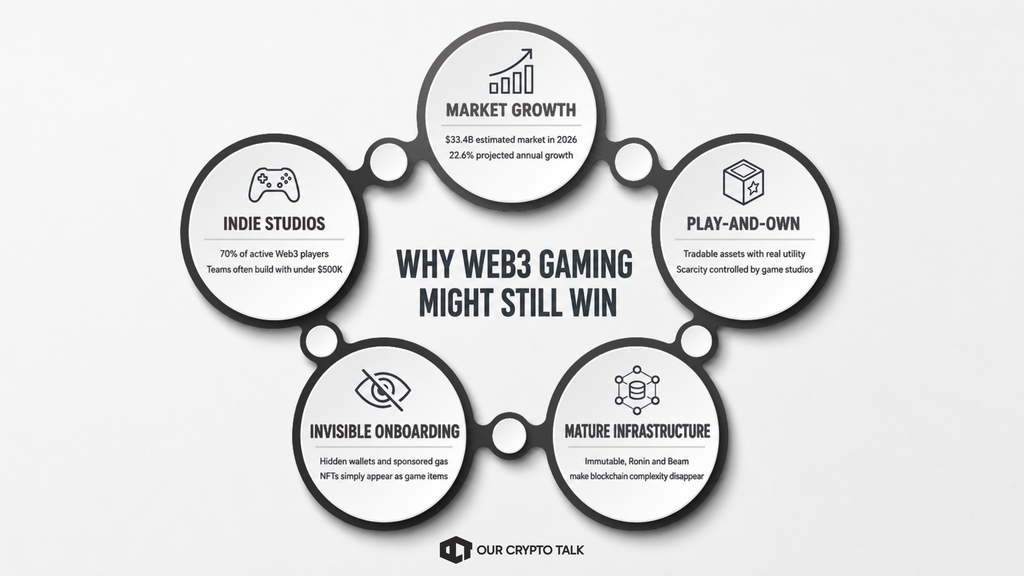
The optimistic case starts with a simple point: the market may continue growing even after most early projects failed. One widely cited estimate values Web3 gaming at approximately $33.4 billion in 2026, while another industry forecast projected 22.6% annual growth from 2024 to 2025. However, market estimates vary significantly depending on whether researchers include games, NFT marketplaces, infrastructure, and token activity. Investors should therefore treat the figures as directional rather than definitive. Even so, the forecasts suggest that Web3 gaming’s addressable market can expand while weak studios and unsustainable token economies disappear. Research and Markets forecast
More importantly, play-and-own is replacing play-to-earn. Instead of paying users to grind and sell inflationary tokens, play-and-own games give players tradable NFT assets with genuine in-game utility. Studios control item scarcity, while separate tokens handle governance, payments, or ecosystem incentives. This structure allows developers to balance the game without treating every reward decision like monetary policy. It also gives players something traditional games rarely provide: the ability to sell an item after earning or buying it. Eventually, shared standards could allow players to use certain assets across multiple games, although developers must cooperate before that vision can work at scale.
Indie studios strengthen the bull case. Industry assessments estimate that smaller developers now serve roughly 70% of active Web3 players, often through teams of five to 20 people working with budgets below $500,000. These figures remain estimates rather than independently audited sector data. Nevertheless, the broader trend makes sense. Small studios can survive with a focused community and 10,000 engaged players, while a studio that raised $50 million needs far greater scale. The AAA token model optimized for fundraising. By contrast, the indie model optimizes for retention and sustainable development.
Finally, infrastructure has matured. The strongest Web3 games no longer resemble crypto applications. They embed wallets, sponsor gas fees, and present NFTs as ordinary in-game items. Players do not need to understand seed phrases, bridges, or blockchain settlement. Immutable supports gasless NFT transactions, Ronin provides a gaming-specific network, and Beam gives developers dedicated blockchain infrastructure. Together, these systems have largely addressed the technical argument that crypto remains too complicated for gamers. The industry must now solve the harder problems: building enjoyable games, earning distribution, and convincing players that digital ownership adds value.
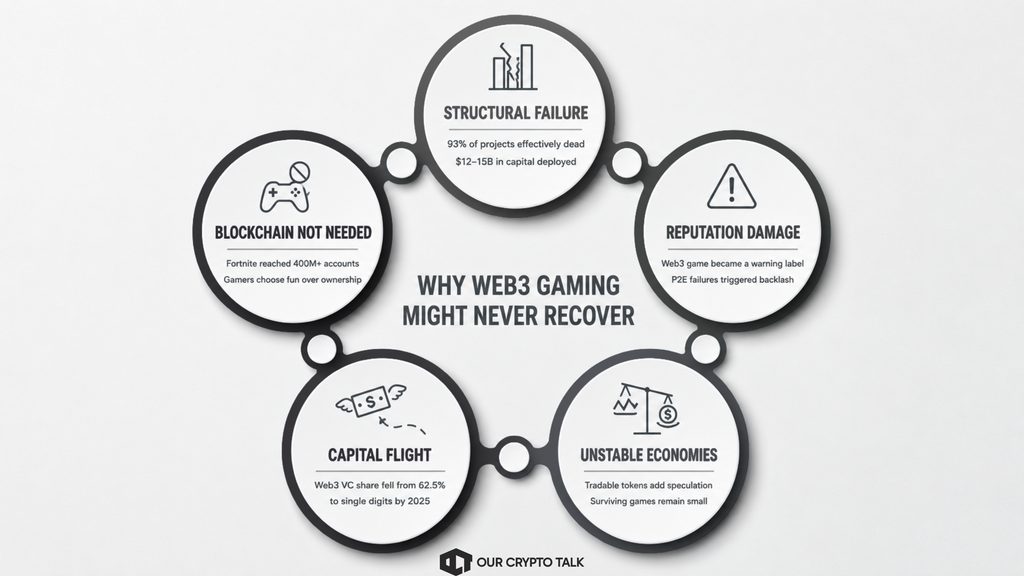
The pessimistic case begins with the scale of the failure. After investors deployed between $12 billion and $15 billion, 93% of Web3 gaming projects became effectively inactive. That does not look like a temporary downturn or a normal startup shakeout. It points to a structural failure across the category. Most projects relied on speculative tokens, unsustainable rewards, and users who disappeared when earnings declined. When nearly an entire generation of products fails for similar reasons, changing the label from play-to-earn to play-and-own does not automatically solve the underlying problem. CoinDesk
Traditional gaming also proves that successful games do not need blockchains. For example, Fortnite has attracted hundreds of millions of registered accounts without NFTs or player-owned tokens. Although the frequently cited 400 million figure refers to registered users rather than active players, the broader comparison still holds. Ultimately, gamers prioritize gameplay, performance, social experiences, updates, and competitive balance. Moreover, most have spent years buying cosmetics inside closed platforms without demanding on-chain ownership. Therefore, digital property rights may offer a genuine benefit, but that benefit will not convince players to choose an inferior game.
Beyond the lack of consumer demand, Web3 gaming also carries a serious reputation problem. Steam’s initial restriction on blockchain and NFT titles, widespread gaming-community backlash, and years of play-to-earn failures turned “Web3 game” into a warning label. Furthermore, capital has moved elsewhere. Gaming captured roughly 62.5% of Web3 venture funding in 2022, but its share fell to single digits by 2025 as investors shifted toward artificial intelligence, real-world assets, and blockchain infrastructure. Although this funding collapse does not prove that every Web3 game will fail, it shows that many professional investors no longer believe the sector can deliver venture-scale returns.
Finally, tokens can destabilize economies that developers already struggle to balance. A freely traded asset introduces outside speculators, exchange liquidity, unlock schedules, and price volatility into every gameplay decision. Consequently, a balance update can suddenly change the value of a player’s portfolio, while falling token prices can weaken demand across the entire game. Meanwhile, the remaining success stories still look small by traditional gaming standards. Off the Grid represents meaningful progress, but it remains one title. Similarly, Illuvium, Pixels, Star Atlas, and the rest of the surviving cohort serve relatively modest audiences. Thus, a few functioning games prove that Web3 gaming can survive, but they do not yet prove that it can recover at scale.
Web3 Gaming Is Dead vs Web3 Gaming Is Evolving
Web3 gaming as it existed in 2021 is dead. Play-to-earn operated like a financial scheme disguised as a gaming model, and it collapsed exactly as unsustainable financial structures collapse. New demand disappeared, rewards fell, token prices crashed, and players left. In total, 93% of projects died and the sector lost or stranded more than $11 billion. The experiment failed.
However, the technology survived. The remaining 7% are building something fundamentally different: games that prioritize fun while blockchain provides ownership, portability, settlement, and marketplace infrastructure underneath. These projects do not need players to understand token emissions or wallet mechanics. Instead, they use blockchain as a supporting layer that improves the game without becoming the game.
Therefore, the industry no longer needs to ask, “Will play-to-earn work?” It needs to ask, “Will gamers care enough about digital ownership to choose a Web3 game over a traditional one?” The honest answer is that we do not know yet. Off the Grid suggests that a blockchain-enabled game can attract mainstream players when it meets traditional quality standards. The other 93% show that the bar remains extremely high.
Web3 gaming is not dead. It remains in intensive care. Its recovery depends on whether the next generation of games becomes good enough that players either do not notice or do not care that a blockchain runs underneath. If players notice the token before the gameplay, the sector will fail again. If they notice the game first, Web3 gaming may finally build the product that the 2021 cycle only promised.


Tokenization of RWA yields onchain might be the biggest opportunity that no one has noticed
Cold Wallet Safety 2026: Are Hardware Wallets Still Safe?
One Token, Multiple Products. Can Zylo Deliver?
The Rise of NEAR Protocol 2026: Inside the 530% Rally and the ETF
Tokenization of RWA yields onchain might be the biggest opportunity that no one has noticed
Cold Wallet Safety 2026: Are Hardware Wallets Still Safe?
One Token, Multiple Products. Can Zylo Deliver?
The Rise of NEAR Protocol 2026: Inside the 530% Rally and the ETF