Compare 7 tokenized real estate crypto projects for 2026, from RealT and Lofty rental income to Propy deeds and Parcl price trading. See which model fits you.

Author: Kritika Gupta
Tokenized real estate 2026 promises to make property investing more accessible, liquid, and transparent. However, not every platform offers the same type of ownership. Some projects sell fractional shares in property-holding companies, while others tokenize deeds, provide synthetic price exposure, or build infrastructure for real estate businesses. This guide compares the top tokenized real estate 2026 crypto projects, including RealT, Lofty, Propy, Propbase, Parcl, Blocksquare, and Centrifuge. It explains what each platform offers, what investors actually own, and which model best fits goals such as rental income, property ownership, trading, or institutional RWA exposure.
Tokenized real estate 2026 converts property ownership rights or property-linked financial claims into blockchain tokens. However, the token does not always represent direct ownership of the building. Instead, the blockchain only records and transfers the claim. Therefore, the legal agreement behind the token determines what investors actually own.
This distinction addresses the sector’s biggest misconception. Different tokenized real estate crypto projects in 2026 provide fundamentally different types of exposure. For example, some platforms offer fractional ownership in a company that holds the property deed. Others tokenize the deed itself. Meanwhile, synthetic platforms provide no physical ownership. Instead, users gain exposure to changes in city-level real estate prices.
Most fractional property platforms follow a common legal structure. First, a sponsor acquires a property and transfers it into a special-purpose vehicle, usually an LLC created for that specific asset. Next, the platform issues the LLC’s ownership interests as security tokens. Because regulators generally classify these tokens as securities in the United States, issuers typically structure offerings under Reg D for accredited investors, Reg A+ for eligible retail participation, or Reg S for offshore investors. As a result, this framework also explains why platforms require KYC and restrict access in certain jurisdictions.
Furthermore, the broader market has already crossed $10 billion when researchers include platforms offering both property-level and tokenized fund investments. At the same time, fractional platforms have reduced the minimum entry point to as little as $50, removing the need for a mortgage or large down payment. Many listings also advertise rental yields between 8% and 12%, with platforms distributing income through stablecoins. Nevertheless, investors should treat these figures as projected returns rather than guaranteed yields because vacancies, repairs, taxes, management fees, and legal disputes can reduce or suspend distributions.
Comparison of leading tokenized real estate crypto projects
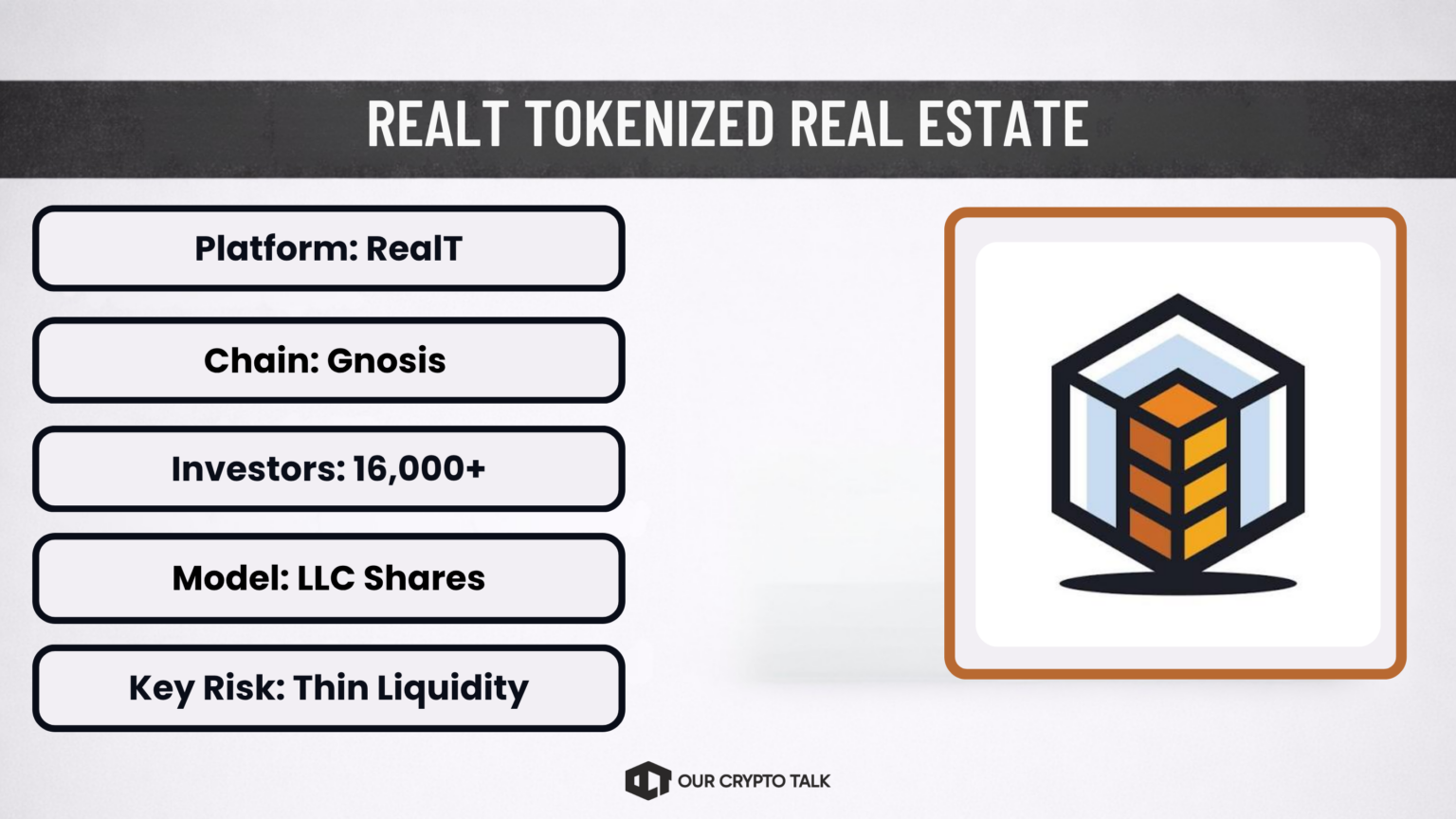
RealT RealT became one of the largest tokenized real estate crypto projects, with industry research citing more than 700 properties and over 16,000 investors. Interexy Historically, the platform offered investments starting at approximately $50, allowing eligible non-U.S. investors to gain exposure to individual rental properties without purchasing an entire home. Smart contracts distributed net rental income weekly in USDC. However, RealT suspended normal distributions amid its 2026 legal and financial difficulties.
In terms of ownership, each property uses a separate Wyoming or Delaware LLC. The LLC holds the property deed, while investors purchase tokenized membership interests in that company. Therefore, token holders do not own the deed directly. Instead, they own shares in the legal entity that owns the property. As a result, this structure separates each asset while defining the investor’s claim on rental income and potential sale proceeds.
From a blockchain perspective, RealT issues its property tokens on Gnosis, an Ethereum sidechain that offers lower transaction costs. Historically, investors could also use supported RealTokens as collateral through DeFi protocols such as Aave. Consequently, this integration gave RealT an advantage over platforms that kept property tokens inside closed marketplaces. Listings commonly targeted net rental yields of roughly 8% to 12%. However, occupancy, repairs, taxes, reserves, and management costs affected actual returns.
Overall, RealT’s main strengths included its large property catalogue, long operating history, and DeFi integration. Nevertheless, secondary-market liquidity varied significantly by property, making fair-value exits difficult. Moreover, Detroit filed a public nuisance lawsuit involving 408 RealT-linked properties, citing code-compliance and property-management concerns. WXYZ Detroit In July 2026, co-founder Jean-Marc Jacobson announced that RealT would enter voluntary liquidation and sell its property portfolio. Outlier Media Ultimately, RealT shows that blockchain settlement can improve ownership records and distributions, but it cannot remove the legal and operational risks of managing physical property.
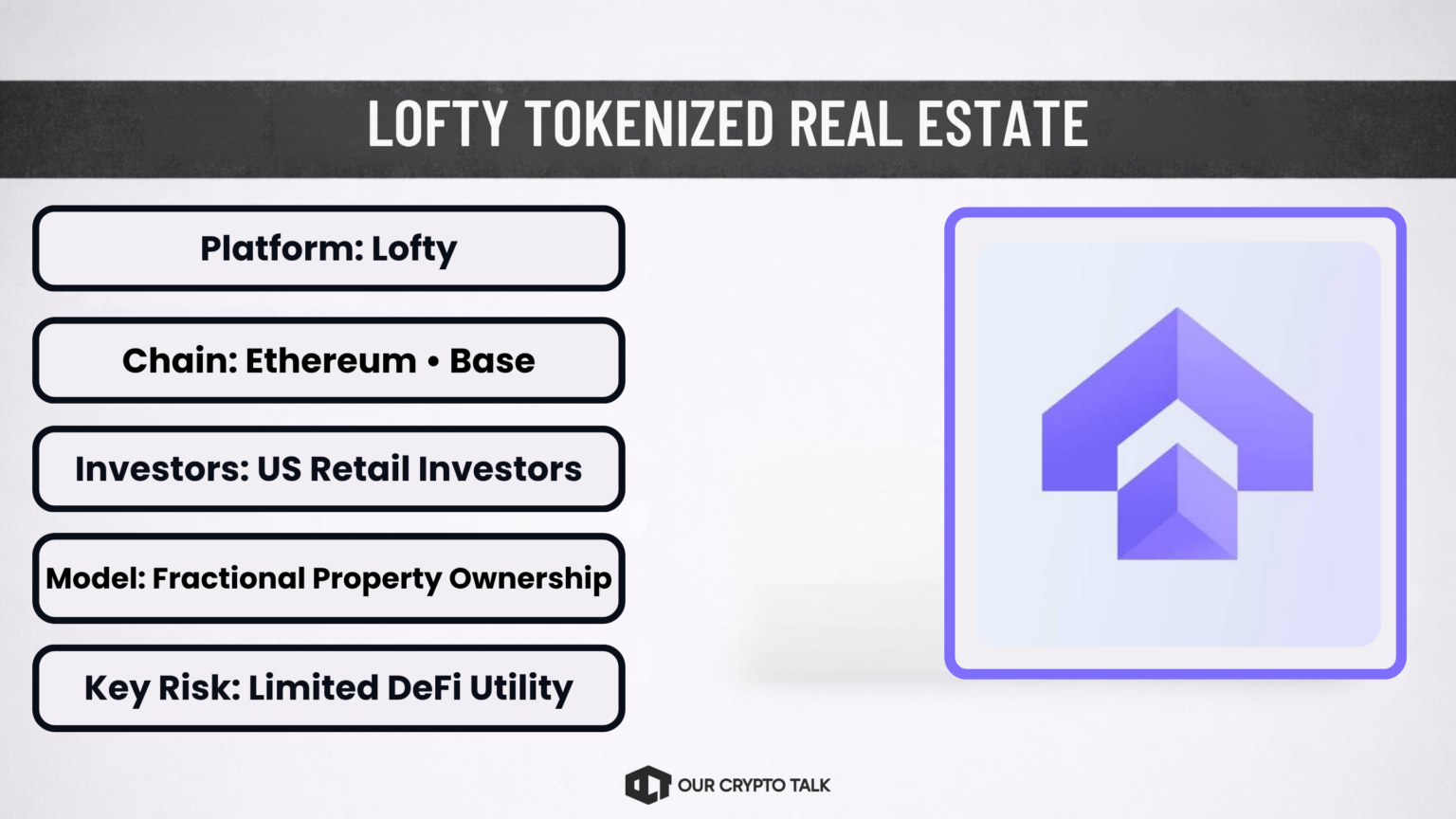
Lofty offers fractional ownership in more than 150 U.S. properties across over 40 markets, with a minimum investment of $50. Unlike RealT’s weekly payment schedule, the platform distributes rental income daily. Moreover, Lofty operates a built-in secondary marketplace where investors can buy and sell property tokens without relying on external liquidity pools.
From a blockchain perspective, Lofty runs on Algorand and gives token holders voting rights over property-level decisions, including renovations, sales, and management changes. In addition, the platform provides K-1 tax forms for U.S. investors, which simplifies tax reporting compared with less structured token models. As a result, Lofty’s main strengths include daily rental distributions, direct governance rights, accessible secondary trading, and clearer tax documentation.
However, Lofty operates within a smaller blockchain ecosystem than Ethereum. Consequently, investors have fewer opportunities to use their property tokens as collateral across external DeFi protocols. Furthermore, the platform focuses exclusively on U.S. properties, so it provides limited geographic diversification for investors seeking international real estate exposure.
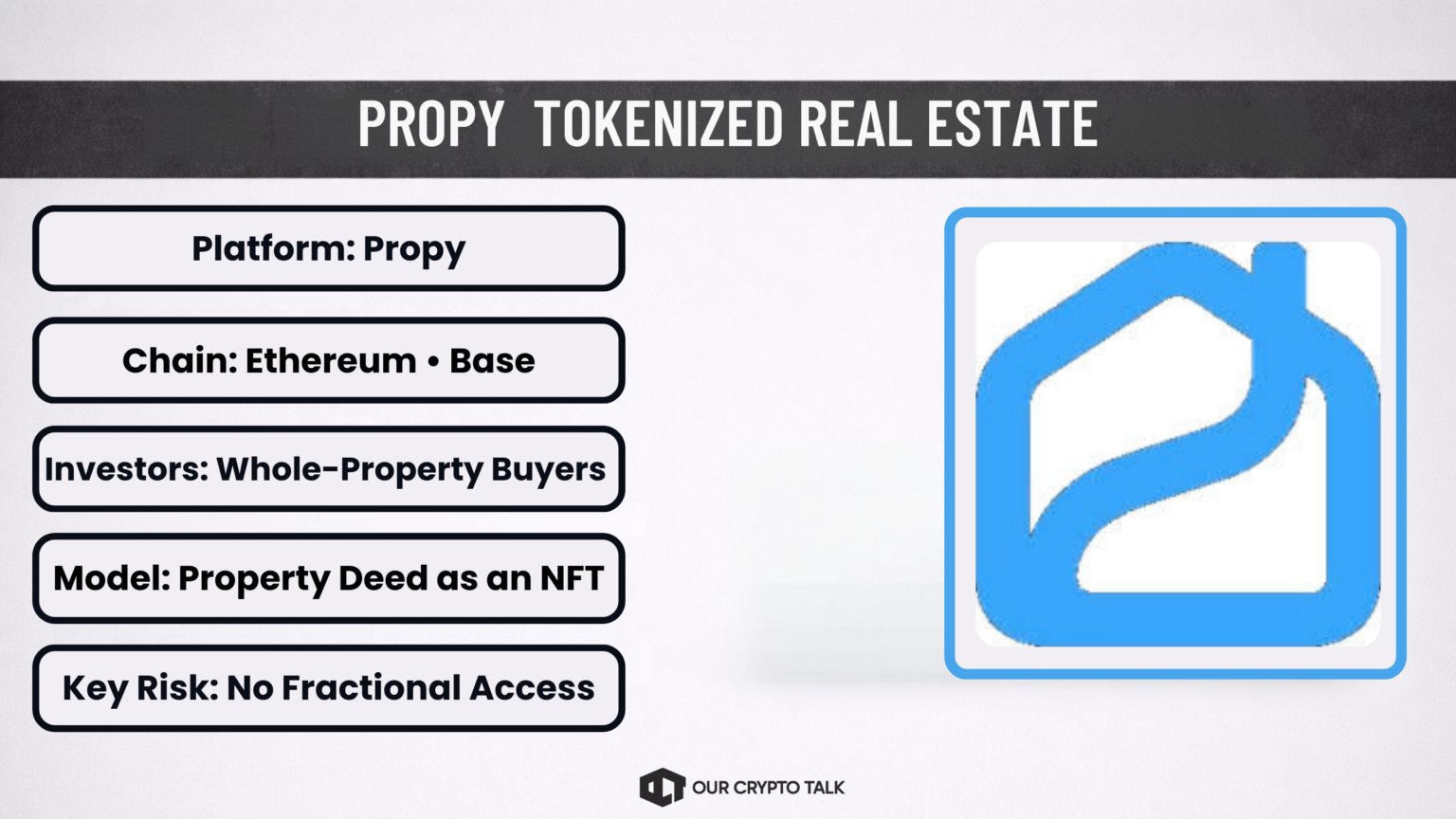
Propy is not competing with RealT and Lofty. It is competing with title companies and closing attorneys. Different market, different customer, same “tokenized real estate” label. Instead of dividing an LLC into fractional security tokens, Propy represents the property deed on-chain as an NFT. Buyers use the platform for whole-property purchases, title transfers, escrow, and settlement, not $50 fractional investments.
Propy runs its infrastructure across Ethereum and Base and uses the PRO token for transaction fees and platform access. As of August 31, 2026, PRO trades near $0.37 with a market capitalization of roughly $37 million. Because crypto prices change continuously, these figures represent a current snapshot. CoinGecko The company is also pursuing a $100 million AI-led expansion strategy focused on acquiring and modernizing title businesses. In January 2026, Propy helped settle a $14 million commercial property purchase in Miami’s Wynwood district entirely in USDT, with the on-chain transfer completing in under a minute. Propy’s Miami deal Propy’s expansion strategy
Propy’s main strength lies in putting the deed and closing process on-chain. This approach can simplify title transfers, accelerate settlement, reduce administrative friction, and give real estate agents and developers blockchain-based closing infrastructure. However, the model does not make property ownership accessible to small investors because buyers still need enough capital to purchase an entire asset. Propy’s growth also depends on title companies, agents, regulators, and local recording systems adopting its technology.
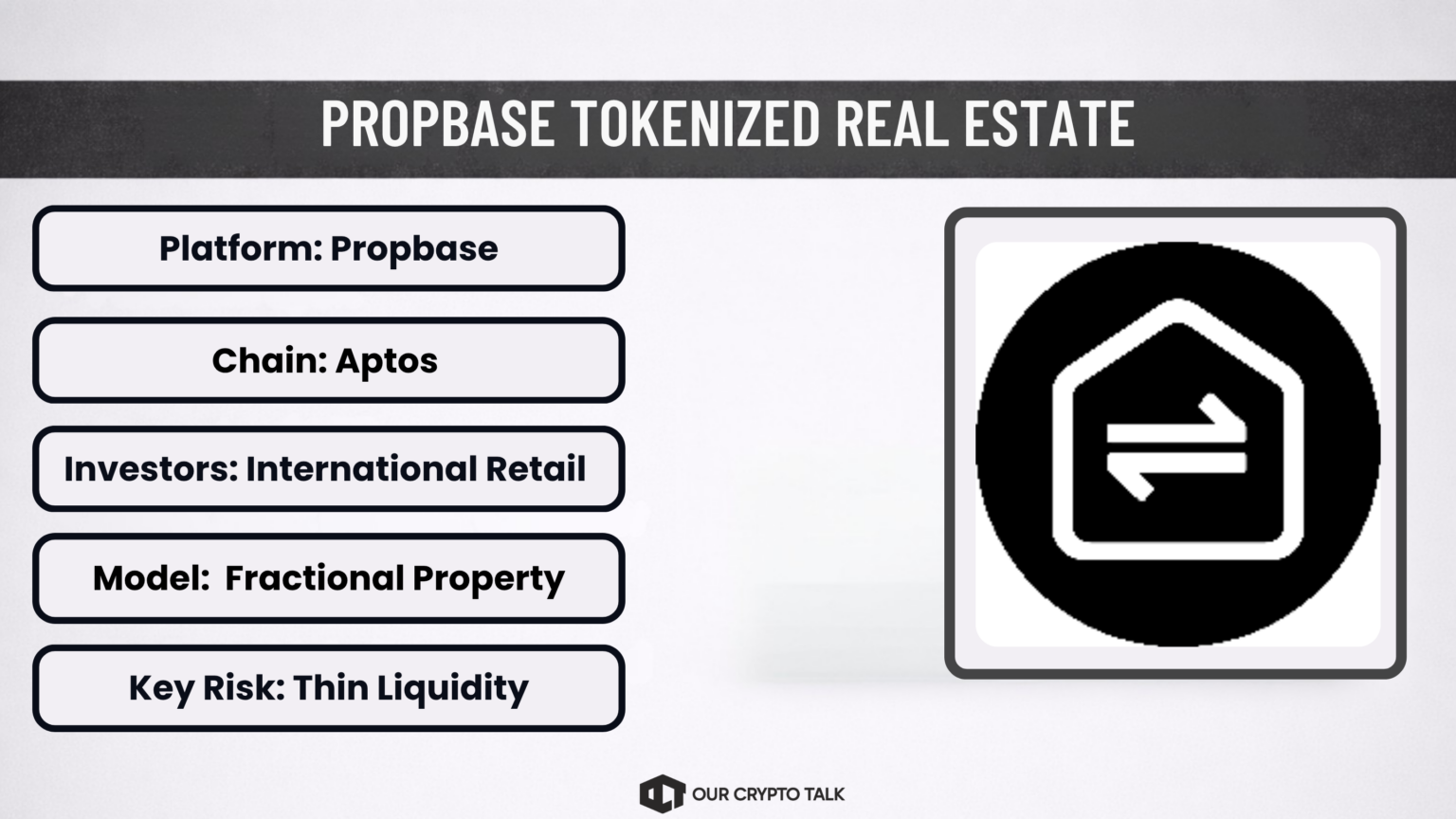
Propbase differentiates itself through geography. The platform focuses on tokenized real estate of 2026 in Southeast Asia, particularly Thailand and Bali, where international investors often face high entry costs and complex ownership rules. Investors can start with $100 and receive monthly rental-income distributions from supported properties. Propbase builds its core marketplace on Aptos, using the Move programming language to provide high throughput and low transaction fees.
The PROPS token powers transaction fees, tiered staking memberships, and ecosystem governance. Propbase also operates a LayerZero-powered bridge that connects PROPS with Ethereum and Base, expanding access beyond Aptos. However, the mobile-app timeline requires a correction. Propbase began developing its iOS and Android apps in August 2025 rather than launching them in mid-2025. Its roadmap scheduled the initial mobile release for Q1 2026, followed by a more complete App 2.0 rollout. Propbase development update Propbase roadmap
Propbase’s main strength lies in giving investors fractional access to Southeast Asian property markets that traditional platforms rarely serve. However, the project remains early-stage and relatively small. As of August 31, 2026, PROPS has a market capitalization of approximately $1.9 million and a fully diluted valuation near $4.5 million.Propbase began developing its iOS and Android apps in August 2025, with the initial release scheduled for Q1 2026.” Remove the meta-commentary. CoinGecko Investors must also consider thin token liquidity and the regulatory complexity of Thai and Indonesian property law, including foreign-ownership restrictions and local enforcement risk.
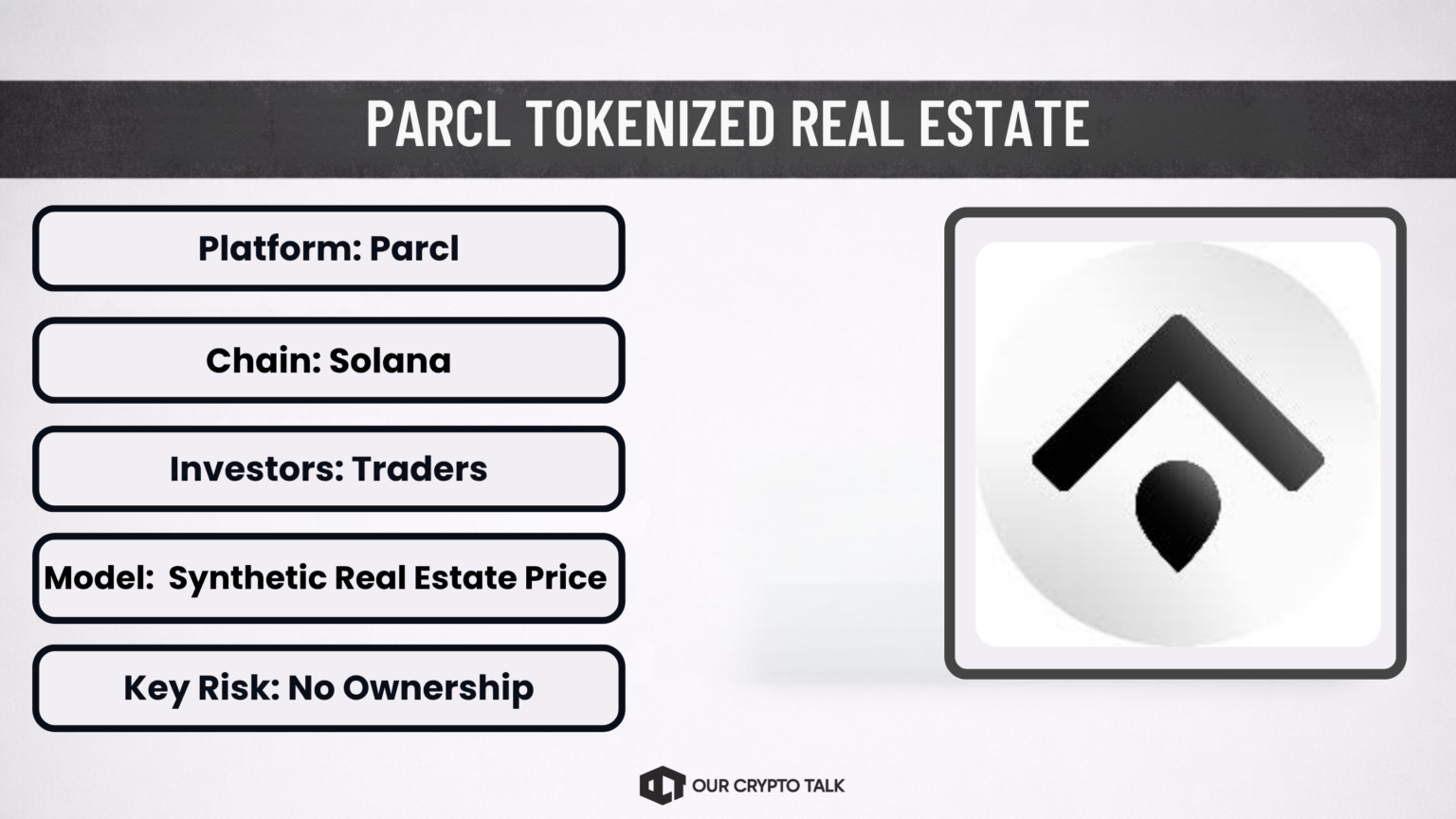
Parcl offers synthetic exposure to city-level real estate price indices for markets such as Miami, New York City, and Los Angeles. Users can go long during a housing recovery or short when they expect prices to fall. The protocol runs on Solana and does not require a fixed minimum investment beyond the collateral needed to open a position. However, users receive no property ownership, rental income, or claim on an underlying building. PRCL serves as the protocol’s native token.
Parcl’s main strength lies in giving traders leveraged, two-sided exposure to real estate prices on-chain. Property owners can also use it to hedge against declines in their local housing markets. However, users face pure price risk, receive no passive income or ownership rights, and may encounter thin liquidity on less popular indices. Parcl is for traders, not traditional real estate investors. If you want rental income, this is not the platform. If you want to speculate on Miami housing prices from your phone, Parcl remains the main on-chain option.
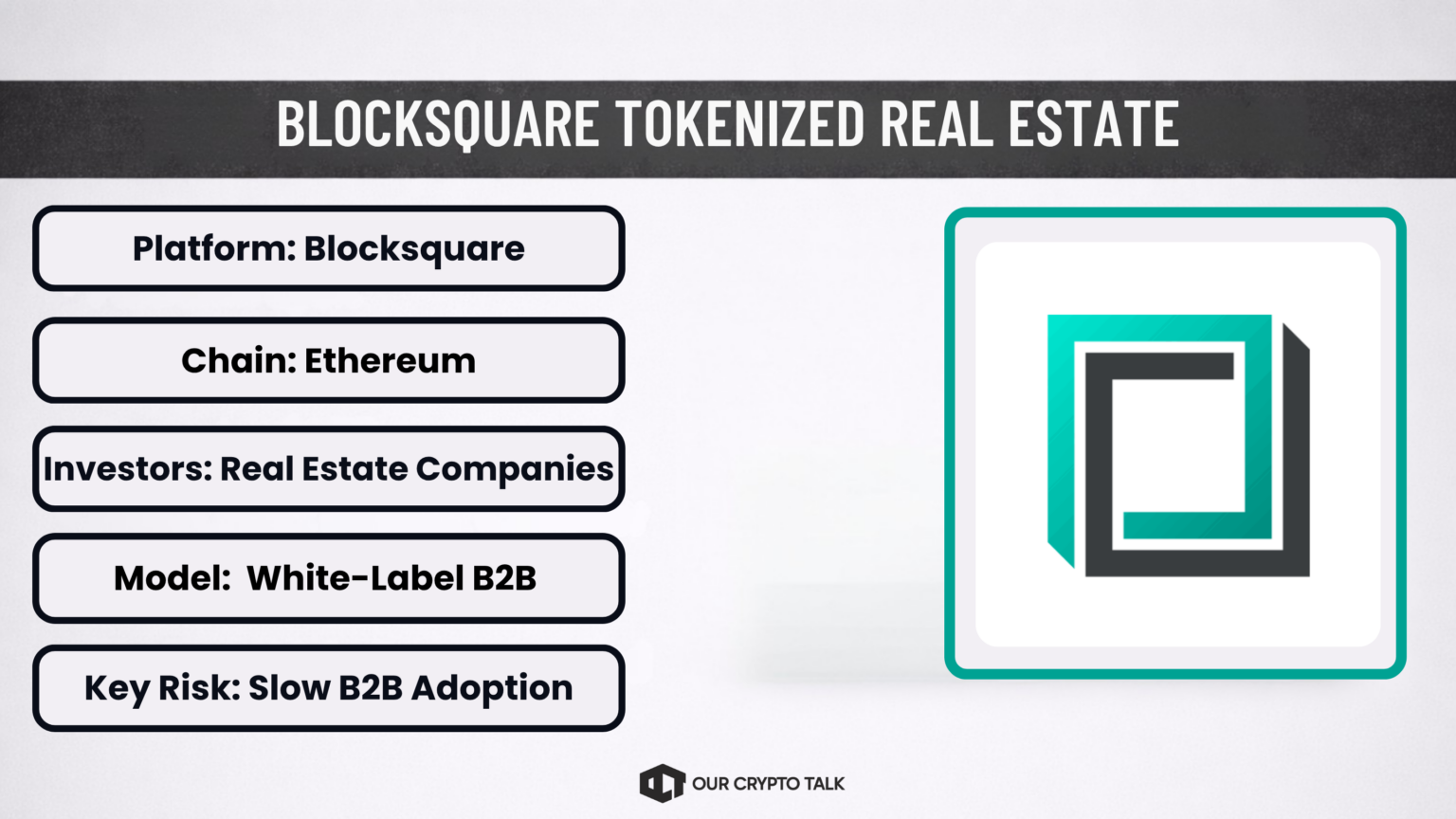
Blocksquare provides white-label tokenization infrastructure for real estate companies rather than selling fractional properties directly to consumers. Specifically, the Slovenia-based company supplies the legal framework, token issuance tools, marketplace software, wallets, and revenue-distribution systems that operators need to launch branded property-investment platforms. Moreover, its infrastructure supports more than 100 tokenized properties across Europe, while the BST token powers utility functions within the ecosystem.
Overall, Blocksquare’s picks-and-shovels model reduces its dependence on the performance of any single property or regional market. Instead, its growth depends on more companies adopting its infrastructure under evolving European Union regulations. However, B2B sales cycles usually move more slowly than consumer adoption. In addition, infrastructure generates less retail excitement than a marketplace that offers individual properties.
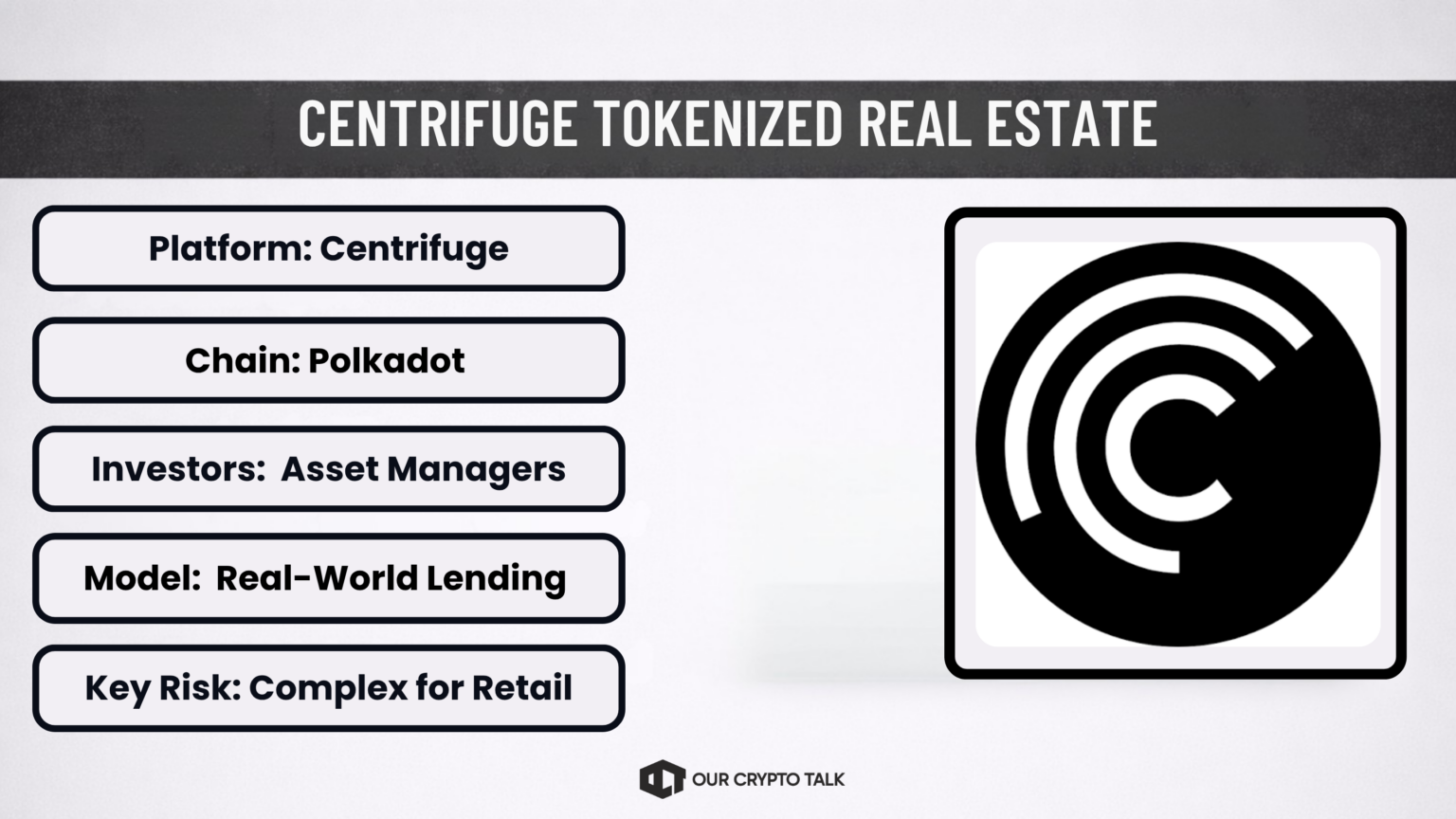
Centrifuge connects real-world assets, including property-backed loans, private credit, invoices, and tokenized funds, with on-chain liquidity. Initially, the protocol operated through a Polkadot parachain. Later, it expanded into Ethereum and other EVM ecosystems, while CFG continued to serve as its native token. In 2021, Centrifuge integrated its first real-world asset pool with MakerDAO and later launched an RWA Market using the Aave protocol. Centrifuge documentation However, Centrifuge does not operate as a consumer property marketplace. Instead, it provides the infrastructure that allows asset managers and lenders to access DeFi capital.
Overall, Centrifuge’s main strength lies in its institutional-grade RWA infrastructure and established DeFi integrations. In particular, its historical work with MakerDAO became an important proof point for using real-world assets as on-chain collateral. Moreover, the Aave-powered RWA Market demonstrated how DeFi liquidity could connect with tokenized off-chain assets. Nevertheless, the protocol remains complex for retail investors and does not offer a simple “buy a share of this property” experience. Therefore, investors who buy CFG gain exposure to the infrastructure layer rather than ownership of a specific building.
First, liquidity creates the biggest practical risk. Buying a $50 property token may take seconds, but selling it quickly at fair value can prove difficult. In particular, secondary markets for individual properties often have few buyers and limited trading volume. As a result, investors may wait weeks for an exit or accept a discount that wipes out months of rental income.
Second, property management introduces another layer of risk. Token holders rely on someone else to screen tenants, collect rent, manage vacancies, pay taxes, and handle repairs. Consequently, bad tenants, empty units, legal disputes, or a major maintenance bill can reduce distributions immediately. Even when a platform gives token holders voting rights, investors usually retain limited control over day-to-day operations. Moreover, advertised yields of 8% to 12% remain projections. These estimates often assume high occupancy, controlled expenses, and no major repairs. Therefore, actual returns can fall well below the advertised rates.
Beyond operational risks, regulation and smart contracts create challenges that traditional property investors do not face. U.S. regulators generally classify fractional property tokens as securities, placing them under SEC oversight and offering exemptions such as Reg D, Reg A+, or Reg S. Meanwhile, European issuers must navigate securities rules, national property laws, and the wider digital-asset framework. MiCA does not automatically govern every property token because tokens classified as financial instruments may fall under other EU securities regulations. Nevertheless, a legal change could restrict investor access, halt onboarding, or force a platform to delist tokens. Similarly, a smart contract exploit could disrupt transfers, distributions, or on-chain ownership records.
Finally, platform failure may create the most complicated recovery scenario. If RealT, Lofty, or another operator shuts down, the underlying LLC shares may continue to exist legally. However, the management layer responsible for tenants, repairs, taxes, reporting, and stablecoin distributions could disappear. In that case, investors would need to rely on replacement managers, courts, or liquidation proceedings. Overall, tokenized real estate of 2026 may carry less volatility than much of crypto, but it does not eliminate risk. Therefore, investors should treat it as real estate investing with additional legal, liquidity, platform, and technology risks, not as a stablecoin substitute.
Do not choose a platform based on its token price. Start by identifying the exposure you actually want:
Ultimately, these platforms represent six different products under the same tokenized real estate label. Choose based on whether you want rental income, synthetic price exposure, deed ownership, platform infrastructure, or institutional credit exposure. The token’s legal and economic claim matters far more than its market price.
This article is for informational purposes and is not financial advice


Tokenization of RWA yields onchain might be the biggest opportunity that no one has noticed
Cold Wallet Safety 2026: Are Hardware Wallets Still Safe?
One Token, Multiple Products. Can Zylo Deliver?
The Rise of NEAR Protocol 2026: Inside the 530% Rally and the ETF
Tokenization of RWA yields onchain might be the biggest opportunity that no one has noticed
Cold Wallet Safety 2026: Are Hardware Wallets Still Safe?
One Token, Multiple Products. Can Zylo Deliver?
The Rise of NEAR Protocol 2026: Inside the 530% Rally and the ETF