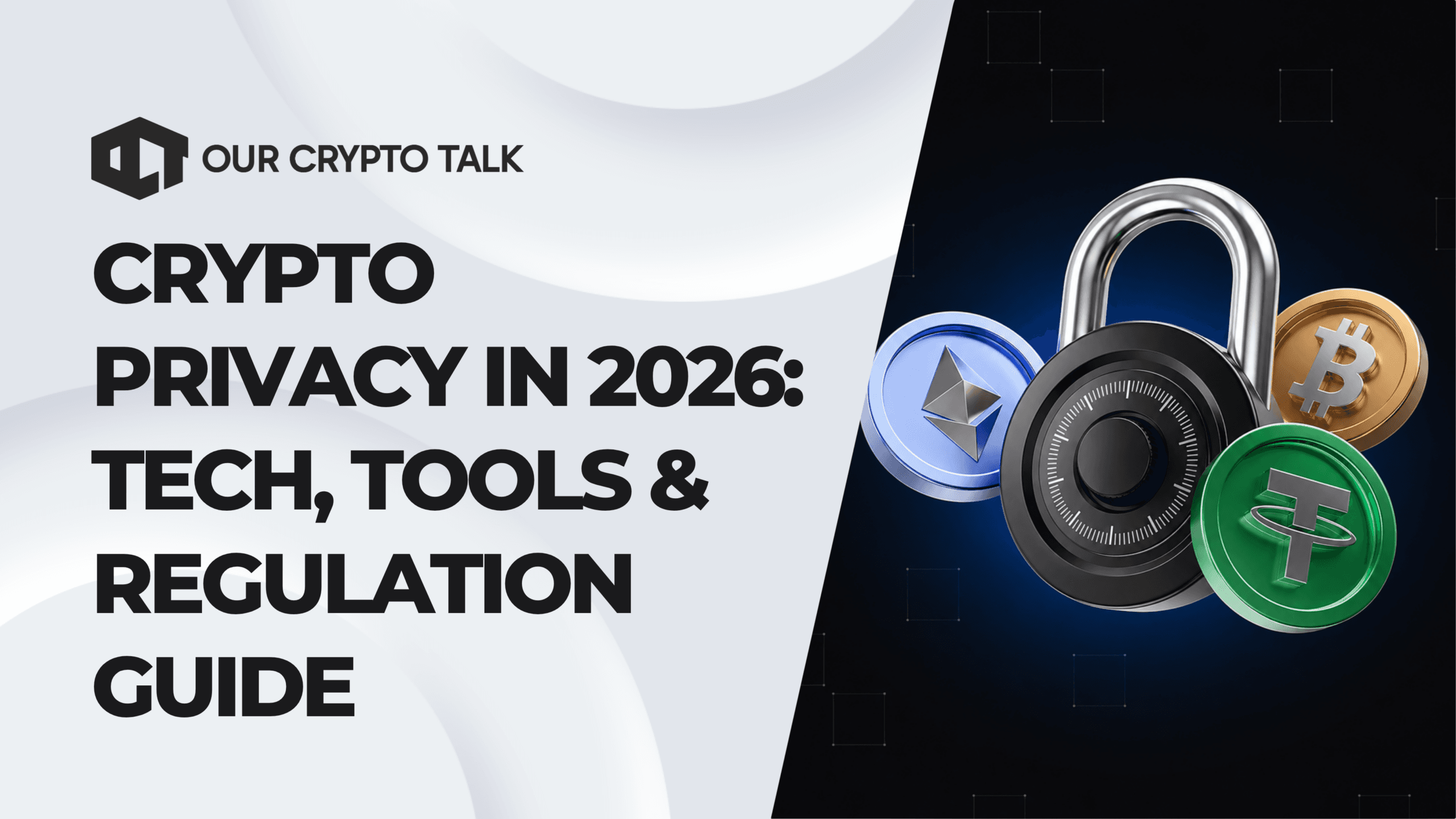
Crypto privacy explained: how ring signatures, zk-proofs, and mixers hide transactions, which coins use them, & privacy crypto laws in 2026.

Author: Akshat Thakur
Many people dismiss financial privacy with a simple argument: if you have nothing to hide, you do not need privacy. That argument overlooks how people use financial privacy every day.
Most people do not share their bank balances, salaries, investment portfolios, or spending habits with strangers. They protect that information because money reveals personal details about their lives, relationships, priorities, and vulnerabilities.
Public blockchains challenge that expectation. Every transaction leaves a permanent record that anyone can inspect. Once someone links an address to a real identity, they can often trace years of financial activity.
Salary payments provide a clear example. Many crypto companies and DAOs pay employees on-chain. When payment wallets become public, coworkers can compare compensation packages, bonus structures, and token allocations. Information that traditionally remains private suddenly becomes visible to everyone.
Businesses face similar risks. Public blockchain data allows competitors, investors, and market participants to monitor treasury movements. Large Bitcoin holders such as Strategy and Metaplanet publish wallet activity that analysts track in real time. Competitors can study those transactions and gain insights into financial decisions.
Financial transparency can also create security risks. Criminals have targeted crypto holders after identifying large wallet balances. Public wealth attracts attention, especially when blockchain activity points to a specific individual.
Political events provide another example. During Nigeria’s 2020 EndSARS protests, organizers used Bitcoin after traditional payment channels faced restrictions. Journalists and activists in several countries have also relied on crypto when governments limited access to banking services.
These examples do not prove that everyone needs complete anonymity. They show something simpler. Financial privacy protects ordinary people, businesses, and organizations from unnecessary exposure. In a world where financial activity becomes increasingly transparent, privacy remains an important safeguard rather than a tool reserved for criminals.
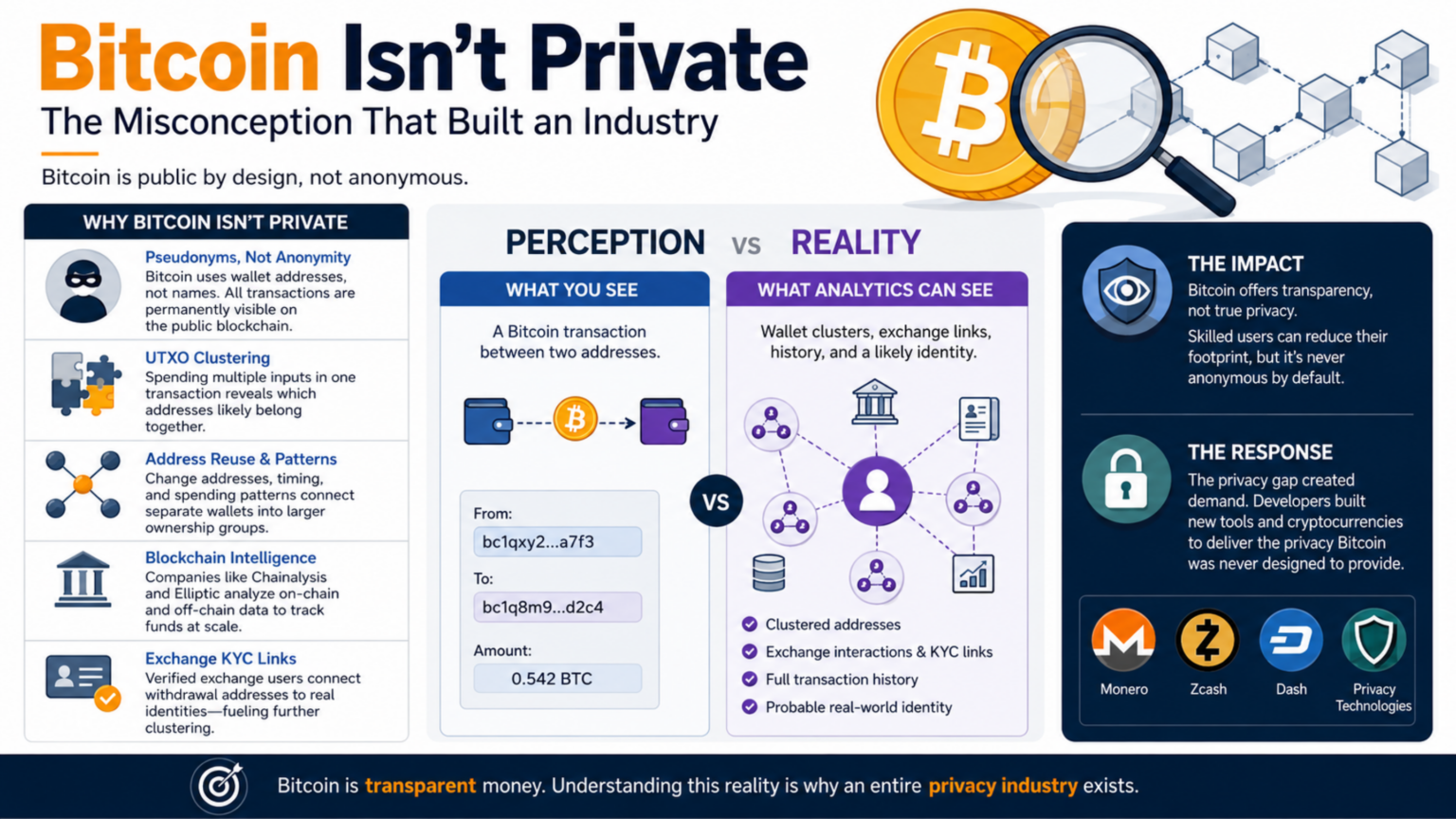
Bitcoin introduced a new way to move value online, but it never delivered true anonymity.
Many people still view Bitcoin as anonymous internet money. The reality looks very different.
Bitcoin uses pseudonyms, not anonymity. Users transact through wallet addresses instead of names. At first glance, those addresses appear disconnected from real-world identities. However, every Bitcoin transaction remains permanently visible on a public blockchain.
That transparency creates opportunities for analysis.
Bitcoin uses a system called Unspent Transaction Outputs, or UTXOs. When users spend Bitcoin, they often combine several transaction inputs into one payment. Analysts use this behavior to identify addresses that likely belong to the same person or organization. They call this process UTXO clustering.
Address reuse creates even more clues. Change addresses, transaction timing, and spending patterns help analysts connect separate wallets into larger ownership groups.
Blockchain intelligence companies built entire businesses around these techniques. Firms such as Chainalysis and Elliptic analyze blockchain data and combine it with off-chain information. Their systems help exchanges, regulators, and law enforcement track the movement of funds across the network.
Exchange KYC data strengthens this process. When users buy Bitcoin through a regulated exchange, they usually provide identification documents. Once an exchange links a withdrawal address to a verified customer, analysts can often connect additional addresses through clustering techniques.
The difference between perception and reality is significant.
You see a Bitcoin transaction moving between two addresses.
A blockchain analytics platform may see wallet clusters, exchange interactions, transaction history, and a likely identity behind the activity.
This visibility does not eliminate privacy entirely. Skilled users can reduce their footprint through careful practices. However, Bitcoin’s public design makes it far more transparent than many people assume.
That gap created demand for privacy-focused cryptocurrencies and technologies. Developers built new tools to address weaknesses that Bitcoin never intended to solve.
Privacy-focused cryptocurrencies do not rely on a single breakthrough. Instead, they combine several techniques that each solve a different visibility problem.
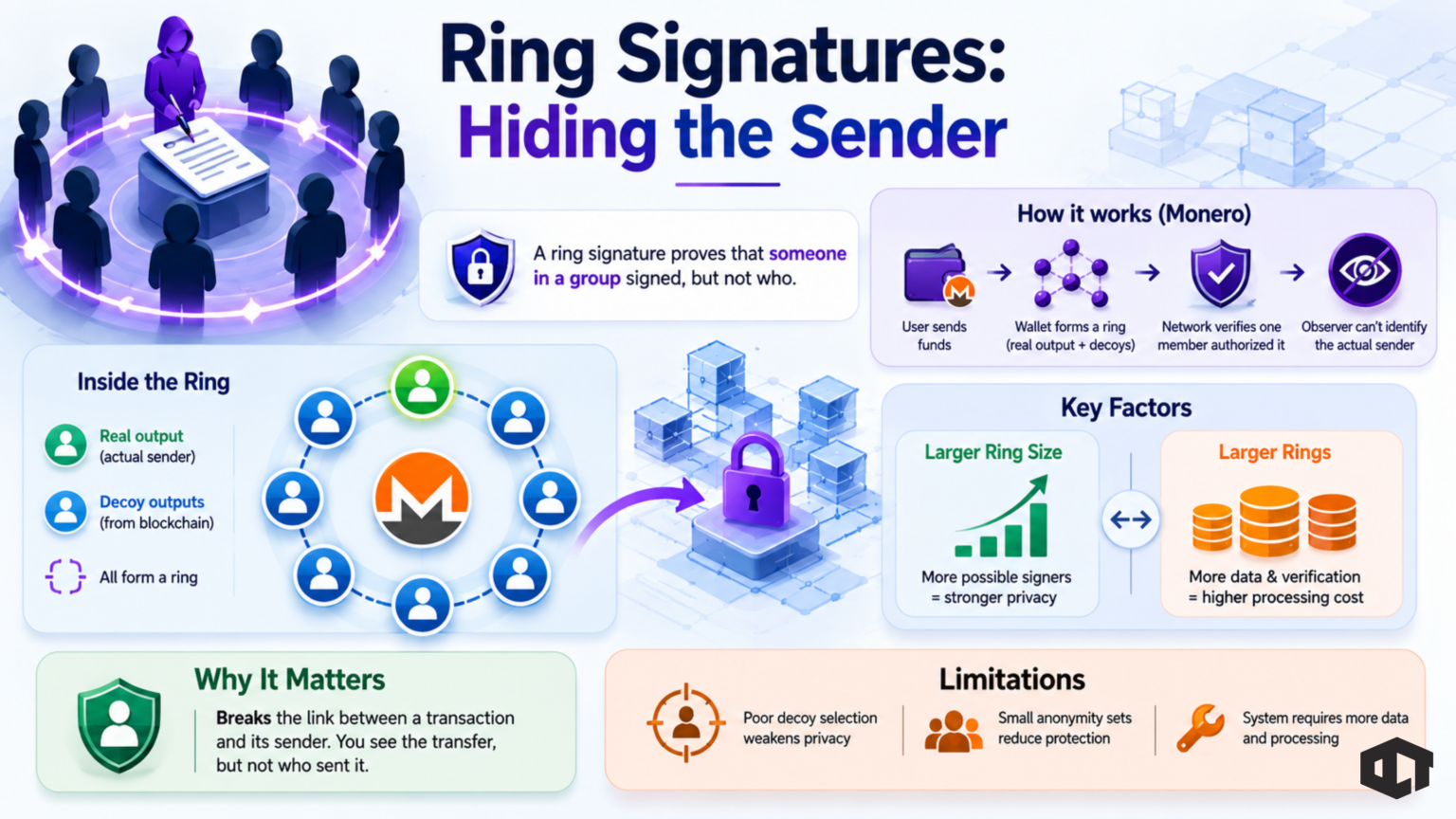
Ring signatures help hide the identity of the sender.
Imagine eleven people standing in a room. One person signs a document, but an observer cannot determine which individual created the signature. The observer only knows that someone in the group signed it.
Ring signatures apply the same concept to blockchain transactions.
When a Monero user sends funds, the wallet combines the real transaction output with several decoy outputs taken from the blockchain. Together, these outputs form a ring. The network verifies that one member of the ring authorized the transaction, but it cannot reliably identify the actual sender.
The strength of the system depends heavily on decoy selection. Monero chooses outputs that resemble real spending behavior so that analysts cannot easily separate genuine transactions from decoys.
Ring size also matters. Larger rings increase the anonymity set because more possible signers exist within the group. However, larger rings also require more data and additional verification work.
This design creates a tradeoff. Users gain stronger privacy, but nodes process larger transactions.
Ring signatures offer one major advantage. They break the direct link between a transaction and its sender. Observers can see that someone authorized the transfer, but they cannot confidently identify who.
The technique does have limitations. Poor decoy selection or small anonymity sets can weaken privacy. Monero developers have spent years refining these mechanisms to reduce those risks.
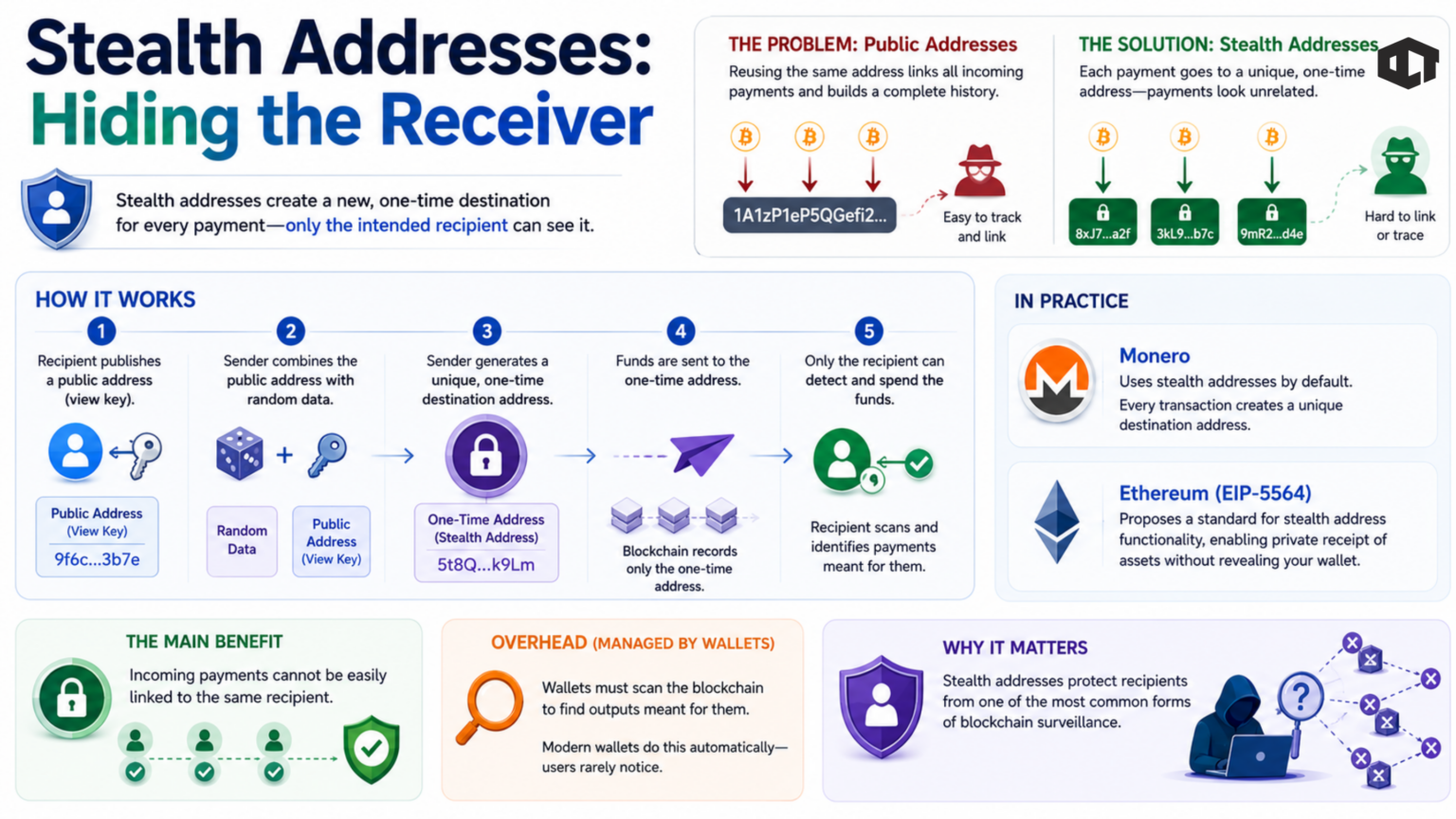
Public receiving addresses create a privacy problem.
If someone reuses the same address repeatedly, anyone can track incoming payments and build a complete transaction history. Analysts can then connect multiple payments to the same person or organization.
Stealth addresses solve this problem.
Instead of sending funds directly to a public address, the sender creates a unique one-time address for every transaction. Only the intended recipient can recognize and spend the funds sent to that address.
The process happens automatically. The recipient publishes a public address. The sender combines that information with random data and generates a new destination address. The blockchain records the one-time address rather than the recipient’s public identity.
To outside observers, each payment appears unrelated.
Monero uses stealth addresses as a core privacy feature. Every transaction creates a unique destination address, making address reuse analysis far more difficult.
Developers have also explored similar concepts on Ethereum. EIP-5564 proposes a standardized framework that would allow users to receive assets through stealth addresses without exposing their primary wallet.
The main benefit is straightforward. Observers cannot easily connect multiple incoming transactions to the same recipient.
The approach does create some overhead. Wallets must scan the blockchain to identify payments intended for their owners. Modern wallet software handles this process automatically, so most users never notice it.
Stealth addresses play a critical role in privacy-focused systems because they protect recipients from one of the most common forms of blockchain surveillance.
Even when users hide senders and receivers, transaction amounts can still reveal valuable information.
Large treasury transfers, employee salaries, and investment positions often become obvious when blockchain networks display amounts publicly.
Ring Confidential Transactions, or RingCT, address this problem.
RingCT hides transaction values while allowing the network to verify that no one creates new coins from nothing. The system relies on cryptographic commitments rather than visible balances.
In simple terms, the sender locks transaction amounts inside mathematical proofs. Network validators can confirm that inputs equal outputs and fees without seeing the actual numbers.
This approach preserves both privacy and security.
Monero introduced RingCT in 2017 and later made it mandatory for all users. Today, every Monero transaction hides the amount transferred.
The result is significant. Observers cannot determine whether a transaction moved ten dollars, ten thousand dollars, or ten million dollars. They only know that the network verified the transaction successfully.
RingCT complements ring signatures and stealth addresses. Ring signatures hide the sender. Stealth addresses hide the receiver. RingCT hides the amount.
The technology does introduce tradeoffs. Hidden amounts require more complex cryptography, which increases transaction size and verification costs. Modern hardware handles these requirements efficiently, but the overhead still exists.
Despite those costs, RingCT remains one of the most important privacy innovations in cryptocurrency because it removes one of the most revealing pieces of information from public view.
Zero-knowledge proofs solve a unique problem. They allow someone to prove a statement is true without revealing the information behind it.
The idea sounds counterintuitive at first. Yet it forms the foundation of some of the most advanced privacy systems in crypto.
A popular analogy comes from the children’s puzzle book Where’s Waldo. Imagine you find Waldo on a crowded page. You want to prove you found him, but you do not want to reveal his location. You could cover the entire page except for Waldo. Your friend sees proof that you found him, but learns nothing about where he sits on the original page.
Another classic example involves a color-blind friend. You know two balls have different colors, but your friend cannot tell them apart. By repeatedly asking your friend to swap or not swap the balls behind their back, you can prove that the colors differ without ever naming the colors themselves.
Zero-knowledge proofs bring this concept to blockchains.
Instead of revealing transaction details, users prove that a transaction follows the network’s rules. The blockchain confirms that the sender owns the funds, spends them only once, and balances inputs and outputs correctly. At the same time, it keeps sensitive information hidden.
Zcash pioneered this approach when it launched shielded transactions in 2016. Its privacy system allows users to transfer ZEC while hiding the sender, receiver, and transaction amount from public view. The network still verifies every transaction, but observers cannot see the underlying details.
This approach differs from Monero’s privacy model. Rather than obscuring information with decoys, Zcash uses cryptographic proofs to hide information entirely.
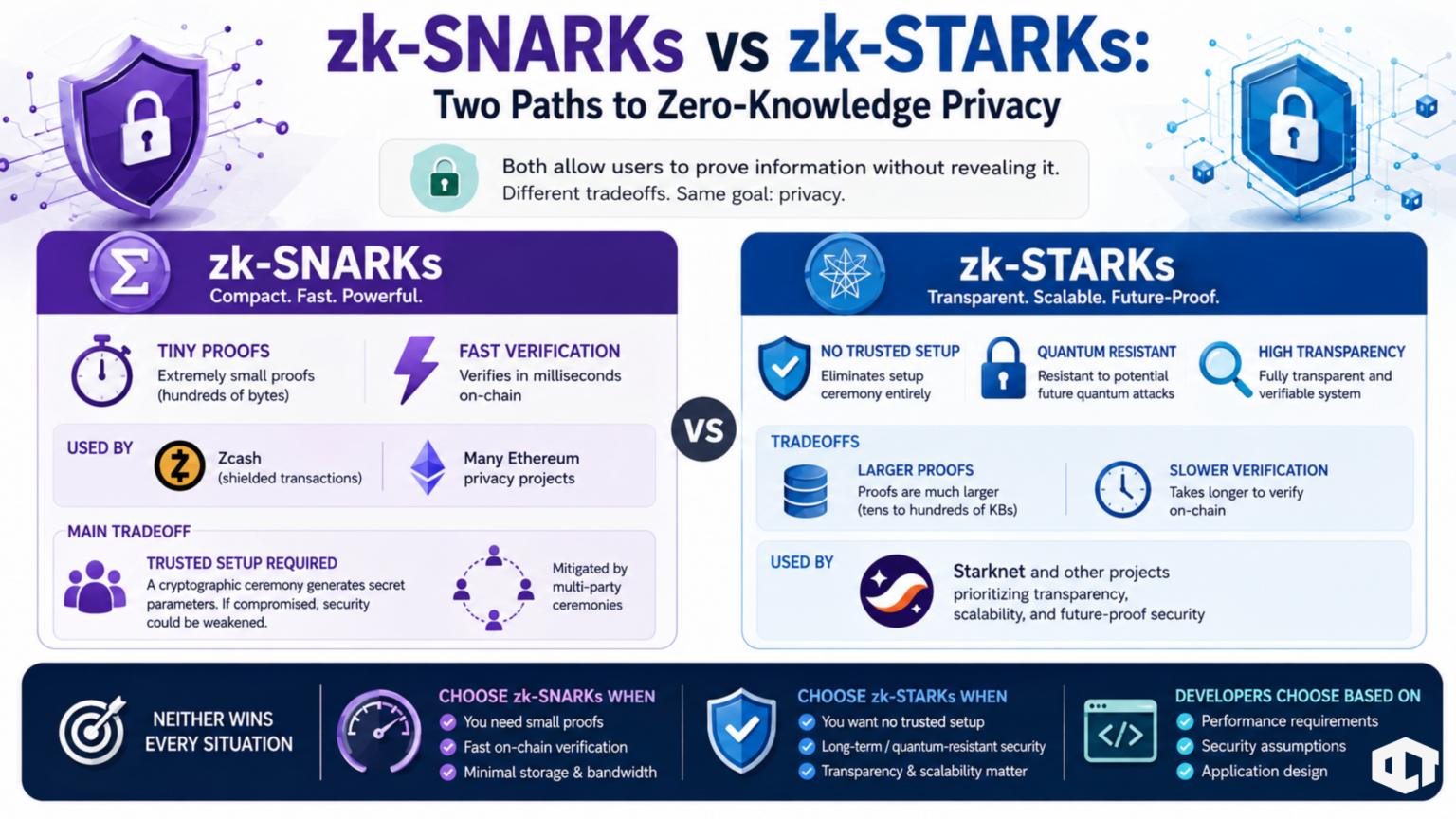
Most modern zero-knowledge systems rely on one of two technologies: zk-SNARKs or zk-STARKs.
Both allow users to prove information without revealing it. However, they make different tradeoffs.
zk-SNARKs create extremely small proofs that verify quickly. A blockchain can check these proofs in milliseconds, making them ideal for privacy applications and on-chain verification. Zcash uses zk-SNARKs for its shielded transactions, and many Ethereum privacy projects rely on the same technology.
The main drawback involves the trusted setup process. Before the system begins operating, participants must complete a cryptographic ceremony that generates secret parameters. If someone compromises that setup, they could weaken the system’s security. Modern projects reduce this risk through multi-party ceremonies involving many independent participants.
zk-STARKs take a different approach.
They eliminate the trusted setup entirely. They also offer resistance against potential future quantum computing attacks. These features make STARKs attractive for long-term security and transparency.
The tradeoff comes from efficiency. STARK proofs require more data and typically take longer to verify. As a result, they consume more storage and bandwidth than SNARKs.
Different projects prioritize different goals. Privacy-focused systems often choose SNARKs because they produce compact proofs. Projects such as Starknet favor STARKs because they value transparency, scalability, and future-proof security.
Neither approach wins in every situation. Developers choose between them based on performance requirements, security assumptions, and application design.
Bitcoin does not include native privacy features like Monero or Zcash. Instead, users often rely on tools that make transaction analysis more difficult.
CoinJoin represents the most widely known example.
The concept is simple. Multiple users combine their coins into a single transaction. The transaction then sends funds back to new addresses. Outside observers can see all inputs and outputs, but they struggle to determine which output belongs to which participant.
This process breaks many common blockchain analysis techniques.
Wasabi Wallet helped popularize CoinJoin by automating the process for Bitcoin users. Its software coordinates participants and creates collaborative transactions in the background. Users gain additional privacy without manually organizing large groups.
Ethereum developed a different model through Tornado Cash. Instead of combining transactions directly, users deposit fixed amounts into a smart contract pool. Later, they withdraw funds to a fresh address. A zero-knowledge proof confirms ownership of the deposit without creating a visible link between deposit and withdrawal.
These tools improve privacy, but they do not guarantee anonymity.
CoinJoin remains completely optional. Participation levels matter because larger groups provide stronger privacy. Timing patterns, transaction amounts, and behavioral clues can still reveal information. Analysts may also reduce anonymity when only a small number of users join a mixing round.
Regulatory scrutiny has created additional challenges. Several privacy services have faced legal pressure, forcing operators to shut down, modify services, or introduce compliance measures.
Despite these limitations, CoinJoin and mixers remain important privacy tools for users who want stronger protections without leaving Bitcoin or Ethereum.
Privacy does not always require complete secrecy.
Businesses, auditors, regulators, and tax authorities often need access to specific financial information. Privacy-focused cryptocurrencies address this challenge through selective disclosure tools.
View keys provide one solution.
A view key allows someone to inspect transactions and balances without gaining the ability to spend funds. The wallet owner can share this key with an auditor, accountant, exchange, or business partner when verification becomes necessary.
Monero supports view keys directly. A company can prove revenue, verify payments, or demonstrate reserves without exposing private keys that control the funds.
Zcash offers similar capabilities. It also supports movement between shielded and transparent addresses. Users can choose which information they reveal and when they reveal it.
This flexibility creates an important middle ground.
Many critics assume privacy and compliance cannot coexist. View keys challenge that assumption. They allow users to keep financial information private by default while still providing evidence when legitimate requests arise.
The concept resembles sharing a bank statement with an accountant. You reveal the information required for a specific purpose, but you do not give permanent access to every financial detail.
As regulation evolves, selective disclosure may become one of the most important privacy tools in crypto. It allows individuals, businesses, and institutions to balance confidentiality with accountability.
Together, zero-knowledge proofs, SNARKs, STARKs, CoinJoin systems, and view keys complete the modern privacy toolkit. Each technology addresses a different source of information leakage. Combined, they transform privacy from a niche feature into a foundational layer of blockchain infrastructure.
Privacy no longer belongs exclusively to privacy coins. Developers now build privacy features into Layer 1 networks, Layer 2 scaling solutions, DeFi applications, smart contract platforms, and decentralized compute systems. This shift gives users more flexibility. Instead of moving entirely to a privacy-focused blockchain, they can access privacy features within ecosystems they already use.
Aztec brings privacy directly to Ethereum through a zero-knowledge Layer 2. Developers can choose which application data remains private and which data stays public. The network supports use cases such as confidential DeFi, private voting, and shielded digital assets while still settling transactions on Ethereum. As of 2026, Aztec’s Alpha Network runs with thousands of sequencers and growing developer participation. It shows how privacy can become a native feature within Ethereum rather than a separate ecosystem.
Railgun adds privacy to Ethereum and other EVM-compatible chains through shielded pools powered by zero-knowledge proofs. Users can interact with DeFi protocols while hiding wallet activity from public observers. Adoption continues to grow as more wallets and applications integrate privacy features directly into existing user experiences. Railgun demonstrates that privacy can function as a simple application layer rather than a separate blockchain.
Secret Network focuses on private smart contracts. Its technology encrypts transaction inputs, outputs, and contract state, allowing developers to build applications that keep sensitive information hidden. The network supports confidential governance, private marketplaces, and hidden trading strategies. More than twenty live applications and an active developer community continue to expand the ecosystem.
GhostwareOS aims to create a privacy-focused environment within the Solana ecosystem. The platform combines shielded transactions, private smart contracts, and developer tools designed for Solana’s high-speed architecture. The project continues to attract attention from builders exploring privacy applications on low-cost, high-throughput infrastructure. Its goal is to pair Solana’s performance with stronger confidentiality guarantees.
Ore PrivacyCash introduces shielded liquidity pools on Solana. Users can move assets into privacy-protected pools, transact within the shielded environment, and later return funds to public addresses. The system uses zero-knowledge proofs to maintain privacy while preserving Solana’s speed and low transaction costs. Early adoption among privacy-conscious DeFi users highlights growing demand for confidential financial activity on Solana.
Akash Confidential AI extends privacy beyond payments and smart contracts. The platform combines confidential computing technology with decentralized infrastructure to protect AI models, training data, and inference results. Node operators cannot access sensitive information processed within secure environments. As decentralized AI grows, confidential compute may become as important as confidential transactions.
Together, these projects highlight a broader trend. Privacy is evolving from a niche category into a foundational layer of crypto infrastructure. Ethereum, Solana, Cosmos, and decentralized compute networks now offer privacy tools that once existed only in specialized privacy coins.
For readers interested in those original privacy-focused assets, see Privacy Coins in 2026 guide.
Follow OCT on X for ongoing coverage of Monero, Zcash, anonymous crypto, and privacy infrastructure trends, including market analysis, regulation updates, and institutional developments.
Privacy crypto faces very different rules depending on the jurisdiction. Some countries restrict privacy-focused assets through exchange regulations. Others allow them with additional compliance requirements. The result is a fragmented global landscape that continues to evolve as regulators balance financial privacy, anti-money laundering rules, and consumer protection.
The European Union’s Markets in Crypto-Assets Regulation, commonly known as MiCA, creates the first unified crypto framework across all EU member states. The regulation requires exchanges, custodians, and other Crypto-Asset Service Providers to obtain authorization and maintain strict AML and compliance controls.
The key date is July 1, 2026. On that day, the transitional period ends. Any platform serving EU users without MiCA authorization must stop operating within the bloc.
MiCA does not explicitly ban privacy coins. However, it requires regulated entities to meet strict compliance obligations, including customer verification and transaction monitoring. These requirements create challenges for assets and protocols that offer complete anonymity.
For exchanges, the practical impact is significant. Platforms must decide whether privacy-focused assets fit within their compliance framework. Projects that support selective disclosure, view keys, or auditable privacy mechanisms face fewer obstacles than systems designed around complete opacity.
For users, privacy remains available through self-custody and non-custodial protocols. However, access to regulated on-ramps, off-ramps, and exchange services increasingly depends on compliance requirements.
MiCA’s approach does not prohibit privacy technology. Instead, it encourages privacy systems that can coexist with regulated financial infrastructure.
The United States has not banned privacy coins.
Users can legally hold, use, and develop privacy-focused technologies such as Monero, Zcash, and privacy-preserving smart contract systems. Regulators have instead focused on enforcement, sanctions, and transaction monitoring.
The most important framework comes from the Office of Foreign Assets Control, or OFAC. The agency targets individuals, organizations, and services that facilitate sanctions evasion or support sanctioned actors.
The Tornado Cash sanctions in 2022 marked a turning point. Regulators moved beyond traditional financial intermediaries and targeted a privacy protocol directly. Subsequent court rulings narrowed some aspects of OFAC’s authority over decentralized software, but the broader regulatory debate continues.
At the same time, exchanges increasingly rely on blockchain analytics providers to monitor transactions. Chain analysis tools combine on-chain activity with KYC information to identify suspicious activity and satisfy regulatory requirements.
As a result, the United States operates under a two-layer system. Privacy technologies remain legal, but regulated financial institutions apply growing levels of monitoring and reporting. The Tornado Cash litigation continues to shape how regulators approach privacy infrastructure, developer responsibility, and decentralized software.
India adopted one of the most restrictive approaches toward privacy-focused cryptocurrencies.
In early 2026, updated anti-money laundering guidance classified privacy coins and anonymity-enhancing crypto assets as high-risk instruments. The rules prohibit regulated exchanges and virtual asset service providers from supporting assets such as Monero and Zcash.
The policy triggered a wave of exchange delistings. Major platforms removed trading pairs, disabled deposits and withdrawals, and restricted access to privacy-focused assets.
Indian users can still hold privacy coins through self-custody wallets. However, they cannot easily buy, sell, or convert those assets through regulated exchanges. Any interaction with compliant financial platforms requires full AML verification and transaction monitoring.
The restrictions focus on regulated service providers rather than individual ownership. Even so, the rules significantly reduce liquidity and accessibility for privacy-focused assets within India’s crypto market.
Japan became the first major jurisdiction to move against privacy coins. Licensed exchanges have delisted assets such as Monero and Zcash since 2018 under guidance from the Financial Services Agency. The restrictions remain in place today.
South Korea followed a similar path. Domestic exchanges generally cannot list privacy coins, although the country does not criminalize personal ownership. The policy mirrors Japan’s focus on exchange-level restrictions.
The United Arab Emirates takes a different approach. Regulators allow privacy-focused assets and protocols, but they require enhanced due diligence, transaction monitoring, and recordkeeping from licensed service providers. Authorities treat privacy as a higher-risk category rather than a prohibited one.
Singapore uses a case-by-case framework under the Monetary Authority of Singapore. Licensed firms must demonstrate strong AML controls before offering privacy-related services. Projects that include selective disclosure features generally face fewer obstacles than fully anonymous systems.
The Tornado Cash case remains the most important legal dispute involving privacy technology in crypto.
In August 2022, OFAC sanctioned Tornado Cash after authorities linked the protocol to billions of dollars in laundering activity, including funds associated with North Korea’s Lazarus Group. The decision prohibited U.S. persons from interacting with the sanctioned system.
The case expanded beyond sanctions when authorities charged Tornado Cash co-founder Roman Storm. Prosecutors argued that Storm and other developers knowingly operated a service that facilitated money laundering and sanctions violations. The defense argued that Tornado Cash functioned as decentralized, non-custodial software and that developers did not control user funds or transactions.
A 2025 jury convicted Storm on a charge related to operating an unlicensed money-transmitting business. However, jurors failed to reach verdicts on more serious money laundering and sanctions-related charges. That outcome led to post-trial motions and plans for a retrial on the unresolved counts.
The legal dispute centers on a broader question. Does publishing and maintaining open-source code constitute protected speech, or can developers face criminal liability when others use that code for illegal activity?
Supporters of the prosecution argue that developers cannot avoid responsibility when they knowingly create and maintain systems that facilitate large-scale criminal activity. Critics argue that software itself remains neutral and that liability should depend on direct control and intent rather than code publication.
The outcome will affect far more than Tornado Cash. Courts, regulators, and developers continue to watch the case because it may define the legal boundaries for privacy protocols, mixers, shielded pools, and other privacy-preserving technologies.
The Financial Action Task Force, or FATF, introduced the Travel Rule to bring crypto transfers closer to traditional banking standards. The rule requires exchanges and other Virtual Asset Service Providers (VASPs) to collect and share information about the sender and recipient of certain transactions.
In most jurisdictions, the rule applies once a transfer exceeds a specific threshold. Exchanges must collect information such as names, account details, wallet information, and transaction values. They then share this data with the receiving institution through secure communication networks.
The rule creates a direct challenge for privacy coins.
Projects such as Monero and Zcash shielded transactions intentionally hide information that the Travel Rule requires exchanges to verify. Monero conceals senders, recipients, and amounts. Zcash shielded transfers can hide the same information through zero-knowledge proofs.
This creates a compliance problem. An exchange may know the identity of its customer, but it may not know who ultimately received the funds or where those funds originated. Regulators expect exchanges to answer those questions. Privacy technologies often prevent them from doing so.
The situation becomes more complicated because countries implement the Travel Rule at different speeds. Regulators call this the “sunrise issue.” Some jurisdictions enforce strict Travel Rule requirements, while others continue developing their frameworks. This uneven rollout creates opportunities for regulatory arbitrage as users move funds through regions with lighter oversight before re-entering regulated markets.
For exchanges, the easiest solution often involves restricting or delisting privacy-focused assets altogether. Supporting privacy coins requires additional compliance resources, legal analysis, and risk management procedures.
As a result, the Travel Rule has become the biggest structural threat to privacy coin listings. It does not ban privacy technology directly. Instead, it increases the compliance burden on the institutions that provide liquidity, custody, and market access. The technology remains legal in many regions, but regulated access becomes harder to maintain as Travel Rule enforcement expands globally.
The next phase of privacy technology will likely focus on a balance between confidentiality and compliance.
Early privacy projects aimed for maximum anonymity. Newer systems increasingly explore what many developers call compliance privacy. The goal is simple: protect user data by default while allowing limited disclosure when legitimate requirements arise.
View keys sit at the center of this approach.
A view key allows someone to inspect transactions and balances without gaining control of the funds. Users can share a view key with auditors, tax authorities, accountants, or business partners when verification becomes necessary. The user retains control over spending privileges while providing evidence when required.
Zcash has embraced this direction more openly than most privacy projects. Its selective disclosure features allow users to reveal specific transaction details without exposing their entire financial history. This flexibility appeals to institutions that need privacy for commercial reasons but must also satisfy regulatory obligations.
The Monero community remains divided on the issue. Some members support view keys as a practical tool that helps privacy technology survive within regulated markets. Others worry that any compliance mechanism creates pressure for mandatory disclosure in the future.
The debate reflects a larger divide across the industry.
Privacy advocates often argue that financial privacy should remain unconditional. They believe any disclosure mechanism weakens the original purpose of privacy-focused systems. Pragmatists take a different view. They argue that privacy projects need bridges to regulators, exchanges, and institutional users if they want broad adoption.
The emerging model combines both perspectives. Privacy remains the default setting. Users gain the option to reveal information when they choose or when regulations require it. Institutions gain auditability without sacrificing confidentiality.
The long-term outcome remains uncertain. However, the industry increasingly appears to favor flexible privacy rather than absolute transparency or absolute anonymity. The projects that succeed may be the ones that give users meaningful choice instead of forcing them to pick one extreme.
Strong privacy comes from layers. No single tool protects every piece of information. The goal is to reduce data leakage at every stage, from buying crypto to spending it.
Start with a privacy-focused blockchain.
Monero remains the strongest option for users who want privacy by default. It hides senders, receivers, and transaction amounts automatically.
Zcash offers a different approach. Users can access shielded transactions while retaining the ability to selectively disclose information when necessary. This flexibility appeals to users who may need compliance or audit features in the future.
Choose one ecosystem and use it consistently. Frequent movement between multiple chains creates additional tracking opportunities.
Your wallet determines how you interact with the network.
Cake Wallet remains one of the most popular mobile wallets for Monero users. Feather Wallet provides a lightweight desktop experience with advanced privacy controls. Zashi focuses on shielded Zcash transactions and selective disclosure tools.
Always choose non-custodial wallets. Control your own keys and backup phrases. Avoid wallets that require centralized account management.
For more options, see: Best Privacy Wallets 2026.
The acquisition method often creates the biggest privacy leak.
KYC exchanges collect personal information and link your identity to your purchases. Regulators and analytics firms can often connect those records to blockchain activity.
Peer-to-peer marketplaces, decentralized exchanges, and privacy-focused trading platforms reduce that connection. However, they may offer lower liquidity and require additional caution.
If you use a KYC exchange, understand that privacy begins only after the purchase, not before it.
Blockchain privacy does not automatically hide your internet activity.
Use a reputable VPN to mask your IP address. For stronger protection, route traffic through Tor or I2P. Several privacy-focused wallets support these networks directly.
This step prevents observers from linking blockchain activity to your physical location or internet connection.
Small mistakes often undermine strong privacy tools.
Never reuse addresses. Use separate wallets or sub-addresses for different activities. Avoid broadcasting multiple transactions in predictable patterns. Store recovery phrases offline and keep wallet software updated.
Pay attention to timing analysis. Even when transactions remain private on-chain, observers can sometimes infer connections from user behavior.
A strong privacy stack combines all five layers. Privacy-focused coins protect transaction data. Secure wallets protect access. Careful acquisition methods reduce identity links. Network tools hide connection data. Good operational security ties everything together.
For detailed coin acquisition guides, see Pillar 1’s privacy coin buying guides.
Disclaimer: Privacy regulations differ by jurisdiction. This article is for informational purposes only and does not constitute legal, tax, or financial advice. Always check your local laws before using privacy-focused cryptocurrencies.
All the opinions in this article are that of the author and in no way are financial advice. Our Crypto Talk and the author always suggest you do your own research in crypto and to never take anything as financial advice that you read on the internet. Check our Terms and conditions for more info.


Web3 Gaming Comeback 2026: GTA 6 Hype vs 99% Crashes
Layer 2 Projects Shutting Down: Who’s Next After Blast?
Embodied Data Pyramid and Decentralized Data Layer for Robotics
DeFi Needs Better Liquidity. Can Ramses Deliver?
Web3 Gaming Comeback 2026: GTA 6 Hype vs 99% Crashes
Layer 2 Projects Shutting Down: Who’s Next After Blast?
Embodied Data Pyramid and Decentralized Data Layer for Robotics
DeFi Needs Better Liquidity. Can Ramses Deliver?