RBC Digital Gold review covering tokenomics, gold backing, utility, risks, TGE, and whether the $RBC token is worth buying before launch.

Author: Akshat Thakur
RBC Digital Gold is building a vertically integrated tokenized gold ecosystem. Unlike most gold-backed tokens that simply represent vaulted bullion, RBC claims to control the entire supply chain, from mining and refining to vaulting and tokenization.
Its flagship gold token, RBGT, represents approximately one gram of 99.99% pure physical gold. The ecosystem also includes the RBC utility token, which supports staking, governance, discounts, and future DeFi applications.
The opportunity is clear. Traditional gold ownership remains expensive, illiquid, and difficult to access. Even today’s leading tokenized gold products mainly provide price exposure without much additional utility. RBC wants to change that by making gold programmable while keeping it fully backed by physical bullion.
The timing also works in its favor. Tokenized gold has become one of the fastest-growing RWA sectors as investors look for safe-haven assets during macro uncertainty. Demand for blockchain-based commodities continues to rise, particularly across the Middle East and emerging markets. RBC enters this market after completing its token presale and ahead of its planned Q3 2026 TGE.
Tokenized gold is already an established market.
PAXG and XAUT dominate the sector, controlling most trading volume and liquidity. Both products are widely accepted, regulated in major jurisdictions, and have years of operating history. Several smaller gold-backed tokens also compete by offering fractional ownership and digital settlement.
RBC takes a different approach.
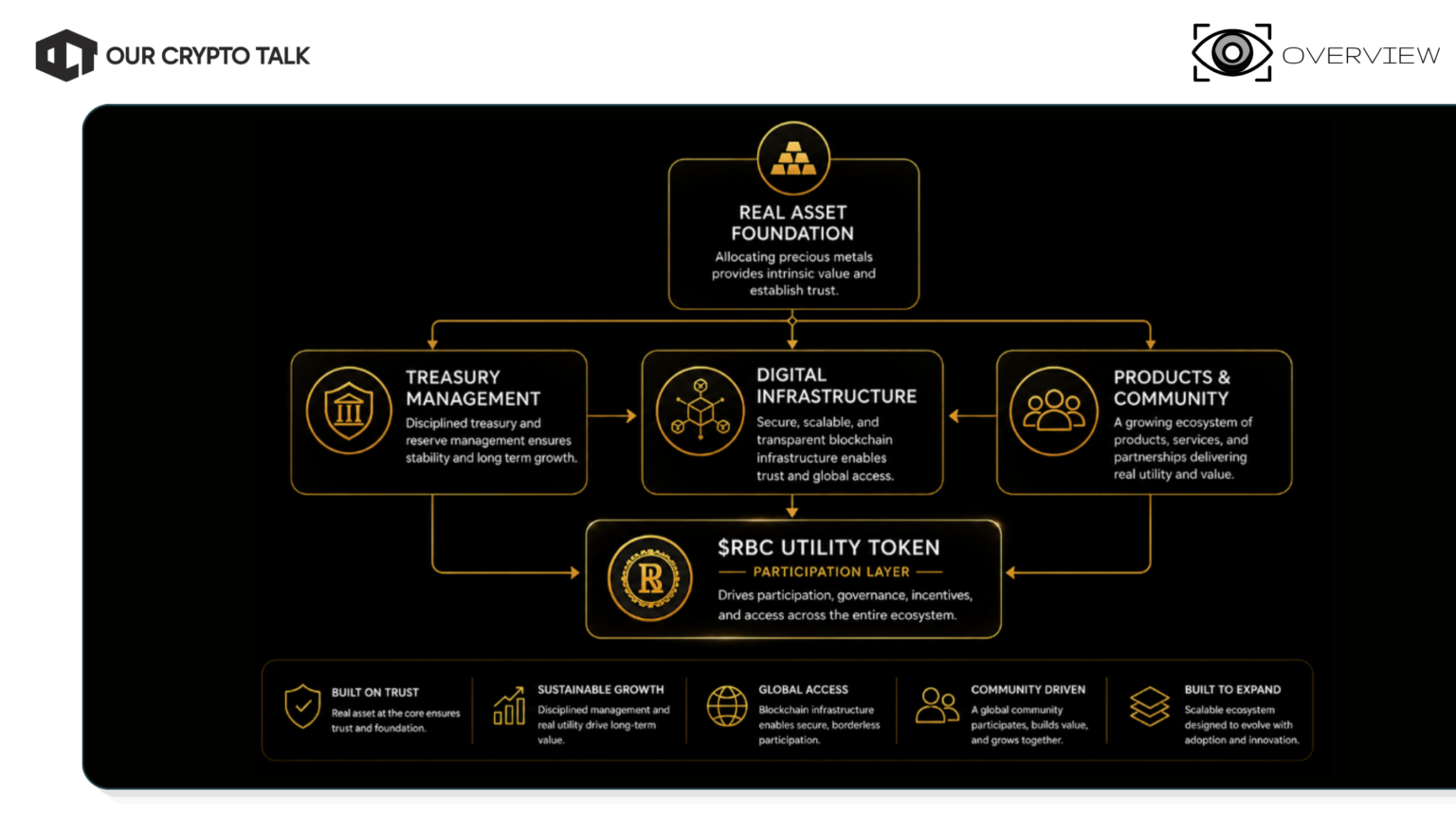
Instead of simply tokenizing vaulted bullion, it claims to operate across the entire value chain. The company says it owns mining operations, refining facilities, bullion trading businesses, vaulting infrastructure, and the tokenization platform itself. The RBC token also introduces staking, governance, platform discounts, and planned DeFi integrations alongside gold ownership.
From OCT’s perspective, the idea is interesting but still requires stronger verification.
Vertical integration could become a meaningful advantage if independent audits consistently prove the mining operations, gold reserves, custody process, and redemption system. Until then, established competitors still have a significant lead in liquidity, transparency, and market trust.
RBC Digital Gold is led by Dr. Katragadda Murali Krishna, commonly known as KMK, who serves as Chairman of Royal Bullion Capital.
He holds a PhD in Computer Science and previously worked at India’s Defence Research and Development Organisation (DRDO) and Oracle before entering the precious metals industry. Royal Bullion Capital says it has spent more than a decade building operations across gold mining, refining, bullion trading, and international distribution.
The business reports mining activities in Sierra Leone and Ghana while operating trading and refining businesses from Dubai and Sharjah. It also highlights its membership with the Dubai Multi Commodities Centre (DMCC).
Unlike many crypto-native projects, RBC comes from the traditional gold industry. That experience is relevant because physical operations matter more than blockchain expertise in this category.
The biggest question is not whether the team is public. It is whether independent verification can consistently support the company’s claims around mining operations, gold reserves, and supply chain ownership.
RBC Digital Gold follows a very different funding model from most crypto projects.
Instead of raising large venture capital rounds, the project appears to rely primarily on the existing Royal Bullion Capital business together with community funding through its completed token presale.
The company highlights its physical gold operations, DMCC membership, claimed custody of more than 1,500 kilograms of bullion, and completed CertiK smart contract audits as its primary credibility signals.
Unlike many infrastructure projects, there are no publicly disclosed investments from major crypto venture firms such as a16z, Paradigm, or Polychain.
That makes execution more dependent on the underlying bullion business than external funding.
If Royal Bullion Capital successfully delivers audited reserves, reliable redemption, and continued ecosystem development, the funding model can work. However, investors have fewer third-party validation signals than they would see in heavily venture-backed RWA projects.
Overall, the project’s credibility depends more on operational transparency than on its investor list.
RBC Digital Gold sits somewhere between a traditional gold business and a crypto project.
Royal Bullion Capital says it operates gold mining, refining, bullion trading, and vaulting across Africa and the UAE. The company claims to hold more than 1,500 kilograms of physical gold and says it has operated in the precious metals industry for over a decade. It also offers the 1mg Gold platform, which lets users buy fractional physical gold with redemption and delivery options in supported regions.
The blockchain side is less mature.
The RBC utility token has not launched yet. TGE is planned for Q3 2026 after the presale ended. RBGT, the tokenized gold product, is also not widely available across public DeFi markets.
The project says its smart contracts have been audited by CertiK. However, there is limited public evidence of a fully operational on-chain ecosystem that retail users can access today. Most of the project’s credibility still comes from its physical gold business rather than blockchain activity.
GitHub is not a major public signal. The team focuses more on physical operations and commercial partnerships than open-source development.
Today, users can interact with the company’s digital gold products where available. The complete mine-to-chain ecosystem remains under development.
RBC’s traction comes from its existing gold business and completed token presale rather than on-chain activity.
The strongest signals include:
Some metrics deserve less attention.
Social media followers, Telegram communities, Discord activity, and marketing campaigns do not prove product quality or long-term adoption.
The biggest question remains transparency.
A completed presale shows investor interest, but it does not prove the mine-to-token model works in production. Long-term confidence will depend on independent reserve audits, successful gold redemptions, and measurable blockchain activity after launch.
RBC is the utility token powering the Royal Bullion Capital ecosystem. The project plans to launch it during Q3 2026. RBGT serves a different role by representing physical gold, with each token designed to track approximately one gram of bullion.
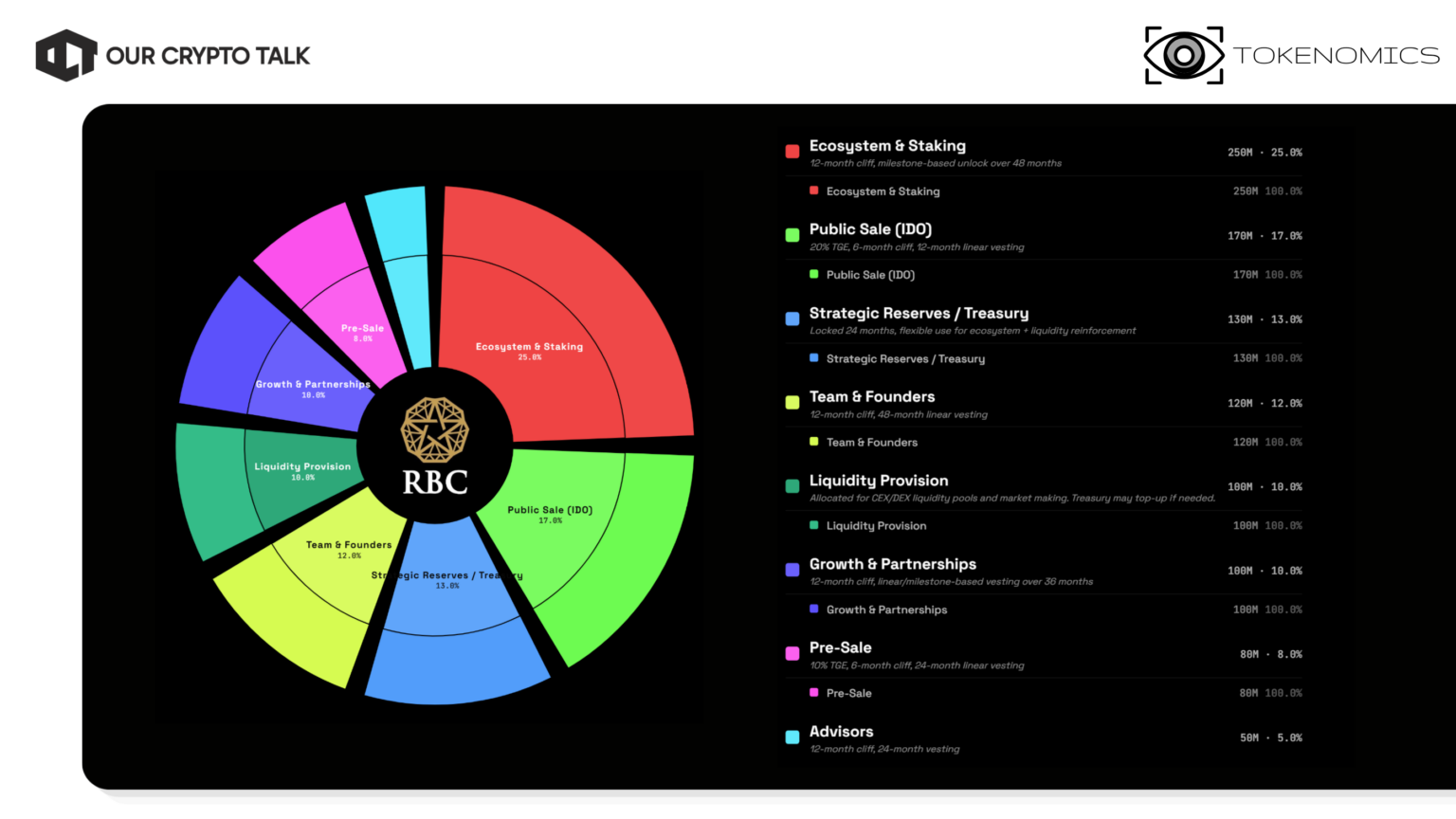
The total supply is fixed at 1 billion RBC.
The published allocation is:
The allocation gives roughly half of the supply to public participants and ecosystem incentives. That is healthier than many recent low-float launches.
The vesting schedule has already been published. Team and Founder tokens have a 12-month cliff followed by 48 months of linear vesting. Advisors also have a 12-month cliff with 24 months of vesting.
The Public Sale unlocks 20% at TGE, followed by a 6-month cliff and 12 months of linear vesting. Presale participants receive 10% at TGE, followed by a 6-month cliff and 24 months of linear vesting.
Ecosystem allocations unlock over 48 months based on milestones, while Growth & Partnerships vest over 36 months after a 12-month cliff. This reduces immediate sell pressure, although investors should still monitor future unlocks.
The token also has several planned utility features.
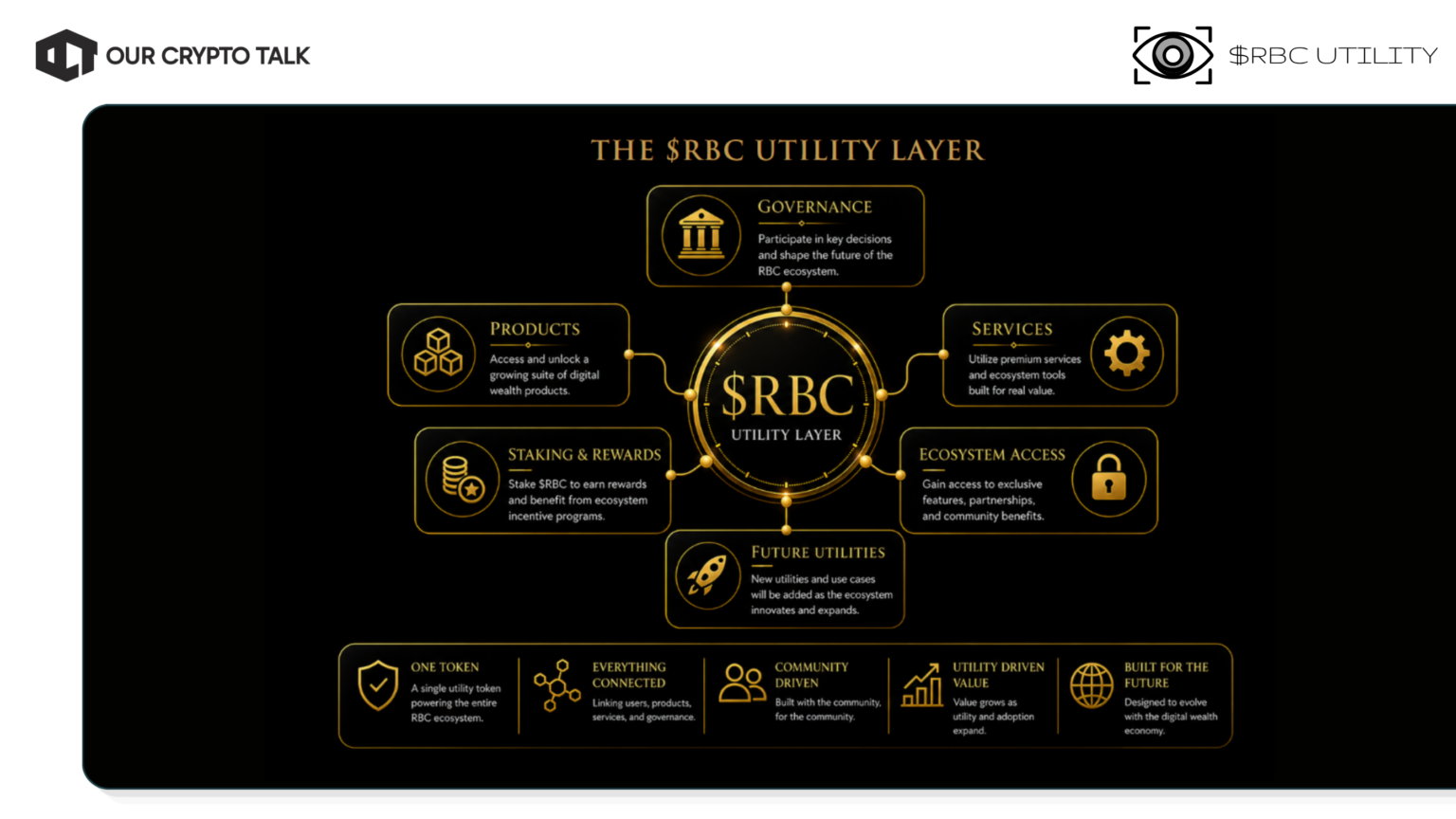
Holders can stake RBC to receive rewards funded by platform revenue. Users receive discounts when buying gold or paying platform fees with RBC. The token also supports governance and future DeFi features.
If these utilities launch as planned and platform activity grows, RBC could have genuine demand beyond speculation. If adoption remains weak, utility alone will not support long-term value.
For most investors, the launch FDV, circulating supply, and vesting schedule will matter more than the allocation percentages.
Most of the early allocation phase has already finished.
The presale closed in July 2026. The next opportunity will likely come through the public sale and planned TGE during Q3 2026.
Current ways to participate include:
This is not a typical points farm.
Most community campaigns offer limited rewards compared to earlier presale participants. The better approach is to evaluate the project’s valuation, vesting schedule, proof of reserves, and utility before buying after launch.
The strongest investment case depends on one thing. The company must prove that its physical gold business and blockchain ecosystem work together at scale. Until then, investors should focus more on execution than marketing.
RBC Digital Gold is an interesting project, but it still carries significant execution and verification risk. The investment thesis combines a real-world gold business with a tokenized ecosystem that promises staking rewards, governance, and DeFi utility. If the team delivers on those promises, the project could offer more than simple gold price exposure. However, most of the blockchain ecosystem remains pre-TGE, and investors still need stronger evidence that the physical operations and on-chain products work together at scale.
The early participation phase has largely passed. The presale ended in July 2026, leaving community campaigns such as quizzes and social activities as the primary ways to engage before launch. These campaigns generally offer limited rewards and attract large numbers of participants, making the expected return for the time invested relatively low. For most users, they are not worth pursuing.
The next opportunity will come through the public sale and the planned Q3 2026 TGE. The vesting schedule is already public, so investors should focus on the initial circulating supply, fully diluted valuation, and the quality of independent proof-of-reserves before making a decision.
The project has several strengths. It claims to operate real mining, refining, bullion trading, and vaulting businesses, while the founder brings relevant experience from the precious metals industry. The planned utility token also goes beyond simple governance by introducing revenue-based staking, platform discounts, and ecosystem incentives.
The risks are equally important. Independent reserve verification remains limited, detailed vesting schedules have not yet been published, and the project enters a market already dominated by trusted players such as PAXG and XAUT. Token value will ultimately depend on whether the physical gold business can generate enough activity to create sustained demand for the RBC ecosystem.
Overall, this looks like a speculative opportunity rather than an obvious asymmetric bet. Investors who have independently verified the physical operations may consider a small allocation once the final launch terms are available. Most participants are better served by waiting until the project demonstrates transparent reserves, live token utility, and meaningful on-chain adoption.
Competition is the first major challenge. PAXG and XAUT already dominate the tokenized gold market with audited reserves, deep liquidity, and years of operational history. RBC must prove that its vertically integrated model delivers clear advantages instead of becoming another gold-backed token with an additional utility layer.
Execution risk is equally important. The project’s entire thesis depends on continuously proving ownership of its physical gold, maintaining reliable custody, and supporting redemptions at scale. Marketing claims alone will not be enough. Investors will expect regular third-party reserve audits and transparent reporting.
Regulation also creates uncertainty. Tokenized gold sits at the intersection of commodities regulation, custody requirements, AML compliance, cross-border payments, and digital asset regulation. Any major regulatory change could affect issuance, trading, or redemption.
Another concern is transparency. The project claims custody of more than 1,500 kilograms of bullion, but those claims need continuous independent verification. Without consistent proof-of-reserves, investor confidence could weaken quickly.
Finally, the utility token must prove it creates real demand. Revenue-based staking only works if the underlying business generates sustainable income. If platform activity remains limited, the token could struggle to justify its valuation despite the physical gold backing.
The biggest catalyst is the planned Q3 2026 Token Generation Event. That will establish the initial circulating supply, market valuation, and the first opportunity for public trading.
Investors should focus on independent proof-of-reserves, confirmation that RBGT and the broader tokenization infrastructure are fully operational, and whether the published vesting schedule is executed as planned after TGE.
Expansion of the 1mg Gold platform into additional markets and evidence that revenue is flowing into staking rewards would further strengthen the investment case.
For now, waiting appears to be the more rational approach. The presale has already closed, and investors lose very little by allowing the team to prove reserve transparency, redemption mechanics, and post-launch adoption before committing capital.
WATCH
RBC Digital Gold has a stronger real-world foundation than many RWA projects because it is built around an existing precious metals business rather than a purely theoretical concept. The combination of physical gold operations, tokenized assets, and planned ecosystem utility gives the project a credible starting point.
However, several important questions remain unanswered. The token has not launched, the published vesting schedule still needs to play out as planned, independent reserve verification remains limited, and the project enters a market where established competitors already enjoy stronger liquidity and trust.
The milestone that changes the rating is straightforward. RBC must complete a successful TGE with reasonable tokenomics, publish continuous third-party proof-of-reserves, demonstrate reliable redemption of its gold-backed assets, and show meaningful on-chain usage after launch.
If those milestones are achieved, the project could establish itself as a differentiated player in tokenized commodities. Until then, it remains a project worth monitoring rather than one that warrants high conviction.
All the opinions in this article are that of the author and in no way are financial advice. Our Crypto Talk and the author always suggest you do your own research in crypto and to never take anything as financial advice that you read on the internet. Check our Terms and conditions for more info.


Tokenization of RWA yields onchain might be the biggest opportunity that no one has noticed
Cold Wallet Safety 2026: Are Hardware Wallets Still Safe?
One Token, Multiple Products. Can Zylo Deliver?
The Rise of NEAR Protocol 2026: Inside the 530% Rally and the ETF
Tokenization of RWA yields onchain might be the biggest opportunity that no one has noticed
Cold Wallet Safety 2026: Are Hardware Wallets Still Safe?
One Token, Multiple Products. Can Zylo Deliver?
The Rise of NEAR Protocol 2026: Inside the 530% Rally and the ETF