Aerodrome Review 2026: Is AERO a Good Buy?
Aerodrome Review covering AERO tokenomics, Base DEX growth, emissions, safety risks, competitors, and whether AERO is worth buying in 2026.


Author: Kritika Gupta
This Aerodrome Review looks at one of the most important DEX projects on Base. Aerodrome has built strong traction through its ve(3,3) model, AERO emissions, and liquidity incentives. But its long-term case depends on more than TVL and trading volume. Investors also need to assess dilution, competition, safety risks, governance quality, and whether Base can keep growing through 2026.
Why DEXes and Liquidity Protocols Are Hard to Get Right
Decentralized exchanges sit at the center of DeFi. They look simple from the outside. Users swap tokens. Liquidity providers earn fees. Protocols issue incentives. In practice, the model creates constant pressure.
Liquidity fragments across chains, pools, bridges, and token pairs. Capital moves fast. Users chase the best price. Liquidity providers chase the best yield. Projects chase the deepest market for their token.
This creates a hard incentive problem. Many liquidity providers act like mercenary capital. They farm rewards while emissions stay high. Then they leave when rewards fall. That hurts trading depth, increases slippage, and weakens the protocol token.
Fee competition also creates pressure. DEXes must stay cheap enough for traders while still rewarding liquidity providers. If fees fall too low, the protocol struggles to create durable value. If fees stay too high, traders move elsewhere.
Aerodrome tries to solve this through specialization. It focuses on Base, one of the fastest-growing Ethereum Layer 2 networks. It also uses a vote-escrow model to coordinate liquidity incentives. That gives it a clear role.
Still, the challenge remains large. A DEX must keep volume, liquidity, token demand, and governance aligned through different market cycles. Aerodrome has built traction, but its long-term value depends on whether its flywheel can survive without excessive emissions.
What Is Aerodrome?
Aerodrome Finance is a decentralized exchange and liquidity hub built on Base. Dromos Labs launched the protocol on August 28, 2023. The same team also built Velodrome Finance on Optimism.
Aerodrome works as an automated market maker. It helps users swap tokens, provide liquidity, and earn rewards. It also helps projects attract liquidity to specific trading pairs through a gauge and voting system.
The protocol adapts the ve(3,3) model. Users can lock AERO to receive veAERO. This gives them voting power. Each week, veAERO holders vote on which liquidity pools should receive new AERO emissions. Projects can also offer incentives to voters to direct emissions toward their pools.
Aerodrome launched without venture capital backing or a token sale. That matters because many DeFi tokens suffer from early insider allocations and unlock pressure. Aerodrome instead uses ongoing emissions to reward liquidity providers and governance participants.
As of early July 2026, AERO traded around $0.59. Its market cap sat near $567 million. Its fully diluted valuation ranged around $1.0 billion to $1.14 billion. Total supply stood near 1.93 billion AERO, with around 964 million in circulation.
TVL moved within a broad $300 million to $600 million range. The protocol also processed more than $185 billion in cumulative trading volume. These numbers show strong usage, but they also depend heavily on Base activity and emissions-driven liquidity.
How Aerodrome Works
Aerodrome uses two main AMM designs. The first is a classic constant-product model. This supports standard liquidity pools and broad token compatibility. The second is Slipstream, a concentrated liquidity system inspired by Uniswap V3.
Traders use Aerodrome to swap tokens on Base. Liquidity providers deposit token pairs into pools. They can also stake LP positions in gauges to earn AERO emissions and trading fees.
The key mechanic sits in the voting layer. Users lock AERO for up to four years to receive veAERO. Longer locks give more voting power. veAERO holders then vote weekly on liquidity gauges.
These votes decide where new AERO emissions go. If a pool receives more votes, it receives more rewards. That attracts more liquidity providers. Deeper liquidity can improve trade execution and reduce slippage. More trading activity then creates more fees.
Projects can also offer bribes, or external incentives, to veAERO voters. This gives projects a way to attract liquidity without renting it directly through unsustainable farming campaigns.
Aerodrome’s flywheel works like this: votes direct emissions, emissions attract liquidity, liquidity improves trading, trading creates fees, and fees reward voters. In theory, this aligns traders, liquidity providers, token lockers, and project teams.
The model creates a marketplace for liquidity. It does not guarantee sustainability. It works best when real trading volume supports the incentives. If volume falls or bribes weaken, the flywheel can slow.
Technology & Architecture
Aerodrome runs fully on-chain on Base. Base is Coinbase’s Ethereum Layer 2 optimistic rollup. Aerodrome does not run its own blockchain, validator set, or consensus system. It relies on Base for execution and Ethereum for final settlement.
This gives Aerodrome low fees and fast user experience. It also ties the protocol’s growth to Base adoption. If Base gains more users, tokens, and applications, Aerodrome can benefit. If Base activity slows, Aerodrome feels that pressure directly.
The protocol combines classic AMM pools with Slipstream concentrated liquidity. Classic pools work well for simple token pairs. Slipstream lets liquidity providers allocate capital within selected price ranges. This can improve capital efficiency and reduce slippage for active pairs.
Aerodrome’s main architectural edge comes from its vote-escrow system. AERO lockers receive veAERO NFTs. These NFTs grant voting power. Voting power decays over time unless users extend their locks.
This design differs from pure AMMs like Uniswap. Uniswap focuses on liquidity and trading infrastructure. Aerodrome adds an incentive coordination layer. It lets protocols compete for liquidity through gauges, votes, and bribes.
That structure gives Aerodrome strong local network effects on Base. It also creates governance complexity. Voters must allocate emissions wisely. Poor voting behavior can reward weak pools, inflate supply, and reduce long-term efficiency.
Team & Backers
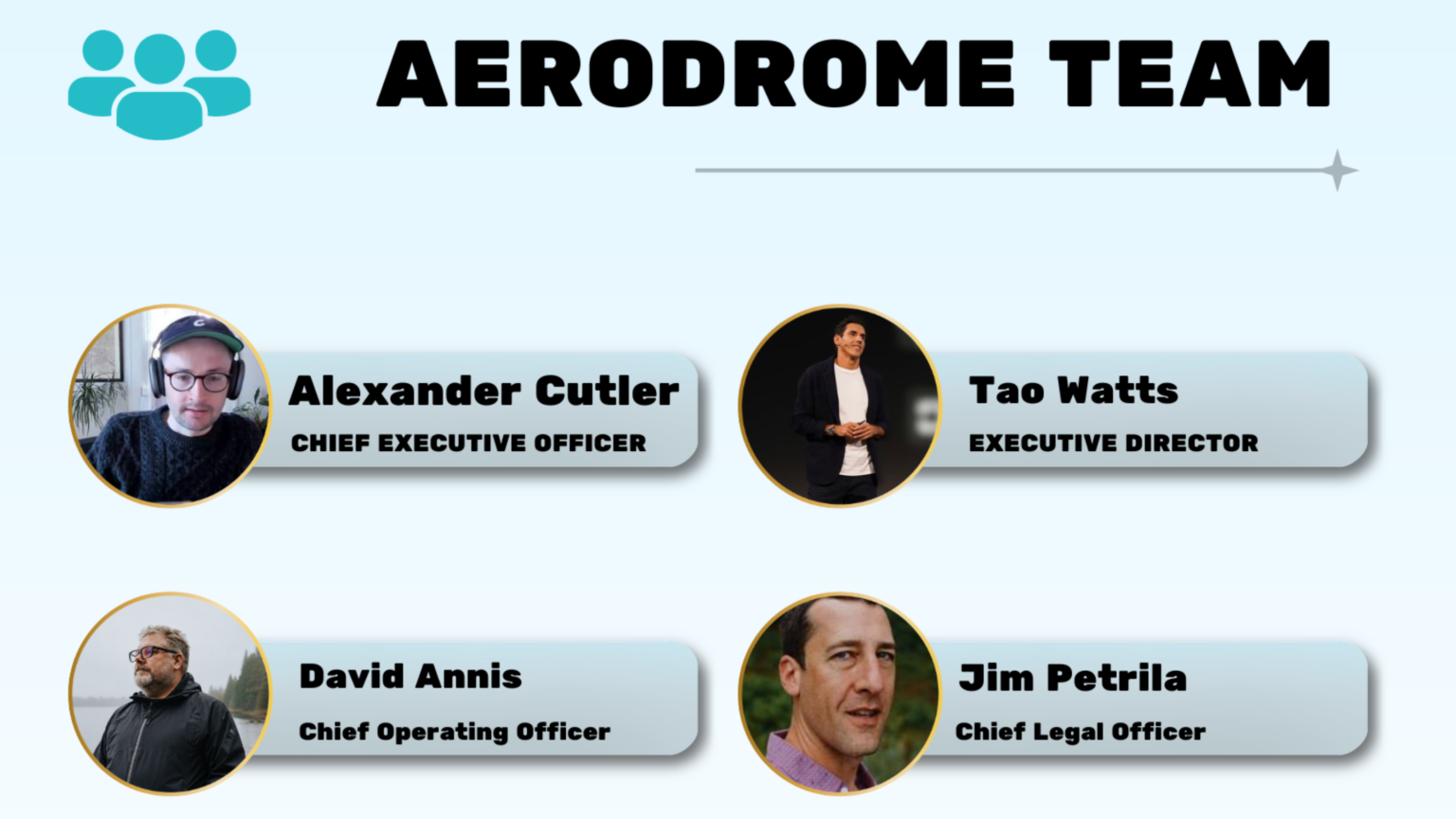
Dromos Labs develops and maintains Aerodrome. The team also built Velodrome Finance on Optimism. That track record gives Aerodrome more credibility than many newer DEX projects.
Alexander Cutler serves as one of the most visible figures behind Aerodrome and Velodrome. He has played a major role in public communication, governance direction, and ecosystem positioning. The broader team started with a more pseudonymous structure, which remains common in DeFi. Over time, the team increased its public presence.
Aerodrome launched without major venture backing, a private sale, or a public token sale. This creates a cleaner initial distribution than many crypto projects. It also reduces the risk of large VC unlocks.
The trade-off is clear. Aerodrome does not rely on deep-pocketed private investors. It depends more on community governance, liquidity providers, protocol partnerships, and Base ecosystem growth.
This can strengthen alignment, but it can also create pressure. Community-led systems must manage incentives carefully. If governance directs emissions poorly, the protocol can dilute holders without producing durable liquidity.
Overall, the team has relevant DeFi experience. The Velodrome connection matters. Still, execution remains the key variable. Aerodrome must keep improving liquidity, security, governance, and product depth as Base grows more competitive.
Aerodrome Tokenomics (AERO)
Token Overview
AERO is Aerodrome’s utility and governance token. It has no hard maximum supply. The protocol mints new AERO weekly to reward liquidity providers through gauges.
Early emissions started high to bootstrap liquidity. This “take-off” phase helped Aerodrome attract TVL and trading activity on Base. After that, emissions entered a decay phase. Weekly emissions declined by about 1% per epoch.
Later, governance gained more control through the Aero Fed. veAERO holders can vote to increase, decrease, or maintain emissions. This gives the community a way to adjust monetary policy based on market conditions.
As of mid-2026, Aerodrome’s annualized inflation sat around 10% to 11%. Total supply stood near 1.9 billion AERO. A large share already circulated, but weekly emissions still created steady supply pressure.
Token Allocation
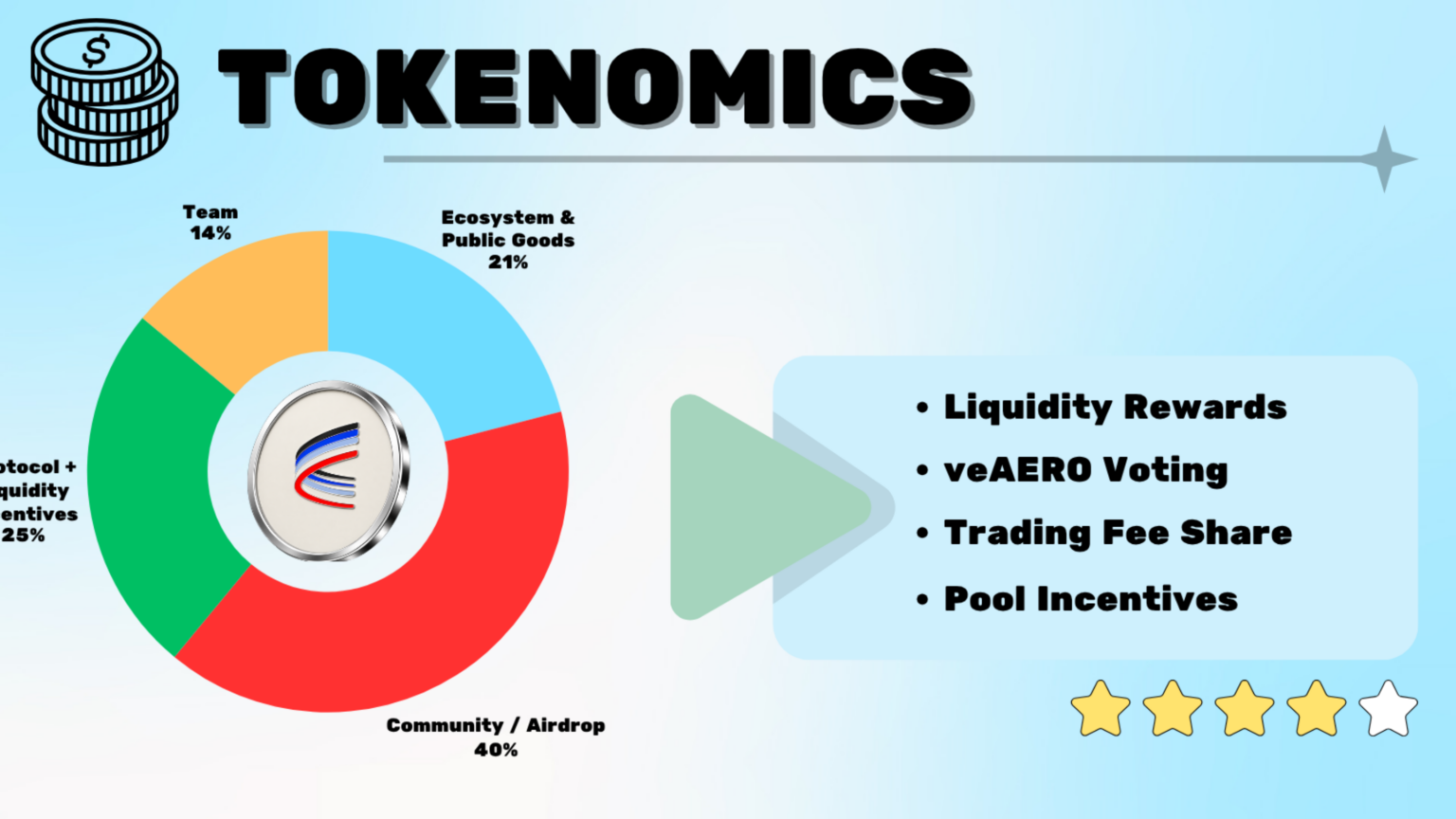
Aerodrome directs most token supply toward ecosystem growth and liquidity incentives. Gauge emissions form the largest category, at roughly 60% to 67% of allocation.
Airdrops account for another meaningful share. These included allocations to early Velodrome lockers and ecosystem participants. Public goods, ecosystem pairs, and protocol grants also received allocations.
Team and foundation allocations remain smaller than many venture-backed projects. Many of these tokens also align with locking and long-term participation.
This structure avoids the worst version of insider-heavy tokenomics. However, it does not remove dilution risk. AERO still depends on ongoing emissions. If new supply grows faster than demand, price can suffer.
Vesting & Unlock Pressure
Aerodrome does not face the same cliff unlock structure that hurts many crypto tokens. Instead, it uses continuous weekly emissions.
This makes supply pressure more predictable. It also makes it constant. Every week, new AERO enters the system.
The lock rate matters. Historically, high veAERO locking helped reduce circulating pressure. If users keep locking tokens, emissions can support governance and liquidity rather than only creating sell pressure.
Still, investors should watch emissions closely. AERO can perform well when volume, fees, bribes, and lock demand grow together. It can struggle when emissions rise but usage weakens.
Token Utility
AERO has clear utility inside Aerodrome. Liquidity providers earn it through gauges. Users lock it to receive veAERO. veAERO holders vote on emissions. They also earn fees and external incentives from selected pools.
This gives AERO more direct utility than many governance tokens. The token connects to liquidity direction, fee capture, and protocol incentives.
The model creates a productive asset for active participants. It does not automatically create value for passive holders. Users must understand locking periods, voting cycles, emissions, and bribe markets.
AERO’s value depends on protocol usage. If Aerodrome keeps attracting volume and liquidity on Base, the token can capture meaningful demand. If volume falls or governance weakens, emissions can dilute holders faster than utility grows.
Is Aerodrome Safe?
Aerodrome uses smart contracts based on the Velodrome V2 codebase. That gives it a stronger starting point than many new DeFi protocols. The codebase has gone through multiple audits, and the ecosystem maintains security review processes.
Aerodrome also keeps contracts verified on Basescan. This improves transparency. Users can inspect contract addresses, transactions, and governance activity on-chain.
The protocol has not suffered a major smart contract exploit that drained protocol funds. That is important. However, users should not confuse smart contract safety with total platform safety.
In November 2025, Aerodrome and Velodrome suffered a front-end and DNS hijacking incident. Attackers compromised centralized domains and redirected users to phishing sites. These sites pushed malicious wallet signatures. Reports placed user losses above $1 million across related incidents.
The underlying smart contracts remained intact. The incident exposed a different risk: front-end security. DeFi users interact with websites, wallets, domains, bridges, and contracts. A secure contract can still expose users if the interface gets compromised.
Aerodrome responded by warning users and pointing them toward safer access routes, including decentralized mirrors. The event did not destroy the protocol, but it remains relevant for risk analysis.
Users should verify URLs, check contract addresses, use hardware wallets, avoid blind signatures, and limit wallet permissions. Aerodrome looks relatively strong at the contract layer. Operational risk still exists.
Aerodrome vs Competitors
Aerodrome vs key DEX competitors
Aerodrome competes in two ways. First, it competes against other Base DEXes for local liquidity. Second, it competes against multi-chain giants like Uniswap for mindshare, integrations, and trading volume.
Its main edge comes from incentive coordination. Aerodrome does not only provide swap infrastructure. It lets protocols buy liquidity direction through gauges and incentives.
That model can work very well during growth cycles. It can also become expensive if rewards drive activity more than organic demand. This makes Aerodrome stronger than a simple farm, but still exposed to incentive fatigue.
Strengths & Risks: Bull vs Bear Case
The bull case starts with Base. Aerodrome holds a strong position on one of the most important Ethereum Layer 2 networks. Coinbase gives Base a major distribution advantage. If Base keeps growing, Aerodrome can capture more volume, TVL, and project liquidity demand.
Aerodrome also has a proven model. The ve(3,3) system gives token lockers real influence over emissions. It creates fee and bribe opportunities. It also gives projects a direct route to liquidity.
The possible Aerodrome and Velodrome unification adds another catalyst. A combined liquidity layer could extend network effects across the Superchain and other ecosystems.
The bear case starts with emissions. AERO has no fixed supply cap. Weekly emissions create ongoing dilution. The model needs constant demand, strong lock rates, and real trading fees to offset that pressure.
Competition also remains intense. Uniswap has stronger brand power. New Base DEXes can target specific pools, offer lower fees, or launch aggressive incentives.
Aerodrome also depends on external bribes and liquidity incentives. If those dry up, liquidity can leave. If governance rewards weak pools, emissions can become inefficient.
The balanced view is simple. Aerodrome has real traction and a coherent model. It also carries real dilution, competition, and governance risk.
Should You Buy AERO? OCT Verdict
AERO suits different market participants in different ways.
Builders and developers can consider Aerodrome. The protocol offers deep Base liquidity, active gauges, and a strong incentive marketplace. Projects that need token liquidity can use Aerodrome to bootstrap trading pairs and attract LPs.
Short-term traders should watch AERO carefully. The token reacts to Base narratives, emissions data, governance votes, merger updates, market rotation, and DeFi sentiment. That creates opportunity, but it also creates sharp volatility.
Long-term investors can consider AERO selectively. The protocol has real usage, clear token utility, and a strong position on Base. However, AERO is not a passive “buy and forget” asset. Investors must track emissions, lock rates, volume, fees, bribes, and Base growth.
AERO can work if usage growth outruns dilution. It can struggle if emissions keep flowing while trading demand weakens.
This makes AERO a higher-conviction DeFi bet rather than a simple infrastructure token. The protocol has a real business model, but the token still depends on disciplined governance and durable liquidity demand.
For investors bullish on Base DeFi, Aerodrome deserves attention. For investors who dislike inflationary token models, AERO carries a clear structural risk.
Final Verdict: Is Aerodrome a Buy in 2026?
Aerodrome stands as one of the strongest DEX projects on Base. It combines trading infrastructure, liquidity incentives, governance, fees, and bribes into one coordinated system. That gives it a clearer value proposition than many DeFi tokens.
The project also benefits from timing. Base continues to attract users, developers, and assets. Aerodrome sits close to that growth. Its role as a liquidity hub gives it leverage to the broader Base ecosystem.
Still, AERO carries meaningful risk. Weekly emissions create dilution. Competition can pressure fees and liquidity. Governance must allocate incentives well. Front-end security incidents also show that DeFi risk extends beyond smart contracts.
Aerodrome looks strongest for users who understand DeFi mechanics and actively track protocol data. It may appeal to investors who believe Base will keep growing and that liquidity coordination will remain valuable.
It looks weaker for passive holders who only want fixed-supply tokenomics or simple value accrual. AERO requires monitoring.
The verdict is balanced. Aerodrome is a serious DeFi protocol with real traction. AERO can be attractive at the right price and risk profile. But it is not a risk-free Base proxy. It is a bet on emissions discipline, governance quality, Base growth, and sustained trading demand.
Frequently Asked Questions
What makes Aerodrome different from other DEXes?
How can users earn on Aerodrome?
Is AERO inflationary?
Does AERO inflation hurt the token price?
Was Aerodrome hacked?
Does Aerodrome only operate on Base?
Who controls Aerodrome governance?
Is Aerodrome good for long-term investors?
In this article
Why DEXes and Liquidity Protocols Are Hard to Get RightWhat Is Aerodrome?How Aerodrome WorksTechnology & ArchitectureTeam & BackersAerodrome Tokenomics (AERO)Is Aerodrome Safe?Aerodrome vs CompetitorsStrengths & Risks: Bull vs Bear CaseShould You Buy AERO? OCT VerdictFinal Verdict: Is Aerodrome a Buy in 2026?