Sonic Labs ($S) Review: Is $S Worth Buying?
Sonic Labs review covering $S tokenomics, TVL decline, leadership reset, dilution risks, competitors, and whether S is worth buying in 2026.


Author: Kritika Gupta
Sonic Labs is trying to rebuild one of crypto’s most recognizable EVM ecosystems at a difficult time. The project launched Sonic as the successor to Fantom, with faster execution, lower fees, Ethereum compatibility, and a developer revenue model built around Fee Monetization.
However, the market has not rewarded the story yet. The $S token trades more than 95% below its all-time high. TVL has fallen sharply. Leadership changed in 2026. Token dilution concerns still sit at the center of investor debate.
That makes Sonic one of the more complicated Layer-1 reviews in 2026. It has real technology, clear developer incentives, and a familiar Fantom legacy. Yet it also carries weak adoption metrics, execution risk, and heavy competition from Solana, Ethereum L2s, Avalanche, Sei, Monad, and other high-performance chains.
So, is $S undervalued after the reset, or is the market correctly pricing the risk? This Sonic review breaks down the technology, tokenomics, team changes, competitors, risks, and whether Sonic is worth buying in 2026.
Why High-Performance EVM Layer-1 Blockchains Are Hard to Get Right
High-performance EVM Layer-1 blockchains sell a simple promise: Ethereum compatibility with faster speed, lower fees, and better developer economics. However, execution rarely looks simple.
A chain can claim high TPS in controlled conditions. Real users test something harder. They test liquidity, bridge reliability, validator security, app quality, incentives, and uptime under pressure. They also compare every new chain against Solana, Ethereum L2s, and older EVM networks with deeper liquidity.
Therefore, speed alone rarely creates a durable ecosystem. Developers need users. Users need liquidity. Liquidity needs trust. Token holders need a reason to believe network growth can outrun dilution.
Sonic Labs enters this difficult category with strong technical claims and a clear developer incentive model. Yet its market data now tells a tougher story. The token trades more than 95% below its all-time high, TVL has fallen sharply, and the project just went through a major leadership reset.
That makes the Sonic review more interesting. It is no longer only a speed story. It is now a recovery story.
What Is Sonic?
Sonic is a high-performance EVM-compatible Layer-1 blockchain. Sonic Labs built it as the successor to Fantom Opera, the older network linked to the Fantom Foundation. They launched the Sonic mainnet on December 18, 2024, with EVM support, sub-second finality, a native Ethereum bridge, and a 1:1 migration path from FTM to S.
The project’s core thesis focuses on three ideas. First, Sonic wants to offer fast and cheap execution. Second, it wants developers to earn directly from the activity they generate. Third, it wants Ethereum users to bridge into Sonic through the Sonic Gateway.
As of late June 2026, $S trades around $0.02 to $0.03. CoinMarketCap lists market cap near $66.7 million, FDV near $74.6 million, total supply at 3.22 billion S, and circulating supply at 2.88 billion S. Binance shows a similar price zone, with market cap near $73 million and an all-time high of $1.03.
That puts $S in a deep drawdown. So the key question is direct: does the market now price Sonic too cheaply, or does the drawdown reflect broken adoption?
How Sonic Works
Sonic works like a performance-focused EVM chain. Users bridge assets into Sonic through the Sonic Gateway. Then they interact with DeFi apps, consumer apps, and other smart contracts using the S token for gas. The chain keeps the Ethereum-style developer environment, so builders can deploy Solidity and Vyper contracts without rewriting their stack from scratch. Sonic’s launch materials also highlight the Gateway’s fail-safe mechanism, which can unlock bridged assets on Ethereum if the bridge stops sending heartbeats for two weeks.
Next, developers can apply for Fee Monetization, known as FeeM. This program lets approved builders earn 90% of the network fees their apps generate. Sonic Labs frames this as a direct alternative to launching separate appchains or relying only on token incentives.
That model gives Sonic one clear advantage. It tries to align the chain with app developers instead of treating them only as traffic sources.
However, users still matter most. FeeM can attract builders, but it cannot force sustained demand. Sonic needs active apps, sticky liquidity, and real transaction volume. Without those, the technology remains underused.
Technology & Architecture
Sonic builds on Fantom’s earlier technical base, but it upgrades the execution layer, storage design, bridge experience, and developer incentive model.
Sonic Labs claims sub-second finality and full EVM compatibility. Its current documentation also claims 400,000 TPS, while its mainnet launch post presented a more conservative 10,000 TPS figure with sub-second finality.
Investors should treat those numbers carefully. Claimed throughput does not equal sustained economic usage. A chain can process transactions quickly and still struggle to attract liquidity, fees, and developers with durable users.
Sonic’s more practical architectural edge comes from EVM compatibility and FeeM. EVM support reduces developer friction. FeeM gives app teams a direct revenue path. The Sonic Gateway also matters because liquidity often enters new EVM chains through Ethereum first.
Still, the architecture does not remove the main risk. Sonic competes against Solana, Avalanche, Sei, Monad, Base, Arbitrum, and other networks that also pitch speed, liquidity, and better user experience.
Therefore, Sonic’s technology gives it a credible foundation. It does not prove investment quality by itself.
Team & Backers
Sonic comes from the Fantom ecosystem. Its history includes well-known Fantom figures such as Andre Cronje, Michael Kong, and David Richardson.
However, 2026 changed the leadership story. Sonic Labs announced that Cronje, Kong, and Richardson would step away from the board. The project named Matt Visser as CEO and Kosta Kourkoumelis as COO. Sonic Labs said the reset would bring clearer communication, governance changes, and a stronger focus on risk and compliance.
This reset creates both upside and risk.
On the positive side, new leadership can rebuild trust after a painful decline. A more disciplined operating structure may help the project move beyond founder-driven execution.
On the negative side, leadership turnover can damage confidence. It also raises execution risk at the exact time when Sonic needs product traction, ecosystem growth, and better investor communication.
Sonic has also raised external capital. In May 2025, Sonic Labs announced a $10 million strategic S token sale to Galaxy for U.S. expansion. DefiLlama also lists Galaxy as a strategic investor in Sonic’s May 2025 round.
So the team story now depends on proof. The new leadership must show traction, not just better messaging.

Sonic Tokenomics ($S)
Token Overview
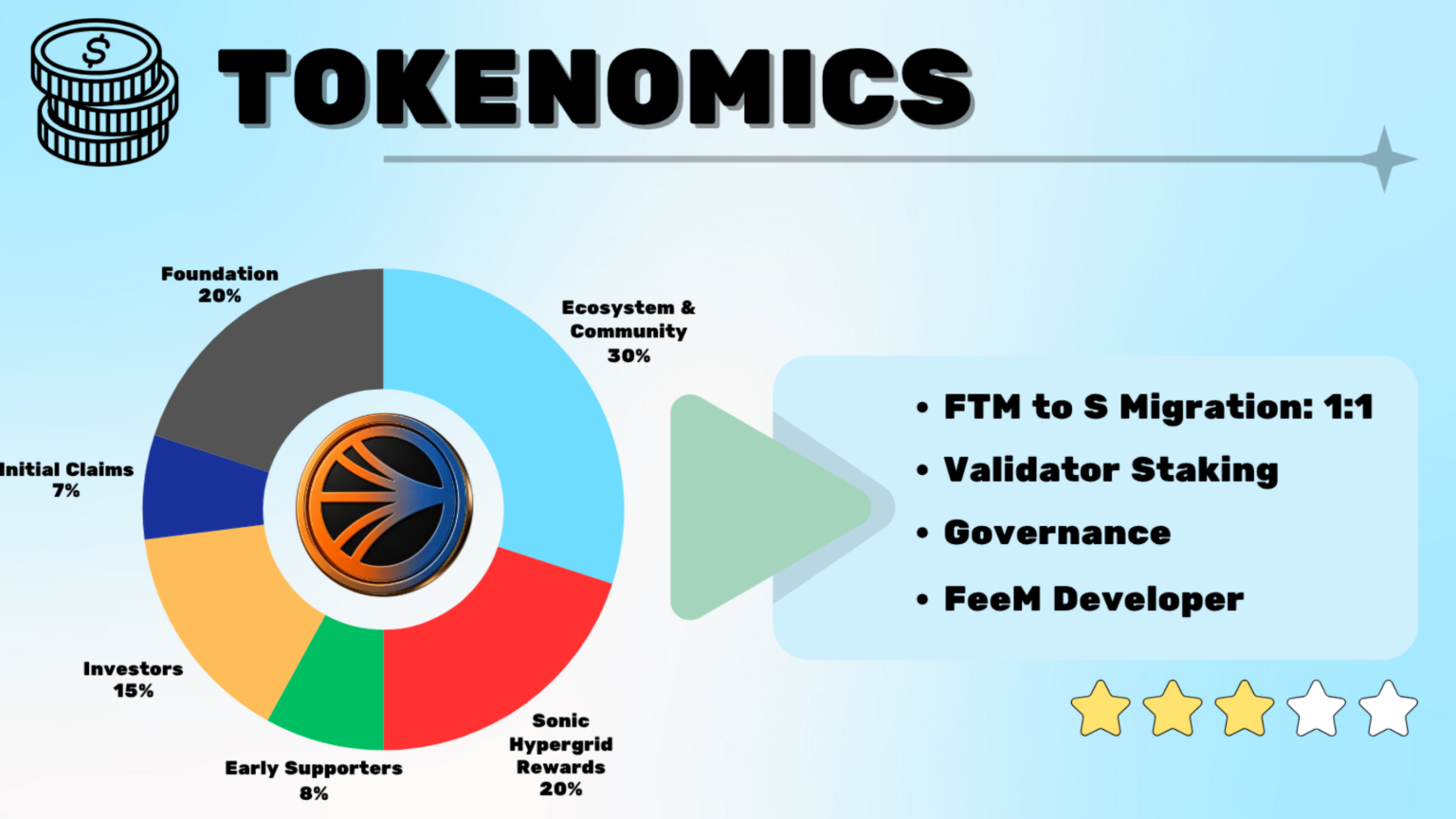
$S is Sonic’s native asset. It powers gas payments, staking, validator security, governance, and network participation. It replaced FTM through a 1:1 migration after Sonic mainnet launched.
Token Allocation
Sonic inherited part of its economic structure from Fantom. It also introduced new ecosystem incentives, airdrop allocations, and governance-approved expansion plans. Sonic’s launch materials referenced a roughly 200 million S airdrop for users and developer-focused Sonic Gems.
Vesting & Unlock Pressure
Token supply remains one of Sonic’s biggest investor concerns. The reported halt of the scheduled 2026 programmatic mint helps short-term sentiment. It shows that the team heard holder concerns.
However, this does not erase earlier dilution. Sonic still carries a history of supply expansion, ecosystem incentives, and strategic issuance. That matters because the token trades far below its prior peak. When the token falls, treasury value and incentive power also weaken.
Token Utility
S has clear utility. Users need it for gas. Validators need it for staking. Governance uses it for decision-making. Developers can also earn S-denominated rewards through FeeM if their apps generate fees.
Still, token utility only matters if the network grows. Without stronger demand, even good utility can fail to support price.
Is Sonic Safe?
Sonic does not look like a simple security red flag. It uses EVM tooling, publishes technical documentation, and highlights audits and bridge design in its official resources. The Sonic Gateway also includes a fail-safe path designed to protect users if the bridge stops transmitting heartbeats.
However, safety means more than smart contract security.
Investors should separate technical safety from investment safety. Sonic may function as a chain, but $S still carries market, liquidity, dilution, governance, and execution risk.
The leadership reset adds another layer. New management can improve transparency. Yet it also must prove that it can operate a complex Layer-1 ecosystem under weak sentiment.
Current on-chain data also weakens the safety profile for investors. DefiLlama shows Sonic TVL around $16.8 million, with 24-hour chain fees and chain revenue around $150 at the latest snapshot.
That does not mean Sonic is unsafe to use. It means the investment case needs much stronger evidence before long-term investors assign high confidence.
Sonic vs Competitors
The table below uses late June 2026 public snapshots. Fee and revenue run rates can change quickly, so treat them as point-in-time comparisons.
Sonic’s strongest relative feature is FeeM. Its weakest relative feature is current adoption. DefiLlama shows Sonic far behind Solana and Avalanche in TVL, while also trailing Monad despite Sonic’s earlier mainnet launch.
Sonic vs high-performance L1 and EVM competitors
Strengths & Risks (Bull vs Bear Case)
Bull Case: Why Sonic Could Recover
Sonic still has a real technical base. It supports EVM apps, offers fast settlement, and gives developers a clear revenue incentive through FeeM. That makes the chain attractive for builders who want EVM compatibility without losing most fee upside to the base layer.
Also, the leadership reset may help. Sonic Labs publicly acknowledged weak sentiment and named new executives instead of pretending the drawdown did not matter. That shift can rebuild trust if the new team communicates clearly and ships consistently.
The valuation also creates optionality. $S no longer prices in perfection. If TVL, fees, and app activity rebound, the market could re-rate the asset from a distressed base.
Bear Case: Why Sonic Still Looks Risky
The bear case starts with usage. Sonic’s current TVL sits near $16.8 million, and latest 24-hour chain fees remain tiny. That makes the network look underused relative to its performance claims.
Next, the token history hurts confidence. Large drawdowns, dilution concerns, and leadership turnover create a difficult backdrop.
Finally, competition remains brutal. Sonic must fight for developers, liquidity, users, and attention against much larger ecosystems. Better tech alone will not win that battle.
Should You Buy $S? (OCT Verdict)
Builders & Developers: Consider
Sonic deserves attention from builders. FeeM gives developers a stronger fee-sharing model than most general-purpose chains. EVM compatibility also lowers deployment friction. If an app can bring its own users and liquidity, Sonic may offer attractive economics.
Short-Term Traders: Watch
$S can move sharply on governance updates, mint changes, leadership communication, and ecosystem announcements. However, the underlying metrics remain weak. Traders should treat it as a news-sensitive recovery trade, not a clean momentum asset.
Long-Term Investors: Avoid or Keep Very Small
Long-term investors need stronger evidence. Sonic must show sustained TVL growth, fee growth, active apps, cleaner token communication, and stable leadership execution. Until then, $S looks more like a high-risk turnaround bet than a core Layer-1 holding. The upside exists, but the proof does not yet match the promise.
Final Verdict: Is Sonic a Buy in 2026?
Sonic still has credible ingredients. It has EVM compatibility, strong performance claims, an Ethereum bridge, and one of the more interesting developer fee-sharing models in crypto. FeeM gives the chain a real differentiation point.
However, the current investment case remains weak. Sonic’s token trades more than 95% below its all-time high. TVL has collapsed from earlier highs. Chain-level fees remain low. Leadership has changed at a critical moment. Competition from Solana, Avalanche, Monad, Sei, Ethereum L2s, and other high-performance ecosystems keeps rising.
Therefore, Sonic is not a straightforward buy in 2026. It is a distressed recovery candidate. That means the risk-reward may interest aggressive investors who can tolerate volatility and wait for execution. But most investors should demand evidence first.
The clearest confirmation would come from rising TVL, stronger app revenue, higher active addresses, better stablecoin liquidity, and consistent leadership communication. Until those signals improve, $S deserves caution more than conviction.
This is not financial advice. Always do your own research.
Frequently Asked Questions
What is the relationship between Sonic and Fantom?
How does the FeeM program benefit developers?
Was the 2026 token mint canceled?
Who leads Sonic Labs now?
What are Sonic’s performance claims?
How has Sonic’s activity performed recently?
What are the main risks for $S?
In this article
Why High-Performance EVM Layer-1 Blockchains Are Hard to Get RightWhat Is Sonic?How Sonic WorksTechnology & ArchitectureTeam & BackersSonic Tokenomics ($S)Is Sonic Safe?Sonic vs Competitors Strengths & Risks (Bull vs Bear Case)Should You Buy $S? (OCT Verdict)Final Verdict: Is Sonic a Buy in 2026?