Supra (SUPRA) Review: Is SUPRA Worth Buying in 2026?
Supra Review 2026: Explore SUPRA tokenomics, AutoFi technology, native oracles, risks, adoption potential, and whether SUPRA is worth buying.


Author: Akshat Thakur
Why High-Performance Layer-1 Blockchains Are Hard to Get Right?
Building a Layer-1 that combines extreme throughput, native oracles, on-chain automation, cross-chain messaging, and smart contract execution in one protocol creates multiple interlocking difficulties. Most attempts run into bottlenecks when trying to keep every component low-latency and secure at the same time. Scaling consensus to hundreds of thousands of transactions per second while embedding oracle data feeds and automation logic adds complexity to block production and validation. Any slowdown or added round-trip in one part can undermine the entire system.
Security becomes harder because native oracles and automation expand the attack surface. Price feed manipulation, faulty random number generation, or automation exploits that trigger unintended executions can affect the whole chain rather than isolated external services. Compliance adds another layer. On-chain automation that executes financial logic without human input can attract regulatory scrutiny in many jurisdictions, especially when it involves recurring payments or conditional trades.
Adoption beyond initial testnet or grant activity has proven difficult for similar projects. Developers and users often stick with familiar modular setups or established oracles unless the integrated alternative shows clear, sustained advantages in cost, speed, and reliability. Token utility frequently lags behind speculation. Gas fees, staking, or service payments may not generate enough real demand to support validator economics or token value if usage stays low.
Economic sustainability requires the network to capture value from its integrated services without relying solely on inflationary emissions or external subsidies. Many vertically integrated designs have struggled to reach the point where fees from oracles, automation, or cross-chain activity meaningfully offset costs.
Terms such as “next Solana with oracles” or “AutoFi killer” oversimplify these challenges. Supra positions itself as a specialized all-in-one Layer-1 for Automatic DeFi and Super dApps. Specialization only matters if the full stack delivers measurable advantages in speed, cost, and developer experience at scale.
What Is Supra?
Supra is a high-performance, fully vertically integrated MultiVM Layer-1 blockchain built primarily around MoveVM while also supporting SupraEVM. The network is designed for Automatic DeFi, often called AutoFi, and includes native oracles, verifiable randomness, cross-chain messaging, and on-chain automation directly within the protocol.
The project originated as SupraOracles, with roots dating back to 2017 and public development beginning around 2020. It initially focused on decentralized oracle infrastructure before expanding into a complete Layer-1 ecosystem. This evolution culminated in the launch of the Supra mainnet and SUPRA token generation event on November 27, 2024.
The core thesis is simple. Most decentralized applications rely on multiple external services for price feeds, automation, randomness, and cross-chain communication. Supra aims to eliminate those dependencies by integrating them directly into the base layer, reducing complexity, latency, and potential security risks.
For investors researching what is Supra or looking for a Supra crypto review, the project stands out because it combines oracle infrastructure, automation, interoperability, and smart contract execution within a single blockchain stack.
How Supra Works
Supra gives developers direct access to core infrastructure services without relying on external protocols.
Developers can build applications on either MoveVM or SupraEVM. Smart contracts gain native access to price oracles, distributed verifiable randomness functions, automation tools, and HyperNova cross-chain messaging. These services operate as part of the protocol itself rather than through third-party integrations.
This architecture enables what Supra calls AutoFi. Applications can automatically execute actions based on predefined conditions without external bots or keeper networks. Examples include portfolio rebalancing, automated payments, collateral management, recurring transfers, and conditional trading strategies.
For users, the experience resembles a traditional blockchain application. Transactions remain fast and low cost while automation and data services operate behind the scenes. This reduces friction and removes several layers of infrastructure that developers would otherwise need to integrate separately.
Key components include native oracle feeds with sub-second updates, dVRF for randomness generation, HyperNova for bridgeless cross-chain communication, and protocol-level automation. Supra Containers also allow developers to customize execution environments for specific applications.
Major milestones include the launch of the MoveVM mainnet, rollout of automation features, and expansion of ecosystem applications that use integrated oracle and automation capabilities. The overall goal is to create self-operating decentralized applications that require less external infrastructure and maintenance.
Technology & Architecture
Supra operates as a vertically integrated Layer-1 blockchain designed to combine execution, data delivery, automation, randomness, and interoperability into a unified architecture.
At its core sits the Moonshot consensus protocol, which targets high throughput and low latency. The network claims performance exceeding 500,000 transactions per second in testing environments alongside sub-second finality. Actual performance on mainnet depends on real-world demand and network conditions.
Native oracle infrastructure provides price feeds and emerging AI-focused oracle services directly from the protocol layer. Distributed verifiable randomness is delivered through dVRF. HyperNova enables bridgeless cross-chain communication by validating source-chain consensus rather than relying on traditional bridge operators.
Supra also incorporates system-level automation, allowing applications to trigger actions automatically based on predefined conditions. MultiVM architecture supports MoveVM as the primary environment while SupraEVM expands compatibility for Ethereum developers.
Recent developments include the rollout of SupraEVM, the launch of SupraOS Alpha in April 2026 for blockchain-enforced AI agent management, and gas model adjustments introduced in May 2026. Supra Containers further extend flexibility by enabling customized execution environments for specific applications.
Compared with high-performance Layer-1 networks such as Sei and Monad, Supra focuses on integrating services that are normally outsourced to separate protocols. Compared with oracle-focused networks, it offers a complete smart contract platform rather than a standalone data layer.
The architecture aims to simplify development and reduce latency across the application stack. The key question is whether these advantages remain meaningful as network usage and complexity increase over time.
Team & Backers
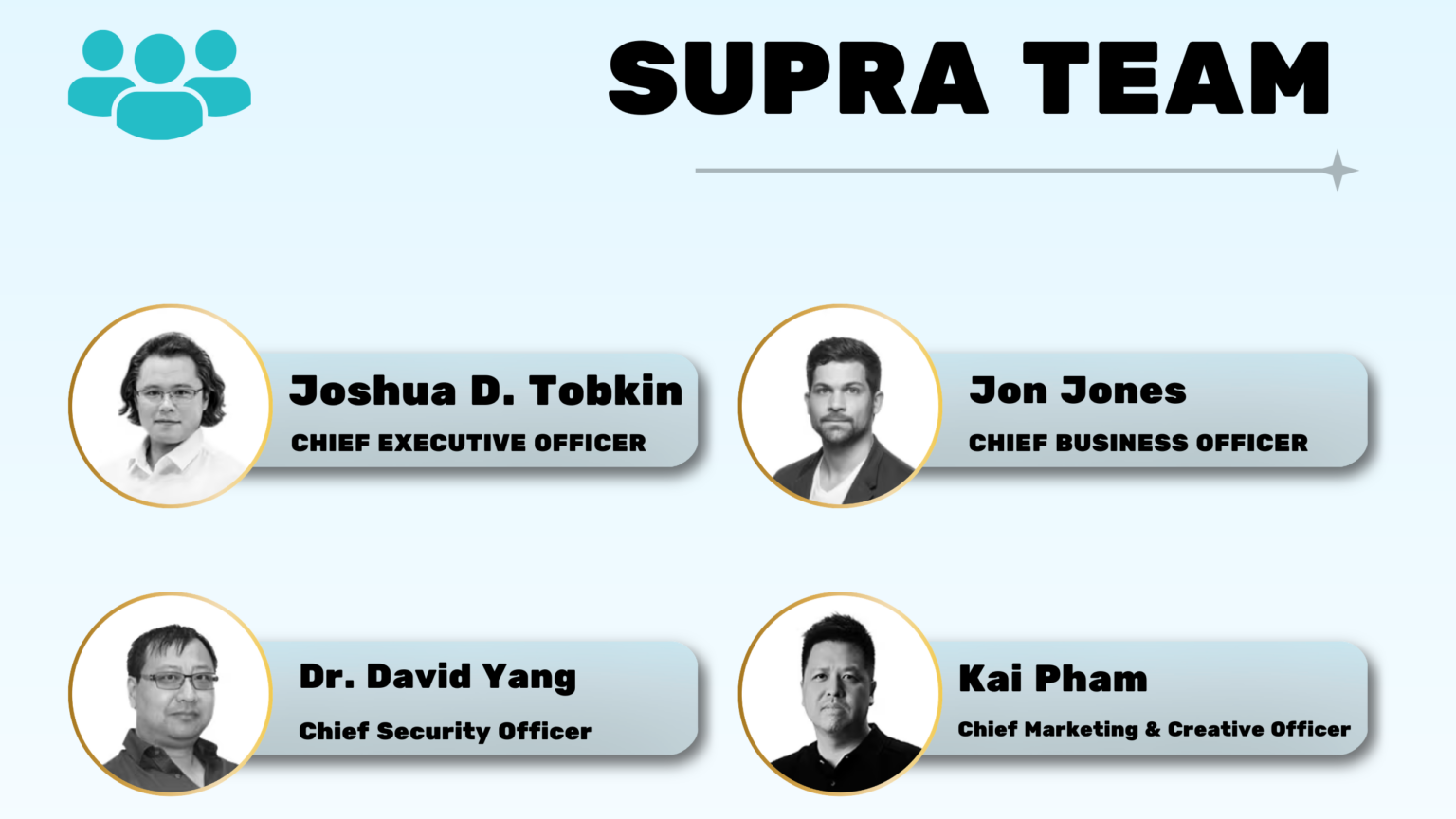
Supra was co-founded by Joshua D. Tobkin and Jon Jones. Tobkin serves as CEO and has more than a decade of experience across SaaS, payments, software architecture, and blockchain infrastructure. Before launching Supra, he built and exited technology businesses while also contributing to the design of Supra’s consensus architecture. He remains one of the key figures behind the project’s technical vision and long-term strategy.
Jon Jones serves as Co-Founder and Chief Business Officer. His background spans entrepreneurship, consulting, and blockchain advocacy. He has played an active role in promoting blockchain adoption across Asia and has built relationships with governments, enterprises, and industry organizations.
The broader leadership team includes researchers, engineers, and cryptography specialists. One notable figure is Chief Research Officer Dr. Aniket Kate, a respected academic known for his work in distributed systems, cryptography, and blockchain security.
Supra has attracted significant institutional backing. The project raised more than $24 million through private funding rounds. Major investors include Animoca Brands, Coinbase Ventures, HashKey Capital, Prosus Ventures, Valor Equity Partners, Hashed, Razer, Galaxy Interactive, Sound Ventures, and United Overseas Bank Venture Management.
The project also participated in Mastercard’s Start Path accelerator program, giving it access to strategic partnerships and enterprise networks.
Compared with bootstrap or community-funded projects, Supra benefits from stronger financial resources and institutional credibility. These advantages can help accelerate ecosystem growth and business development. However, VC-backed projects also face higher expectations around execution, adoption, and long-term returns.
Supra Tokenomics (SUPRA)
Token Overview
SUPRA is the native utility token of the Supra ecosystem. It powers transactions, staking, governance, and access to protocol-level services across the network.
The token’s maximum supply was increased from 10 billion to 100 billion in 2024 as part of a broader tokenomics redesign. Current circulating supply sits at roughly 31.5 billion SUPRA, while total supply stands near 81.7 billion tokens.
SUPRA reached an all-time high of approximately $0.07 shortly after launch in late 2024. Since then, the token has experienced a drawdown exceeding 99 percent, reflecting both broader market conditions and the challenges of growing a new Layer-1 ecosystem.
As the network’s native asset, SUPRA is required for gas payments, staking, governance participation, and usage of several integrated protocol services. Long-term value creation depends on whether network activity grows alongside token supply.
Token Allocation
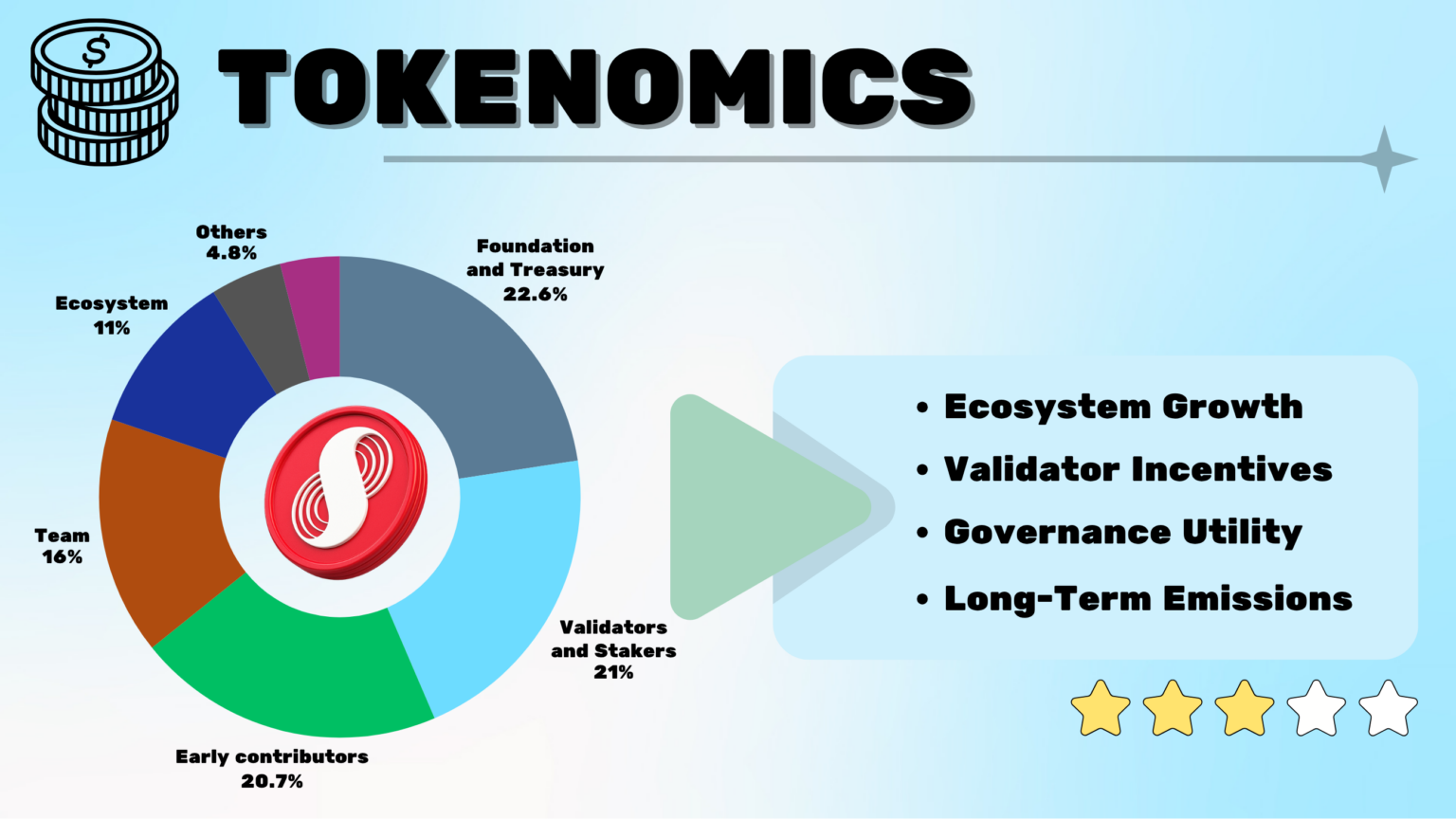
- 22.6%: Foundation and Treasury (dedicated to fostering the ecosystem)
- 21.0%: Validators and Stakers (for fostering network security and longevity)
- 20.7%: Early contributors
- 16.0%: Team (Structured to promote long term development of the network)
- 11.0%: Ecosystem and Community
- 4.8%: Others (Advisors, strategic partners, marketing, legal, admin, and more)
- 4.0%: Blast Off Airdrop
Vesting & Unlock Pressure
Supply expansion remains one of the most important risks for SUPRA holders.
Team allocations received no immediate unlock at the token generation event. Instead, vesting schedules distribute tokens gradually over several years. Early contributors follow similar long-term release structures designed to align incentives with network growth.
Community distributions, including the Blast Off airdrop, follow their own release schedules. Various ecosystem and treasury allocations continue to enter circulation over time through grants, incentives, rewards, and ecosystem funding programs.
The challenge is scale. With a maximum supply of 100 billion tokens, even relatively small percentage unlocks can introduce large amounts of new supply into the market.
While the vesting structure avoids major cliff unlocks, ongoing monthly and periodic releases create continuous dilution pressure. For SUPRA to maintain long-term value, demand from transactions, staking, oracle usage, automation services, and developer activity must grow faster than circulating supply.
Investors should monitor future unlock schedules closely, particularly as ecosystem incentives and contributor allocations continue entering circulation.
Token Utility
SUPRA serves several functions across the network.
Users pay gas fees in SUPRA when executing transactions or interacting with smart contracts. Validators and delegators stake tokens to secure the network and participate in consensus. Token holders can also vote on governance decisions affecting protocol upgrades and ecosystem development.
Beyond standard Layer-1 functions, SUPRA powers access to integrated services such as oracle feeds, distributed verifiable randomness, cross-chain messaging, and automation features. These services create additional demand sources that many competing Layer-1 networks do not possess natively.
The token also supports ecosystem incentives, developer grants, and community participation programs designed to encourage adoption.
Staking rewards provide an additional incentive for participation. However, rewards alone do not create sustainable value. Long-term demand depends on real usage of Supra’s blockchain, oracle infrastructure, automation engine, and cross-chain services.
If developer activity and AutoFi adoption increase, token utility could strengthen. If usage remains limited, token demand may struggle to offset ongoing supply growth.
Is Supra Safe?
Investors often ask a simple question: is Supra safe?
The project has implemented several security measures. Supra operates an active bug bounty program and publishes audit information for core infrastructure components through its documentation portal. Multiple protocol components, including dVRF and core Layer-1 infrastructure, have undergone independent security reviews.
Since mainnet launch, the network has not suffered a major exploit affecting the core blockchain itself. This provides an encouraging early track record, although the network remains relatively young compared with more established ecosystems.
Not all incidents have been avoided. In 2026, Dexlyn Labs, a project within the broader Supra ecosystem, experienced a security incident that later underwent recovery efforts. The core chain was not compromised.
Another notable event occurred in June 2026 when CEO Joshua Tobkin’s X account was temporarily compromised and used to promote a fake SUPRA token through phishing links. The team responded quickly, warned users across official channels, and regained control of the account within hours. No major user losses were publicly reported.
Supra’s vertically integrated architecture may reduce some risks associated with relying on multiple external oracle, automation, and randomness providers. Fewer external dependencies can mean fewer potential points of failure.
However, audits and bug bounties are not guarantees. Smart contract vulnerabilities, validator risks, governance issues, and operational failures remain possible in any blockchain network. Investors should review the latest audit reports and security disclosures directly from official sources before making decisions
Supra vs Competitors
Supra operates in a competitive Layer-1 market that includes high-performance execution chains, oracle networks, and developer-focused ecosystems. Its primary differentiator is vertical integration. Rather than relying on external oracle providers, automation networks, or cross-chain services, Supra builds these capabilities directly into the protocol.
Supra
MoveVM (primary)
SupraEVM
Native oracles
Native VRF
Sub-second finality
Oracle updates in ~600–900ms
AutoFi rollout underway.
SupraEVM launch in progress.
Staking
Governance
Oracle fees
VRF fees
Automation payments
Sei
Cosmos-based Layer 1
Giga Target: 200K TPS
Sub-400ms finality target
Giga upgrade rolling out during 2026.
Governance
Trading ecosystem fees
Monad
~0.8s finality
Full EVM tooling ecosystem.
Staking
Sui
Sub-second finality
1M ops/sec claims
Large ecosystem and developer base.
Staking
Governance
Compared with Sei and Monad, Supra offers deeper protocol-level integration of infrastructure services. Compared with Chainlink, it combines oracle functionality with a full Layer-1 execution environment. The tradeoff is complexity. Supra must prove that its integrated architecture can attract developers and users at scale while competing against specialized leaders in each category.
Strengths & Risks (Bull vs Bear Case)
The bull case for Supra centers on its integrated architecture. Most blockchain applications rely on several external services for data feeds, automation, randomness, and cross-chain communication. Supra combines these capabilities within a single protocol. This can reduce latency, simplify development, and lower operational costs.
The network also benefits from strong venture backing. Investors include Animoca Brands, Coinbase Ventures, HashKey Capital, and Prosus Ventures. Mainnet launched in late 2024, while new products such as SupraEVM, HyperNova, and SupraOS continue expanding the ecosystem. If AutoFi gains traction, Supra could occupy a unique position within the Layer-1 landscape.
The bear case is equally important. The token supply remains large at 100 billion SUPRA, with ongoing unlocks creating long-term dilution pressure. Competition is intense from high-performance networks such as Sui, Sei, and Monad, as well as established infrastructure providers like Chainlink.
Execution risk also remains significant. AutoFi is still an emerging concept, and large-scale adoption has yet to be proven. Ecosystem incidents such as the DexlynLabs exploit and the June 2026 compromise of the CEO’s X account demonstrate that operational and social risks still exist even when the core chain remains secure.
Ultimately, Supra must prove that its integrated model delivers meaningful advantages that developers cannot achieve through existing modular alternatives.
Should You Buy SUPRA? (OCT Verdict)
Builders and developers may want to consider Supra. Native access to oracles, automation, randomness, and cross-chain messaging can simplify application design and reduce infrastructure complexity. Projects focused on AutoFi may find the platform particularly attractive.
Short-term traders should primarily watch. SUPRA remains a low-cap asset with relatively high volatility. News around ecosystem launches, exchange listings, token unlocks, or adoption milestones can drive large price movements in either direction.
Long-term investors should approach with caution. The project offers an ambitious technical vision and a differentiated architecture. However, adoption metrics, ecosystem growth, and token demand must improve significantly before the investment thesis becomes stronger.
For investors asking, “is Supra worth buying?”, the answer depends largely on confidence in future execution. The technology is innovative, but market adoption remains the key variable.
Always conduct your own research and assess your personal risk tolerance before investing in any cryptocurrency.
Final Verdict: Is Supra a Buy in 2026?
Supra presents one of the more ambitious approaches to blockchain infrastructure through its vertically integrated AutoFi stack, native oracle network, automation engine, and MultiVM architecture. However, large token supply dynamics, execution risk, and the need for measurable adoption remain important challenges. The technology is compelling, but sustained traction will ultimately determine whether the investment case strengthens over time.
Frequently Asked Questions
What is Supra?
How does Supra work?
What are Supra’s latest upgrades and roadmap developments?
What is SUPRA used for?
Is Supra safe?
How is Supra different from other high-performance Layer-1 blockchains?
Is SUPRA a good investment?
In this article
Why High-Performance Layer-1 Blockchains Are Hard to Get Right?What Is Supra?How Supra WorksTechnology & ArchitectureTeam & BackersSupra Tokenomics (SUPRA)Is Supra Safe?Supra vs CompetitorsStrengths & Risks (Bull vs Bear Case)Should You Buy SUPRA? (OCT Verdict)Final Verdict: Is Supra a Buy in 2026?