Zcash vs Monero vs Dash: the 2026 privacy coin ranking from most private to most buyable, plus delistings, the EU rules, and the ZEC rally.

Author: Akshat Thakur
In the debate over Zcash vs Monero vs Dash, the answer is no longer as simple as choosing the coin with the strongest privacy. In 2026, the most private cryptocurrency and the easiest one to buy, trade, or use are often not the same. Regulatory changes, exchange listings, compliance requirements, and evolving blockchain technology have reshaped how each project fits into today’s market.
This guide compares Zcash, Monero, and Dash across privacy, technology, adoption, regulation, accessibility, and real-world use cases. Rather than recommending a winner, it explains where each project stands in 2026 so readers can understand the trade-offs before evaluating which cryptocurrency best matches their priorities.
Monero has become the benchmark for default privacy because every transaction uses privacy features automatically. Users do not need to change any settings or choose between private and transparent transfers. This design has helped Monero build the largest ecosystem focused entirely on financial privacy, although it has also resulted in multiple exchange delistings.
Zcash takes a different approach by making privacy optional. Users can send either transparent transactions, which resemble Bitcoin, or shielded transactions that hide transaction details.
The project received renewed attention in 2026 after higher shielded usage, the closure of a long-running SEC investigation without enforcement action, and continued progress around Grayscale’s proposed Zcash investment products.
Dash began as a digital payments cryptocurrency focused on speed and low transaction fees. It later added optional privacy through PrivateSend, which uses CoinJoin to make transaction histories more difficult to trace. Privacy remains a secondary feature rather than the network’s default operating mode.
Although all three coins aim to improve financial privacy, they achieve it in very different ways. Understanding these differences helps explain why their real-world privacy levels are not the same.
Monero combines three privacy technologies that work automatically on every transaction. The first is a ring signature, a cryptographic method that allows someone to prove they own one output without revealing which output is actually being spent. You can think of it like signing a document with a group of 16 people, where everyone appears equally likely to be the signer. The observer knows one signature is genuine but cannot identify which one.
The second technology is Ring Confidential Transactions (RingCT), which hides the amount being transferred. Even though the network verifies that no new coins were created, outside observers cannot see the transaction value.
The third component is a stealth address. A stealth address creates a unique one-time receiving address for every payment, preventing anyone from linking incoming transactions to the recipient’s public wallet. Monero also supports a view key, a special read-only key that lets the wallet owner selectively share transaction history without giving anyone permission to spend the funds.
Zcash uses zk-SNARKs, short for zero-knowledge succinct non-interactive arguments of knowledge. A zero-knowledge proof allows the network to verify that a transaction is valid without revealing the sender, recipient, or amount.
This privacy only applies inside the shielded pool, which is the part of the blockchain where shielded addresses interact using zero-knowledge proofs. Transactions that move between shielded and transparent addresses can still reveal useful information to blockchain analysts.
Dash relies on CoinJoin through its PrivateSend feature. CoinJoin combines transactions from multiple users into one larger transaction before redistributing the coins. This makes it much harder to determine which outputs belong to which users.
Unlike Monero or Zcash, CoinJoin does not cryptographically hide addresses or transaction amounts. Instead, it obscures ownership by mixing many users’ transactions together.
The biggest structural difference is that Monero makes privacy automatic. Every transaction contributes to the same anonymity set, which is the group of possible users a transaction could belong to. A larger anonymity set makes it harder to identify the real sender or recipient.
Zcash and Dash take the opposite approach. Privacy is optional, so users must actively choose shielded transactions or CoinJoin mixing. As a result, only part of each network benefits from privacy at any given time.
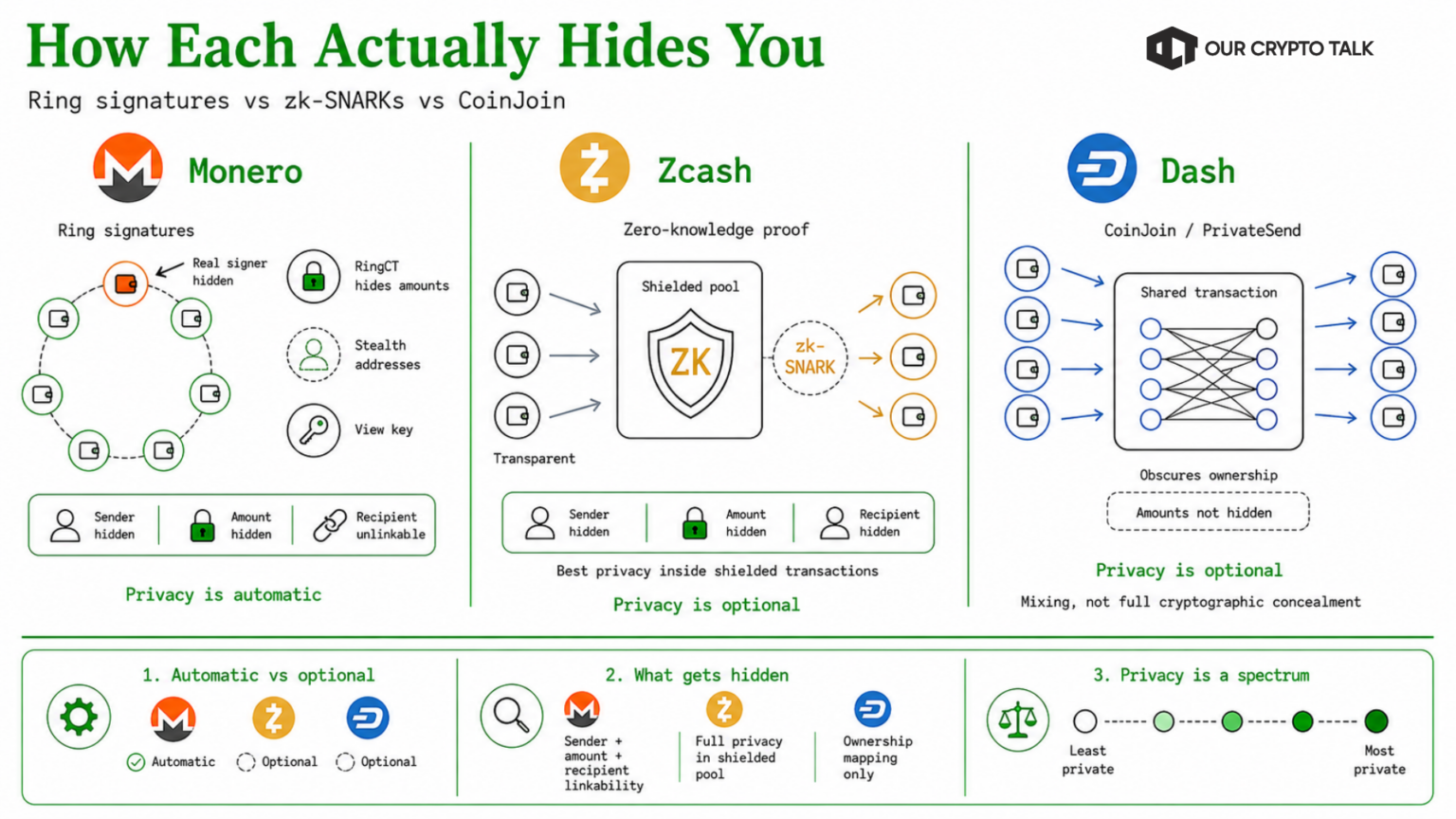
From a practical privacy perspective, the ranking is straightforward: Monero offers the strongest protection, followed by shielded Zcash transactions, then Dash’s CoinJoin mixing, with transparent Zcash providing no on-chain privacy.
The biggest reason is not the underlying cryptography. It is participation.
Privacy systems become stronger when more people use them because every additional private transaction expands the anonymity set. When nearly everyone participates, identifying one person’s transaction becomes much more difficult. When only a small percentage of users choose privacy, those transactions become easier to isolate and analyze.
This is where Monero has its biggest advantage. Every transaction automatically uses ring signatures, RingCT, and stealth addresses. Users cannot accidentally expose themselves by forgetting to enable privacy, and every network participant strengthens the privacy of everyone else.
Zcash presents a more nuanced picture. Shielded transactions use some of the most advanced cryptography available through zk-SNARKs. However, privacy remains optional rather than mandatory. Shielded transaction activity reached approximately 59.3% of all network transactions in February 2026, while about 30% of the circulating ZEC supply was held inside shielded pools.
These metrics measure different aspects of adoption. Despite this progress, transparent transactions remain part of the network, meaning not every transaction contributes to the same anonymity set. That optional design gives users greater flexibility, but it creates different privacy trade-offs from Monero’s privacy-by-default model.
They are different metrics and should not be confused. During early 2026, shielded transaction activity briefly reached about 59.3% while shielded supply remained around 30%. Although adoption has improved significantly, many users still rely on transparent transactions, reducing the overall anonymity available to shielded users.
Dash ranks below both Monero and shielded Zcash because CoinJoin provides transaction mixing rather than full cryptographic concealment. Participation is optional, users must wait for mixing rounds, and transaction amounts remain visible. During periods of lower participation, the anonymity set also becomes smaller, making transaction analysis easier.
Transparent Zcash ranks last because it offers no additional privacy compared with Bitcoin. Sender addresses, recipient addresses, and transaction amounts remain publicly visible on the blockchain.
Shielded Zcash arguably has more advanced underlying cryptography than Monero. However, theoretical strength is only part of the equation. Real-world privacy depends on consistent adoption across the network. Monero’s default-on model ensures every transaction contributes to network-wide privacy, while optional systems rely on users choosing privacy every time they transact.
Future upgrades such as FCMP++ aim to expand Monero’s anonymity set even further through full-chain membership proofs, but its mandatory privacy model already gives it the strongest practical privacy among the three today.
Privacy coins have become significantly harder to access over the past few years. While demand for financial privacy has grown, regulators and exchanges have taken a much stricter approach toward assets that make blockchain activity difficult to trace. As a result, accessibility has become one of the biggest differences between Monero, Zcash, and Dash.
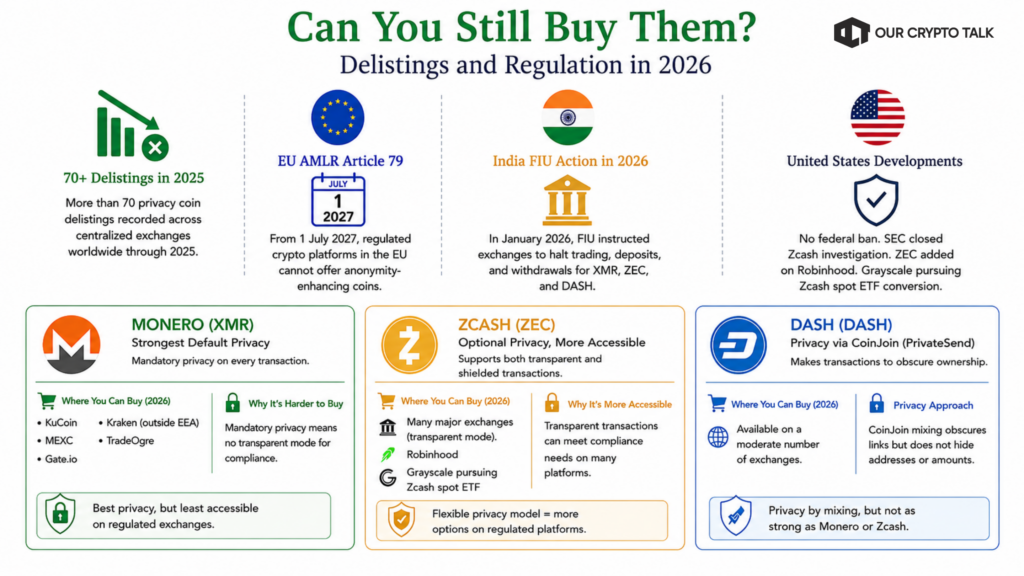
Through 2025, more than 70 privacy coin delistings were recorded across centralized exchanges worldwide. Monero has been affected the most because every transaction uses mandatory privacy.
In 2026, it remains available on a smaller group of exchanges, including KuCoin, MEXC, Gate.io, Kraken for customers outside the European Economic Area (EEA), and TradeOgre. Many larger exchanges removed XMR over the past several years after concluding that its privacy model could not meet their compliance requirements.
Regulation in Europe is set to tighten further. Article 79 of the European Union’s Anti-Money Laundering Regulation (AMLR) prevents regulated crypto asset service providers from offering anonymity-enhancing coins from 1 July 2027. Because Monero applies privacy to every transaction, there is no transparent mode that exchanges can support instead.
Zcash occupies a different position because it supports both transparent and shielded transactions. That flexibility may allow some regulated platforms to continue offering transparent-only ZEC while restricting shielded functionality.
India also adopted a stricter approach during 2026. In January, the Financial Intelligence Unit (FIU) instructed registered exchanges to halt trading, deposits, and withdrawals for Monero, Zcash, and Dash as part of broader anti-money laundering measures. The action targeted regulated exchanges rather than making the assets themselves illegal to own.
The United States has taken a different path. There is still no federal ban on privacy coins, although many exchanges voluntarily removed Monero over the past several years. Zcash benefited from several positive developments in early 2026.
The SEC closed its long-running investigation into the Zcash Foundation without taking enforcement action. Robinhood later added support for ZEC, and Grayscale continued pursuing the conversion of its Zcash Trust into a spot ETF, increasing institutional visibility around the asset.
These developments create an unusual paradox. Monero delivers the strongest default privacy but has become the hardest of the three coins to buy through regulated centralized exchanges. Zcash’s optional privacy model, often viewed as a privacy compromise, is also the reason it has remained available on many more trading platforms.
Privacy coins attracted renewed investor attention during 2026, although each project benefited from different catalysts. Rather than moving together, Monero and Zcash followed distinct narratives driven by regulation, technology, and investor sentiment.
Zcash generated most of the headlines. Its November 2024 halving reduced the block reward, tightening new supply entering circulation. That supply change combined with stronger shielded adoption during 2026, helping renew interest across the market.
The closure of the SEC investigation into the Zcash Foundation removed a long-standing regulatory overhang, while Multicoin Capital disclosed a ZEC position and investor Arthur Hayes described Zcash as part of his “holy trinity” of preferred crypto assets.
Momentum accelerated enough for Zcash to briefly overtake Monero by market capitalization during parts of 2026. Shielded transaction activity reached approximately 59.3% of all Zcash transactions in February 2026, while shielded supply remained close to 30% of the circulating ZEC supply.
These figures measure different things. Shielded transaction activity reflects how often users choose shielded transactions, whereas shielded supply measures how much of the total ZEC supply currently resides inside the shielded pool.
The rally reversed sharply in June 2026 after developers disclosed a soundness bug affecting Orchard, Zcash’s current shielded transaction system. The vulnerability had existed since Orchard launched in 2022.
Developers responded with emergency protocol upgrades that temporarily disabled affected functionality before deploying a permanent fix. Although there was no evidence that the flaw had been exploited, the announcement triggered a rapid sell-off as investors reassessed technical risk.
Monero followed a much steadier path. The project recorded solid gains throughout 2025 and reached fresh highs during early 2026 without relying on major marketing announcements or regulatory catalysts.
Development remained focused on long-term protocol improvements, including continued work on FCMP++, a proposed upgrade designed to expand Monero’s effective anonymity set.
Together, these events show how regulation, protocol upgrades, security disclosures, and investor positioning can drive large price swings in privacy coins without implying anything about future performance.
The best privacy coin depends less on which project is “winning” and more on what you actually need. Each offers a different balance between privacy, accessibility, and ease of use.
If your priority is the strongest practical on-chain privacy, Monero remains the leading choice. Every transaction automatically uses ring signatures, RingCT, and stealth addresses, so users receive privacy without changing wallet settings. The trade-off is accessibility. Monero is available on fewer regulated exchanges than it was several years ago, meaning buyers may have fewer purchasing options before moving funds into self-custody.
If you want strong privacy while keeping broader exchange access, shielded Zcash offers a compelling middle ground. Transactions inside the shielded pool use zk-SNARKs to hide the sender, recipient, and amount.
Wallets that default to shielded addresses make this process much easier, although users must still choose shielded transactions if they want full privacy. Transparent transactions remain publicly visible on the blockchain.
Dash is better viewed as a payments coin with an optional privacy feature rather than a dedicated privacy cryptocurrency. PrivateSend uses CoinJoin to make transaction histories more difficult to follow, but it does not hide addresses or transaction amounts with advanced cryptography. Its privacy guarantees are therefore weaker than those provided by Monero or shielded Zcash.
Some investors may buy Zcash primarily because of its market momentum rather than its privacy technology. That is a different investment thesis. ZEC has experienced large price swings during 2026, driven by regulatory developments, institutional interest, and protocol news. Investors should recognize that these same catalysts can produce equally sharp declines when sentiment changes.
Disclaimer: This article is for educational and informational purposes only. It is not financial or legal advice and should not be considered a recommendation to buy, sell, or use any cryptocurrency. Cryptocurrency regulations vary by jurisdiction and may change over time. Always conduct your own research and consult qualified financial or legal professionals before making investment or compliance decisions.
All the opinions in this article are that of the author and in no way are financial advice. Our Crypto Talk and the author always suggest you do your own research in crypto and to never take anything as financial advice that you read on the internet. Check our Terms and conditions for more info.


Tokenization of RWA yields onchain might be the biggest opportunity that no one has noticed
Cold Wallet Safety 2026: Are Hardware Wallets Still Safe?
One Token, Multiple Products. Can Zylo Deliver?
The Rise of NEAR Protocol 2026: Inside the 530% Rally and the ETF
Tokenization of RWA yields onchain might be the biggest opportunity that no one has noticed
Cold Wallet Safety 2026: Are Hardware Wallets Still Safe?
One Token, Multiple Products. Can Zylo Deliver?
The Rise of NEAR Protocol 2026: Inside the 530% Rally and the ETF