The Zcash Orchard bug hid in the shielded pool for four years. Here's how an AI-assisted audit found it, and why ZEC crashed despite zero confirmed theft.

Author: Kritika Gupta
The Zcash Orchard bug emerged on May 29, 2026, when independent security researcher Taylor Hornby discovered a critical soundness vulnerability in Zcash’s Orchard shielded pool during an audit commissioned by Shielded Labs. Within days, Zcash developers and ecosystem participants coordinated emergency network upgrades that contained and permanently fixed the flaw before publicly disclosing it to the market.
The vulnerability had existed since Orchard launched as part of the NU5 upgrade in May 2022. According to developers, the flaw could have allowed an attacker to create counterfeit ZEC within the shielded pool by generating invalid zero-knowledge proofs that still passed verification.
After receiving the private disclosure, Zcash Open Development Lab (ZODL), the Zcash Foundation, miners, exchanges, wallet providers, and infrastructure operators coordinated a rapid response that first disabled Orchard activity and then deployed a permanent fix.
Key milestones related to this development
Taylor Hornby discovers the Orchard vulnerability and privately discloses it to ZODL.
Developers, miners, exchanges, and ecosystem participants begin coordinating the emergency response.
The emergency soft fork temporarily disables Orchard transactions to contain risk.
The NU6.2 hard fork deploys the corrected Orchard circuit and restores functionality.
Zcash publicly discloses the vulnerability and market volatility accelerates as investors reassess protocol risk.
Importantly, developers reported no evidence of unauthorized supply expansion, theft, or successful exploitation before the patch. However, because Orchard transactions are fully shielded, the network cannot definitively prove that the flaw was never exploited during the four years it remained active. That uncertainty, rather than any confirmed loss of funds, became the central issue for investors and ultimately drove the broader market reaction discussed later in this analysis.
Related reading: Privacy Coins Guide
To understand the Zcash Orchard bug, it helps to first understand what Orchard is.
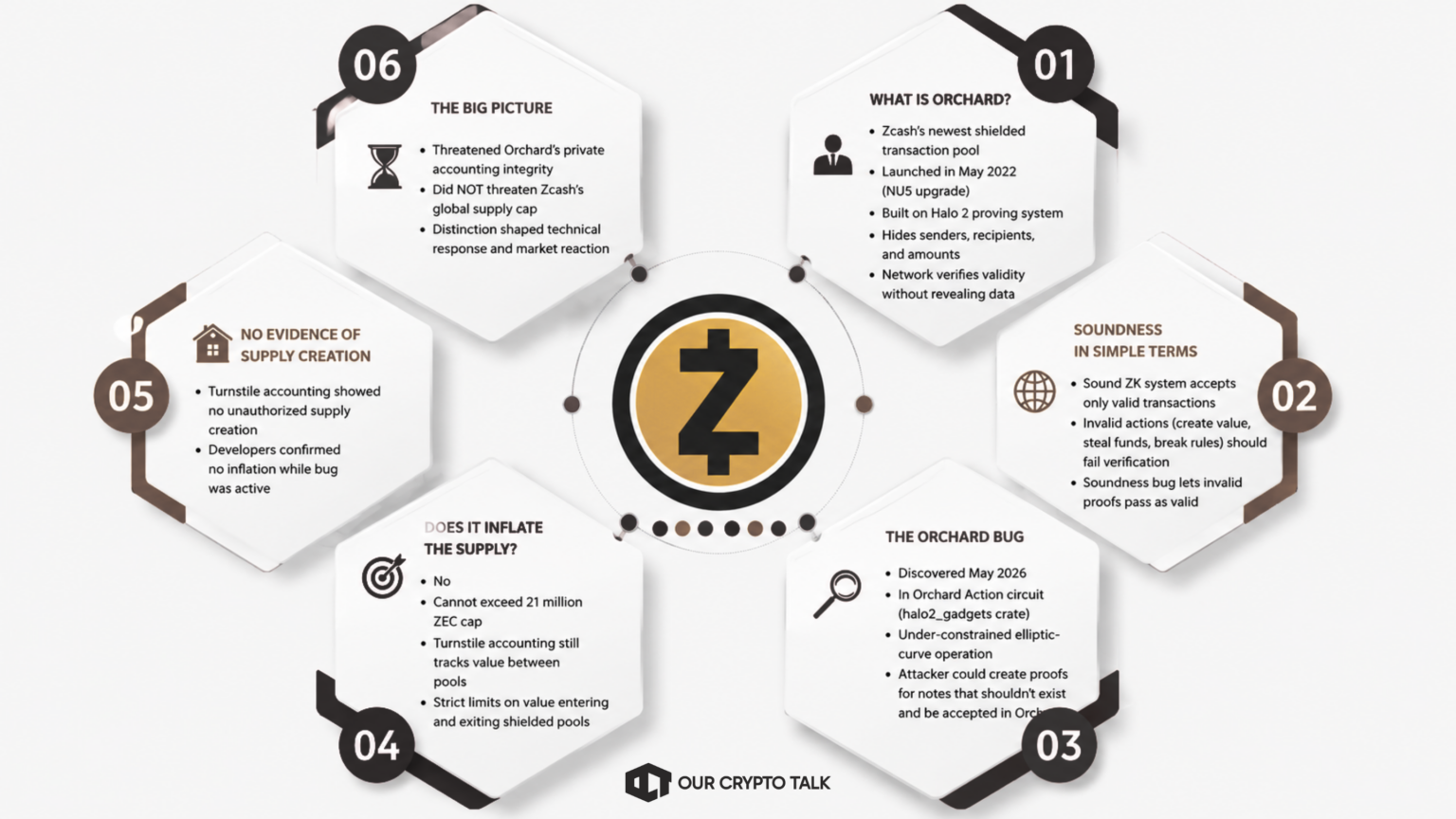
Orchard is Zcash’s newest and most advanced shielded transaction pool. The network introduced it in May 2022 as part of the NU5 upgrade, and it now processes the majority of shielded ZEC activity. Built on the Halo 2 proving system, Orchard allows users to send private transactions that conceal senders, recipients, and amounts while still allowing the network to verify that every transaction follows Zcash’s rules.
That verification process depends on a property known as soundness.
In simple terms, a sound zero-knowledge system should accept only valid transactions. If a transaction attempts to create value from nothing, spend funds it does not own, or violate protocol rules, the proof should fail verification. A soundness bug breaks that guarantee. It allows specially crafted inputs to pass checks that should reject them.
The flaw discovered in May 2026 existed within the Orchard Action circuit implementation, specifically inside the halo2_gadgets crate. Researchers traced the issue to an under-constrained elliptic-curve operation. While the underlying mathematics is highly technical, the practical implication was straightforward: an attacker could potentially generate proofs for notes that should not exist and have the network accept them as valid inside Orchard.
Importantly, this did not mean an attacker could inflate Zcash’s total supply beyond its 21 million coin cap.
This distinction is critical.
The bug could have enabled counterfeiting within the Orchard shielded pool, but Zcash’s turnstile accounting mechanism still tracked value moving between transparent and shielded pools. Those accounting rules place strict limits on how value enters and exits shielded environments. As a result, even if counterfeit balances had existed inside Orchard, they could not automatically expand the network’s total monetary supply.
Developers later confirmed that turnstile accounting showed no evidence of unauthorized supply creation while the vulnerability remained active.
In short, the flaw threatened the integrity of Orchard’s private accounting system, not the integrity of Zcash’s global supply cap. That distinction shaped both the technical response and the market reaction that followed.
Many headlines surrounding the Zcash Orchard bug described the incident as “AI discovering a critical Zcash flaw.” However, that framing oversimplifies what actually happened.
The discovery was not the result of an autonomous AI system independently auditing Zcash. Instead, it emerged from an AI-assisted security audit led by a human expert.
In April 2026, Shielded Labs commissioned independent security researcher Taylor Hornby to search for protocol-level vulnerabilities within Zcash. Hornby combined traditional security analysis, formal verification techniques, custom auditing tools, and emerging AI models as part of that effort.
On May 28, Anthropic released Claude Opus 4.8. The following day, Hornby integrated the model into a custom auditing framework designed to analyze Orchard’s complex zero-knowledge circuits. During that review, the system helped identify a subtle under-constrained elliptic-curve component within the Orchard circuit. Hornby then investigated the finding, verified the flaw manually, and developed a working proof-of-concept exploit to confirm its real-world impact.
In other words, the AI helped surface the anomaly, but the researcher validated the result, understood its significance, and demonstrated exploitability. That distinction matters.
The model did not independently discover, verify, exploit, disclose, or patch the vulnerability. Hornby remained responsible for every critical step in the process. The AI functioned as a powerful research and analysis tool, not an autonomous security researcher. Just as important is what happened next.
After confirming the vulnerability, Hornby privately disclosed the issue to Zcash Open Development Lab (ZODL) on May 29. Developers immediately began coordinating a fix, ultimately deploying both the emergency soft fork and the NU6.2 hard fork before publicly revealing the flaw. As a result, attackers never received advance notice of the vulnerability window.
The episode does not prove that AI can replace human security researchers. Likewise, it does not suggest that AI has suddenly made all cryptographic systems unsafe. Instead, it demonstrates how skilled researchers can use increasingly capable AI tools to accelerate complex audits, uncover subtle issues, and strengthen security through responsible disclosure.
One of the most uncomfortable questions raised by the Orchard incident is also one of the most important: how did a vulnerability capable of undermining a critical security guarantee remain undetected for four years?
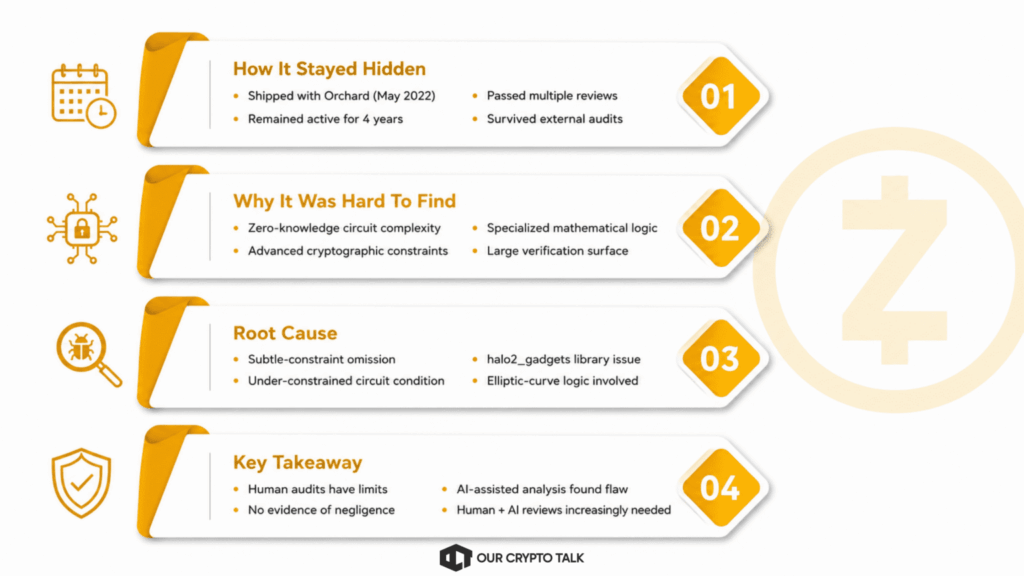
The flaw shipped with Orchard’s activation in May 2022 and survived multiple reviews by experienced cryptographers, engineers, and security auditors before Taylor Hornby’s AI-assisted audit uncovered it in May 2026. At first glance, that timeline may appear alarming. However, it also highlights the unique difficulty of auditing modern zero-knowledge systems.
Unlike traditional software, zero-knowledge circuits combine advanced cryptography, complex mathematical constraints, and highly specialized implementations. Auditors must verify not only that the code behaves correctly but also that every mathematical relationship inside the proving system enforces the intended security guarantees.
That challenge creates a large surface area for subtle mistakes.
In many cases, a vulnerability does not arise from a glaring coding error. Instead, a seemingly minor omission or under-constrained condition can weaken a critical security property. A flaw spanning only a few lines of code may remain hidden because the surrounding system appears mathematically correct.
The Orchard vulnerability fit that pattern. Researchers ultimately traced the issue to a subtle constraint problem within the halo2_gadgets library, an area dense with elliptic-curve logic and circuit mathematics. Finding that type of issue requires a combination of cryptographic expertise, deep protocol knowledge, and increasingly sophisticated analysis tools.
That does not excuse the oversight. Security audits exist to find exactly these kinds of flaws. However, the episode illustrates the limits of human-only review when applied to some of the most complex cryptographic systems in production today.
Rather than a story about Zcash-specific incompetence, the incident serves as a reminder that advanced privacy technologies remain difficult to verify exhaustively, even for expert reviewers. As a result, researchers increasingly view AI-assisted analysis as a complement to human expertise rather than a replacement for it.
Zcash developers responded to the Zcash Orchard bug with a two-phase emergency upgrade process.
First, they moved to contain the risk. After ZODL engineers confirmed the issue, Shielded Labs, the Zcash Foundation, Electric Coin Company contributors, ZODL, miners, exchanges, wallet providers, and infrastructure operators coordinated privately to prepare a network response before public disclosure.
The first phase came through Zebra 4.5.3. This emergency soft fork activated on June 2, 2026, at approximately 02:00 UTC, at mainnet block 3,363,426. It temporarily disabled Orchard actions by causing upgraded nodes to reject transactions and blocks that contained Orchard activity. As a result, developers bought time to finalize the circuit-level fix while reducing the chance that an attacker could exploit the flaw after learning about it.
Importantly, the soft fork did not stop all Zcash activity. Transparent and Sapling transactions continued to operate normally while Orchard remained paused.
Then came the permanent fix. On June 3, 2026, at 00:05 EDT, the NU6.2 hard fork activated at mainnet block 3,364,600 through Zebra 5.0.0. This upgrade restored Orchard functionality with a corrected circuit and new verification rules. In practice, it re-enabled the shielded pool while closing the soundness vulnerability that the emergency soft fork had temporarily contained.
The supply check also mattered. According to the Zcash Foundation, turnstile accounting confirmed that no unauthorized value creation occurred while the vulnerability remained live. That does not prove nobody ever attempted to exploit the private pool, but it does support the key monetary point: the total ZEC supply remained intact.
Overall, the protocol response was fast, coordinated, and orderly. The later market selloff was not about a slow fix or a confirmed loss of funds. Instead, it centered on a separate issue: whether a fully shielded system can prove clean historical activity after a long-undetected bug.
The Zcash Orchard bug created a unique market problem that no software patch could immediately solve. At first glance, the market reaction appears difficult to explain. Developers patched the vulnerability within days. No theft was confirmed. Turnstile accounting showed no evidence of unauthorized supply creation. Furthermore, the bug never broke Zcash’s 21 million coin cap.
Yet ZEC still experienced a sharp repricing following public disclosure. The reason lies in a problem that the emergency forks could not solve: unprovability. Because Orchard transactions are fully shielded, outside observers cannot inspect their history the way they can inspect transactions on transparent blockchains. That privacy is one of Zcash’s core features. However, in this case, it created a difficult tradeoff.
The vulnerability remained active from May 2022 until May 2026. During that four-year period, an attacker could theoretically have created counterfeit notes inside Orchard if they had discovered the flaw before researchers did. Developers stated that they found no evidence of successful exploitation, and several factors suggest exploitation was unlikely. However, they also acknowledged a crucial limitation: nobody can cryptographically prove that the bug was never used.
That distinction drove the market response.
In a transparent system, analysts could review historical activity and potentially rule out certain forms of abuse. Orchard’s privacy model intentionally prevents that kind of visibility. As a result, the same privacy guarantees that protect legitimate users also prevent the network from producing definitive proof that all historical Orchard balances remained uncompromised throughout the vulnerability window.
Markets generally price certainty better than uncertainty.
Once traders understood that a real soundness flaw had existed for four years, attention shifted away from the successful patch and toward the unknowable historical risk. Investors were not reacting to a confirmed loss. Instead, they were repricing the possibility that an undetected event may have occurred in the past and could never be conclusively disproven.
Market data from major exchanges showed ZEC falling sharply after disclosure. Depending on the exchange, intraday highs near the $620-$624 range on June 4 gave way to lows between roughly $300 and $370 by June 5. Exact figures vary by venue and timestamp, but the direction of the move was unmistakable: traders assigned a discount to uncertainty.
Even so, context matters. Despite the selloff, ZEC remained significantly higher on a year-over-year basis, reflecting the broader privacy-coin rally that preceded the incident. Ultimately, the market did not punish Zcash for a proven loss of funds. It punished Zcash for something far harder to quantify: the inability to prove that no loss ever occurred.
Related reading: Zcash vs Monero 2026
Arthur Hayes became the highest-profile investor to react publicly to the Orchard disclosure.
Around the time Zcash disclosed the vulnerability, the BitMEX co-founder and Maelstrom CIO said he had liquidated his entire ZEC position. That move completed the unwind of what he had previously described as his “Holy Trinity,” following earlier exits from HYPE and NEAR.
His reasoning focused on one core issue: a privacy thesis depends on cryptographic confidence. In Hayes’ view, Zcash did not merely suffer a bug that developers could patch and move past. Instead, it exposed a four-year vulnerability window that the network could not prove clean because Orchard transactions remain shielded. For an investor buying ZEC as a high-conviction privacy asset, that distinction mattered more than the absence of confirmed theft.
Put differently, Hayes appeared to view the issue as a thesis break rather than a normal software incident. The protocol fixed the bug, but it could not prove the past. For him, that uncertainty weakened the reliability of the privacy argument itself.
There are two fair ways to read the exit.
The first interpretation sees it as disciplined protocol-risk management. Under this view, Hayes updated his position after new information revealed a tail risk that the market had not previously priced. If an asset’s core investment case depends on privacy, soundness, and confidence in shielded balances, then an unprovable historical flaw can justify a full exit.
The second interpretation sees it as a reactive flush after a major scare. Under this view, the market already punished ZEC heavily, no theft was confirmed, and the emergency response worked. Selling into the disclosure-driven panic may therefore look more like risk-off behavior than a final verdict on Zcash.
Both readings have merit. Neither fully resolves the question.
What is clear, however, is that Hayes’ exit reversed the bullish stance highlighted in OCT’s earlier coverage of his ZEC positioning. That makes this more than a personal portfolio update. It marks a visible break between one of ZEC’s most prominent recent backers and the privacy thesis he had helped amplify.
The Zcash Orchard bug raises questions that extend far beyond Zcash itself.
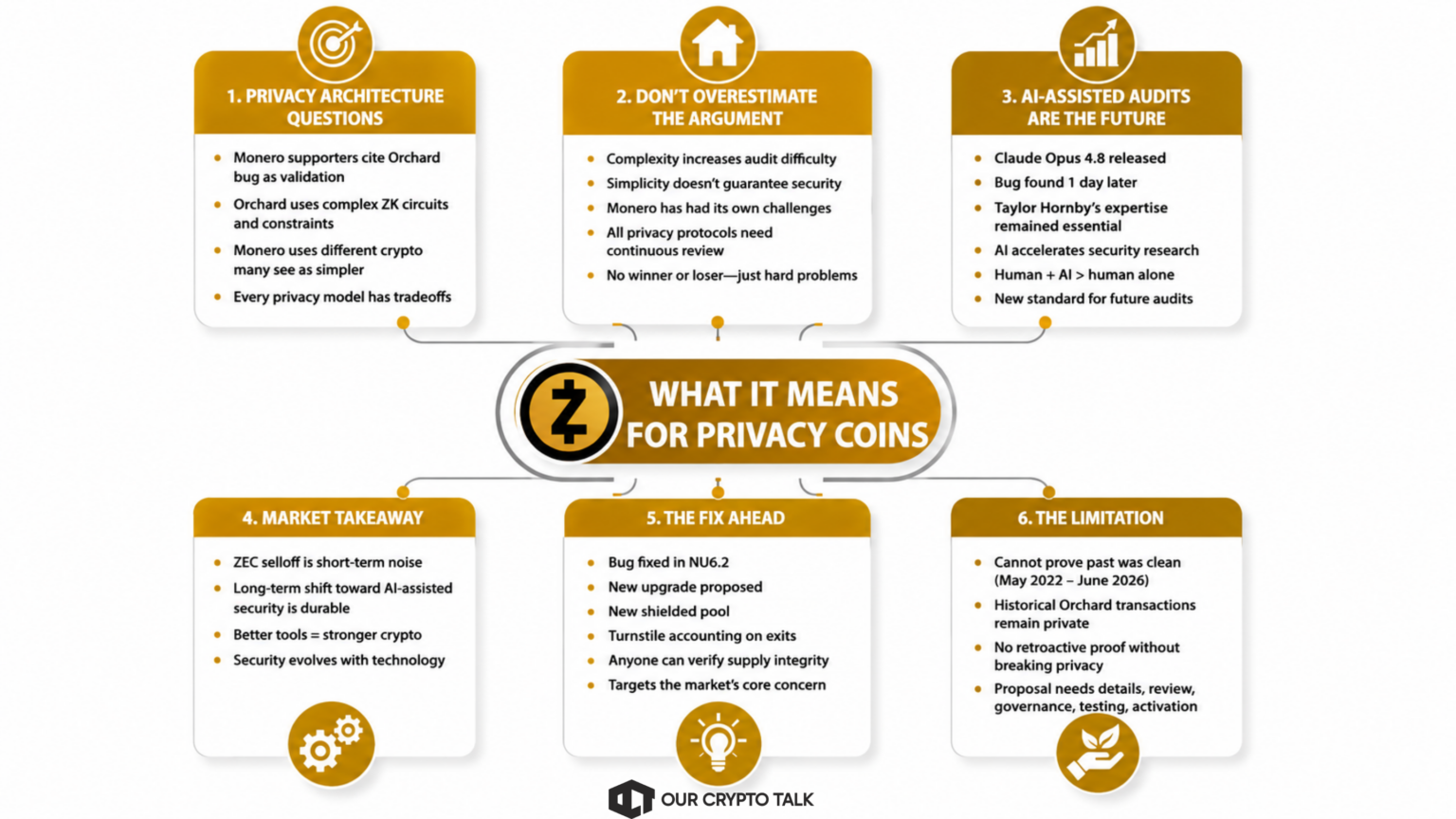
The first concerns privacy architecture. Unsurprisingly, many Monero supporters pointed to the event as evidence that simpler privacy systems may be easier to secure than highly complex shielded environments. Their argument is straightforward: Orchard relies on advanced zero-knowledge circuits, intricate proving systems, and dense mathematical constraints, all of which create opportunities for subtle implementation errors. By comparison, Monero’s privacy model relies on different cryptographic techniques that many advocates view as easier to reason about and audit.
That argument deserves consideration, but it should not be overstated.
Complexity can increase audit difficulty, yet simplicity does not automatically guarantee security. Monero has faced its own implementation challenges, protocol upgrades, and security research efforts throughout its history. Every privacy system introduces tradeoffs, and every privacy protocol depends on continuous review by researchers and auditors. The Orchard flaw does not prove that one privacy model has won and another has lost. Instead, it highlights how difficult it remains to verify advanced cryptographic systems at scale.
The second takeaway may prove far more important over the long term.
Only one day separated the release of Claude Opus 4.8 and the discovery of a vulnerability that had survived expert review for four years. While Taylor Hornby’s expertise remained central to the process, the incident demonstrated how AI-assisted analysis can accelerate security research in ways that were difficult to imagine just a few years ago.
That does not mean AI will replace auditors. Rather, it suggests that future audits will increasingly combine human expertise with AI-powered tooling capable of reviewing massive codebases, identifying unusual patterns, and helping researchers focus attention on areas of elevated risk.
For the broader crypto industry, that may be the most durable lesson. Markets will eventually move past a single price correction. However, the shift toward AI-assisted security auditing is likely to persist long after the ZEC selloff fades from memory.
ZEC entered the public disclosure window near its highest levels of the year. On June 3, 2026, the same day the NU6.2 hard fork deployed the permanent fix, Zcash closed at $621.81, giving the network a market cap of approximately $10.35 billion. The patch was already live and the network was technically secure. However, the market had not yet priced in what was about to happen.
Market cap destruction during the ZEC disclosure selloff
Once Zcash publicly disclosed the vulnerability on June 4 and 5, traders rapidly repriced the asset.
On June 4, ZEC opened near $623 and briefly reached an intraday high of $628.41. That marked the final moment of pre-disclosure equilibrium visible on the chart. By the end of the session, sellers had pushed the price down to $457.34, resulting in a single-day decline of roughly 27% as the market absorbed the news.
Selling intensified on June 5. During the session, ZEC plunged to an intraday low of $261.82. At that point, traders were willing to sell at less than half of the previous day’s opening price. Buyers eventually stepped in and helped the asset recover to a close of $388.39, but the damage had already been done.
From the June 4 intraday high to the June 5 panic low, ZEC lost 58.3% in less than 48 hours. On a close-to-close basis, the token fell 37.5% between June 3 and June 5.
At the June 5 intraday low, ZEC’s market cap had fallen to approximately $4.36 billion. As a result, the peak-to-trough decline wiped out roughly $6.1 billion in market value within two trading sessions. Even when using the more conservative close-to-close measure, the selloff erased approximately $3.89 billion in market capitalization.
Volume data shows that this was not an orderly correction.
In the ten days leading up to the disclosure, ZEC averaged approximately $736 million in daily trading volume. Once the news reached the market, activity surged:
The June 6 spike stands out as the largest volume day in the entire period. Interestingly, the heaviest trading activity occurred after the initial disclosure. This suggests that many participants only reacted once the broader market fully understood the implications of the “unprovability problem.”
Despite the severity of the selloff, longer-term context remains important.
One year earlier, during the first week of June 2025, ZEC traded between $47 and $54. By the time it reached its June 4 intraday high of $628.41, the asset had gained approximately 1,150% year over year, making it one of the strongest performers in the privacy coin sector.
Even after the panic selloff, ZEC remained significantly above its 2025 levels. At the June 5 low of $261.82, the token still traded approximately 447% higher than it had a year earlier. As of June 10, with ZEC trading near $416.52, the year-over-year gain stood at approximately 704%.
In other words, the market did not price Zcash as if it were headed to zero, nor did it erase the entire rally. Instead, traders aggressively discounted a new and highly unusual uncertainty. Since then, ZEC has recovered approximately 59% from its June 5 low.
Going forward, the durability of that recovery will depend on whether the Zcash community can establish credible new standards for verifying the historical integrity of shielded-pool activity. While the hard fork resolved the vulnerability itself, restoring confidence may prove to be a much longer process.
The next step for Zcash is not just fixing the bug. Developers already did that through NU6.2. The harder task is restoring confidence that the total ZEC supply can be independently verified going forward.
Shielded Labs says it is exploring a proposed network upgrade with help from other Zcash developers. The proposal would create a new shielded pool and enforce turnstile accounting on coins leaving Orchard, allowing anyone to verify the integrity of Zcash’s supply and prove that counterfeit ZEC does not remain hidden inside the Orchard pool.
That directly targets the problem that spooked the market.
If implemented, the upgrade could give users, exchanges, custodians, and node operators stronger forward confidence in ZEC’s supply integrity. Instead of relying on developer assessments, outside observers would gain a cryptographic accounting path for checking that shielded value still matches the monetary rules.
However, the proposed fix has a clear limit.
It can improve future verifiability, but it cannot retroactively prove that the May 2022 to June 2026 Orchard window was clean. Because historical Orchard transactions remain private, no later upgrade can fully reconstruct that shielded history without breaking the privacy model that Zcash was built to preserve.
As of publication, Shielded Labs has described the upgrade direction publicly, but the proposal still needs fuller technical details, community review, governance support, testing, and activation before it becomes part of the live network.
The Orchard incident leaves Zcash with several open questions rather than one simple conclusion.
First, the market will watch whether the proposed supply-verification upgrade moves from concept to implementation. Technical details, community support, testing progress, and activation timelines will matter more than broad reassurances.
Second, large-holder behavior now matters. Arthur Hayes has already exited publicly, but the bigger question is whether other major holders, funds, custodians, or long-term privacy-coin investors follow him or choose to wait for the proposed fix.
Third, exchanges and custody providers may reassess how they handle shielded assets. That could include stricter internal risk reviews, new disclosure requirements, additional proof-of-reserves expectations, or changes to support for shielded functionality.
Finally, regulators may pay attention to the framing of the bug itself. Even without confirmed theft or inflation, the phrase “undetectable counterfeiting” creates an obvious policy concern. Any official commentary could shape how privacy coins get discussed beyond the crypto-native market.
The honest takeaway is that this incident is less a final verdict on Zcash than a stress test of what strong privacy costs in verifiability. Zcash fixed the live vulnerability quickly, but the network still needs to answer the deeper supply-confidence question. How Zcash addresses that question will matter more than this week’s candle.


Web3 Gaming Comeback 2026: GTA 6 Hype vs 99% Crashes
Layer 2 Projects Shutting Down: Who’s Next After Blast?
Embodied Data Pyramid and Decentralized Data Layer for Robotics
DeFi Needs Better Liquidity. Can Ramses Deliver?
Web3 Gaming Comeback 2026: GTA 6 Hype vs 99% Crashes
Layer 2 Projects Shutting Down: Who’s Next After Blast?
Embodied Data Pyramid and Decentralized Data Layer for Robotics
DeFi Needs Better Liquidity. Can Ramses Deliver?