Explore Genius Terminal's features, GENIUS token, team, investors, trading volume, and why traders are watching this trading platform.

Author: Akshat Thakur
Genius Terminal is a non-custodial on-chain trading operating system that combines spot trading, perpetuals, pre-launch tokens, and yield strategies into a single interface. Instead of forcing users to manage multiple wallets, bridges, and chains, it creates one unified balance where trades execute seamlessly across more than ten blockchains.
The protocol’s biggest innovation is Ghost Orders, an MPC-powered execution system that splits large trades across hundreds of temporary wallets before settling them on-chain. This helps reduce slippage, hides trading intent, and delivers a level of execution privacy that most decentralized exchanges cannot offer. Combined with signatureless transactions and direct Hyperliquid integration, the experience feels closer to a centralized trading terminal while remaining fully self-custodial.
The timing is significant. Professional traders increasingly want the speed and simplicity of centralized exchanges without giving up control of their assets. At the same time, chain abstraction, account abstraction, and intent-based execution have become some of the fastest-growing infrastructure narratives in crypto. Genius Terminal sits directly at that intersection.
Unlike many projects still pitching future infrastructure, Genius already has a live product. Since launching in January 2026, the platform has processed more than $16 billion in spot trading volume before completing its token launch in April 2026. With DeFi moving toward invisible infrastructure rather than more chains and wallets, Genius is positioned around one of the sector’s clearest user-experience problems.
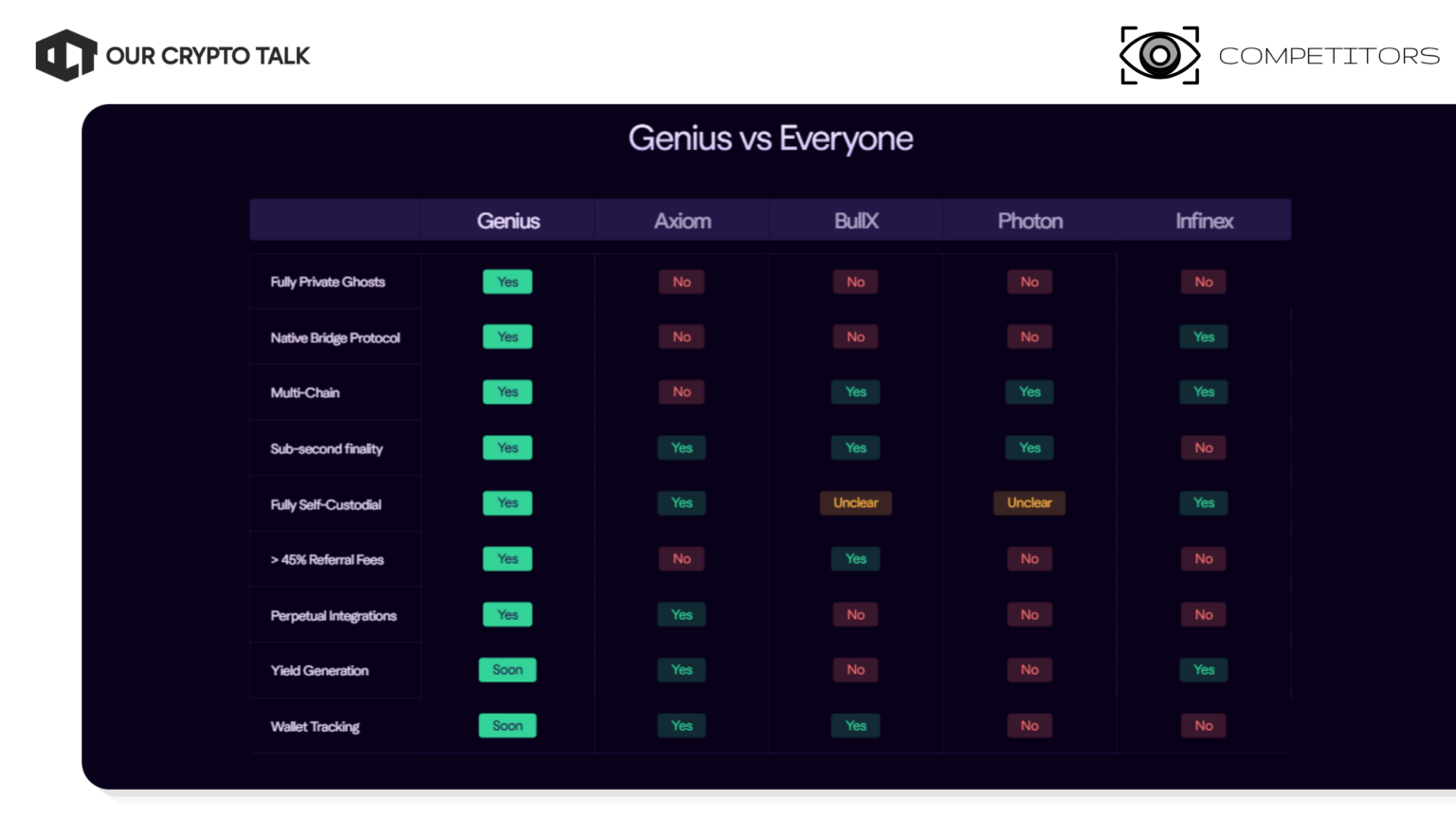
The on-chain trading market is already crowded with established products. Jupiter dominates Solana routing, 1inch and ParaSwap aggregate liquidity across multiple DEXs, while Hyperliquid and Aevo have become leading perpetual trading venues. Meanwhile, tools like Photon and BullX optimize trading workflows for active users.
Most of these products solve only one part of the trading experience. Aggregators focus on swaps, perpetual exchanges focus on derivatives, and trading bots specialize in execution. Users still manage multiple wallets, approvals, bridges, and interfaces to access the full market.
Genius Terminal attempts to combine everything into one platform. Traders can access spot markets, , pre-launch tokens, and yield opportunities through a single programmable balance without manually switching chains or signing every transaction. Ghost Orders add another differentiator by breaking large orders into hundreds of MPC-controlled wallets, reducing both slippage and on-chain visibility.
From an OCT perspective, the competitive advantage is not another liquidity aggregator. It is the combination of chain abstraction, signatureless execution, privacy-preserving order flow, and multi-product trading inside one interface. Replicating that requires far more than adding another routing engine it requires rebuilding the execution layer itself.
Genius Terminal is developed by Shuttle Labs, a New York-based Web3 infrastructure company focused on improving professional on-chain trading.
The company was founded by Armaan Kalsi (CEO), Ryan Myher (COO), and Brihu Sundararaman (CTO). The founders began working together while studying at Yale, initially building blockchain analytics tools before shifting their attention toward trading infrastructure and execution technology.
That evolution matters. Rather than entering crypto through speculative trading products, the team spent its early years understanding market data, cross-chain infrastructure, and execution bottlenecks. Those experiences eventually led to Genius Terminal, which combines trading, wallet abstraction, and cross-chain execution into a single product.
The founders are fully public, regularly communicate product updates, and have already shipped a technically demanding system that combines MPC, cross-chain settlement, and professional trading workflows. In a category where infrastructure quality determines long-term success, the team’s ability to execute carries more weight than previous startup exits.
Overall, Genius scores well on one of OCT’s strongest filters: a technical, doxxed founding team building directly within the category they understand best.

Genius Terminal has attracted backing from one of the most recognizable names in crypto infrastructure.
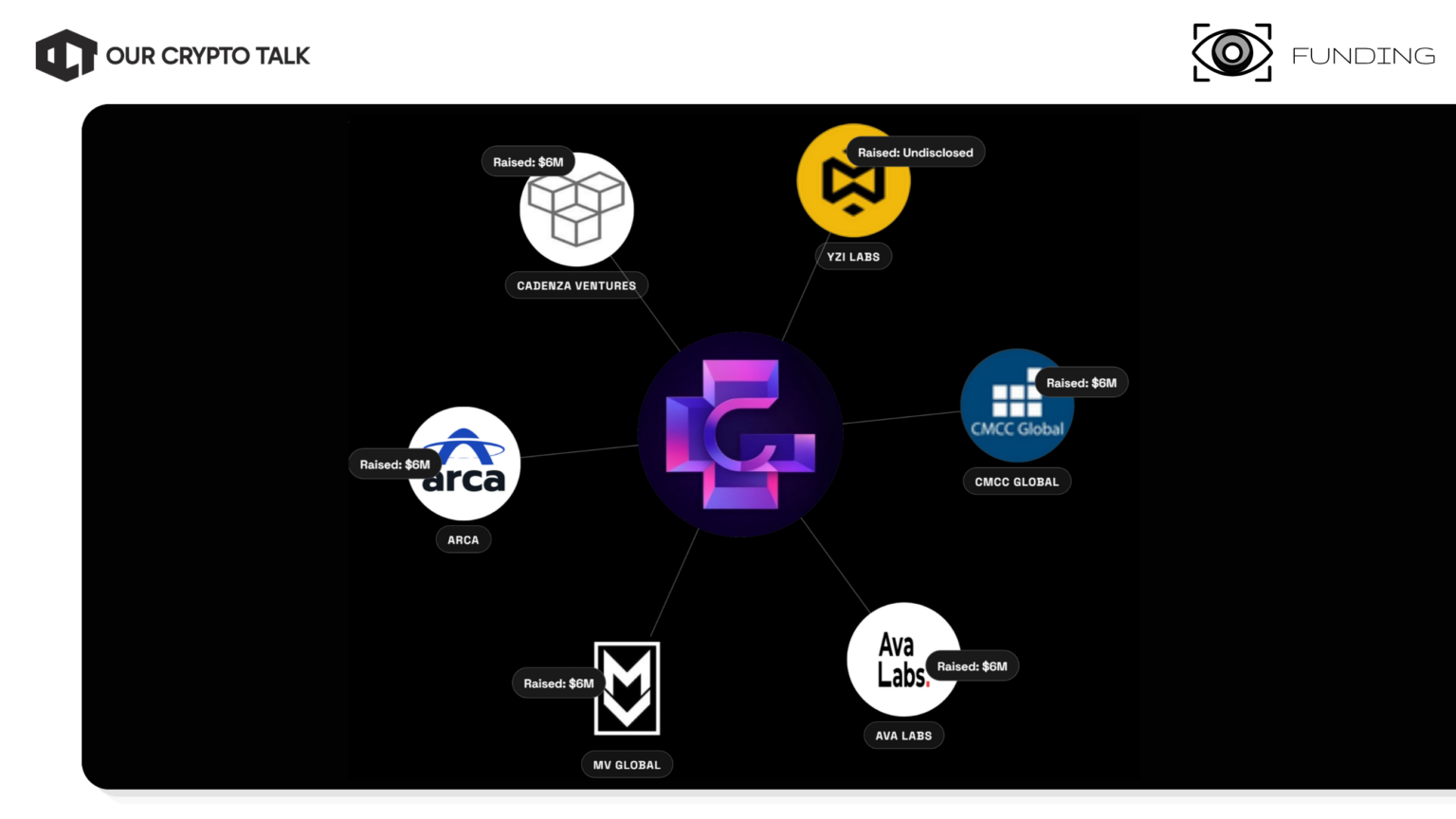
In January 2026, YZi Labs (formerly Binance Labs) announced a strategic investment into Shuttle Labs, the company behind Genius Terminal. Former Binance CEO Changpeng “CZ” Zhao also joined the project as an advisor, providing both credibility and ecosystem reach.
Although the company has not publicly disclosed the exact funding amount or complete investor list, the backing itself carries significant weight. YZi Labs has historically focused on infrastructure projects with long-term utility rather than short-lived narratives, making the investment a strong signal that Genius addresses a real market need.
Beyond capital, the relationship offers distribution advantages across exchanges, wallets, and institutional trading networks. That support is particularly valuable for a product targeting professional traders, where liquidity, integrations, and user acquisition matter as much as technology.
Unlike projects that raised large venture rounds before shipping a product, Genius entered the market with a live platform, measurable trading volume, and strategic backing rather than a heavily marketed retail fundraising campaign. From an OCT perspective, it checks the “raised from the right people” box while avoiding excessive fundraising that often creates future token selling pressure.
Yes. Genius Terminal is a live mainnet product that anyone can use today.
The platform launched in January 2026 and has been processing real trading volume ever since. Users can connect a wallet through Turnkey and Lit Protocol, then trade spot assets across more than 150 DEXs on over 10 blockchains. They can also access Hyperliquid perpetuals, pre-launch token markets, and yield opportunities from a single balance.
The experience feels closer to a centralized exchange than a typical DeFi app. Users do not manage bridges, approvals, or gas across multiple chains. The platform handles execution through its own infrastructure while remaining fully non-custodial.
Ghost Orders are one of the terminal’s standout features. The system uses MPC to split large trades across as many as 500 temporary wallets before settlement. This helps reduce slippage while making large on-chain trades much harder to track.
Genius Terminal runs on the Genius Bridge Protocol rather than acting as another DEX frontend. Shuttle Labs continues to ship new infrastructure, including GeniusFi, its upcoming PropAMM on BNB Chain.
Development is also active on GitHub, where the team maintains repositories for its bridge and execution infrastructure. The codebase is not completely open like many DeFi protocols, but the team continues shipping production features.
The product is live today. Anyone can connect a wallet and trade. This is a working trading terminal with billions in executed volume, not another landing page collecting waitlist signups.
The strongest signal is trading activity. Not social media.
Since launching in January 2026, Genius Terminal has processed more than $16 billion in spot trading volume. Weekly volume has exceeded $2 billion during peak periods. The platform also reported more than 27,000 active wallets and over 150,000 users during mid-2026.
The business is already generating revenue. Public updates estimate an annualized revenue run rate of roughly $60 million. Those numbers suggest traders continue using the platform after onboarding instead of leaving once incentives end.
Before TGE, Genius also ran a CoinMarketCap Launch campaign that rewarded users for interacting with the terminal. It helped attract new users, but it should not be confused with long-term product validation.
Follower counts and quest participation are weak signals because they are easy to inflate.
Trading volume is much harder to fake. Every trade represents real capital flowing through the platform. That is the metric that matters. From an OCT perspective, sustained execution volume carries far more weight than social engagement or a successful airdrop campaign.
GENIUS is the native utility token of the ecosystem. It launched on BNB Chain on April 13, 2026.
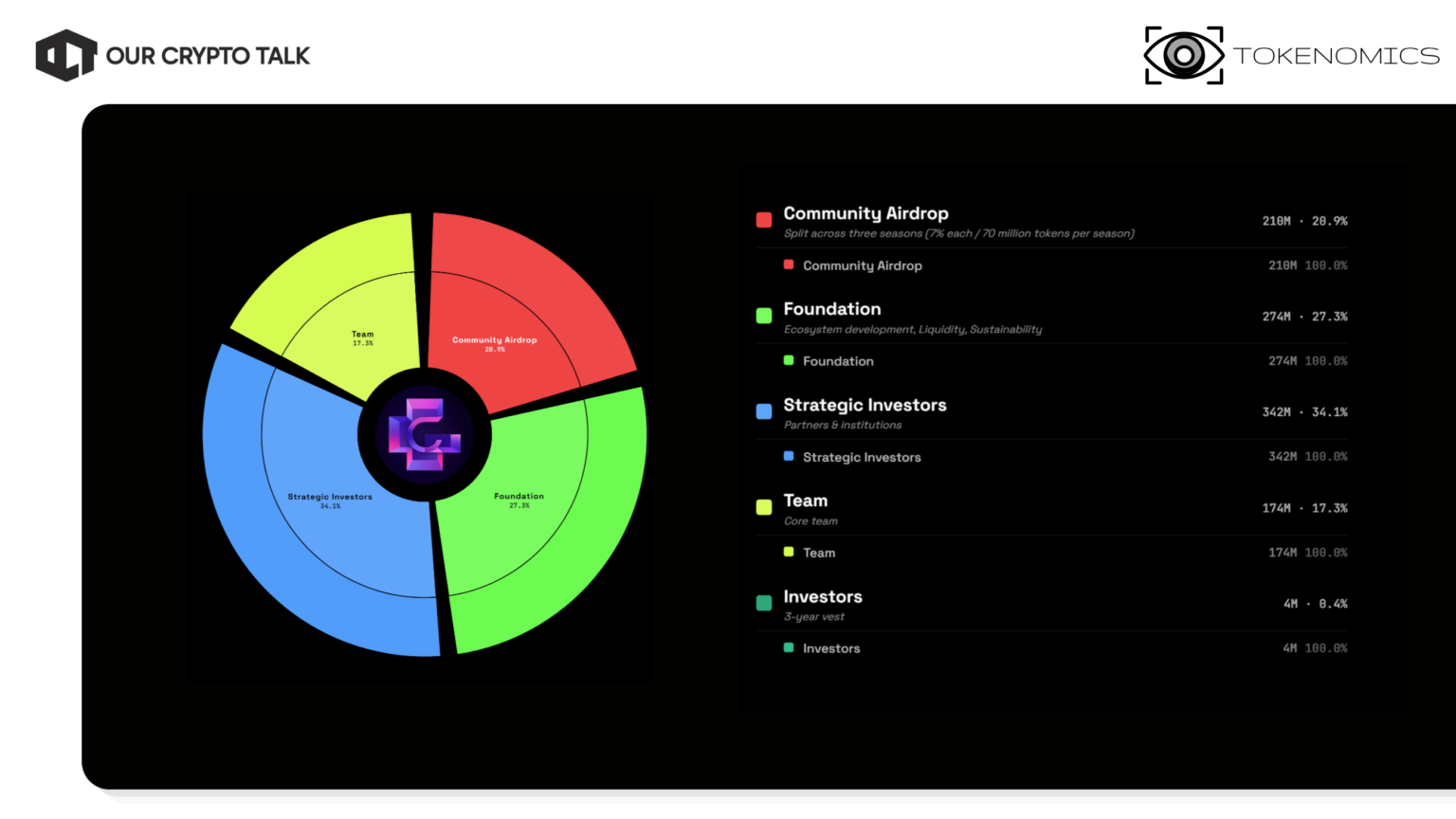
The token has a fixed maximum supply of 1 billion GENIUS. About 335.4 million tokens entered circulation at launch, representing roughly one-third of the total supply. That is a healthier starting point than many recent launches that released less than 10% of supply.
Around 21% of the supply is reserved for community rewards across multiple campaign seasons. The remaining allocation supports the team, strategic investors, ecosystem growth, liquidity, and treasury. These allocations unlock over time through vesting schedules.
GENIUS has utility beyond governance. Holding or locking tokens reduces trading fees across supported chains. Users can also unlock higher referral tiers, premium terminal features, and future governance rights.
The referral system is one of the strongest demand drivers. Top participants can earn up to 45% of referred trading fees, paid directly in USDC. That creates recurring utility instead of relying only on token speculation.
The token structure looks healthy overall. The relatively high circulating supply reduces immediate dilution risk. The main thing to watch is future team and investor unlocks. Large unlocks without matching growth in trading activity could create selling pressure.
The farming phase ended when GENIUS launched in April 2026. Today, the best way to participate is by using the platform.
Active traders can use Genius Terminal for spot trading, Hyperliquid perpetuals, pre-launch tokens, and yield strategies. Regular usage may qualify users for future incentive campaigns as the ecosystem expands.
Holding or locking GENIUS unlocks lower trading fees and higher referral rewards. The highest referral tier pays up to 45% of trading fees in USDC, creating a recurring income stream for active users.
The project has already completed multiple community reward seasons, and future campaigns are expected to focus on real platform activity instead of simple social tasks.
This is no longer a points farm. The value comes from using the product. Traders who already execute meaningful on-chain volume benefit from lower fees, faster execution, and Ghost Orders. Casual farmers looking for another quest campaign will likely find fewer opportunities than before TGE.
Genius Terminal is one of the better “use the product to earn” opportunities in today’s on-chain trading market. It rewards traders who already generate volume instead of people chasing free quests.
Before TGE, the platform ran a CoinMarketCap Launch campaign that rewarded users for trading and interacting with the terminal. Similar campaigns from major trading platforms and aggregators during 2025 and 2026 rewarded active users who generated meaningful volume over several months.
Today, the value proposition is different. Traders who use Genius receive lower trading fees and can unlock referral rewards worth up to 45% of their invitees’ trading fees, paid directly in USDC. Those benefits have real value, especially for high-volume traders.
GENIUS also launched with a healthier token structure than many recent projects. About 33.5% of the total supply entered circulation at TGE, which reduced immediate unlock pressure compared to launches with very small circulating supplies.
The opportunity depends on how you use the platform.
If you already trade across multiple chains, Genius can reduce friction, improve execution, and lower costs. The referral program also creates an additional revenue stream for active users.
If you only plan to buy the token and hold it, the outlook is less compelling. Token demand still depends on trading activity and user growth rather than staking rewards or aggressive token burns.
Overall, Genius looks attractive for traders who will actually use the product. It is much less attractive for passive investors looking for easy farming or quick speculation.
Competition is the biggest challenge.
Jupiter dominates Solana trading. Hyperliquid owns much of the perpetual futures market. 1inch and Paraswap remain strong cross-chain aggregators. New trading terminals continue launching every few months. Genius needs to keep offering better execution and a smoother experience if it wants users to stay.
Regulation is another major risk.
Ghost Orders use MPC to improve privacy by splitting trades across multiple wallets before settlement. While this protects traders from unwanted attention, privacy-focused trading infrastructure could attract additional regulatory scrutiny in some jurisdictions.
Execution risk also remains high.
Running signatureless execution across multiple chains is technically difficult. The platform must deliver fast settlements, reliable routing, and secure infrastructure every day. Any major outage or security issue could push traders toward competing platforms.
The upcoming GeniusFi PropAMM also adds execution risk. Launching a new liquidity layer is much harder than building a trading interface.
Finally, GENIUS depends on platform growth. The token has useful features such as fee discounts and referral rewards, but long-term demand will rise only if trading volume continues growing. If user activity slows, token demand could weaken as well.
The biggest catalyst is continued product expansion.
GeniusFi is the next major release. The new PropAMM aims to improve liquidity and execution while giving the platform more control over order flow. A successful launch would strengthen the entire ecosystem.
Trading activity is another key metric to watch.
The platform has already processed more than $16 billion in spot volume. Continued growth in trading volume, active wallets, and revenue would show that users continue choosing Genius after the initial launch period.
The referral program could also become a meaningful growth driver. As more traders join and referral payouts increase, the platform gains another reason for users to stay active.
Additional chain integrations and deeper support for existing trading venues could further expand the addressable market.
If you already trade on-chain, there is little reason to wait. The product is live, and its main benefits are available today.
If you are investing only for the token, it makes sense to watch platform growth over the next few months. Higher trading volume and successful GeniusFi adoption would strengthen the long-term investment case.
WATCH
Genius Terminal has already shipped what many trading platforms promise. The product is live, fully non-custodial, and has processed more than $16 billion in spot trading volume since launch. Features such as Ghost Orders, signatureless execution, and direct Hyperliquid access clearly differentiate it from basic DEX aggregators.
The team is fully doxxed, backed by YZi Labs, and supported by CZ as an advisor. GENIUS also has practical utility through fee discounts and referral rewards instead of relying only on governance.
The challenge is competition.
Trading infrastructure is one of the most competitive sectors in crypto. Genius must continue attracting traders while proving that its privacy layer and execution engine offer clear advantages over established platforms.
The milestone that changes our rating is simple.
GeniusFi needs to launch successfully and attract meaningful trading volume. If the platform continues growing users, revenue, and execution volume after that launch, Genius becomes much stronger as a long-term infrastructure play.
Until then, it remains a project worth watching closely. It offers the most value to active traders who can benefit from lower fees, better execution, and referral income. Passive investors should wait for stronger evidence that platform growth continues.
All the opinions in this article are that of the author and in no way are financial advice. Our Crypto Talk and the author always suggest you do your own research in crypto and to never take anything as financial advice that you read on the internet. Check our Terms and conditions for more info.


Tokenization of RWA yields onchain might be the biggest opportunity that no one has noticed
Cold Wallet Safety 2026: Are Hardware Wallets Still Safe?
One Token, Multiple Products. Can Zylo Deliver?
The Rise of NEAR Protocol 2026: Inside the 530% Rally and the ETF
Tokenization of RWA yields onchain might be the biggest opportunity that no one has noticed
Cold Wallet Safety 2026: Are Hardware Wallets Still Safe?
One Token, Multiple Products. Can Zylo Deliver?
The Rise of NEAR Protocol 2026: Inside the 530% Rally and the ETF