Robinhood Chain meme coins turned a stock-trading blockchain into a speculative frenzy. See how CASHCAT hit $156M, the 26:1 volume-to-TVL ratio, and the risks.

Author: Kritika Gupta
Robinhood Chain Meme Coins turned the network’s launch into a speculative frenzy. CASHCAT and other tokens drove massive trading volume, rapid user growth, and sharp liquidity swings. Meanwhile, tokenized stocks remained a small part of the ecosystem. The chain’s peak turnover ratio revealed the true intensity of launch-week speculation.
Robinhood launched its own blockchain on July 1, 2026. The pitch focused on tokenized stocks, institutional lending, and regulated real-world assets onchain. The reality looked very different. Within nine days, a cat-themed meme coin became the network’s busiest asset and reached a valuation greater than every tokenized stock on the chain combined. That contrast defined Robinhood Chain’s opening weeks.
Robinhood built the network as an Ethereum Layer 2 using the Arbitrum Orbit stack. It uses ETH as its native gas token, targets block times of roughly 100 milliseconds, and supports permissionless, EVM-compatible applications. Therefore, developers can deploy existing Ethereum contracts and infrastructure without rebuilding their products for a new execution environment. Launch partners included Uniswap for decentralized trading, Chainlink for oracle infrastructure, Morpho for lending, BitGo for custody infrastructure, and teams connected to dYdX Labs.
The chain’s flagship products reflected Robinhood’s broader plan to connect traditional markets with crypto rails. It launched with approximately 95 tradeable stock tokens linked to companies such as NVIDIA, Apple, and Google, giving eligible users 24/7 market exposure. Robinhood also positioned USDG, issued through a Paxos-led consortium, as the network’s primary stablecoin. USDG accounted for roughly $200 million of the chain’s approximately $337 million stablecoin supply, giving the ecosystem a large pool of dollar-denominated liquidity from the start.
However, traders deployed that liquidity differently than Robinhood expected. Daily DEX volume reached roughly $570 million, while total value locked climbed from about $39 million to more than $400 million within weeks. Despite that growth, tokenized real-world assets represented only around 4.1% of TVL at key measurement points. Meme coins generated much of the early trading, attention, and address activity. Robinhood built the chain to bring traditional assets onchain, but speculative tokens provided its first major source of product-market traction.
Robinhood Chain launch, activity, liquidity, and ecosystem metrics
| Metric | Value | Source |
|---|---|---|
| Launch Date | July 1, 2026 | Robinhood |
| Chain Type | Ethereum Layer 2 built on Arbitrum Orbit | Robinhood |
| TVL (Current) | $260.3M | DefiLlama |
| Cumulative DEX Volume | $7.70B | DefiLlama |
| Peak 24h DEX Volume | $877.6M | DefiLlama |
| Daily Transactions (Peak) | 10.8M | Blockscout / Growthepie |
| Daily Active Addresses (Peak) | 295K | Blockscout / Growthepie |
| Stablecoin Market Cap | $399.9M | DefiLlama |
| RWA Active Market Cap | Approximately $12M, or 4.1% of TVL | CoinDesk / Dune |
| CASHCAT Market Cap | $156M | CoinDesk |
| Meme Coin Category Cap | Approximately $162M | CoinGecko |
| Stock Tokens Available | 95 | Robinhood |
| Launch Partners | Uniswap, Chainlink, Morpho, dYdX Labs, and BitGo | Robinhood |
| Robinhood User Base | Approximately 28M customers | Robinhood |
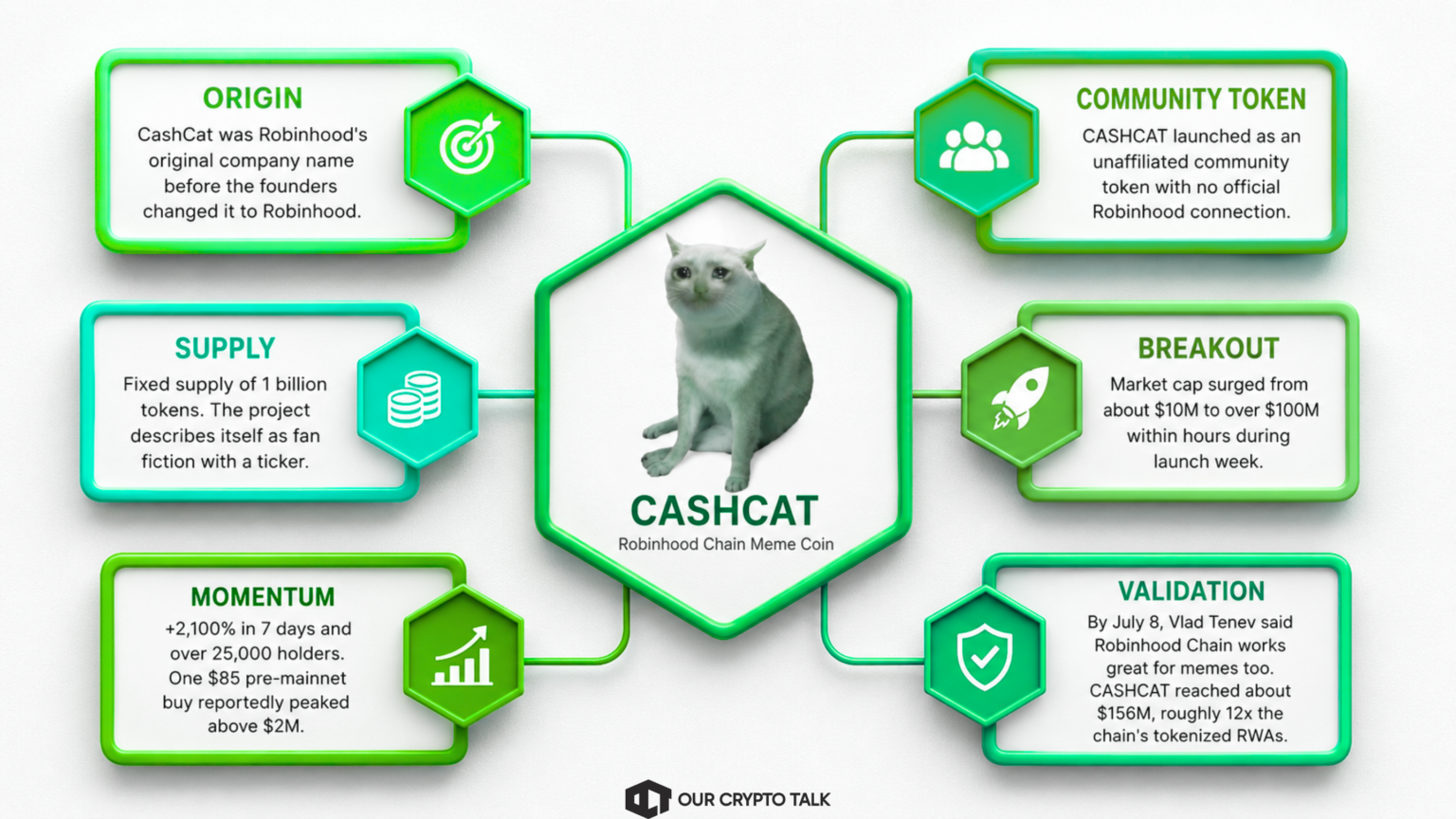
Before Robinhood became Robinhood, co-founders Vlad Tenev and Baiju Bhatt called the company CashCat. They eventually abandoned the name because they felt it lacked the stature required for a financial platform. However, the detail survived in a New Yorker profile and later became part of Robinhood’s early-company lore. Years later, meme-coin traders revived that discarded identity on Robinhood Chain.
CASHCAT then launched as an unaffiliated community token with a fixed supply of 1 billion tokens. Its website describes the project as “fan fiction with a ticker” and clearly states that Robinhood Markets has no connection to it. Even so, the token benefited directly from Robinhood’s brand history. As a result, traders did not need a complex roadmap or technical narrative to understand its appeal.
The market reacted almost immediately. CASHCAT’s market capitalization climbed from roughly $10 million to more than $100 million within hours during the chain’s first full week of trading. Moreover, the token gained more than 2,100% over seven days and attracted over 25,000 wallet holders. This growth showed how rapidly narrative-driven liquidity could form on a new network, especially when traders could connect the token to a well-known consumer brand.
Meanwhile, early-wallet returns added further momentum. According to Lookonchain data, one wallet turned an $85 pre-mainnet purchase into more than $2 million at peak valuations. Consequently, the trade became a powerful marketing story for the token. However, it also represented an extreme outlier. Such gains depended on entering before liquidity expanded and before the wider market discovered the asset.
Finally, Vlad Tenev’s response strengthened the narrative. On July 2, he questioned the long-term value of assets without utility. However, by July 8, he acknowledged that Robinhood Chain “works great for memes too” and followed the CASHCAT account.
Traders therefore interpreted the shift as cultural validation, despite the absence of any official endorsement. At a market capitalization near $156 million, CASHCAT was worth roughly twelve times the combined value of every tokenized real-world asset on Robinhood Chain, which stood near $12.81 million.
Hundreds of meme coins launched during Robinhood Chain’s opening days. However, only a handful survived the first week, while most lost liquidity and disappeared within hours. Together, the remaining tokens formed a recognizable speculative ecosystem built around Robinhood’s brand history, WallStreetBets culture, and internet-native humor.
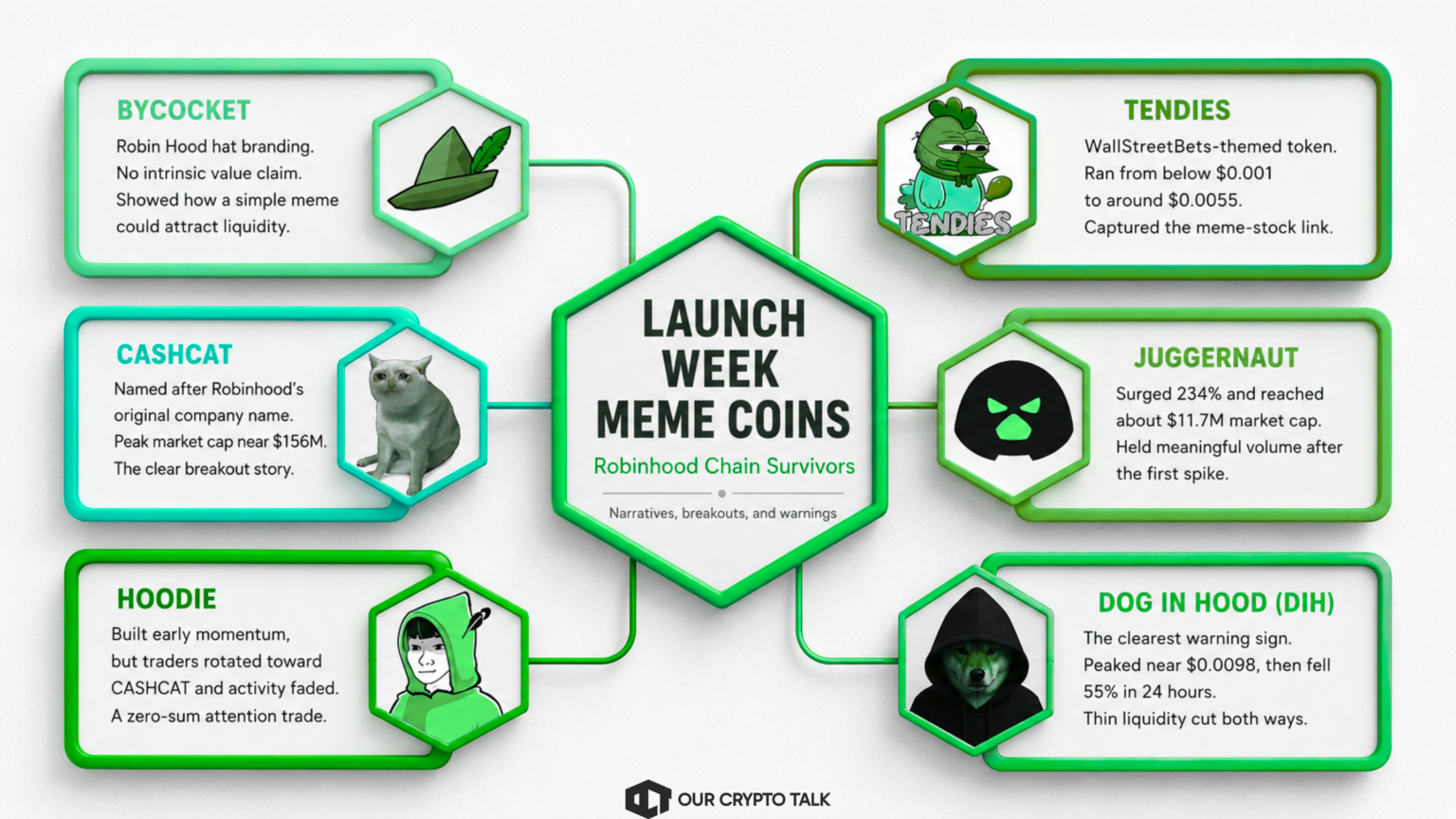
Among them, TENDIES captured the clearest link between Robinhood, meme stocks, and crypto speculation. The WallStreetBets-themed token climbed from below $0.001 to a peak near $0.0055. As a result, its breakout showed how easily Robinhood’s retail-trading identity could transfer into an onchain meme market.
Meanwhile, JUGGERNAUT emerged as another early leader. The token surged 234% and reached a market capitalization of approximately $11.7 million. More importantly, it maintained meaningful trading volume after the initial spike, which helped it outlast many launch-week competitors.
By contrast, BYCOCKET relied almost entirely on branding. Its name referenced the medieval hat associated with Robin Hood, while its website openly promised no intrinsic value. Nevertheless, traders embraced the token because its simple visual identity matched the chain’s broader theme. Therefore, BYCOCKET showed that a strong meme can attract capital without utility or a detailed roadmap.
However, Dog In Hood, or DIH, provided the clearest warning. The token peaked near $0.0098 before falling 55% within 24 hours. Thin liquidity accelerated both sides of the move, so the decline unfolded as quickly as the rally. Consequently, DIH showed that a high market capitalization does not guarantee sufficient exit liquidity.
Similarly, HOODIE gained early momentum, but capital later rotated toward CASHCAT. As attention shifted, HOODIE lost both volume and relevance. Its decline therefore exposed the zero-sum dynamics of meme-coin markets, where one token’s breakout often drains liquidity from smaller competitors.
Finally, several other tokens formed a secondary tier. Hoodrat reached a market capitalization near $9.7 million, Wishbone approached $8.5 million, and VEX climbed toward $8 million. Meanwhile, ARROW rallied 208% to approximately $2.85, although Bubblemaps flagged concerns about token-supply concentration. Overall, these projects reinforced the same pattern: rapid launches created broad activity, but only tokens with strong narratives, active communities, and sustained liquidity survived beyond the first wave.
Robinhood Chain meme coins: peak valuations, narratives, and market implications
| Token | Market Cap (Peak) | The Story | Why It Matters |
|---|---|---|---|
| CASHCAT Breakout Story | $156M–$174M | Named after Robinhood’s original company name, “CashCat,” which the founders discarded 16 years ago. The detail survived in a New Yorker profile. One trader reportedly turned an $85 position into more than $2 million, while Vlad Tenev followed the token’s account on X. | CASHCAT turned obscure corporate history into speculative fuel. Tenev’s engagement gave the token cultural legitimacy and helped it attract more than 25,000 holders. |
| TENDIES | ~$6M | A WallStreetBets-themed token whose name references the community’s slang for trading profits. Its holders organized through Reddit, Discord, and other retail-trading communities. | TENDIES shows the direct Robinhood-to-WallStreetBets-to-crypto pipeline. It transferred the culture of meme-stock speculation into a new onchain market. |
| BYCOCKET | ~$900K | Named after the medieval hat associated with Robin Hood. Its website openly states that the token promises no intrinsic value and relies entirely on meme branding. | BYCOCKET shows how a simple, recognizable narrative can attract liquidity without utility, a roadmap, or a complex product. |
| JUGGERNAUT | ~$11.7M | One of the largest community tokens launched during the chain’s opening period. It surged 234% early and maintained meaningful DEX volume after the initial rally. | JUGGERNAUT benefited from early-mover advantage. Its initial liquidity attracted more traders, which then produced deeper liquidity and stronger visibility. |
| HOODIE | Sizeable, but declining | Another Robinhood-themed meme coin that generated strong early momentum. However, its activity faded as traders rotated capital toward CASHCAT. | HOODIE illustrates the zero-sum nature of meme-coin attention. When one token dominates the narrative, smaller competitors often lose volume and liquidity. |
| Dog In Hood (DIH) Cautionary Tale | ~$3.6M | DIH retraced 55% from its peak and recorded heavy trading volume during both the rally and the sell-off. Its chart became one of the clearest launch-week warnings. | DIH shows how quickly meme coins can reverse when liquidity remains thin. The same market structure that accelerates a pump can intensify the decline. |
The meme-coin boom did not emerge by accident. Robinhood Chain combined mass distribution, low transaction friction, strong cultural branding, permissionless launch infrastructure, and a market pattern that crypto has repeated across several ecosystems. Together, these factors created ideal conditions for speculation to spread faster than Robinhood’s tokenized-stock and lending products.
First, Robinhood entered the market with a ready-made distribution channel. The company already served roughly 28 million customers who understood stocks, options, and high-risk retail trading, even if many had never used a decentralized exchange.
Once Robinhood Wallet integrated the chain, users could access onchain markets through a familiar interface. As a result, Robinhood Chain gained exposure to a retail audience that most new Layer 2 networks spend years trying to attract. In fact, few major Layer 2 launches have started with a comparable consumer funnel.
Second, Robinhood removed much of the friction that usually slows early adoption. The chain targeted block times of roughly 100 milliseconds, while Robinhood covered gas costs during the initial launch period. Moreover, EVM compatibility allowed users and developers to access established tools such as MetaMask and Uniswap immediately.
Consequently, traders could enter the ecosystem without learning a new technical stack. Crypto markets have repeatedly shown that lower costs and simpler access encourage speculative activity. Solana, BNB Chain, and Base all experienced major meme-coin cycles after they made trading faster, cheaper, or easier.
Third, Robinhood brought a pre-loaded cultural narrative. The company helped make mobile stock trading mainstream and became closely associated with the GameStop era, WallStreetBets, and millennial retail speculation. Therefore, a Robinhood-branded blockchain naturally attracted meme-driven activity.
CASHCAT, TENDIES, and BYCOCKET did not rely on random themes. Instead, each token drew directly from Robinhood’s history, branding, or retail-trading culture. That familiarity allowed traders to understand and circulate the narratives without studying technical documentation.
Fourth, launchpads lowered the barrier to token creation. NOXA.fun, one of the first launchpads on Robinhood Chain, allowed users to deploy tokens permissionlessly and create Uniswap liquidity within minutes. In practice, this model followed the same basic playbook that Pump.fun used on Solana. Anyone could launch an asset, attach a meme, and compete for attention without building a protocol or raising capital. Consequently, hundreds of tokens entered the market almost immediately. However, most failed once early liquidity and attention disappeared.
Finally, Robinhood Chain followed a pattern that has defined several new crypto ecosystems. BNB Chain relied heavily on speculative tokens during its 2021 expansion. Similarly, Base experienced a major meme cycle in 2023 and 2024, while Solana’s 2024 and 2025 growth drew substantial activity from meme coins.
These assets often generate the first wave of transactions, wallet creation, liquidity, and social attention before more durable applications reach scale. In that sense, speculation acts as a gateway to adoption. Robinhood Chain did not invent a new launch model. Instead, it followed the same sequence that has repeatedly turned new networks into active markets.
robinhood chain meme coins peak turnover ratio revealed the intensity of launch-week speculation. The network recorded roughly $570 million in daily DEX volume against just $21.68 million in total value locked, producing a 26-to-1 ratio. In other words, traders turned over the chain’s entire liquidity base 26 times in a single day. By comparison, most established DEX ecosystems with years of deeper, battle-tested liquidity operate near or below a 1-to-1 ratio. Therefore, the figure reflected rapid capital rotation rather than a proportionally large pool of long-term liquidity.
The composition of TVL further showed where users placed their capital. Morpho lending accounted for approximately $133 million, while Uniswap held around $55 million in liquidity. By contrast, tokenized real-world assets represented only about 4.1% of TVL. Robinhood launched the chain around tokenized stocks and institutional finance. However, meme coins, DEX trading, and speculative liquidity generated most of the early growth.
At the same time, stablecoin inflows provided a more constructive signal. Robinhood Chain held between $290 million and $337 million in stablecoins at key measurement points, with USDG accounting for the largest share. These balances showed that users had moved substantial dollar-denominated capital into the ecosystem. Nevertheless, stablecoin supply alone does not confirm durable adoption. The market must still show that users will deploy that capital into lending, tokenized equities, and other recurring financial activity after speculative demand cools.
Meanwhile, transaction and user metrics reached unusually high levels. Daily transactions climbed into the 7 million to 10.8 million range, while active addresses peaked near 295,000. Meme trading clearly helped generate that initial user base. However, raw transaction counts can rise quickly when bots, launchpads, and high-frequency traders repeatedly interact with low-value tokens. As a result, retention, repeat users, and sustained protocol revenue will provide stronger evidence of adoption than peak activity alone.
Finally, daily DEX volume fell back into the tens of millions after the $570 million peak. That decline confirmed that the launch included a significant speculative spike. The central question now is whether the lower base level remains active. Robinhood Chain has already proved that it can attract traders and liquidity. Its next test is whether Morpho lending, USDG, and tokenized stocks can convert those users into longer-term participants.
Robinhood did not plan to launch a meme-coin ecosystem, but the speculative surge gave the chain a powerful bootstrapping mechanism. Meme trading helped attract nearly 295,000 active addresses at peak, pushed TVL above $400 million, and generated billions of dollars in cumulative volume. Robinhood might have needed months to build that level of activity through tokenized stocks and lending products alone. Instead, meme coins supplied users, liquidity, and market awareness within weeks.
The key question is whether Robinhood can convert speculative users into long-term financial participants. The trader who buys CASHCAT today could buy tokenized NVIDIA exposure, lend USDG through Morpho, or explore other onchain products tomorrow. Robinhood’s established consumer brand gives it a stronger chance of making that transition than most Layer 2 networks. However, high wallet activity does not guarantee conversion. Robinhood still needs to give users clear reasons to remain after meme-coin returns and social attention decline.
Vlad Tenev’s shift in tone also reflected the strategic value of maintaining community momentum. He initially questioned the value of utility-free assets, but later acknowledged that Robinhood Chain “works great for memes too.” Fighting the activity could have alienated the users who created the network’s earliest liquidity and attention. By recognizing it without officially endorsing individual tokens, Tenev allowed the community to continue expanding while Robinhood maintained its broader RWA positioning.
Morpho’s roughly $133 million in TVL provides a more encouraging signal of potential retention. Lending markets can create recurring engagement because users deposit capital, monitor yields, and respond to changing borrowing demand. Robinhood Earn also combines Morpho infrastructure with an estimated 7% APY and insurance arrangements covering certain technical risks. However, that coverage does not eliminate borrower, liquidity, governance, or market risk, and the yield can change. Therefore, the lending layer may provide stickier activity than meme trading, but Robinhood still needs to prove that users will remain active across different market conditions.
Robinhood Chain’s permissionless design accelerated growth, but it also made scams easier to launch. Platforms such as NOXA.fun allowed anyone to create a token and seed liquidity within minutes. As a result, hundreds of assets appeared during launch week, while most collapsed or disappeared within hours. At the same time, traders flagged fake contracts and duplicate liquidity pools, which increased the risk of buying the wrong token even when a legitimate project used the same name.
Beyond launch risk, token ownership creates another major concern. Bubblemaps flagged ARROW for possible supply concentration, while many smaller meme coins offered little transparency about deployer wallets, insider allocations, or linked addresses. When a small group of wallets controls a large share of supply, it can heavily influence price action. Therefore, traders should not treat a growing holder count or rising market capitalization as proof of fair distribution.
Moreover, thin liquidity makes these risks more severe. CASHCAT reached a market capitalization near $156 million, but its available liquidity represented only a fraction of that valuation. Consequently, a few large sell orders could move the price sharply and leave later buyers without a viable exit. Dog In Hood showed how quickly that structure can break down when it fell 55% within 24 hours. In other words, the same liquidity conditions that accelerate a rally can also intensify the crash.
The network has also followed a familiar spike-and-decline pattern. Daily DEX volume surged to roughly $570 million during the first week, but later fell into the tens of millions. Typically, speculative markets produce diminishing returns as early traders take profits and new buyers become harder to attract. If volume, liquidity, and social attention continue to decline together, many remaining tokens could lose relevance regardless of their communities or branding.
Furthermore, Robinhood does not endorse CASHCAT or the wider meme ecosystem. CASHCAT’s own website states that the token has no affiliation with Robinhood Markets. Although Tenev’s public acknowledgment helped sustain interest, Robinhood could distance itself if scams, losses, or regulatory pressure increase. A publicly traded U.S. brokerage operating a blockchain that becomes known primarily for meme coins may attract scrutiny, especially when the company continues to position the network around tokenized assets and financial infrastructure.
Ultimately, most people who trade meme coins on Robinhood Chain will lose money. The wallet that reportedly turned $85 into more than $2 million represents an exceptional outcome, not the expected result. Early insiders, automated traders, and well-positioned wallets usually enter before broader liquidity arrives. By the time a success story reaches social media, later buyers often face worse prices, thinner exits, and much higher downside risk.