Discover the Top 10 Web3 Infrastructure Providers of 2025 powering decentralized apps and blockchains worldwide.

Author: Akshat Thakur
What does a Web3 infrastructure provider do? A Web3 infrastructure provider supplies the backend systems that let decentralized applications connect to blockchains without running their own complex node architecture. These companies manage the infrastructure layer behind wallets, DeFi apps, AI agents, games, and exchanges.
The core services usually include RPC APIs, validators, indexing, APIs, and node hosting. RPC endpoints process blockchain requests and send transaction data between applications and networks. Validators help secure proof-of-stake chains by confirming transactions and maintaining consensus. Indexing systems organize raw blockchain data into searchable formats, while node hosting providers maintain synchronized blockchain nodes with high uptime and low latency.
These services matter because modern dApps require constant availability, fast response times, and scalable backend systems. Running this infrastructure independently is expensive and operationally difficult. That is why the top web3 node providers and blockchain infrastructure companies have become critical to the industry.
Today’s top web3 infrastructure providers support everything from Ethereum rollups and modular chains to enterprise blockchain applications. Without them, most Web3 products would struggle to scale reliably.
Web3 infrastructure works as a distributed backend system connecting applications to blockchain networks in real time. Every wallet interaction, smart contract call, or token transfer relies on multiple infrastructure layers operating together.
The process starts with RPC APIs. When a user interacts with a dApp, the application sends RPC calls to a blockchain node. These requests retrieve balances, broadcast transactions, or access smart contract data. Providers route these requests through globally distributed node clusters to reduce latency and improve uptime.
Indexing layers sit on top of raw blockchain data. Since blockchain ledgers are inefficient for direct searching, indexers reorganize transactions, wallet activity, and smart contract events into structured databases. This makes analytics dashboards, explorers, and DeFi interfaces usable at scale.
Modern providers also rely heavily on load balancing and caching systems. Traffic is distributed across multiple nodes and regions to avoid downtime during network spikes. Enterprise-grade providers typically target 99.99% uptime because even brief outages can break trading platforms, games, or AI applications.
Rollups and modular blockchain systems add another layer. Instead of processing every transaction directly on the main chain, rollups batch transactions off-chain before settlement. This improves throughput and lowers costs, making blockchain scaling more efficient.
When a user interacts with a dApp, the application sends requests through RPC APIs to blockchain nodes. These requests retrieve wallet balances, smart contract states, transaction history, or broadcast transactions onto the network. Infrastructure providers route these calls through globally distributed node clusters designed for low latency and high uptime.
Behind the scenes, indexing layers restructure raw blockchain data into searchable databases. Without indexing, querying blockchain activity would be slow and inefficient. Modern infrastructure stacks also use caching systems, load balancing, and regional routing to improve response speed and reliability.
Scalability has become increasingly important in 2026 due to the rise of rollups, Layer 2 ecosystems, and modular blockchain architectures. Many providers now support optimistic rollups, zero-knowledge rollups, and data availability layers to improve blockchain scaling while reducing congestion on base networks.
Enterprise-grade providers maintain uptime targets above 99.99 percent through redundant infrastructure, automatic failover systems, and continuous monitoring. This backend architecture allows decentralized applications to feel as responsive as Web2 products while remaining fully onchain.
The best crypto infrastructure platforms separate themselves through reliability, performance, scalability, and developer experience. In production environments, even small outages or latency spikes can impact trading systems, wallets, games, and DeFi protocols handling millions in daily activity.
Uptime remains one of the most important factors. The best RPC providers maintain globally distributed infrastructure with automatic failover and redundant node clusters to minimize downtime. Latency is equally critical, especially for applications requiring fast transaction execution and real-time data delivery.
Chain support has also become a major differentiator. Leading providers now support dozens of ecosystems across EVM chains, Layer 2 networks, appchains, and emerging modular ecosystems. Strong analytics and monitoring tools help developers track usage, debug errors, and optimize infrastructure costs in real time.
Decentralization is another growing priority. Some decentralized infrastructure providers distribute requests across independent node operators instead of relying on centralized server clusters. This reduces single points of failure and improves censorship resistance.
Pricing transparency also matters more in 2026 as applications scale rapidly. Developers increasingly favor providers with predictable billing models, stable request limits, and clear performance metrics instead of hidden compute-based pricing structures.
The top web3 infrastructure providers combine low latency, high uptime, broad chain coverage, scalable architecture, and developer-friendly tooling into a unified backend layer capable of supporting the next generation of blockchain applications.
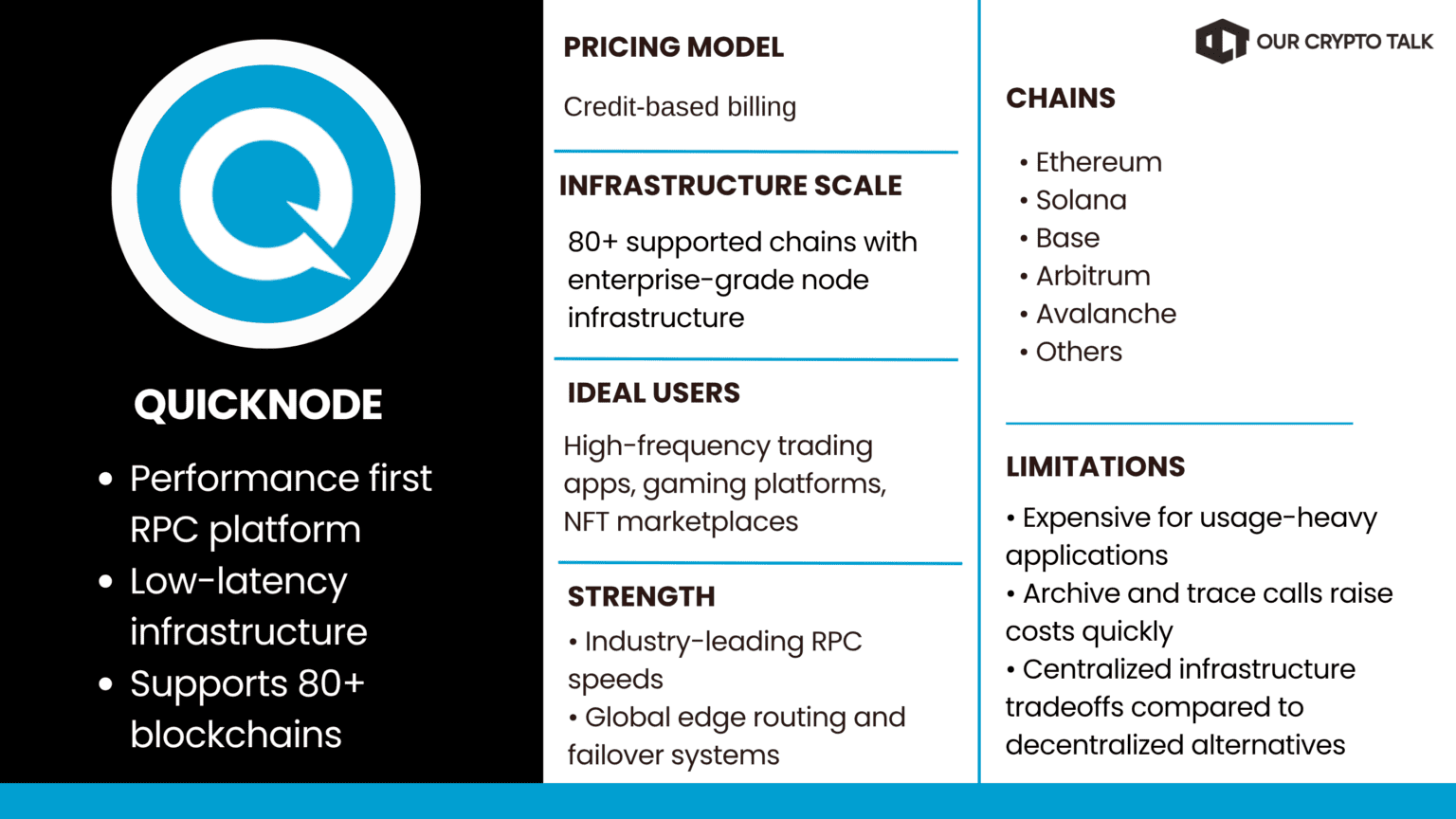
QuickNode has positioned itself as the performance-first infrastructure platform for latency-sensitive applications. It supports more than 80 blockchains including Ethereum, Solana, Base, Arbitrum, Avalanche, and several emerging Layer 2 ecosystems. The platform focuses heavily on high-speed RPC delivery, real-time streaming, and scalable node infrastructure.
QuickNode’s strongest advantage is speed. Independent benchmark tests in 2026 consistently place its global latency below 100 milliseconds, outperforming several competitors in trading-heavy environments. This makes it popular among high-frequency DeFi traders, gaming applications, NFT marketplaces, and MEV-sensitive systems where milliseconds matter.
Its product suite includes RPC APIs, Streams, Webhooks, gRPC support, archive nodes, and marketplace integrations for analytics and indexing. Many production-grade dApps use QuickNode because of its global edge routing and automatic failover systems that maintain uptime during network congestion spikes.
The tradeoff comes from pricing. While the platform offers one of the best developer experiences among the best Web3 APIs for developers, usage-heavy applications can become expensive due to credit-based billing. Complex trace calls and archive queries scale costs faster than flat-rate competitors like Chainstack.
QuickNode’s customer base includes major DeFi applications, Solana ecosystem projects, and enterprise blockchain teams. Compared to Pocket Network’s decentralized model, QuickNode prioritizes centralized performance optimization and enterprise reliability over censorship resistance.
For applications prioritizing low latency and uptime over pricing efficiency, QuickNode remains one of the strongest options among the top Web3 infrastructure providers in 2026.
Alchemy focuses heavily on developer tooling and enhanced APIs rather than pure node access. It supports Ethereum, Solana, Polygon, Arbitrum, Optimism, Base, and dozens of Layer 2 ecosystems. In 2026, it remains one of the most widely used platforms among enterprise dApps and NFT applications.
Alchemy stands out because it bundles infrastructure with analytics, notifications, mempool monitoring, SDKs, and debugging tools. Its enhanced APIs reduce the need for teams to build separate indexing layers internally. This makes onboarding significantly faster for developers building wallets, NFT applications, and DeFi dashboards.
Compared to QuickNode, Alchemy trades a small amount of latency for stronger tooling. Real-world benchmarks show slightly slower RPC response times, but the difference becomes less important for applications focused on analytics or user experience rather than high-frequency execution.
The platform’s pricing model uses Compute Units, which can become expensive for applications making large trace or debug calls. However, many teams still consider it among the best Web3 APIs for developers because of its mature ecosystem and detailed monitoring dashboards.
Alchemy’s customers include large NFT platforms, DeFi protocols, and enterprise blockchain pilots. For developer-heavy teams wanting analytics and infrastructure inside one stack, Alchemy remains one of the strongest infrastructure platforms in the industry.

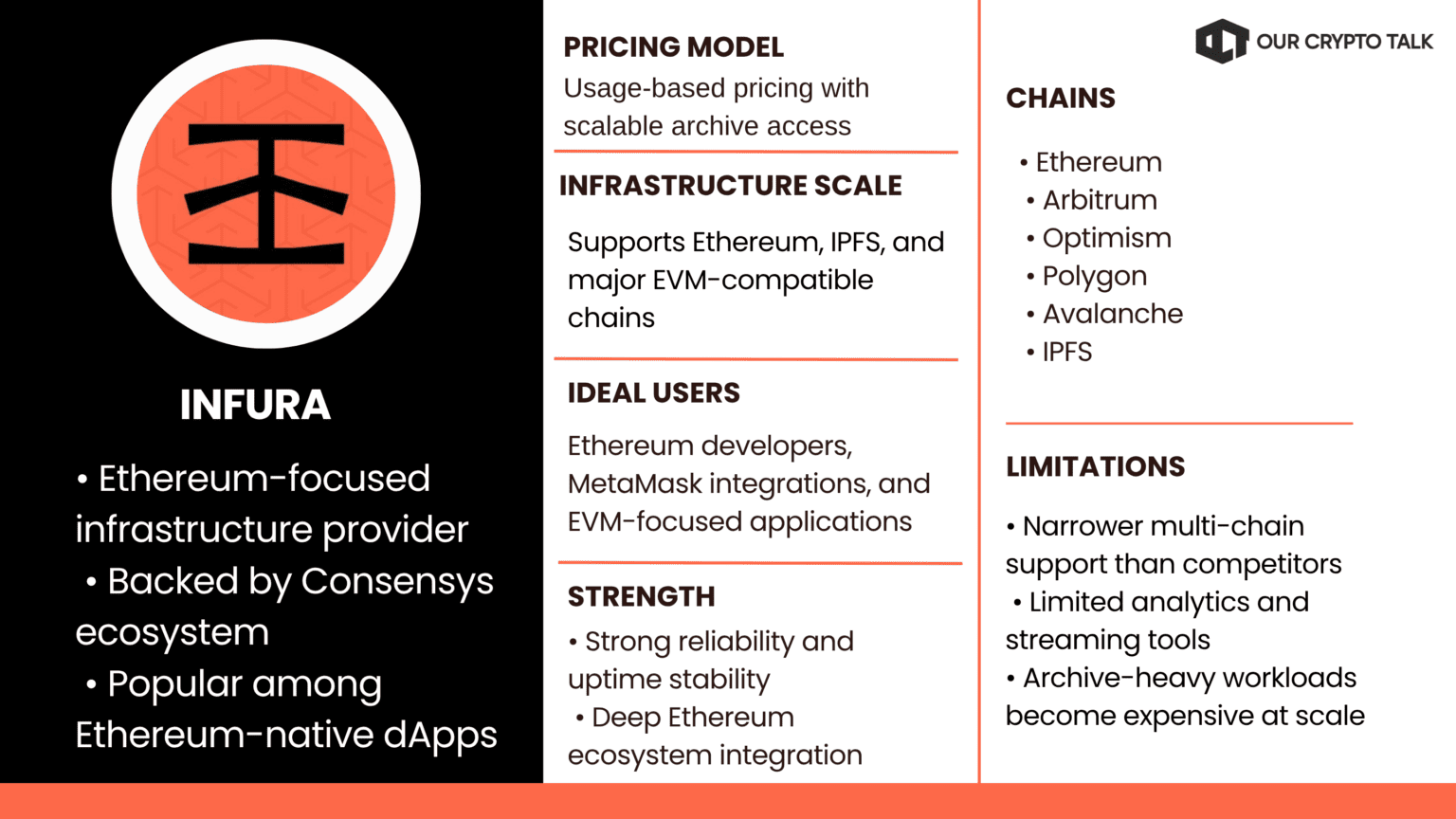
Infura remains deeply connected to the Ethereum ecosystem through its relationship with Consensys and MetaMask. It primarily focuses on Ethereum, IPFS, and major EVM-compatible chains like Arbitrum, Optimism, Polygon, and Avalanche.
Infura became the default RPC layer for many Ethereum applications during the early DeFi era. Its biggest strength is reliability. Even during periods of extreme network activity, it maintained strong uptime and stable request handling for large-scale production systems.
The platform provides JSON-RPC APIs, IPFS access, archive nodes, transaction relays, and Ethereum tooling integrations. It is particularly useful for teams building directly within the Ethereum ecosystem rather than managing dozens of chains simultaneously.
Its weakness is narrower ecosystem coverage compared to multi-chain competitors like GetBlock or Ankr. It also lacks some of the advanced streaming and analytics capabilities offered by Alchemy and QuickNode.
Pricing remains relatively straightforward, though archive-heavy workloads can become expensive at scale. Despite stronger competition in 2026, Infura still powers thousands of Ethereum-native applications and remains one of the safest choices for Ethereum-focused infrastructure.
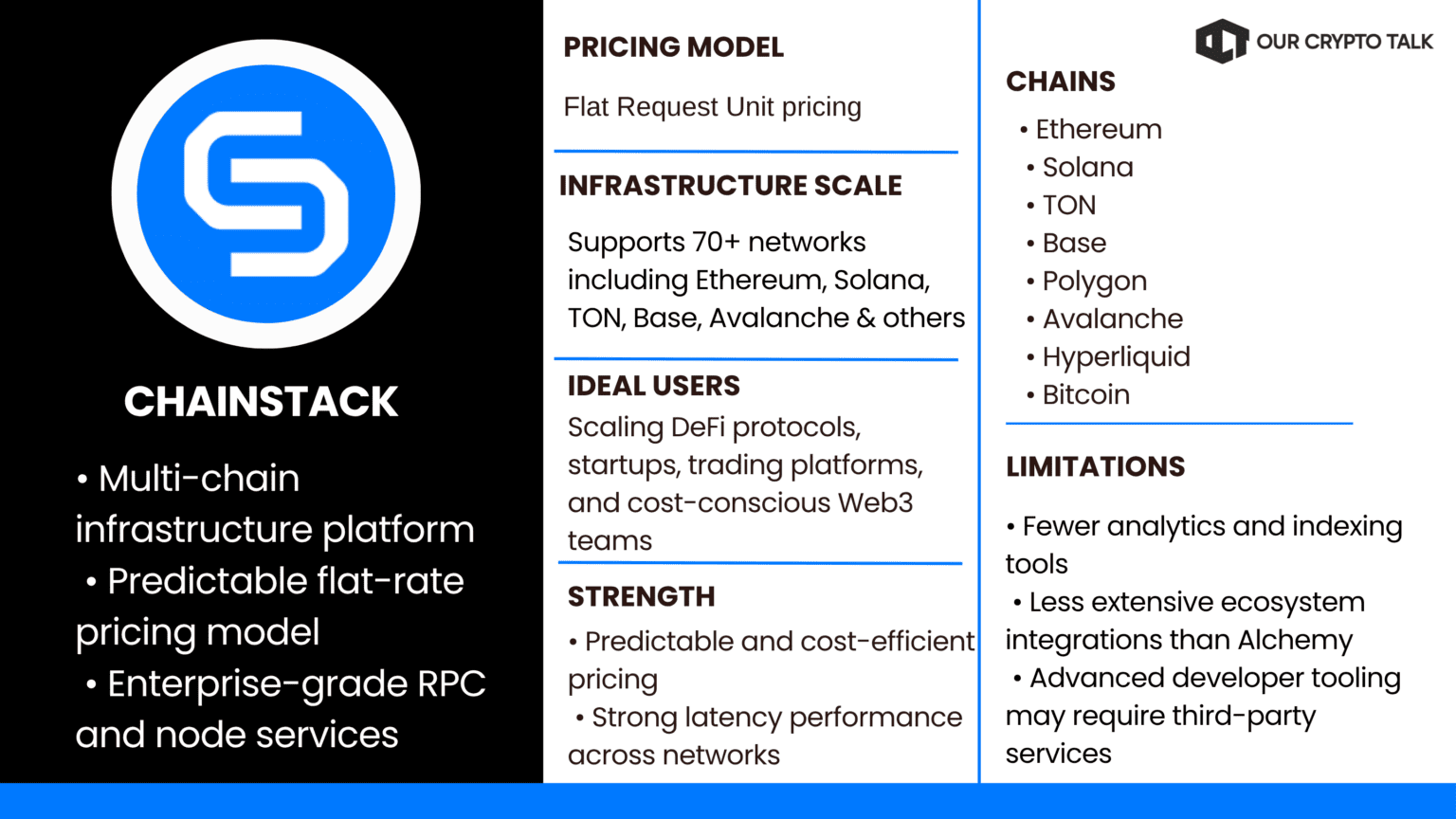
Chainstack has built its reputation around predictable pricing and balanced multi-chain support. The platform supports more than 70 networks including Ethereum, Solana, Base, TON, Polygon, Hyperliquid, Avalanche, and Bitcoin infrastructure.
Unlike many competitors using heavily weighted compute systems, Chainstack uses flat Request Unit pricing. This transparency has made it increasingly popular among startups and scaling DeFi protocols looking for predictable infrastructure costs.
Its services include RPC APIs, dedicated nodes, archive nodes, debug APIs, trader-focused mempool endpoints, and benchmarking tools. The platform consistently ranks near the top in independent latency tests while remaining significantly cheaper than some enterprise-focused providers.
Chainstack’s biggest strength is cost efficiency. Many teams migrating from self-hosted infrastructure report lower operational costs without sacrificing uptime. This makes it a strong candidate for the cheapest blockchain node provider category among enterprise-capable platforms.
The downside is that it offers fewer advanced ecosystem integrations than Alchemy or Moralis. Teams needing extensive indexing or analytics tooling may still require additional providers.
For projects prioritizing cost predictability, multi-chain flexibility, and enterprise-grade reliability, Chainstack remains one of the most balanced infrastructure providers in Web3.
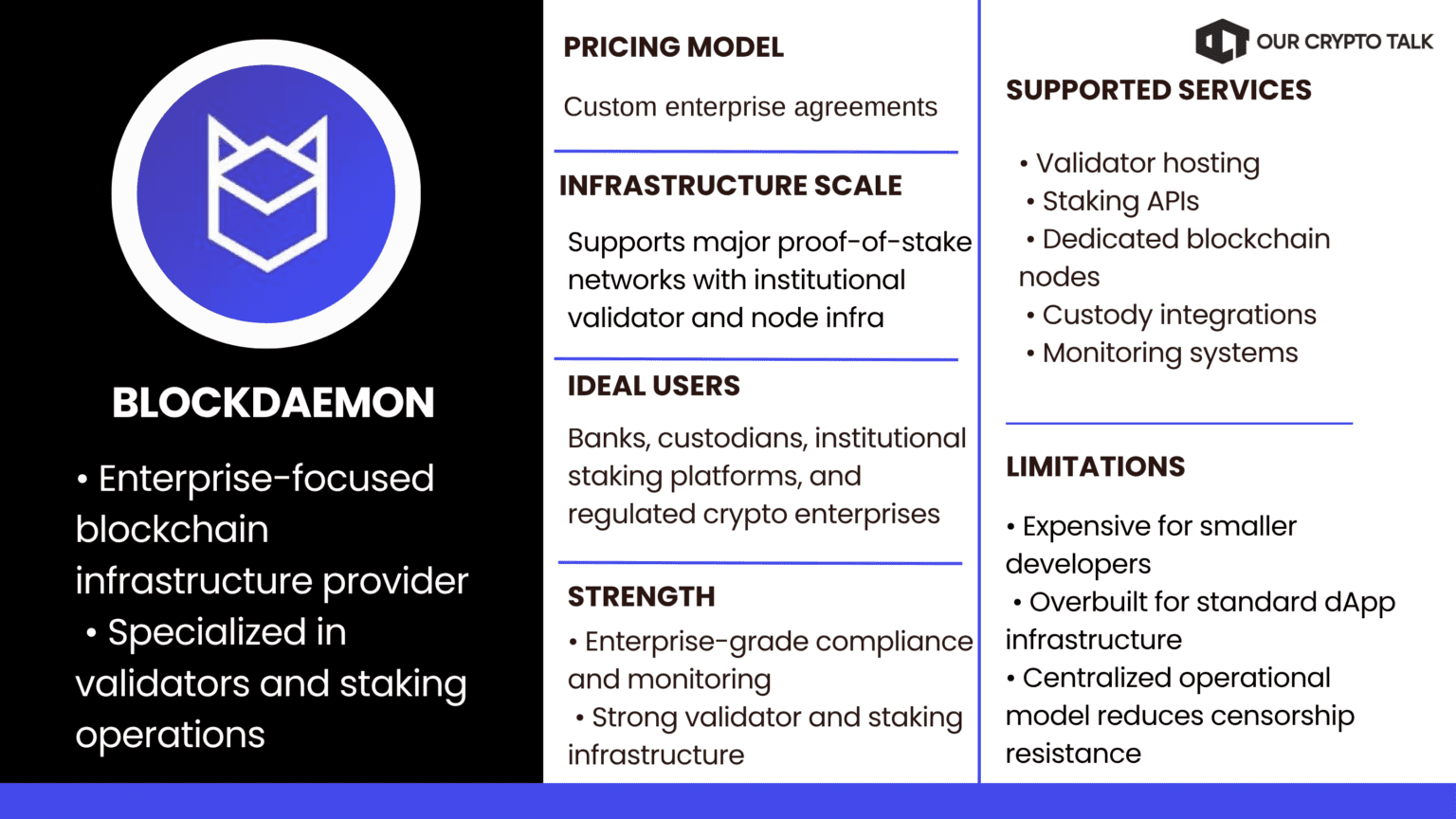
Blockdaemon targets enterprise and institutional customers rather than retail developers. It supports dozens of major blockchain networks while specializing in validators, staking infrastructure, custody integrations, and regulated node operations.
Its infrastructure is heavily compliance-focused. SOC 2 certifications, institutional SLAs, and enterprise-grade monitoring systems make it attractive to banks, custodians, and regulated crypto firms entering blockchain infrastructure.
Blockdaemon’s core products include validator hosting, staking APIs, dedicated blockchain nodes, monitoring systems, and custody infrastructure integrations. It powers billions of dollars in staked assets across multiple proof-of-stake networks.
Compared to decentralized infrastructure providers like Pocket Network, Blockdaemon operates with centralized enterprise control and stricter operational guarantees. This creates stronger reliability for institutions but less censorship resistance.
Pricing is significantly higher than retail-focused providers, often requiring custom enterprise agreements. Smaller developers may find the platform excessive for standard dApp infrastructure needs.
However, for institutions requiring compliance, validator infrastructure, and enterprise-grade blockchain operations, Blockdaemon remains one of the most trusted infrastructure providers in the industry.
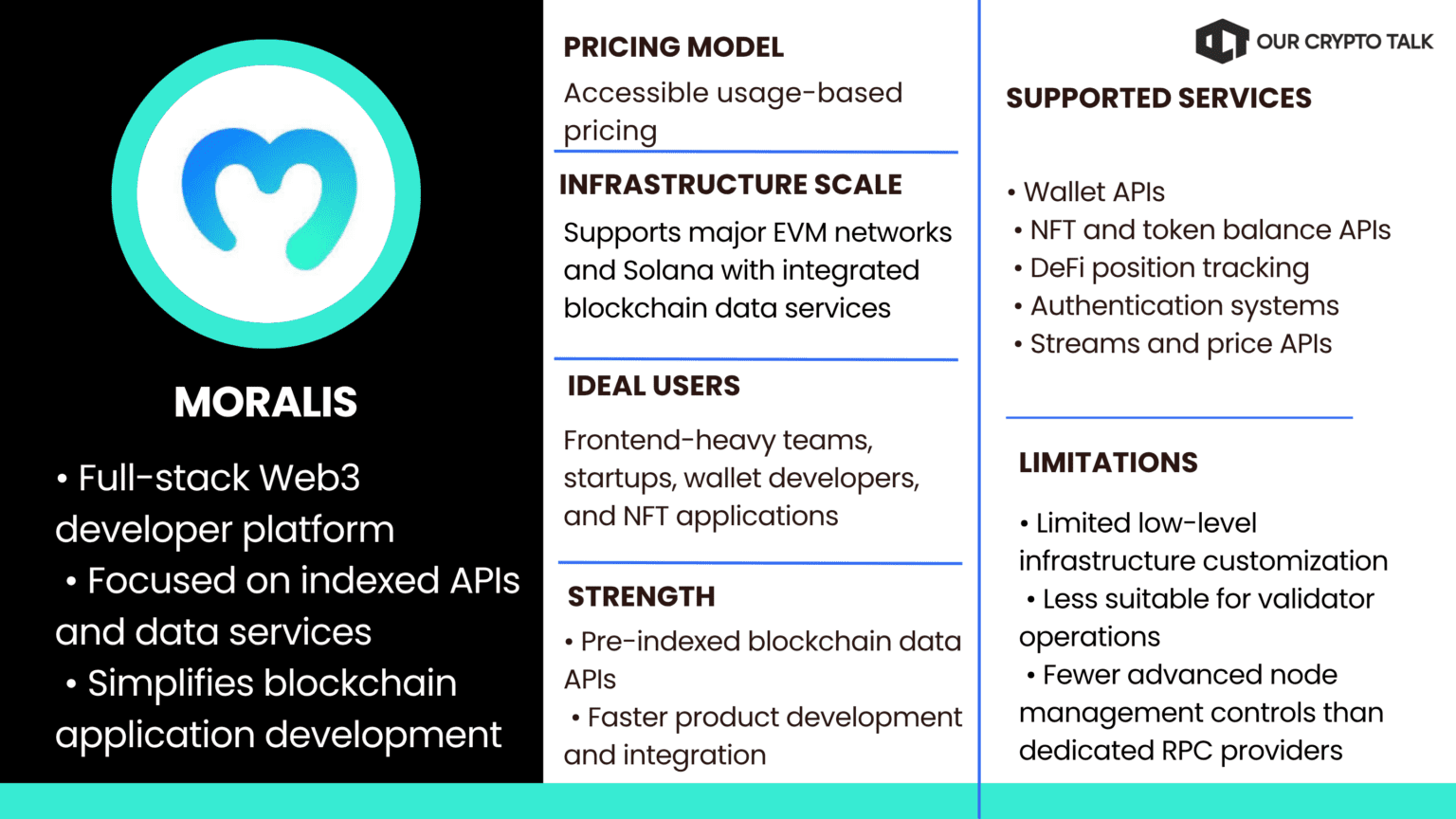
Moralis positions itself as a full-stack developer platform rather than just an RPC provider. Instead of focusing purely on node access, Moralis simplifies blockchain development through indexed APIs and pre-built data services.
It supports major EVM ecosystems and Solana while offering APIs for wallets, NFTs, token balances, DeFi positions, prices, authentication, and streams. This dramatically reduces backend complexity for developers building consumer-facing applications.
Moralis performs especially well for startups and frontend-heavy teams because developers can access indexed blockchain data immediately without building custom infrastructure. Many NFT and wallet applications choose Moralis because it accelerates product development significantly.
The weakness is customization. Teams requiring low-level node control or advanced validator infrastructure may find Moralis less flexible than QuickNode or Chainstack.
Pricing remains relatively accessible for smaller projects, especially compared to running separate indexing systems internally. For developers prioritizing speed of development over infrastructure customization, Moralis remains one of the best Web3 APIs for developers in 2026.
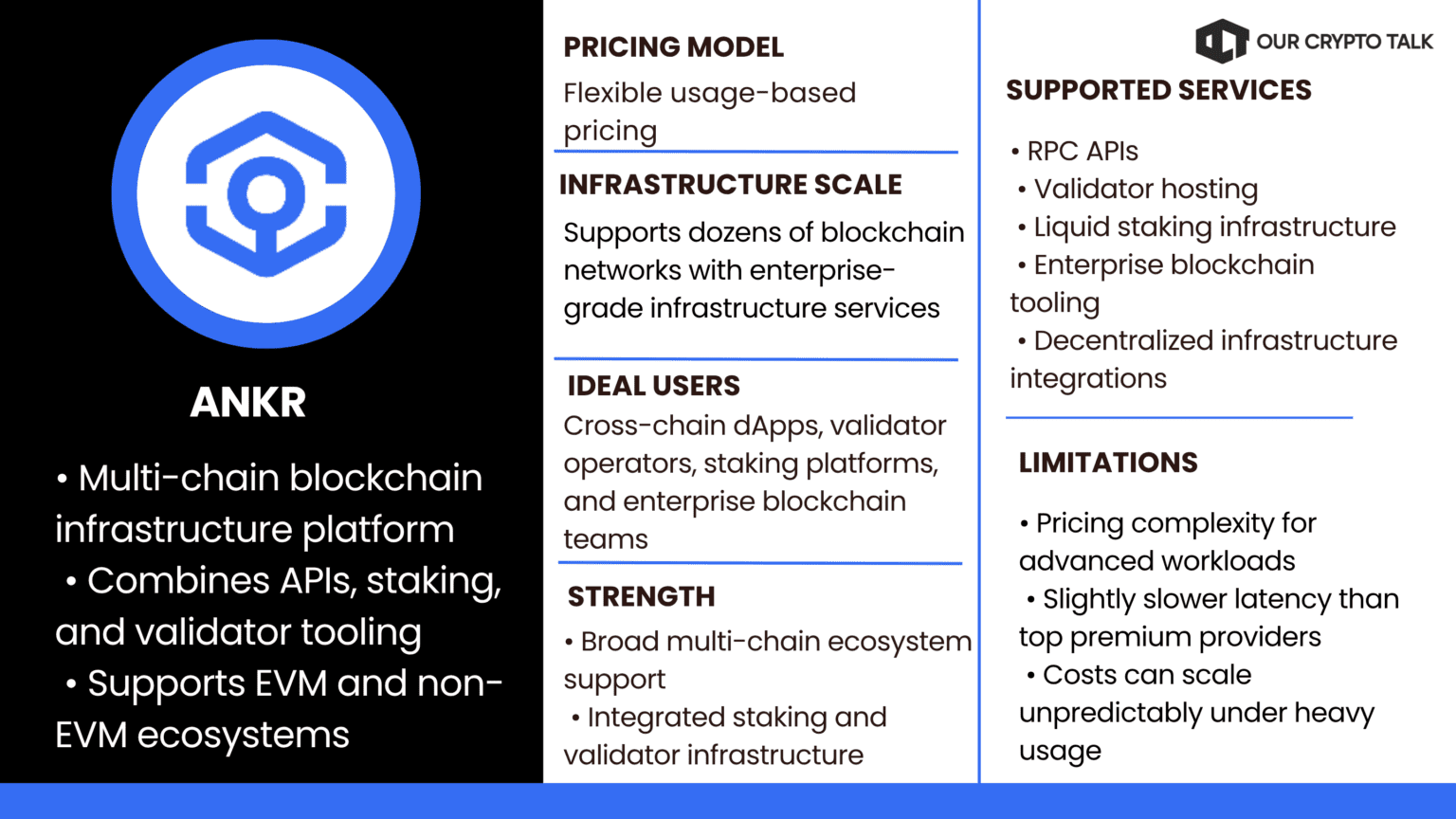
Ankr has built one of the broadest infrastructure ecosystems in the industry. It supports dozens of EVM and non-EVM chains while processing trillions of blockchain requests annually.
Its services include RPC APIs, staking infrastructure, liquid staking, validator hosting, enterprise blockchain tooling, and decentralized physical infrastructure integrations. This broad coverage makes Ankr attractive for teams operating across multiple ecosystems simultaneously.
Ankr’s strongest advantage is scale. Major partners include enterprises, cloud providers, and large blockchain ecosystems. The platform also integrates infrastructure with staking and validator tooling, creating a more unified backend experience.
Performance benchmarks place Ankr slightly behind QuickNode in raw latency, but still competitive enough for most production applications. Pricing remains relatively flexible and affordable for multi-chain workloads.
The main criticism involves pricing complexity. Some advanced request types can scale unpredictably depending on workload intensity.
Still, for cross-chain teams wanting infrastructure, staking, APIs, and validator tooling inside one ecosystem, Ankr remains one of the most versatile blockchain infrastructure companies available today.
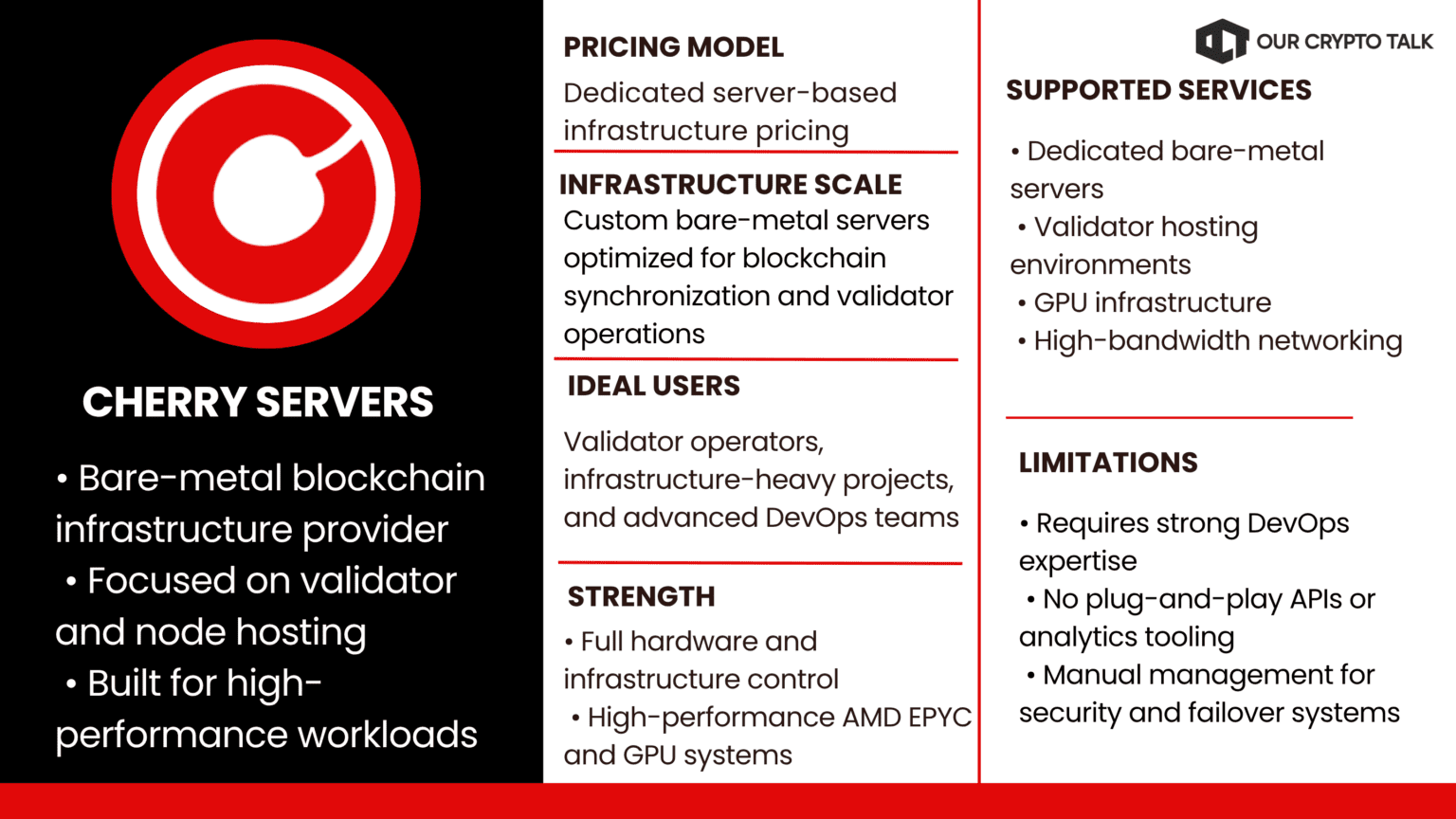
Cherry Servers takes a very different approach from managed RPC providers. Instead of abstracting infrastructure away, it gives teams direct access to dedicated bare-metal servers optimized for blockchain workloads.
Cherry Servers has become particularly popular among Solana validators and high-performance node operators. Many infrastructure-heavy projects prefer bare-metal hosting because it avoids vendor lock-in while delivering maximum hardware control.
Its infrastructure includes dedicated AMD EPYC systems, GPU servers, custom validator setups, and high-bandwidth networking optimized for blockchain synchronization. Real-world usage shows strong performance for validators handling intensive workloads.
The downside is operational complexity. Teams need DevOps expertise to manage nodes, security, backups, and failover systems manually. Unlike Alchemy or QuickNode, Cherry Servers does not provide plug-and-play APIs or indexing layers.
Pricing can actually become cheaper long term for validator-heavy applications compared to managed infrastructure subscriptions. This makes it attractive for projects prioritizing decentralization and infrastructure ownership.
For advanced teams wanting complete infrastructure control instead of managed services, Cherry Servers offers one of the strongest self-hosted blockchain environments available in 2026.
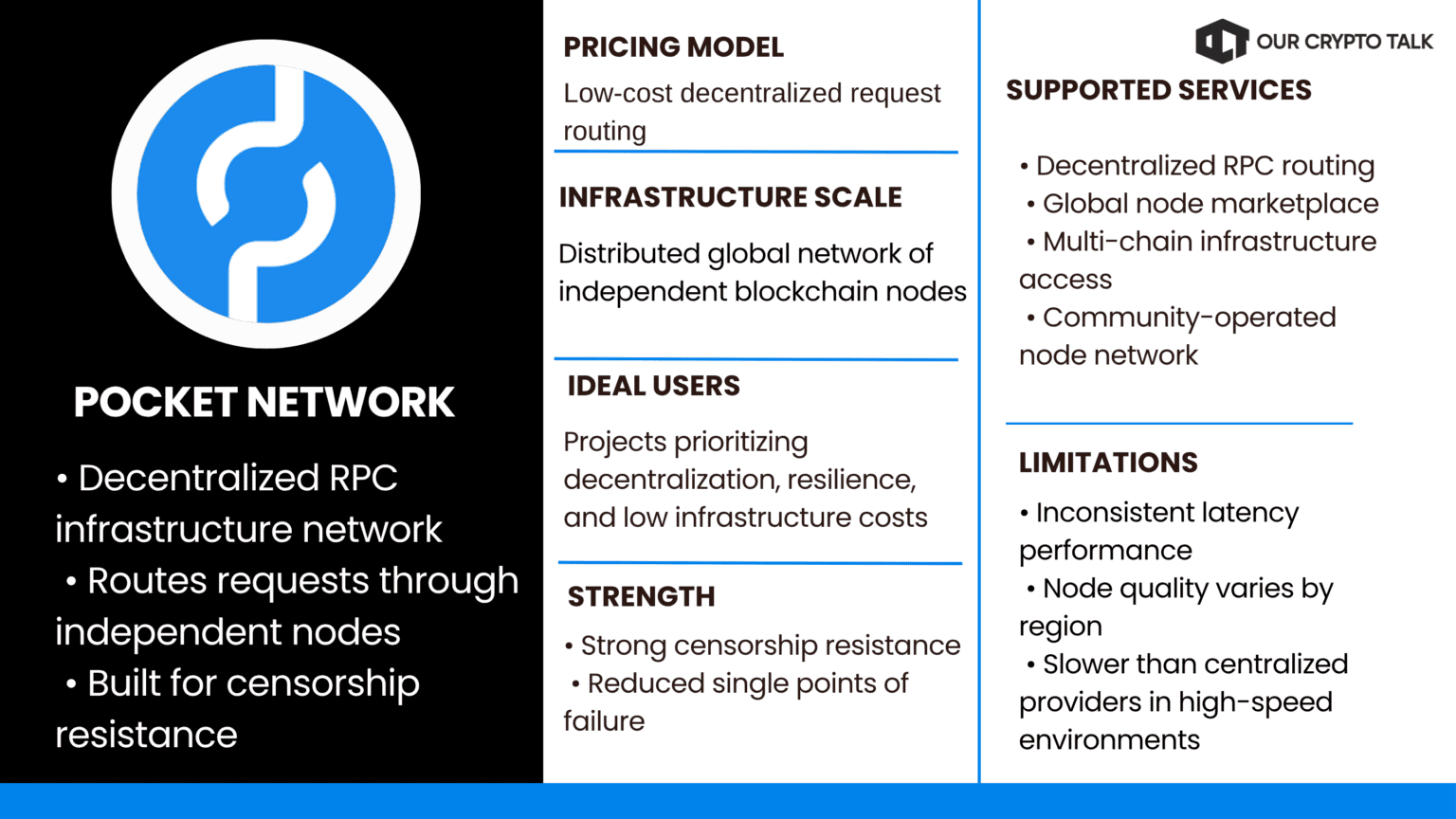
Pocket Network operates differently from almost every other provider on this list. Instead of centralized server clusters, it routes requests across thousands of independent nodes worldwide.
This decentralized architecture improves censorship resistance and reduces single points of failure. For projects prioritizing decentralization, Pocket Network represents one of the strongest alternatives to centralized RPC providers.
Its biggest strength is cost efficiency. Pocket’s decentralized request routing allows it to offer extremely low pricing compared to enterprise infrastructure providers. This makes it one of the strongest contenders for the cheapest blockchain node provider title.
The tradeoff is consistency. Performance can vary depending on node quality and regional routing conditions. While upgrades in 2026 improved reliability significantly, centralized competitors still outperform Pocket in raw latency benchmarks.
Pocket works best for teams prioritizing decentralization, resilience, and cost savings rather than ultra-low-latency execution environments.
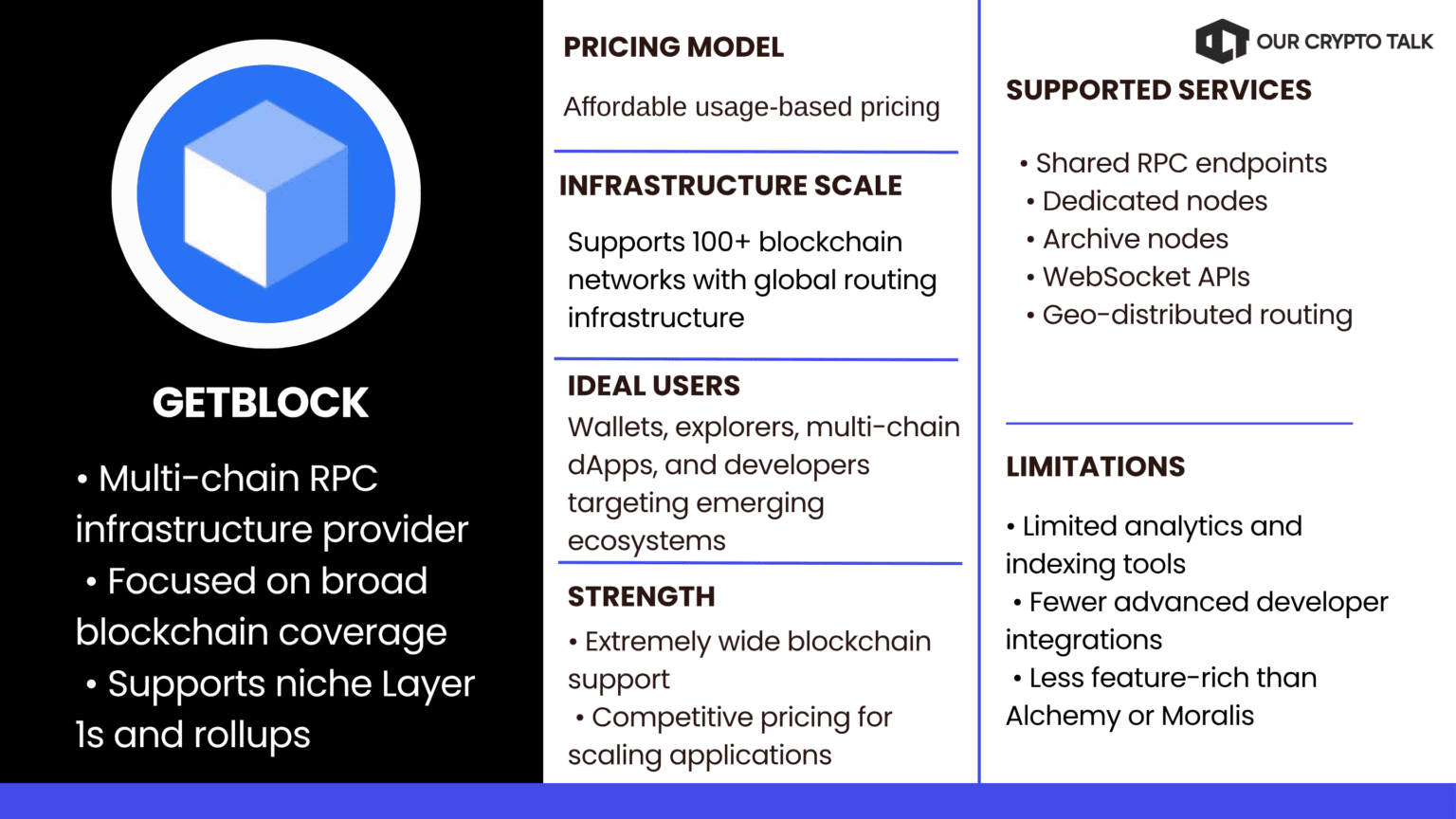
GetBlock focuses heavily on breadth of chain support. It supports well over 100 blockchain networks, including many niche Layer 1 ecosystems and emerging rollup environments often ignored by larger providers.
Its infrastructure includes shared RPC endpoints, dedicated nodes, archive nodes, WebSocket APIs, and geo-distributed routing systems. This makes it especially useful for wallets, explorers, and applications operating across obscure ecosystems.
GetBlock consistently performs well in regional latency tests while maintaining competitive pricing compared to premium providers like QuickNode. Many developers use it specifically because of its unusually large ecosystem coverage.
The weakness is ecosystem tooling. Compared to Alchemy or Moralis, GetBlock provides fewer advanced analytics and developer-focused integrations.
Pricing remains relatively affordable and scalable, especially for projects needing broad multi-chain support without enterprise-level costs.
For teams prioritizing chain diversity and scalability over premium analytics tooling, GetBlock remains one of the strongest infrastructure providers in the multi-chain ecosystem.
The QuickNode vs Alchemy comparison dominates commercial infrastructure searches in 2026 because all three providers target Ethereum developers at scale. While each platform offers RPC access, APIs, and enterprise infrastructure, they optimize for different priorities.
QuickNode currently leads in raw speed. Independent benchmarks consistently place it among the fastest RPC providers globally, making it attractive for trading systems, gaming infrastructure, and real-time blockchain applications. Its edge routing and low-latency architecture give it a clear advantage for execution-heavy workloads.
Alchemy focuses more heavily on developer experience. Enhanced APIs, analytics dashboards, debugging systems, and notification tools reduce backend complexity significantly. For many teams building wallets or NFT applications, Alchemy remains one of the best RPC provider for Ethereum environments because of its tooling depth rather than pure latency.
Infura still dominates Ethereum-native infrastructure due to its deep integration with MetaMask and the broader Ethereum ecosystem. While it supports fewer chains than QuickNode, many enterprise teams still trust Infura for stability and production reliability.
In practice, many large applications now combine providers. QuickNode often handles primary traffic, while Alchemy or Infura operate as fallback infrastructure during outages or congestion spikes.
The rise of decentralized RPC providers has changed how teams think about blockchain infrastructure reliability and censorship resistance. Instead of relying entirely on centralized server clusters, many protocols now distribute requests across decentralized node networks.
Infura represents the centralized model. The platform operates managed infrastructure directly under Consensys control. This allows highly optimized performance and consistent uptime, but it also creates centralization risks. Questions like Is Infura centralized? became more common after several ecosystem outages highlighted the risks of depending on a single infrastructure provider.
During major Ethereum congestion periods and historical outages, applications relying entirely on Infura experienced disruptions simultaneously. This exposed how much of the Ethereum ecosystem depended on one centralized backend provider.
Ankr operates somewhere in the middle. Its infrastructure combines managed enterprise systems with geographically distributed node operations. This hybrid structure improves redundancy while still maintaining centralized coordination and enterprise tooling.
Pocket Network pushes decentralization further. Instead of routing requests through one company, Pocket distributes traffic across independent node operators globally. This improves censorship resistance and reduces single points of failure.
The tradeoff is consistency. Centralized providers usually deliver lower latency and more predictable performance. Decentralized systems improve resilience but can introduce variability depending on node quality and routing conditions.
As Web3 infrastructure matures, many teams now use hybrid setups combining centralized performance with decentralized redundancy. This balances reliability, censorship resistance, and operational flexibility more effectively than relying on one model alone.
The future of blockchain infrastructure is increasingly tied to modular blockchain architecture, rollups, and data availability systems. The monolithic blockchain model is slowly being replaced by specialized layers handling execution, settlement, consensus, and storage independently.
The rollup boom accelerated this transition. Instead of every application competing for limited Layer 1 blockspace, optimistic and zero-knowledge rollups now process transactions separately before settling back onto Ethereum or other base chains. This dramatically improves scalability and lowers costs.
Infrastructure providers are adapting quickly. Modern RPC systems now need to support multiple execution environments, cross-rollup communication, and specialized indexing for modular ecosystems. Supporting Ethereum alone is no longer enough.
Data availability layers have become particularly important. Networks like Celestia and EigenDA separate transaction data storage from execution itself, allowing rollups to scale without overwhelming base chains. Infrastructure providers increasingly integrate DA retrieval, indexing, and verification systems directly into their backend stacks.
Another major shift is chain abstraction. Developers increasingly want applications that work across multiple ecosystems without users needing to understand which chain they are interacting with. Infrastructure providers are now building unified APIs and routing systems that abstract blockchain complexity away from end users.
AI agents may push this trend even further. Autonomous onchain systems require constant low-latency access to mempools, indexing systems, transaction relays, and real-time analytics. Future infrastructure platforms will likely operate less like simple node providers and more like intelligent coordination layers for automated blockchain applications.
The post-rollup era is changing infrastructure from isolated RPC services into modular, multi-layer backend ecosystems designed for scalability, interoperability, and abstraction.
The next era of Web3 infrastructure will be defined by intelligence, interoperability, and decentralization. We are entering a phase where AI-driven node orchestration, modular blockchains, and cross-chain messaging systems become the new normal. Projects like Ankr, Pocket Network, and Akash are pioneering decentralized cloud compute, while QuickNode and Alchemy integrate machine learning to optimize RPC routing.
As real-world asset tokenization, AI agents, and gaming demand more data throughput, the evolution of infrastructure will dictate Web3’s growth curve. The convergence of decentralized storage, compute, and networking will make Web3 as fast and dependable as Web2 but open to everyone.


AI Needs Cheap Inference. Can Orbio Deliver?
Web3 Gaming Comeback 2026: GTA 6 Hype vs 99% Crashes
Layer 2 Projects Shutting Down: Who’s Next After Blast?
Embodied Data Pyramid and Decentralized Data Layer for Robotics
AI Needs Cheap Inference. Can Orbio Deliver?
Web3 Gaming Comeback 2026: GTA 6 Hype vs 99% Crashes
Layer 2 Projects Shutting Down: Who’s Next After Blast?
Embodied Data Pyramid and Decentralized Data Layer for Robotics